




eLearning


 Rick McKinnon, Ph.D.
 Supported by the WIRED grant from the State of Washington
                                                             1
How do you feel about
           elearning?
1.   All hat and no cowboy?
2.   A necessary evil?
3.   A valuable complement to f2f teaching?
4.   Undecided?
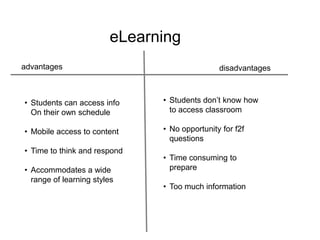
eLearning
advantages                                    disadvantages


• Students can access info    • Students don’t know how
  On their own schedule         to access classroom

• Mobile access to content    • No opportunity for f2f
                                questions
• Time to think and respond
                              • Time consuming to
• Accommodates a wide           prepare
  range of learning styles
                              • Too much information

                              • Unverified information
Something is broken


 Slide from: Diplomas Count 2008: School to College, Education Week, 6/508.


As presently configured, our schools produce a
failure rate (30% not graduating high school)
that would be intolerable if it were found in any
other field.                                                                  4
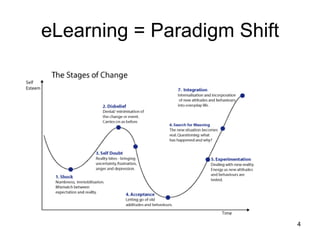
A Paradigm Shift


                   5
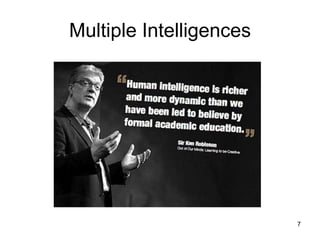
Multiple Intelligences


                         6
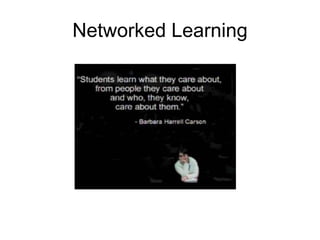
Learning is Inherently Social


 Buy-in Amplifies Learning
Peers are important


                      8
Rule: If a card has a “D” on one side,
                           then it must have a “3” on the other.


Abstract:
                                                                                                      Hard!


                            Rule: If an individual is over 21, then
                            that person can drink a beverage
                            with that contains alcohol.
  Social:                                                                                              Easy!


Ref.: Cosmides, L., & Tooby, J. Neurocognitive Adaptations Designed for Social Exchange. In D. M. Buss (Ed.),
Evolutionary Psychology Handbook. NY: Wiley.                                                                    9
The web,
Weinberger writes,
"is enabling us to
rediscover what
we've always known
about being human:
we are connected
creatures in a
connected world
about which we care
passionately."
                      10
Humans, as well as
                                                         other primates tend
                                                         to suppress certain
                                                         behaviors under
                                                         conditions of acute
                                                         crowding.


This is referred to as the
“Elevator Effect” by social
psychologists, and is an
adaptive mechanism for
reducing the likelihood of
conflict.

                                                                                            11
Ref: de Waal, F., Aureli, F., & Judge, P. Coping with Crowding. Scientific American, 5/00
What’s the optical proximity for learning?
                                             12
Free range learners
Free-range learners choose
how and what they learn. Self-
service is less expensive and
more timely than the
alternative. Informal learning
has no need for the busywork
and bureaucracy that
accompany typical educational
practices. Less is more.


                                 13
How Networks Evolve
as communication costs drop


 Nodes         Top-down       Distributed


                                            14
Human Governance


 Bands   Kingdoms   Democracies


                                  15
Business


Single Proprietors   Franchises   Business Webs


                                                  16
Learning


One-on-one   Classroom   Informal


                                    17
How do people learn their jobs?
Participatory web culture

     ACTIVE                         PASSIV
                                          E

Web 2.0 culture: Pull          School culture: Push
Learner-driven                 Instructor-driven
Process focus                  Event focus
Content defined by learner’s   Content mandated by others’
perception of need             perception of need

Relationships, conversation    Courses, workshops
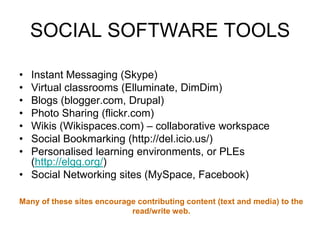
SOCIAL SOFTWARE TOOLS

• Instant Messaging (Skype)
• Virtual classrooms (Elluminate, DimDim)
• Blogs (Blogger, WordPress, Drupal)
• Photo Sharing (flickr.com)
• Wikis (Wikispaces.com) – collaborative workspace
• Social Bookmarking (http://del.icio.us/)
• Personalised learning environments, or PLEs (
  http://elgg.org/)
• Social Networking sites (MySpace, Facebook)

Many of these sites encourage contributing content (text and media) to the
                            read/write web.
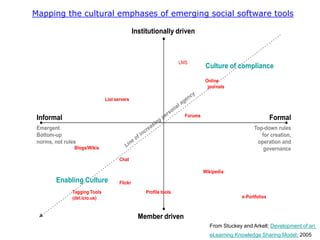
Mapping the cultural emphases of emerging social software tools


  Adapted from Stuckey and Arkell; Development of an eLearning Knowledge Sharing Model; 2005
Employability Skills
•   Communication
•   Teamwork
•   Problem Solving
•   Initiative and Enterprise
•   Planning and Organizing
•   Self-management
•   Learning
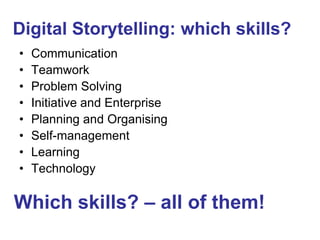
•   Technology
eLearning: which skills?
•   Communication
•   Teamwork
•   Problem Solving
•   Initiative and Enterprise
•   Planning and Organising
•   Self-management
•   Learning
•   Technology


Which skills? – all of them!
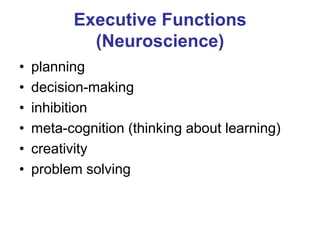
Executive Functions
            (Neuroscience)
•   planning
•   decision-making
•   inhibition
•   meta-cognition (thinking about learning)
•   creativity
•   problem solving
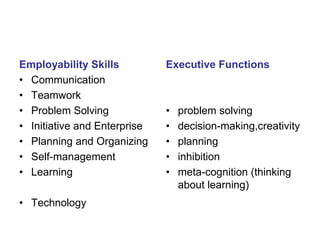
Employability Skills          Executive Functions
• Communication
• Teamwork
• Problem Solving             •   problem solving
• Initiative and Enterprise   •   decision-making,creativity
• Planning and Organizing     •   planning
• Self-management             •   inhibition
• Learning                    •   meta-cognition (thinking
• Technology                      about learning)

E Learning Bootcamp Introduction

  • 1.
    eLearning Rick McKinnon,Ph.D. Supported by the WIRED grant from the State of Washington 1
  • 2.
    How do youfeel about elearning? 1. All hat and no cowboy? 2. A necessary evil? 3. A valuable complement to f2f teaching? 4. Undecided?
  • 3.
    eLearning advantages disadvantages • Students can access info • Students don’t know how On their own schedule to access classroom • Mobile access to content • No opportunity for f2f questions • Time to think and respond • Time consuming to • Accommodates a wide prepare range of learning styles • Too much information • Unverified information
  • 4.
    Something is broken Slide from: Diplomas Count 2008: School to College, Education Week, 6/508. As presently configured, our schools produce a failure rate (30% not graduating high school) that would be intolerable if it were found in any other field. 4
  • 5.
  • 6.
  • 7.
    Learning is InherentlySocial Buy-in Amplifies Learning
  • 8.
  • 9.
    Rule: If acard has a “D” on one side, then it must have a “3” on the other. Abstract: Hard! Rule: If an individual is over 21, then that person can drink a beverage with that contains alcohol. Social: Easy! Ref.: Cosmides, L., & Tooby, J. Neurocognitive Adaptations Designed for Social Exchange. In D. M. Buss (Ed.), Evolutionary Psychology Handbook. NY: Wiley. 9
  • 10.
    The web, Weinberger writes, "isenabling us to rediscover what we've always known about being human: we are connected creatures in a connected world about which we care passionately." 10
  • 11.
    Humans, as wellas other primates tend to suppress certain behaviors under conditions of acute crowding. This is referred to as the “Elevator Effect” by social psychologists, and is an adaptive mechanism for reducing the likelihood of conflict. 11 Ref: de Waal, F., Aureli, F., & Judge, P. Coping with Crowding. Scientific American, 5/00
  • 12.
    What’s the opticalproximity for learning? 12
  • 13.
    Free range learners Free-rangelearners choose how and what they learn. Self- service is less expensive and more timely than the alternative. Informal learning has no need for the busywork and bureaucracy that accompany typical educational practices. Less is more. 13
  • 14.
    How Networks Evolve ascommunication costs drop Nodes Top-down Distributed 14
  • 15.
    Human Governance Bands Kingdoms Democracies 15
  • 16.
    Business Single Proprietors Franchises Business Webs 16
  • 17.
    Learning One-on-one Classroom Informal 17
  • 18.
    How do peoplelearn their jobs?
  • 19.
    Participatory web culture ACTIVE PASSIV E Web 2.0 culture: Pull School culture: Push Learner-driven Instructor-driven Process focus Event focus Content defined by learner’s Content mandated by others’ perception of need perception of need Relationships, conversation Courses, workshops
  • 20.
    SOCIAL SOFTWARE TOOLS •Instant Messaging (Skype) • Virtual classrooms (Elluminate, DimDim) • Blogs (Blogger, WordPress, Drupal) • Photo Sharing (flickr.com) • Wikis (Wikispaces.com) – collaborative workspace • Social Bookmarking (http://del.icio.us/) • Personalised learning environments, or PLEs ( http://elgg.org/) • Social Networking sites (MySpace, Facebook) Many of these sites encourage contributing content (text and media) to the read/write web.
  • 21.
    Mapping the culturalemphases of emerging social software tools Adapted from Stuckey and Arkell; Development of an eLearning Knowledge Sharing Model; 2005
  • 22.
    Employability Skills • Communication • Teamwork • Problem Solving • Initiative and Enterprise • Planning and Organizing • Self-management • Learning • Technology
  • 23.
    eLearning: which skills? • Communication • Teamwork • Problem Solving • Initiative and Enterprise • Planning and Organising • Self-management • Learning • Technology Which skills? – all of them!
  • 24.
    Executive Functions (Neuroscience) • planning • decision-making • inhibition • meta-cognition (thinking about learning) • creativity • problem solving
  • 25.
    Employability Skills Executive Functions • Communication • Teamwork • Problem Solving • problem solving • Initiative and Enterprise • decision-making,creativity • Planning and Organizing • planning • Self-management • inhibition • Learning • meta-cognition (thinking • Technology about learning)