




Outcomes…
At the end of this course you will be able to:
 demonstrate a sound understanding of the web and its potential
  benefits for teaching and learning in the primary school;
 review critically UK government online initiatives in education;
 demonstrate an understanding of pedagogical approaches suited to
  e-learning;
 reflect on approaches to support pupils’ safe and responsible use of
  the internet;
 develop and evaluate a Course inside a VLE to support a sequence of
  lessons, using a variety of the tools available;
 integrate externally produced resources and activities and resources
  and activities developed by you.
Outline
1. The web as a resource for learning
   	
 Linking and uploading
2. Effective web design
   	
 Creating resources and labels
3. E-learning
   	
 Quizzes, assignments, hot potatoes
4. Web 2.0 – blog, podcasts etc.
   	
 Audio and video filters
5. Web 2.0 – wikis, forums, mashups
   	
 Wikis and forums
6. E-Safety and digital literacy
   	
 Chat, AUPs, peer review
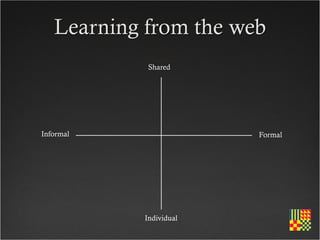
Learning from the web
            Shared


Informal                Formal


           Individual
Plowden
                         1967


 ‘At the heart of the educational process lies the
  child’
 ‘Until a child is ready to take a particular step
  forward it is a waste of time to try to teach him to
  take it’
 ‘One of the main educational tasks of the primary
  school is to build on and strengthen children's
  intrinsic interest in learning and lead them to learn
  for themselves’
Rose
                          2009


 Primary children relish learning independently and
  co-operatively; they love to be challenged and
  engaged in practical activities; they delight in the
  wealth of opportunities for understanding more
  about the world; and they readily empathise with
  others
 The touchstone of an excellent curriculum is that it
  instils in children a love of learning for its own sake.
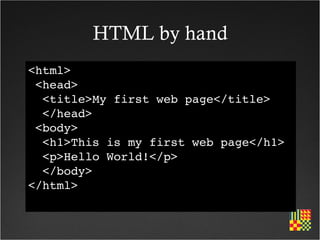
HTML by hand
<html>
 <head>
  <title>My first web page</title>
  </head>
 <body>
  <h1>This is my first web page</h1>
  <p>Hello World!</p>
  </body>
</html>
Design Principles
Content is king
Intuitive navigation
The pages belong to the site
Layout
 Golden ratio
 Rule of thirds
 Symmetry
 Balance
Design Principles
  Unity
   Proximity
   Repetition
   Colour and style
  Emphasis
   Placement
   Isolation
   Contrast
  Form follows function
In education?
Audience
   Readability
   Engagement
   Interactivity
   Dumbing down?

Pedagogy
   Investigation
   Play
   Social constructivist
   Behaviourism

E-Safety
Behaviourism
 Practice should take the form of question - answer frames
  which expose the student to the subject in gradual steps
 Require that the learner make a response for every frame
  and receive immediate feedback
 Try to arrange the difficulty of the questions so the
  response is always correct and hence a positive
  reinforcement
 Ensure that good performance in the lesson is paired with
  secondary reinforcers such as verbal praise, prizes and good
  grades.
Thorndike 1912

If, by a miracle of mechanical ingenuity, a
 book could be so arranged that only to him
 who had done what was directed on page one
 would page two become visible, and so on,
 much that now requires personal instruction
 could be managed by print.
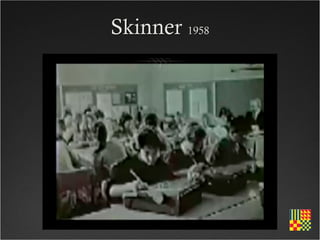
Skinner 1958
Ivan Illich 1971

Ivan Illich describes computer-based "learning webs" in
 his book Deschooling Society. Among the features of his
 proposed system are
  •   Reference Services to Educational Objects
  •   Skill Exchanges
  •   Peer-Matching
  •   Reference Services to Educators-at-Large
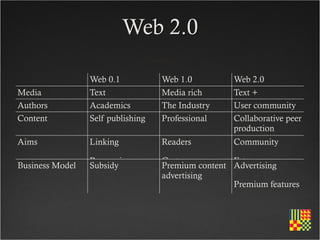
Web 2.0

                 Web 0.1           Web 1.0         Web 2.0
Media            Text              Media rich      Text +
Authors          Academics         The Industry    User community
Content          Self publishing   Professional    Collaborative peer
                                                   production
Aims             Linking           Readers         Community

                 Peer review       Customers       Esteem
Business Model   Subsidy           Premium content Advertising
                                   advertising
                                                   Premium features

                                                   Open Source
How can blogs help
      learning?
Creating not just consuming
Writing for pleasure
Informal learning
Personalisation – choice and voice
Self esteem
Shared blogs
Reflection and review
How can podcasts
 help learning?

Multimodal literacy
Speaking and listening!
Engagement
Accessibility
Lesson recording
E-Portfolios
Online Communities

Professional   Personal
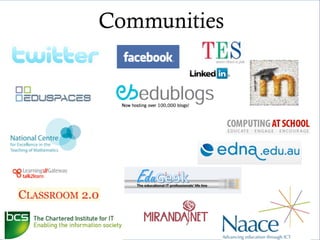
Communities
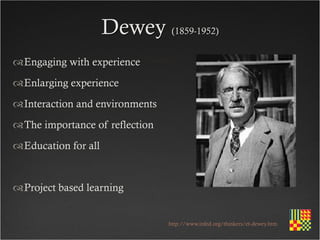
Dewey (1859-1952)
Engaging with experience
Enlarging experience
Interaction and environments
The importance of reflection
Education for all


Project based learning


                                http://www.infed.org/thinkers/et-dewey.htm
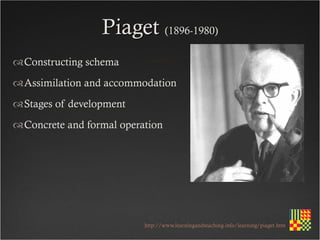
Piaget (1896-1980)
Constructing schema
Assimilation and accommodation
Stages of development
Concrete and formal operation


                          http://www.learningandteaching.info/learning/piaget.htm
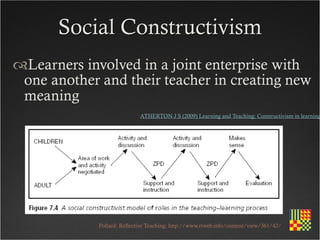
Social Constructivism
Learners involved in a joint enterprise with
 one another and their teacher in creating new
 meaning
                             ATHERTON J S (2009) Learning and Teaching; Constructivism in learning


             Pollard: Reflective Teaching; http://www.rtweb.info/content/view/361/42/
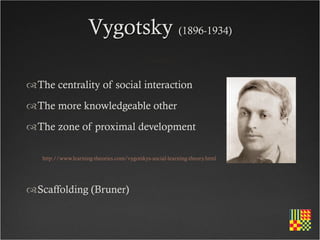
Vygotsky (1896-1934)

The centrality of social interaction
The more knowledgeable other
The zone of proximal development

   http://www.learning-theories.com/vygotskys-social-learning-theory.html


Scaffolding (Bruner)
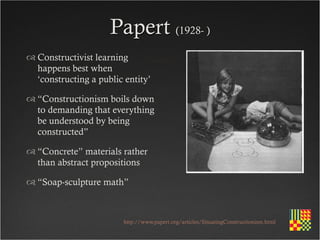
Papert (1928- )
 Constructivist learning
  happens best when
  ‘constructing a public entity’

 “Constructionism boils down
  to demanding that everything
  be understood by being
  constructed”

 “Concrete” materials rather
  than abstract propositions

 “Soap-sculpture math”


                         http://www.papert.org/articles/SituatingConstructionism.html
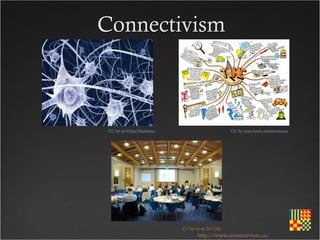
Connectivism


 CC by-sa Hijod.Huskona                        CC by jean-louis zimmermann


                          CC by-nc-sa Mr Ush
                                 http://www.connectivism.ca/
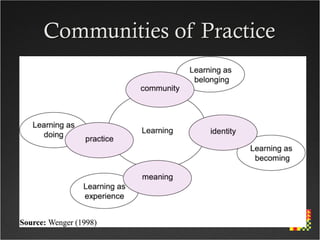
Communities of Practice
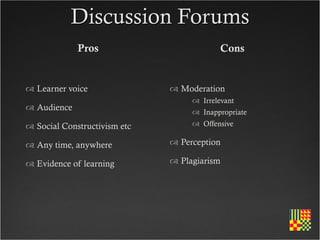
Discussion Forums
             Pros                          Cons


 Learner voice                Moderation
                                    Irrelevant
 Audience                          Inappropriate
 Social Constructivism etc         Offensive

 Any time, anywhere           Perception

 Evidence of learning         Plagiarism
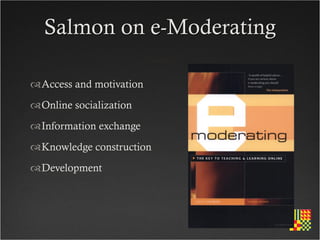
Salmon on e-Moderating

Access and motivation
Online socialization
Information exchange
Knowledge construction
Development
How can wikis help
            learning?
• Writing for an audience
• Proofreading, fact checking
• Awareness of different perspectives
• Evaluation and Discernment – issues of trust,
  ownership and authority
• Social construction
• Policy documents
CC by markhillary   34
CC by-nc Xerones   35
                   35
CC by-nc Xerones
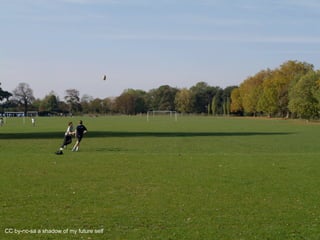
   by-nc-sa a shadow of my future self   36
I've watched this with interest.  At the risk of over simplifying,  consider an event x
 with probability of 1 in 1 million. How should:
A parent with responsibility for 2 children
A teacher with responsibility for 30 children
A school with responsibility for 800 children
An LA with responsibility for 10 000 children
A secretary of state with responsibility for 6 000 000 children
 respond?
 Risks that are manageable at the every day level for individuals become
 unmanageable when aggregated to system level.
 That's the issue that needs to be resolved before we can have a rational debate about
 this. Only by actively embracing the risk at a local level can we shift the debate away
 from over prescription in order to manage the risk at a regional/national level.
 Sorry if this does not help the flow, but it's always worth spending a little time
 working out why something that is nonsensical form one perspective is rational
 from another.
 Excuse thumb typing.
                                      Niel Mclean (Becta) via NaaceTalk, 10/12/2008
CEOP
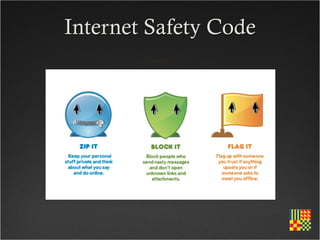
Internet Safety Code
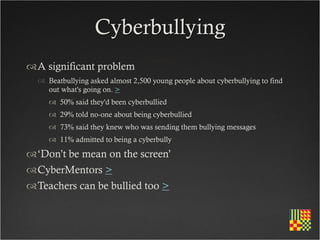
Cyberbullying
A significant problem
   Beatbullying asked almost 2,500 young people about cyberbullying to find
    out what's going on. >
      50% said they'd been cyberbullied
      29% told no-one about being cyberbullied
      73% said they knew who was sending them bullying messages
      11% admitted to being a cyberbully

‘Don’t be mean on the screen’
CyberMentors >
Teachers can be bullied too >
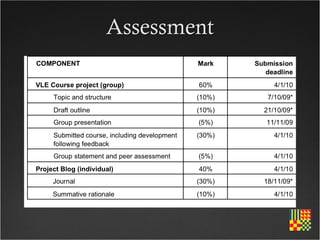
Assessment
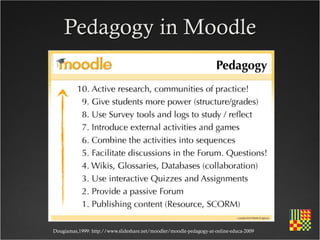
Pedagogy in Moodle


Dougiamas,1999: http://www.slideshare.net/moodler/moodle-pedagogy-at-online-educa-2009
What went well?

Participatory iterative design

 Planning and development

Reflection on practice
Peer review
Blogging
Assessment
Could do better?

Comments on the blog
The blog engine
User testing
Embedding vs linking or uploading
Subject linking
Wider participation
Would this work
outside of ITT?
As in-school CPD?
Across schools?
As accredited CPD?
Adapted as an M-level module?


Or isn’t hands on practical training
 enough?
Getting in touch…

      mberry@bcs.org
         @mberry
       milesberry.net


   www.roehampton.ac.uk
  opensourceschools.org.uk

Teaching teachers to Moodle

  • 4.
    Outcomes… At the endof this course you will be able to:  demonstrate a sound understanding of the web and its potential benefits for teaching and learning in the primary school;  review critically UK government online initiatives in education;  demonstrate an understanding of pedagogical approaches suited to e-learning;  reflect on approaches to support pupils’ safe and responsible use of the internet;  develop and evaluate a Course inside a VLE to support a sequence of lessons, using a variety of the tools available;  integrate externally produced resources and activities and resources and activities developed by you.
  • 5.
    Outline 1. The webas a resource for learning Linking and uploading 2. Effective web design Creating resources and labels 3. E-learning Quizzes, assignments, hot potatoes 4. Web 2.0 – blog, podcasts etc. Audio and video filters 5. Web 2.0 – wikis, forums, mashups Wikis and forums 6. E-Safety and digital literacy Chat, AUPs, peer review
  • 7.
    Learning from theweb Shared Informal Formal Individual
  • 8.
    Plowden 1967  ‘At the heart of the educational process lies the child’  ‘Until a child is ready to take a particular step forward it is a waste of time to try to teach him to take it’  ‘One of the main educational tasks of the primary school is to build on and strengthen children's intrinsic interest in learning and lead them to learn for themselves’
  • 9.
    Rose 2009  Primary children relish learning independently and co-operatively; they love to be challenged and engaged in practical activities; they delight in the wealth of opportunities for understanding more about the world; and they readily empathise with others  The touchstone of an excellent curriculum is that it instils in children a love of learning for its own sake.
  • 11.
    HTML by hand <html> <head> <title>My first web page</title> </head> <body> <h1>This is my first web page</h1> <p>Hello World!</p> </body> </html>
  • 12.
    Design Principles Content isking Intuitive navigation The pages belong to the site Layout Golden ratio Rule of thirds Symmetry Balance
  • 13.
    Design Principles Unity Proximity Repetition Colour and style Emphasis Placement Isolation Contrast Form follows function
  • 14.
    In education? Audience  Readability  Engagement  Interactivity  Dumbing down? Pedagogy  Investigation  Play  Social constructivist  Behaviourism E-Safety
  • 15.
    Behaviourism  Practice shouldtake the form of question - answer frames which expose the student to the subject in gradual steps  Require that the learner make a response for every frame and receive immediate feedback  Try to arrange the difficulty of the questions so the response is always correct and hence a positive reinforcement  Ensure that good performance in the lesson is paired with secondary reinforcers such as verbal praise, prizes and good grades.
  • 16.
    Thorndike 1912 If, bya miracle of mechanical ingenuity, a book could be so arranged that only to him who had done what was directed on page one would page two become visible, and so on, much that now requires personal instruction could be managed by print.
  • 17.
  • 18.
    Ivan Illich 1971 IvanIllich describes computer-based "learning webs" in his book Deschooling Society. Among the features of his proposed system are • Reference Services to Educational Objects • Skill Exchanges • Peer-Matching • Reference Services to Educators-at-Large
  • 19.
    Web 2.0 Web 0.1 Web 1.0 Web 2.0 Media Text Media rich Text + Authors Academics The Industry User community Content Self publishing Professional Collaborative peer production Aims Linking Readers Community Peer review Customers Esteem Business Model Subsidy Premium content Advertising advertising Premium features Open Source
  • 20.
    How can blogshelp learning? Creating not just consuming Writing for pleasure Informal learning Personalisation – choice and voice Self esteem Shared blogs Reflection and review
  • 21.
    How can podcasts help learning? Multimodal literacy Speaking and listening! Engagement Accessibility Lesson recording E-Portfolios
  • 22.
  • 23.
  • 24.
    Dewey (1859-1952) Engaging withexperience Enlarging experience Interaction and environments The importance of reflection Education for all Project based learning http://www.infed.org/thinkers/et-dewey.htm
  • 25.
    Piaget (1896-1980) Constructing schema Assimilationand accommodation Stages of development Concrete and formal operation http://www.learningandteaching.info/learning/piaget.htm
  • 26.
    Social Constructivism Learners involvedin a joint enterprise with one another and their teacher in creating new meaning ATHERTON J S (2009) Learning and Teaching; Constructivism in learning Pollard: Reflective Teaching; http://www.rtweb.info/content/view/361/42/
  • 27.
    Vygotsky (1896-1934) The centralityof social interaction The more knowledgeable other The zone of proximal development http://www.learning-theories.com/vygotskys-social-learning-theory.html Scaffolding (Bruner)
  • 28.
    Papert (1928- ) Constructivist learning happens best when ‘constructing a public entity’  “Constructionism boils down to demanding that everything be understood by being constructed”  “Concrete” materials rather than abstract propositions  “Soap-sculpture math” http://www.papert.org/articles/SituatingConstructionism.html
  • 29.
    Connectivism CC by-saHijod.Huskona CC by jean-louis zimmermann CC by-nc-sa Mr Ush http://www.connectivism.ca/
  • 30.
  • 31.
    Discussion Forums Pros Cons  Learner voice  Moderation  Irrelevant  Audience  Inappropriate  Social Constructivism etc  Offensive  Any time, anywhere  Perception  Evidence of learning  Plagiarism
  • 32.
    Salmon on e-Moderating Accessand motivation Online socialization Information exchange Knowledge construction Development
  • 33.
    How can wikishelp learning? • Writing for an audience • Proofreading, fact checking • Awareness of different perspectives • Evaluation and Discernment – issues of trust, ownership and authority • Social construction • Policy documents
  • 34.
  • 35.
  • 36.
    CC by-nc Xerones by-nc-sa a shadow of my future self 36
  • 37.
    I've watched thiswith interest.  At the risk of over simplifying,  consider an event x with probability of 1 in 1 million. How should: A parent with responsibility for 2 children A teacher with responsibility for 30 children A school with responsibility for 800 children An LA with responsibility for 10 000 children A secretary of state with responsibility for 6 000 000 children respond? Risks that are manageable at the every day level for individuals become unmanageable when aggregated to system level. That's the issue that needs to be resolved before we can have a rational debate about this. Only by actively embracing the risk at a local level can we shift the debate away from over prescription in order to manage the risk at a regional/national level. Sorry if this does not help the flow, but it's always worth spending a little time working out why something that is nonsensical form one perspective is rational from another. Excuse thumb typing. Niel Mclean (Becta) via NaaceTalk, 10/12/2008
  • 38.
  • 39.
  • 40.
    Cyberbullying A significant problem  Beatbullying asked almost 2,500 young people about cyberbullying to find out what's going on. >  50% said they'd been cyberbullied  29% told no-one about being cyberbullied  73% said they knew who was sending them bullying messages  11% admitted to being a cyberbully ‘Don’t be mean on the screen’ CyberMentors > Teachers can be bullied too >
  • 41.
  • 42.
    Pedagogy in Moodle Dougiamas,1999:http://www.slideshare.net/moodler/moodle-pedagogy-at-online-educa-2009
  • 43.
    What went well? Participatoryiterative design  Planning and development Reflection on practice Peer review Blogging Assessment
  • 44.
    Could do better? Commentson the blog The blog engine User testing Embedding vs linking or uploading Subject linking Wider participation
  • 45.
    Would this work outsideof ITT? As in-school CPD? Across schools? As accredited CPD? Adapted as an M-level module? Or isn’t hands on practical training enough?
  • 46.
    Getting in touch… mberry@bcs.org @mberry milesberry.net www.roehampton.ac.uk opensourceschools.org.uk