DYSLEXIA
D.KALAIVANI
ASST.PROFESSOR
MJCOE.
 The student teacher able to,
 Defines Dyslexia.
 Lists out causes of Dyslexia.
 Classifies dyslexia.
 Explains symptoms of dyslexia
 Elucidate Treatments and Intervention Services for
dyslexia.
 Identifies the children with dyslexia
What is Dyslexia?
 Dyslexia has been around for a long time and
has been defined in different ways. For
example, in 1968, the World Federation of
Neurologists defined dyslexia as "a disorder in
children who, despite conventional classroom
experience, fail to attain the language skills of
reading, writing, and spelling commensurate
with their intellectual abilities."
 As per the definition given by National
Institute of Neurological and Stroke, “
Dyslexia is a brain based type of learning
disability that specifically impairs a person’s
disability to read”.
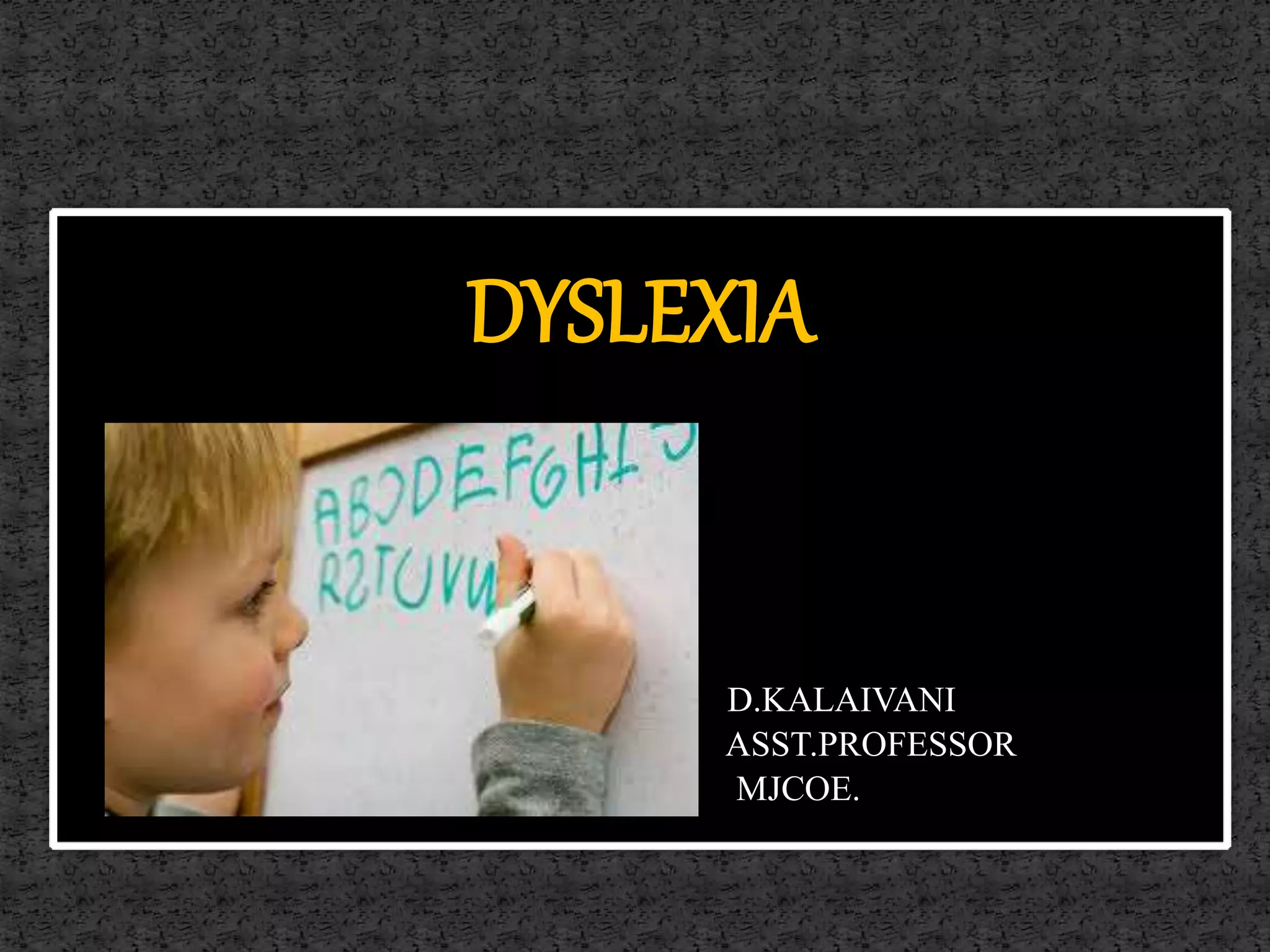
 Example :Reading the word "now" as "won"
or "left" as "felt." Words may also blend
together and spaces are lost.
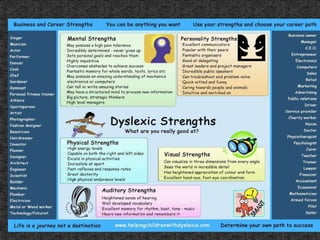
 Dyslexia is the most common learning disability in
children and persists throughout life. The severity of
dyslexia can vary from mild to severe. The sooner
dyslexia is treated, the more favorable the outcome.
However, it is never too late for people with dyslexia to
learn to improve their language skills.
 Dyslexia can go undetected in the early grades of
schooling. Children can become frustrated by the
difficulty in learning to read.
What causes dyslexia?
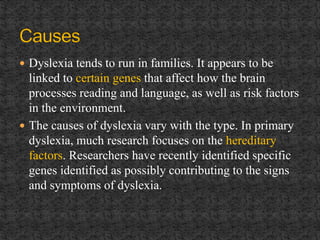
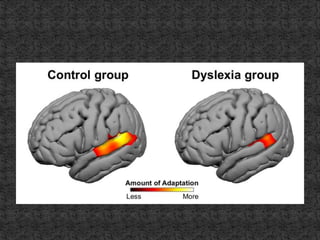
 Dyslexia tends to run in families. It appears to be
linked to certain genes that affect how the brain
processes reading and language, as well as risk factors
in the environment.
 The causes of dyslexia vary with the type. In primary
dyslexia, much research focuses on the hereditary
factors. Researchers have recently identified specific
genes identified as possibly contributing to the signs
and symptoms of dyslexia.
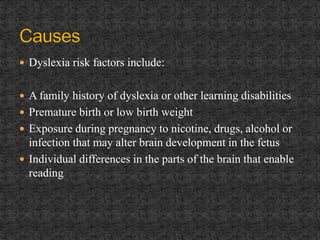
 Dyslexia risk factors include:
 A family history of dyslexia or other learning disabilities
 Premature birth or low birth weight
 Exposure during pregnancy to nicotine, drugs, alcohol or
infection that may alter brain development in the fetus
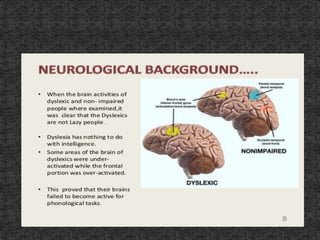
 Individual differences in the parts of the brain that enable
reading
Different types of dyslexia
 Here are the three main types of dyslexia.
 Primary dyslexia: This is the most common type of dyslexia,
and is a dysfunction of, rather than damage to, the left side of
the brain (cerebral cortex) and does not change with age. There
is variability in the severity of the disability for Individuals
with this type of dyslexia, and most who receive an appropriate
educational intervention will be academically successful
throughout their lives. Unfortunately, there are others who
continue to struggle significantly with reading, writing, and
spelling throughout their adult lives. Primary dyslexia is passed
in family lines through genes (hereditary) or through new
genetic mutations and it is found more often in boys than in
girls.
 Secondary or developmental dyslexia: This type of
dyslexia is caused by problems with brain development
during the early stages of fetal development.
Developmental dyslexia diminishes as the child matures.
It is also more common in boys.
 Trauma dyslexia: This type of dyslexia usually occurs
after some form of brain trauma or injury to the area of the
brain that controls reading and writing. It is rarely seen in
today's school-age population.
 Other types of learning disability include:
 The term visual dyslexia is sometimes used to refer to
visual processing disorder, a condition in which the brain
does not properly interpret visual signals.
 The term auditory dyslexia has been used to refer to
auditory processing disorder. Similar to visual processing
disorder, there are problems with the brain's processing of
sounds and speech.
Signs and symptoms of
dyslexia
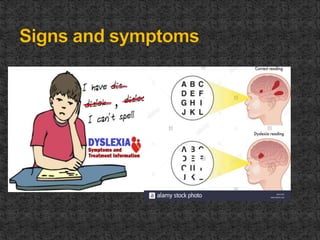
 Signs and symptoms of dyslexia
 Delayed early language development
 Problems recognizing the differences between similar
sounds or segmenting words.
 Slow learning of new vocabulary words
 Difficulty copying from the board or a book.
 Difficulty with learning reading, writing, and spelling
skills
 A child may not be able to remember content, even if it
involves a favorite video or storybook.
 Signs and symptoms of dyslexia
 Problems with spatial relationships can extend beyond the
classroom and be observed on the playground. The child
may appear to be uncoordinated and have difficulty with
organized sports or games.
 Difficulty with left and right is common, and often
dominance for either hand has not been established.
 Many subtle signs can be observed in children with dyslexia.
 Children may become withdrawn and appear to be
depressed.
 They may begin to act out, drawing attention away from their
learning difficulty.
 Problems with self-esteem can arise, and peer and sibling
interactions can become strained.
 These children may lose their interest in school-related
activities and appear to be unmotivated or lazy.
 The emotional symptoms and signs are just as important as the
academic and require equal attention.
 Dyslexia is a difficult disorder to diagnose. There are
many factors the psychologist or other health professional
reviews to diagnose the disability. The testing determines
the child's functional reading level and compares it to
reading potential, which is evaluated by an intelligence
test. All aspects of the reading process are examined to
pinpoint where the breakdown is occurring. The testing
further assesses how a child takes in and processes
information and what the child does with the information.
 A standard battery of tests can include, but is not limited to, the
following:
 Wechsler Intelligence Scale for Children-Third Edition (WISC-
III)
 Kaufman Assessment Battery for Children (KABC)
 Stanford-Binet Intelligence Scale
 Woodcock-Johnson Psycho-Educational Battery
 Peabody Individual Achievement Tests-Revised (PIAT)
 Wechsler Individual Achievement Tests (WIAT)
 Kaufman Tests of Educational Achievement (KTEA)
Treatment
 There's no known way to correct the
underlying brain abnormality that causes
dyslexia — dyslexia is a lifelong problem.
However, early detection and evaluation
to determine specific needs and
appropriate treatment can improve
success.
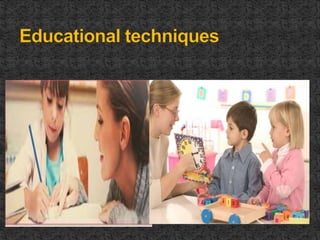
 Dyslexia is treated using specific educational approaches
and techniques, and the sooner the intervention begins, the
better. Psychological testing will help your child's teachers
develop a suitable teaching program.
 Teachers may use techniques involving hearing, vision
and touch to improve reading skills. Helping a child use
several senses to learn — for example, listening to a taped
lesson and tracing with a finger the shape of the letters
used and the words spoken — can help in processing the
information.
 Treatment focuses on helping child:
 Learn to recognize and use the smallest sounds that make
up words (phonemes)
 Understand that letters and strings of letters represent
these sounds and words (phonics)
 Comprehend what he or she is reading
 Read aloud to build reading accuracy, speed and
expression (fluency)
 Build a vocabulary of recognized and understood words
What parents can do?
Address the problem early.
Read aloud to your child.
Work with your child's school.
Encourage reading time.
Set an example for reading.
 How will you identify early the symptoms of dyslexia in
children?
 2. How will you help students with dyslexia in the
classroom?
Dyslexia

Dyslexia

  • 1.
  • 2.
     The studentteacher able to,  Defines Dyslexia.  Lists out causes of Dyslexia.  Classifies dyslexia.  Explains symptoms of dyslexia  Elucidate Treatments and Intervention Services for dyslexia.  Identifies the children with dyslexia
  • 4.
  • 5.
     Dyslexia hasbeen around for a long time and has been defined in different ways. For example, in 1968, the World Federation of Neurologists defined dyslexia as "a disorder in children who, despite conventional classroom experience, fail to attain the language skills of reading, writing, and spelling commensurate with their intellectual abilities."
  • 6.
     As perthe definition given by National Institute of Neurological and Stroke, “ Dyslexia is a brain based type of learning disability that specifically impairs a person’s disability to read”.  Example :Reading the word "now" as "won" or "left" as "felt." Words may also blend together and spaces are lost.
  • 7.
     Dyslexia isthe most common learning disability in children and persists throughout life. The severity of dyslexia can vary from mild to severe. The sooner dyslexia is treated, the more favorable the outcome. However, it is never too late for people with dyslexia to learn to improve their language skills.  Dyslexia can go undetected in the early grades of schooling. Children can become frustrated by the difficulty in learning to read.
  • 8.
  • 9.
     Dyslexia tendsto run in families. It appears to be linked to certain genes that affect how the brain processes reading and language, as well as risk factors in the environment.  The causes of dyslexia vary with the type. In primary dyslexia, much research focuses on the hereditary factors. Researchers have recently identified specific genes identified as possibly contributing to the signs and symptoms of dyslexia.
  • 12.
     Dyslexia riskfactors include:  A family history of dyslexia or other learning disabilities  Premature birth or low birth weight  Exposure during pregnancy to nicotine, drugs, alcohol or infection that may alter brain development in the fetus  Individual differences in the parts of the brain that enable reading
  • 13.
  • 14.
     Here arethe three main types of dyslexia.  Primary dyslexia: This is the most common type of dyslexia, and is a dysfunction of, rather than damage to, the left side of the brain (cerebral cortex) and does not change with age. There is variability in the severity of the disability for Individuals with this type of dyslexia, and most who receive an appropriate educational intervention will be academically successful throughout their lives. Unfortunately, there are others who continue to struggle significantly with reading, writing, and spelling throughout their adult lives. Primary dyslexia is passed in family lines through genes (hereditary) or through new genetic mutations and it is found more often in boys than in girls.
  • 15.
     Secondary ordevelopmental dyslexia: This type of dyslexia is caused by problems with brain development during the early stages of fetal development. Developmental dyslexia diminishes as the child matures. It is also more common in boys.  Trauma dyslexia: This type of dyslexia usually occurs after some form of brain trauma or injury to the area of the brain that controls reading and writing. It is rarely seen in today's school-age population.
  • 16.
     Other typesof learning disability include:  The term visual dyslexia is sometimes used to refer to visual processing disorder, a condition in which the brain does not properly interpret visual signals.  The term auditory dyslexia has been used to refer to auditory processing disorder. Similar to visual processing disorder, there are problems with the brain's processing of sounds and speech.
  • 17.
    Signs and symptomsof dyslexia
  • 19.
     Signs andsymptoms of dyslexia  Delayed early language development  Problems recognizing the differences between similar sounds or segmenting words.  Slow learning of new vocabulary words  Difficulty copying from the board or a book.  Difficulty with learning reading, writing, and spelling skills  A child may not be able to remember content, even if it involves a favorite video or storybook.
  • 20.
     Signs andsymptoms of dyslexia  Problems with spatial relationships can extend beyond the classroom and be observed on the playground. The child may appear to be uncoordinated and have difficulty with organized sports or games.  Difficulty with left and right is common, and often dominance for either hand has not been established.
  • 21.
     Many subtlesigns can be observed in children with dyslexia.  Children may become withdrawn and appear to be depressed.  They may begin to act out, drawing attention away from their learning difficulty.  Problems with self-esteem can arise, and peer and sibling interactions can become strained.  These children may lose their interest in school-related activities and appear to be unmotivated or lazy.  The emotional symptoms and signs are just as important as the academic and require equal attention.
  • 22.
     Dyslexia isa difficult disorder to diagnose. There are many factors the psychologist or other health professional reviews to diagnose the disability. The testing determines the child's functional reading level and compares it to reading potential, which is evaluated by an intelligence test. All aspects of the reading process are examined to pinpoint where the breakdown is occurring. The testing further assesses how a child takes in and processes information and what the child does with the information.
  • 23.
     A standardbattery of tests can include, but is not limited to, the following:  Wechsler Intelligence Scale for Children-Third Edition (WISC- III)  Kaufman Assessment Battery for Children (KABC)  Stanford-Binet Intelligence Scale  Woodcock-Johnson Psycho-Educational Battery  Peabody Individual Achievement Tests-Revised (PIAT)  Wechsler Individual Achievement Tests (WIAT)  Kaufman Tests of Educational Achievement (KTEA)
  • 24.
  • 25.
     There's noknown way to correct the underlying brain abnormality that causes dyslexia — dyslexia is a lifelong problem. However, early detection and evaluation to determine specific needs and appropriate treatment can improve success.
  • 26.
     Dyslexia istreated using specific educational approaches and techniques, and the sooner the intervention begins, the better. Psychological testing will help your child's teachers develop a suitable teaching program.  Teachers may use techniques involving hearing, vision and touch to improve reading skills. Helping a child use several senses to learn — for example, listening to a taped lesson and tracing with a finger the shape of the letters used and the words spoken — can help in processing the information.
  • 28.
     Treatment focuseson helping child:  Learn to recognize and use the smallest sounds that make up words (phonemes)  Understand that letters and strings of letters represent these sounds and words (phonics)  Comprehend what he or she is reading  Read aloud to build reading accuracy, speed and expression (fluency)  Build a vocabulary of recognized and understood words
  • 29.
  • 30.
    Address the problemearly. Read aloud to your child. Work with your child's school. Encourage reading time. Set an example for reading.
  • 34.
     How willyou identify early the symptoms of dyslexia in children?  2. How will you help students with dyslexia in the classroom?