DYSLEXIA


 … A Brief Look

     Mrs Helen Lyall   1
A Definition of Dyslexia:
     “Dyslexia is best described as a combination of
abilities and difficulties which affect the learning process
in one or more areas –
     reading; writing; language; Numeracy.
     Accompanying weaknesses may be identified in
speed of processing:
     short term memory; auditory/visual perception;
     sequencing; spoken language and motor skills .
     Dyslexia occurs despite normal intellectual ability and
conventional teaching. It is independent of socio-
economic or language background.”
                                            British Dyslexia Association 2001


                          Mrs Helen Lyall                                       2
Dispelling the Dyslexia Myths:
• Dyslexia is not a disease that can be cured but with proper
  diagnosis and appropriate intervention, hard work and
  support dyslexics can succeed. (www.learn2learn.co.nz)
• People do not „grow out of‟ Dyslexia – they may develop
  coping strategies or these may need to be taught.
• Dyslexia is not a sign of being „thick‟ nor of having above
  average intelligence, though many dyslexic people have
  outstanding talents in Art, Architecture, Athletics, Drama,
  Electronics, Engineering, Graphics, and Music.
• People with Dyslexia are not lazy, they have to work
  harder than non-dyslexic people to de-code the written
  word or text; a skill whichMrs Helen Lyallpeople take for granted. 3
                              most
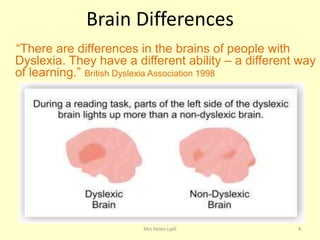
Brain Differences
“There are differences in the brains of people with
Dyslexia. They have a different ability – a different way
of learning.” British Dyslexia Association 1998


                        Mrs Helen Lyall              4
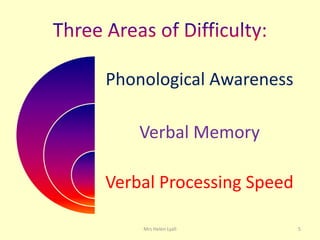
Phonological Awareness

    Verbal Memory

Verbal Processing Speed

    Mrs Helen Lyall       5
Important Info:
• Dyslexia is a continuum ranging from mild to very severe;
  and unique to each person.
• People with Dyslexia become excessively tired due to the
  concentration and effort they have to make and because
  of their inability to cut out extraneous noises and stimuli.
• People with Dyslexia have a maximum concentration
  of their chronological age plus 2 minutes up to 25 yrs
  old.
• The causes for Dyslexia are neurobiological and genetic,
  so Dyslexia does run in families; but the specific genetic
  link has not yet been conclusively identified.
                            Mrs Helen Lyall                6
The Specific Learning Difficulties or
      Differences Spectrum
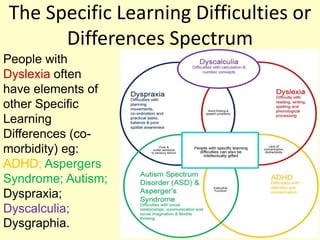
People with
Dyslexia often
have elements of
other Specific
Learning
Differences (co-
morbidity) eg:
ADHD; Aspergers
Syndrome; Autism;
Dyspraxia;
Dyscalculia;
Dysgraphia.         Mrs Helen Lyall   7
Day to Day Dyslexia in the Classroom –
           Pollock & Waller
 “Everyone has two eyes, a nose and a
 mouth, yet incredibly – every face is
 different. It follows that we are all
 constitutionally different and therefore,
 there should be no cause for surprise that
 we tend to acquire knowledge in different
 ways; there are always some things that
 each of us has difficulty in mastering.”

                   Mrs Helen Lyall            8
Recognising Possible Indicators
          of Dyslexia:
                         You may think:
              She (or he)’s not listening
                                          but…
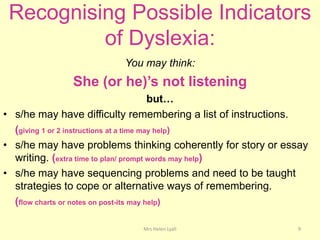
• s/he may have difficulty remembering a list of instructions.
  (giving 1 or 2 instructions at a time may help)
• s/he may have problems thinking coherently for story or essay
  writing. (extra time to plan/ prompt words may help)
• s/he may have sequencing problems and need to be taught
  strategies to cope or alternative ways of remembering.
  (flow charts or notes on post-its may help)

                             Mrs Helen Lyall                9
Recognising Possible Indicators
         of Dyslexia:                               cont


                             You may think:

     She (or he)’s not trying/making enough effort
                              but …
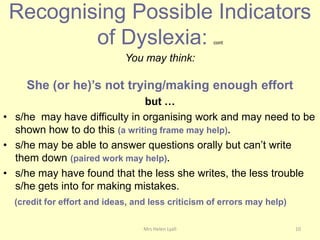
• s/he may have difficulty in organising work and may need to be
  shown how to do this (a writing frame may help).
• s/he may be able to answer questions orally but can‟t write
  them down (paired work may help).
• s/he may have found that the less she writes, the less trouble
  s/he gets into for making mistakes.
  (credit for effort and ideas, and less criticism of errors may help)

                                  Mrs Helen Lyall                        10
Recognising Possible Indicators of
             Dyslexia:                             cont


                            You may think:

            She (or he)’s not concentrating
                                  but …
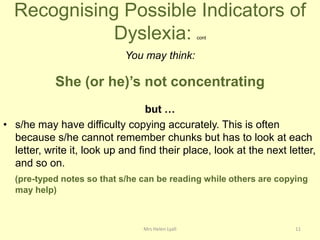
• s/he may have difficulty copying accurately. This is often
  because s/he cannot remember chunks but has to look at each
  letter, write it, look up and find their place, look at the next letter,
  and so on.
  (pre-typed notes so that s/he can be reading while others are copying
  may help)


                                 Mrs Helen Lyall                     11
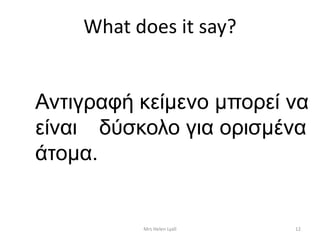
What does it say?


Ανηιγραθή κείμενο μπορεί να
είναι δύζκολο για οριζμένα
άηομα.


          Mrs Helen Lyall   12
Recognising Possible Indicators:     cont


                            You may think:

    She (or he)’s careless / not checking their work
                               but …
• s/he may have poor handwriting due to insufficient hand skills
  to control the pen/pencil. (short daily practices may help)
• s/he may spell the same word several different ways because
  s/he has no visual memory of which is the right way, nor
  kinaesthetic memory for it to feel right as s/he is writing it. (use
  the Look, Say, Write, Cover, Check spelling method to learn words)

• s/he may have a visual memory deficiency making interpreting
  symbols difficult. (1-to-1 learning support may help)

                                Mrs Helen Lyall                    13
Recognising Possible Indicators:    cont


                           You may think:

    She (or he)’s being awkward on purpose
                               but …

• S//he or he may be able to produce very good work one day but
  „trip up over every word‟ the next.
• „Off days‟ are quite common. These are so demoralising and
  frustrating and can quickly cause lowered self-esteem.
   (acknowledgement that we understand what an off day feels like plus
  reminders of past successes may help)

                               Mrs Helen Lyall                    14
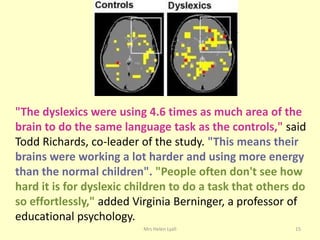
"The dyslexics were using 4.6 times as much area of the
brain to do the same language task as the controls," said
Todd Richards, co-leader of the study. "This means their
brains were working a lot harder and using more energy
than the normal children". "People often don't see how
hard it is for dyslexic children to do a task that others do
so effortlessly," added Virginia Berninger, a professor of
educational psychology.
                          Mrs Helen Lyall                15
Some Common Strengths:
•   A good visual eye
•   May be able to see in 3-D
•   May be imaginative
•   May be skilful with his/her hands
•   May be practical – make the best models
•   May be keen on sport and even excel at one or more
•   May have a fantastic imagination when conversing
•   May be able to tell wonderful stories if his/her long-
    term memory is good
                           Mrs Helen Lyall             16
Some Common Difficulties:
• Sequencing - eg: days of week; words in sentences;
  order of months; polysyllables; order of story
• Direction/orientation - eg: left/right confusion
• Understanding Prepositions - eg: in/out; under/over;
  before/after.
• Fine Motor Skills - eg: using scissors; holding pens;
  keeping within lines; clapping to music.
• Gross Motor Co-ordination - eg: appears clumsy;
  hand/eye co-ordination

                          Mrs Helen Lyall            17
Some Common Difficulties:                 cont.


• Speaking/Listening - eg: assimilating verbal
  instructions; expressing themselves fluently despite
  having a good vocabulary; forgetting or „losing‟ the
  word they need; mispronouncing words; using strange
  grammatical structures but can explain what they
  mean; difficulty following rhythm patterns; recalling
  and producing the right word and getting it slightly
  wrong – probe instead of prong
• Organization - eg: personal – being on time; school -
  remembering equipment; losing things.
• Information Processing - eg: retrieval (even things
  like their own address); interpretation.
• Time Concepts - eg: yesterday/today/tomorrow;
  telling the time; time passing.
                        Mrs Helen Lyall                18
Ten Top Tips:
1. Find out/recognise and acknowledge the dyslexic pupil‟s strengths
2. Praise the dyslexic pupil‟s efforts and achievements – s/he needs
    you to believe in them
3. Help dyslexic pupils to recognise their own learning style – Visual,
    Aural, Kinaesthetic or a combination (meta-cognitive)
4. Incorporate a Multi-Sensory Approach to learning
5. Provide opportunities for over-learning or cumulative learning
6. Teach students to use logic rather than rote memory because short
    term and long term memory are common areas of weakness for
    dyslexics.
7. Mark for content not for spelling (especially during „off days‟)
    4 positives to 1 negative
8. Sit dyslexic students near to the front beside a well-motivated peer
9. Play to the dyslexic pupil‟s strengths and let him/her „shine‟ every so
    often
10. Give time for processing eg: paired discussions before hands up

                                 Mrs Helen Lyall                     19
Legible Logistics!
• Use a cream or pastel background on your whiteboard – to cut down on
  glare and reduce visual disturbance
• Print or photocopy on cream or pastel paper
• On handouts and/or the whiteboard, use a sans serif font such as Ariel or
  Century Gothic with a minimum font size 12
• Keep copying from the board/books to a minimum but if it has to be done,
  put a coloured dot at each end of every line to help with tracking;
• or write each line in a different colour
• Hand out a copy of the homework instructions
• Give a photocopied transcript to dyslexic pupils to read rather than have
  them copy large amounts from the board
• Modify worksheets and boards so the layout is uncluttered and important
  sections highlighted
• Present material sequentially, start from the very beginning and build slowly,
  step by step. Most people remember best when facts and experiences are
  connected with one another, and when material is presented in small units.
  'Less is better'.
                                    Mrs Helen Lyall                        20
Helpful Hints:
• Initiate „study buddies‟ whose skills complement each other. Eg: a
  student who has good ideas for writing (composition) but difficulty
  with handwriting is paired with a student who is good at handwriting
  (transcription) but weaker at composition
• Encourage a positive view of Dyslexia eg: talk about role models
  and/or put photos up in your room (www.xtraordinarypeople.com)
• Consider pairing a dyslexic student with another student who can
  support reading of texts
• Keep a range of practical aids that will help the dyslexic student to
  access the curriculum – highlighters; post-its; etc.
• Present instructions and facts both visually and orally.
• Consider the pace of the lesson and the amount of information given.
                                 Mrs Helen Lyall                    21
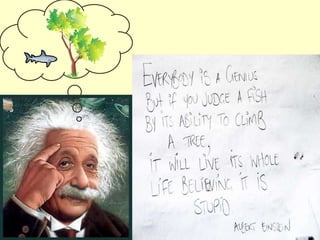
A Few Famous Dyslexics:
•   Albert Einstein 1879 – 1955 Physicist
•   Winston Churchill 1874 – 1965 Prime Minister
•   Susan Hampshire (Actress)
•   Tom Cruise (Actor)
•   Will Smith (Actor)
•   Robyn Williams (Actor)
•   Pam Ayres (Poet)
•   Benjamin Zephaniah (Jamaican Poet)

                      Mrs Helen Lyall          22
Mrs Helen Lyall   23

A brief look at dyslexia

  • 1.
    DYSLEXIA … ABrief Look Mrs Helen Lyall 1
  • 2.
    A Definition ofDyslexia: “Dyslexia is best described as a combination of abilities and difficulties which affect the learning process in one or more areas – reading; writing; language; Numeracy. Accompanying weaknesses may be identified in speed of processing: short term memory; auditory/visual perception; sequencing; spoken language and motor skills . Dyslexia occurs despite normal intellectual ability and conventional teaching. It is independent of socio- economic or language background.” British Dyslexia Association 2001 Mrs Helen Lyall 2
  • 3.
    Dispelling the DyslexiaMyths: • Dyslexia is not a disease that can be cured but with proper diagnosis and appropriate intervention, hard work and support dyslexics can succeed. (www.learn2learn.co.nz) • People do not „grow out of‟ Dyslexia – they may develop coping strategies or these may need to be taught. • Dyslexia is not a sign of being „thick‟ nor of having above average intelligence, though many dyslexic people have outstanding talents in Art, Architecture, Athletics, Drama, Electronics, Engineering, Graphics, and Music. • People with Dyslexia are not lazy, they have to work harder than non-dyslexic people to de-code the written word or text; a skill whichMrs Helen Lyallpeople take for granted. 3 most
  • 4.
    Brain Differences “There aredifferences in the brains of people with Dyslexia. They have a different ability – a different way of learning.” British Dyslexia Association 1998 Mrs Helen Lyall 4
  • 5.
    Phonological Awareness Verbal Memory Verbal Processing Speed Mrs Helen Lyall 5
  • 6.
    Important Info: • Dyslexiais a continuum ranging from mild to very severe; and unique to each person. • People with Dyslexia become excessively tired due to the concentration and effort they have to make and because of their inability to cut out extraneous noises and stimuli. • People with Dyslexia have a maximum concentration of their chronological age plus 2 minutes up to 25 yrs old. • The causes for Dyslexia are neurobiological and genetic, so Dyslexia does run in families; but the specific genetic link has not yet been conclusively identified. Mrs Helen Lyall 6
  • 7.
    The Specific LearningDifficulties or Differences Spectrum People with Dyslexia often have elements of other Specific Learning Differences (co- morbidity) eg: ADHD; Aspergers Syndrome; Autism; Dyspraxia; Dyscalculia; Dysgraphia. Mrs Helen Lyall 7
  • 8.
    Day to DayDyslexia in the Classroom – Pollock & Waller “Everyone has two eyes, a nose and a mouth, yet incredibly – every face is different. It follows that we are all constitutionally different and therefore, there should be no cause for surprise that we tend to acquire knowledge in different ways; there are always some things that each of us has difficulty in mastering.” Mrs Helen Lyall 8
  • 9.
    Recognising Possible Indicators of Dyslexia: You may think: She (or he)’s not listening but… • s/he may have difficulty remembering a list of instructions. (giving 1 or 2 instructions at a time may help) • s/he may have problems thinking coherently for story or essay writing. (extra time to plan/ prompt words may help) • s/he may have sequencing problems and need to be taught strategies to cope or alternative ways of remembering. (flow charts or notes on post-its may help) Mrs Helen Lyall 9
  • 10.
    Recognising Possible Indicators of Dyslexia: cont You may think: She (or he)’s not trying/making enough effort but … • s/he may have difficulty in organising work and may need to be shown how to do this (a writing frame may help). • s/he may be able to answer questions orally but can‟t write them down (paired work may help). • s/he may have found that the less she writes, the less trouble s/he gets into for making mistakes. (credit for effort and ideas, and less criticism of errors may help) Mrs Helen Lyall 10
  • 11.
    Recognising Possible Indicatorsof Dyslexia: cont You may think: She (or he)’s not concentrating but … • s/he may have difficulty copying accurately. This is often because s/he cannot remember chunks but has to look at each letter, write it, look up and find their place, look at the next letter, and so on. (pre-typed notes so that s/he can be reading while others are copying may help) Mrs Helen Lyall 11
  • 12.
    What does itsay? Ανηιγραθή κείμενο μπορεί να είναι δύζκολο για οριζμένα άηομα. Mrs Helen Lyall 12
  • 13.
    Recognising Possible Indicators: cont You may think: She (or he)’s careless / not checking their work but … • s/he may have poor handwriting due to insufficient hand skills to control the pen/pencil. (short daily practices may help) • s/he may spell the same word several different ways because s/he has no visual memory of which is the right way, nor kinaesthetic memory for it to feel right as s/he is writing it. (use the Look, Say, Write, Cover, Check spelling method to learn words) • s/he may have a visual memory deficiency making interpreting symbols difficult. (1-to-1 learning support may help) Mrs Helen Lyall 13
  • 14.
    Recognising Possible Indicators: cont You may think: She (or he)’s being awkward on purpose but … • S//he or he may be able to produce very good work one day but „trip up over every word‟ the next. • „Off days‟ are quite common. These are so demoralising and frustrating and can quickly cause lowered self-esteem. (acknowledgement that we understand what an off day feels like plus reminders of past successes may help) Mrs Helen Lyall 14
  • 15.
    "The dyslexics wereusing 4.6 times as much area of the brain to do the same language task as the controls," said Todd Richards, co-leader of the study. "This means their brains were working a lot harder and using more energy than the normal children". "People often don't see how hard it is for dyslexic children to do a task that others do so effortlessly," added Virginia Berninger, a professor of educational psychology. Mrs Helen Lyall 15
  • 16.
    Some Common Strengths: • A good visual eye • May be able to see in 3-D • May be imaginative • May be skilful with his/her hands • May be practical – make the best models • May be keen on sport and even excel at one or more • May have a fantastic imagination when conversing • May be able to tell wonderful stories if his/her long- term memory is good Mrs Helen Lyall 16
  • 17.
    Some Common Difficulties: •Sequencing - eg: days of week; words in sentences; order of months; polysyllables; order of story • Direction/orientation - eg: left/right confusion • Understanding Prepositions - eg: in/out; under/over; before/after. • Fine Motor Skills - eg: using scissors; holding pens; keeping within lines; clapping to music. • Gross Motor Co-ordination - eg: appears clumsy; hand/eye co-ordination Mrs Helen Lyall 17
  • 18.
    Some Common Difficulties: cont. • Speaking/Listening - eg: assimilating verbal instructions; expressing themselves fluently despite having a good vocabulary; forgetting or „losing‟ the word they need; mispronouncing words; using strange grammatical structures but can explain what they mean; difficulty following rhythm patterns; recalling and producing the right word and getting it slightly wrong – probe instead of prong • Organization - eg: personal – being on time; school - remembering equipment; losing things. • Information Processing - eg: retrieval (even things like their own address); interpretation. • Time Concepts - eg: yesterday/today/tomorrow; telling the time; time passing. Mrs Helen Lyall 18
  • 19.
    Ten Top Tips: 1.Find out/recognise and acknowledge the dyslexic pupil‟s strengths 2. Praise the dyslexic pupil‟s efforts and achievements – s/he needs you to believe in them 3. Help dyslexic pupils to recognise their own learning style – Visual, Aural, Kinaesthetic or a combination (meta-cognitive) 4. Incorporate a Multi-Sensory Approach to learning 5. Provide opportunities for over-learning or cumulative learning 6. Teach students to use logic rather than rote memory because short term and long term memory are common areas of weakness for dyslexics. 7. Mark for content not for spelling (especially during „off days‟) 4 positives to 1 negative 8. Sit dyslexic students near to the front beside a well-motivated peer 9. Play to the dyslexic pupil‟s strengths and let him/her „shine‟ every so often 10. Give time for processing eg: paired discussions before hands up Mrs Helen Lyall 19
  • 20.
    Legible Logistics! • Usea cream or pastel background on your whiteboard – to cut down on glare and reduce visual disturbance • Print or photocopy on cream or pastel paper • On handouts and/or the whiteboard, use a sans serif font such as Ariel or Century Gothic with a minimum font size 12 • Keep copying from the board/books to a minimum but if it has to be done, put a coloured dot at each end of every line to help with tracking; • or write each line in a different colour • Hand out a copy of the homework instructions • Give a photocopied transcript to dyslexic pupils to read rather than have them copy large amounts from the board • Modify worksheets and boards so the layout is uncluttered and important sections highlighted • Present material sequentially, start from the very beginning and build slowly, step by step. Most people remember best when facts and experiences are connected with one another, and when material is presented in small units. 'Less is better'. Mrs Helen Lyall 20
  • 21.
    Helpful Hints: • Initiate„study buddies‟ whose skills complement each other. Eg: a student who has good ideas for writing (composition) but difficulty with handwriting is paired with a student who is good at handwriting (transcription) but weaker at composition • Encourage a positive view of Dyslexia eg: talk about role models and/or put photos up in your room (www.xtraordinarypeople.com) • Consider pairing a dyslexic student with another student who can support reading of texts • Keep a range of practical aids that will help the dyslexic student to access the curriculum – highlighters; post-its; etc. • Present instructions and facts both visually and orally. • Consider the pace of the lesson and the amount of information given. Mrs Helen Lyall 21
  • 22.
    A Few FamousDyslexics: • Albert Einstein 1879 – 1955 Physicist • Winston Churchill 1874 – 1965 Prime Minister • Susan Hampshire (Actress) • Tom Cruise (Actor) • Will Smith (Actor) • Robyn Williams (Actor) • Pam Ayres (Poet) • Benjamin Zephaniah (Jamaican Poet) Mrs Helen Lyall 22
  • 23.

Editor's Notes

  • #13 Copy the following sentence : Note the white background which most dyslexics will find harder to read from.Compare it to the previous slides and see if you notice a difference.