DYSLEXIA
Presenter: Dr Ira K.C.
Moderator: Dr Ranjana Karki
LANGUAGE
• one of the most critical and complex cognitive functions
• broadly divided into receptive (auditory
comprehension/understanding) and expressive (speech and
language production and/or communication) functions
• Receptive language problems may have difficulty understanding
verbal information, following instructions and explanations, and
interpreting what they hear
• Expressive language weaknesses can result from problems with
speech production and/or problems with higher level language
development
• Speech production difficulties include oromotor problems
affecting articulation, verbal fluency, and naming, trouble with
sound sequencing within words, difficulty to regulate the rhythm
or prosody of their verbal output
Components:
• Phonology: ability to process and integrate the individual sounds
in words
• Semantics: understanding the meaning of words
• Syntax: mastery of word order and grammatical rules
• Discourse: processing and producing paragraphs and passages
• Metalinguistics: ability to think about and analyse how language
works and draw inferences
• Pragmatics: social understanding and application of language
Common learning and developmental
disorders
• Neurodevelopmental and executive dysfunction
• Dyslexia
• Dyscalculia
• Language development and communication disorders
• Developmental delay and intellectual disability
• Autism spectrum disorders
• Attention deficit hyperactivity disorder
INTRODUCTION
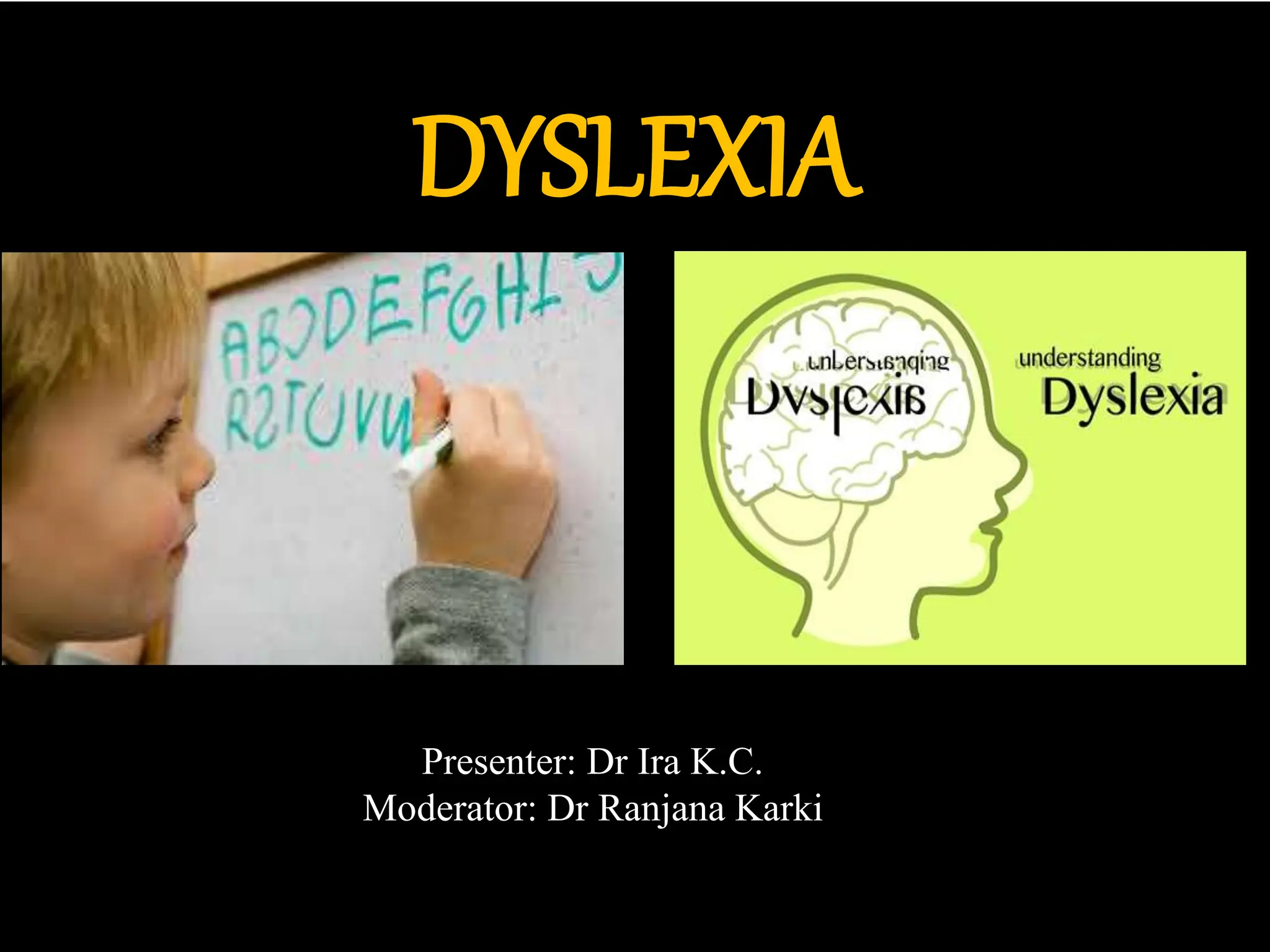
• Unexpected difficulty in reading for an individual who has the
intelligence to be a much better reader
• Caused by difficulty in phonological processing
• Affects the ability of an individual to speak, read and spell
• most common learning disability in children and persists
throughout life
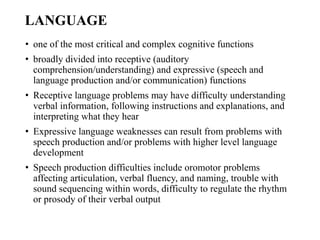
• Example :Reading the word "now" as "won" or "left" as "felt."
Words may also blend together and spaces are lost.
• severity of dyslexia can vary from mild to severe
• categorized separately in ICD-10 under “Symptoms and Signs Not
Elsewhere Classified”
ETIOLOGY
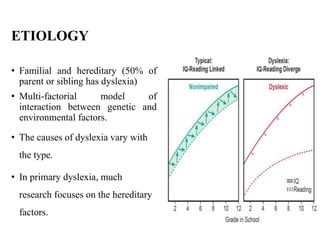
• Familial and hereditary (50% of
parent or sibling has dyslexia)
• Multi-factorial model of
interaction between genetic and
environmental factors.
• The causes of dyslexia vary with
the type.
• In primary dyslexia, much
research focuses on the hereditary
factors.
RISK FACTORS
• A family history of dyslexia or other learning disabilities
• Premature birth or low birth weight
• Exposure during pregnancy to nicotine, drugs, alcohol or infection
that may alter brain development in the fetus
• Individual differences in the parts of the brain that enable reading
PATHOGENESIS
• Defect in phonologic component of the language system engaged
in processing the sounds of speech
• Difficulty developing an awareness that spoken words can be
segmented into smaller elemental units of sound (phonemes).
• Increasing evidence indicates that disruption of attentional
mechanisms may also play an important role in reading
difficulties.
NEUROLOGICAL BACKGROUND
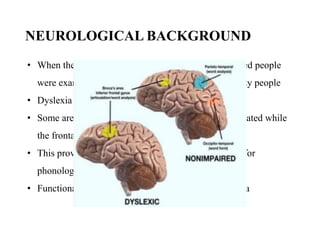
• When the brain activities of dyslexic and non-impaired people
were examined, it was clear that Dyslexics are not lazy people
• Dyslexia has nothing to do with intelligence
• Some areas of the brain of dyslexics were under activated while
the frontal portion was over activated
• This proved that their brains failed to become active for
phonological tasks
• Functional brain imaging: neural signature of dyslexia
TYPES OF DYSLEXIA
1. Primary dyslexia:
• most common type
• dysfunction of, rather than damage to, the left side of the brain
(cerebral cortex) and does not change with age
• variability in the severity of the disability for Individuals with this
type of dyslexia
• most who receive an appropriate educational intervention will be
academically successful throughout their lives
• passed in family lines through genes (hereditary) or through new
genetic mutations
• found more often in boys than in girls
2. Secondary or developmental dyslexia:
• caused by problems with brain development during the early
stages of fetal development
• Developmental dyslexia diminishes as the child matures
• more common in boys.
3. Trauma dyslexia:
• usually occurs after some form of brain trauma or injury to the
area of the brain that controls reading and writing
• rarely seen in today's school-age population
Other types of learning disability include:
• The term visual dyslexia is sometimes used to refer to visual
processing disorder, a condition in which the brain does not
properly interpret visual signals.
• The term auditory dyslexia has been used to refer to auditory
processing disorder. Similar to visual processing disorder, there
are problems with the brain's processing of sounds and speech.
SIGNS AND SYMPTOMS
SIGNS AND SYMPTOMS
• Delayed early language development
• Problems recognizing the differences between similar sounds or
segmenting words.
• Slow learning of new vocabulary words
• Difficulty copying from the board or a book.
• Difficulty with learning reading, writing, and spelling skills
• A child may not be able to remember content, even if it involves a
favourite video or storybook.
SIGNS AND SYMPTOMS
• Problems with spatial relationships can extend beyond the
classroom and be observed on the playground.
• The child may appear to be uncoordinated and have difficulty with
organized sports or games.
• Difficulty with left and right is common, and often dominance for
either hand has not been established.
• Many subtle signs can be observed in children with dyslexia.
• Children may become withdrawn and appear to be depressed.
• They may begin to act out, drawing attention away from their
learning difficulty.
• Problems with self-esteem can arise, and peer and sibling
interactions can become strained.
• These children may lose their interest in school-related activities
and appear to be unmotivated or lazy.
• The emotional symptoms and signs are just as important as the
academic and require equal attention.
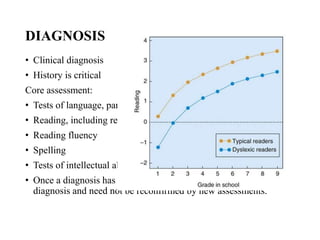
DIAGNOSIS
• Clinical diagnosis
• History is critical
Core assessment:
• Tests of language, particularly phonology
• Reading, including real and pseudowords
• Reading fluency
• Spelling
• Tests of intellectual ability
• Once a diagnosis has been made, dyslexia is a permanent
diagnosis and need not be reconfirmed by new assessments.
TREATMENT
1. Providing information about the disorder
2. Treatment of any mental symptoms and concurrent disorders
3. Regular reading support
4. Individual spelling support
Treatment focuses on helping child:
• Learn to recognize and use the smallest sounds that make up words
(phonemes)
• Understand that letters and strings of letters represent these sounds and
words (phonics)
• Comprehend what he or she is reading
• Read aloud to build reading accuracy, speed and expression (fluency)
• Build a vocabulary of recognized and understood words
EDUCATIONAL TECHNIQUES
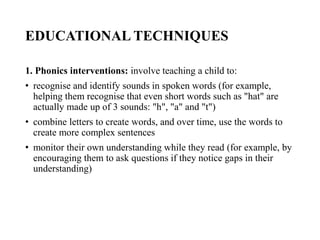
1. Phonics interventions: involve teaching a child to:
• recognise and identify sounds in spoken words (for example,
helping them recognise that even short words such as "hat" are
actually made up of 3 sounds: "h", "a" and "t")
• combine letters to create words, and over time, use the words to
create more complex sentences
• monitor their own understanding while they read (for example, by
encouraging them to ask questions if they notice gaps in their
understanding)
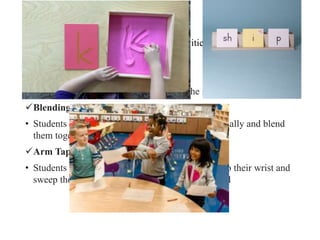
2. Multisensory learning
• Incorporates tactile and kinesthetic activities into learning process
• Includes:
Sand Writing
• Students trace a letter as they verbalise the sound
Blending Boards
• Students produce the sound of each letter individually and blend
them together to read an entire word
Arm Tapping
• Students tap their arms as they say letters, down to their wrist and
sweep their hands down as if underlining the word
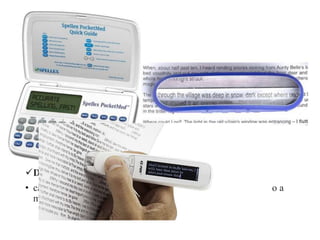
3. Assistive Technology
• Includes:
Pocket Spellcheckers
• Device contain dictionaries that recognize phonetically misspelled
words
• Students type in a word to the best of their ability and the
spellchecker provides the word’s correct spelling through text or
audio
 Line Readers
• Tool highlights a single line of text at a time and blocks the
surrounding areas
Digital Scanning Pens
• can capture both handwritten and digital text and transmit it to a
mobile device or a computer
Efficacy of dynamic visuo-attentional interventions for reading in
dyslexic and neurotypical children: A systematic review
Jessica L. Peters a, Lauren De Losa a, Edith L. Bavin a b, Sheila G. Crewther.A
• Introduction: Dyslexia is associated with phonological and visuo-
attentional deficits. Phonological interventions improve word
accuracy and letter-sound knowledge, but not reading fluency
• Method: Literature searches in Medline, PsycINFO, EMBASE,
Scopus, ERIC, PubMed, Web of Science, and Cochrane Library
identified 1266 unique articles, of which 18 met inclusion criteria
(620 participants; 91.40% dyslexic). Three types of visuo-
attentional interventions were identified.
• Result: Results show that visual perceptual training (n = 5)
benefited reading fluency and comprehension, visually-based
reading acceleration programs (n = 8) improved reading accuracy
and rate, and action video games (n = 5) increased rate and
fluency.
• Conclusion: Visuo-attentional interventions are effective options
for treating childhood dyslexia, improving reading generally equal
to or greater than other strategies.
BIBLIOGRAPHY
• Uptodate 2024
• Nelson Textbook of Pediatrics, 21st edition
• Schulte-Körne G. The prevention, diagnosis, and treatment of
dyslexia. Dtsch Arztebl Int. 2010 Oct
• Jessica L. Peters, Lauren De Losa, Edith L. Bavin, Sheila G.
Crewther,Efficacy of dynamic visuo-attentional interventions for
reading in dyslexic and neurotypical children: A systematic
review,Neuroscience & Biobehavioral Reviews,Volume 100, 2019
• Teaching Strategies for Students with Dyslexia, Journal of school
of education, American University
dyslexia a specific language and phonology disorder

dyslexia a specific language and phonology disorder

  • 1.
    DYSLEXIA Presenter: Dr IraK.C. Moderator: Dr Ranjana Karki
  • 2.
    LANGUAGE • one ofthe most critical and complex cognitive functions • broadly divided into receptive (auditory comprehension/understanding) and expressive (speech and language production and/or communication) functions • Receptive language problems may have difficulty understanding verbal information, following instructions and explanations, and interpreting what they hear • Expressive language weaknesses can result from problems with speech production and/or problems with higher level language development • Speech production difficulties include oromotor problems affecting articulation, verbal fluency, and naming, trouble with sound sequencing within words, difficulty to regulate the rhythm or prosody of their verbal output
  • 3.
    Components: • Phonology: abilityto process and integrate the individual sounds in words • Semantics: understanding the meaning of words • Syntax: mastery of word order and grammatical rules • Discourse: processing and producing paragraphs and passages • Metalinguistics: ability to think about and analyse how language works and draw inferences • Pragmatics: social understanding and application of language
  • 4.
    Common learning anddevelopmental disorders • Neurodevelopmental and executive dysfunction • Dyslexia • Dyscalculia • Language development and communication disorders • Developmental delay and intellectual disability • Autism spectrum disorders • Attention deficit hyperactivity disorder
  • 5.
    INTRODUCTION • Unexpected difficultyin reading for an individual who has the intelligence to be a much better reader • Caused by difficulty in phonological processing • Affects the ability of an individual to speak, read and spell • most common learning disability in children and persists throughout life • Example :Reading the word "now" as "won" or "left" as "felt." Words may also blend together and spaces are lost. • severity of dyslexia can vary from mild to severe • categorized separately in ICD-10 under “Symptoms and Signs Not Elsewhere Classified”
  • 6.
    ETIOLOGY • Familial andhereditary (50% of parent or sibling has dyslexia) • Multi-factorial model of interaction between genetic and environmental factors. • The causes of dyslexia vary with the type. • In primary dyslexia, much research focuses on the hereditary factors.
  • 7.
    RISK FACTORS • Afamily history of dyslexia or other learning disabilities • Premature birth or low birth weight • Exposure during pregnancy to nicotine, drugs, alcohol or infection that may alter brain development in the fetus • Individual differences in the parts of the brain that enable reading
  • 8.
    PATHOGENESIS • Defect inphonologic component of the language system engaged in processing the sounds of speech • Difficulty developing an awareness that spoken words can be segmented into smaller elemental units of sound (phonemes). • Increasing evidence indicates that disruption of attentional mechanisms may also play an important role in reading difficulties.
  • 9.
    NEUROLOGICAL BACKGROUND • Whenthe brain activities of dyslexic and non-impaired people were examined, it was clear that Dyslexics are not lazy people • Dyslexia has nothing to do with intelligence • Some areas of the brain of dyslexics were under activated while the frontal portion was over activated • This proved that their brains failed to become active for phonological tasks • Functional brain imaging: neural signature of dyslexia
  • 10.
    TYPES OF DYSLEXIA 1.Primary dyslexia: • most common type • dysfunction of, rather than damage to, the left side of the brain (cerebral cortex) and does not change with age • variability in the severity of the disability for Individuals with this type of dyslexia • most who receive an appropriate educational intervention will be academically successful throughout their lives • passed in family lines through genes (hereditary) or through new genetic mutations • found more often in boys than in girls
  • 11.
    2. Secondary ordevelopmental dyslexia: • caused by problems with brain development during the early stages of fetal development • Developmental dyslexia diminishes as the child matures • more common in boys. 3. Trauma dyslexia: • usually occurs after some form of brain trauma or injury to the area of the brain that controls reading and writing • rarely seen in today's school-age population
  • 12.
    Other types oflearning disability include: • The term visual dyslexia is sometimes used to refer to visual processing disorder, a condition in which the brain does not properly interpret visual signals. • The term auditory dyslexia has been used to refer to auditory processing disorder. Similar to visual processing disorder, there are problems with the brain's processing of sounds and speech.
  • 13.
  • 14.
    SIGNS AND SYMPTOMS •Delayed early language development • Problems recognizing the differences between similar sounds or segmenting words. • Slow learning of new vocabulary words • Difficulty copying from the board or a book. • Difficulty with learning reading, writing, and spelling skills • A child may not be able to remember content, even if it involves a favourite video or storybook.
  • 15.
    SIGNS AND SYMPTOMS •Problems with spatial relationships can extend beyond the classroom and be observed on the playground. • The child may appear to be uncoordinated and have difficulty with organized sports or games. • Difficulty with left and right is common, and often dominance for either hand has not been established.
  • 16.
    • Many subtlesigns can be observed in children with dyslexia. • Children may become withdrawn and appear to be depressed. • They may begin to act out, drawing attention away from their learning difficulty. • Problems with self-esteem can arise, and peer and sibling interactions can become strained. • These children may lose their interest in school-related activities and appear to be unmotivated or lazy. • The emotional symptoms and signs are just as important as the academic and require equal attention.
  • 17.
    DIAGNOSIS • Clinical diagnosis •History is critical Core assessment: • Tests of language, particularly phonology • Reading, including real and pseudowords • Reading fluency • Spelling • Tests of intellectual ability • Once a diagnosis has been made, dyslexia is a permanent diagnosis and need not be reconfirmed by new assessments.
  • 18.
    TREATMENT 1. Providing informationabout the disorder 2. Treatment of any mental symptoms and concurrent disorders 3. Regular reading support 4. Individual spelling support Treatment focuses on helping child: • Learn to recognize and use the smallest sounds that make up words (phonemes) • Understand that letters and strings of letters represent these sounds and words (phonics) • Comprehend what he or she is reading • Read aloud to build reading accuracy, speed and expression (fluency) • Build a vocabulary of recognized and understood words
  • 19.
    EDUCATIONAL TECHNIQUES 1. Phonicsinterventions: involve teaching a child to: • recognise and identify sounds in spoken words (for example, helping them recognise that even short words such as "hat" are actually made up of 3 sounds: "h", "a" and "t") • combine letters to create words, and over time, use the words to create more complex sentences • monitor their own understanding while they read (for example, by encouraging them to ask questions if they notice gaps in their understanding)
  • 20.
    2. Multisensory learning •Incorporates tactile and kinesthetic activities into learning process • Includes: Sand Writing • Students trace a letter as they verbalise the sound Blending Boards • Students produce the sound of each letter individually and blend them together to read an entire word Arm Tapping • Students tap their arms as they say letters, down to their wrist and sweep their hands down as if underlining the word
  • 21.
    3. Assistive Technology •Includes: Pocket Spellcheckers • Device contain dictionaries that recognize phonetically misspelled words • Students type in a word to the best of their ability and the spellchecker provides the word’s correct spelling through text or audio  Line Readers • Tool highlights a single line of text at a time and blocks the surrounding areas Digital Scanning Pens • can capture both handwritten and digital text and transmit it to a mobile device or a computer
  • 22.
    Efficacy of dynamicvisuo-attentional interventions for reading in dyslexic and neurotypical children: A systematic review Jessica L. Peters a, Lauren De Losa a, Edith L. Bavin a b, Sheila G. Crewther.A • Introduction: Dyslexia is associated with phonological and visuo- attentional deficits. Phonological interventions improve word accuracy and letter-sound knowledge, but not reading fluency • Method: Literature searches in Medline, PsycINFO, EMBASE, Scopus, ERIC, PubMed, Web of Science, and Cochrane Library identified 1266 unique articles, of which 18 met inclusion criteria (620 participants; 91.40% dyslexic). Three types of visuo- attentional interventions were identified. • Result: Results show that visual perceptual training (n = 5) benefited reading fluency and comprehension, visually-based reading acceleration programs (n = 8) improved reading accuracy and rate, and action video games (n = 5) increased rate and fluency. • Conclusion: Visuo-attentional interventions are effective options for treating childhood dyslexia, improving reading generally equal to or greater than other strategies.
  • 23.
    BIBLIOGRAPHY • Uptodate 2024 •Nelson Textbook of Pediatrics, 21st edition • Schulte-Körne G. The prevention, diagnosis, and treatment of dyslexia. Dtsch Arztebl Int. 2010 Oct • Jessica L. Peters, Lauren De Losa, Edith L. Bavin, Sheila G. Crewther,Efficacy of dynamic visuo-attentional interventions for reading in dyslexic and neurotypical children: A systematic review,Neuroscience & Biobehavioral Reviews,Volume 100, 2019 • Teaching Strategies for Students with Dyslexia, Journal of school of education, American University

Editor's Notes

  • #5 Written expression and graphics: dygraphia
  • #6 Specific Learning Disorder (SLD) by(DSM-V).
  • #7 DYX2 6p DYX3 2p, variation in cortical thickness Fig. uncoupling of reading and IQ over time. In left the reading and IQ devm are linked over time. In right, reading and IQ devm are dissociated and one does not influence the other visual–spatial deficits in Turner syndrome or language deficits in fragile X syndrome. Chromosome 22q11.2 deletion syndrome (Di George or velocardiofacial syndrome)
  • #8 Meningitis, HIV, hypoxic brain injury, PVL, IVH, lead
  • #9 Phonology: ability to process and integrate the individual sounds in words Phonological processing: verbal short term memory, rapid serial processing, articulation speed, phonological awareness
  • #10 Underactivation in left posterior reading system: neural signature of dyslexia
  • #15 slow and laborious reading and writing.
  • #18 Reading from grades 1 through 9 in typical and dyslexic readers. The achievement gap between typical and dyslexic readers is evident as early as 1st grade and persists through adolescence
  • #21 For sand writing activities, students receive paper plates with sand. The teacher calls out a sound and students repeat it. Students then trace a letter in the sand corresponding to that sound as they verbalize the letter’s name and sound. This kinesthetic activity stimulates the brain in many different ways, giving students a greater chance of successful retention For blending board activities, teachers use large cards printed with individual letters to form a CVC word: a word consisting of a consonant, a vowel. teacher covers up the letters and reveals them one by one. Students produce the sound of each letter individually and then blend them together to read the word in its entirety.  For arm tapping activities, teachers display a card with a word written on it. Using their dominant hand, students say the letters of the word. As they say each letter, they simultaneously tap their arms, starting from their shoulder down to their wrist. Next, students say the whole word and sweep their hands down their arms as if underlining the word. 
  • #22 Some students with dyslexia struggle to see words accurately on the page, Letters may appear to be moving or students may see them in the wrong order
  • #23 Neuroscience & Biobehavioral Reviews Elsevier may 2019 5-15 years, research over last 40 years 1979-2019 Studies identified through electronic database: medline, Embase, Cochrane library, eric, pubmed,web of science