Sherise Koneferenisi
National University - SPD 608
                      1.30.13
                  Mary Worth
Dys:
           absence


Lexia:
language
                  The Greek
               origin combines
                „dys‟ & „lexia‟
                 meaning an
                  absence of
                   language
   According to the International Dyslexia
    Association and the National Institute of Child
    Health and Human Development,
    Dyslexia is defined as:
     a specific learning disability that is neurobiological
      in origin
     characterized by difficulties with accurate and/or
      fluent word recognition
     poor spelling and decoding abilities
       these difficulties typically result from a deficit in
        the phonological component of language
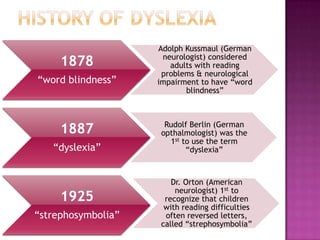
Adolph Kussmaul (German
                     neurologist) considered
     1878              adults with reading
                     problems & neurological
“word blindness”    impairment to have “word
                           blindness”


                     Rudolf Berlin (German
     1887           opthalmologist) was the
                      1st to use the term
   “dyslexia”              “dyslexia”


                       Dr. Orton (American
                        neurologist) 1st to
     1925            recognize that children
                     with reading difficulties
“strephosymbolia”    often reversed letters,
                    called “strephosymbolia”
1900’s         Dr. Orton also introduced
                 the term “developmental
                     alexia” to describe
“developmental     children with reading
    alexia”              difficulties


  1930’s            The term “dyslexia”
                  became a more common
  “dyslexia”       term used in literature


                    Children with literacy
   Mid             difficulties began to be
                    considered under the
  1900’s         jurisdiction of educational
                  & psychological research
 Click on the icon on
the left to be directed
to a short informational
documentary.
The documentary
includes both adults
and children with the
dyslexia and the
difficulties that they
face.
 Although  medicine continues to play a
  prominent role in research, showing that the
  causes of dyslexia lie within biology and
  neurology, its treatment will most likely
  continue to be in the field of education.
 In the 21st century, dyslexia is officially
  recognized & has become a topic of research
  for both education & medicine.
 The professions of medicine & psychology are
  seen now collaborating in significant research
  into the origins & management of dyslexia.
 Accordingto the
 International Dyslexia
 Association (IDA) :
    Estimated that 15–20% of
     the general population
     experiences one or more
     symptoms of dyslexia
 Based   on a 2010 study:
  80% of children identified
   as learning disabled
  These children have
   primary deficits in the area
   of reading and related
   language functions
   Students with dyslexia:
       Experience difficulties in
        reading and further
        language functions
       Demonstrate lower reading
        skills, which will result in
        poor comprehension
       May need more time and
        assistance than others
        when reading
       May have lower self-
        esteem
       May exhibit more
        emotional and behavioral
        difficulties
 Accommodation,   Modification &
 Differentitation Strategies include:
  Use less difficult and lengthy words with written
   instruction
  Lessen the amount of items that students are
   expected to learn or complete
  Provide ample time for students to read content
  Increase the amount of reading
   instruction/directions aloud to students
  Occasionally substitute pictures/graphics for
   words
  Allow students to voice their responses rather
   than write them
PROVIDE MORE
   ADDRESS THE          USE SCIENTIFIC
                                           EFFECTIVE LEARNING
CHALLENGES OF THE      RESEARCH-BASED
                                           STRATEGIES FOR THE
     STUDENT         TEACHING STRATEGIES
                                                STUDENT


 BE PATIENT WHEN     HELP THE STUDENT’S      PROVIDE HELPFUL
  TEACHIING & BE      PEERS & PARENTS      LEARNING STRATEGIES
AVAILABLE TO OFFER   BETTER UNDERSTAND      FOR THE STUDENT’S
 ASSISTANCE WHEN       THE STUDENT’S       PARENTS TO PRACTICE
      NEEDED            DIFFERENCES         WITH THE STUDENT
• The International Dyslexia Association
               • http://www.interdys.org/
  Info &     • Davis Dyslexia Association International
               • http://www.dyslexia.com/
 Support


             • Smart Kids with Learning Disabilities
               • http://www.smartkidswithld.org/parents-community/parent-
                 to-parent/can-a-support-group-for-parents-of-kids-with-
  For            learning-disabilities-help-you
PARENTS


             • National Center for Learning Disabilities
               • http://www.ncld.org/types-learning-
                 disabilities/dyslexia/what-is-dyslexia
   For   • Reading Rockets: Teaching Kids to Read & Helping
           Those Who Struggle
TEACHERS • http://www.readingrockets.org/helping/questions/dyslexia/
   Culbertson (2012) discusses misconceptions of dyslexia and claims
    that, “Professional development in the area of dyslexia can help
    educators understand dyslexia is a problem with reading and not of
    intelligence” (p. 4). Based on Culbertson‟s discussion, I think it is
    important that teachers take the initiative to learn about dyslexia as
    a disability and gain as much knowledge on effective teaching
    strategies for students with dyslexia. Therefore, misconceptions
    about dyslexia can be avoided and dyslexic student‟s problems can be
    better assisted or prevented.
   Washburn et al. (2011) conducted studies that “…clearly support the
    common misconception that the core deficit in dyslexia is visual
    rather than phonological” (p. 180). It is essential that teachers use
    research-based teaching strategies rather than use faulty strategies
    that are based on misconceptions. For that reason, Washburn et al.
    (2011) demonstrate the benefits of teachers furthering their own
    education and knowledge by learning more about basic language
    concepts. By teachers being more aware of concepts such as
    phonology and morphology, they will be more prepared for effective
    instruction of reading.
   Culbertson, D. (2012). Uncovering the many misconceptions of
    dyslexia. CEDER Yearbook, 51-65. Retrieved from
    http://ehis.ebscohost.com.ezproxy.nu.edu/eds/pdfviewer/pdfview
    er?sid=bb03c131-7746-42ad-94bf-
    10b3f0baa070%40sessionmgr113&vid=1&hid=103

   Kirby, J., Silvestri, R., Allingham, B., Parrila, R., & La Fave, C.
    (2008). Learning strategies and study approaches of postsecondary
    students with dyslexia. Journal Of Learning Disabilities, 41(1), 85-
    96. Retrieved from
    http://ehis.ebscohost.com.ezproxy.nu.edu/eds/pdfviewer/pdfview
    er?sid=0406af74-de92-494f-a029-
    fa611dfab511%40sessionmgr110&vid=4&hid=121

   Klein, R. M., & McMullen, P. A. (1999). Converging methods for
    understanding reading and dyslexia / edited by Raymond M. Klein
    and Patricia McMullen. Cambridge, Mass. : MIT Press, c1999.

   Lawrence, D. (2009). Understanding dyslexia: a guide for teachers
    and parents. Maidenhead: Open University Press. Retrieved from
    http://mcgraw-hill.co.uk/openup/chapters/9780335235940.pdf
   Smith, T. E., Polloway, E. A., Patton, J. R., & Dowdy, C. A. (2012).
    Teaching students with special needs in inclusive settings (6th
    ed.). Upper Saddle River, NJ: Pearson Education.

   Terras, M. M., Thompson, L. C., & Minnis, H. (2009). Dyslexia and
    psycho-social functioning: an exploratory study of the role of self-
    esteem and understanding. 15(4), 304-327. Retrieved from
    http://ehis.ebscohost.com.ezproxy.nu.edu/eds/pdfviewer/pdfvie
    wer?sid=86a5434d-b2fa-4d0b-b07b-
    6e76b493b6fc%40sessionmgr114&vid=2&hid=121

   Washburn, E. K., Joshi, R., & Binks-Cantrell, E. S. (2011). Teacher
    knowledge of basic language concepts and dyslexia. 17(2), 165-
    183. Retrieved from
    http://ehis.ebscohost.com.ezproxy.nu.edu/eds/pdfviewer/pdfvie
    wer?sid=d2437b4f-6737-441d-bec7-
    c29053ea00a3%40sessionmgr111&vid=5&hid=5

   (2011, April 16). Dyslexia: A Hidden Disability. Retrieved from
    http://www.youtube.com/watch?v=8m1fCz3ohMw

Dyslexia

  • 1.
    Sherise Koneferenisi National University- SPD 608 1.30.13 Mary Worth
  • 2.
    Dys: absence Lexia: language The Greek origin combines „dys‟ & „lexia‟ meaning an absence of language
  • 3.
    According to the International Dyslexia Association and the National Institute of Child Health and Human Development, Dyslexia is defined as:  a specific learning disability that is neurobiological in origin  characterized by difficulties with accurate and/or fluent word recognition  poor spelling and decoding abilities  these difficulties typically result from a deficit in the phonological component of language
  • 4.
    Adolph Kussmaul (German neurologist) considered 1878 adults with reading problems & neurological “word blindness” impairment to have “word blindness” Rudolf Berlin (German 1887 opthalmologist) was the 1st to use the term “dyslexia” “dyslexia” Dr. Orton (American neurologist) 1st to 1925 recognize that children with reading difficulties “strephosymbolia” often reversed letters, called “strephosymbolia”
  • 5.
    1900’s Dr. Orton also introduced the term “developmental alexia” to describe “developmental children with reading alexia” difficulties 1930’s The term “dyslexia” became a more common “dyslexia” term used in literature Children with literacy Mid difficulties began to be considered under the 1900’s jurisdiction of educational & psychological research
  • 6.
     Click onthe icon on the left to be directed to a short informational documentary. The documentary includes both adults and children with the dyslexia and the difficulties that they face.
  • 7.
     Although medicine continues to play a prominent role in research, showing that the causes of dyslexia lie within biology and neurology, its treatment will most likely continue to be in the field of education.  In the 21st century, dyslexia is officially recognized & has become a topic of research for both education & medicine.  The professions of medicine & psychology are seen now collaborating in significant research into the origins & management of dyslexia.
  • 8.
     Accordingto the International Dyslexia Association (IDA) :  Estimated that 15–20% of the general population experiences one or more symptoms of dyslexia  Based on a 2010 study:  80% of children identified as learning disabled  These children have primary deficits in the area of reading and related language functions
  • 9.
    Students with dyslexia:  Experience difficulties in reading and further language functions  Demonstrate lower reading skills, which will result in poor comprehension  May need more time and assistance than others when reading  May have lower self- esteem  May exhibit more emotional and behavioral difficulties
  • 10.
     Accommodation, Modification & Differentitation Strategies include:  Use less difficult and lengthy words with written instruction  Lessen the amount of items that students are expected to learn or complete  Provide ample time for students to read content  Increase the amount of reading instruction/directions aloud to students  Occasionally substitute pictures/graphics for words  Allow students to voice their responses rather than write them
  • 11.
    PROVIDE MORE ADDRESS THE USE SCIENTIFIC EFFECTIVE LEARNING CHALLENGES OF THE RESEARCH-BASED STRATEGIES FOR THE STUDENT TEACHING STRATEGIES STUDENT BE PATIENT WHEN HELP THE STUDENT’S PROVIDE HELPFUL TEACHIING & BE PEERS & PARENTS LEARNING STRATEGIES AVAILABLE TO OFFER BETTER UNDERSTAND FOR THE STUDENT’S ASSISTANCE WHEN THE STUDENT’S PARENTS TO PRACTICE NEEDED DIFFERENCES WITH THE STUDENT
  • 12.
    • The InternationalDyslexia Association • http://www.interdys.org/ Info & • Davis Dyslexia Association International • http://www.dyslexia.com/ Support • Smart Kids with Learning Disabilities • http://www.smartkidswithld.org/parents-community/parent- to-parent/can-a-support-group-for-parents-of-kids-with- For learning-disabilities-help-you PARENTS • National Center for Learning Disabilities • http://www.ncld.org/types-learning- disabilities/dyslexia/what-is-dyslexia For • Reading Rockets: Teaching Kids to Read & Helping Those Who Struggle TEACHERS • http://www.readingrockets.org/helping/questions/dyslexia/
  • 13.
    Culbertson (2012) discusses misconceptions of dyslexia and claims that, “Professional development in the area of dyslexia can help educators understand dyslexia is a problem with reading and not of intelligence” (p. 4). Based on Culbertson‟s discussion, I think it is important that teachers take the initiative to learn about dyslexia as a disability and gain as much knowledge on effective teaching strategies for students with dyslexia. Therefore, misconceptions about dyslexia can be avoided and dyslexic student‟s problems can be better assisted or prevented.  Washburn et al. (2011) conducted studies that “…clearly support the common misconception that the core deficit in dyslexia is visual rather than phonological” (p. 180). It is essential that teachers use research-based teaching strategies rather than use faulty strategies that are based on misconceptions. For that reason, Washburn et al. (2011) demonstrate the benefits of teachers furthering their own education and knowledge by learning more about basic language concepts. By teachers being more aware of concepts such as phonology and morphology, they will be more prepared for effective instruction of reading.
  • 14.
    Culbertson, D. (2012). Uncovering the many misconceptions of dyslexia. CEDER Yearbook, 51-65. Retrieved from http://ehis.ebscohost.com.ezproxy.nu.edu/eds/pdfviewer/pdfview er?sid=bb03c131-7746-42ad-94bf- 10b3f0baa070%40sessionmgr113&vid=1&hid=103  Kirby, J., Silvestri, R., Allingham, B., Parrila, R., & La Fave, C. (2008). Learning strategies and study approaches of postsecondary students with dyslexia. Journal Of Learning Disabilities, 41(1), 85- 96. Retrieved from http://ehis.ebscohost.com.ezproxy.nu.edu/eds/pdfviewer/pdfview er?sid=0406af74-de92-494f-a029- fa611dfab511%40sessionmgr110&vid=4&hid=121  Klein, R. M., & McMullen, P. A. (1999). Converging methods for understanding reading and dyslexia / edited by Raymond M. Klein and Patricia McMullen. Cambridge, Mass. : MIT Press, c1999.  Lawrence, D. (2009). Understanding dyslexia: a guide for teachers and parents. Maidenhead: Open University Press. Retrieved from http://mcgraw-hill.co.uk/openup/chapters/9780335235940.pdf
  • 15.
    Smith, T. E., Polloway, E. A., Patton, J. R., & Dowdy, C. A. (2012). Teaching students with special needs in inclusive settings (6th ed.). Upper Saddle River, NJ: Pearson Education.  Terras, M. M., Thompson, L. C., & Minnis, H. (2009). Dyslexia and psycho-social functioning: an exploratory study of the role of self- esteem and understanding. 15(4), 304-327. Retrieved from http://ehis.ebscohost.com.ezproxy.nu.edu/eds/pdfviewer/pdfvie wer?sid=86a5434d-b2fa-4d0b-b07b- 6e76b493b6fc%40sessionmgr114&vid=2&hid=121  Washburn, E. K., Joshi, R., & Binks-Cantrell, E. S. (2011). Teacher knowledge of basic language concepts and dyslexia. 17(2), 165- 183. Retrieved from http://ehis.ebscohost.com.ezproxy.nu.edu/eds/pdfviewer/pdfvie wer?sid=d2437b4f-6737-441d-bec7- c29053ea00a3%40sessionmgr111&vid=5&hid=5  (2011, April 16). Dyslexia: A Hidden Disability. Retrieved from http://www.youtube.com/watch?v=8m1fCz3ohMw

Editor's Notes

  • #3 REFERENCES:Lawrence, D. (2009). Understanding dyslexia: a guide for teachers and parents. Maidenhead: Open University Press. Retrieved from http://mcgraw-hill.co.uk/openup/chapters/9780335235940.pdf
  • #4 REFERENCES:Kirby, J., Silvestri, R., Allingham, B., Parrila, R., & La Fave, C. (2008). Learning strategies and study approaches of postsecondary students with dyslexia. Journal Of Learning Disabilities, 41(1), 85-96. Retrieved from http://ehis.ebscohost.com.ezproxy.nu.edu/eds/pdfviewer/pdfviewer?sid=0406af74-de92-494f-a029-fa611dfab511%40sessionmgr110&vid=4&hid=121
  • #5 REFERENCES:Lawrence, D. (2009). Understanding dyslexia: a guide for teachers and parents. Maidenhead: Open University Press. Retrieved from http://mcgraw-hill.co.uk/openup/chapters/9780335235940.pdf
  • #6 REFERENCES:Lawrence, D. (2009). Understanding dyslexia: a guide for teachers and parents. Maidenhead: Open University Press. Retrieved from http://mcgraw-hill.co.uk/openup/chapters/9780335235940.pdf
  • #7 REFERENCES:(2011, April 16). Dyslexia: A Hidden Disability. Retrieved from http://www.youtube.com/watch?v=8m1fCz3ohMw
  • #8 REFERENCES:Lawrence, D. (2009). Understanding dyslexia: a guide for teachers and parents. Maidenhead: Open University Press. Retrieved from http://mcgraw-hill.co.uk/openup/chapters/9780335235940.pdf
  • #9 REFERENCES:Smith, T. E., Polloway, E. A., Patton, J. R., & Dowdy, C. A. (2012). Teaching students with special needs in inclusive settings (6th ed.). Upper Saddle River, NJ: Pearson Education. Washburn, E. K., Joshi, R., & Binks-Cantrell, E. S. (2011). Teacher knowledge of basic language concepts and dyslexia. 17(2), 165-183. Retrieved from http://ehis.ebscohost.com.ezproxy.nu.edu/eds/pdfviewer/pdfviewer?sid=d2437b4f-6737-441d-bec7-c29053ea00a3%40sessionmgr111&vid=5&hid=5
  • #10 REFERENCES:Kirby, J., Silvestri, R., Allingham, B., Parrila, R., & La Fave, C. (2008). Learning strategies and study approaches of postsecondary students with dyslexia. Journal Of Learning Disabilities, 41(1), 85-96. Retrieved from http://ehis.ebscohost.com.ezproxy.nu.edu/eds/pdfviewer/pdfviewer?sid=0406af74-de92-494f-a029-fa611dfab511%40sessionmgr110&vid=4&hid=121Terras, M. M., Thompson, L. C., & Minnis, H. (2009). Dyslexia and psycho-social functioning: an exploratory study of the role of self-esteem and understanding. 15(4), 304-327. Retrieved from http://ehis.ebscohost.com.ezproxy.nu.edu/eds/pdfviewer/pdfviewer?sid=86a5434d-b2fa-4d0b-b07b-6e76b493b6fc%40sessionmgr114&vid=2&hid=121
  • #11 REFERENCES:Smith, T. E., Polloway, E. A., Patton, J. R., & Dowdy, C. A. (2012). Teaching students with special needs in inclusive settings (6th ed.). Upper Saddle River, NJ: Pearson Education.
  • #12 REFERENCES:Smith, T. E., Polloway, E. A., Patton, J. R., & Dowdy, C. A. (2012). Teaching students with special needs in inclusive settings (6th ed.). Upper Saddle River, NJ: Pearson Education.
  • #14 REFERENCES:Culbertson, D. (2012). Uncovering the many misconceptions of dyslexia. CEDER Yearbook, 51-65. Retrieved from http://ehis.ebscohost.com.ezproxy.nu.edu/eds/pdfviewer/pdfviewer?sid=bb03c131-7746-42ad-94bf-10b3f0baa070%40sessionmgr113&vid=1&hid=103Washburn, E. K., Joshi, R., & Binks-Cantrell, E. S. (2011). Teacher knowledge of basic language concepts and dyslexia. 17(2), 165-183. Retrieved from http://ehis.ebscohost.com.ezproxy.nu.edu/eds/pdfviewer/pdfviewer?sid=d2437b4f-6737-441d-bec7-c29053ea00a3%40sessionmgr111&vid=5&hid=5