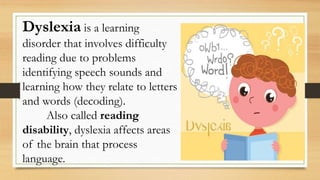
Dyslexia is a learning
disorder that involves difficulty
reading due to problems
identifying speech sounds and
learning how they relate to letters
and words (decoding).
Also called reading
disability, dyslexia affects areas
of the brain that process
language.
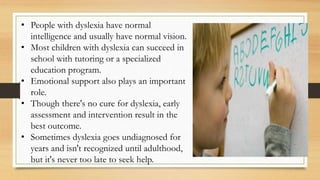
• People with dyslexia have normal
intelligence and usually have normal vision.
• Most children with dyslexia can succeed in
school with tutoring or a specialized
education program.
• Emotional support also plays an important
role.
• Though there's no cure for dyslexia, early
assessment and intervention result in the
best outcome.
• Sometimes dyslexia goes undiagnosed for
years and isn't recognized until adulthood,
but it's never too late to seek help.
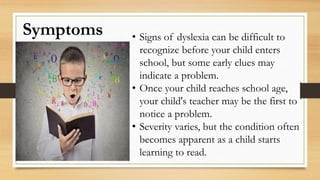
Symptoms • Signs of dyslexia can be difficult to
recognize before your child enters
school, but some early clues may
indicate a problem.
• Once your child reaches school age,
your child's teacher may be the first to
notice a problem.
• Severity varies, but the condition often
becomes apparent as a child starts
learning to read.
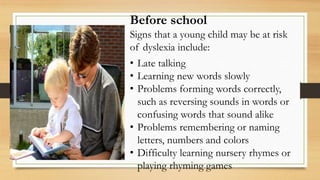
Before school
Signs that a young child may be at risk
of dyslexia include:
• Late talking
• Learning new words slowly
• Problems forming words correctly,
such as reversing sounds in words or
confusing words that sound alike
• Problems remembering or naming
letters, numbers and colors
• Difficulty learning nursery rhymes or
playing rhyming games
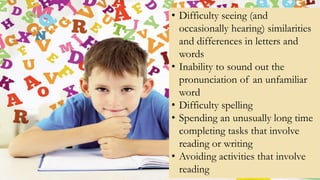
• Difficulty seeing (and
occasionally hearing) similarities
and differences in letters and
words
• Inability to sound out the
pronunciation of an unfamiliar
word
• Difficulty spelling
• Spending an unusually long time
completing tasks that involve
reading or writing
• Avoiding activities that involve
reading
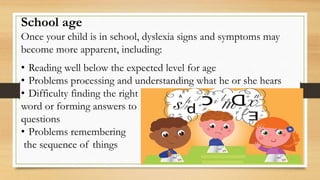
School age
Once your child is in school, dyslexia signs and symptoms may
become more apparent, including:
• Reading well below the expected level for age
• Problems processing and understanding what he or she hears
• Difficulty finding the right
word or forming answers to
questions
• Problems remembering
the sequence of things
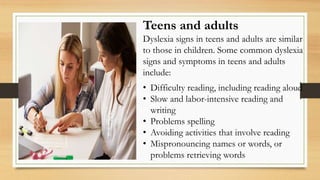
Teens and adults
Dyslexia signs in teens and adults are similar
to those in children. Some common dyslexia
signs and symptoms in teens and adults
include:
• Difficulty reading, including reading aloud
• Slow and labor-intensive reading and
writing
• Problems spelling
• Avoiding activities that involve reading
• Mispronouncing names or words, or
problems retrieving words
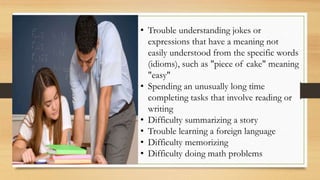
• Trouble understanding jokes or
expressions that have a meaning not
easily understood from the specific words
(idioms), such as "piece of cake" meaning
"easy"
• Spending an unusually long time
completing tasks that involve reading or
writing
• Difficulty summarizing a story
• Trouble learning a foreign language
• Difficulty memorizing
• Difficulty doing math problems
Causes
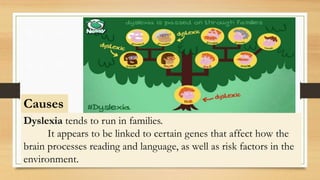
Dyslexia tends to run in families.
It appears to be linked to certain genes that affect how the
brain processes reading and language, as well as risk factors in the
environment.
Risk factors
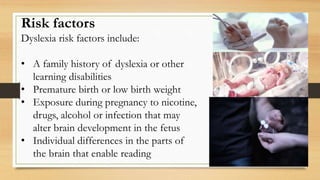
Dyslexia risk factors include:
• A family history of dyslexia or other
learning disabilities
• Premature birth or low birth weight
• Exposure during pregnancy to nicotine,
drugs, alcohol or infection that may
alter brain development in the fetus
• Individual differences in the parts of
the brain that enable reading
Complications
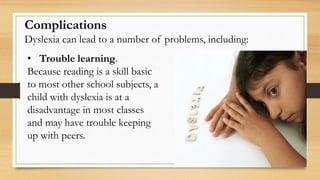
Dyslexia can lead to a number of problems, including:
• Trouble learning.
Because reading is a skill basic
to most other school subjects, a
child with dyslexia is at a
disadvantage in most classes
and may have trouble keeping
up with peers.
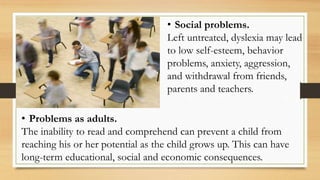
• Social problems.
Left untreated, dyslexia may lead
to low self-esteem, behavior
problems, anxiety, aggression,
and withdrawal from friends,
parents and teachers.
• Problems as adults.
The inability to read and comprehend can prevent a child from
reaching his or her potential as the child grows up. This can have
long-term educational, social and economic consequences.
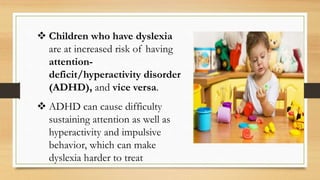
 Children who have dyslexia
are at increased risk of having
attention-
deficit/hyperactivity disorder
(ADHD), and vice versa.
 ADHD can cause difficulty
sustaining attention as well as
hyperactivity and impulsive
behavior, which can make
dyslexia harder to treat
Diagnosis
There's no single test that can diagnose dyslexia.
A number of factors are considered, such as:
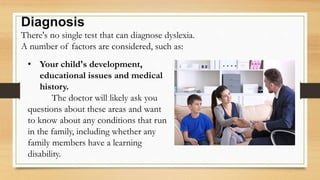
• Your child's development,
educational issues and medical
history.
The doctor will likely ask you
questions about these areas and want
to know about any conditions that run
in the family, including whether any
family members have a learning
disability.
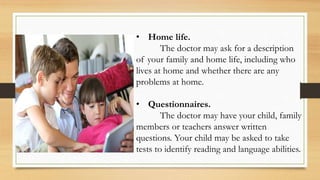
• Home life.
The doctor may ask for a description
of your family and home life, including who
lives at home and whether there are any
problems at home.
• Questionnaires.
The doctor may have your child, family
members or teachers answer written
questions. Your child may be asked to take
tests to identify reading and language abilities.
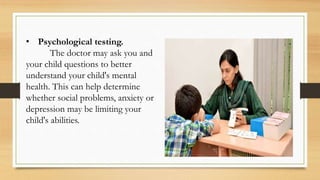
• Psychological testing.
The doctor may ask you and
your child questions to better
understand your child's mental
health. This can help determine
whether social problems, anxiety or
depression may be limiting your
child's abilities.
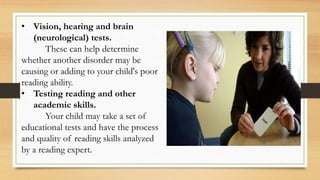
• Vision, hearing and brain
(neurological) tests.
These can help determine
whether another disorder may be
causing or adding to your child's poor
reading ability.
• Testing reading and other
academic skills.
Your child may take a set of
educational tests and have the process
and quality of reading skills analyzed
by a reading expert.
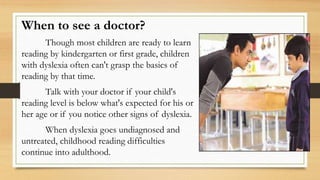
When to see a doctor?
Though most children are ready to learn
reading by kindergarten or first grade, children
with dyslexia often can't grasp the basics of
reading by that time.
Talk with your doctor if your child's
reading level is below what's expected for his or
her age or if you notice other signs of dyslexia.
When dyslexia goes undiagnosed and
untreated, childhood reading difficulties
continue into adulthood.
 There's no known way to correct the underlying brain
abnormality that causes dyslexia — dyslexia is a lifelong
problem.
 However, early detection and evaluation to determine
specific needs and appropriate treatment can improve
success.
Treatment
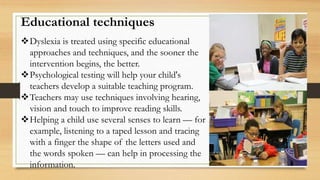
Educational techniques
Dyslexia is treated using specific educational
approaches and techniques, and the sooner the
intervention begins, the better.
Psychological testing will help your child's
teachers develop a suitable teaching program.
Teachers may use techniques involving hearing,
vision and touch to improve reading skills.
Helping a child use several senses to learn — for
example, listening to a taped lesson and tracing
with a finger the shape of the letters used and
the words spoken — can help in processing the
information.
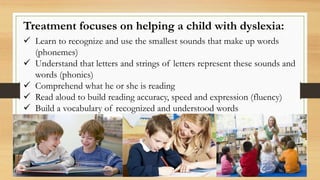
Treatment focuses on helping a child with dyslexia:
 Learn to recognize and use the smallest sounds that make up words
(phonemes)
 Understand that letters and strings of letters represent these sounds and
words (phonics)
 Comprehend what he or she is reading
 Read aloud to build reading accuracy, speed and expression (fluency)
 Build a vocabulary of recognized and understood words
To the Parents for Coping
and support
Emotional support and opportunities
for achievement in activities that don't
involve reading are important for
children with dyslexia.
If your child has dyslexia:
o Be supportive
o Talk to your child. Explain to your
child what dyslexia is and that it's not
a personal failure.
o Take steps to help your child learn
at home
o Limit screen time. Limit electronic
screen time each day and use the
extra time for reading practice.
o Stay in contact with your child's
teachers
o Join a support group
Sources: https://www.mayoclinic.org/diseases-conditions/dyslexia/symptoms-causes/syc-20353552
https://www.mayoclinic.org/diseases-conditions/dyslexia/diagnosis-treatment/drc-20353557

Dyslexia

  • 2.
    Dyslexia is alearning disorder that involves difficulty reading due to problems identifying speech sounds and learning how they relate to letters and words (decoding). Also called reading disability, dyslexia affects areas of the brain that process language.
  • 3.
    • People withdyslexia have normal intelligence and usually have normal vision. • Most children with dyslexia can succeed in school with tutoring or a specialized education program. • Emotional support also plays an important role. • Though there's no cure for dyslexia, early assessment and intervention result in the best outcome. • Sometimes dyslexia goes undiagnosed for years and isn't recognized until adulthood, but it's never too late to seek help.
  • 4.
    Symptoms • Signsof dyslexia can be difficult to recognize before your child enters school, but some early clues may indicate a problem. • Once your child reaches school age, your child's teacher may be the first to notice a problem. • Severity varies, but the condition often becomes apparent as a child starts learning to read.
  • 5.
    Before school Signs thata young child may be at risk of dyslexia include: • Late talking • Learning new words slowly • Problems forming words correctly, such as reversing sounds in words or confusing words that sound alike • Problems remembering or naming letters, numbers and colors • Difficulty learning nursery rhymes or playing rhyming games
  • 6.
    • Difficulty seeing(and occasionally hearing) similarities and differences in letters and words • Inability to sound out the pronunciation of an unfamiliar word • Difficulty spelling • Spending an unusually long time completing tasks that involve reading or writing • Avoiding activities that involve reading
  • 7.
    School age Once yourchild is in school, dyslexia signs and symptoms may become more apparent, including: • Reading well below the expected level for age • Problems processing and understanding what he or she hears • Difficulty finding the right word or forming answers to questions • Problems remembering the sequence of things
  • 8.
    Teens and adults Dyslexiasigns in teens and adults are similar to those in children. Some common dyslexia signs and symptoms in teens and adults include: • Difficulty reading, including reading aloud • Slow and labor-intensive reading and writing • Problems spelling • Avoiding activities that involve reading • Mispronouncing names or words, or problems retrieving words
  • 9.
    • Trouble understandingjokes or expressions that have a meaning not easily understood from the specific words (idioms), such as "piece of cake" meaning "easy" • Spending an unusually long time completing tasks that involve reading or writing • Difficulty summarizing a story • Trouble learning a foreign language • Difficulty memorizing • Difficulty doing math problems
  • 10.
    Causes Dyslexia tends torun in families. It appears to be linked to certain genes that affect how the brain processes reading and language, as well as risk factors in the environment.
  • 11.
    Risk factors Dyslexia riskfactors include: • A family history of dyslexia or other learning disabilities • Premature birth or low birth weight • Exposure during pregnancy to nicotine, drugs, alcohol or infection that may alter brain development in the fetus • Individual differences in the parts of the brain that enable reading
  • 12.
    Complications Dyslexia can leadto a number of problems, including: • Trouble learning. Because reading is a skill basic to most other school subjects, a child with dyslexia is at a disadvantage in most classes and may have trouble keeping up with peers.
  • 13.
    • Social problems. Leftuntreated, dyslexia may lead to low self-esteem, behavior problems, anxiety, aggression, and withdrawal from friends, parents and teachers. • Problems as adults. The inability to read and comprehend can prevent a child from reaching his or her potential as the child grows up. This can have long-term educational, social and economic consequences.
  • 14.
     Children whohave dyslexia are at increased risk of having attention- deficit/hyperactivity disorder (ADHD), and vice versa.  ADHD can cause difficulty sustaining attention as well as hyperactivity and impulsive behavior, which can make dyslexia harder to treat
  • 15.
    Diagnosis There's no singletest that can diagnose dyslexia. A number of factors are considered, such as: • Your child's development, educational issues and medical history. The doctor will likely ask you questions about these areas and want to know about any conditions that run in the family, including whether any family members have a learning disability.
  • 16.
    • Home life. Thedoctor may ask for a description of your family and home life, including who lives at home and whether there are any problems at home. • Questionnaires. The doctor may have your child, family members or teachers answer written questions. Your child may be asked to take tests to identify reading and language abilities.
  • 17.
    • Psychological testing. Thedoctor may ask you and your child questions to better understand your child's mental health. This can help determine whether social problems, anxiety or depression may be limiting your child's abilities.
  • 18.
    • Vision, hearingand brain (neurological) tests. These can help determine whether another disorder may be causing or adding to your child's poor reading ability. • Testing reading and other academic skills. Your child may take a set of educational tests and have the process and quality of reading skills analyzed by a reading expert.
  • 20.
    When to seea doctor? Though most children are ready to learn reading by kindergarten or first grade, children with dyslexia often can't grasp the basics of reading by that time. Talk with your doctor if your child's reading level is below what's expected for his or her age or if you notice other signs of dyslexia. When dyslexia goes undiagnosed and untreated, childhood reading difficulties continue into adulthood.
  • 21.
     There's noknown way to correct the underlying brain abnormality that causes dyslexia — dyslexia is a lifelong problem.  However, early detection and evaluation to determine specific needs and appropriate treatment can improve success. Treatment
  • 22.
    Educational techniques Dyslexia istreated using specific educational approaches and techniques, and the sooner the intervention begins, the better. Psychological testing will help your child's teachers develop a suitable teaching program. Teachers may use techniques involving hearing, vision and touch to improve reading skills. Helping a child use several senses to learn — for example, listening to a taped lesson and tracing with a finger the shape of the letters used and the words spoken — can help in processing the information.
  • 23.
    Treatment focuses onhelping a child with dyslexia:  Learn to recognize and use the smallest sounds that make up words (phonemes)  Understand that letters and strings of letters represent these sounds and words (phonics)  Comprehend what he or she is reading  Read aloud to build reading accuracy, speed and expression (fluency)  Build a vocabulary of recognized and understood words
  • 24.
    To the Parentsfor Coping and support Emotional support and opportunities for achievement in activities that don't involve reading are important for children with dyslexia.
  • 25.
    If your childhas dyslexia: o Be supportive o Talk to your child. Explain to your child what dyslexia is and that it's not a personal failure. o Take steps to help your child learn at home o Limit screen time. Limit electronic screen time each day and use the extra time for reading practice. o Stay in contact with your child's teachers o Join a support group Sources: https://www.mayoclinic.org/diseases-conditions/dyslexia/symptoms-causes/syc-20353552 https://www.mayoclinic.org/diseases-conditions/dyslexia/diagnosis-treatment/drc-20353557