Learning
Disability
-Neha Farheen Mushtaq
LEARNING DISABILITIES
I. Introduction and Definition
II. Prevalence
III. Characteristics of Students with
LD
IV. Teaching Strategies for Students
with LD
I. Introduction to LD
• The term learning disability was only founded in 1963
by Samuel Kirk. At that time, children with LD were
referred to by such terms as:
• “perceptually handicapped,”
• “brain-injured,” and
• “neurologically impaired”
Definition of a Learning
Disability
(1) A disorder in the processing of information
involved in understanding and using language
(spoken or written)
(2) Difficulties in learning, particularly reading,
writing, mathematics, and/or spelling
(3) Special educational services needed to
succeed in school
1. Disorder in the
Processing of Information
• First, having a learning disability means that the
brain "processes" information differently than
most other students.
• Simply stated, certain kinds of information get
stuck or lost while traveling through the brain of
the student with LD.
1. Disorder in the
Processing of Information
Information processing refers to how your
brain:
• Takes in information,
• Uses information,
• Stores the information in memory,
• Retrieves the information from memory,
• and Expresses the information
1. Disorder in the
Processing of Information
• Students with LD struggle with certain
kinds of learning because their brains have
difficulty "processing" certain kinds of
information.
• It is like when you go on a car trip and get
stuck in road construction and need to
take a detour. It takes you a lot longer to
get where you are going. Its the same with
information going through the brain of a
student with LD.
1. Disorder in the
Processing of Information
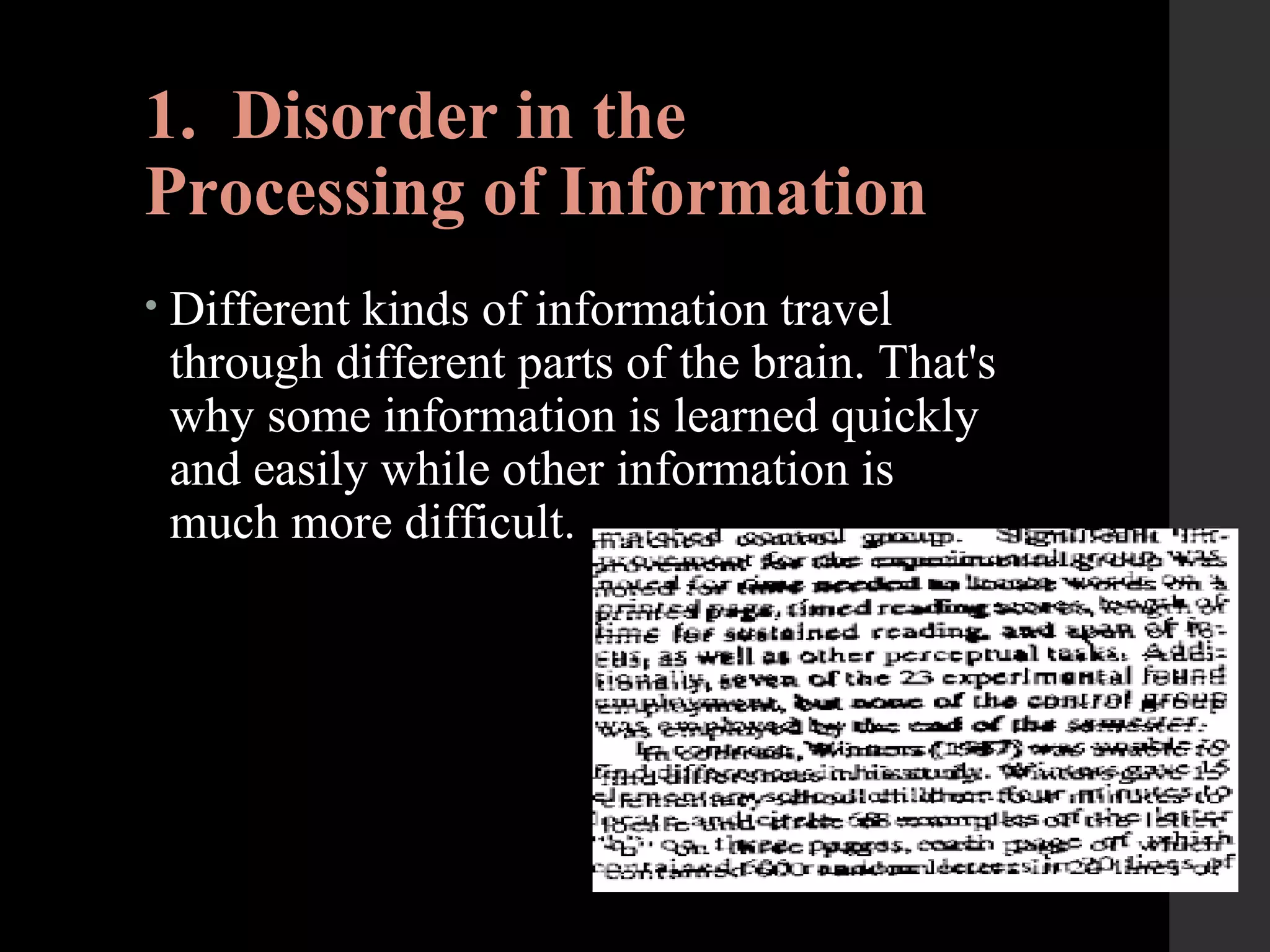
• Different kinds of information travel
through different parts of the brain. That's
why some information is learned quickly
and easily while other information is
much more difficult.
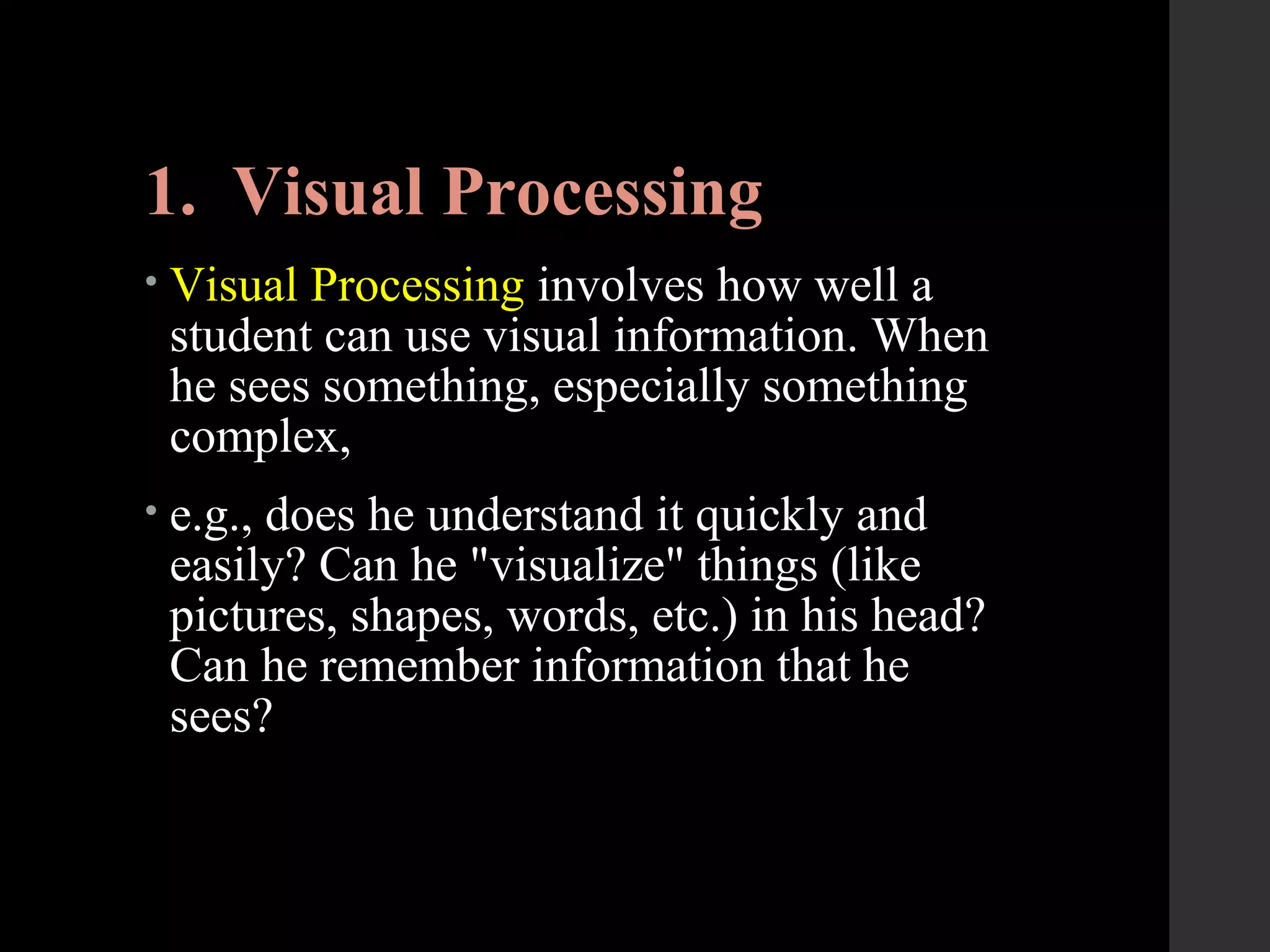
1. Visual Processing
• Visual Processing involves how well a
student can use visual information. When
he sees something, especially something
complex,
• e.g., does he understand it quickly and
easily? Can he "visualize" things (like
pictures, shapes, words, etc.) in his head?
Can he remember information that he
sees?
 
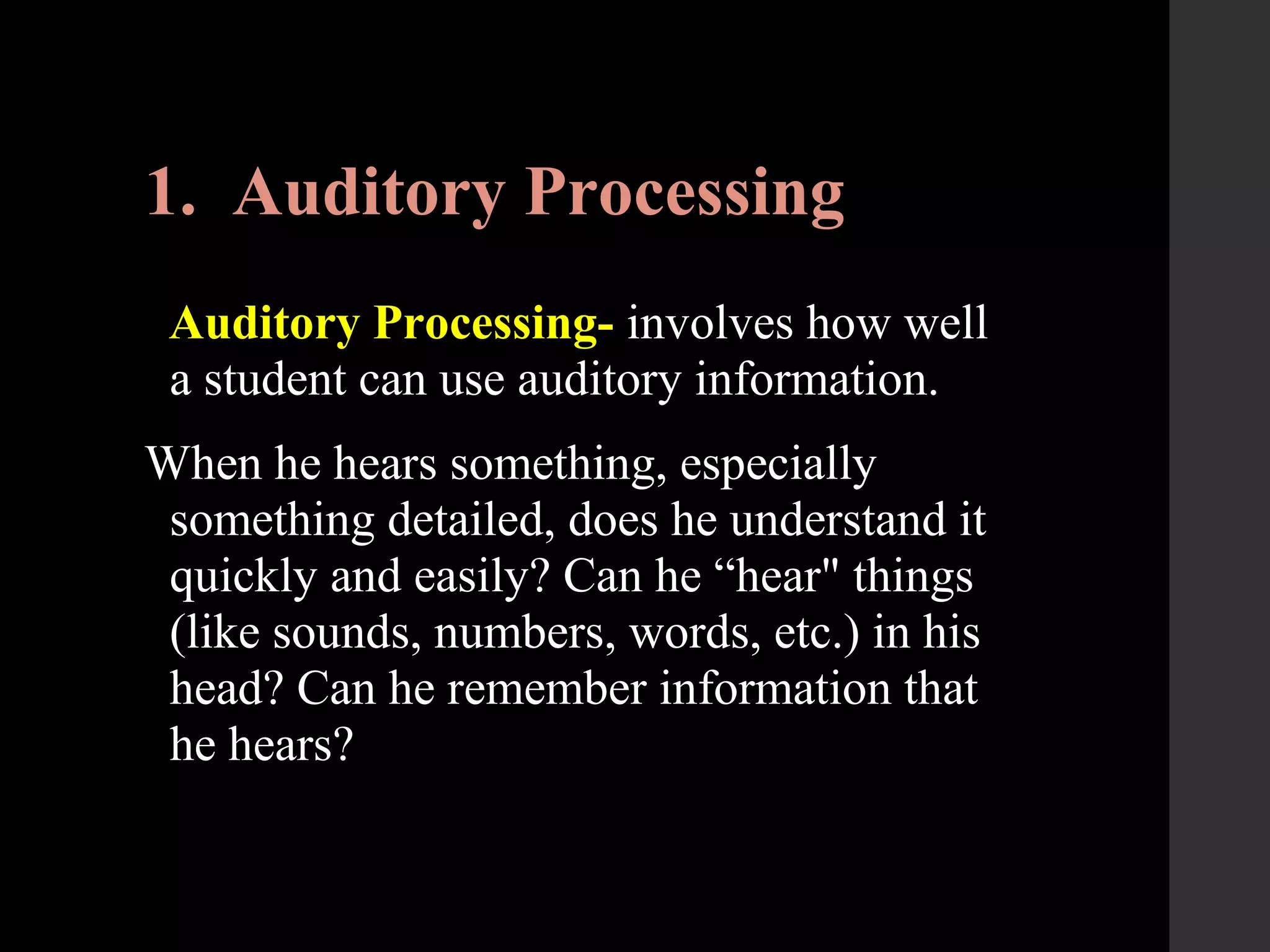
1. Auditory Processing
Auditory Processing- involves how well
a student can use auditory information.
When he hears something, especially
something detailed, does he understand it
quickly and easily? Can he “hear" things
(like sounds, numbers, words, etc.) in his
head? Can he remember information that
he hears?
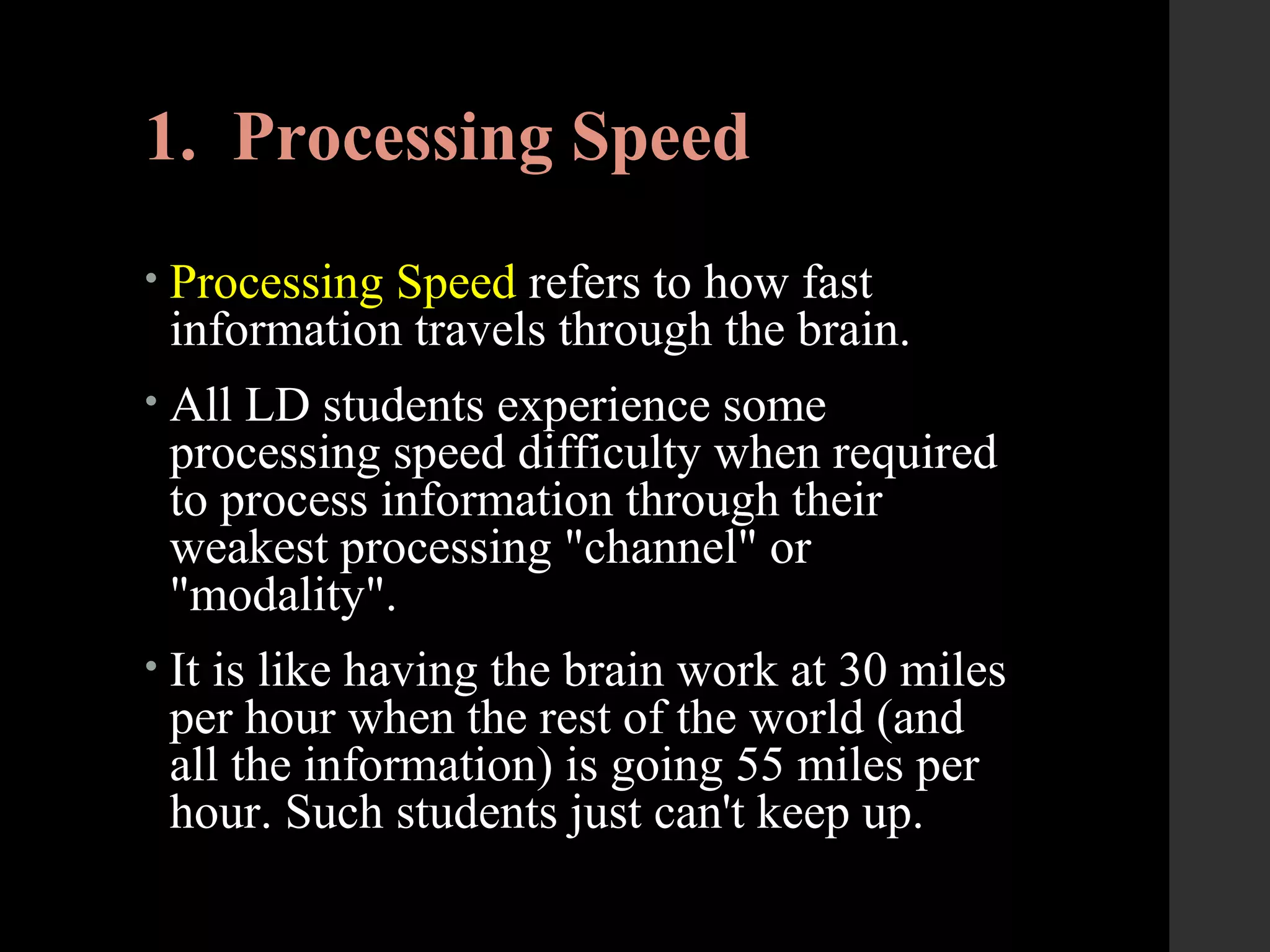
1. Processing Speed
• Processing Speed refers to how fast
information travels through the brain.
• All LD students experience some
processing speed difficulty when required
to process information through their
weakest processing "channel" or
"modality".
• It is like having the brain work at 30 miles
per hour when the rest of the world (and
all the information) is going 55 miles per
hour. Such students just can't keep up.
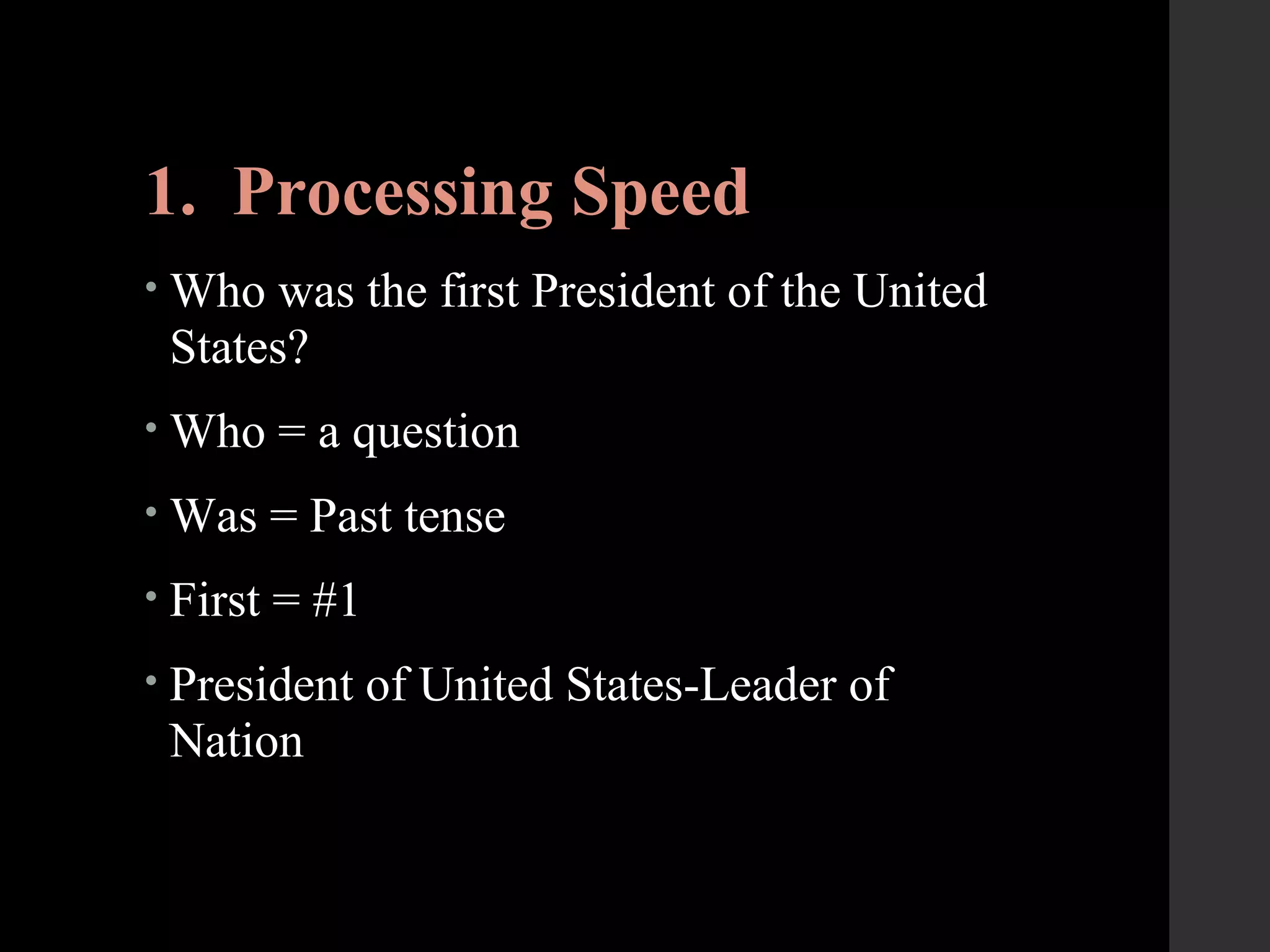
1. Processing Speed
• Who was the first President of the United
States?
• Who = a question
• Was = Past tense
• First = #1
• President of United States-Leader of
Nation
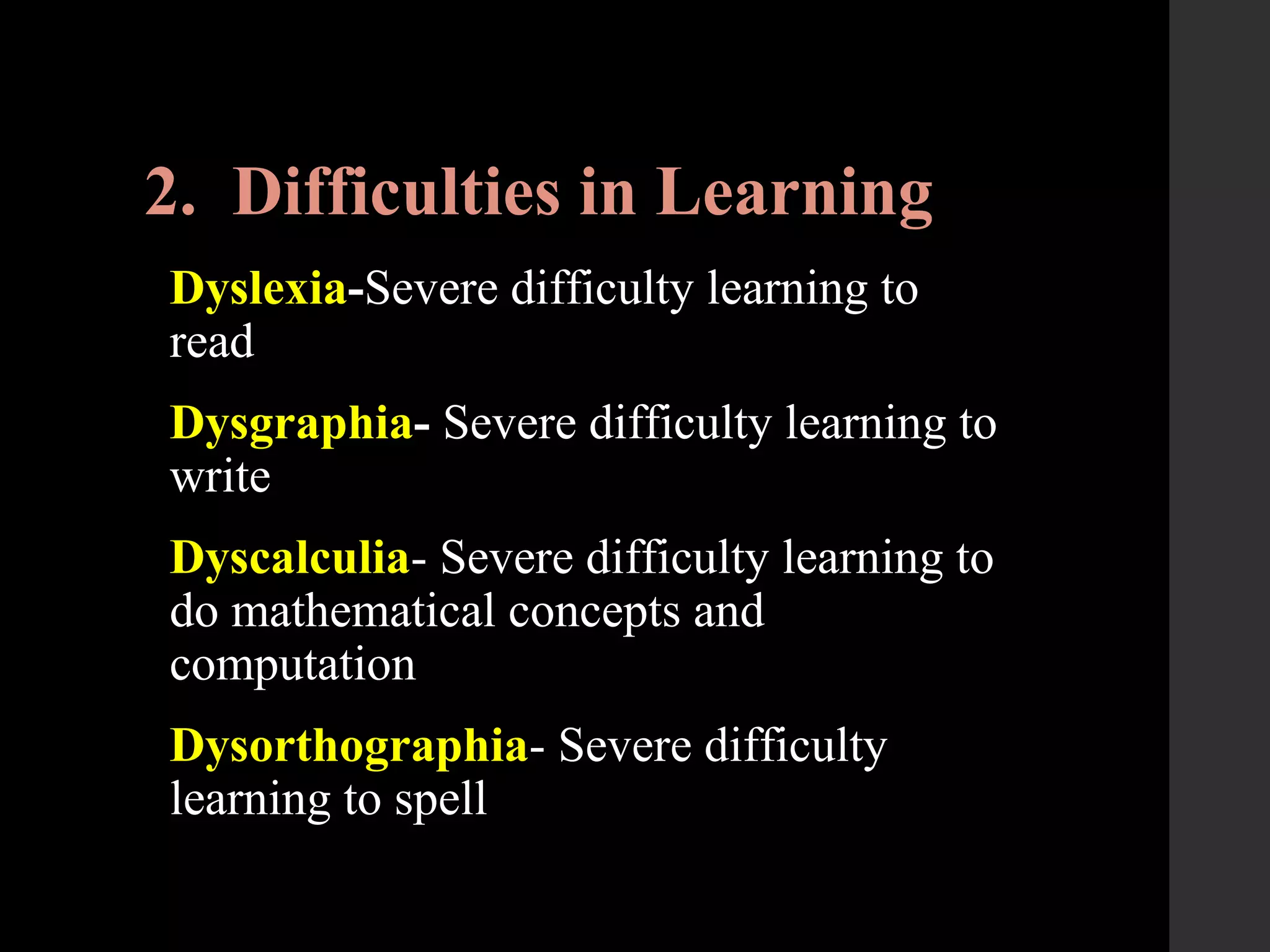
2. Difficulties in Learning
Dyslexia-Severe difficulty learning to
read
Dysgraphia- Severe difficulty learning to
write
Dyscalculia- Severe difficulty learning to
do mathematical concepts and
computation
Dysorthographia- Severe difficulty
learning to spell
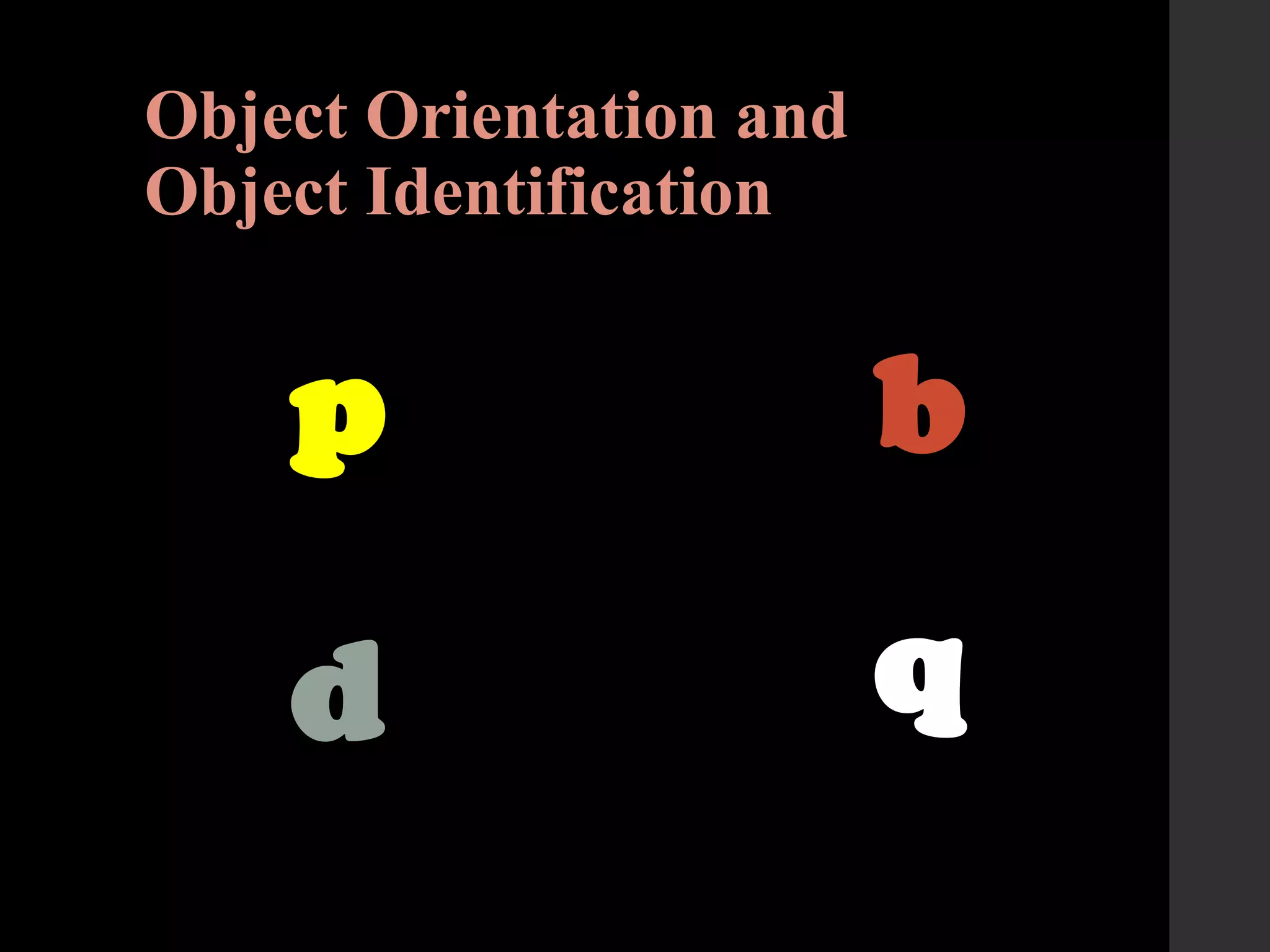
Object Orientation and
Object Identification
p
d
b
q
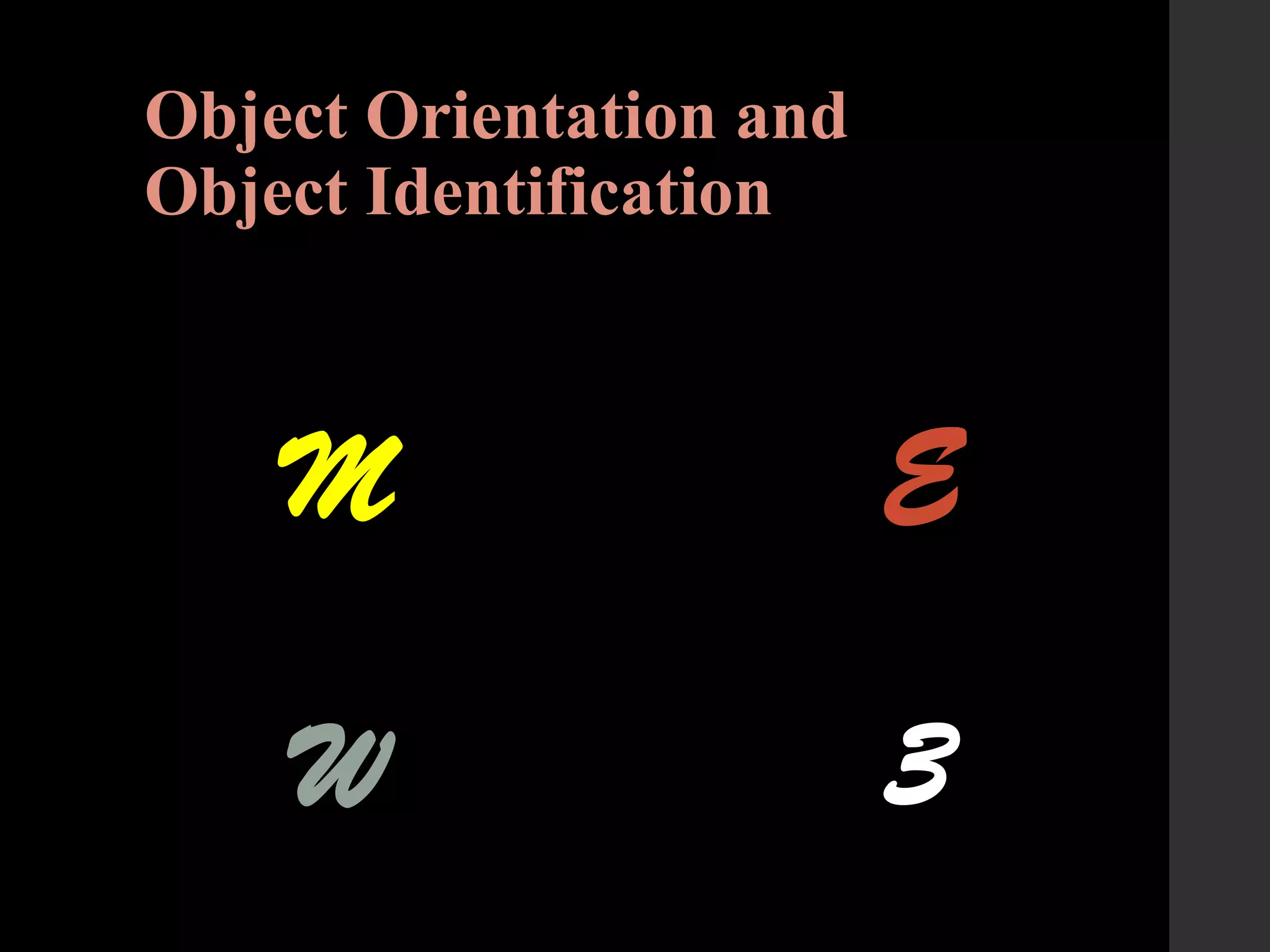
Object Orientation and
Object Identification
M
W
E
3
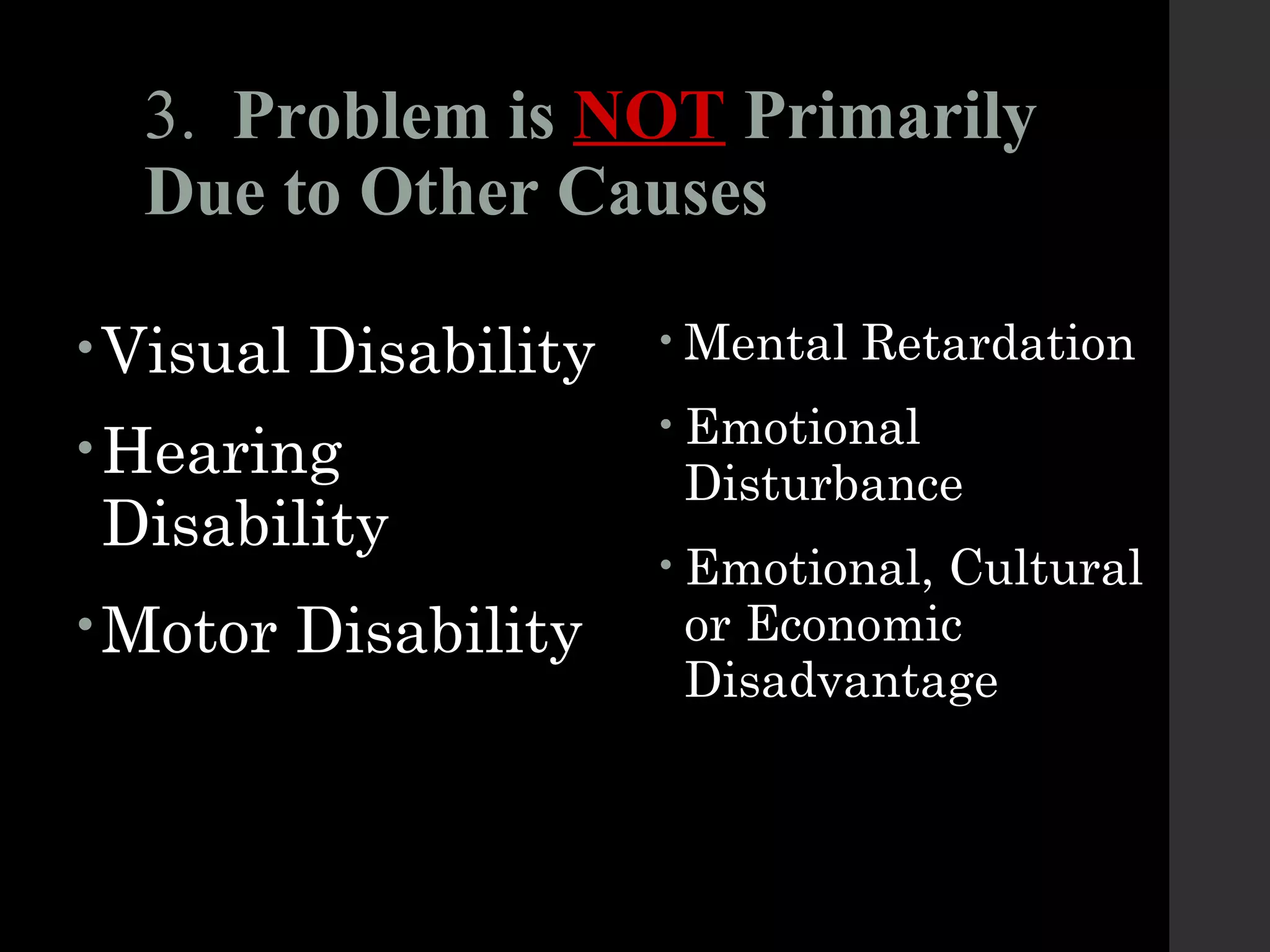
3. Problem is NOT Primarily
Due to Other Causes
•Visual Disability
•Hearing
Disability
•Motor Disability
• Mental Retardation
• Emotional
Disturbance
• Emotional, Cultural
or Economic
Disadvantage
4. Special Educational Services Needed
to Succeed in School
It is possible for a student to
"technically" have a disability but not
to "qualify" for special education
services.
This happens when a student
demonstrates the information
processing difficulties associated with
a LD but his or her academic skills are
not found to be "severely discrepant"
from their ability. This may indicate
that the student has learned how to
"cope" with his/her learning difficulties
at least to some extent.
II. Prevalence
• Almost 3 million children (ages 6 through
21) have some form of a learning
disability and receive special education in
school.
• LD form the largest category in special
education.
II. Prevalence
• In fact, approximately 50% of all
children who receive special
education have a learning disability
• 3:1 ratio males to females
III. Characteristics
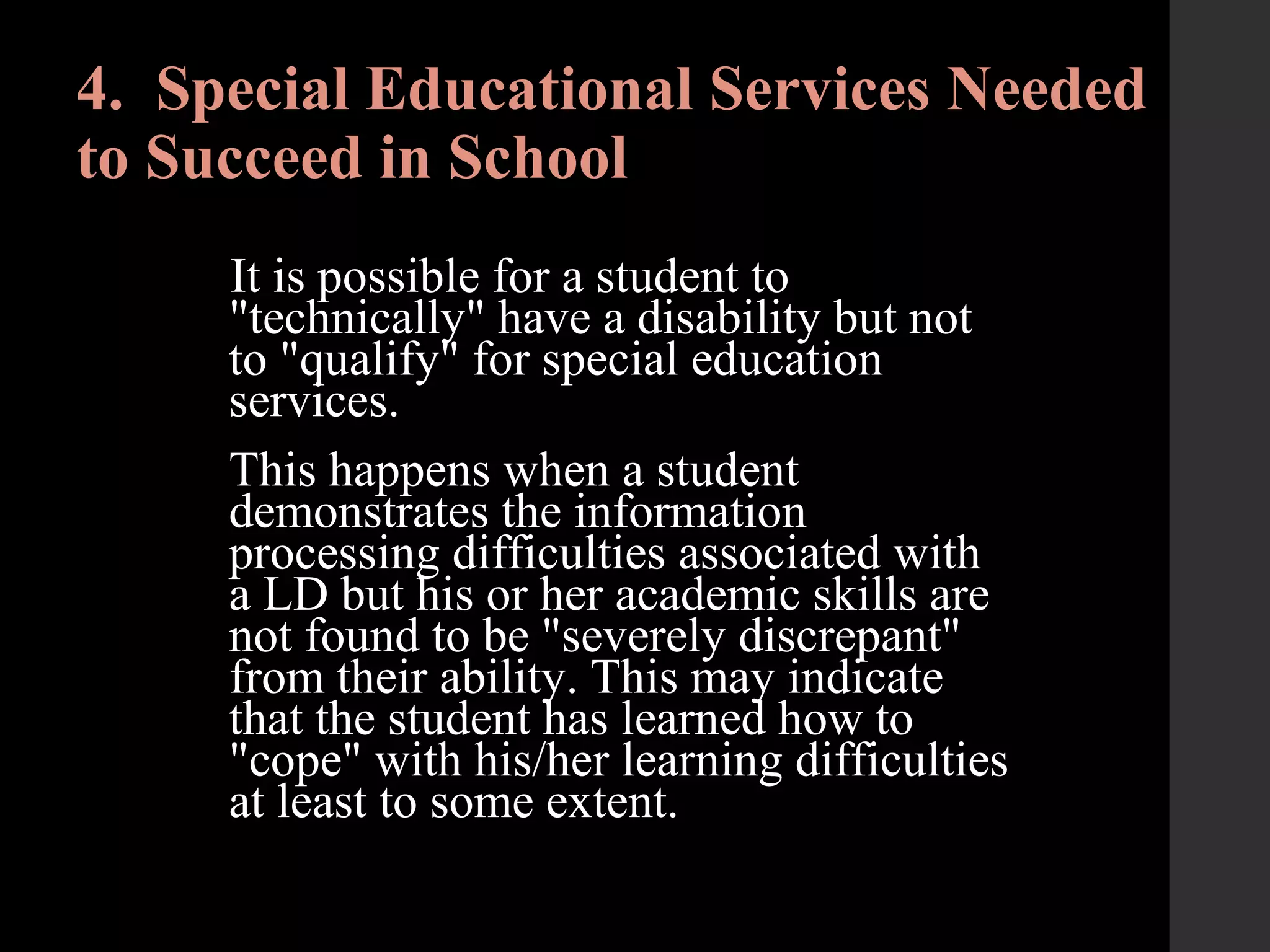
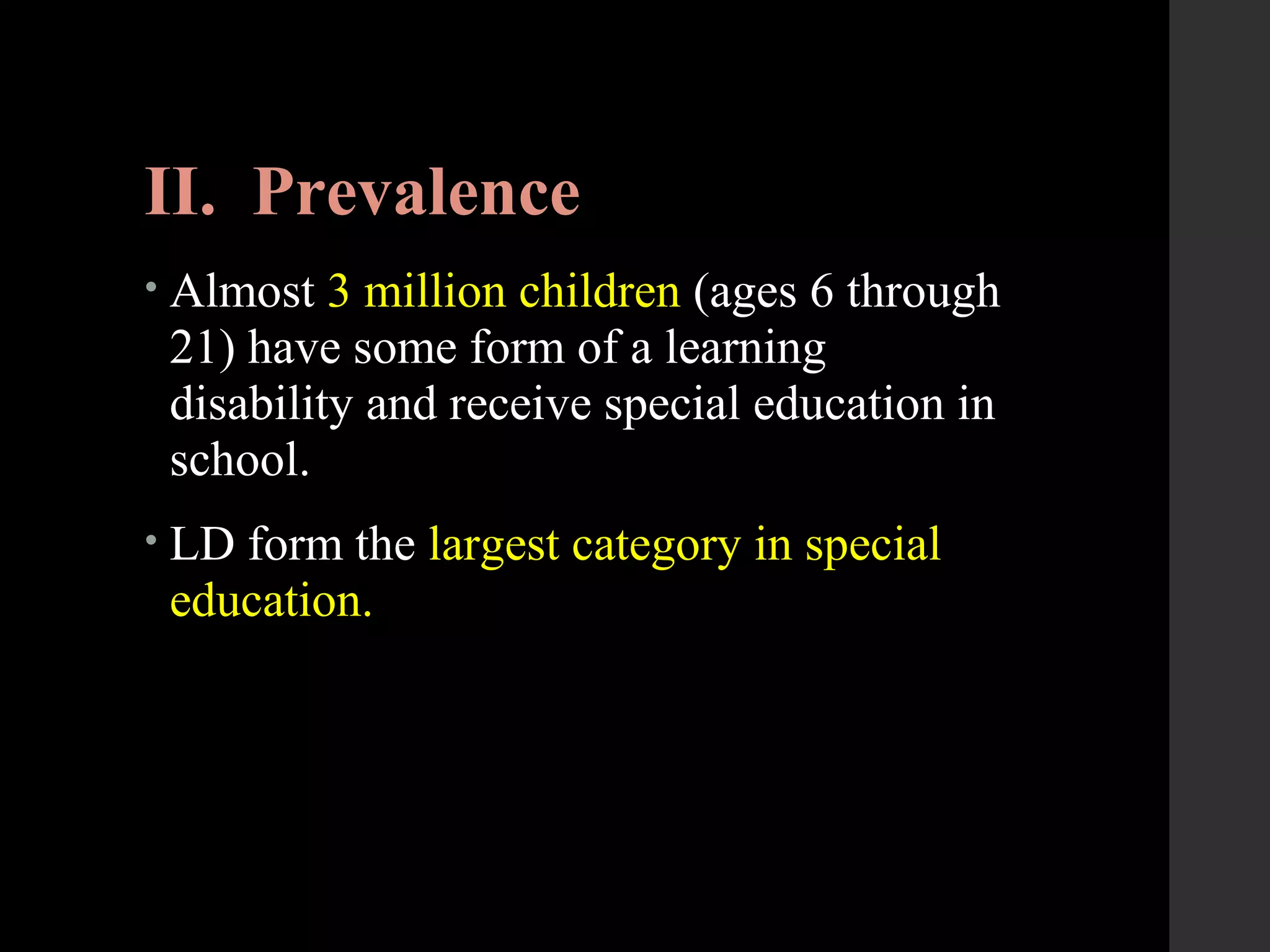
• may have trouble
learning the alphabet,
or connecting letters
to their sounds;
• may make many
mistakes when
reading aloud, and
repeat and pause
often;
• may not understand
what he or she reads;
• may have real trouble
with spelling;
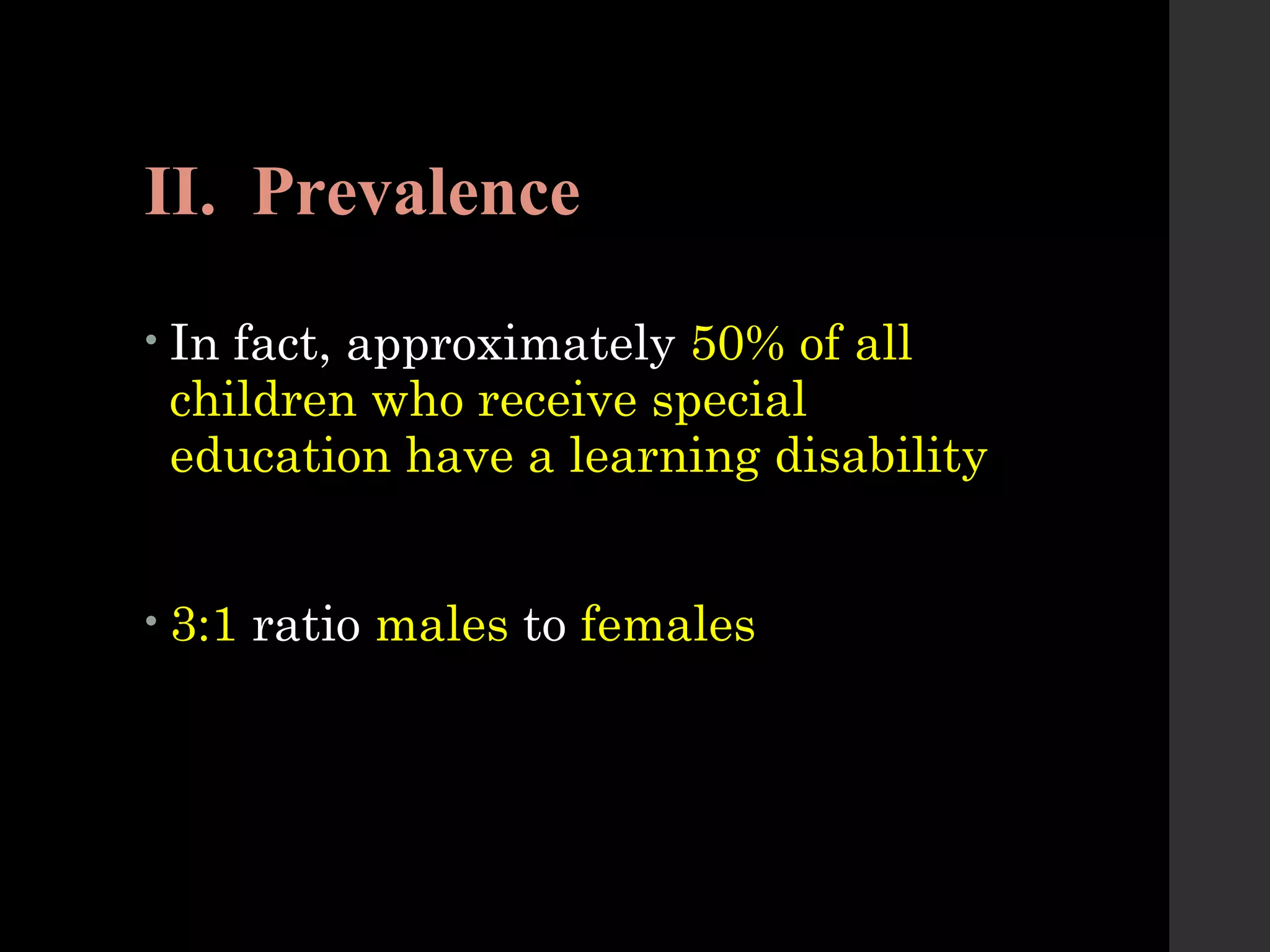
• may confuse math
symbols and misread
numbers;
III. Characteristics
• may have very messy
handwriting or hold a pencil
awkwardly;
• may struggle to express ideas
in writing;
• may learn language late and
have a limited vocabulary;
• may not follow the social
rules of conversation, such
as taking turns, and may
stand too close to the
listener;
III. Characteristics
• may have trouble
remembering the sounds that
letters make or hearing slight
differences between words;
• may have trouble following
directions;
• may not be able to retell a
story in order (what happened
first, second, third)
• may mispronounce words or
use a wrong word that sounds
similar;
• may have trouble organizing
what he or she wants to say
or not be able to think of the
word he or she needs for
writing or conversation;
IV. Teaching Strategies
• Provide high structure and clear
expectations. Children who are LD
tend to have difficulty focusing, getting
started and setting priorities. Creating a
clear structured program allows the
student to be exposed to fewer
distractions and possible avoidance and
allow for greater focus on work related
tasks.
IV. Teaching Strategies
• Learning materials should easily accessible,
well organized and stored in the same place
each day. The less the LD student has to
worry about, comprehend or remember, the
greater chance for success. Too many details
can easily overwhelm this type of student.
IV. Teaching Strategies
• All assignments should be presented on the
blackboard as well as orally presented. This
multilevel sensory approach will only
enhance the chances of the child being able to
bring home the correct assignment. This will
also cut down on parent child frustration
which often occurs when the child with
learning disabilities brings home part of the
assignment or and assumption of what needs
to be done due to a lack of ability in copying
quickly.
IV. Teaching Strategies
• Make sure that the child's desk is free
from all unnecessary materials.
Children with learning disabilities tend
to have organizational problems as
well. The less chaos, the better the
focus. Use small binders that hold
fewer papers. Keep the desk free of
most materials. Otherwise he may be
embarrassed to get up to go to the pail
and stuff it in his desk.
IV. Teaching Strategies
• Correct the student's work as soon as
possible to allow for immediate
gratification and feedback. Students
with learning disabilities do not often
have foundations of success when it
comes to schoolwork. Therefore, when
they hand in work they begin to worry
about how they did. If they do not
receive it back quickly, some children
may use a great deal of energy
worrying about the reactions of others
if they did not do well.
IV. Teaching Strategies
• Try to separate him from students who
may be distracting. Some children with
learning disabilities are very
distractible, while others may use any
external situation to avoid a potential
failure situation. Sitting a child with
learning disabilities next to students
who are self-motivated and internally
controlled will provide extra structure
and controls.
IV. Teaching Strategies
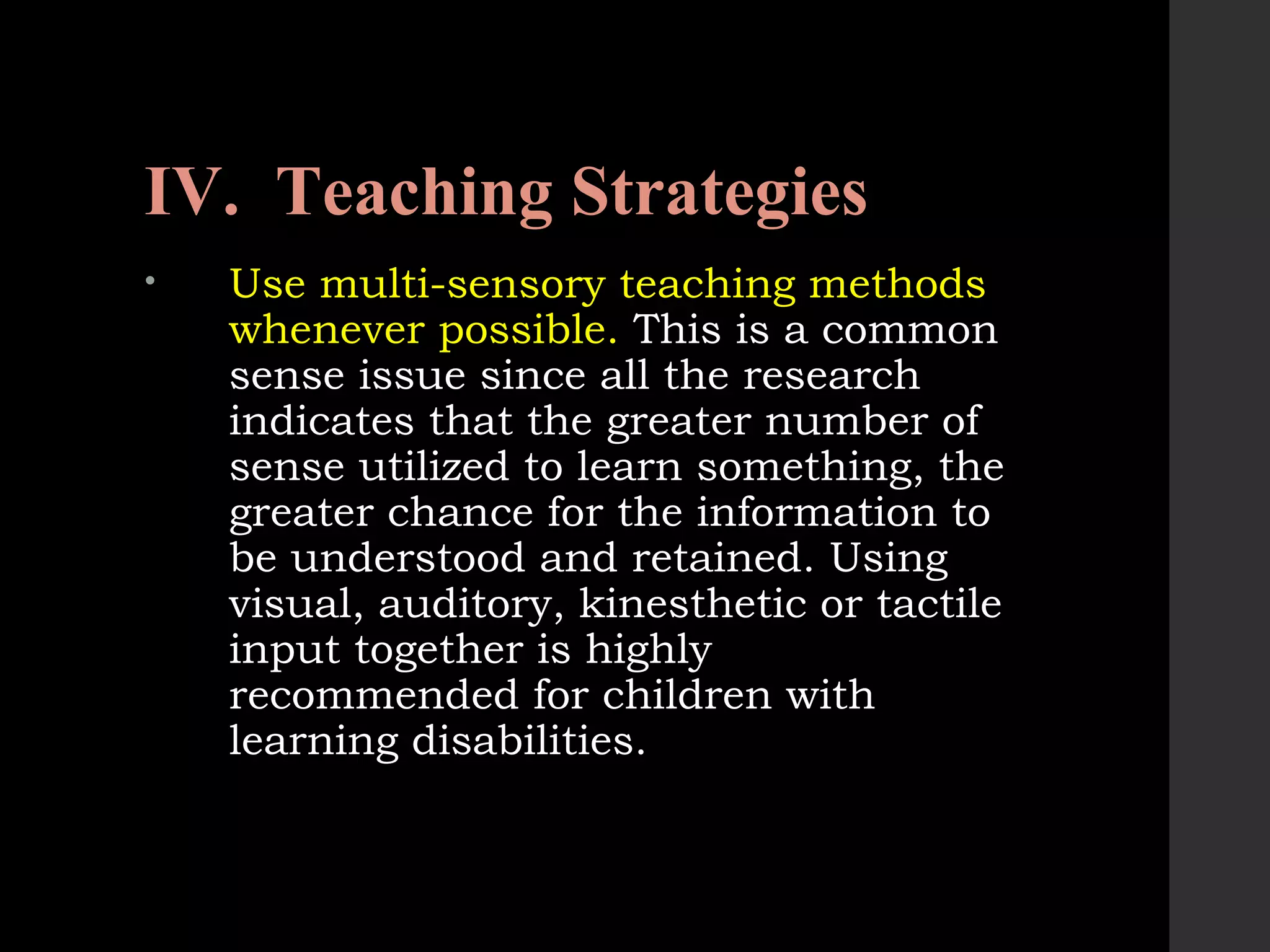
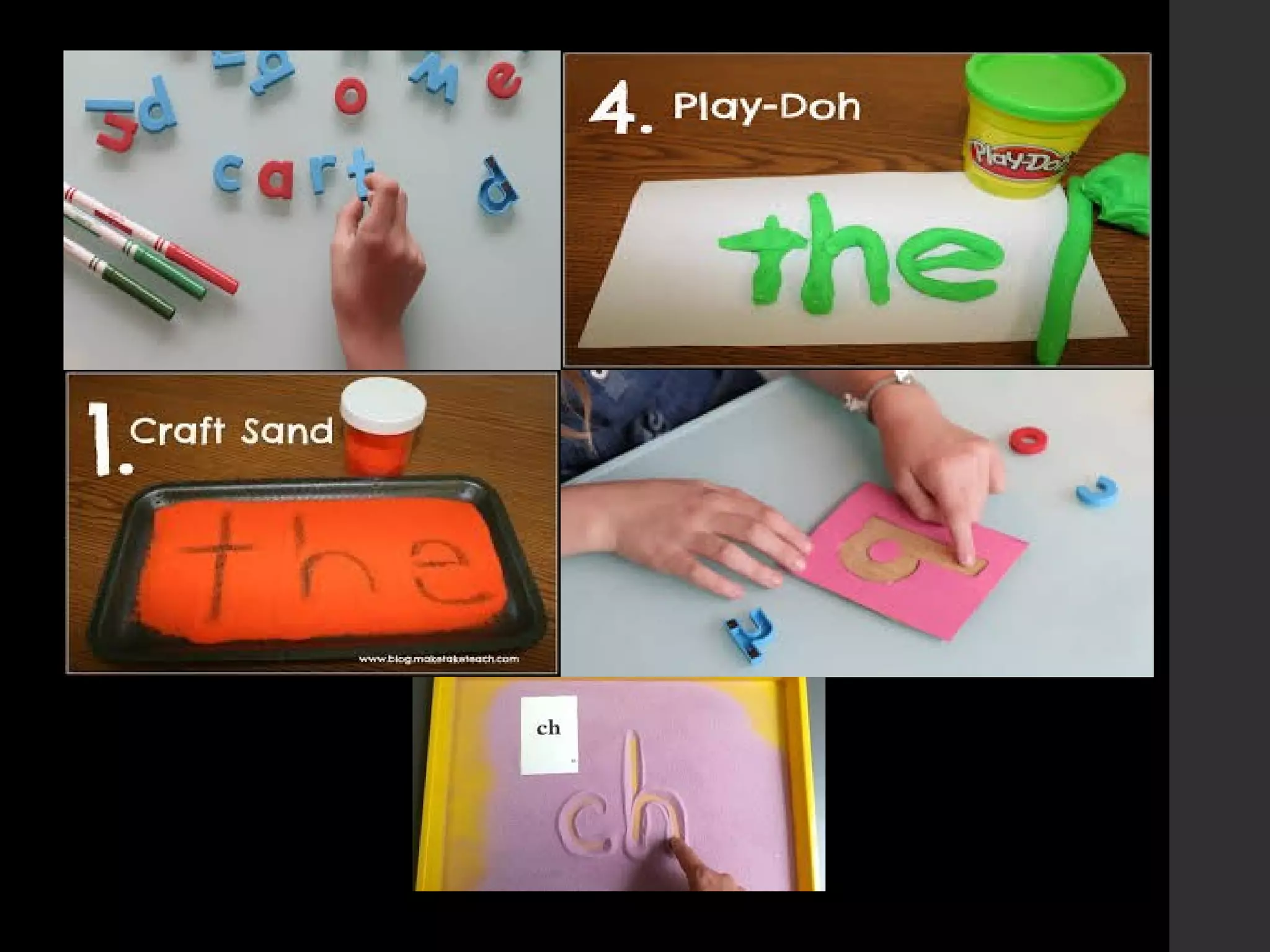
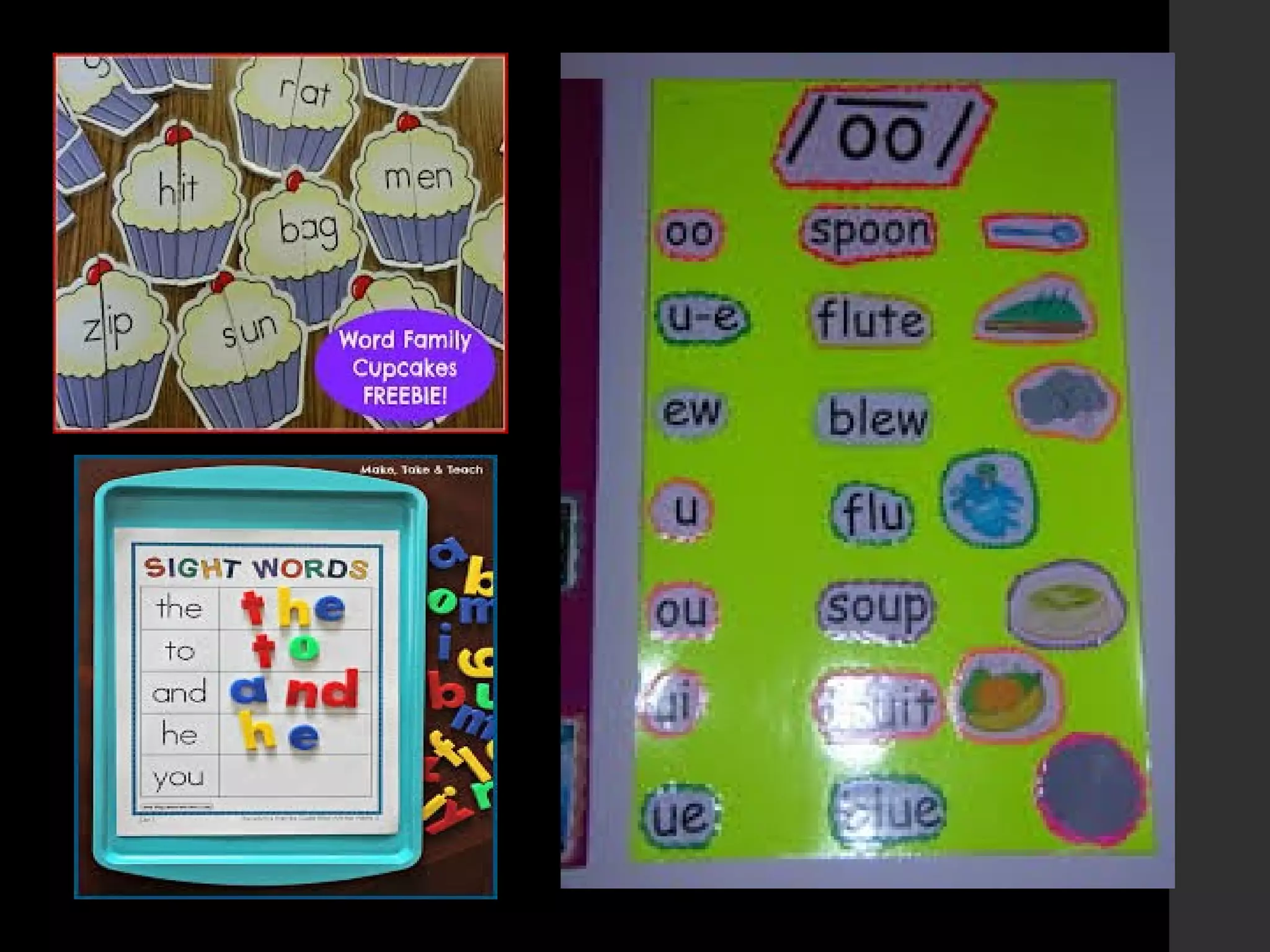
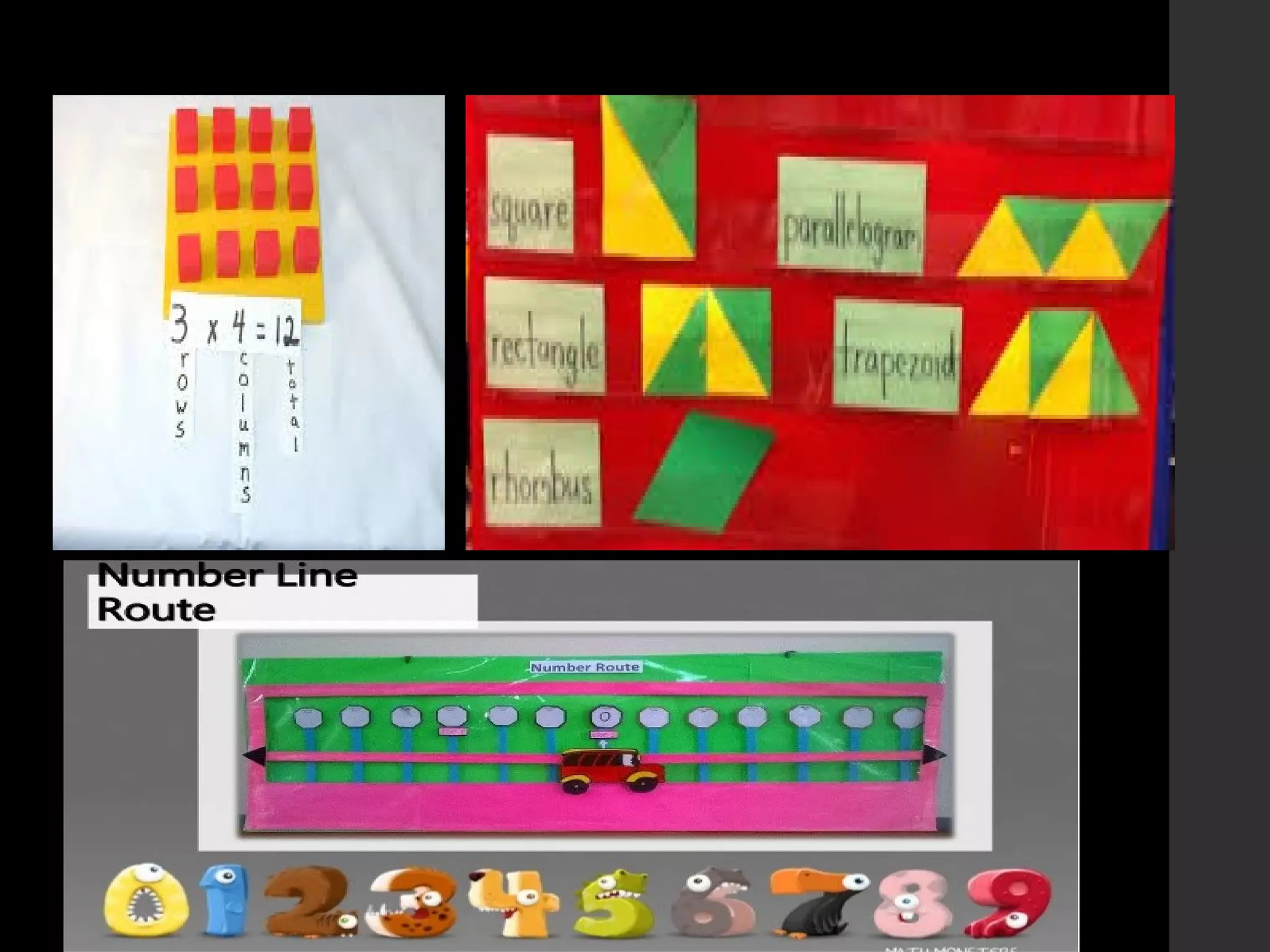
• Use multi-sensory teaching methods
whenever possible. This is a common
sense issue since all the research
indicates that the greater number of
sense utilized to learn something, the
greater chance for the information to
be understood and retained. Using
visual, auditory, kinesthetic or tactile
input together is highly
recommended for children with
learning disabilities.
IV. Teaching Strategies
• Respond to the child’s comments
praising whenever possible. Many
children with learning disabilities
tend to have secondary emotional
issues as a result of frustration and
lower sense of self worth due to
academic failure and stress.
Consequently, when he responds or
initiates conversation, praise for the
initiation of communication should
be praised.
IV. Teaching Strategies
• Give constant feedback. Many
children with learning disabilities
tend to write negative scripts about
their ability and their performance.
Feedback in any form reduces this
negative energy pattern and offers
reality, the only thing that breaks
down fear.
SUCCESSFUL AND
FAMOUS PEOPLE
WHO HAD DYSLEXIA
.
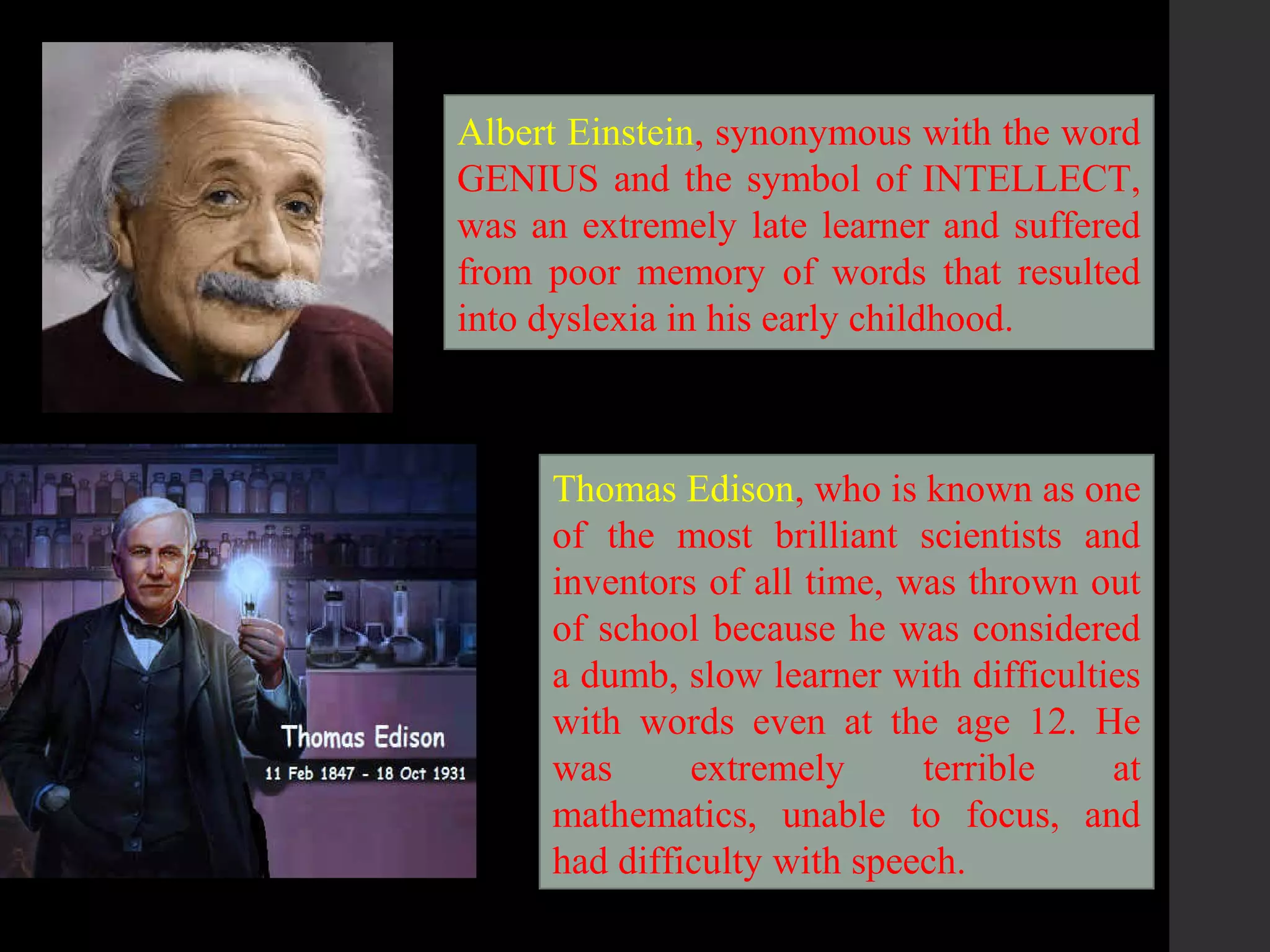
Albert Einstein, synonymous with the word
GENIUS and the symbol of INTELLECT,
was an extremely late learner and suffered
from poor memory of words that resulted
into dyslexia in his early childhood.
Thomas Edison, who is known as one
of the most brilliant scientists and
inventors of all time, was thrown out
of school because he was considered
a dumb, slow learner with difficulties
with words even at the age 12. He
was extremely terrible at
mathematics, unable to focus, and
had difficulty with speech.
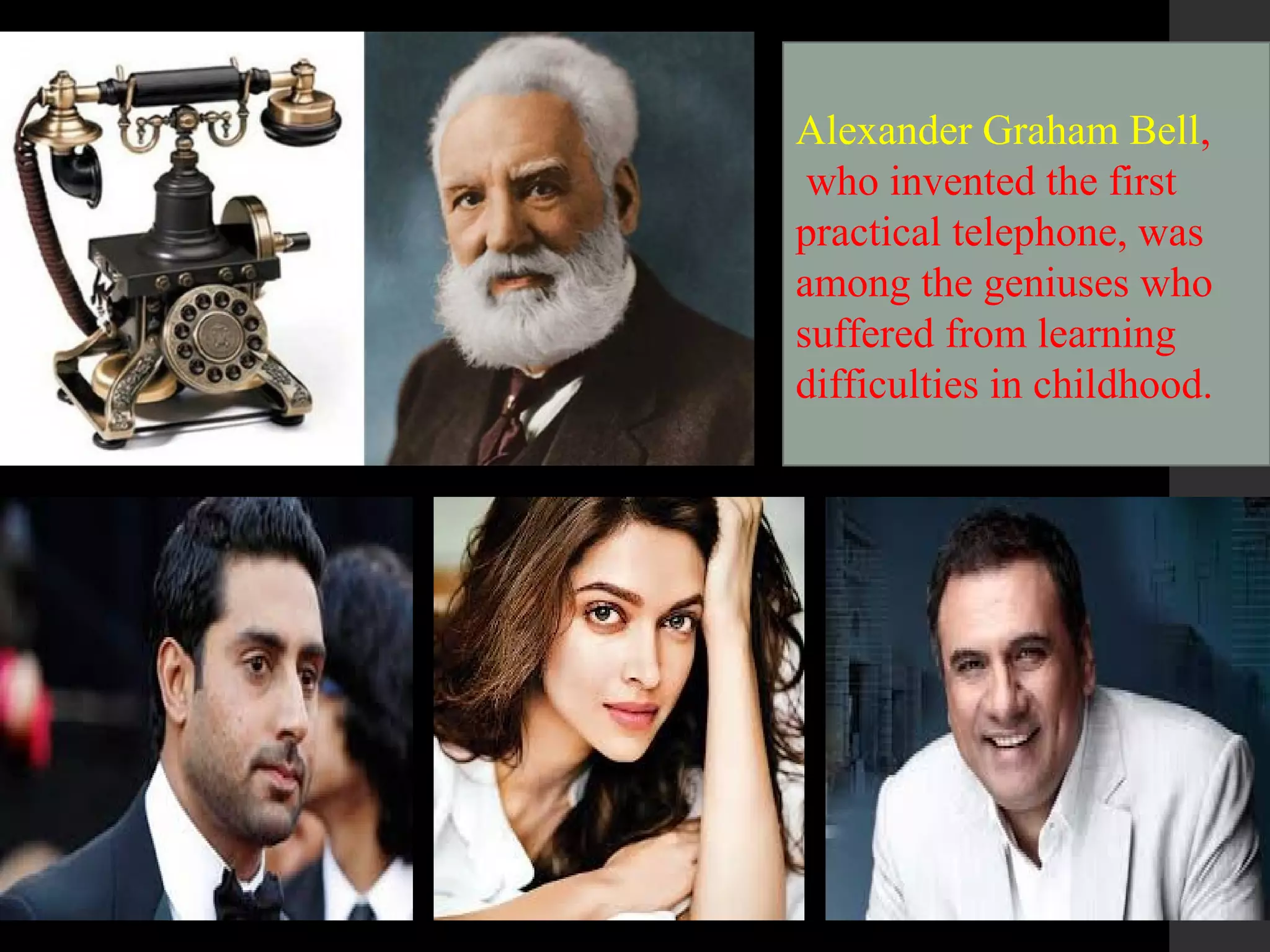
Alexander Graham Bell,
who invented the first
practical telephone, was
among the geniuses who
suffered from learning
difficulties in childhood. 
Teaching children with_learning_disabilities_02 (1)

Teaching children with_learning_disabilities_02 (1)

  • 1.
  • 3.
    LEARNING DISABILITIES I. Introductionand Definition II. Prevalence III. Characteristics of Students with LD IV. Teaching Strategies for Students with LD
  • 4.
    I. Introduction toLD • The term learning disability was only founded in 1963 by Samuel Kirk. At that time, children with LD were referred to by such terms as: • “perceptually handicapped,” • “brain-injured,” and • “neurologically impaired”
  • 5.
    Definition of aLearning Disability (1) A disorder in the processing of information involved in understanding and using language (spoken or written) (2) Difficulties in learning, particularly reading, writing, mathematics, and/or spelling (3) Special educational services needed to succeed in school
  • 6.
    1. Disorder inthe Processing of Information • First, having a learning disability means that the brain "processes" information differently than most other students. • Simply stated, certain kinds of information get stuck or lost while traveling through the brain of the student with LD.
  • 7.
    1. Disorder inthe Processing of Information Information processing refers to how your brain: • Takes in information, • Uses information, • Stores the information in memory, • Retrieves the information from memory, • and Expresses the information
  • 8.
    1. Disorder inthe Processing of Information • Students with LD struggle with certain kinds of learning because their brains have difficulty "processing" certain kinds of information. • It is like when you go on a car trip and get stuck in road construction and need to take a detour. It takes you a lot longer to get where you are going. Its the same with information going through the brain of a student with LD.
  • 9.
    1. Disorder inthe Processing of Information • Different kinds of information travel through different parts of the brain. That's why some information is learned quickly and easily while other information is much more difficult.
  • 10.
    1. Visual Processing •Visual Processing involves how well a student can use visual information. When he sees something, especially something complex, • e.g., does he understand it quickly and easily? Can he "visualize" things (like pictures, shapes, words, etc.) in his head? Can he remember information that he sees?  
  • 12.
    1. Auditory Processing AuditoryProcessing- involves how well a student can use auditory information. When he hears something, especially something detailed, does he understand it quickly and easily? Can he “hear" things (like sounds, numbers, words, etc.) in his head? Can he remember information that he hears?
  • 13.
    1. Processing Speed •Processing Speed refers to how fast information travels through the brain. • All LD students experience some processing speed difficulty when required to process information through their weakest processing "channel" or "modality". • It is like having the brain work at 30 miles per hour when the rest of the world (and all the information) is going 55 miles per hour. Such students just can't keep up.
  • 14.
    1. Processing Speed •Who was the first President of the United States? • Who = a question • Was = Past tense • First = #1 • President of United States-Leader of Nation
  • 15.
    2. Difficulties inLearning Dyslexia-Severe difficulty learning to read Dysgraphia- Severe difficulty learning to write Dyscalculia- Severe difficulty learning to do mathematical concepts and computation Dysorthographia- Severe difficulty learning to spell
  • 16.
    Object Orientation and ObjectIdentification p d b q
  • 17.
    Object Orientation and ObjectIdentification M W E 3
  • 18.
    3. Problem isNOT Primarily Due to Other Causes •Visual Disability •Hearing Disability •Motor Disability • Mental Retardation • Emotional Disturbance • Emotional, Cultural or Economic Disadvantage
  • 19.
    4. Special EducationalServices Needed to Succeed in School It is possible for a student to "technically" have a disability but not to "qualify" for special education services. This happens when a student demonstrates the information processing difficulties associated with a LD but his or her academic skills are not found to be "severely discrepant" from their ability. This may indicate that the student has learned how to "cope" with his/her learning difficulties at least to some extent.
  • 20.
    II. Prevalence • Almost3 million children (ages 6 through 21) have some form of a learning disability and receive special education in school. • LD form the largest category in special education.
  • 21.
    II. Prevalence • Infact, approximately 50% of all children who receive special education have a learning disability • 3:1 ratio males to females
  • 22.
  • 23.
    III. Characteristics • mayhave trouble learning the alphabet, or connecting letters to their sounds; • may make many mistakes when reading aloud, and repeat and pause often; • may not understand what he or she reads; • may have real trouble with spelling; • may confuse math symbols and misread numbers;
  • 24.
    III. Characteristics • mayhave very messy handwriting or hold a pencil awkwardly; • may struggle to express ideas in writing; • may learn language late and have a limited vocabulary; • may not follow the social rules of conversation, such as taking turns, and may stand too close to the listener;
  • 25.
    III. Characteristics • mayhave trouble remembering the sounds that letters make or hearing slight differences between words; • may have trouble following directions; • may not be able to retell a story in order (what happened first, second, third) • may mispronounce words or use a wrong word that sounds similar; • may have trouble organizing what he or she wants to say or not be able to think of the word he or she needs for writing or conversation;
  • 27.
    IV. Teaching Strategies •Provide high structure and clear expectations. Children who are LD tend to have difficulty focusing, getting started and setting priorities. Creating a clear structured program allows the student to be exposed to fewer distractions and possible avoidance and allow for greater focus on work related tasks.
  • 28.
    IV. Teaching Strategies •Learning materials should easily accessible, well organized and stored in the same place each day. The less the LD student has to worry about, comprehend or remember, the greater chance for success. Too many details can easily overwhelm this type of student.
  • 29.
    IV. Teaching Strategies •All assignments should be presented on the blackboard as well as orally presented. This multilevel sensory approach will only enhance the chances of the child being able to bring home the correct assignment. This will also cut down on parent child frustration which often occurs when the child with learning disabilities brings home part of the assignment or and assumption of what needs to be done due to a lack of ability in copying quickly.
  • 31.
    IV. Teaching Strategies •Make sure that the child's desk is free from all unnecessary materials. Children with learning disabilities tend to have organizational problems as well. The less chaos, the better the focus. Use small binders that hold fewer papers. Keep the desk free of most materials. Otherwise he may be embarrassed to get up to go to the pail and stuff it in his desk.
  • 32.
    IV. Teaching Strategies •Correct the student's work as soon as possible to allow for immediate gratification and feedback. Students with learning disabilities do not often have foundations of success when it comes to schoolwork. Therefore, when they hand in work they begin to worry about how they did. If they do not receive it back quickly, some children may use a great deal of energy worrying about the reactions of others if they did not do well.
  • 33.
    IV. Teaching Strategies •Try to separate him from students who may be distracting. Some children with learning disabilities are very distractible, while others may use any external situation to avoid a potential failure situation. Sitting a child with learning disabilities next to students who are self-motivated and internally controlled will provide extra structure and controls.
  • 34.
    IV. Teaching Strategies •Use multi-sensory teaching methods whenever possible. This is a common sense issue since all the research indicates that the greater number of sense utilized to learn something, the greater chance for the information to be understood and retained. Using visual, auditory, kinesthetic or tactile input together is highly recommended for children with learning disabilities.
  • 38.
    IV. Teaching Strategies •Respond to the child’s comments praising whenever possible. Many children with learning disabilities tend to have secondary emotional issues as a result of frustration and lower sense of self worth due to academic failure and stress. Consequently, when he responds or initiates conversation, praise for the initiation of communication should be praised.
  • 39.
    IV. Teaching Strategies •Give constant feedback. Many children with learning disabilities tend to write negative scripts about their ability and their performance. Feedback in any form reduces this negative energy pattern and offers reality, the only thing that breaks down fear.
  • 40.
  • 41.
    . Albert Einstein, synonymouswith the word GENIUS and the symbol of INTELLECT, was an extremely late learner and suffered from poor memory of words that resulted into dyslexia in his early childhood. Thomas Edison, who is known as one of the most brilliant scientists and inventors of all time, was thrown out of school because he was considered a dumb, slow learner with difficulties with words even at the age 12. He was extremely terrible at mathematics, unable to focus, and had difficulty with speech.
  • 42.
    Alexander Graham Bell, whoinvented the first practical telephone, was among the geniuses who suffered from learning difficulties in childhood.