Downloaded 42 times

![Memoization
There are following two different ways to store the values so that these values
can be reused
a) Memoization (Top Down)
b) Tabulation (Bottom Up)
/* function for nth Fibonacci number */
int fib(int n)
{
if (lookup[n] == NIL)
{
if (n <= 1)
lookup[n] = n;
else
lookup[n] = fib(n-1) + fib(n-2);
}](https://image.slidesharecdn.com/f2temyprc6daqcjpifzk-signature-f108737b1c907c7b4e4403cfd2b3432fcfd048c7ca137b3ef83b0195a034db35-poli-170210160325/85/Dynamic-programming-fundamentals-review-5-320.jpg)
![Tabulation
The tabulated program for a given problem builds a table in bottom up fashion
and returns the last entry from table.
int fib(int n)
{
int f[n+1];
int i;
f[0] = 0; f[1] = 1;
for (i = 2; i <= n; i++)
f[i] = f[i-1] + f[i-2];
return f[n];
}
def fib(x: Int): BigInt = {
@tailrec def fibHelper(x: Int, prev: BigInt = 0, next: BigInt
= 1): BigInt = x match {
case 0 => prev
case 1 => next
case _ => fibHelper(x - 1, next, (next + prev))
}
fibHelper(x)
}](https://image.slidesharecdn.com/f2temyprc6daqcjpifzk-signature-f108737b1c907c7b4e4403cfd2b3432fcfd048c7ca137b3ef83b0195a034db35-poli-170210160325/85/Dynamic-programming-fundamentals-review-6-320.jpg)
![Longest Increasing Subsequence
The Longest Increasing Subsequence (LIS) problem is to find the length of the longest
subsequence of a given sequence such that all elements of the subsequence are sorted
in increasing order. For example, the length of LIS for {10, 22, 9, 33, 21, 50, 41, 60, 80} is
6 and LIS is {10, 22, 33, 50, 60, 80}.
Input : arr[] = {50, 3, 10, 7, 40, 80}
Output : Length of LIS = 4
The longest increasing subsequence is {3, 7,
40, 80}](https://image.slidesharecdn.com/f2temyprc6daqcjpifzk-signature-f108737b1c907c7b4e4403cfd2b3432fcfd048c7ca137b3ef83b0195a034db35-poli-170210160325/85/Dynamic-programming-fundamentals-review-10-320.jpg)
![Optimal Substructure
Let arr[0..n-1] be the input array and L(i) be the length of the LIS ending at
index i such that arr[i] is the last element of the LIS.
Then, L(i) can be recursively written as:
L(i) = 1 + max( L(j) ) where 0 < j < i and arr[j] < arr[i]; or
L(i) = 1, if no such j exists.
To find the LIS for a given array, we need to return max(L(i)) where 0 < i < n.
Thus, we see the LIS problem satisfies the optimal substructure property as
the main problem can be solved using solutions to subproblems.](https://image.slidesharecdn.com/f2temyprc6daqcjpifzk-signature-f108737b1c907c7b4e4403cfd2b3432fcfd048c7ca137b3ef83b0195a034db35-poli-170210160325/85/Dynamic-programming-fundamentals-review-11-320.jpg)
![Overlapping Subproblems
Considering the above implementation, following is recursion tree for an
array of size 4. lis(n) gives us the length of LIS for arr[].
We can see that there are many subproblems which are solved again and
again. So this problem has Overlapping Substructure property and
recomputation of same subproblems can be avoided by either using
Memoization or Tabulation. Following is a tabluated implementation for
the LIS problem.](https://image.slidesharecdn.com/f2temyprc6daqcjpifzk-signature-f108737b1c907c7b4e4403cfd2b3432fcfd048c7ca137b3ef83b0195a034db35-poli-170210160325/85/Dynamic-programming-fundamentals-review-12-320.jpg)
![/* Initialize LIS values for all indexes */
for (i = 0; i < n; i++ )
lis[i] = 1;
/* Compute optimized LIS values in bottom up manner */
for (i = 1; i < n; i++ )
for (j = 0; j < i; j++ )
if ( arr[i] > arr[j] && lis[i] < lis[j] + 1)
lis[i] = lis[j] + 1;
/* Pick maximum of all LIS values */
for (i = 0; i < n; i++ )
if (max < lis[i])
max = lis[i];](https://image.slidesharecdn.com/f2temyprc6daqcjpifzk-signature-f108737b1c907c7b4e4403cfd2b3432fcfd048c7ca137b3ef83b0195a034db35-poli-170210160325/85/Dynamic-programming-fundamentals-review-13-320.jpg)
![Optimal Substructure
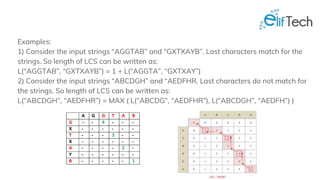
Let the input sequences be X[0..m-1] and Y[0..n-1] of lengths m and n
respectively. And let L(X[0..m-1], Y[0..n-1]) be the length of LCS of the two
sequences X and Y. Following is the recursive definition of L(X[0..m-1],
Y[0..n-1]).
If last characters of both sequences match (or X[m-1] == Y[n-1]) then
L(X[0..m-1], Y[0..n-1]) = 1 + L(X[0..m-2], Y[0..n-2])
If last characters of both sequences do not match (or X[m-1] != Y[n-1]) then
L(X[0..m-1], Y[0..n-1]) = MAX ( L(X[0..m-2], Y[0..n-1]), L(X[0..m-1], Y[0..n-2])](https://image.slidesharecdn.com/f2temyprc6daqcjpifzk-signature-f108737b1c907c7b4e4403cfd2b3432fcfd048c7ca137b3ef83b0195a034db35-poli-170210160325/85/Dynamic-programming-fundamentals-review-15-320.jpg)
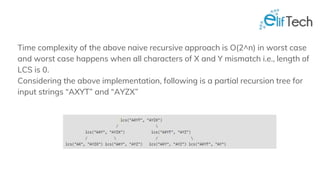
![/* Returns length of LCS for X[0..m-1], Y[0..n-1] */
int lcs( char *X, char *Y, int m, int n )
{
int L[m+1][n+1];
int i, j;
/* Following steps build L[m+1][n+1] in bottom up fashion. Note
that L[i][j] contains length of LCS of X[0..i-1] and Y[0..j-1] */
for (i=0; i<=m; i++)
{
for (j=0; j<=n; j++)
{
if (i == 0 || j == 0)
L[i][j] = 0;
else if (X[i-1] == Y[j-1])
L[i][j] = L[i-1][j-1] + 1;
else
L[i][j] = max(L[i-1][j], L[i][j-1]);
}
}
/* L[m][n] contains length of LCS for X[0..n-1] and Y[0..m-1] */
return L[m][n];
}](https://image.slidesharecdn.com/f2temyprc6daqcjpifzk-signature-f108737b1c907c7b4e4403cfd2b3432fcfd048c7ca137b3ef83b0195a034db35-poli-170210160325/85/Dynamic-programming-fundamentals-review-18-320.jpg)
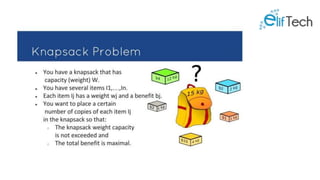
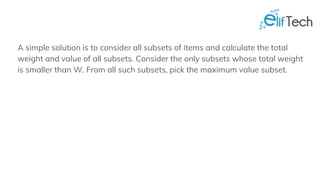
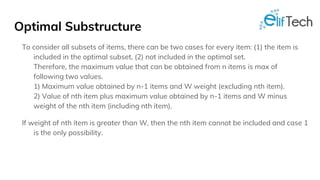
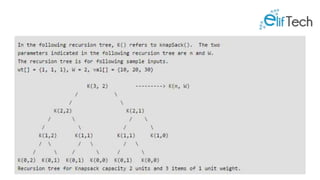
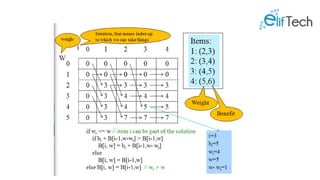
![// Returns the maximum value that can be put in a knapsack of capacity W
int knapSack(int W, int wt[], int val[], int n)
{
int i, w;
int K[n+1][W+1];
// Build table K[][] in bottom up manner
for (i = 0; i <= n; i++)
{
for (w = 0; w <= W; w++)
{
if (i==0 || w==0)
K[i][w] = 0;
else if (wt[i-1] <= w)
K[i][w] = max(val[i-1] + K[i-1][w-wt[i-1]], K[i-1][w]);
else
K[i][w] = K[i-1][w];
}
}
return K[n][W];
}](https://image.slidesharecdn.com/f2temyprc6daqcjpifzk-signature-f108737b1c907c7b4e4403cfd2b3432fcfd048c7ca137b3ef83b0195a034db35-poli-170210160325/85/Dynamic-programming-fundamentals-review-24-320.jpg)
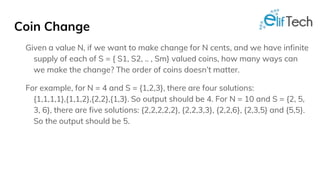
![Optimal Substructure
To count total number solutions, we can divide all set solutions in two sets.
1) Solutions that do not contain mth coin (or Sm).
2) Solutions that contain at least one Sm.
Let count(S[], m, n) be the function to count the number of solutions, then it can
be written as sum of count(S[], m-1, n) and count(S[], m, n-Sm).](https://image.slidesharecdn.com/f2temyprc6daqcjpifzk-signature-f108737b1c907c7b4e4403cfd2b3432fcfd048c7ca137b3ef83b0195a034db35-poli-170210160325/85/Dynamic-programming-fundamentals-review-26-320.jpg)
![// Returns the count of ways we can sum S[0...m-
1] coins to get sum n
int count( int S[], int m, int n )
{
// If n is 0 then there is 1 solution (do not include
any coin)
if (n == 0)
return 1;
// If n is less than 0 then no solution exists
if (n < 0)
return 0;
// If there are no coins and n is greater than 0,
then no solution exist
if (m <=0 && n >= 1)
return 0;
// count is sum of solutions (i) including S[m-1] (ii)
excluding S[m-1]
return count( S, m - 1, n ) + count( S, m, n-S[m-1]
);
}](https://image.slidesharecdn.com/f2temyprc6daqcjpifzk-signature-f108737b1c907c7b4e4403cfd2b3432fcfd048c7ca137b3ef83b0195a034db35-poli-170210160325/85/Dynamic-programming-fundamentals-review-27-320.jpg)
![int count( int S[], int m, int n )
{
int i, j, x, y;
// We need n+1 rows as the table is constructed in bottom up manner using
// the base case 0 value case (n = 0)
int table[n+1][m];
// Fill the entries for 0 value case (n = 0)
for (i=0; i<m; i++)
table[0][i] = 1;
// Fill rest of the table entries in bottom up manner
for (i = 1; i < n+1; i++)
{
for (j = 0; j < m; j++)
{
// Count of solutions including S[j]
x = (i-S[j] >= 0)? table[i - S[j]][j]: 0;
// Count of solutions excluding S[j]
y = (j >= 1)? table[i][j-1]: 0;
// total count
table[i][j] = x + y;
}
}
return table[n][m-1];
}](https://image.slidesharecdn.com/f2temyprc6daqcjpifzk-signature-f108737b1c907c7b4e4403cfd2b3432fcfd048c7ca137b3ef83b0195a034db35-poli-170210160325/85/Dynamic-programming-fundamentals-review-28-320.jpg)
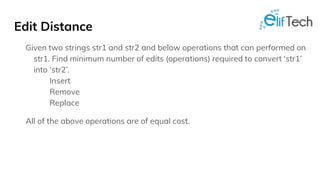
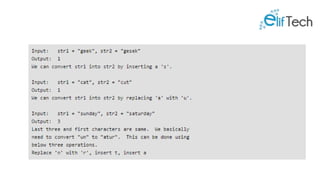
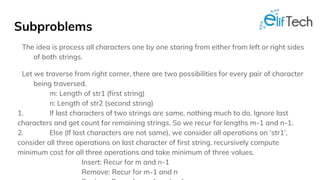
![int editDist(string str1 , string str2 , int m ,int n)
{
// If first string is empty, the only option is to
// insert all characters of second string into first
if (m == 0) return n;
// If second string is empty, the only option is to
// remove all characters of first string
if (n == 0) return m;
// If last characters of two strings are same, nothing
// much to do. Ignore last characters and get count for
// remaining strings.
if (str1[m-1] == str2[n-1])
return editDist(str1, str2, m-1, n-1);
// If last characters are not same, consider all three
// operations on last character of first string, recursively
// compute minimum cost for all three operations and take
// minimum of three values.
return 1 + min ( editDist(str1, str2, m, n-1), // Insert
editDist(str1, str2, m-1, n), // Remove
editDist(str1, str2, m-1, n-1) // Replace
);
}](https://image.slidesharecdn.com/f2temyprc6daqcjpifzk-signature-f108737b1c907c7b4e4403cfd2b3432fcfd048c7ca137b3ef83b0195a034db35-poli-170210160325/85/Dynamic-programming-fundamentals-review-32-320.jpg)
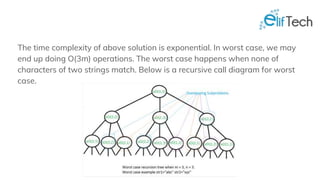
![Recomputations of same subproblems can be avoided by constructing a temporary array
that stores results of subpriblems
int editDistDP(string str1, string str2, int m, int n)
{
// Create a table to store results of subproblems
int dp[m+1][n+1];
// Fill d[][] in bottom up manner
for (int i=0; i<=m; i++)
{
for (int j=0; j<=n; j++)
{
// If first string is empty, only option is to
// isnert all characters of second string
if (i==0)
dp[i][j] = j; // Min. operations = j
// If second string is empty, only option is to
// remove all characters of second string
else if (j==0)
dp[i][j] = i; // Min. operations = i
// If last characters are same, ignore last char
// and recur for remaining string
else if (str1[i-1] == str2[j-1])
dp[i][j] = dp[i-1][j-1];
// If last character are different, consider all
// possibilities and find minimum
else
dp[i][j] = 1 + min(dp[i][j-1], // Insert
dp[i-1][j], // Remove
dp[i-1][j-1]); // Replace
}
}
return dp[m][n];
}](https://image.slidesharecdn.com/f2temyprc6daqcjpifzk-signature-f108737b1c907c7b4e4403cfd2b3432fcfd048c7ca137b3ef83b0195a034db35-poli-170210160325/85/Dynamic-programming-fundamentals-review-34-320.jpg)
![Floyd–Warshall
Algorithm for finding shortest paths in a weighted graph with positive or negative edge
weights (but with no negative cycles)
/* Add all vertices one by one to the set of intermediate vertices. */
for (k = 0; k < V; k++)
{
// Pick all vertices as source one by one
for (i = 0; i < V; i++)
{
// Pick all vertices as destination for the
// above picked source
for (j = 0; j < V; j++)
{
// If vertex k is on the shortest path from
// i to j, then update the value of dist[i][j]
if (dist[i][k] + dist[k][j] < dist[i][j])
dist[i][j] = dist[i][k] + dist[k][j];
}
}
}](https://image.slidesharecdn.com/f2temyprc6daqcjpifzk-signature-f108737b1c907c7b4e4403cfd2b3432fcfd048c7ca137b3ef83b0195a034db35-poli-170210160325/85/Dynamic-programming-fundamentals-review-35-320.jpg)
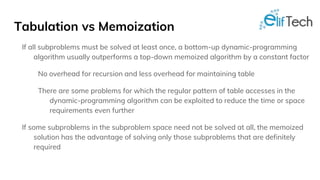
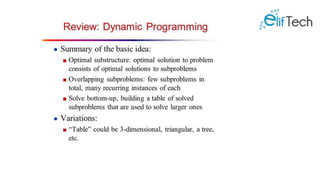


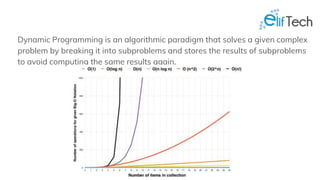
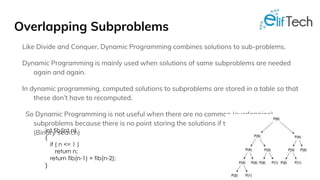
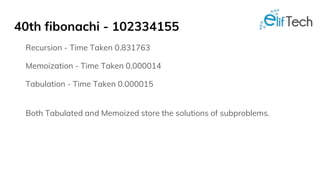
Dynamic programming is an algorithmic paradigm for solving complex problems by breaking them down into overlapping subproblems and storing their solutions to avoid redundancy. Key properties include overlapping subproblems and optimal substructure, which allow for problems like Fibonacci sequences, longest increasing subsequences, longest common subsequences, and more to be solved efficiently. Techniques such as memoization and tabulation are used to store solutions, significantly improving performance over naive recursive methods.


![谷歌留痕技术教程[ 𝙩𝙤𝙥 𝟮𝟯𝟯. 𝙘 𝙤𝙢 ]](https://cdn.slidesharecdn.com/ss_thumbnails/top233-260130173900-2eb784f9-thumbnail.jpg?width=640&height=640&fit=bounds)

