Presented By : Subhradeep Mitra
Ankita Dutta
Debanjana Biswas
(Student of mca rajabazar sc college)
Contents
• Graph-coloring using Intelligent Backtracking
• Graph-coloring
• Hamiltonian-cycle
• Subset-sum problem
• N-Queen problem
• Backtracking
• Conclusion
BACKTRACKING
The principle idea of back-tracking is to
construct solutions as component at a time.
And then evaluate such partially
constructed solutions.
Backtracking [animation]
start ?
?
dead end
dead end
?
?
dead end
dead end
?
success!
dead end
Key Terms:
• State-space tree
• Root
• Components
• Promising & Non-promising
• Leaves
N-Queen Problem
Problem:- The problem is to place n queens on an
n-by-n chessboard so that no two
queens attack each other by being in
the same row, or in the same column, or
in the same diagonal.
Observation:- Case 1 : n=1
Case 2 : n=2
Case 3 : n=3
Case 4 : n=4
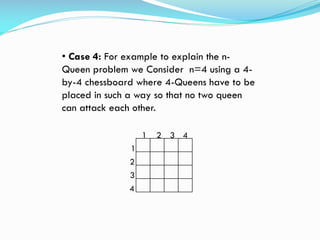
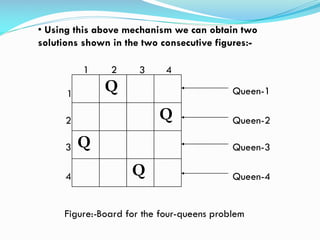
• Case 4: For example to explain the n-
Queen problem we Consider n=4 using a 4-
by-4 chessboard where 4-Queens have to be
placed in such a way so that no two queen
can attack each other.
4
3
2
1
4321
Q
Q
Q
Q
Q
Q
Q
Q
Q
Q
Q
Q
Q
Q
Q
Q
Q
Q
2
1
3
5
6
4
0
7
8
x x
xxx
x x
x
xxxx
xx
xxx
Q
Q
Q
Q
Queen-1
Queen-2
Queen-3
Queen-44
3
2
1
4321
Board for the four-queens problemFigure:-
• Using this above mechanism we can obtain two
solutions shown in the two consecutive figures:-
Q
Q
Q
Q
Queen-1
Queen-2
Queen-3
Queen-44
3
2
1
4321
Board for the four-queens problemFigure:-
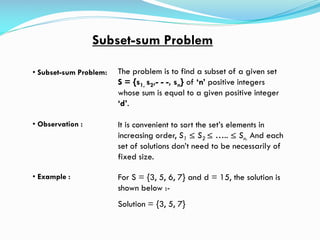
• Subset-sum Problem: The problem is to find a subset of a given set
S = {s1, s2,- - -, sn} of ‘n’ positive integers
whose sum is equal to a given positive integer
‘d’.
• Example : For S = {3, 5, 6, 7} and d = 15, the solution is
shown below :-
Solution = {3, 5, 7}
Subset-sum Problem
• Observation : It is convenient to sort the set’s elements in
increasing order, S1 ≤ S2 ≤ ….. ≤ Sn. And each
set of solutions don’t need to be necessarily of
fixed size.
15 8
511
05
814 3
8
9
3
0
3
0
with 6
with 5
with 6
with 7
with 6
with 5
with 3
w/o 5
w/o 6
w/o 5
w/o 3
w/o 6
w/o 7
w/o 6
solution
14+7>15 3+7<159+7>15 11+7>15
0+6+7<15
5+7<15
8<15
7
0
3
5
6
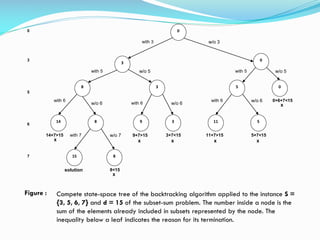
Figure : Compete state-space tree of the backtracking algorithm applied to the instance S =
{3, 5, 6, 7} and d = 15 of the subset-sum problem. The number inside a node is the
sum of the elements already included in subsets represented by the node. The
inequality below a leaf indicates the reason for its termination.
x
xx xxx
x
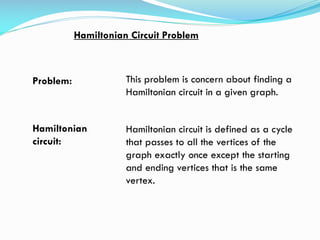
This problem is concern about finding a
Hamiltonian circuit in a given graph.
Problem:
Hamiltonian Circuit Problem
Hamiltonian circuit is defined as a cycle
that passes to all the vertices of the
graph exactly once except the starting
and ending vertices that is the same
vertex.
Hamiltonian
circuit:
Figure: • (a) Graph.
• (b) State-space tree for finding a Hamiltonian circuit. The
numbers above the nodes of the tree indicate the order the order
in which nodes are generated.
For example consider the given graph
and evaluate the mechanism:-
(a)
(b)
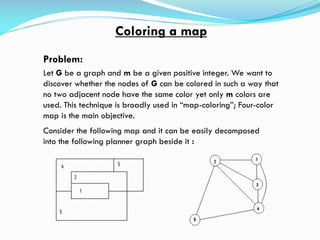
Coloring a map
Problem:
Let G be a graph and m be a given positive integer. We want to
discover whether the nodes of G can be colored in such a way that
no two adjacent node have the same color yet only m colors are
used. This technique is broadly used in “map-coloring”; Four-color
map is the main objective.
Consider the following map and it can be easily decomposed
into the following planner graph beside it :
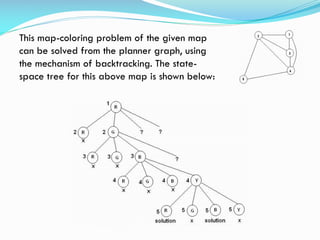
This map-coloring problem of the given map
can be solved from the planner graph, using
the mechanism of backtracking. The state-
space tree for this above map is shown below:
Four colors are chosen as
- Red, Green, Blue and
Yellow
Now the map can be
colored as shown here:-
(a) The principal states and territories of Australia. Coloring this map can
be viewed as a constraint satisfaction problem (CSP). The goal is to assign colors
to each region so that no neighboring regions have the same color. (b) The map-
coloring problem represented as a constraint graph.
Figure:
Artificial Intelligence
Constraints: C = {SA WA, SA NT, SA Q, SA NSW, SA V, WA NT,
NT Q, Q NSW , NSW V}
domain of each variable Di = {red, green, blue}
We are given the task of coloring each region either red,
green, or blue in such a way that no neighboring regions have
the same color. To formulate this as a CSP the following
assumptions are made:
Problem:
regions as, X = {WA, NT ,Q, NSW ,V,SA,T}
Observation:-
• Once we have chosen {SA = blue}, none of the five neighboring
variables can take on the value blue. So we have only 25 = 32
assignments to look at instead of 35= 243 assignments for the five
neighboring variables.
• Furthermore, we can see why the assignment is not a solution—we
see which variables violate a constraint—so we can focus attention
on the variables that matter.
Now the map can be colored as shown here:-
Conclusion
In conclusion, three things on behalf of backtracking need
to be said:-
• It is typically applied to difficult combinatorial problems
for which no efficient algorithm for finding, exact solutions
possibly exist.
• Backtracking solves each instances of a problem in an
acceptable amount of time.
• It generates all elements of the problem state.
Reference: Books:
• Anany Levitin Design and Analysis of
Algorithms (page 394-405)
• Computer Algorithms Horowitz and Sahani
(page 380-393)
•http://www.2shared.com/document/W1dBNI
GP/Stuart_Russell_and_Peter_Norvi.html
Thank You

Backtracking

  • 1.
    Presented By :Subhradeep Mitra Ankita Dutta Debanjana Biswas (Student of mca rajabazar sc college)
  • 2.
    Contents • Graph-coloring usingIntelligent Backtracking • Graph-coloring • Hamiltonian-cycle • Subset-sum problem • N-Queen problem • Backtracking • Conclusion
  • 3.
    BACKTRACKING The principle ideaof back-tracking is to construct solutions as component at a time. And then evaluate such partially constructed solutions.
  • 4.
    Backtracking [animation] start ? ? deadend dead end ? ? dead end dead end ? success! dead end
  • 5.
    Key Terms: • State-spacetree • Root • Components • Promising & Non-promising • Leaves
  • 6.
    N-Queen Problem Problem:- Theproblem is to place n queens on an n-by-n chessboard so that no two queens attack each other by being in the same row, or in the same column, or in the same diagonal. Observation:- Case 1 : n=1 Case 2 : n=2 Case 3 : n=3 Case 4 : n=4
  • 7.
    • Case 4:For example to explain the n- Queen problem we Consider n=4 using a 4- by-4 chessboard where 4-Queens have to be placed in such a way so that no two queen can attack each other. 4 3 2 1 4321
  • 8.
  • 9.
    Q Q Q Q Queen-1 Queen-2 Queen-3 Queen-44 3 2 1 4321 Board for thefour-queens problemFigure:- • Using this above mechanism we can obtain two solutions shown in the two consecutive figures:-
  • 10.
  • 11.
    • Subset-sum Problem:The problem is to find a subset of a given set S = {s1, s2,- - -, sn} of ‘n’ positive integers whose sum is equal to a given positive integer ‘d’. • Example : For S = {3, 5, 6, 7} and d = 15, the solution is shown below :- Solution = {3, 5, 7} Subset-sum Problem • Observation : It is convenient to sort the set’s elements in increasing order, S1 ≤ S2 ≤ ….. ≤ Sn. And each set of solutions don’t need to be necessarily of fixed size.
  • 12.
    15 8 511 05 814 3 8 9 3 0 3 0 with6 with 5 with 6 with 7 with 6 with 5 with 3 w/o 5 w/o 6 w/o 5 w/o 3 w/o 6 w/o 7 w/o 6 solution 14+7>15 3+7<159+7>15 11+7>15 0+6+7<15 5+7<15 8<15 7 0 3 5 6 Figure : Compete state-space tree of the backtracking algorithm applied to the instance S = {3, 5, 6, 7} and d = 15 of the subset-sum problem. The number inside a node is the sum of the elements already included in subsets represented by the node. The inequality below a leaf indicates the reason for its termination. x xx xxx x
  • 13.
    This problem isconcern about finding a Hamiltonian circuit in a given graph. Problem: Hamiltonian Circuit Problem Hamiltonian circuit is defined as a cycle that passes to all the vertices of the graph exactly once except the starting and ending vertices that is the same vertex. Hamiltonian circuit:
  • 14.
    Figure: • (a)Graph. • (b) State-space tree for finding a Hamiltonian circuit. The numbers above the nodes of the tree indicate the order the order in which nodes are generated. For example consider the given graph and evaluate the mechanism:- (a) (b)
  • 15.
    Coloring a map Problem: LetG be a graph and m be a given positive integer. We want to discover whether the nodes of G can be colored in such a way that no two adjacent node have the same color yet only m colors are used. This technique is broadly used in “map-coloring”; Four-color map is the main objective. Consider the following map and it can be easily decomposed into the following planner graph beside it :
  • 16.
    This map-coloring problemof the given map can be solved from the planner graph, using the mechanism of backtracking. The state- space tree for this above map is shown below:
  • 17.
    Four colors arechosen as - Red, Green, Blue and Yellow Now the map can be colored as shown here:-
  • 18.
    (a) The principalstates and territories of Australia. Coloring this map can be viewed as a constraint satisfaction problem (CSP). The goal is to assign colors to each region so that no neighboring regions have the same color. (b) The map- coloring problem represented as a constraint graph. Figure: Artificial Intelligence
  • 19.
    Constraints: C ={SA WA, SA NT, SA Q, SA NSW, SA V, WA NT, NT Q, Q NSW , NSW V} domain of each variable Di = {red, green, blue} We are given the task of coloring each region either red, green, or blue in such a way that no neighboring regions have the same color. To formulate this as a CSP the following assumptions are made: Problem: regions as, X = {WA, NT ,Q, NSW ,V,SA,T}
  • 20.
    Observation:- • Once wehave chosen {SA = blue}, none of the five neighboring variables can take on the value blue. So we have only 25 = 32 assignments to look at instead of 35= 243 assignments for the five neighboring variables. • Furthermore, we can see why the assignment is not a solution—we see which variables violate a constraint—so we can focus attention on the variables that matter.
  • 21.
    Now the mapcan be colored as shown here:-
  • 22.
    Conclusion In conclusion, threethings on behalf of backtracking need to be said:- • It is typically applied to difficult combinatorial problems for which no efficient algorithm for finding, exact solutions possibly exist. • Backtracking solves each instances of a problem in an acceptable amount of time. • It generates all elements of the problem state.
  • 23.
    Reference: Books: • AnanyLevitin Design and Analysis of Algorithms (page 394-405) • Computer Algorithms Horowitz and Sahani (page 380-393) •http://www.2shared.com/document/W1dBNI GP/Stuart_Russell_and_Peter_Norvi.html
  • 24.