Chapter 5
Advanced design and analysis techniques
Chapter About…..
Dynamic programming
Greedy algorithms
Amortized analysis
• Dynamic Programming is a technique for algorithm design.
• It is a tabular method in which it uses divide-and-conquer
to solve problems.
• dynamic programming is applicable when the subproblems
are not independent.
• So to solve a given problem, we need to solve different
parts of the problem.
What is Dynamic Programming?
Advantage
• A dynamic-programming algorithm solves every
subproblem just once and then saves its answer in a
table, thereby avoiding the work of recomputing the
answer every time the subproblem is encountered.
• Dynamic programming is typically applied to
optimization problems. In such problems there can be
many possible solutions. Each solution has a value,
and we wish to find a solution with the optimal
(minimum or maximum) value.
DP algorithm can be broken into a
sequence of four steps.
1. Characterize the structure of an optimal solution.
2. Recursively define the value of an optimal solution.
3. Compute the value of an optimal solution in a
bottom-up fashion.
4. Construct an optimal solution from computed
information
Algorithms
• Elements of dynamic programming
 Optimal substructure
 Overlapping subproblems
 Memoization
Example :
• Matrix-chain multiplication
• Longest common subsequence
Elements of dynamic programming
• Optimal substructure
if an optimal solution to the problem contains
within it optimal solutions to subproblems.
Whenever a problem exhibits optimal
substructure, it is a good clue that dynamic
programming might apply.
Overlapping subproblems
• Dynamic-programming algorithms typically
take advantage of overlapping subproblems
by solving each subproblem once and then
storing the solution in a table where it can be
looked up when needed, using constant time
per lookup.
Example
Memoization
• offers the efficiency of the usual dynamic-
programming approach while maintaining a top-down
strategy.
• A memoized recursive algorithm maintains an entry
in a table for the solution to each subproblem. Each
table entry initially contains a special value to
indicate that the entry has yet to be filled in.
• When the subproblem is first encountered during the
execution of the recursive algorithm, its solution is
computed and then stored in the table.
• Each subsequent time that the subproblem is
encountered, the value stored in the table is simply
looked up and returned.
Matrix-chain multiplication
• Dynamic programming is an algorithm that solves
the problem of matrix-chain multiplication. We
are given a sequence (chain) A1, A2, . . ., An of n
matrices to be multiplied, and we wish to
compute the product A1 .A2. ……. A
n
.
• We can evaluate the expression using the standard
algorithm for multiplying pairs of matrices as a
subroutine once we have parenthesized it to
resolve all ambiguities in how the matrices are
multiplied together.
• A product of matrices is fully parenthesized if it
is either a single matrix or the product of two
fully parenthesized matrix products, surrounded
by parentheses
For example,
• if the chain of matrices is A1, A2, A3, A4 , the
product A1A2A3A4 can be fully parenthesized in
five distinct ways:
(A1(A2(A3A4))) ,
• (A1((A2A3)A4)) ,
• ((A1A2)(A3A4)) ,
• ((A1(A2A3))A4) ,
• (((A1A2)A3)A4) .
matrix-chain multiplication problem
• given a chain A1, A2, . . . , An of n matrices,
where for i = 1, 2, . . . , n , matrix Ai has
dimension pi - 1 X pi, fully parenthesize the
product A1 A2...An in a way that minimizes the
number of scalar multiplications.
Steps to be followed
• Structure of an optimal parenthesization
• A recursive solution
• Computing the optimal costs
Algorithm
MATRIX-CHAIN-ORDER(p)
1 n  length[p] - 1
2 for i  1 to n
3 do m[i, i]  0
4 for l  2 to n
5 do for i  1 to n - l + 1
6 do j  i + l-1
7 m[i, j] ∞
8 for k  i to j - 1
9 do q  m[i, k] + m[k + 1, j] +pi-1pkpj
10 if q < m[i, j]
11 then m[i, j] q
12 s[i, j]  k
13 return m and s
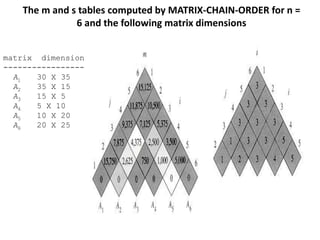
The m and s tables computed by MATRIX-CHAIN-ORDER for n =
6 and the following matrix dimensions
matrix dimension
-----------------
A1 30 X 35
A2 35 X 15
A3 15 X 5
A4 5 X 10
A5 10 X 20
A6 20 X 25
Longest common subsequence
• A subsequence of a given sequence is just the
given sequence with some elements (possibly
none) left out
• X = (x1, x2, . . . , xm ), another sequence Z =( z1, z2,
. . . , zk )is a subsequence of X if there exists a
strictly increasing sequence (i1, i2, . . . , ik )of
indices of X such that for all j = 1, 2, . . . , k, we
have xij = zj.
• For example, Z = <B, C, D, B >is a subsequence
of X =< A, B, C, B, D, A, B> with corresponding
index sequence <2, 3, 5, 7 >
Example
• Given two sequences X and Y, we say that a
sequence Z is a common subsequence of X
and Y if Z is a subsequence of both X and Y.
For example, if X = <A, B, C, B, D, A, B> and
Y = <B, D, C, A, B, A , >
Theorem
• Let X = <x1, x2, . . . , xm >and Y = <y1, y2, . . . , yn
> be sequences, and let Z = <z1, z2, . . . , zk >be
any LCS of X and Y.
1. If xm = yn, then zk = xm = yn and Zk-l is an LCS of
Xm-l and Yn-l.
2. If xm ≠yn, then zk ≠xm implies that Z is an LCS of
Xm-1 and Y.
3. If xm ≠yn, then zk ≠yn implies that Z is an LCS of
X and Yn-l.
A recursive solution to subproblems
Computing the length of an LCS
• LCS-LENGTH on the sequences X = <A, B, C, B, D,
A, B> and Y = <B, D, C, A, B, A> .
• The square in row i and column j contains the value of
c[i, j] and the appropriate arrow for the value of b[i, j].
• The entry 4 in c[7, 6]--the lower right-hand corner of
the table--is the length of an LCS B, C, B, A of X and
Y.
• For i, j > 0, entry c[i, j] depends only on whether xi = yj
and the values in entries c[i -1, j], c[i, j - 1], and c[i - 1,
j - 1], which are computed before c[i, j].
• To reconstruct the elements of an LCS, follow the b[i, j]
arrows from the lower right-hand corner; the path is
shaded. Each " on the path corresponds to an entry
(highlighted) for which xi = yj is a member of an LCS.
Algorithm
LCS-LENGTH(X,Y)
1 m  length[X]
2 n  length[Y]
3 for i  1 to m
4 do c[i,0]  0
5 for j  0 to n
6 do c[0, j]  0
7 for i  1 to m
8 do for j  1 to n
9 do if xi = yj
10 then c[i, j] c[i - 1, j -1] + 1
11 b[i, j]  " ↖"
12 else if c[i - 1, j] ≥c[i, j - 1]
13 then c[i, j]  c[i - 1, j]
14 b[i, j]  " ↑“
15 else c[i, j]  c[i, j -1]
16 b[i, j]  "  "
17 return c and b
Constructing an LCS
Greedy Algorithm
• A greedy algorithm always makes the choice
that looks best at the moment. That is, it
makes a locally optimal choice in the hope
that this choice will lead to a globally optimal
solution.
Applications
• Nontrivial problem,
• The activity-selection problem,
• Data-compression (Huffman) codes.
• problem of scheduling unit-time tasks with
deadlines and penalties.
• The greedy method is quite powerful and works
well for a wide range of problems.
• minimum-spanning-tree algorithms
• Dijkstra's algorithm for shortest paths form a
single source
• Minimum spanning trees
activity-selection problem
• Suppose we have a set S = { 1, 2, . . . , n} of n proposed
activities that wish to use a resource, such as a lecture
hall, which can be used by only one activity at a time.
• Each activity i has a start time si
• finish time âi, where si ≤ âi. If selected, activity i takes
place during the half-open time interval [si,âi).
• Activities i and j are compatible if the intervals [si, âi)
and [sj,âj) do not overlap (i.e., i and j are compatible if
si ≥âj or sj ≥âi).
• The activity-selection problem is to select a maximum-
size set of mutually compatible activities.
Algorithm
GREEDY-ACTIVITY-SELECTOR(s, f)
1 n  length[s]
2 A  {1}
3 j  1
4 for i  2 to n
5 do if si ≥ âj
6 then A  A U {i}
7 j  i
8 return A
Example
0-1 knapsack problem
• A thief robbing a store finds n items; the ith item
is worth vi dollars and weighs wi pounds, where vi
and wi are integers.
• He wants to take as valuable a load as possible,
but he can carry at most W pounds in his
knapsack for some integer W.
• What items should he take?
• (This is called the 0-1 knapsack problem because
each item must either be taken or left behind; the
thief cannot take a fractional amount of an item
or take an item more than once.)
fractional knapsack problem
• the setup is the same, but the thief can take
fractions of items, rather than having to make
a binary (0-1) choice for each item.
• You can think of an item in the 0-1 knapsack
problem as being like a gold ingot, while an
item in the fractional knapsack problem is
more like gold dust.
Solution
(a)The thief must select a subset of the three items shown whose weight must
not exceed 50 pounds.
(b)The optimal subset includes items 2 and 3. Any solution with item 1 is
suboptimal, even though item 1 has the greatest value per pound.
(c) For the fractional knapsack problem, taking the items in order of greatest
value per pound yields an optimal solution.
AMORTIZED ANALYSIS
• In an amortized analysis, the time required to
perform a sequence of data-structure
operations is averaged over all the operations
performed.
• Amortized analysis can be used to show that
the average cost of an operation is small, if one
averages over a sequence of operations, even
though a single operation might be expensive.
• Amortized analysis differs from average-case
analysis in that probability is not involved; an
amortized analysis guarantees the average
performance of each operation in the worst
case.
Importance of AA
• we want to analyze the complexity of
performing a sequence of operations on a
particular data structure. In some cases,
knowing the complexity of each operation in
the sequence is important, so we can simply
analyze the worst-case complexity of each
operation.
• In other cases, only the time complexity for
processing the entire sequence is important.
Definition of Worst case sequence
complexity
• "worst-case sequence complexity" of a
sequence of m operations as the MAXIMUM
total time over all sequences of m operations
T(m) = worst-case cost of doing a sequence of m
operations
Definition of amortized sequence
complexity
• amortized sequence complexity of a sequence of m
operations is defined as follows:
amortized worst-case sequence complexity
Sequence = ---------------------------------------------
m
Amortized analyses make more sense than a plain
worst-case time analysis in many situation
Three Most Common Techniques Used
In Amortized Analysis
• Aggregate Method
• Accounting Method
• Potential Method
Aggregate Method
• In the aggregate method of amortized
analysis, we show that for all n, a sequence of
n operations takes worst-case time T(n) in
total. In the worst case, the average cost, or
amortized cost, per operation
• therefore T(n) / n.
The accounting method
• In the accounting method of amortized
analysis, we assign differing charges to
different operations, with some operations
charged more or less than they actually cost.
The amount we charge an operation is called
its amortized cost.
• When an operation's amortized cost exceeds
its actual cost, the difference is assigned to
specific objects in the data structure as credit.
• Credit can be used later on to help pay for
operations whose amortized cost is less than
their actual cost
The potential method
• Instead of representing prepaid work as credit
stored with specific objects in the data
structure, the potential method of amortized
analysis represents the prepaid work as
"potential energy,"or just "potential," that can
be released to pay for future operations.
• The potential is associated with the data
structure as a whole rather than with specific
objects within the data structure.
potential function
A potential function maps each data structure D
to a real number(Di), which is the potential
associated with data structure Di.
The amortized cost of the ith operation with
respect to potential function

Chapter 5.pptx

  • 1.
    Chapter 5 Advanced designand analysis techniques
  • 2.
    Chapter About….. Dynamic programming Greedyalgorithms Amortized analysis
  • 3.
    • Dynamic Programmingis a technique for algorithm design. • It is a tabular method in which it uses divide-and-conquer to solve problems. • dynamic programming is applicable when the subproblems are not independent. • So to solve a given problem, we need to solve different parts of the problem. What is Dynamic Programming?
  • 4.
    Advantage • A dynamic-programmingalgorithm solves every subproblem just once and then saves its answer in a table, thereby avoiding the work of recomputing the answer every time the subproblem is encountered. • Dynamic programming is typically applied to optimization problems. In such problems there can be many possible solutions. Each solution has a value, and we wish to find a solution with the optimal (minimum or maximum) value.
  • 5.
    DP algorithm canbe broken into a sequence of four steps. 1. Characterize the structure of an optimal solution. 2. Recursively define the value of an optimal solution. 3. Compute the value of an optimal solution in a bottom-up fashion. 4. Construct an optimal solution from computed information
  • 6.
    Algorithms • Elements ofdynamic programming  Optimal substructure  Overlapping subproblems  Memoization Example : • Matrix-chain multiplication • Longest common subsequence
  • 7.
    Elements of dynamicprogramming • Optimal substructure if an optimal solution to the problem contains within it optimal solutions to subproblems. Whenever a problem exhibits optimal substructure, it is a good clue that dynamic programming might apply.
  • 8.
    Overlapping subproblems • Dynamic-programmingalgorithms typically take advantage of overlapping subproblems by solving each subproblem once and then storing the solution in a table where it can be looked up when needed, using constant time per lookup.
  • 9.
  • 10.
    Memoization • offers theefficiency of the usual dynamic- programming approach while maintaining a top-down strategy. • A memoized recursive algorithm maintains an entry in a table for the solution to each subproblem. Each table entry initially contains a special value to indicate that the entry has yet to be filled in. • When the subproblem is first encountered during the execution of the recursive algorithm, its solution is computed and then stored in the table. • Each subsequent time that the subproblem is encountered, the value stored in the table is simply looked up and returned.
  • 11.
    Matrix-chain multiplication • Dynamicprogramming is an algorithm that solves the problem of matrix-chain multiplication. We are given a sequence (chain) A1, A2, . . ., An of n matrices to be multiplied, and we wish to compute the product A1 .A2. ……. A n . • We can evaluate the expression using the standard algorithm for multiplying pairs of matrices as a subroutine once we have parenthesized it to resolve all ambiguities in how the matrices are multiplied together. • A product of matrices is fully parenthesized if it is either a single matrix or the product of two fully parenthesized matrix products, surrounded by parentheses
  • 12.
    For example, • ifthe chain of matrices is A1, A2, A3, A4 , the product A1A2A3A4 can be fully parenthesized in five distinct ways: (A1(A2(A3A4))) , • (A1((A2A3)A4)) , • ((A1A2)(A3A4)) , • ((A1(A2A3))A4) , • (((A1A2)A3)A4) .
  • 13.
    matrix-chain multiplication problem •given a chain A1, A2, . . . , An of n matrices, where for i = 1, 2, . . . , n , matrix Ai has dimension pi - 1 X pi, fully parenthesize the product A1 A2...An in a way that minimizes the number of scalar multiplications.
  • 14.
    Steps to befollowed • Structure of an optimal parenthesization • A recursive solution • Computing the optimal costs
  • 15.
    Algorithm MATRIX-CHAIN-ORDER(p) 1 n length[p] - 1 2 for i  1 to n 3 do m[i, i]  0 4 for l  2 to n 5 do for i  1 to n - l + 1 6 do j  i + l-1 7 m[i, j] ∞ 8 for k  i to j - 1 9 do q  m[i, k] + m[k + 1, j] +pi-1pkpj 10 if q < m[i, j] 11 then m[i, j] q 12 s[i, j]  k 13 return m and s
  • 16.
    The m ands tables computed by MATRIX-CHAIN-ORDER for n = 6 and the following matrix dimensions matrix dimension ----------------- A1 30 X 35 A2 35 X 15 A3 15 X 5 A4 5 X 10 A5 10 X 20 A6 20 X 25
  • 17.
    Longest common subsequence •A subsequence of a given sequence is just the given sequence with some elements (possibly none) left out • X = (x1, x2, . . . , xm ), another sequence Z =( z1, z2, . . . , zk )is a subsequence of X if there exists a strictly increasing sequence (i1, i2, . . . , ik )of indices of X such that for all j = 1, 2, . . . , k, we have xij = zj. • For example, Z = <B, C, D, B >is a subsequence of X =< A, B, C, B, D, A, B> with corresponding index sequence <2, 3, 5, 7 >
  • 18.
    Example • Given twosequences X and Y, we say that a sequence Z is a common subsequence of X and Y if Z is a subsequence of both X and Y. For example, if X = <A, B, C, B, D, A, B> and Y = <B, D, C, A, B, A , >
  • 19.
    Theorem • Let X= <x1, x2, . . . , xm >and Y = <y1, y2, . . . , yn > be sequences, and let Z = <z1, z2, . . . , zk >be any LCS of X and Y. 1. If xm = yn, then zk = xm = yn and Zk-l is an LCS of Xm-l and Yn-l. 2. If xm ≠yn, then zk ≠xm implies that Z is an LCS of Xm-1 and Y. 3. If xm ≠yn, then zk ≠yn implies that Z is an LCS of X and Yn-l.
  • 20.
    A recursive solutionto subproblems
  • 21.
    Computing the lengthof an LCS • LCS-LENGTH on the sequences X = <A, B, C, B, D, A, B> and Y = <B, D, C, A, B, A> . • The square in row i and column j contains the value of c[i, j] and the appropriate arrow for the value of b[i, j]. • The entry 4 in c[7, 6]--the lower right-hand corner of the table--is the length of an LCS B, C, B, A of X and Y. • For i, j > 0, entry c[i, j] depends only on whether xi = yj and the values in entries c[i -1, j], c[i, j - 1], and c[i - 1, j - 1], which are computed before c[i, j]. • To reconstruct the elements of an LCS, follow the b[i, j] arrows from the lower right-hand corner; the path is shaded. Each " on the path corresponds to an entry (highlighted) for which xi = yj is a member of an LCS.
  • 22.
    Algorithm LCS-LENGTH(X,Y) 1 m length[X] 2 n  length[Y] 3 for i  1 to m 4 do c[i,0]  0 5 for j  0 to n 6 do c[0, j]  0 7 for i  1 to m 8 do for j  1 to n 9 do if xi = yj 10 then c[i, j] c[i - 1, j -1] + 1 11 b[i, j]  " ↖" 12 else if c[i - 1, j] ≥c[i, j - 1] 13 then c[i, j]  c[i - 1, j] 14 b[i, j]  " ↑“ 15 else c[i, j]  c[i, j -1] 16 b[i, j]  "  " 17 return c and b
  • 23.
  • 24.
    Greedy Algorithm • Agreedy algorithm always makes the choice that looks best at the moment. That is, it makes a locally optimal choice in the hope that this choice will lead to a globally optimal solution.
  • 25.
    Applications • Nontrivial problem, •The activity-selection problem, • Data-compression (Huffman) codes. • problem of scheduling unit-time tasks with deadlines and penalties. • The greedy method is quite powerful and works well for a wide range of problems. • minimum-spanning-tree algorithms • Dijkstra's algorithm for shortest paths form a single source • Minimum spanning trees
  • 26.
    activity-selection problem • Supposewe have a set S = { 1, 2, . . . , n} of n proposed activities that wish to use a resource, such as a lecture hall, which can be used by only one activity at a time. • Each activity i has a start time si • finish time âi, where si ≤ âi. If selected, activity i takes place during the half-open time interval [si,âi). • Activities i and j are compatible if the intervals [si, âi) and [sj,âj) do not overlap (i.e., i and j are compatible if si ≥âj or sj ≥âi). • The activity-selection problem is to select a maximum- size set of mutually compatible activities.
  • 27.
    Algorithm GREEDY-ACTIVITY-SELECTOR(s, f) 1 n length[s] 2 A  {1} 3 j  1 4 for i  2 to n 5 do if si ≥ âj 6 then A  A U {i} 7 j  i 8 return A
  • 28.
  • 29.
    0-1 knapsack problem •A thief robbing a store finds n items; the ith item is worth vi dollars and weighs wi pounds, where vi and wi are integers. • He wants to take as valuable a load as possible, but he can carry at most W pounds in his knapsack for some integer W. • What items should he take? • (This is called the 0-1 knapsack problem because each item must either be taken or left behind; the thief cannot take a fractional amount of an item or take an item more than once.)
  • 30.
    fractional knapsack problem •the setup is the same, but the thief can take fractions of items, rather than having to make a binary (0-1) choice for each item. • You can think of an item in the 0-1 knapsack problem as being like a gold ingot, while an item in the fractional knapsack problem is more like gold dust.
  • 31.
    Solution (a)The thief mustselect a subset of the three items shown whose weight must not exceed 50 pounds. (b)The optimal subset includes items 2 and 3. Any solution with item 1 is suboptimal, even though item 1 has the greatest value per pound. (c) For the fractional knapsack problem, taking the items in order of greatest value per pound yields an optimal solution.
  • 32.
    AMORTIZED ANALYSIS • Inan amortized analysis, the time required to perform a sequence of data-structure operations is averaged over all the operations performed. • Amortized analysis can be used to show that the average cost of an operation is small, if one averages over a sequence of operations, even though a single operation might be expensive. • Amortized analysis differs from average-case analysis in that probability is not involved; an amortized analysis guarantees the average performance of each operation in the worst case.
  • 33.
    Importance of AA •we want to analyze the complexity of performing a sequence of operations on a particular data structure. In some cases, knowing the complexity of each operation in the sequence is important, so we can simply analyze the worst-case complexity of each operation. • In other cases, only the time complexity for processing the entire sequence is important.
  • 34.
    Definition of Worstcase sequence complexity • "worst-case sequence complexity" of a sequence of m operations as the MAXIMUM total time over all sequences of m operations T(m) = worst-case cost of doing a sequence of m operations
  • 35.
    Definition of amortizedsequence complexity • amortized sequence complexity of a sequence of m operations is defined as follows: amortized worst-case sequence complexity Sequence = --------------------------------------------- m Amortized analyses make more sense than a plain worst-case time analysis in many situation
  • 36.
    Three Most CommonTechniques Used In Amortized Analysis • Aggregate Method • Accounting Method • Potential Method
  • 37.
    Aggregate Method • Inthe aggregate method of amortized analysis, we show that for all n, a sequence of n operations takes worst-case time T(n) in total. In the worst case, the average cost, or amortized cost, per operation • therefore T(n) / n.
  • 38.
    The accounting method •In the accounting method of amortized analysis, we assign differing charges to different operations, with some operations charged more or less than they actually cost. The amount we charge an operation is called its amortized cost. • When an operation's amortized cost exceeds its actual cost, the difference is assigned to specific objects in the data structure as credit. • Credit can be used later on to help pay for operations whose amortized cost is less than their actual cost
  • 39.
    The potential method •Instead of representing prepaid work as credit stored with specific objects in the data structure, the potential method of amortized analysis represents the prepaid work as "potential energy,"or just "potential," that can be released to pay for future operations. • The potential is associated with the data structure as a whole rather than with specific objects within the data structure.
  • 40.
    potential function A potentialfunction maps each data structure D to a real number(Di), which is the potential associated with data structure Di. The amortized cost of the ith operation with respect to potential function