What is recursion?
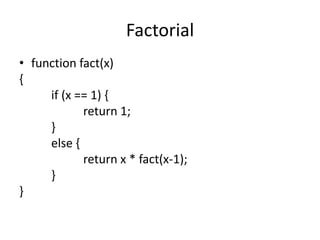
•Sometimes, the best way to solve a problem is
by solving a smaller version of the exact same
problem first
• Recursion is a technique that solves a problem
by solving a smaller problem of the same type
3.
Problems defined recursively
•There are many problems whose solution
can be defined recursively
Example: n factorial
1 if n = 0
n!= (recursive solution)
(n-1)!*n if n > 0
1 if n = 0
n!= (closed form solution)
1*2*3*…*(n-1)*n if n > 0
4.
Recursion vs. iteration
•Recursive solutions are often less efficient, in
terms of both time and space, than iterative
solutions
• Recursion can simplify the solution of a problem,
often resulting in shorter, more easily understood
source code
5.
Three Things toremember
1. 1. Base Condition:
Is there a non-recursive way out of the
function, and does the routine work correctly
for this "base" case?
2. 2. Progress towards Base condition and
eventually meet base condition:
Does each recursive call to the function
involve a smaller case of the original problem,
leading inescapably to the base case?
3. 3. Correctness:
Assuming that the recursive call(s) work
correctly, does the whole function work
correctly?
6.
How is recursionimplemented?
• What happens when a function gets called?
int f1(int x)
{
return 2*x;
}
int f2(int x)
{
int z,y;
……………… // other statements
z = f1(x) + y;
return z;
}
int main(){
int x=5;
print f2(5);
return 0;
}
7.
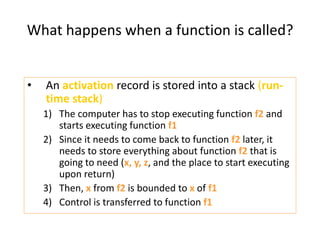
What happens whena function is called?
• An activation record is stored into a stack (run-
time stack)
1) The computer has to stop executing function f2 and
starts executing function f1
2) Since it needs to come back to function f2 later, it
needs to store everything about function f2 that is
going to need (x, y, z, and the place to start executing
upon return)
3) Then, x from f2 is bounded to x of f1
4) Control is transferred to function f1
Merge Sort
• Input:Given an unordered list of integers L=[l1,l2,l3…ln] where li ∈
Integers,
• Output L1= [m1,m2,…..mn] and mi <= mi+1 for all 1<i<n-1 and mi==lj for
1<i,j<=n and set(L)==set(L1)
• MergeSort(arr[], l, r)
If r > l
1. Find the middle point to divide the array into two halves: middle m =
(l+r)/2
2. Call mergeSort for first half: Call mergeSort(arr, l, m)
3. Call mergeSort for second half: Call mergeSort(arr, m+1, r)
4. Merge the two halves sorted in step 2 and 3: Call merge(arr, l, m, r)
13.
merge(arr, l, m,r) {
int leftArray[m-l+1],rightArray[r-m];
for i:l to m
– leftArray[i-l]=arr[i]
for i:m+1 to r
– rightArray[i-m-1]=arr[i]
i=l,j=l,k=m+1;
While(j<=m and k<=r)
– If(leftArray[j]<=rightArray[k])
• Arr[i++]=leftArray[j++];
Homework
• Try todevelop a recursive version for merging
two sorted arrays.
19.
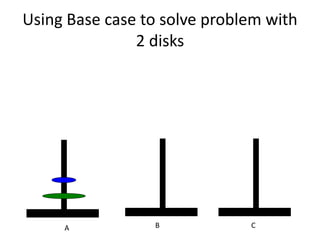
Tower of Hanoi
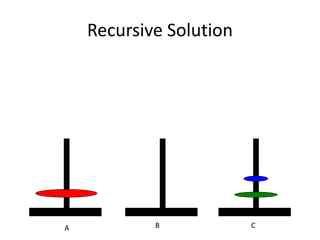
•There are three towers A, B, C
• There are n disks, with decreasing sizes (largest disk
is placed at the bottom of the tower and on the top
smallest size disk is placed ), on the first tower A
• You need to move all of the disks from A to B
following few rules
– You can move only one disk at a time
– You can move only that disk which is currently at the top of
any stack
– Larger disks can not be placed on top of a smaller disk
– Tower C can be used to temporarily hold disks
Recursive Algorithm
void Hanoi(intn, string A, string B, string C)
{
if (n == 1) /* base case */
Move(A,B);
else { /* recursion */
Hanoi(n-1,A,C,B);
Move(A,B);
Hanoi(n-1,C,B,A);
}
}
35.
Induction
• To provea statement S(n) for positive integers
n
– Prove S(1)
– Prove that if S(n) is true [inductive hypothesis]
then S(n+1) is true.
• This implies that S(n) is true for n=1,2,3,…
36.
Cost
• The numberof moves M(n) required by the
algorithm to solve the n-disk problem satisfies
the recurrence relation
– M(n) = 2M(n-1) + 1
– M(1) = 1
37.
Guess and prove
•Calculate M(n) for
small n and look for
a pattern.
• Guess the result
and prove your
guess correct using
induction.
n M(n)
1 1
2 3
3 7
4 15
5 31
38.
Substitution Method
• Unwindrecurrence, by repeatedly replacing
M(n) by the r.h.s. of the recurrence until the
base case is encountered.
M(n) = 2M(n-1) + 1
= 2*[2*M(n-2)+1] + 1 = 22 * M(n-2) + 1+2
= 22 * [2*M(n-3)+1] + 1 + 2
= 23 * M(n-3) + 1+2 + 22
39.
Geometric Series
• Afterk steps
M(n) = 2k * M(n-k) + 1+2 + 22 + … + 2n-k-1
• Base case encountered when k = n-1
M(n) = 2n-1 * M(1) + 1+2 + 22 + … + 2n-2
= 1 + 2 + … + 2n-1 =
1
0
2
n
i
i
40.
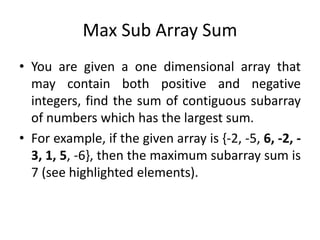
Max Sub ArraySum
• You are given a one dimensional array that
may contain both positive and negative
integers, find the sum of contiguous subarray
of numbers which has the largest sum.
• For example, if the given array is {-2, -5, 6, -2, -
3, 1, 5, -6}, then the maximum subarray sum is
7 (see highlighted elements).
41.
• Iterative methodwith two loops can solve the
problem
• Cost of the solution in terms of number of
addition:
• (n-1)+(n-2)+…+1=(n-1)(n-2)/2 = (n^2 – 3n +
2)/2 = O(n^2)
42.
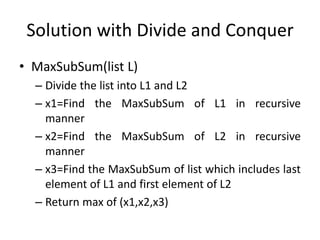
Solution with Divideand Conquer
• MaxSubSum(list L)
– Divide the list into L1 and L2
– x1=Find the MaxSubSum of L1 in recursive
manner
– x2=Find the MaxSubSum of L2 in recursive
manner
– x3=Find the MaxSubSum of list which includes last
element of L1 and first element of L2
– Return max of (x1,x2,x3)
43.
• Base Condition:when there is single element
in the list return it.
• How to get x3?
• Start from last element of left list and find max
sum and in similar way start with first element
of right list and find max sum then add
• When arraycontains following a b max c d
• How much max will contribute?
• max X number of groups in which max is maximum element.
• Max will be maximum element of following subgroups
• max
• b max
• a b max
• max c
• b max c
• a b max c
• max c d
• b max c d
• a b max c d
• Can we come up with a formula?
47.
• Lets say(l,r) is a range in which max is the maximum element
• Lets also say that index of max is i
• In left of max, number of elements is i-l and in right of max number
of elements is r-i.
• From left side we can choose sub-array in i-l+1 way where max is
included
• Like a b max
• b max
• max
• We can choose in 3 ways where max is included
• Similarly for each sub-array chosen from left side we can choose
right-sub array in (r-i+1) ways
• So number of sub-array where arr[i] will contribute is (i-l+1)*(r-i+1)
HomeWork
• Develop arecursive code for trinary search. A search
would be called trinary when input list is divided in
three sub-lists of size n/3, (n-n/3)/2, n-(n-n/3)/2 -n/3
and search is performed in appropriate sub-list.
• Make a comparison of worst case cost for binary search
and trinary search for n=10-100 and find if you can
conclude which one is better.
• Input : A list of sorted integer in increasing order and
an element to be searched
• Output: position of the element in the list if it is found
otherwise -1.




![Merge Sort
• Input: Given an unordered list of integers L=[l1,l2,l3…ln] where li ∈
Integers,
• Output L1= [m1,m2,…..mn] and mi <= mi+1 for all 1<i<n-1 and mi==lj for
1<i,j<=n and set(L)==set(L1)
• MergeSort(arr[], l, r)
If r > l
1. Find the middle point to divide the array into two halves: middle m =
(l+r)/2
2. Call mergeSort for first half: Call mergeSort(arr, l, m)
3. Call mergeSort for second half: Call mergeSort(arr, m+1, r)
4. Merge the two halves sorted in step 2 and 3: Call merge(arr, l, m, r)](https://image.slidesharecdn.com/2-250911195009-41422b49/85/Recursion_Introductory_Slides_notes_important_for-learning-basics-12-320.jpg)
![merge(arr, l, m, r) {
int leftArray[m-l+1],rightArray[r-m];
for i:l to m
– leftArray[i-l]=arr[i]
for i:m+1 to r
– rightArray[i-m-1]=arr[i]
i=l,j=l,k=m+1;
While(j<=m and k<=r)
– If(leftArray[j]<=rightArray[k])
• Arr[i++]=leftArray[j++];](https://image.slidesharecdn.com/2-250911195009-41422b49/85/Recursion_Introductory_Slides_notes_important_for-learning-basics-13-320.jpg)
![– else
• Arr[i++]=rightArray[k++];
• While(i<=r)
– if(j<=m)
• Arr[i++]=leftArray[j++]
– else
• Arr[i++]=rightArray[k++]](https://image.slidesharecdn.com/2-250911195009-41422b49/85/Recursion_Introductory_Slides_notes_important_for-learning-basics-14-320.jpg)






![Induction
• To prove a statement S(n) for positive integers
n
– Prove S(1)
– Prove that if S(n) is true [inductive hypothesis]
then S(n+1) is true.
• This implies that S(n) is true for n=1,2,3,…](https://image.slidesharecdn.com/2-250911195009-41422b49/85/Recursion_Introductory_Slides_notes_important_for-learning-basics-35-320.jpg)


![Substitution Method
• Unwind recurrence, by repeatedly replacing
M(n) by the r.h.s. of the recurrence until the
base case is encountered.
M(n) = 2M(n-1) + 1
= 2*[2*M(n-2)+1] + 1 = 22 * M(n-2) + 1+2
= 22 * [2*M(n-3)+1] + 1 + 2
= 23 * M(n-3) + 1+2 + 22](https://image.slidesharecdn.com/2-250911195009-41422b49/85/Recursion_Introductory_Slides_notes_important_for-learning-basics-38-320.jpg)




![Sum of maximum of all subarrays
• Input : arr[] = {1, 3, 1, 7}
• Output : 42
• Max of all sub-arrays:
• {1} - 1
• {1, 3} - 3
• {1, 3, 1} - 3
• {1, 3, 1, 7} - 7
• {3} - 3
• {3, 1} - 3
• {3, 1, 7} - 7
• {1} - 1
• {1, 7} - 7
• {7} - 7
• Total= 1 + 3 + 3 + 7 + 3 + 3 + 7 + 1 + 7 + 7 = 42](https://image.slidesharecdn.com/2-250911195009-41422b49/85/Recursion_Introductory_Slides_notes_important_for-learning-basics-45-320.jpg)

![• Lets say (l,r) is a range in which max is the maximum element
• Lets also say that index of max is i
• In left of max, number of elements is i-l and in right of max number
of elements is r-i.
• From left side we can choose sub-array in i-l+1 way where max is
included
• Like a b max
• b max
• max
• We can choose in 3 ways where max is included
• Similarly for each sub-array chosen from left side we can choose
right-sub array in (r-i+1) ways
• So number of sub-array where arr[i] will contribute is (i-l+1)*(r-i+1)](https://image.slidesharecdn.com/2-250911195009-41422b49/85/Recursion_Introductory_Slides_notes_important_for-learning-basics-47-320.jpg)
![maxSumSubarray(arr, l, r) {
if(l==r)
return arr[l];
i=index_of_max(arr,l,r)
return (arr[i]*(r-i+1)*(i-l+1) +
maxSumSubarray(arr, l, i-1) +
maxSumSubarray(arr, i+1, r))
}](https://image.slidesharecdn.com/2-250911195009-41422b49/85/Recursion_Introductory_Slides_notes_important_for-learning-basics-48-320.jpg)


