BY
DAVID KUMAR
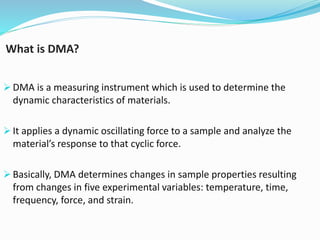
What is DMA?
 DMA is a measuring instrument which is used to determine the
dynamic characteristics of materials.
 It applies a dynamic oscillating force to a sample and analyze the
material’s response to that cyclic force.
 Basically, DMA determines changes in sample properties resulting
from changes in five experimental variables: temperature, time,
frequency, force, and strain.
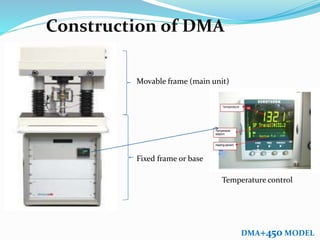
Movable frame (main unit)
Fixed frame or base
Temperature control
DMA+450 MODEL
Construction of DMA
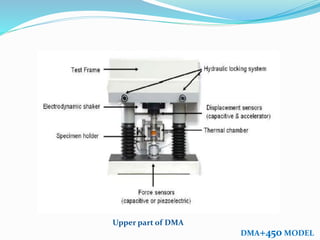
Upper part of DMA
DMA+450 MODEL
How does DMA work?
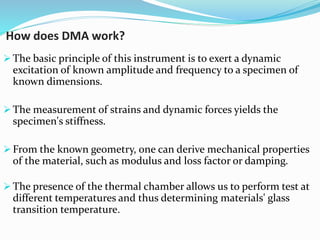
 The basic principle of this instrument is to exert a dynamic
excitation of known amplitude and frequency to a specimen of
known dimensions.
 The measurement of strains and dynamic forces yields the
specimen's stiffness.
 From the known geometry, one can derive mechanical properties
of the material, such as modulus and loss factor or damping.
 The presence of the thermal chamber allows us to perform test at
different temperatures and thus determining materials' glass
transition temperature.
Which materials can be analyzed with DMA?
DMA instrument can be used to characterize mechanical and/or thermal properties of a
great numbers of materials:
 Polymers
 Elastomers
 Composites
 Metals and metallic alloys
 Ceramics, glass
 Adhesives
 Bitumen (solid and pasty)
 Paint and varnish (gels or films)
 Cosmetics (gels, spray….)
 Oils
 Biomaterials
 Leather, skin hair….
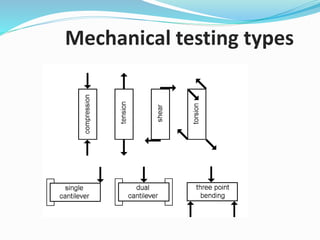
Mechanical testing types
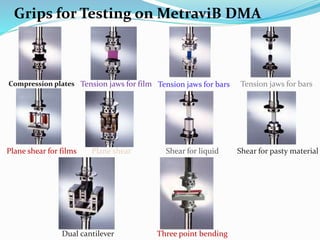
Compression plates Tension jaws for film Tension jaws for bars Tension jaws for bars
Plane shear for films Plane shear Shear for liquid Shear for pasty material
Dual cantilever Three point bending
Grips for Testing on MetraviB DMA
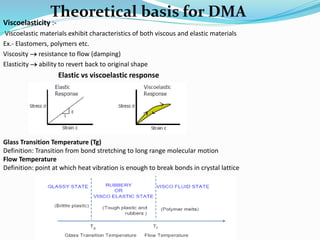
Viscoelasticity :-
Viscoelastic materials exhibit characteristics of both viscous and elastic materials
Ex.- Elastomers, polymers etc.
Viscosity  resistance to flow (damping)
Elasticity  ability to revert back to original shape
Elastic vs viscoelastic response
Glass Transition Temperature (Tg)
Definition: Transition from bond stretching to long range molecular motion
Flow Temperature
Definition: point at which heat vibration is enough to break bonds in crystal lattice
Theoretical basis for DMA
Continued….
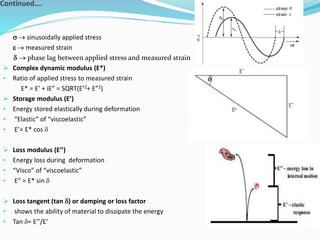
 sinusoidally applied stress
 measured strain
  phase lag between applied stress and measured strain
 Complex dynamic modulus (E*)
• Ratio of applied stress to measured strain
E* = E’ + iE” = SQRT(E’2+ E”2)
 Storage modulus (E’)
• Energy stored elastically during deformation
• “Elastic” of “viscoelastic”
• E’= E* cos 
 Loss modulus (E’’)
• Energy loss during deformation
• “Visco” of “viscoelastic”
• E” = E* sin 
 Loss tangent (tan ) or damping or loss factor
• shows the ability of material to dissipate the energy
• Tan = E’’/E’

Continued….
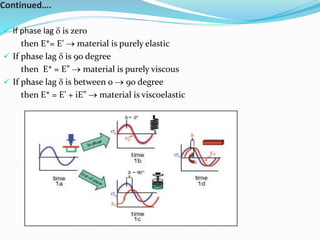
 If phase lag  is zero
then E*= E’  material is purely elastic
 If phase lag  is 90 degree
then E* = E”  material is purely viscous
 If phase lag  is between 0  90 degree
then E* = E’ + iE”  material is viscoelastic
1. Preparation of specimen
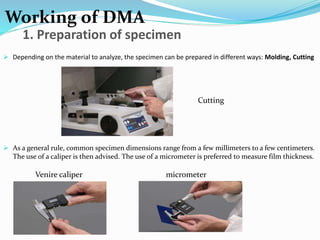
 Depending on the material to analyze, the specimen can be prepared in different ways: Molding, Cutting
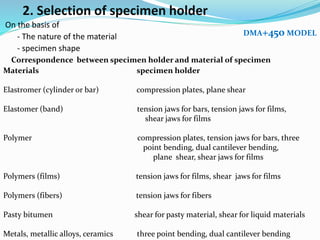
 As a general rule, common specimen dimensions range from a few millimeters to a few centimeters.
The use of a caliper is then advised. The use of a micrometer is preferred to measure film thickness.
Cutting
Venire caliper micrometer
Working of DMA
2. Selection of specimen holder
On the basis of
- The nature of the material
- specimen shape
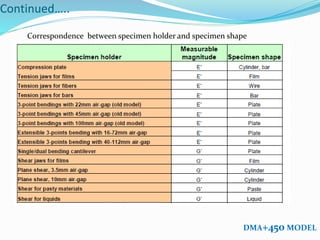
Correspondence between specimen holder and material of specimen
DMA+450 MODEL
Materials specimen holder
Elastromer (cylinder or bar) compression plates, plane shear
Elastomer (band) tension jaws for bars, tension jaws for films,
shear jaws for films
Polymer compression plates, tension jaws for bars, three
point bending, dual cantilever bending,
plane shear, shear jaws for films
Polymers (films) tension jaws for films, shear jaws for films
Polymers (fibers) tension jaws for fibers
Pasty bitumen shear for pasty material, shear for liquid materials
Metals, metallic alloys, ceramics three point bending, dual cantilever bending
Continued…..
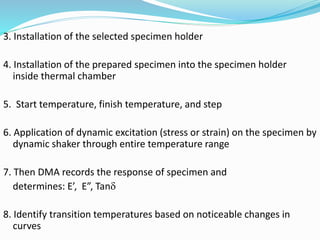
Correspondence between specimen holder and specimen shape
DMA+450 MODEL
3. Installation of the selected specimen holder
4. Installation of the prepared specimen into the specimen holder
inside thermal chamber
5. Start temperature, finish temperature, and step
6. Application of dynamic excitation (stress or strain) on the specimen by
dynamic shaker through entire temperature range
7. Then DMA records the response of specimen and
determines: E’, E”, Tan
8. Identify transition temperatures based on noticeable changes in
curves
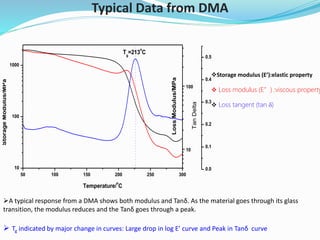
Typical Data from DMA
50 100 150 200 250 300
10
100
1000
Temperature/
o
C
StorageModulus/MPa
LossModulus/MPa
TanDelta
10
100
Tg
=213
o
C
0.0
0.1
0.2
0.3
0.4
0.5
Storage modulus (E’):elastic property
 Loss modulus (E”) :viscous property
 Loss tangent (tan )
A typical response from a DMA shows both modulus and Tanδ. As the material goes through its glass
transition, the modulus reduces and the Tanδ goes through a peak.
 Tg indicated by major change in curves: Large drop in log E’ curve and Peak in Tanδ curve
Sources
 MetraviB DMA user manual
 DMA book by Dr. K. P. Menard
Thank you

Dynamic Mechanical Analyzer

  • 1.
  • 2.
    What is DMA? DMA is a measuring instrument which is used to determine the dynamic characteristics of materials.  It applies a dynamic oscillating force to a sample and analyze the material’s response to that cyclic force.  Basically, DMA determines changes in sample properties resulting from changes in five experimental variables: temperature, time, frequency, force, and strain.
  • 3.
    Movable frame (mainunit) Fixed frame or base Temperature control DMA+450 MODEL Construction of DMA
  • 4.
    Upper part ofDMA DMA+450 MODEL
  • 5.
    How does DMAwork?  The basic principle of this instrument is to exert a dynamic excitation of known amplitude and frequency to a specimen of known dimensions.  The measurement of strains and dynamic forces yields the specimen's stiffness.  From the known geometry, one can derive mechanical properties of the material, such as modulus and loss factor or damping.  The presence of the thermal chamber allows us to perform test at different temperatures and thus determining materials' glass transition temperature.
  • 6.
    Which materials canbe analyzed with DMA? DMA instrument can be used to characterize mechanical and/or thermal properties of a great numbers of materials:  Polymers  Elastomers  Composites  Metals and metallic alloys  Ceramics, glass  Adhesives  Bitumen (solid and pasty)  Paint and varnish (gels or films)  Cosmetics (gels, spray….)  Oils  Biomaterials  Leather, skin hair….
  • 7.
  • 8.
    Compression plates Tensionjaws for film Tension jaws for bars Tension jaws for bars Plane shear for films Plane shear Shear for liquid Shear for pasty material Dual cantilever Three point bending Grips for Testing on MetraviB DMA
  • 9.
    Viscoelasticity :- Viscoelastic materialsexhibit characteristics of both viscous and elastic materials Ex.- Elastomers, polymers etc. Viscosity  resistance to flow (damping) Elasticity  ability to revert back to original shape Elastic vs viscoelastic response Glass Transition Temperature (Tg) Definition: Transition from bond stretching to long range molecular motion Flow Temperature Definition: point at which heat vibration is enough to break bonds in crystal lattice Theoretical basis for DMA
  • 10.
    Continued….  sinusoidally appliedstress  measured strain   phase lag between applied stress and measured strain  Complex dynamic modulus (E*) • Ratio of applied stress to measured strain E* = E’ + iE” = SQRT(E’2+ E”2)  Storage modulus (E’) • Energy stored elastically during deformation • “Elastic” of “viscoelastic” • E’= E* cos   Loss modulus (E’’) • Energy loss during deformation • “Visco” of “viscoelastic” • E” = E* sin   Loss tangent (tan ) or damping or loss factor • shows the ability of material to dissipate the energy • Tan = E’’/E’ 
  • 11.
    Continued….  If phaselag  is zero then E*= E’  material is purely elastic  If phase lag  is 90 degree then E* = E”  material is purely viscous  If phase lag  is between 0  90 degree then E* = E’ + iE”  material is viscoelastic
  • 12.
    1. Preparation ofspecimen  Depending on the material to analyze, the specimen can be prepared in different ways: Molding, Cutting  As a general rule, common specimen dimensions range from a few millimeters to a few centimeters. The use of a caliper is then advised. The use of a micrometer is preferred to measure film thickness. Cutting Venire caliper micrometer Working of DMA
  • 13.
    2. Selection ofspecimen holder On the basis of - The nature of the material - specimen shape Correspondence between specimen holder and material of specimen DMA+450 MODEL Materials specimen holder Elastromer (cylinder or bar) compression plates, plane shear Elastomer (band) tension jaws for bars, tension jaws for films, shear jaws for films Polymer compression plates, tension jaws for bars, three point bending, dual cantilever bending, plane shear, shear jaws for films Polymers (films) tension jaws for films, shear jaws for films Polymers (fibers) tension jaws for fibers Pasty bitumen shear for pasty material, shear for liquid materials Metals, metallic alloys, ceramics three point bending, dual cantilever bending
  • 14.
    Continued….. Correspondence between specimenholder and specimen shape DMA+450 MODEL
  • 15.
    3. Installation ofthe selected specimen holder 4. Installation of the prepared specimen into the specimen holder inside thermal chamber 5. Start temperature, finish temperature, and step 6. Application of dynamic excitation (stress or strain) on the specimen by dynamic shaker through entire temperature range 7. Then DMA records the response of specimen and determines: E’, E”, Tan 8. Identify transition temperatures based on noticeable changes in curves
  • 16.
    Typical Data fromDMA 50 100 150 200 250 300 10 100 1000 Temperature/ o C StorageModulus/MPa LossModulus/MPa TanDelta 10 100 Tg =213 o C 0.0 0.1 0.2 0.3 0.4 0.5 Storage modulus (E’):elastic property  Loss modulus (E”) :viscous property  Loss tangent (tan ) A typical response from a DMA shows both modulus and Tanδ. As the material goes through its glass transition, the modulus reduces and the Tanδ goes through a peak.  Tg indicated by major change in curves: Large drop in log E’ curve and Peak in Tanδ curve
  • 17.
    Sources  MetraviB DMAuser manual  DMA book by Dr. K. P. Menard
  • 18.