Dynamic Mechanical
Analysis
Mohammad Ansar
Senior Project Engineer
SCTIMST
1
Contents
• Visco-Elasticity
• DMA
• Temperature sweep
• Strain sweep
• Frequency sweep
• Stress relaxation
• Creep
• Miscellenous calculations
2
Uninstalling Chain theory
• Polymers are complex chains
• Property of polymers depends on chemical
structure,molecular weight, side groups etc
• Prediction of final property is complex
3
Installing visco-elastic theory
• Polymers are just combination of Viscous componant
and elastic componant
• Property of polymers depends on viscous componant,
elastc componant and composition of this componats
• Prediction of final property is simple
4
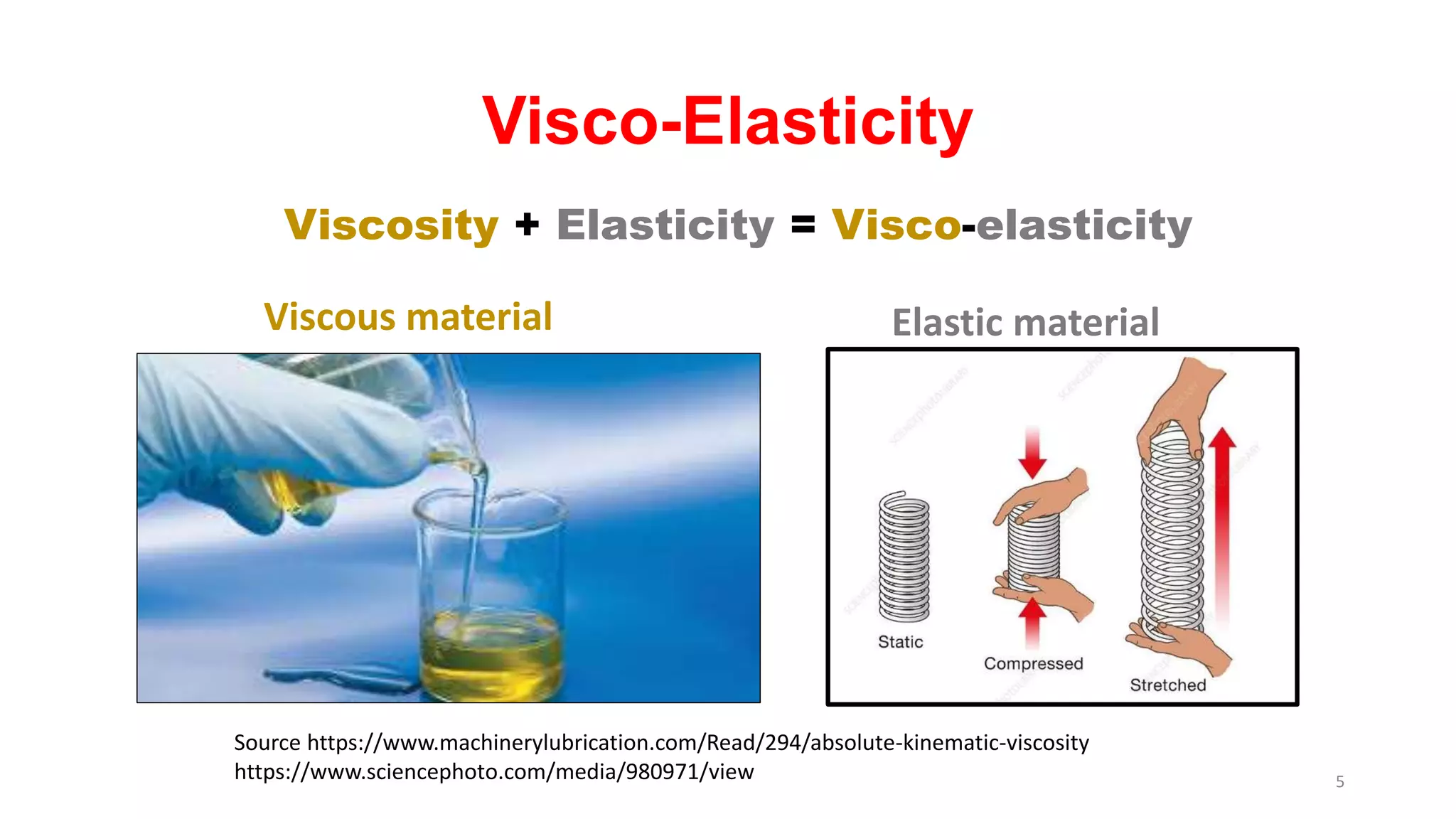
Visco-Elasticity
Viscous material Elastic material
Viscosity + Elasticity = Visco-elasticity
Source https://www.machinerylubrication.com/Read/294/absolute-kinematic-viscosity
https://www.sciencephoto.com/media/980971/view 5
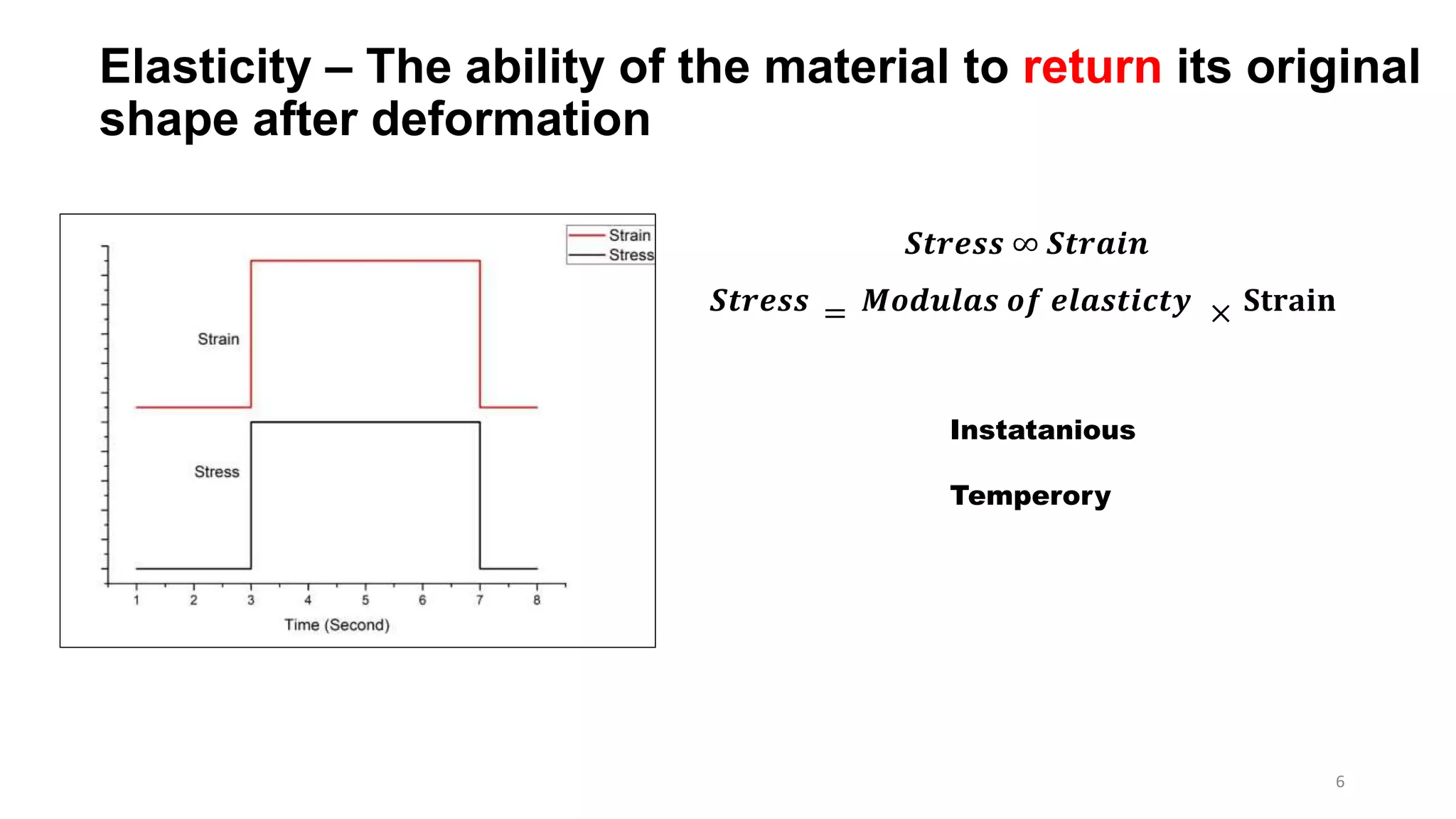
Elasticity – The ability of the material to return its original
shape after deformation
𝑺𝒕𝒓𝒆𝒔𝒔 ∞ 𝑺𝒕𝒓𝒂𝒊𝒏
𝑺𝒕𝒓𝒆𝒔𝒔 = 𝑴𝒐𝒅𝒖𝒍𝒂𝒔 𝒐𝒇 𝒆𝒍𝒂𝒔𝒕𝒊𝒄𝒕𝒚 × 𝐒𝐭𝐫𝐚𝐢𝐧
Instatanious
Temperory
6
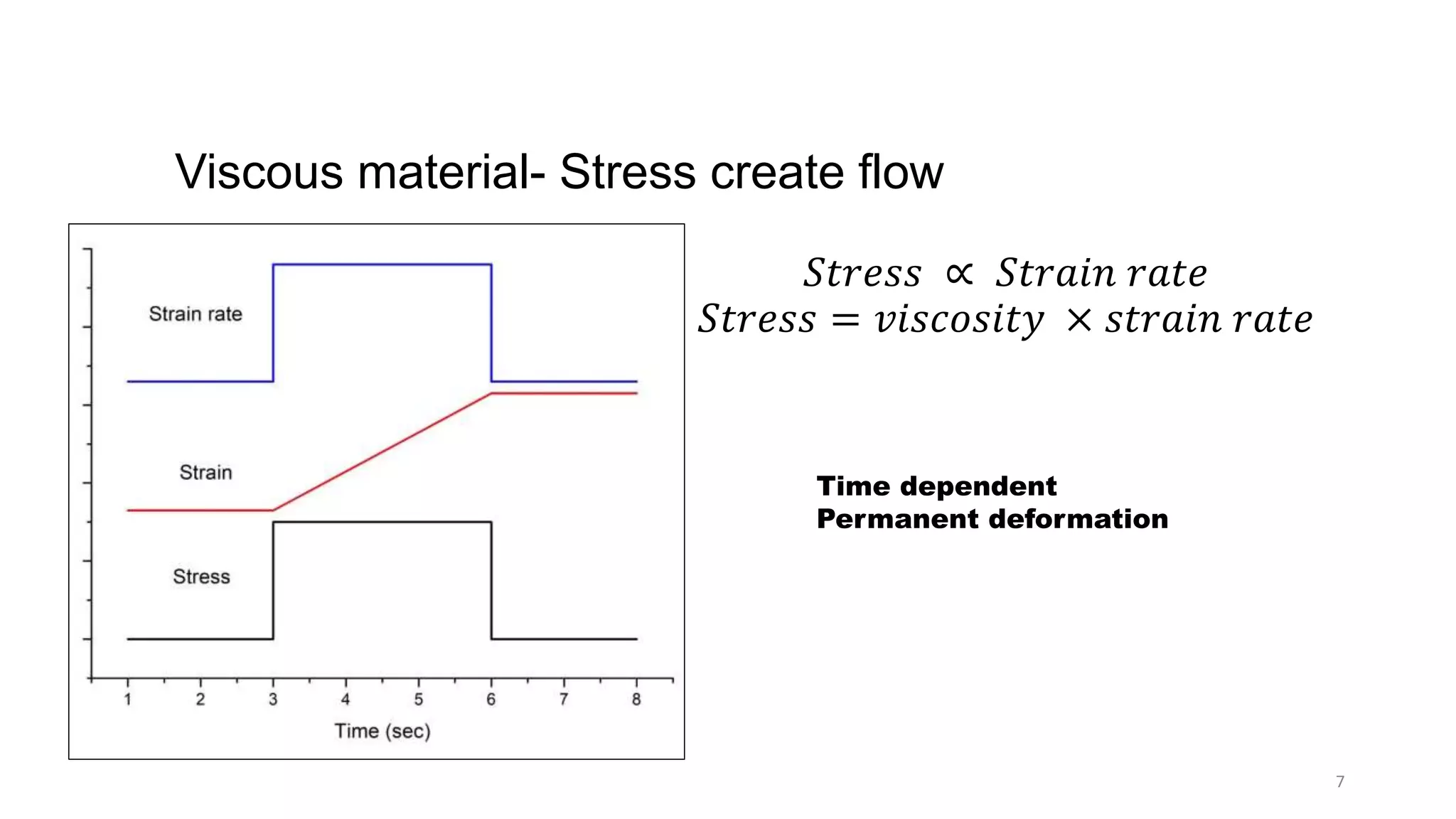
Viscous material- Stress create flow
𝑆𝑡𝑟𝑒𝑠𝑠 ∝ 𝑆𝑡𝑟𝑎𝑖𝑛 𝑟𝑎𝑡𝑒
𝑆𝑡𝑟𝑒𝑠𝑠 = 𝑣𝑖𝑠𝑐𝑜𝑠𝑖𝑡𝑦 × 𝑠𝑡𝑟𝑎𝑖𝑛 𝑟𝑎𝑡𝑒
Time dependent
Permanent deformation
7
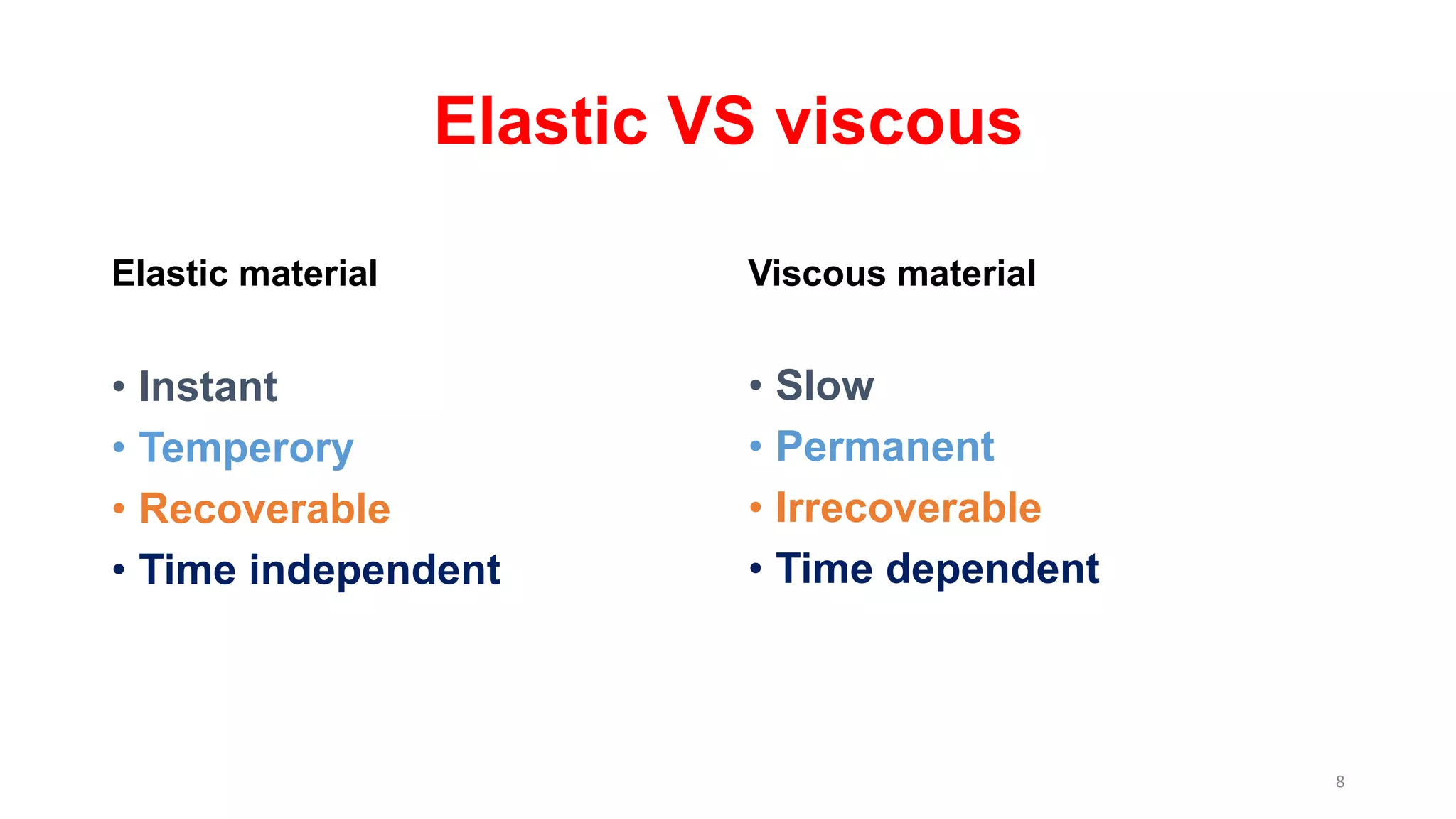
Elastic VS viscous
Elastic material
• Instant
• Temperory
• Recoverable
• Time independent
Viscous material
• Slow
• Permanent
• Irrecoverable
• Time dependent
8
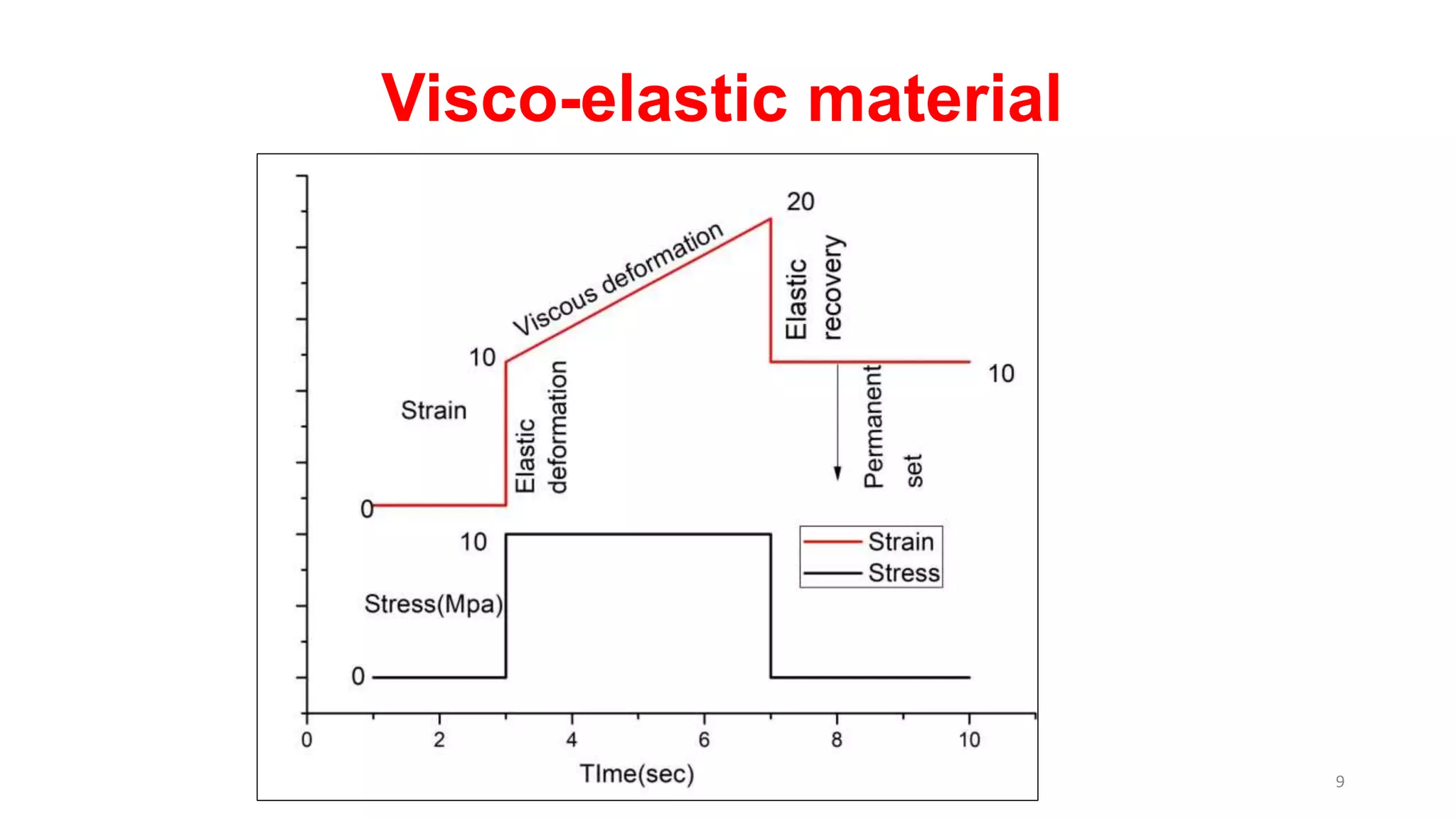
Visco-elastic material
9
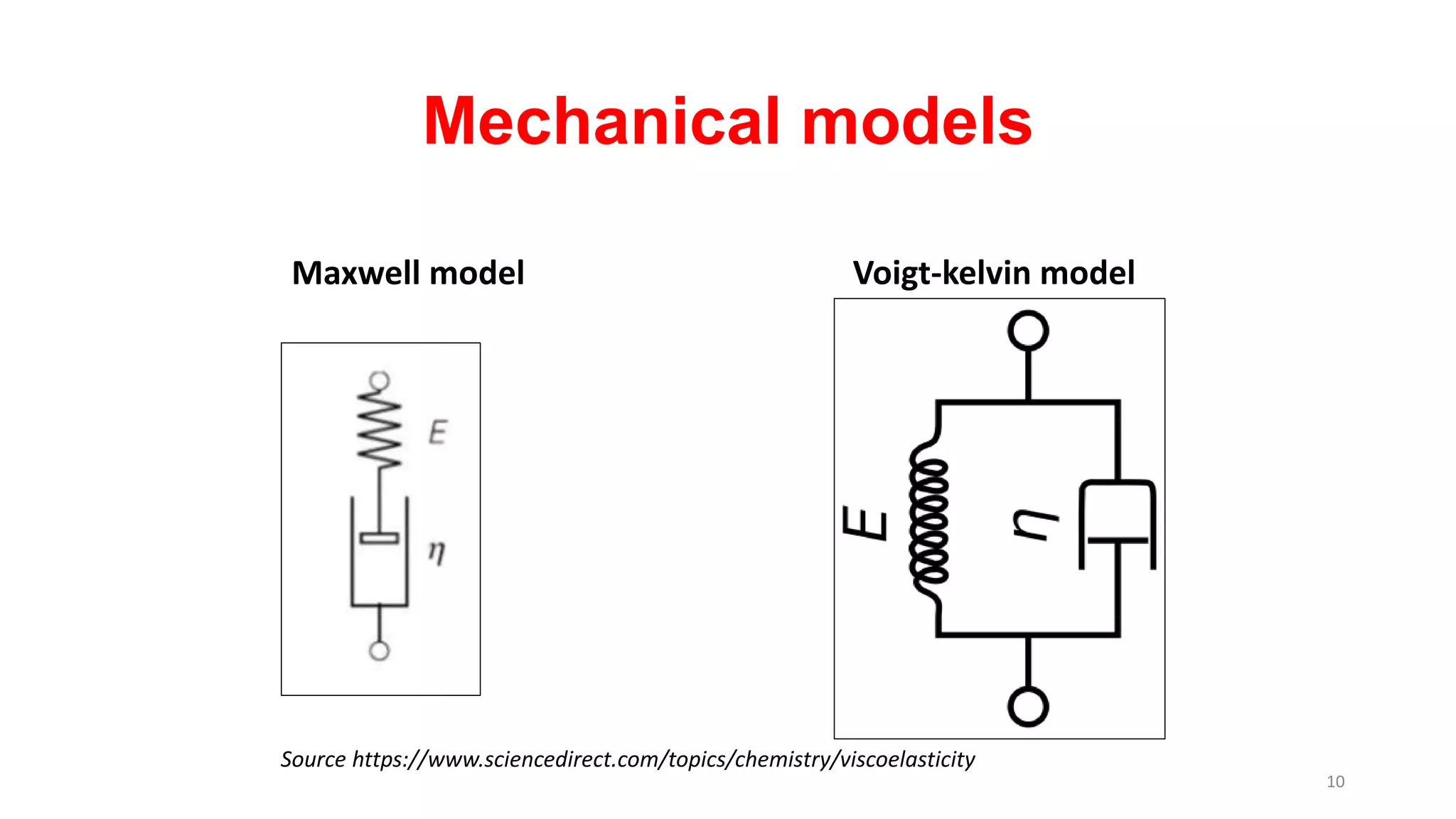
Mechanical models
Maxwell model Voigt-kelvin model
Source https://www.sciencedirect.com/topics/chemistry/viscoelasticity
10
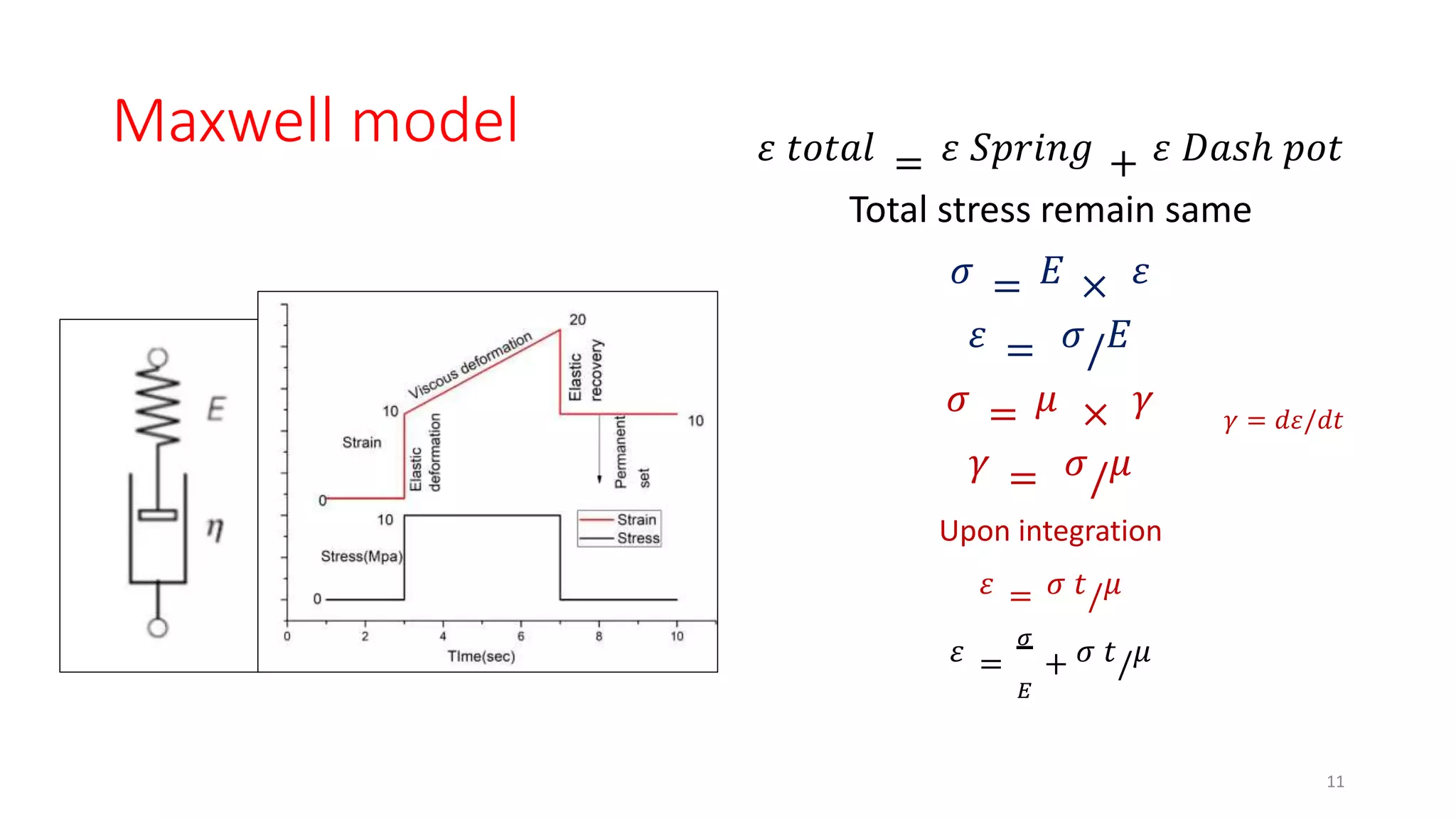
Maxwell model 𝜀 𝑡𝑜𝑡𝑎𝑙 = 𝜀 𝑆𝑝𝑟𝑖𝑛𝑔 + 𝜀 𝐷𝑎𝑠ℎ 𝑝𝑜𝑡
Total stress remain same
𝜎 = 𝐸 × 𝜀
𝜀 = 𝜎/ 𝐸
𝜎 = 𝜇 × 𝛾
𝛾 = 𝜎/ 𝜇
Upon integration
𝜀 = 𝜎 𝑡/ 𝜇
𝜀 =
𝜎
𝐸
+ 𝜎 𝑡/ 𝜇
𝛾 = 𝑑𝜀/𝑑𝑡
11
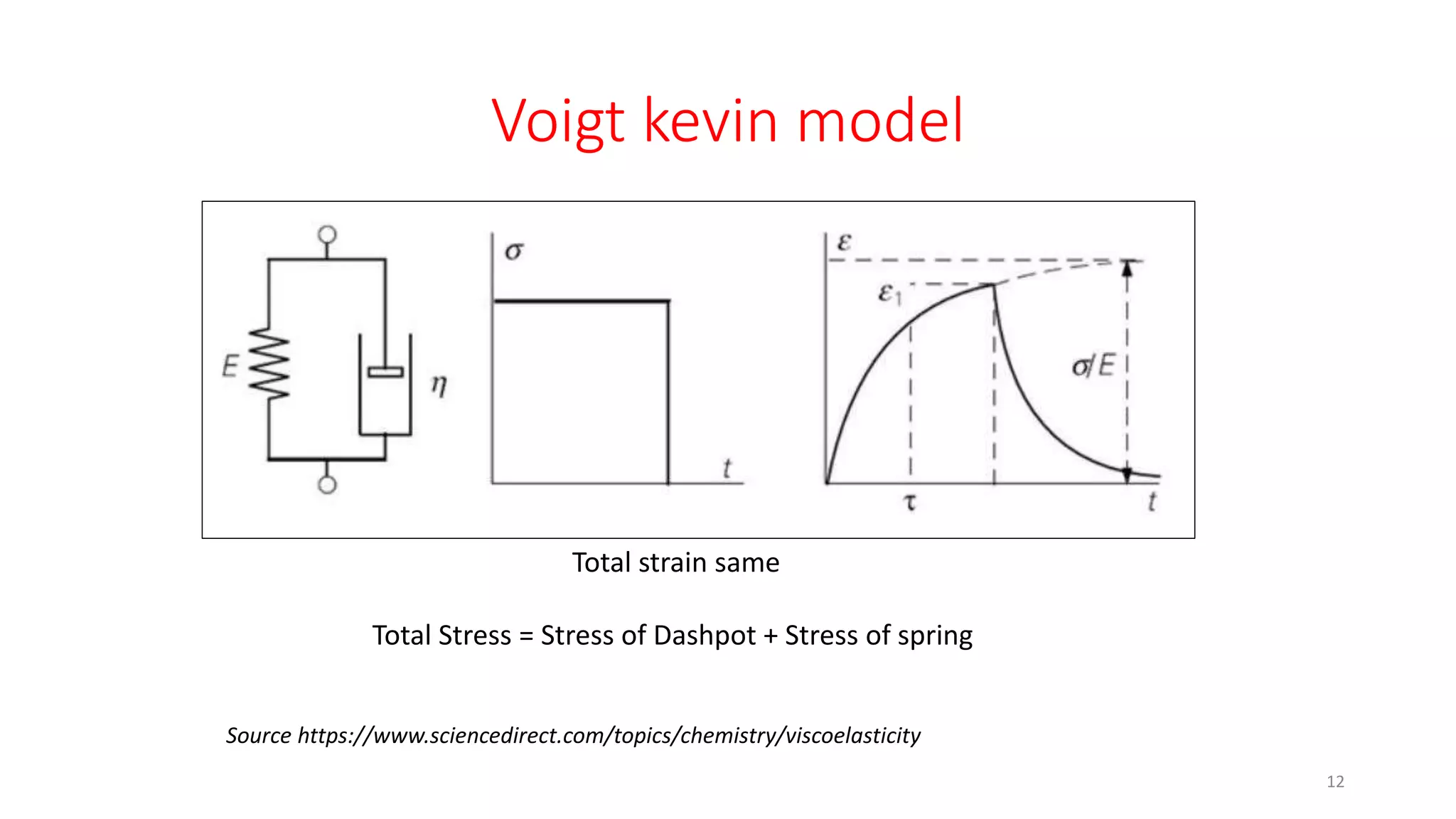
Voigt kevin model
Total strain same
Total Stress = Stress of Dashpot + Stress of spring
Source https://www.sciencedirect.com/topics/chemistry/viscoelasticity
12
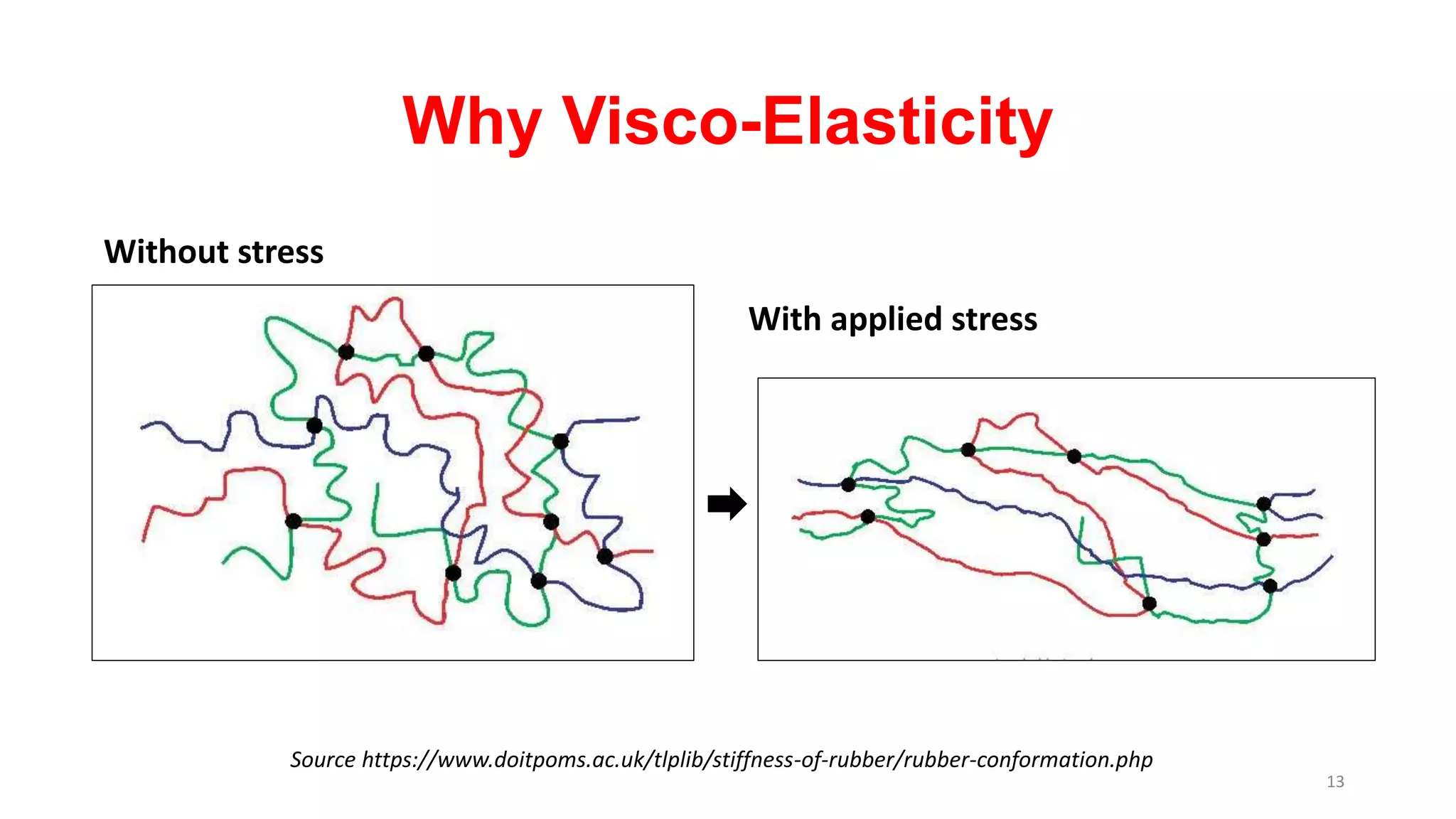
Why Visco-Elasticity
Without stress
With applied stress
Source https://www.doitpoms.ac.uk/tlplib/stiffness-of-rubber/rubber-conformation.php
13
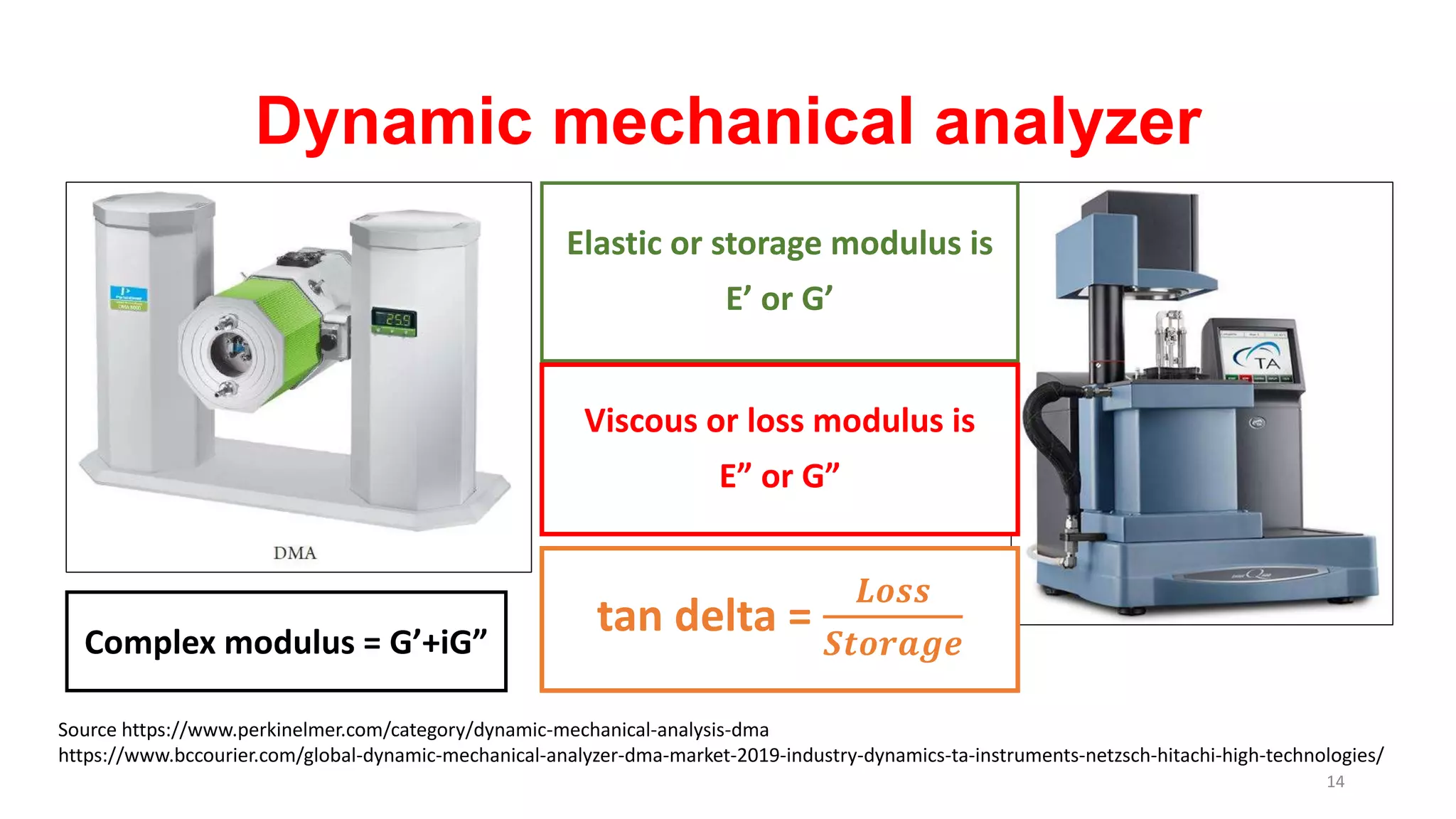
Dynamic mechanical analyzer
Elastic or storage modulus is
E’ or G’
Viscous or loss modulus is
E” or G”
tan delta =
𝑳𝒐𝒔𝒔
𝑺𝒕𝒐𝒓𝒂𝒈𝒆
Source https://www.perkinelmer.com/category/dynamic-mechanical-analysis-dma
https://www.bccourier.com/global-dynamic-mechanical-analyzer-dma-market-2019-industry-dynamics-ta-instruments-netzsch-hitachi-high-technologies/
Complex modulus = G’+iG”
14
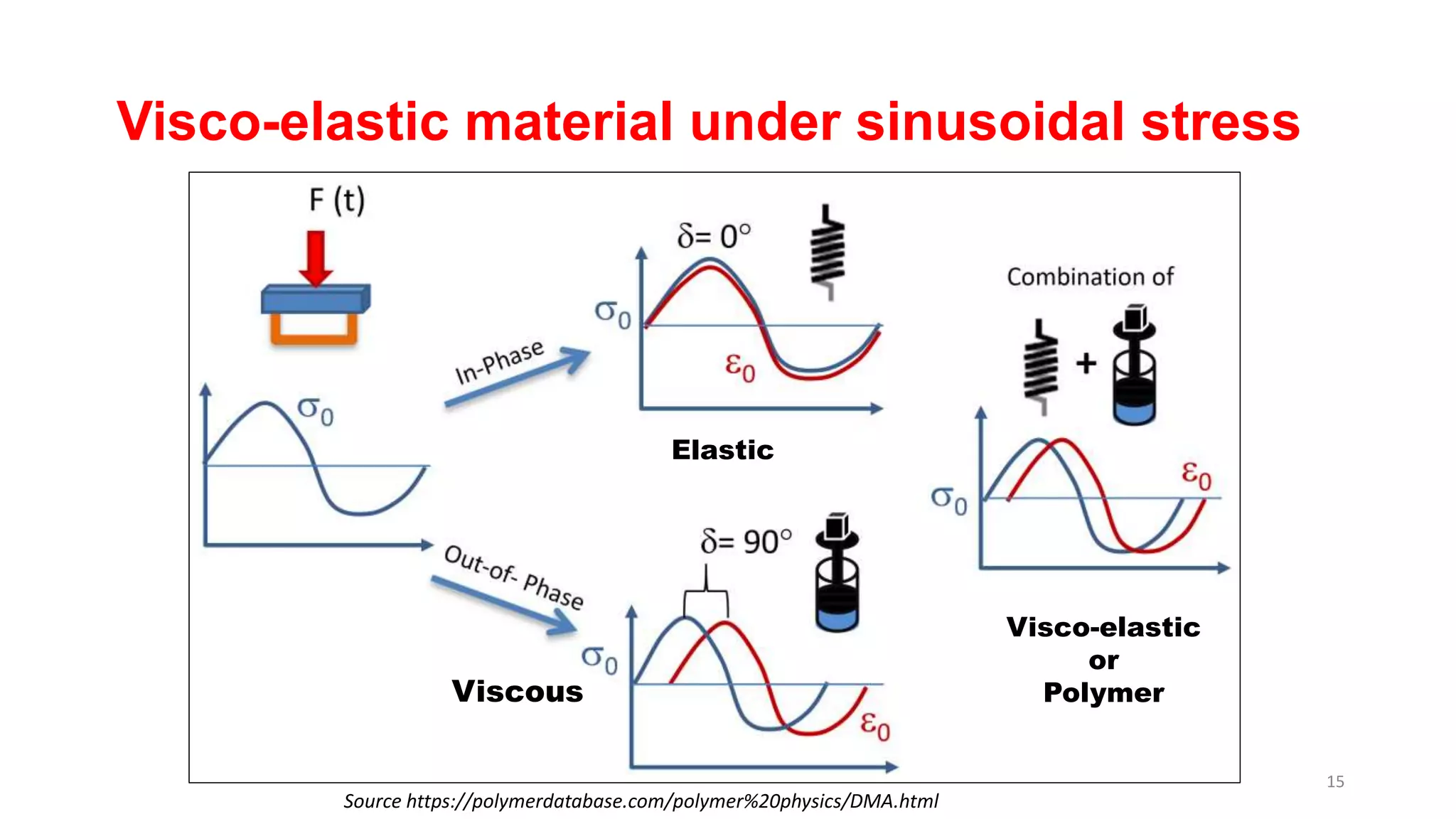
Visco-elastic material under sinusoidal stress
Elastic
Viscous
Visco-elastic
or
Polymer
Source https://polymerdatabase.com/polymer%20physics/DMA.html
15
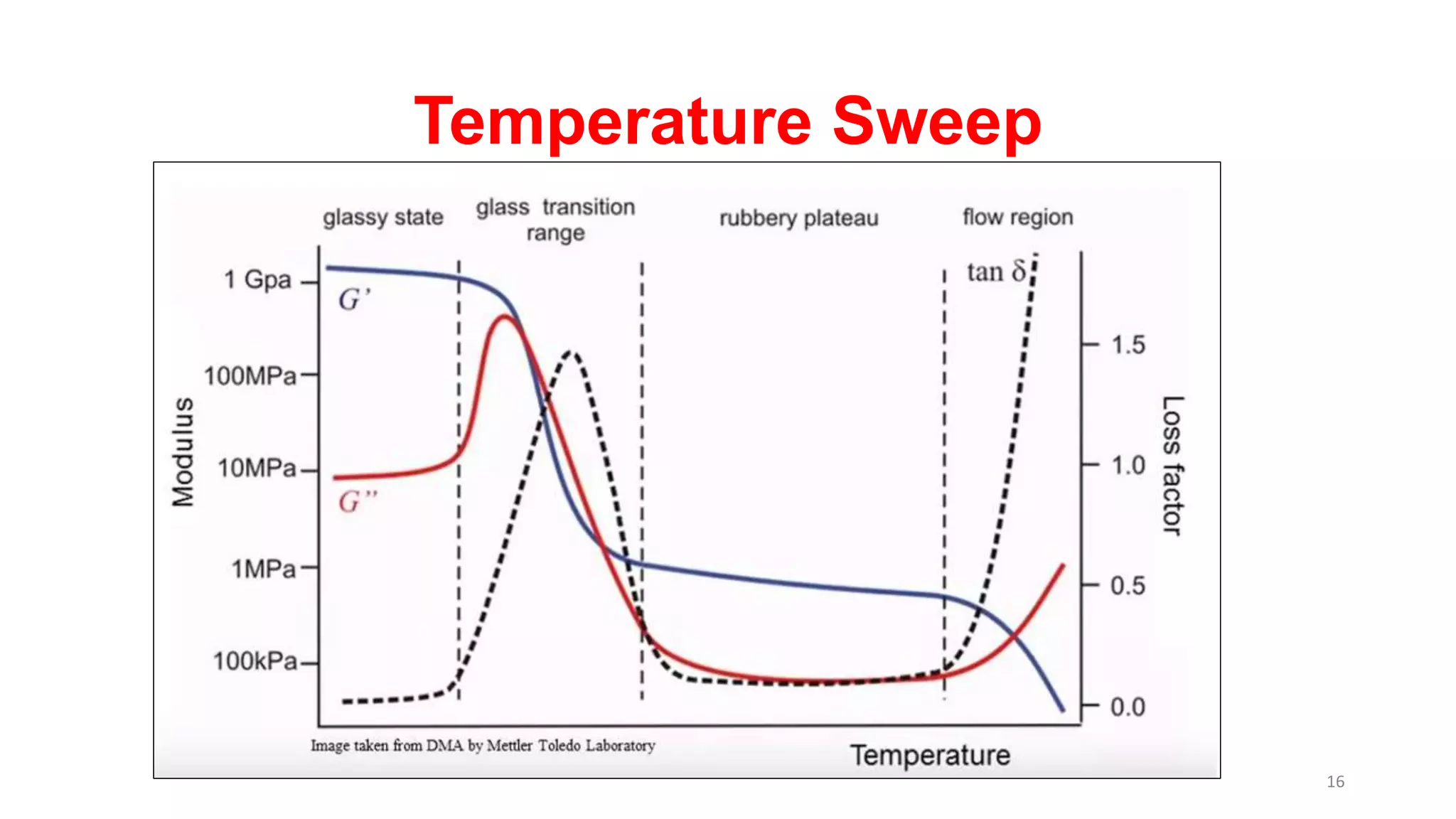
Temperature Sweep
16
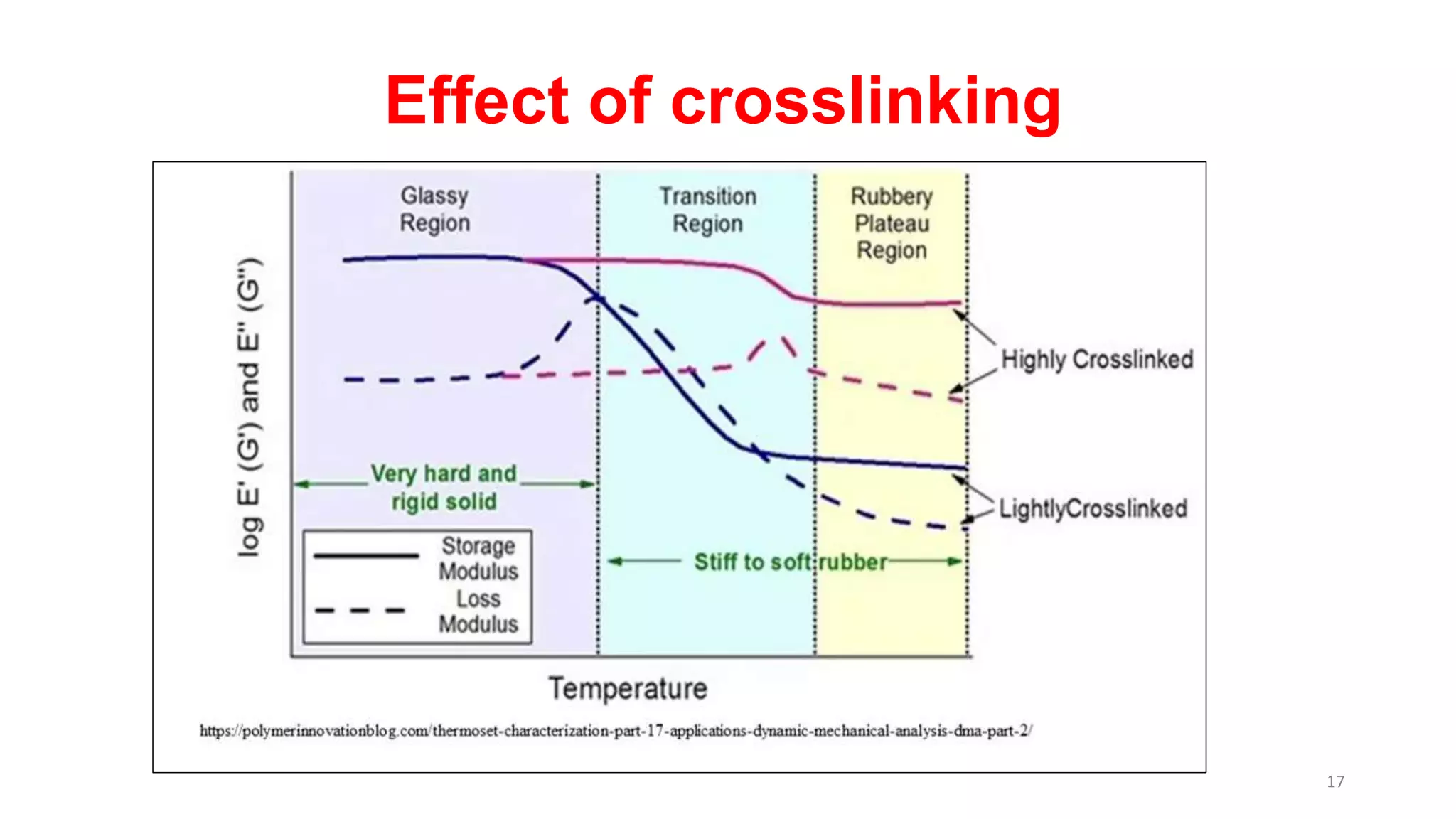
Effect of crosslinking
17
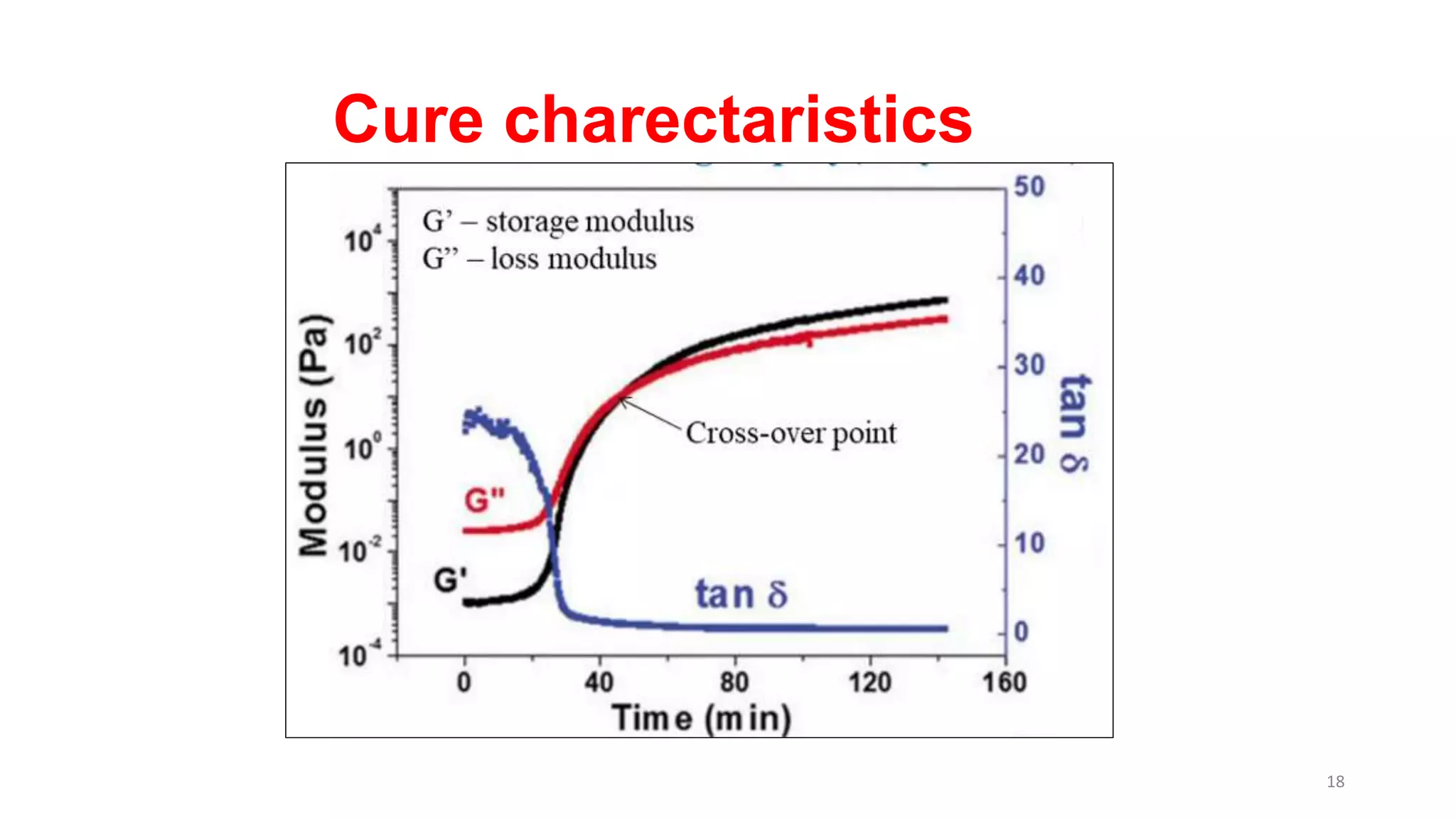
Cure charectaristics
18
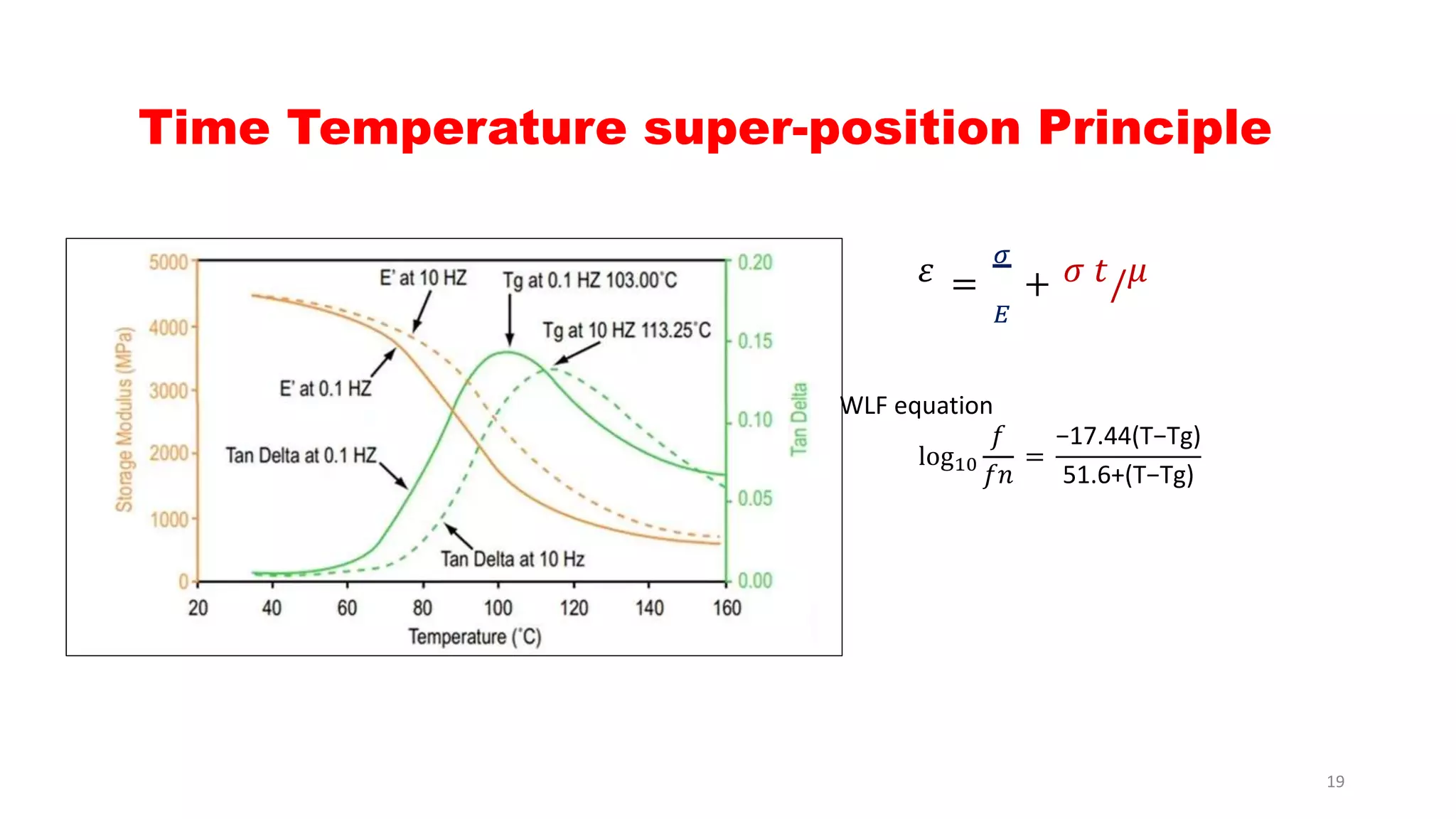
Time Temperature super-position Principle
𝜀 =
𝜎
𝐸
+ 𝜎 𝑡/ 𝜇
WLF equation
log10
𝑓
𝑓𝑛
=
−17.44(T−Tg)
51.6+(T−Tg)
19
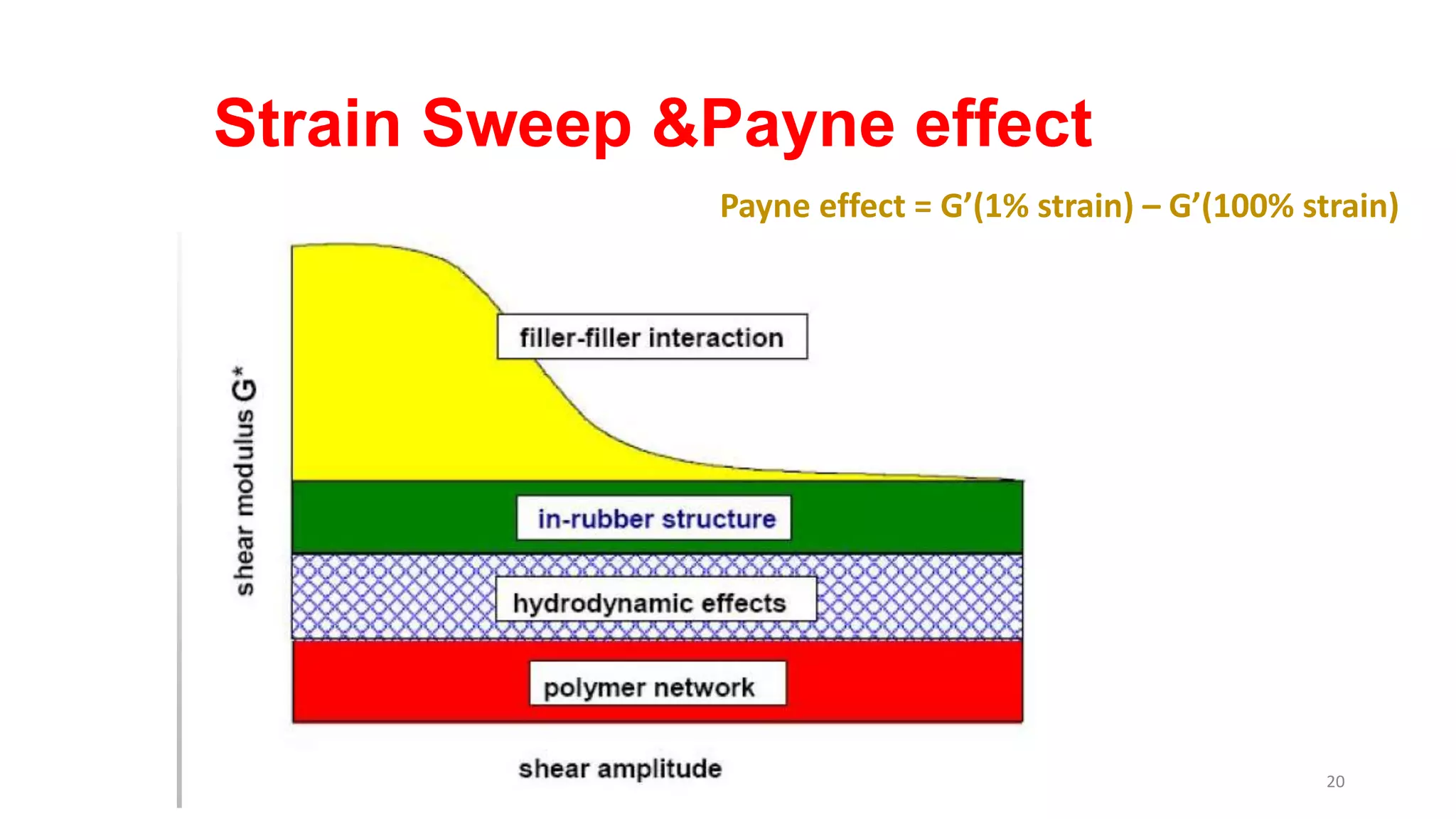
Strain Sweep &Payne effect
Payne effect = G’(1% strain) – G’(100% strain)
20
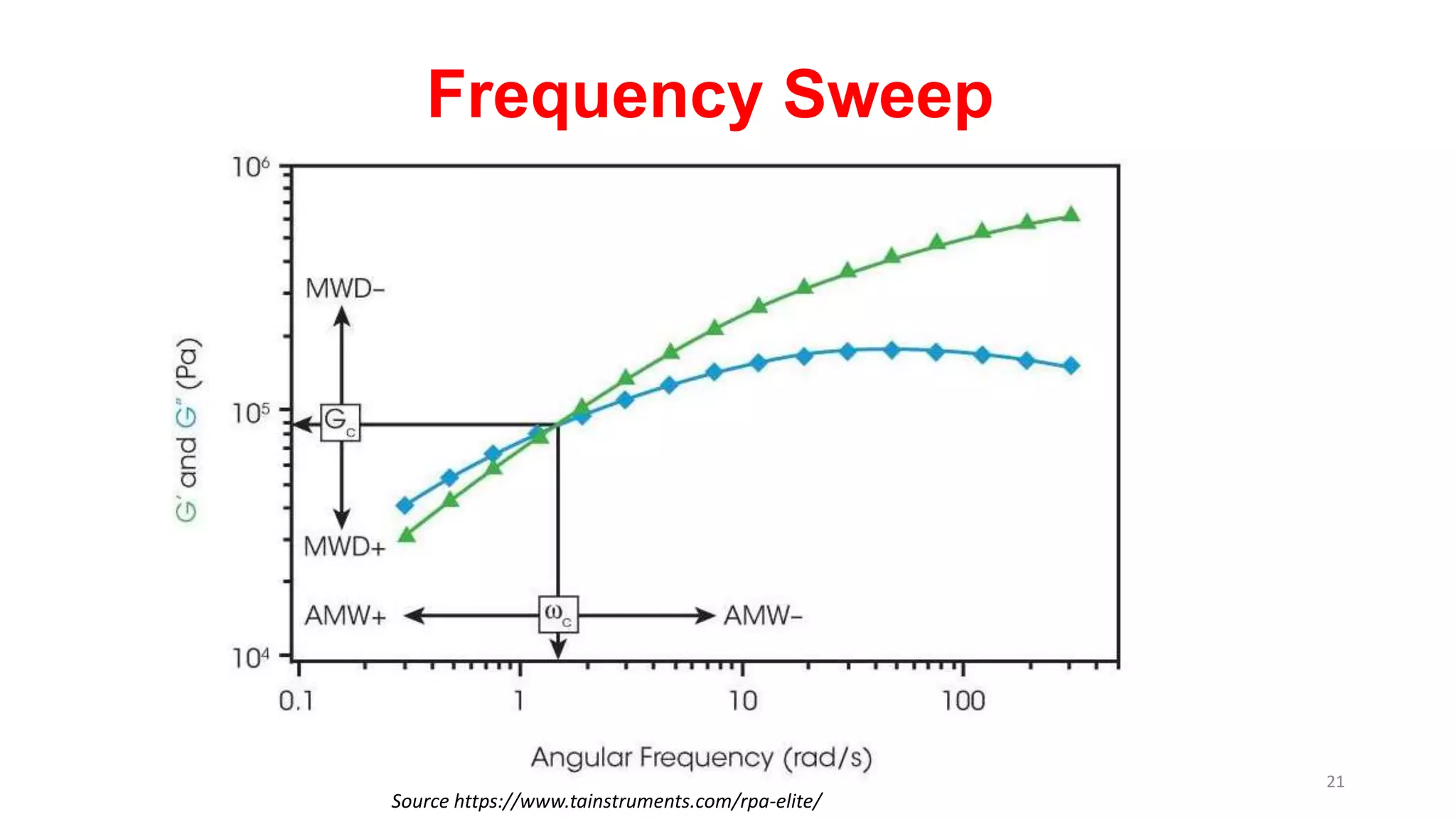
Frequency Sweep
Source https://www.tainstruments.com/rpa-elite/
21
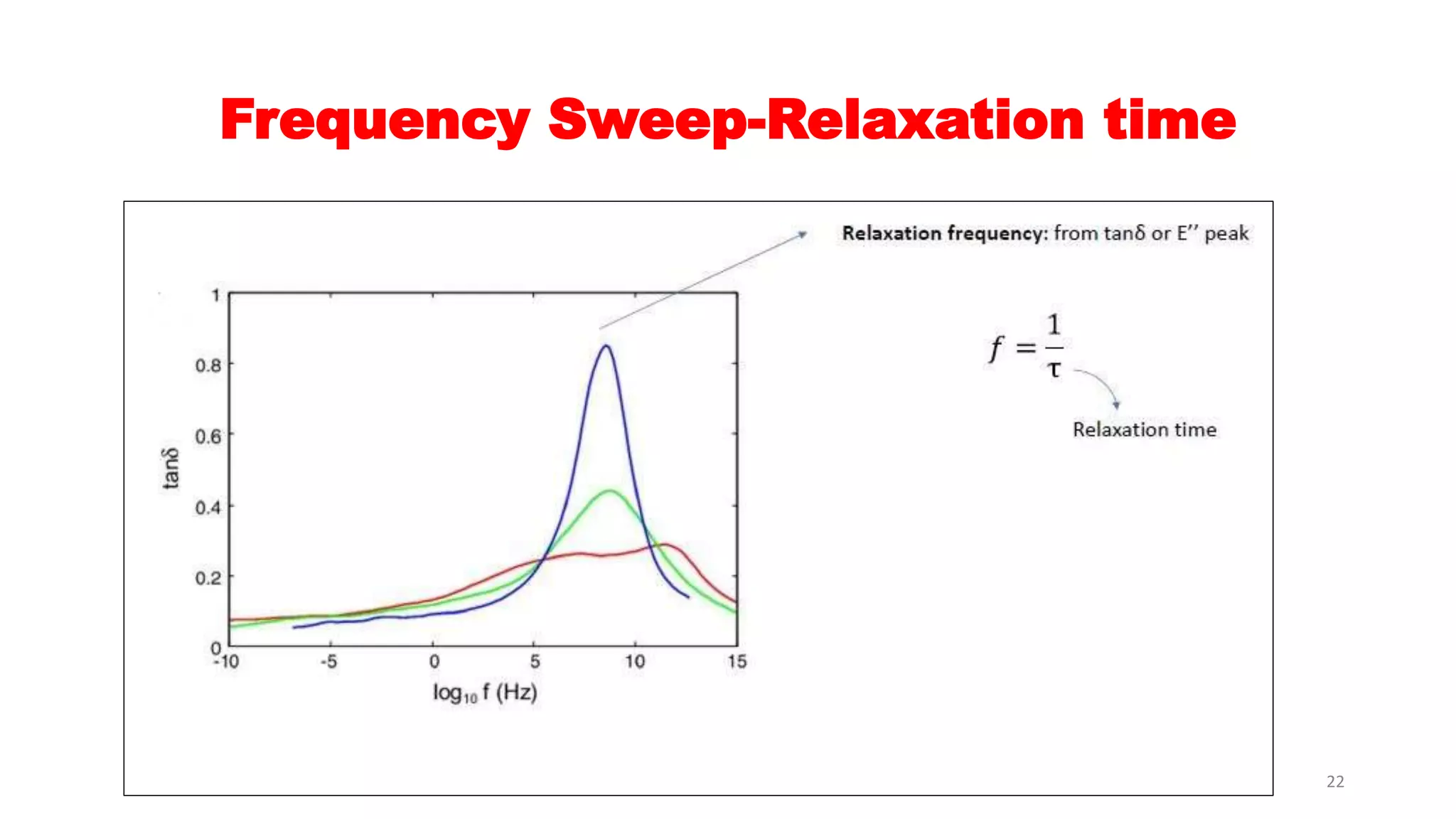
Frequency Sweep-Relaxation time
22
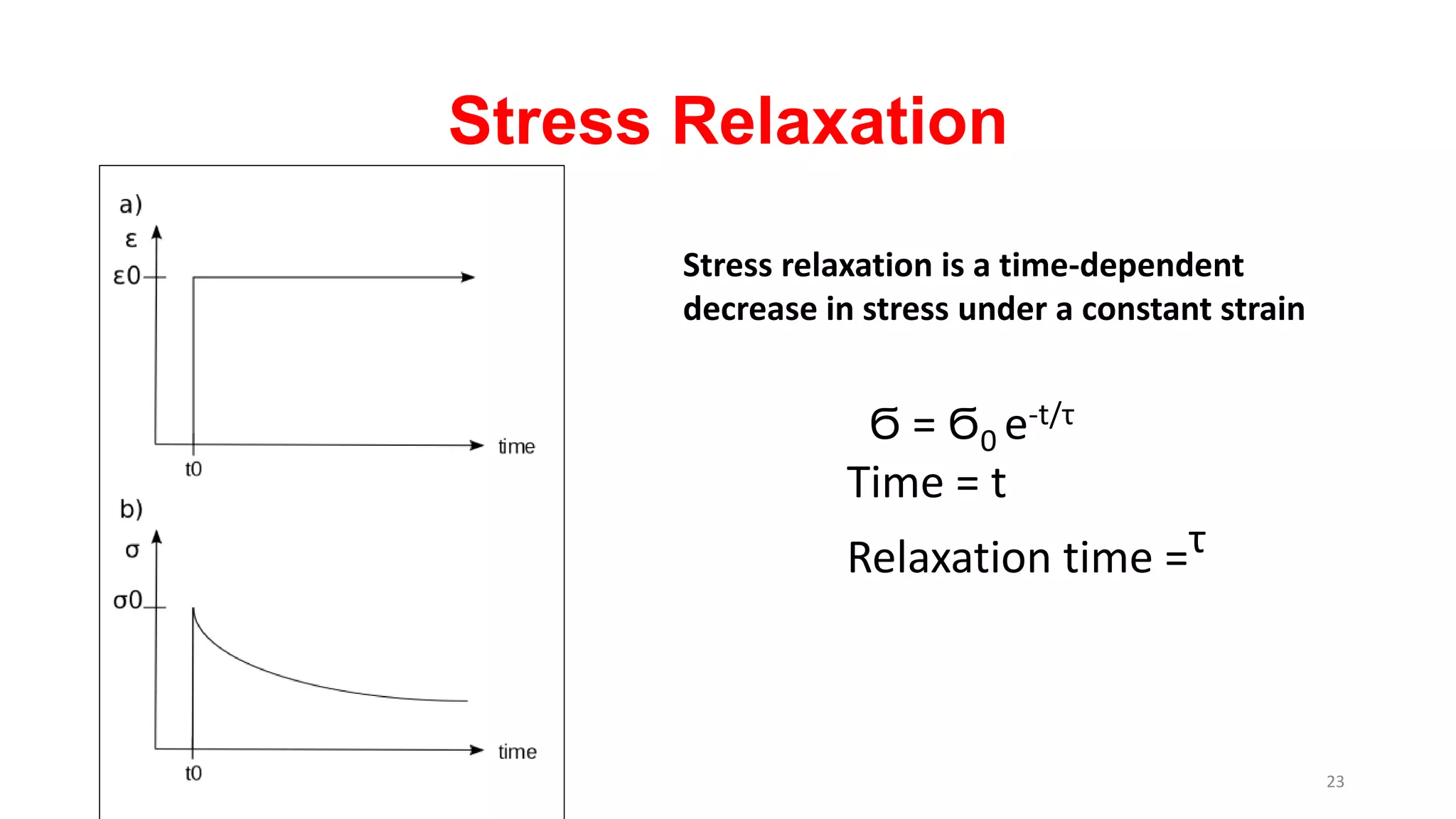
Stress Relaxation
Stress relaxation is a time-dependent
decrease in stress under a constant strain
Ϭ = Ϭ0 e-t/τ
Time = t
Relaxation time =τ
23
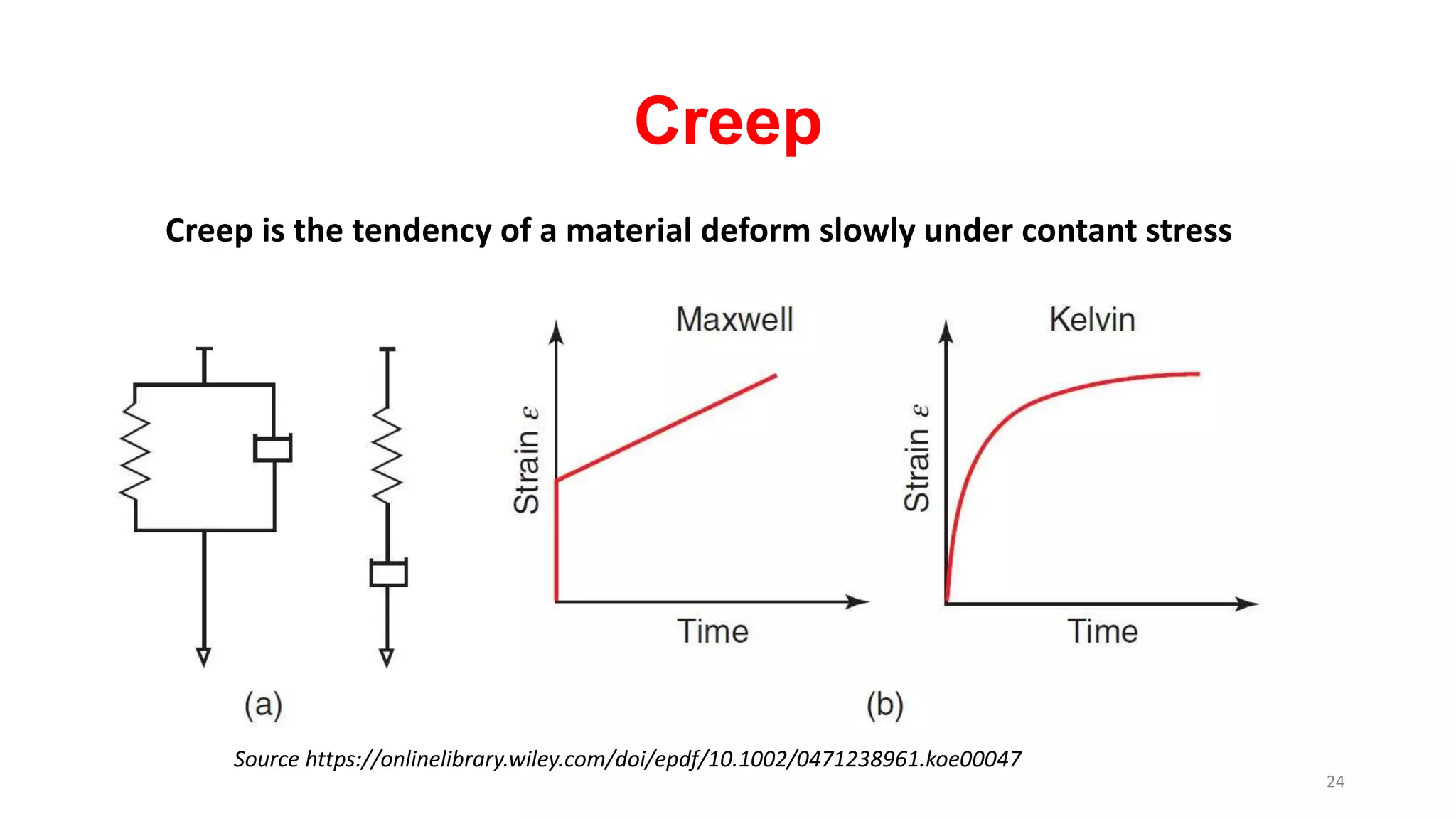
Creep
Creep is the tendency of a material deform slowly under contant stress
Source https://onlinelibrary.wiley.com/doi/epdf/10.1002/0471238961.koe00047
24
Question and Answers
25
Q. Choose highly elastic material
from the options
a. Steel
b. Rubber
c. Fibre
d. Plastic
26
Q.
If a rubber ball can rebouce back upto 80 cm
after droping height from 1 meter.

Then what will be the aproximate phase angle
between its storage modulas and loss
modulus
27
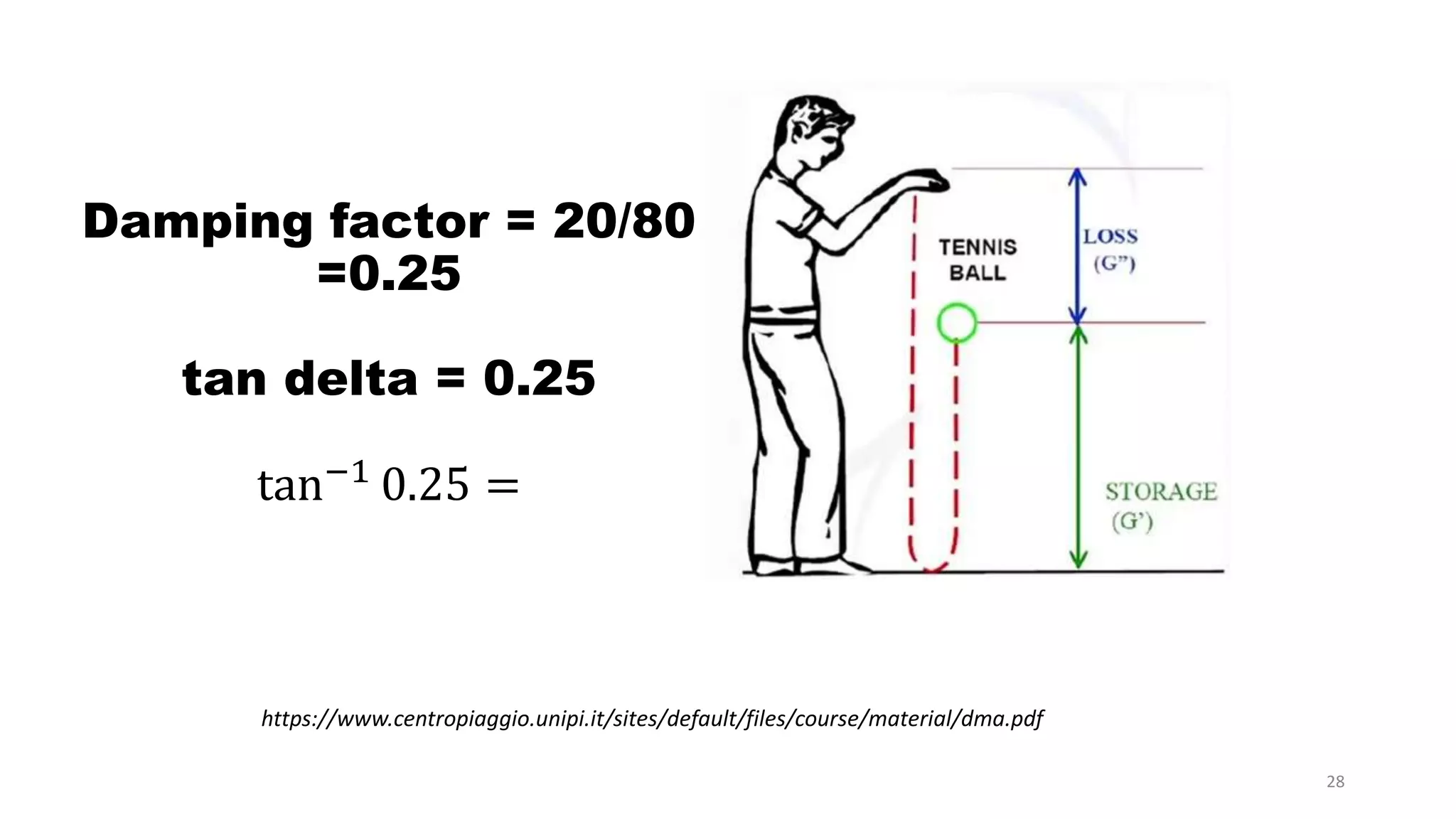
Damping factor = 20/80
=0.25
tan delta = 0.25
tan−1
0.25 =
https://www.centropiaggio.unipi.it/sites/default/files/course/material/dma.pdf
28
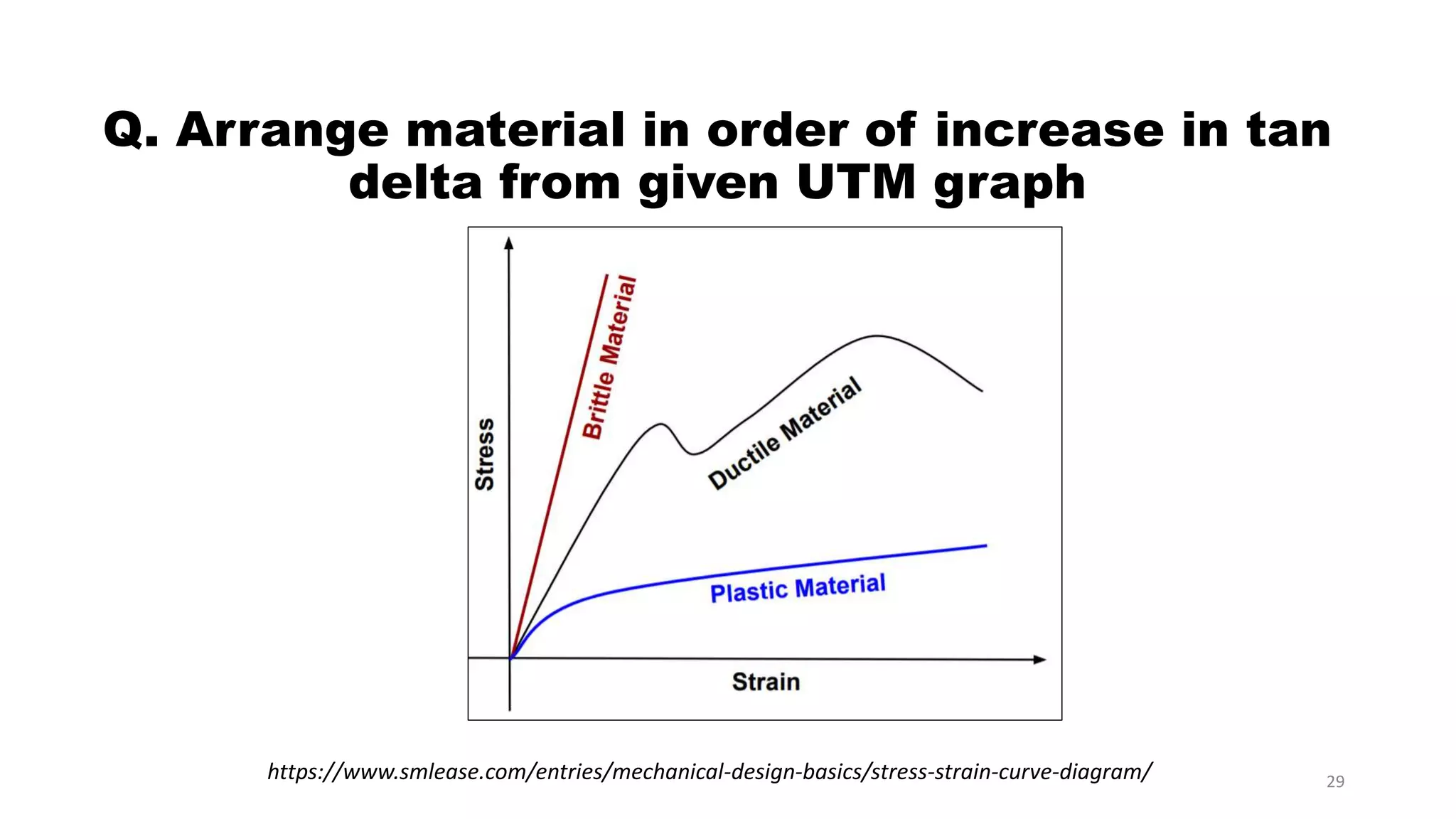
Q. Arrange material in order of increase in tan
delta from given UTM graph
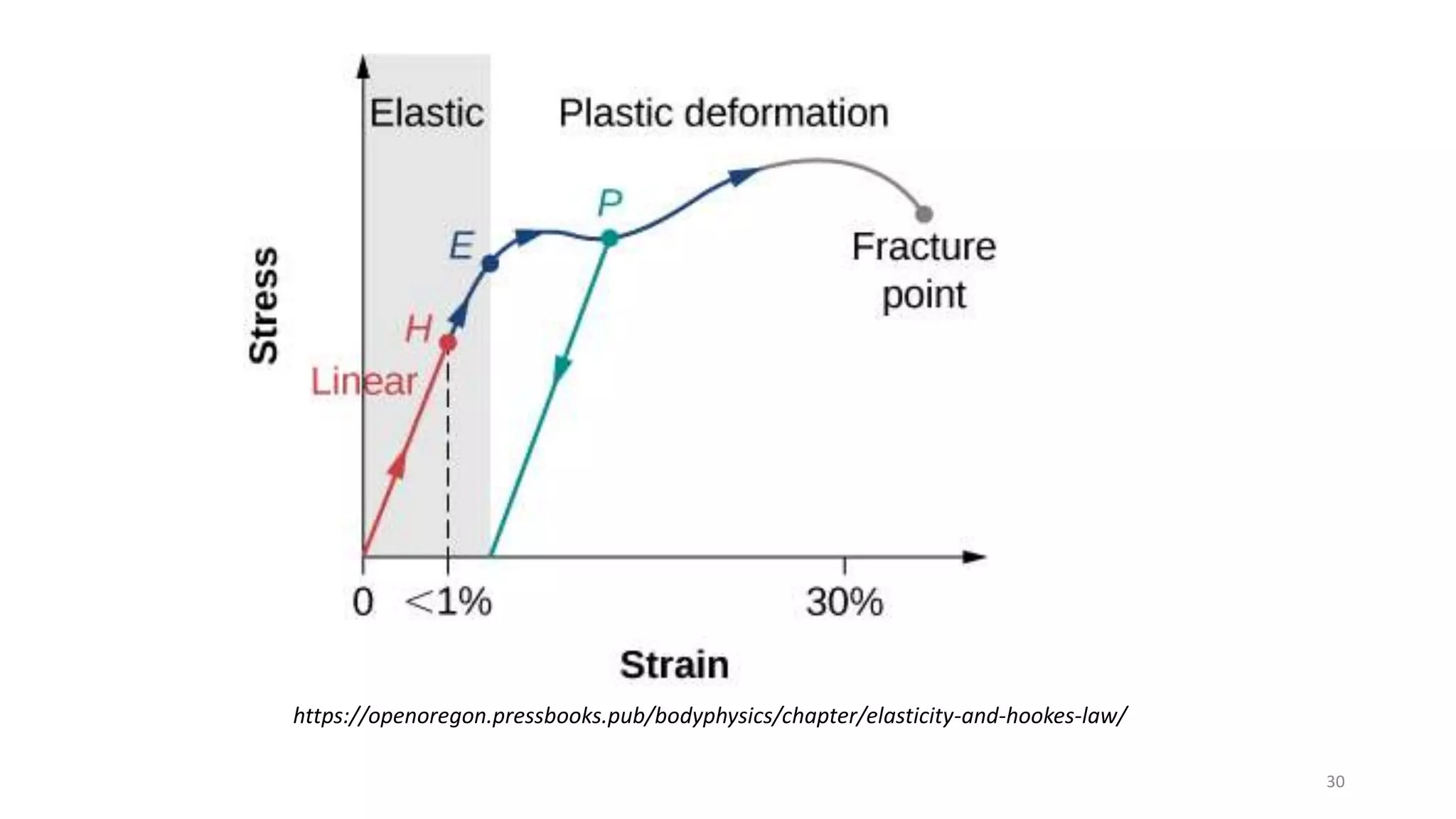
https://www.smlease.com/entries/mechanical-design-basics/stress-strain-curve-diagram/ 29
https://openoregon.pressbooks.pub/bodyphysics/chapter/elasticity-and-hookes-law/
30
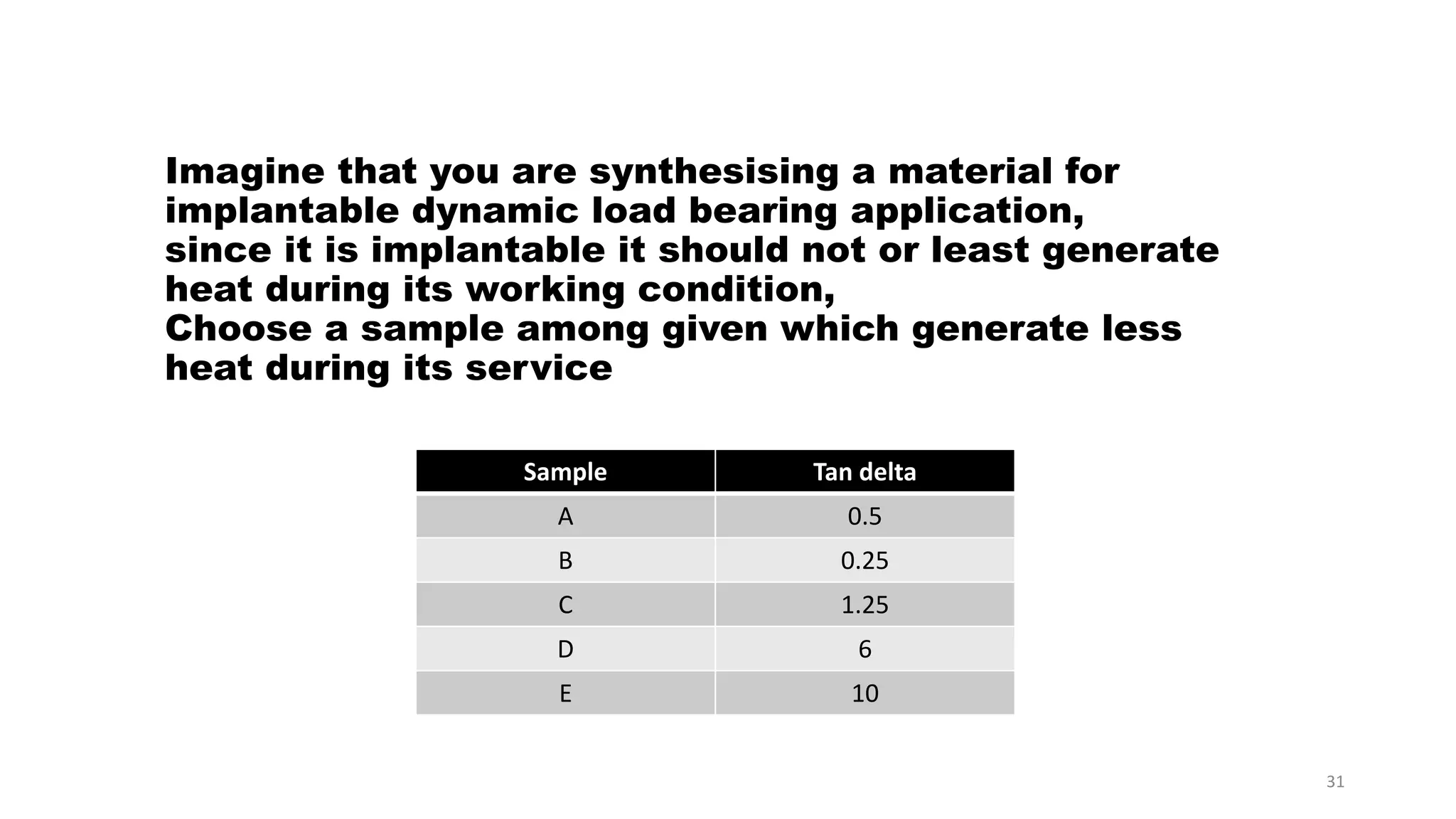
Imagine that you are synthesising a material for
implantable dynamic load bearing application,
since it is implantable it should not or least generate
heat during its working condition,
Choose a sample among given which generate less
heat during its service
Sample Tan delta
A 0.5
B 0.25
C 1.25
D 6
E 10
31
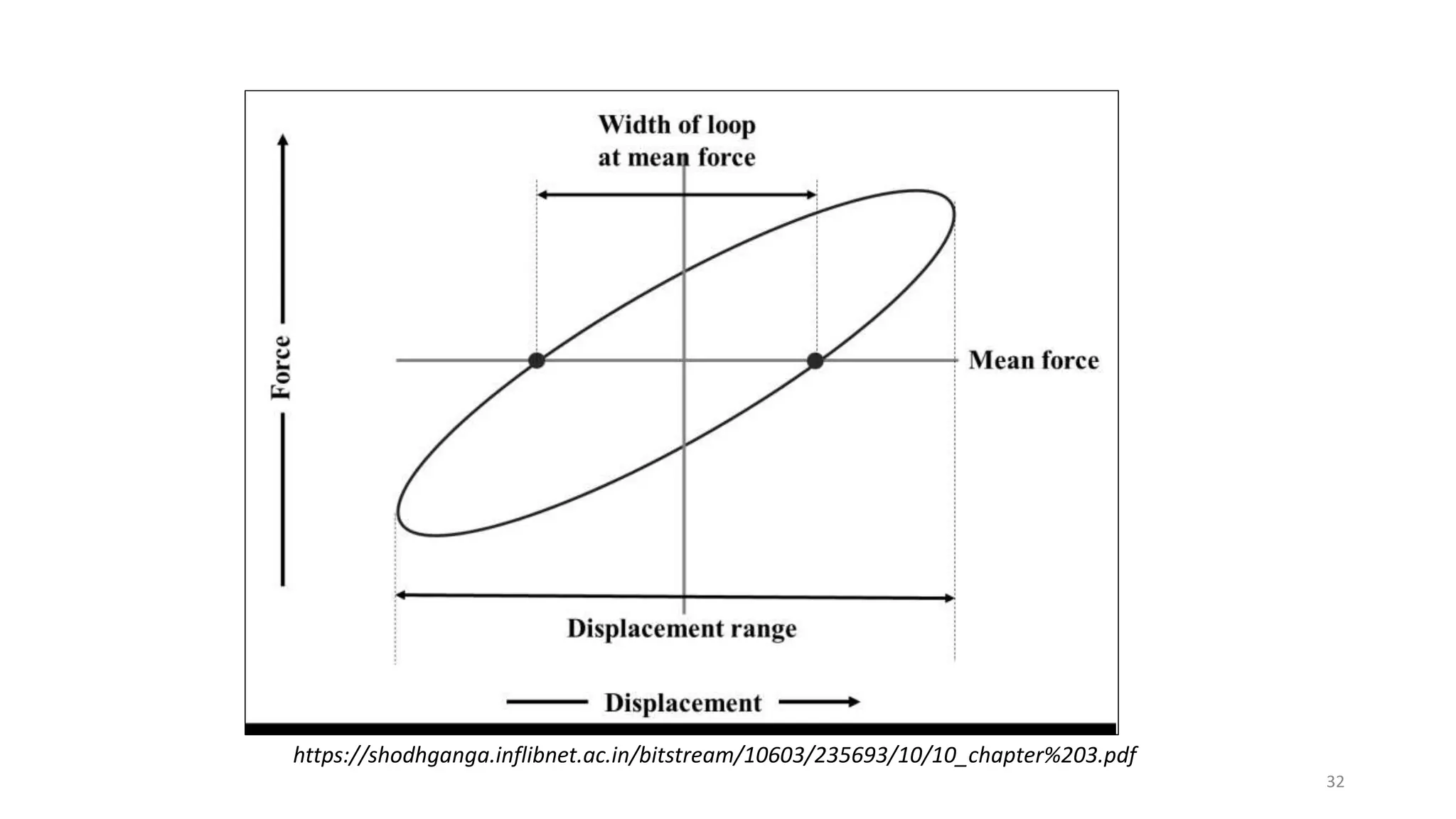
https://shodhganga.inflibnet.ac.in/bitstream/10603/235693/10/10_chapter%203.pdf
32
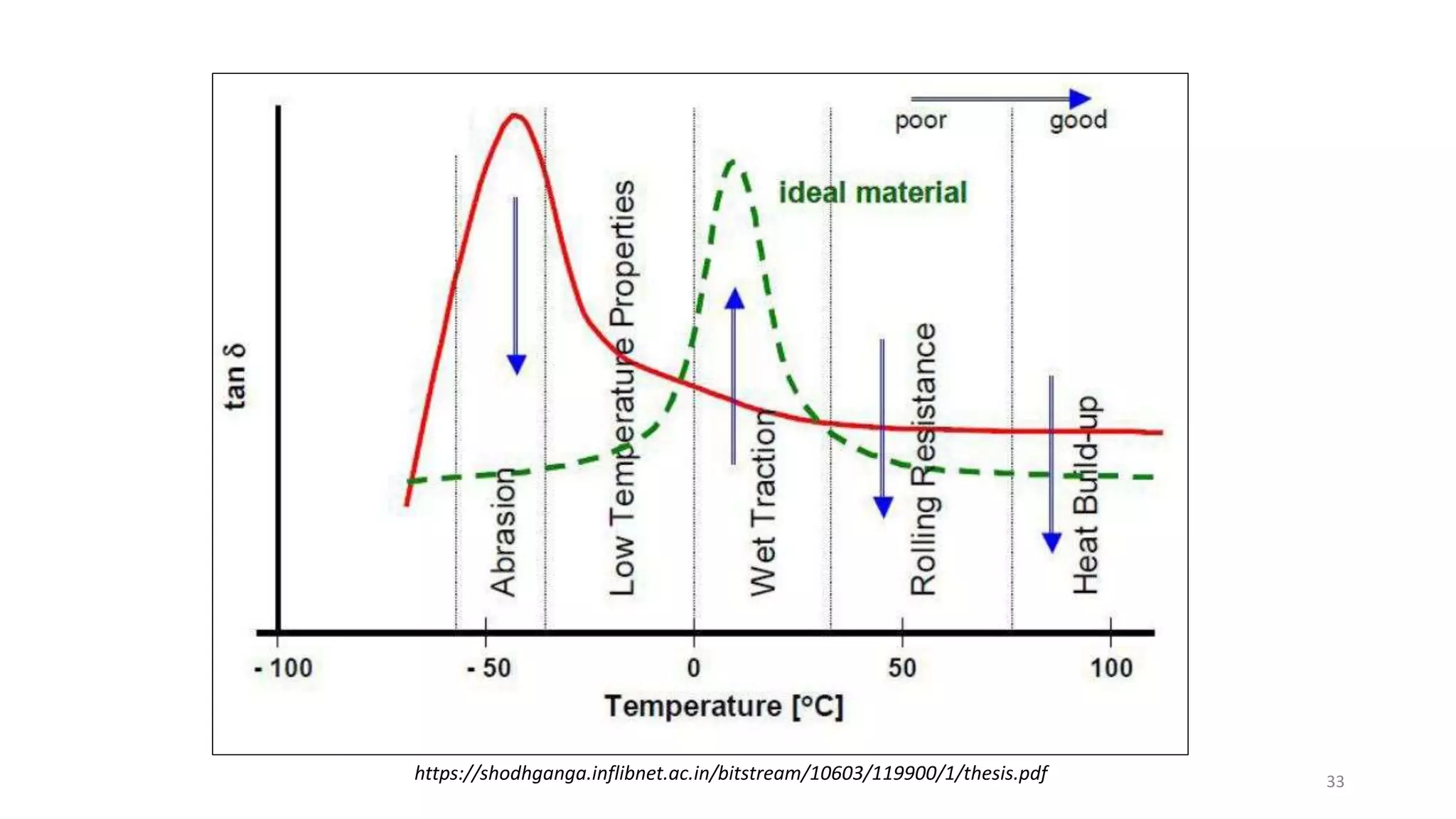
https://shodhganga.inflibnet.ac.in/bitstream/10603/119900/1/thesis.pdf 33
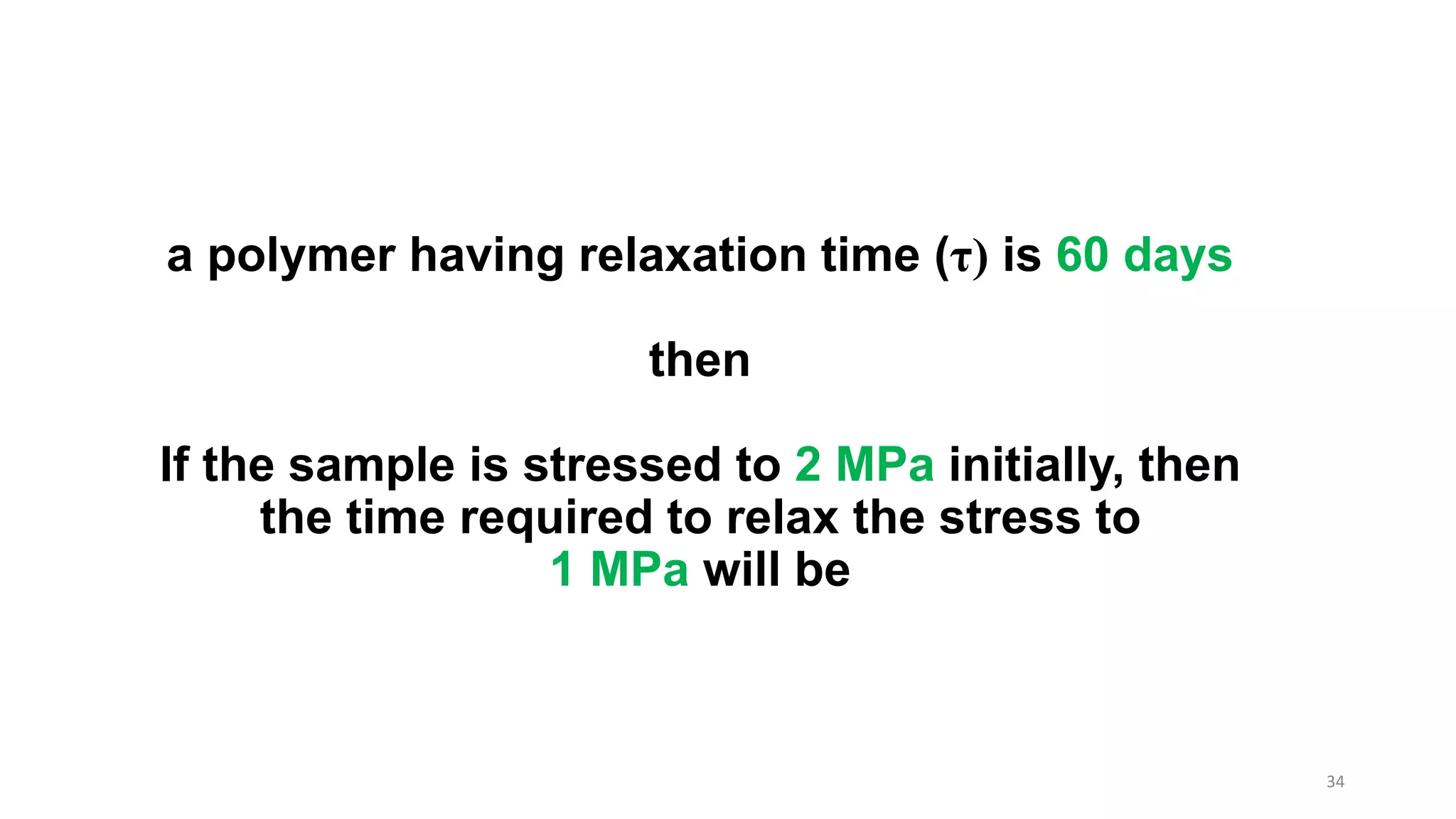
a polymer having relaxation time (τ) is 60 days
then
If the sample is stressed to 2 MPa initially, then
the time required to relax the stress to
1 MPa will be
34
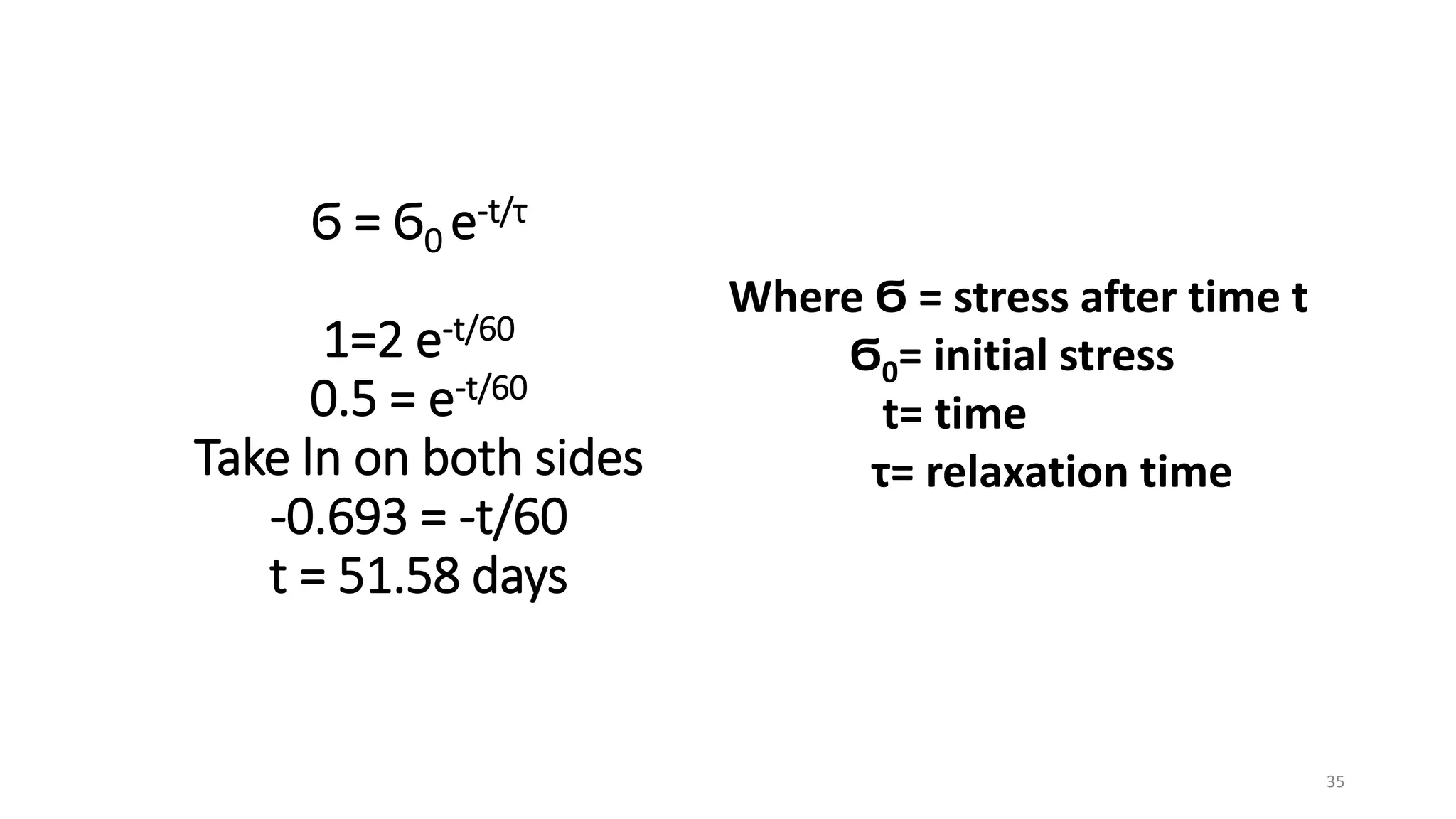
Ϭ = Ϭ0 e-t/τ
1=2 e-t/60
0.5 = e-t/60
Take ln on both sides
-0.693 = -t/60
t = 51.58 days
Where Ϭ = stress after time t
Ϭ0= initial stress
t= time
τ= relaxation time
35
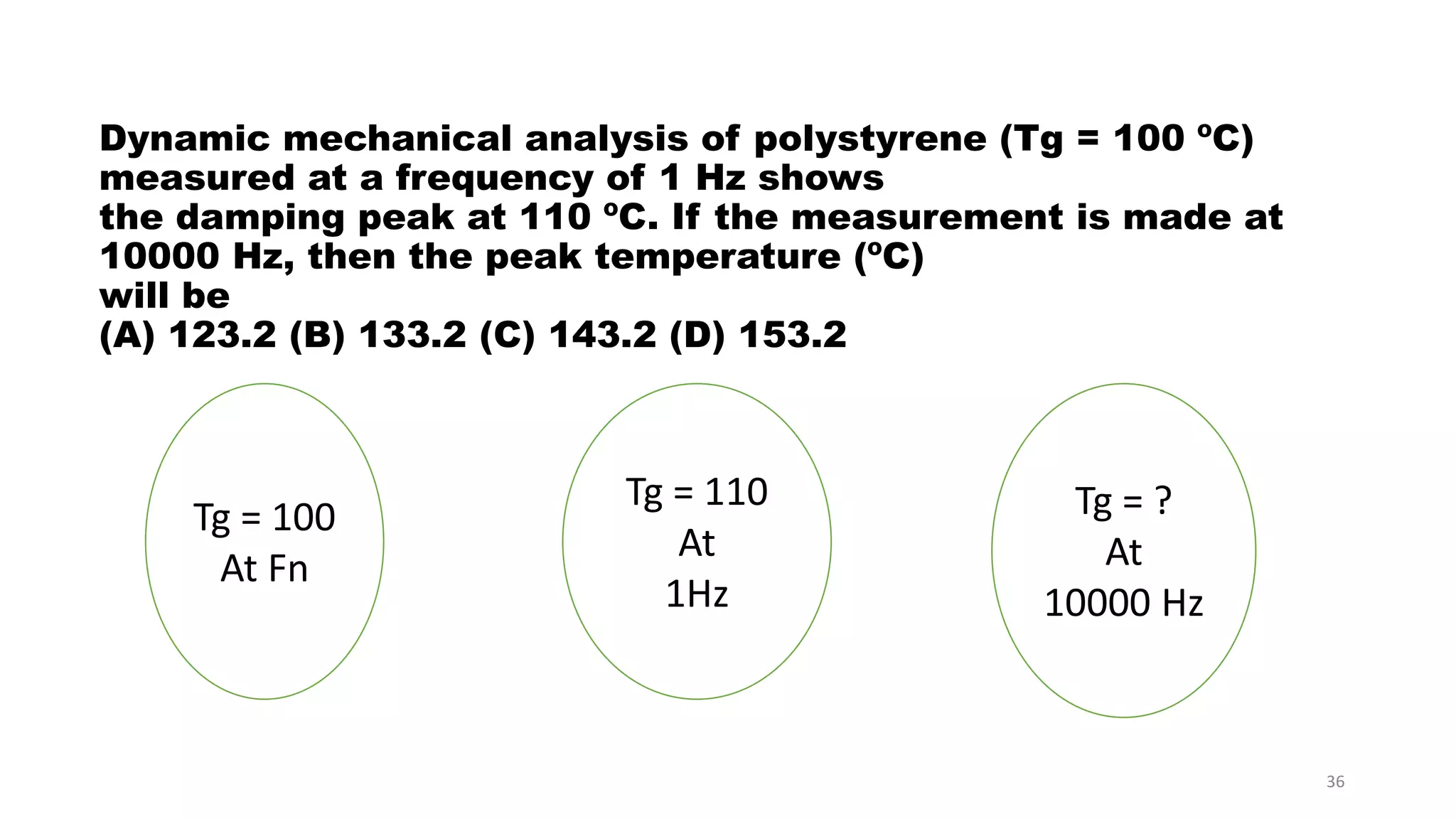
Dynamic mechanical analysis of polystyrene (Tg = 100 ºC)
measured at a frequency of 1 Hz shows
the damping peak at 110 ºC. If the measurement is made at
10000 Hz, then the peak temperature (ºC)
will be
(A) 123.2 (B) 133.2 (C) 143.2 (D) 153.2
Tg = 100
At Fn
Tg = 110
At
1Hz
Tg = ?
At
10000 Hz
36
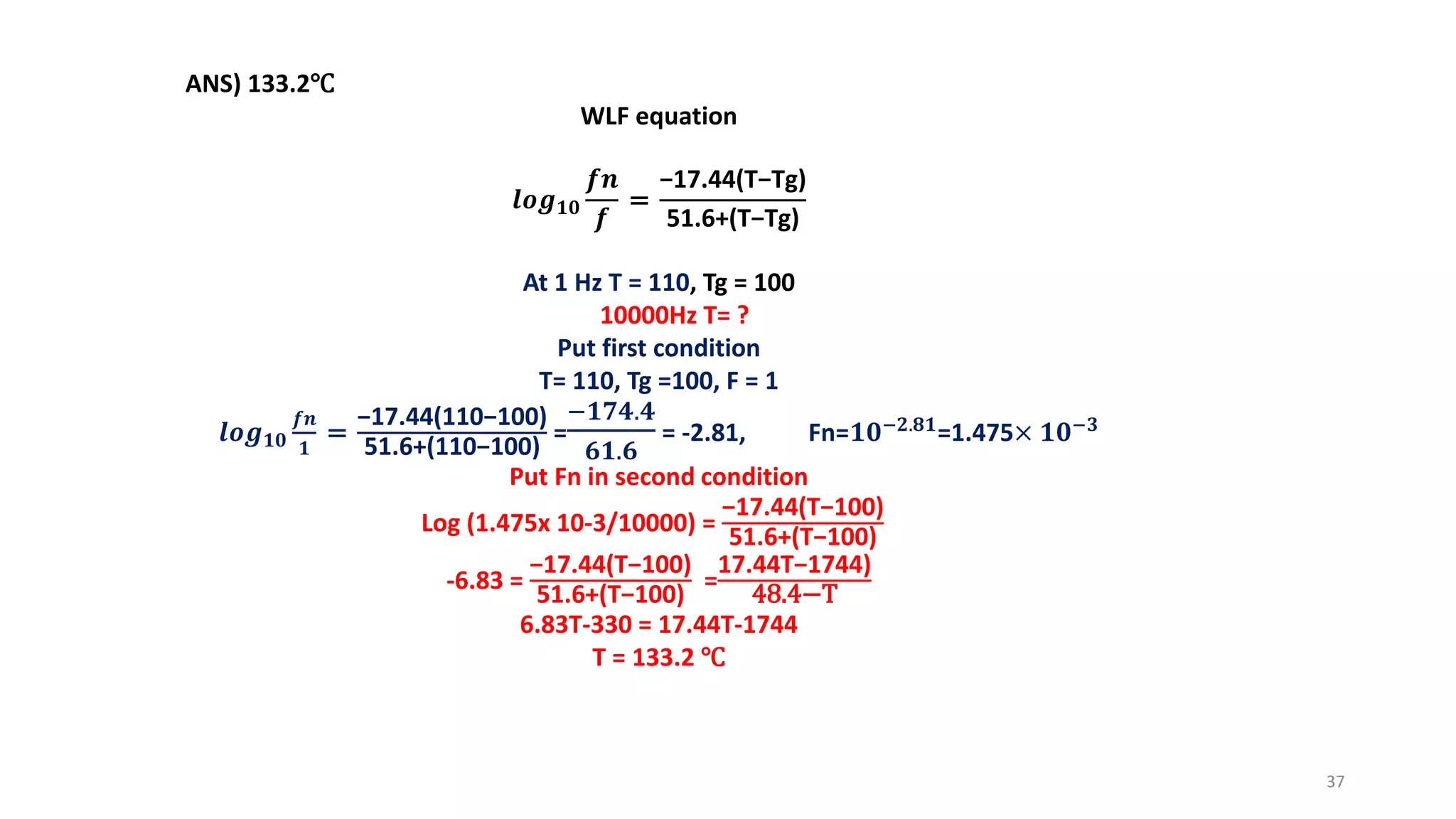
ANS) 133.2℃
WLF equation
𝒍𝒐𝒈 𝟏𝟎
𝒇𝒏
𝒇
=
−17.44(T−Tg)
51.6+(T−Tg)
At 1 Hz T = 110, Tg = 100
10000Hz T= ?
Put first condition
T= 110, Tg =100, F = 1
𝒍𝒐𝒈 𝟏𝟎
𝒇𝒏
𝟏
=
−17.44(110−100)
51.6+(110−100)
=
−𝟏𝟕𝟒.𝟒
𝟔𝟏.𝟔
= -2.81, Fn=𝟏𝟎−𝟐.𝟖𝟏
=1.475× 𝟏𝟎−𝟑
Put Fn in second condition
Log (1.475x 10⁻³/10000) =
−17.44(T−100)
51.6+(T−100)
-6.83 =
−17.44(T−100)
51.6+(T−100)
=
17.44T−1744)
48.4−T
6.83T-330 = 17.44T-1744
T = 133.2 ℃
37
Thank you
38

Dynamic mechanical analysis

  • 1.
  • 2.
    Contents • Visco-Elasticity • DMA •Temperature sweep • Strain sweep • Frequency sweep • Stress relaxation • Creep • Miscellenous calculations 2
  • 3.
    Uninstalling Chain theory •Polymers are complex chains • Property of polymers depends on chemical structure,molecular weight, side groups etc • Prediction of final property is complex 3
  • 4.
    Installing visco-elastic theory •Polymers are just combination of Viscous componant and elastic componant • Property of polymers depends on viscous componant, elastc componant and composition of this componats • Prediction of final property is simple 4
  • 5.
    Visco-Elasticity Viscous material Elasticmaterial Viscosity + Elasticity = Visco-elasticity Source https://www.machinerylubrication.com/Read/294/absolute-kinematic-viscosity https://www.sciencephoto.com/media/980971/view 5
  • 6.
    Elasticity – Theability of the material to return its original shape after deformation 𝑺𝒕𝒓𝒆𝒔𝒔 ∞ 𝑺𝒕𝒓𝒂𝒊𝒏 𝑺𝒕𝒓𝒆𝒔𝒔 = 𝑴𝒐𝒅𝒖𝒍𝒂𝒔 𝒐𝒇 𝒆𝒍𝒂𝒔𝒕𝒊𝒄𝒕𝒚 × 𝐒𝐭𝐫𝐚𝐢𝐧 Instatanious Temperory 6
  • 7.
    Viscous material- Stresscreate flow 𝑆𝑡𝑟𝑒𝑠𝑠 ∝ 𝑆𝑡𝑟𝑎𝑖𝑛 𝑟𝑎𝑡𝑒 𝑆𝑡𝑟𝑒𝑠𝑠 = 𝑣𝑖𝑠𝑐𝑜𝑠𝑖𝑡𝑦 × 𝑠𝑡𝑟𝑎𝑖𝑛 𝑟𝑎𝑡𝑒 Time dependent Permanent deformation 7
  • 8.
    Elastic VS viscous Elasticmaterial • Instant • Temperory • Recoverable • Time independent Viscous material • Slow • Permanent • Irrecoverable • Time dependent 8
  • 9.
  • 10.
    Mechanical models Maxwell modelVoigt-kelvin model Source https://www.sciencedirect.com/topics/chemistry/viscoelasticity 10
  • 11.
    Maxwell model 𝜀𝑡𝑜𝑡𝑎𝑙 = 𝜀 𝑆𝑝𝑟𝑖𝑛𝑔 + 𝜀 𝐷𝑎𝑠ℎ 𝑝𝑜𝑡 Total stress remain same 𝜎 = 𝐸 × 𝜀 𝜀 = 𝜎/ 𝐸 𝜎 = 𝜇 × 𝛾 𝛾 = 𝜎/ 𝜇 Upon integration 𝜀 = 𝜎 𝑡/ 𝜇 𝜀 = 𝜎 𝐸 + 𝜎 𝑡/ 𝜇 𝛾 = 𝑑𝜀/𝑑𝑡 11
  • 12.
    Voigt kevin model Totalstrain same Total Stress = Stress of Dashpot + Stress of spring Source https://www.sciencedirect.com/topics/chemistry/viscoelasticity 12
  • 13.
    Why Visco-Elasticity Without stress Withapplied stress Source https://www.doitpoms.ac.uk/tlplib/stiffness-of-rubber/rubber-conformation.php 13
  • 14.
    Dynamic mechanical analyzer Elasticor storage modulus is E’ or G’ Viscous or loss modulus is E” or G” tan delta = 𝑳𝒐𝒔𝒔 𝑺𝒕𝒐𝒓𝒂𝒈𝒆 Source https://www.perkinelmer.com/category/dynamic-mechanical-analysis-dma https://www.bccourier.com/global-dynamic-mechanical-analyzer-dma-market-2019-industry-dynamics-ta-instruments-netzsch-hitachi-high-technologies/ Complex modulus = G’+iG” 14
  • 15.
    Visco-elastic material undersinusoidal stress Elastic Viscous Visco-elastic or Polymer Source https://polymerdatabase.com/polymer%20physics/DMA.html 15
  • 16.
  • 17.
  • 18.
  • 19.
    Time Temperature super-positionPrinciple 𝜀 = 𝜎 𝐸 + 𝜎 𝑡/ 𝜇 WLF equation log10 𝑓 𝑓𝑛 = −17.44(T−Tg) 51.6+(T−Tg) 19
  • 20.
    Strain Sweep &Payneeffect Payne effect = G’(1% strain) – G’(100% strain) 20
  • 21.
  • 22.
  • 23.
    Stress Relaxation Stress relaxationis a time-dependent decrease in stress under a constant strain Ϭ = Ϭ0 e-t/τ Time = t Relaxation time =τ 23
  • 24.
    Creep Creep is thetendency of a material deform slowly under contant stress Source https://onlinelibrary.wiley.com/doi/epdf/10.1002/0471238961.koe00047 24
  • 25.
  • 26.
    Q. Choose highlyelastic material from the options a. Steel b. Rubber c. Fibre d. Plastic 26
  • 27.
    Q. If a rubberball can rebouce back upto 80 cm after droping height from 1 meter. Then what will be the aproximate phase angle between its storage modulas and loss modulus 27
  • 28.
    Damping factor =20/80 =0.25 tan delta = 0.25 tan−1 0.25 = https://www.centropiaggio.unipi.it/sites/default/files/course/material/dma.pdf 28
  • 29.
    Q. Arrange materialin order of increase in tan delta from given UTM graph https://www.smlease.com/entries/mechanical-design-basics/stress-strain-curve-diagram/ 29
  • 30.
  • 31.
    Imagine that youare synthesising a material for implantable dynamic load bearing application, since it is implantable it should not or least generate heat during its working condition, Choose a sample among given which generate less heat during its service Sample Tan delta A 0.5 B 0.25 C 1.25 D 6 E 10 31
  • 32.
  • 33.
  • 34.
    a polymer havingrelaxation time (τ) is 60 days then If the sample is stressed to 2 MPa initially, then the time required to relax the stress to 1 MPa will be 34
  • 35.
    Ϭ = Ϭ0e-t/τ 1=2 e-t/60 0.5 = e-t/60 Take ln on both sides -0.693 = -t/60 t = 51.58 days Where Ϭ = stress after time t Ϭ0= initial stress t= time τ= relaxation time 35
  • 36.
    Dynamic mechanical analysisof polystyrene (Tg = 100 ºC) measured at a frequency of 1 Hz shows the damping peak at 110 ºC. If the measurement is made at 10000 Hz, then the peak temperature (ºC) will be (A) 123.2 (B) 133.2 (C) 143.2 (D) 153.2 Tg = 100 At Fn Tg = 110 At 1Hz Tg = ? At 10000 Hz 36
  • 37.
    ANS) 133.2℃ WLF equation 𝒍𝒐𝒈𝟏𝟎 𝒇𝒏 𝒇 = −17.44(T−Tg) 51.6+(T−Tg) At 1 Hz T = 110, Tg = 100 10000Hz T= ? Put first condition T= 110, Tg =100, F = 1 𝒍𝒐𝒈 𝟏𝟎 𝒇𝒏 𝟏 = −17.44(110−100) 51.6+(110−100) = −𝟏𝟕𝟒.𝟒 𝟔𝟏.𝟔 = -2.81, Fn=𝟏𝟎−𝟐.𝟖𝟏 =1.475× 𝟏𝟎−𝟑 Put Fn in second condition Log (1.475x 10⁻³/10000) = −17.44(T−100) 51.6+(T−100) -6.83 = −17.44(T−100) 51.6+(T−100) = 17.44T−1744) 48.4−T 6.83T-330 = 17.44T-1744 T = 133.2 ℃ 37
  • 38.