BAHIRDAR UNIVERSTIY
First yearTMNGMSC
program
• Physical propertyof textile Fiber seminar # 1
• Seminar title: Dynamic mechanical analysis(DMA)
• PREPARED BY: Tekalgn Mamay
Submitted to: ass. Professor Adane H.
 Introduction
 Theoretical back ground
 Working principle
• Main parts of the machine
• Data analysis and interpretation
 General application
 Fiber characterization by DMA
 summary
1. Introduction
Mechanical analysis of fibers/polymers
A. STRESS–STRAIN EXPERIMENTS
• the specimen is deformed (pulled) at a constant
rate
• and the stress required for this deformation is
measured simultaneously
B. CREEP EXPERIMENTS
• a specimen is subjected to a constant
load
• and the strain is measured as a
function of time.
C. STRESS RELAXATION EXPERIMENTS
• the specimen is rapidly extended a
given amount of stress
• When a fibre is held stretched, its
stress gradually decays.
• It may drop to a limiting value or
may disappear completely.
• This phenomenon is known as
relaxation
• When this stress is divided by the constant
strain, the resultant ratio is the relaxation
modulus (Er(t,T),
which is a function of both time and
temperature.
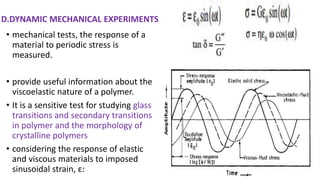
• mechanical tests, the response of a
material to periodic stress is
measured.
• provide useful information about the
viscoelastic nature of a polymer.
• It is a sensitive test for studying glass
transitions and secondary transitions
in polymer and the morphology of
crystalline polymers
• considering the response of elastic
and viscous materials to imposed
sinusoidal strain, ε:
D.DYNAMIC MECHANICAL EXPERIMENTS
2. Theoretical background
DMA measures
• Viscoelastic materials as a function of
temperature of frequency
when the materials are deformed under
the action of a periodic force or
displacement
• Modulus as a function of time or
temperature is measured
• provides information on phase
transitions.
What is viscoelastic material ?
Phase lag
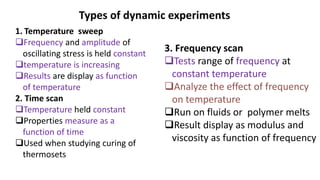
1. Temperature sweep
Frequency and amplitude of
oscillating stress is held constant
temperature is increasing
Results are display as function
of temperature
2. Time scan
Temperature held constant
Properties measure as a
function of time
Used when studying curing of
thermosets
Types of dynamic experiments
3. Frequency scan
Tests range of frequency at
constant temperature
Analyze the effect of frequency
on temperature
Run on fluids or polymer melts
Result display as modulus and
viscosity as function of frequency
3. Working principle
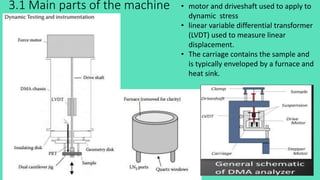
3.1 Main parts of the machine • motor and driveshaft used to apply to
dynamic stress
• linear variable differential transformer
(LVDT) used to measure linear
displacement.
• The carriage contains the sample and
is typically enveloped by a furnace and
heat sink.
Sample holding mechanism
• Different fixtures can
be used to hold the
samples
• and should be chosen
according to the type
of samples
How DMA works?
• The sample is clamped into a frame and is heated
by the furnace.
• The sample in the furnace is applied the stress
from the force generator via probe.
• To make the strain amplitude constant, the stress
is applied as the sinusoidal force.
• The deformation amount generated by the
sinusoidal force is detected.
• Viscoelastic values such as elasticity and viscosity
is calculated from the applied stress and the
strain and plotted as a function of temperature or
time.
• As the free volume of the
chain segment increases, its
ability to move in various
directions also increases
• This increased mobility in
either side chains or small
groups of adjacent
backbone atoms results in
a greater compliance
(lower modulus) of the
molecule.
• These movements have
been classified β and γ
transitions by their type of
motion.
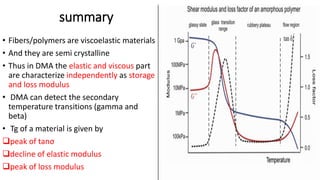
Results from DMA and analysis
An idealized DMA scan showing the types of transitions
• As the temperature increases, the
material goes through a number of minor
transitions (Tγ and Tβ) due to expansion.
At these transitions, the modulus also
undergoes changes.
• The glass transition (Tg) occurs with the
rapid change of physical properties at
some temperature
• the storage (elastic) modulus of the
polymer drops dramatically at Tg.
• As the temperature rises above the glass
transition point, the material loses its
structure and becomes rubbery before
finally melting
DMA and different molecular parameters
The transition
curves are
influenced by
crystallinity and
orientation
How determine Tg
• Depending on industry standards or
background of the operator, the peak
or onset of the tan δ curve, the
beginning of the E′ drop, or the onset
or peak of the E″ curve may be used.
• The values obtained from these
methods can differ up to 25°C from
one another on the same run.
• For DMA, defining the heating rate,
applied stresses (or strains), the
frequency used, and the method of
determining the Tg.
• For example, the sample will be run at
10°C/min under 0.05% strain at 1 Hz in
nitrogen purge (20 cc/min) and the Tg
determined from peak of the tanδ
curve.
4. General application of DMA
• Varying the composition of monomers
• Effectively evaluate the miscibility of
polymers
• characterize the glass transition temperature
of a material
DMA characteristics can be used to describe quality defects,
processing flaws, and other parameters.
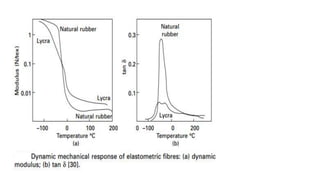
5. Fiber characterization
Dynamic mechanical properties of various
polymers. Upper lines are real (dynamic) and lower
lines are imaginary (loss) moduli.
A=pp
B=acrylic
C=nylon6,6
D=polyester
The transition curves are influenced by crystallinity and orientation
A= undrawn 2% crystalline
B= undrawn 50%crystalline
C= drawn 5x, 25%crystalline
Effect of temperature @ various humidity
Advantage
• Dynamic mechanical analysis is an
essential analytical technique for
determining the viscoelastic
properties of polymers.
• Due to its use of oscillating stress,
this method is able to quickly scan
and calculate the modulus for a
range of temperatures.
• Fast analysis time (typically 30
minutes).
• Easy sample preparation.
• The modulus value is very
dependent on sample
dimensions
• large inaccuracies are
introduced if dimensional
measurements of samples are
slightly inaccurate.
• Oscillating stress converts
mechanical energy to heat and
changes the temperature of the
sample.
Limitations
summary
• Fibers/polymers are viscoelastic materials
• And they are semi crystalline
• Thus in DMA the elastic and viscous part
are characterize independently as storage
and loss modulus
• DMA can detect the secondary
temperature transitions (gamma and
beta)
• Tg of a material is given by
peak of tanσ
decline of elastic modulus
peak of loss modulus
Reference
1. W.E.Morton and J.W.S. hearle “physical property of textile fibers ”
wodhead publishing in textiles
2. Hevin P. Menard “Dynamic mechanical analysis /a practical
introduction” second edition, CRS press
3. Robert O. Ebewele “polymer science and technology”, New York, CRC
press
4. And others
If you have any question you are well come

Dma

  • 1.
    BAHIRDAR UNIVERSTIY First yearTMNGMSC program •Physical propertyof textile Fiber seminar # 1 • Seminar title: Dynamic mechanical analysis(DMA) • PREPARED BY: Tekalgn Mamay Submitted to: ass. Professor Adane H.
  • 2.
     Introduction  Theoreticalback ground  Working principle • Main parts of the machine • Data analysis and interpretation  General application  Fiber characterization by DMA  summary
  • 3.
    1. Introduction Mechanical analysisof fibers/polymers A. STRESS–STRAIN EXPERIMENTS • the specimen is deformed (pulled) at a constant rate • and the stress required for this deformation is measured simultaneously B. CREEP EXPERIMENTS • a specimen is subjected to a constant load • and the strain is measured as a function of time.
  • 4.
    C. STRESS RELAXATIONEXPERIMENTS • the specimen is rapidly extended a given amount of stress • When a fibre is held stretched, its stress gradually decays. • It may drop to a limiting value or may disappear completely. • This phenomenon is known as relaxation • When this stress is divided by the constant strain, the resultant ratio is the relaxation modulus (Er(t,T), which is a function of both time and temperature.
  • 5.
    • mechanical tests,the response of a material to periodic stress is measured. • provide useful information about the viscoelastic nature of a polymer. • It is a sensitive test for studying glass transitions and secondary transitions in polymer and the morphology of crystalline polymers • considering the response of elastic and viscous materials to imposed sinusoidal strain, ε: D.DYNAMIC MECHANICAL EXPERIMENTS
  • 6.
  • 7.
    DMA measures • Viscoelasticmaterials as a function of temperature of frequency when the materials are deformed under the action of a periodic force or displacement • Modulus as a function of time or temperature is measured • provides information on phase transitions. What is viscoelastic material ?
  • 10.
  • 11.
    1. Temperature sweep Frequencyand amplitude of oscillating stress is held constant temperature is increasing Results are display as function of temperature 2. Time scan Temperature held constant Properties measure as a function of time Used when studying curing of thermosets Types of dynamic experiments 3. Frequency scan Tests range of frequency at constant temperature Analyze the effect of frequency on temperature Run on fluids or polymer melts Result display as modulus and viscosity as function of frequency
  • 12.
  • 13.
    3.1 Main partsof the machine • motor and driveshaft used to apply to dynamic stress • linear variable differential transformer (LVDT) used to measure linear displacement. • The carriage contains the sample and is typically enveloped by a furnace and heat sink.
  • 15.
    Sample holding mechanism •Different fixtures can be used to hold the samples • and should be chosen according to the type of samples
  • 16.
    How DMA works? •The sample is clamped into a frame and is heated by the furnace. • The sample in the furnace is applied the stress from the force generator via probe. • To make the strain amplitude constant, the stress is applied as the sinusoidal force. • The deformation amount generated by the sinusoidal force is detected. • Viscoelastic values such as elasticity and viscosity is calculated from the applied stress and the strain and plotted as a function of temperature or time.
  • 18.
    • As thefree volume of the chain segment increases, its ability to move in various directions also increases • This increased mobility in either side chains or small groups of adjacent backbone atoms results in a greater compliance (lower modulus) of the molecule. • These movements have been classified β and γ transitions by their type of motion.
  • 19.
    Results from DMAand analysis An idealized DMA scan showing the types of transitions • As the temperature increases, the material goes through a number of minor transitions (Tγ and Tβ) due to expansion. At these transitions, the modulus also undergoes changes. • The glass transition (Tg) occurs with the rapid change of physical properties at some temperature • the storage (elastic) modulus of the polymer drops dramatically at Tg. • As the temperature rises above the glass transition point, the material loses its structure and becomes rubbery before finally melting
  • 20.
    DMA and differentmolecular parameters The transition curves are influenced by crystallinity and orientation
  • 21.
    How determine Tg •Depending on industry standards or background of the operator, the peak or onset of the tan δ curve, the beginning of the E′ drop, or the onset or peak of the E″ curve may be used. • The values obtained from these methods can differ up to 25°C from one another on the same run. • For DMA, defining the heating rate, applied stresses (or strains), the frequency used, and the method of determining the Tg. • For example, the sample will be run at 10°C/min under 0.05% strain at 1 Hz in nitrogen purge (20 cc/min) and the Tg determined from peak of the tanδ curve.
  • 22.
    4. General applicationof DMA • Varying the composition of monomers • Effectively evaluate the miscibility of polymers • characterize the glass transition temperature of a material
  • 23.
    DMA characteristics canbe used to describe quality defects, processing flaws, and other parameters.
  • 24.
  • 25.
    Dynamic mechanical propertiesof various polymers. Upper lines are real (dynamic) and lower lines are imaginary (loss) moduli. A=pp B=acrylic C=nylon6,6 D=polyester
  • 27.
    The transition curvesare influenced by crystallinity and orientation
  • 28.
    A= undrawn 2%crystalline B= undrawn 50%crystalline C= drawn 5x, 25%crystalline
  • 29.
    Effect of temperature@ various humidity
  • 31.
    Advantage • Dynamic mechanicalanalysis is an essential analytical technique for determining the viscoelastic properties of polymers. • Due to its use of oscillating stress, this method is able to quickly scan and calculate the modulus for a range of temperatures. • Fast analysis time (typically 30 minutes). • Easy sample preparation. • The modulus value is very dependent on sample dimensions • large inaccuracies are introduced if dimensional measurements of samples are slightly inaccurate. • Oscillating stress converts mechanical energy to heat and changes the temperature of the sample. Limitations
  • 32.
    summary • Fibers/polymers areviscoelastic materials • And they are semi crystalline • Thus in DMA the elastic and viscous part are characterize independently as storage and loss modulus • DMA can detect the secondary temperature transitions (gamma and beta) • Tg of a material is given by peak of tanσ decline of elastic modulus peak of loss modulus
  • 33.
    Reference 1. W.E.Morton andJ.W.S. hearle “physical property of textile fibers ” wodhead publishing in textiles 2. Hevin P. Menard “Dynamic mechanical analysis /a practical introduction” second edition, CRS press 3. Robert O. Ebewele “polymer science and technology”, New York, CRC press 4. And others
  • 34.
    If you haveany question you are well come