By Dr. Heman Pathak
1
2
3
An interconnection network in a parallel
machine transfers information from any source
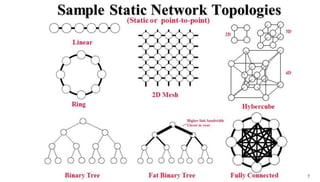
node to any desired destination node.
The network is composed of links and switches,
which helps to send the information from the
source node to the destination node. A network is
specified by its topology & routing algorithm.
4
Topology: It indicates how the nodes in a network are organised.
Interconnection Network
Static
1-D 2-D Hypercube
Dynamic
Bus Based
Single Multiple
Switch
Based
Single
Stage
Multi Stage Crossbar
5
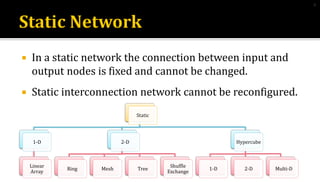
 In a static network the connection between input and
output nodes is fixed and cannot be changed.
 Static interconnection network cannot be reconfigured.
Static
1-D
Linear
Array
2-D
Ring Mesh Tree
Shuffle
Exchange
Hypercube
1-D 2-D Multi-D
6
7
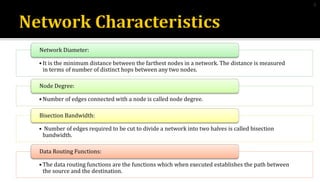
• It is the minimum distance between the farthest nodes in a network. The distance is measured
in terms of number of distinct hops between any two nodes.
Network Diameter:
• Number of edges connected with a node is called node degree.
Node Degree:
• Number of edges required to be cut to divide a network into two halves is called bisection
bandwidth.
Bisection Bandwidth:
• The data routing functions are the functions which when executed establishes the path between
the source and the destination.
Data Routing Functions:
8
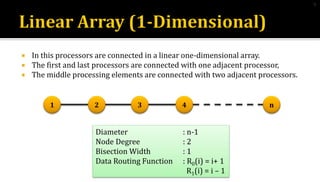
 In this processors are connected in a linear one-dimensional array.
 The first and last processors are connected with one adjacent processor,
 The middle processing elements are connected with two adjacent processors.
1 2 3 4 n
Diameter : n-1
Node Degree : 2
Bisection Width : 1
Data Routing Function : R0(i) = i+ 1
R1(i) = i – 1
9
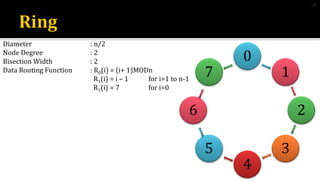
Diameter : n/2
Node Degree : 2
Bisection Width : 2
Data Routing Function : R0(i) = (i+ 1)MODn
R1(i) = i – 1 for i=1 to n-1
R1(i) = 7 for i=0
0
1
2
3
4
5
6
7
10
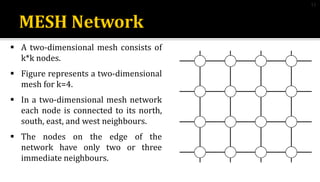
 A two-dimensional mesh consists of
k*k nodes.
 Figure represents a two-dimensional
mesh for k=4.
 In a two-dimensional mesh network
each node is connected to its north,
south, east, and west neighbours.
 The nodes on the edge of the
network have only two or three
immediate neighbours.
11
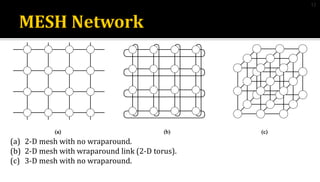
(a) 2-D mesh with no wraparound.
(b) 2-D mesh with wraparound link (2-D torus).
(c) 3-D mesh with no wraparound.
12
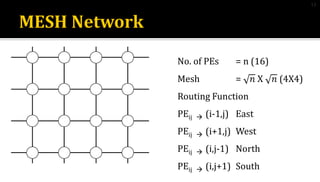
No. of PEs = n (16)
Mesh = 𝑛 X 𝑛 (4X4)
Routing Function
PEij  (i-1,j) East
PEij  (i+1,j) West
PEij  (i,j-1) North
PEij  (i,j+1) South
13
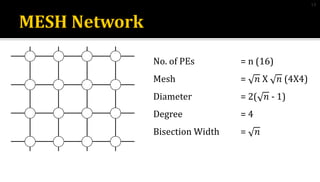
No. of PEs = n (16)
Mesh = 𝑛 X 𝑛 (4X4)
Diameter = 2( 𝑛 - 1)
Degree = 4
Bisection Width = 𝑛
14
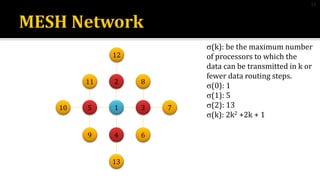
(k): be the maximum number
of processors to which the
data can be transmitted in k or
fewer data routing steps.
(0): 1
(1): 5
(2): 13
(k): 2k2 +2k + 1
1
5 3
2
4
7
8
6
10
11
9
12
13
15
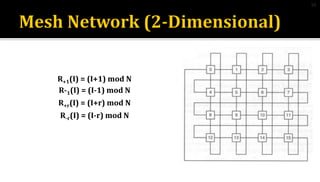
R+1(I) = (I+1) mod N
R-1(I) = (I-1) mod N
R+r(I) = (I+r) mod N
R-r(I) = (I-r) mod N
16
17
18
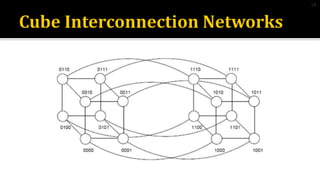
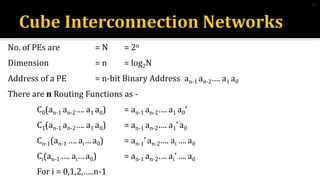
No. of PEs are = N = 2n
Dimension = n = log2N
Address of a PE = n-bit Binary Address an-1 an-2…. a1 a0
There are n Routing Functions as -
C0(an-1 an-2…. a1 a0) = an-1 an-2…. a1 a0’
C1(an-1 an-2…. a1 a0) = an-1 an-2…. a1’ a0
Cn-1(an-1 …. ai… a0) = an-1’ an-2…. ai ….a0
Ci(an-1 …. ai… a0) = an-1 an-2…. ai’ ….a0
For i = 0,1,2,…..n-1
19
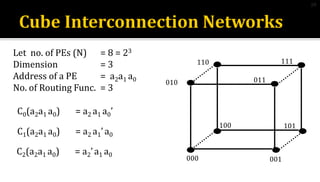
Let no. of PEs (N) = 8 = 23
Dimension = 3
Address of a PE = a2a1 a0
No. of Routing Func. = 3
000 001
010
100
C0(a2a1 a0) = a2 a1 a0’
C1(a2a1 a0) = a2 a1’a0
C2(a2a1 a0) = a2’a1 a0
101
011
110 111
20
0 1 2 3 4 5 6 7
C0
0 1 2 3 4 5 6 7
C1
0 1 2 3 4 5 6 7
C2
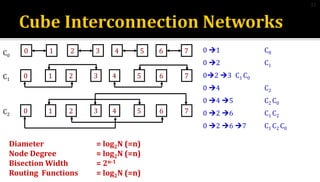
0 1 C0
0 2 C1
02 3 C1 C0
0 4 C2
0 4 5 C2 C0
0 2 6 C1 C2
0 2 6 7 C1 C2 C0
Diameter = log2N (=n)
Node Degree = log2N (=n)
Bisection Width = 2n-1
Routing Functions = log2N (=n)
21
0
1
2
3
4
5
6
7
0
1
2
3
4
5
6
7
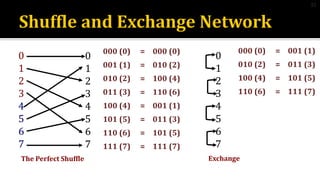
000 (0) = 000 (0)
001 (1) = 010 (2)
010 (2) = 100 (4)
011 (3) = 110 (6)
100 (4) = 001 (1)
101 (5) = 011 (3)
110 (6) = 101 (5)
111 (7) = 111 (7)
The Perfect Shuffle
0
1
2
3
4
5
6
7
000 (0) = 001 (1)
010 (2) = 011 (3)
100 (4) = 101 (5)
110 (6) = 111 (7)
Exchange
22
No. of PEs are N = 2n
Address of a PE an-1 an-2…. a1 a0
This network is based on two routing functions –
Shuffle : S(an-1 an-2…. a1 a0) = an-2…. a1 a0 an-1
Exchange : E(an-1 an-2…. a1 a0) = an-1an-2…. a1 a0 ‘
23
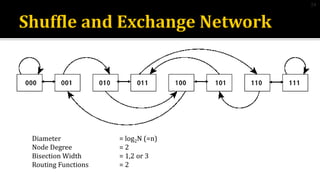
Diameter = log2N (=n)
Node Degree = 2
Bisection Width = 1,2 or 3
Routing Functions = 2
24

Interconnection Network

  • 1.
    By Dr. HemanPathak 1
  • 2.
  • 3.
  • 4.
    An interconnection networkin a parallel machine transfers information from any source node to any desired destination node. The network is composed of links and switches, which helps to send the information from the source node to the destination node. A network is specified by its topology & routing algorithm. 4
  • 5.
    Topology: It indicateshow the nodes in a network are organised. Interconnection Network Static 1-D 2-D Hypercube Dynamic Bus Based Single Multiple Switch Based Single Stage Multi Stage Crossbar 5
  • 6.
     In astatic network the connection between input and output nodes is fixed and cannot be changed.  Static interconnection network cannot be reconfigured. Static 1-D Linear Array 2-D Ring Mesh Tree Shuffle Exchange Hypercube 1-D 2-D Multi-D 6
  • 7.
  • 8.
    • It isthe minimum distance between the farthest nodes in a network. The distance is measured in terms of number of distinct hops between any two nodes. Network Diameter: • Number of edges connected with a node is called node degree. Node Degree: • Number of edges required to be cut to divide a network into two halves is called bisection bandwidth. Bisection Bandwidth: • The data routing functions are the functions which when executed establishes the path between the source and the destination. Data Routing Functions: 8
  • 9.
     In thisprocessors are connected in a linear one-dimensional array.  The first and last processors are connected with one adjacent processor,  The middle processing elements are connected with two adjacent processors. 1 2 3 4 n Diameter : n-1 Node Degree : 2 Bisection Width : 1 Data Routing Function : R0(i) = i+ 1 R1(i) = i – 1 9
  • 10.
    Diameter : n/2 NodeDegree : 2 Bisection Width : 2 Data Routing Function : R0(i) = (i+ 1)MODn R1(i) = i – 1 for i=1 to n-1 R1(i) = 7 for i=0 0 1 2 3 4 5 6 7 10
  • 11.
     A two-dimensionalmesh consists of k*k nodes.  Figure represents a two-dimensional mesh for k=4.  In a two-dimensional mesh network each node is connected to its north, south, east, and west neighbours.  The nodes on the edge of the network have only two or three immediate neighbours. 11
  • 12.
    (a) 2-D meshwith no wraparound. (b) 2-D mesh with wraparound link (2-D torus). (c) 3-D mesh with no wraparound. 12
  • 13.
    No. of PEs= n (16) Mesh = 𝑛 X 𝑛 (4X4) Routing Function PEij  (i-1,j) East PEij  (i+1,j) West PEij  (i,j-1) North PEij  (i,j+1) South 13
  • 14.
    No. of PEs= n (16) Mesh = 𝑛 X 𝑛 (4X4) Diameter = 2( 𝑛 - 1) Degree = 4 Bisection Width = 𝑛 14
  • 15.
    (k): be themaximum number of processors to which the data can be transmitted in k or fewer data routing steps. (0): 1 (1): 5 (2): 13 (k): 2k2 +2k + 1 1 5 3 2 4 7 8 6 10 11 9 12 13 15
  • 16.
    R+1(I) = (I+1)mod N R-1(I) = (I-1) mod N R+r(I) = (I+r) mod N R-r(I) = (I-r) mod N 16
  • 17.
  • 18.
  • 19.
    No. of PEsare = N = 2n Dimension = n = log2N Address of a PE = n-bit Binary Address an-1 an-2…. a1 a0 There are n Routing Functions as - C0(an-1 an-2…. a1 a0) = an-1 an-2…. a1 a0’ C1(an-1 an-2…. a1 a0) = an-1 an-2…. a1’ a0 Cn-1(an-1 …. ai… a0) = an-1’ an-2…. ai ….a0 Ci(an-1 …. ai… a0) = an-1 an-2…. ai’ ….a0 For i = 0,1,2,…..n-1 19
  • 20.
    Let no. ofPEs (N) = 8 = 23 Dimension = 3 Address of a PE = a2a1 a0 No. of Routing Func. = 3 000 001 010 100 C0(a2a1 a0) = a2 a1 a0’ C1(a2a1 a0) = a2 a1’a0 C2(a2a1 a0) = a2’a1 a0 101 011 110 111 20
  • 21.
    0 1 23 4 5 6 7 C0 0 1 2 3 4 5 6 7 C1 0 1 2 3 4 5 6 7 C2 0 1 C0 0 2 C1 02 3 C1 C0 0 4 C2 0 4 5 C2 C0 0 2 6 C1 C2 0 2 6 7 C1 C2 C0 Diameter = log2N (=n) Node Degree = log2N (=n) Bisection Width = 2n-1 Routing Functions = log2N (=n) 21
  • 22.
    0 1 2 3 4 5 6 7 0 1 2 3 4 5 6 7 000 (0) =000 (0) 001 (1) = 010 (2) 010 (2) = 100 (4) 011 (3) = 110 (6) 100 (4) = 001 (1) 101 (5) = 011 (3) 110 (6) = 101 (5) 111 (7) = 111 (7) The Perfect Shuffle 0 1 2 3 4 5 6 7 000 (0) = 001 (1) 010 (2) = 011 (3) 100 (4) = 101 (5) 110 (6) = 111 (7) Exchange 22
  • 23.
    No. of PEsare N = 2n Address of a PE an-1 an-2…. a1 a0 This network is based on two routing functions – Shuffle : S(an-1 an-2…. a1 a0) = an-2…. a1 a0 an-1 Exchange : E(an-1 an-2…. a1 a0) = an-1an-2…. a1 a0 ‘ 23
  • 24.
    Diameter = log2N(=n) Node Degree = 2 Bisection Width = 1,2 or 3 Routing Functions = 2 24