Downloaded 128 times
![13
17. State Amdahl law with derivation and example.
Ans:
• Amdahl's Law states that the maximum speedup of an algorithm is limited by the relative number of
operations that must be performed sequentially, i.e., by its serial fraction.
• If a is the serial fraction, n is the number of operations in the sequential algorithm, and N the number of
processors, then the time for the parallel algorithm is:
Tpar(N) = (an + (1-a)n/N)t + C(n,N)
where C(n,N) is the time for overhead due to communication, load balancing, etc., and t is the time for
one operation.
Derivation:
• The speed-up satisfies:
S(N) = Tseq/Tpar(N) = nt/[(an + (1-a)n/N)t + C(n,N)]
= 1/[(a + (1-a)/N) + C(n,N)/(nt)]
< 1/(a + (1-a)/N)
• Note that as N®¥, then S(N)®1/a, so the speed-up is always limited to a maximum of 1/a no matter how
many processors are used.
Example:
18. Write the implications of Amdahl law.
Ans:
• Amdahl's Law says that the serial fraction puts a severe constraint on the speed-up that can be achieved
as the number of processors increases.
• Amdahl's Law suggests that it is not cost effective to build systems with large numbers of processors
because sufficient speed-up will not be achieved.
• It turns out that most important applications that need to be parallelised contain very small serial
fractions, so large machines are justified.
•
19. Explain the semantics of message sends and receives.
Ans:
Message Sending:
• Suppose one node sends a message to another node:
send (data, count, datatype, destination)
• There are two possible behaviours:
-Blocking send
-Non-blocking send](https://image.slidesharecdn.com/questionsanswers-160403172016/85/parallel-Questions-amp-answers-13-320.jpg)

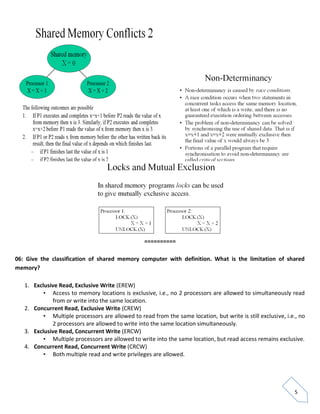
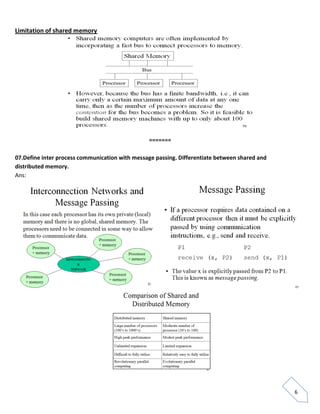
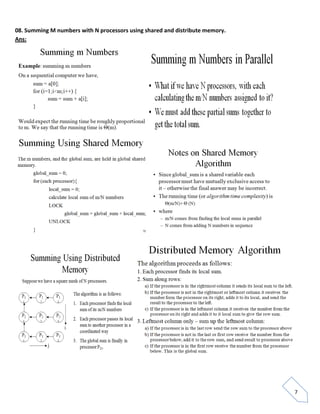
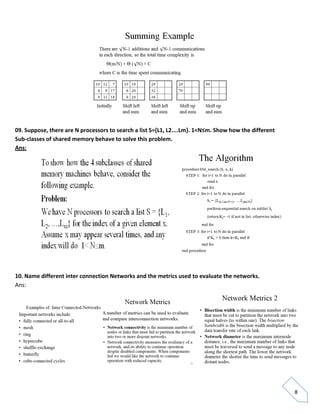
Parallelism involves executing multiple processes simultaneously using two or more processors. There are different types of parallelism including instruction level, job level, and program level. Parallelism is used in supercomputing to solve complex problems more quickly in fields like weather forecasting, climate modeling, engineering, and material science. Parallel computers can be classified based on whether they have a single or multiple instruction and data streams, including SISD, MISD, SIMD, and MIMD architectures. Shared memory parallel computers allow processors to access a global address space but can have conflicts when simultaneous writes occur, while message passing computers communicate via messages to avoid conflicts. Factors like software overhead and load balancing can limit the speedup achieved by parallel algorithms


