Nico R. Penaredondo
MSICT
Goal Programming
Goal Programming
▪ May be used to solve linear programs with multiple
objectives, with each objective viewed as a “goal”.
▪ The goals themselves are subtracted and added to
the constraint set with di
+ and di
– acting as the
surplus and slack variables
▪ A hierarchy of importance needs to be established
so that higher-priority goals are satisfied before
lower-priority goals are addressed
Goal Programming
▪ It is not always possible to satisfy every goal so
goal programming attempts to reach a
satisfactory level of multiple objectives
▪ The main difference is in the objective function
where goal programming tries to minimize the
deviations between goals and what we can
actually achieve within the given constraints
Goal Programming and Linear Programming
Differences
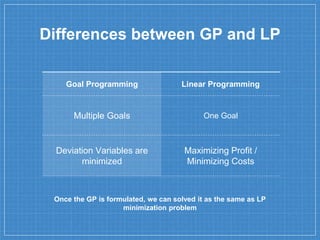
Differences between GP and LP
Goal Programming Linear Programming
Multiple Goals One Goal
Deviation Variables are
minimized
Maximizing Profit /
Minimizing Costs
Once the GP is formulated, we can solved it as the same as LP
minimization problem
Example Problem
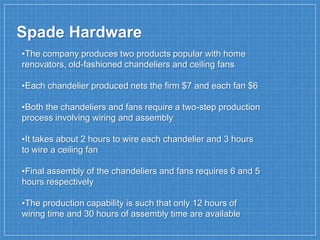
▪The company produces two products popular with home
renovators, old-fashioned chandeliers and ceiling fans
▪Each chandelier produced nets the firm $7 and each fan $6
▪Both the chandeliers and fans require a two-step production
process involving wiring and assembly
▪It takes about 2 hours to wire each chandelier and 3 hours
to wire a ceiling fan
▪Final assembly of the chandeliers and fans requires 6 and 5
hours respectively
▪The production capability is such that only 12 hours of
wiring time and 30 hours of assembly time are available
Spade Hardware
LP Formulation
[Maximize Profit]
Z = 7x1 + 6x2
[Subject To]
2x1 + 3x2 <= 12 (Wiring Hours)
6x1 + 5x2 <= 30 (Assembly Hours)
x1,x2 >= 0
[Let]
x1 = # of chandeliers produced
x2 = # of ceiling fans produced
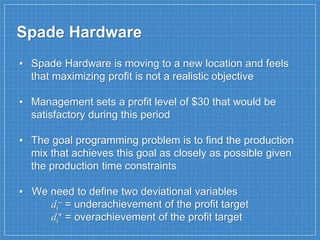
▪ Spade Hardware is moving to a new location and feels
that maximizing profit is not a realistic objective
▪ Management sets a profit level of $30 that would be
satisfactory during this period
▪ The goal programming problem is to find the production
mix that achieves this goal as closely as possible given
the production time constraints
▪ We need to define two deviational variables
di
– = underachievement of the profit target
di
+ = overachievement of the profit target
Spade Hardware
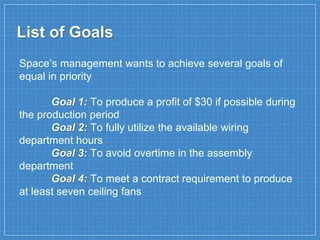
Space’s management wants to achieve several goals of
equal in priority
Goal 1: To produce a profit of $30 if possible during
the production period
Goal 2: To fully utilize the available wiring
department hours
Goal 3: To avoid overtime in the assembly
department
Goal 4: To meet a contract requirement to produce
at least seven ceiling fans
List of Goals
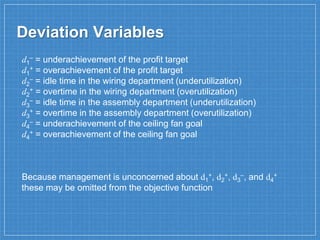
d1
– = underachievement of the profit target
d1
+ = overachievement of the profit target
d2
– = idle time in the wiring department (underutilization)
d2
+ = overtime in the wiring department (overutilization)
d3
– = idle time in the assembly department (underutilization)
d3
+ = overtime in the assembly department (overutilization)
d4
– = underachievement of the ceiling fan goal
d4
+ = overachievement of the ceiling fan goal
Because management is unconcerned about d1
+, d2
+, d3
–, and d4
+
these may be omitted from the objective function
Deviation Variables
[Minimize Total Deviation]
d1
– + d2
– + d3
+ + d4
–
[Subject To]
7x1 + 6x2 + d1
– – d1
+ = 30 (Profit Constraint)
2x1 + 3x2 + d2
– – d2
+ = 12 (Wiring Hours)
6x1 + 5x2 + d3
– – d3
+ = 30 (Assembly Hours)
x2 + d4
– – d4
+ = 7 (Ceiling Fan Constraint)
All xi,di variables >= 0
GP Model
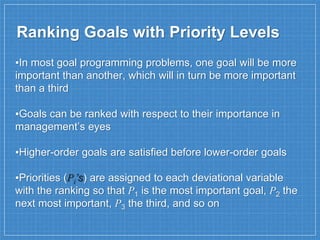
Ranking Goals with Priority Levels
▪In most goal programming problems, one goal will be more
important than another, which will in turn be more important
than a third
▪Goals can be ranked with respect to their importance in
management’s eyes
▪Higher-order goals are satisfied before lower-order goals
▪Priorities (Pi’s) are assigned to each deviational variable
with the ranking so that P1 is the most important goal, P2 the
next most important, P3 the third, and so on
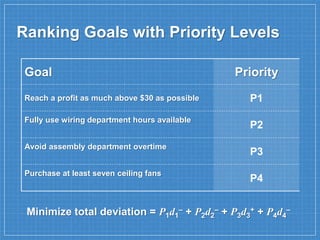
Goal Priority
Reach a profit as much above $30 as possible P1
Fully use wiring department hours available
P2
Avoid assembly department overtime
P3
Purchase at least seven ceiling fans
P4
Ranking Goals with Priority Levels
Minimize total deviation = P1d1
– + P2d2
– + P3d3
+ + P4d4
–
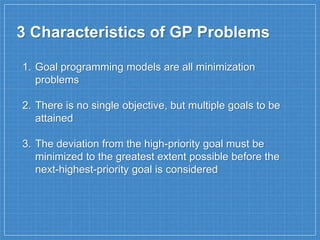
3 Characteristics of GP Problems
1. Goal programming models are all minimization
problems
2. There is no single objective, but multiple goals to be
attained
3. The deviation from the high-priority goal must be
minimized to the greatest extent possible before the
next-highest-priority goal is considered
[Minimize Total Deviation]
P1d1
– + P2d2
– + P3d3
+ + P4d4
–
[Subject To]
7x1 + 6x2 + d1
– – d1
+ = 30 (Profit Constraint)
2x1 + 3x2 + d2
– – d2
+ = 12 (Wiring Hours)
6x1 + 5x2 + d3
– – d3
+ = 30 (Assembly Hours)
x2 + d4
– – d4
+ = 7 (Ceiling Fan Constraint)
All xi,di variables >= 0
Recalling GP Model
Solving GP Problems
Graphically
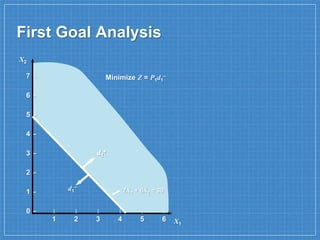
First Goal Analysis
7 –
6 –
5 –
4 –
3 –
2 –
1 –
0 –
X1
X2
| | | | | |
1 2 3 4 5 6
7X1 + 6X2 = 30d1
–
Minimize Z = P1d1
–
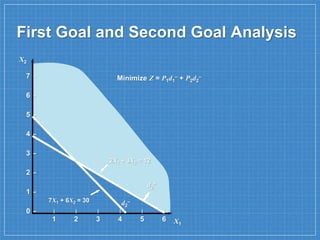
First Goal and Second Goal Analysis
7 –
6 –
5 –
4 –
3 –
2 –
1 –
0 –
X1
X2
| | | | | |
1 2 3 4 5 6
7X1 + 6X2 = 30 d2
–
2X1 + 3X2 = 12
d2
+
Minimize Z = P1d1
– + P2d2
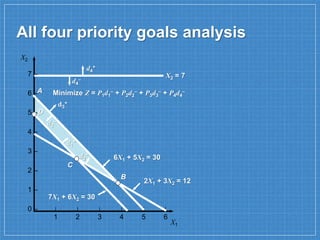
–
All four priority goals analysis
Minimize Z = P1d1
– + P2d2
– + P3d3
– + P4d4
–
d3
–
7 –
6 –
5 –
4 –
3 –
2 –
1 –
0 –
X1
X2
| | | | | |
1 2 3 4 5 6
7X1 + 6X2 = 30
d1
+
d2
+
2X1 + 3X2 = 12
d3
+
6X1 + 5X2 = 30
d4
–
d4
+
A
B
C
D
X2 = 7
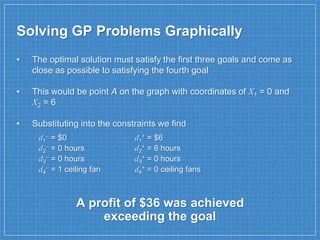
▪ The optimal solution must satisfy the first three goals and come as
close as possible to satisfying the fourth goal
▪ This would be point A on the graph with coordinates of X1 = 0 and
X2 = 6
▪ Substituting into the constraints we find
Solving GP Problems Graphically
d1
– = $0 d1
+ = $6
d2
– = 0 hours d2
+ = 6 hours
d3
– = 0 hours d3
+ = 0 hours
d4
– = 1 ceiling fan d4
+ = 0 ceiling fans
A profit of $36 was achieved
exceeding the goal
Thanks!
Goal Programming
Nico Penaredondo
MSICT

Goal Programming

  • 1.
  • 2.
    Goal Programming ▪ Maybe used to solve linear programs with multiple objectives, with each objective viewed as a “goal”. ▪ The goals themselves are subtracted and added to the constraint set with di + and di – acting as the surplus and slack variables ▪ A hierarchy of importance needs to be established so that higher-priority goals are satisfied before lower-priority goals are addressed
  • 3.
    Goal Programming ▪ Itis not always possible to satisfy every goal so goal programming attempts to reach a satisfactory level of multiple objectives ▪ The main difference is in the objective function where goal programming tries to minimize the deviations between goals and what we can actually achieve within the given constraints
  • 4.
    Goal Programming andLinear Programming Differences
  • 5.
    Differences between GPand LP Goal Programming Linear Programming Multiple Goals One Goal Deviation Variables are minimized Maximizing Profit / Minimizing Costs Once the GP is formulated, we can solved it as the same as LP minimization problem
  • 6.
  • 7.
    ▪The company producestwo products popular with home renovators, old-fashioned chandeliers and ceiling fans ▪Each chandelier produced nets the firm $7 and each fan $6 ▪Both the chandeliers and fans require a two-step production process involving wiring and assembly ▪It takes about 2 hours to wire each chandelier and 3 hours to wire a ceiling fan ▪Final assembly of the chandeliers and fans requires 6 and 5 hours respectively ▪The production capability is such that only 12 hours of wiring time and 30 hours of assembly time are available Spade Hardware
  • 8.
    LP Formulation [Maximize Profit] Z= 7x1 + 6x2 [Subject To] 2x1 + 3x2 <= 12 (Wiring Hours) 6x1 + 5x2 <= 30 (Assembly Hours) x1,x2 >= 0 [Let] x1 = # of chandeliers produced x2 = # of ceiling fans produced
  • 9.
    ▪ Spade Hardwareis moving to a new location and feels that maximizing profit is not a realistic objective ▪ Management sets a profit level of $30 that would be satisfactory during this period ▪ The goal programming problem is to find the production mix that achieves this goal as closely as possible given the production time constraints ▪ We need to define two deviational variables di – = underachievement of the profit target di + = overachievement of the profit target Spade Hardware
  • 10.
    Space’s management wantsto achieve several goals of equal in priority Goal 1: To produce a profit of $30 if possible during the production period Goal 2: To fully utilize the available wiring department hours Goal 3: To avoid overtime in the assembly department Goal 4: To meet a contract requirement to produce at least seven ceiling fans List of Goals
  • 11.
    d1 – = underachievementof the profit target d1 + = overachievement of the profit target d2 – = idle time in the wiring department (underutilization) d2 + = overtime in the wiring department (overutilization) d3 – = idle time in the assembly department (underutilization) d3 + = overtime in the assembly department (overutilization) d4 – = underachievement of the ceiling fan goal d4 + = overachievement of the ceiling fan goal Because management is unconcerned about d1 +, d2 +, d3 –, and d4 + these may be omitted from the objective function Deviation Variables
  • 12.
    [Minimize Total Deviation] d1 –+ d2 – + d3 + + d4 – [Subject To] 7x1 + 6x2 + d1 – – d1 + = 30 (Profit Constraint) 2x1 + 3x2 + d2 – – d2 + = 12 (Wiring Hours) 6x1 + 5x2 + d3 – – d3 + = 30 (Assembly Hours) x2 + d4 – – d4 + = 7 (Ceiling Fan Constraint) All xi,di variables >= 0 GP Model
  • 13.
    Ranking Goals withPriority Levels ▪In most goal programming problems, one goal will be more important than another, which will in turn be more important than a third ▪Goals can be ranked with respect to their importance in management’s eyes ▪Higher-order goals are satisfied before lower-order goals ▪Priorities (Pi’s) are assigned to each deviational variable with the ranking so that P1 is the most important goal, P2 the next most important, P3 the third, and so on
  • 14.
    Goal Priority Reach aprofit as much above $30 as possible P1 Fully use wiring department hours available P2 Avoid assembly department overtime P3 Purchase at least seven ceiling fans P4 Ranking Goals with Priority Levels Minimize total deviation = P1d1 – + P2d2 – + P3d3 + + P4d4 –
  • 15.
    3 Characteristics ofGP Problems 1. Goal programming models are all minimization problems 2. There is no single objective, but multiple goals to be attained 3. The deviation from the high-priority goal must be minimized to the greatest extent possible before the next-highest-priority goal is considered
  • 16.
    [Minimize Total Deviation] P1d1 –+ P2d2 – + P3d3 + + P4d4 – [Subject To] 7x1 + 6x2 + d1 – – d1 + = 30 (Profit Constraint) 2x1 + 3x2 + d2 – – d2 + = 12 (Wiring Hours) 6x1 + 5x2 + d3 – – d3 + = 30 (Assembly Hours) x2 + d4 – – d4 + = 7 (Ceiling Fan Constraint) All xi,di variables >= 0 Recalling GP Model
  • 17.
  • 18.
    First Goal Analysis 7– 6 – 5 – 4 – 3 – 2 – 1 – 0 – X1 X2 | | | | | | 1 2 3 4 5 6 7X1 + 6X2 = 30d1 – Minimize Z = P1d1 –
  • 19.
    First Goal andSecond Goal Analysis 7 – 6 – 5 – 4 – 3 – 2 – 1 – 0 – X1 X2 | | | | | | 1 2 3 4 5 6 7X1 + 6X2 = 30 d2 – 2X1 + 3X2 = 12 d2 + Minimize Z = P1d1 – + P2d2 –
  • 20.
    All four prioritygoals analysis Minimize Z = P1d1 – + P2d2 – + P3d3 – + P4d4 – d3 – 7 – 6 – 5 – 4 – 3 – 2 – 1 – 0 – X1 X2 | | | | | | 1 2 3 4 5 6 7X1 + 6X2 = 30 d1 + d2 + 2X1 + 3X2 = 12 d3 + 6X1 + 5X2 = 30 d4 – d4 + A B C D X2 = 7
  • 21.
    ▪ The optimalsolution must satisfy the first three goals and come as close as possible to satisfying the fourth goal ▪ This would be point A on the graph with coordinates of X1 = 0 and X2 = 6 ▪ Substituting into the constraints we find Solving GP Problems Graphically d1 – = $0 d1 + = $6 d2 – = 0 hours d2 + = 6 hours d3 – = 0 hours d3 + = 0 hours d4 – = 1 ceiling fan d4 + = 0 ceiling fans A profit of $36 was achieved exceeding the goal
  • 22.

Editor's Notes

  • #19 - To solve this we graph one constraint at a time starting with the constraint with the highest-priority deviational variables - In this case we start with the profit constraint as it has the variable d1– with a priority of P1 - Note that in graphing this constraint the deviational variables are ignored - To minimize d1– the feasible area is the shaded region
  • #20 - The next graph is of the second priority goal of minimizing d2– - The region below the constraint line 2X1 + 3X2 = 12 represents the values for d2– while the region above the line stands for d2+ - To avoid underutilizing wiring department hours the area below the line is eliminated - This goal must be attained within the feasible region already defined by satisfying the first goal
  • #21 - The third goal is to avoid overtime in the assembly department - We want d3+ to be as close to zero as possible - This goal can be obtained - Any point inside the feasible region bounded by the first three constraints will meet the three most critical goals - The fourth constraint seeks to minimize d4– - To do this requires eliminating the area below the constraint line X2 = 7 which is not possible given the previous, higher priority, constraints