AUTONOMIC NERVOUS
   SYSTEM AGENTS

      Nelia B. Perez RN, MSN
PCU – Mary Johnston College of Nursing
1. Drugs that stimulate the sympathetic
   nervous system are called
   a. adrenergics
   b. Cholinergics
   c. Analeptics
   d. benzodiazepines
2. The sympathetic neurotransmitters are
   norepinephrine and epinephrine.
   a. true
   b. false
3. These receptors are found predominantly
in the smooth muscle membrane.
      a. alpha adrenergic receptors
      b. Alpha 2 adrenergic receptors
      c. Beta adrenergic receptors
      d. Beta2 adrenergic receptors
4. The most important clinical effect of this
  drug is contraction of smooth muscles.
  a. beta adrenergic drugs
  b. Anxiolitics
  c. Alpha-adrenergic Drugs
  b. Anticholinergics
5. A beta2 adrenergic drug which is
primarily used as a bronchodilator.
     a. Epinephrine
     b. Norepinephrine
     c. albuterol
     d. ephedrine
6. When used as a Beta1 Adrenergic drug, it
causes over-stimulation of the heart.
     a. Norepinephrine
     b. Epinephrine
     c. Ephedrine
     d. isoetharine
7. It is a Neurotransmitter in the brain and
  serves as a precursor in the synthesis of
  norepinephrine.
  a. Dopamine
  b. Dobutamine
  c. Epinephrine
  d. Ephedrine
8. It antagonizes the effect of
Norepinephrine and epinephrine which
results in vasodilatation and thus decrease in
BP.
      a. Alpha-adrenergic blocking drugs
      b. Alpha2-adrenergic blocking drugs
      c. Beta-adrenergic blocking drugs
      d. Beta2-adrenergic blocking drugs
9. It leads to a decrease in sympathetic
response resulting in decrease heart rate and
force of contraction.
       a. Alpha-adrenergic blocking drugs
       b. Alpha2-adrenergic blocking drugs
       c. Beta-adrenergic blocking drugs
       d. Beta2-adrenergic blocking drugs
10. Adrenergic neuronal blockers are those
  which
  a. interfere with the formation and or
  storage of NE
  b. Blocks the synthesis of epinephrine
  c. Dilates blood vessels in hypertension
  d. Serves as bronchodilators
Drugs Affecting the
Sympathetic Nervous
      System
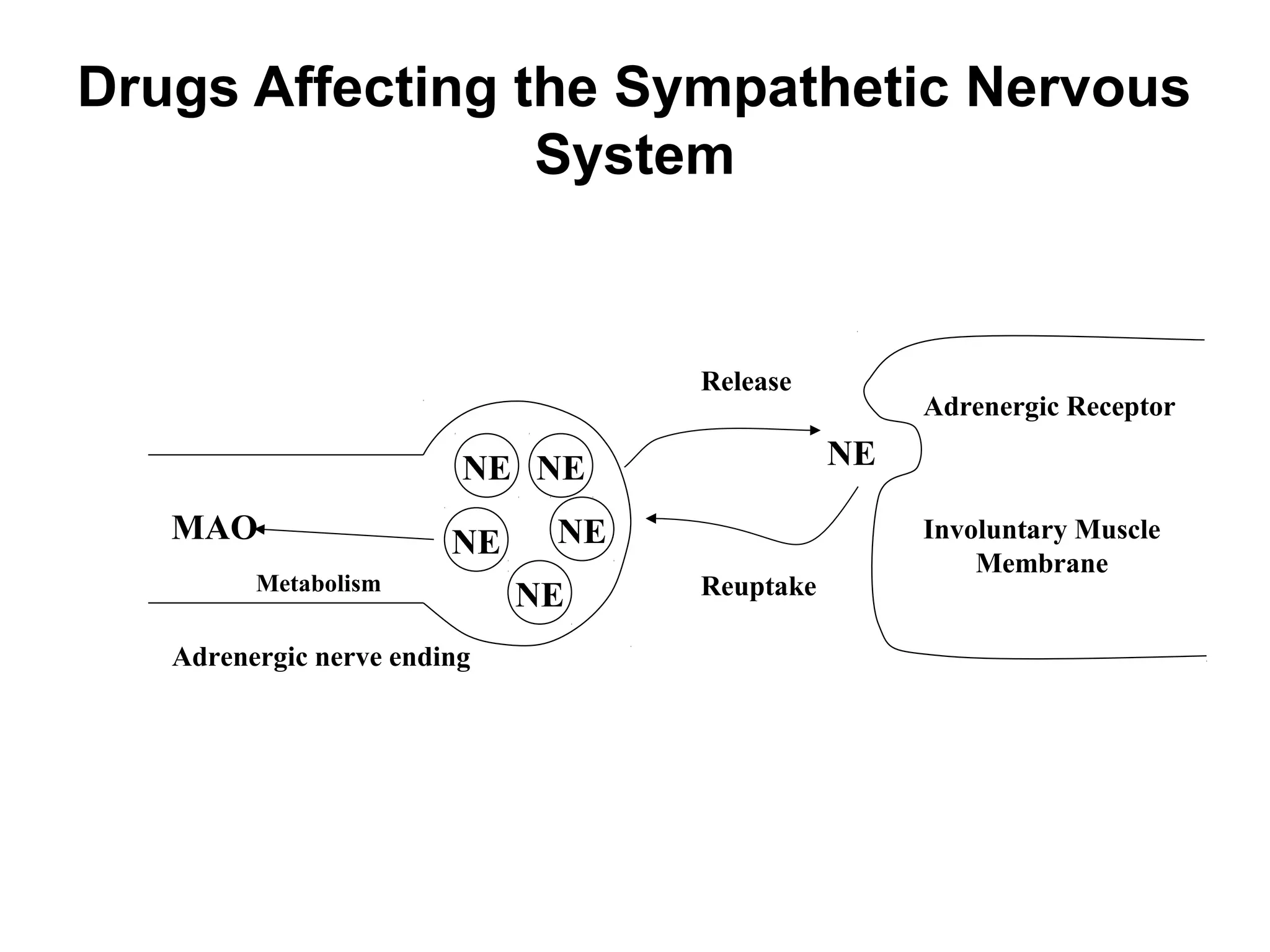
Drugs Affecting the Sympathetic Nervous
                 System


                                   Release
                                                   Adrenergic Receptor

                         NE NE                NE

   MAO                  NE    NE                   Involuntary Muscle
                                                       Membrane
         Metabolism                Reuptake
                             NE
   Adrenergic nerve ending
Drugs Affecting the Sympathetic Nervous
                 System

                      Adrenergic
                       Receptors


           Alpha                        Beta
          Receptors                   Receptors


                           Beta 1                  Beta 2
                          Receptors               Receptors
Drugs Affecting the Sympathetic Nervous
                 System

    Alpha-adrenergic Receptors

    •   Found predominantly on smooth muscle
        membrane.

    •   When stimulated by NE or EPI produce
        contraction.

    •   Produces vasoconstriction of most blood vessels.
Drugs Affecting the Sympathetic Nervous
                 System


     Beta-adrenergic Receptors

     •   Found on both cardiac and some smooth
         muscle membranes.

     •   In the heart, beta 1 receptors
         predominates.

     •   When stimulated by NE or EPI, they
         increase heart rate and force of
         contraction.
Drugs Affecting the Sympathetic Nervous
                 System

   Beta-adrenergic Receptors


   • Found on smooth muscle in the bronchus and
     smooth muscles of blood vessels supplying
     muscle and the heart.

   • Stimulated with EPI result in relaxation.
Drugs Affecting the Sympathetic Nervous
                 System

    Beta-adrenergic Receptors

    •   In smooth muscle, beta 2 receptors
        predominates.

    •   When stimulated by EPI, they produces muscle
        relaxation.

    •   Found in smooth muscles of blood vessels
        supplying skeletal muscle and the coronary
        arteries.

    •   Found on smooth muscle in the bronchial tree.
Drugs Affecting the Sympathetic Nervous
                 System


                      Beta 1
                     Receptors


                Found on smooth
                muscle in the heart


              Increase heart rate and
              force of contraction.
Drugs Affecting the Sympathetic Nervous
                 System


                                    Beta 2
                                   Receptors


                                               Found on smooth
  Found on smooth muscle
                                               muscle in the
  of blood vessels supplying
                                               bronchial tree.
  skeletal muscle and the heart.


        Vasodilatation.                          Bronchodilation.
Drugs Affecting the Sympathetic Nervous
                 System


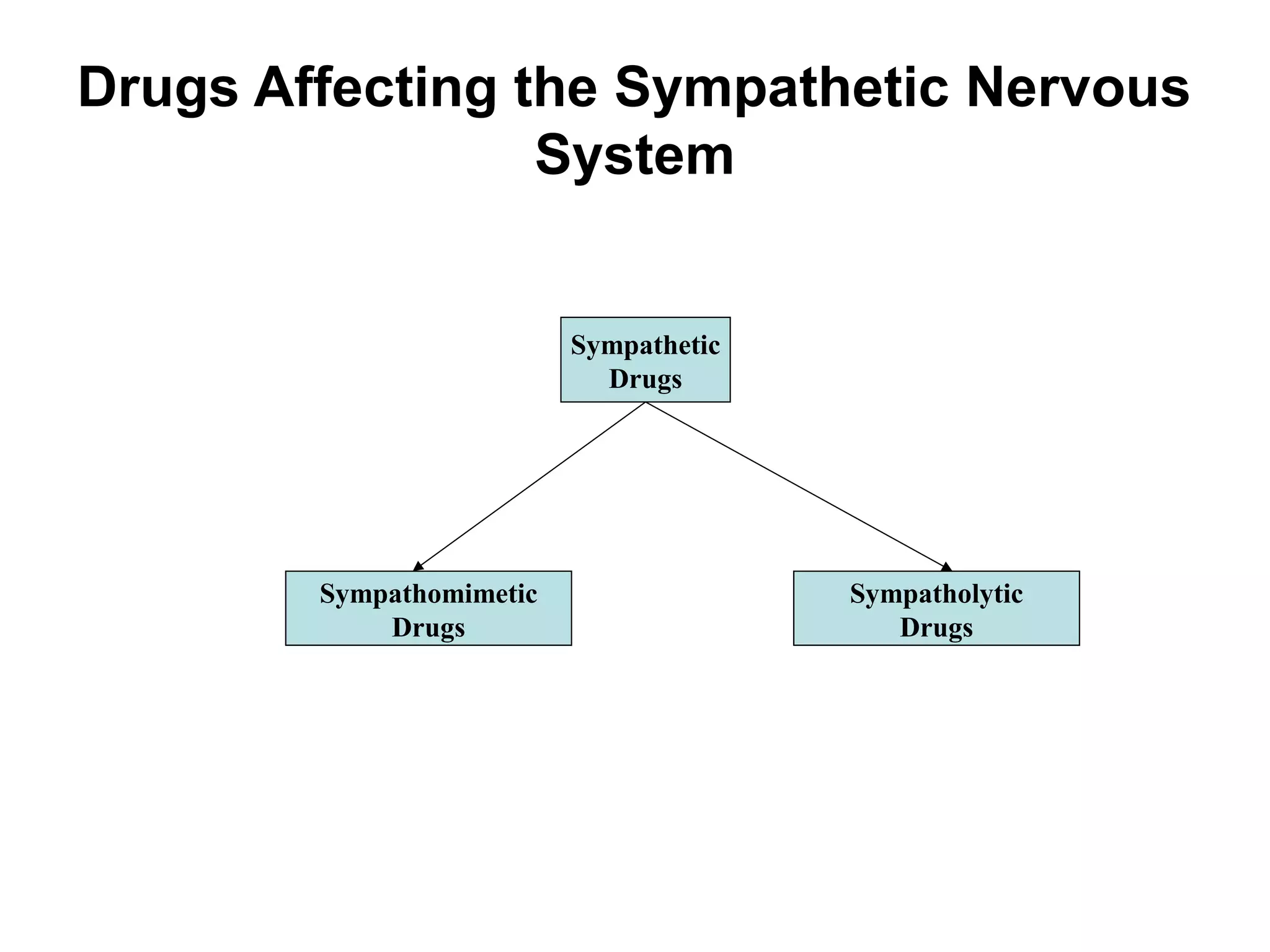
                          Sympathetic
                            Drugs


        Sympathomimetic                 Sympatholytic
            Drugs                          Drugs
Drugs Affecting the Sympathetic Nervous
                 System

                          Sympathomimetic
                              Drugs


       Alpha-adrenergic                      Beta- adrenergic


                          Selective Beta 1                Selective Beta 2
                            Adrenergic.                     Adrenergic.
Drugs Affecting the Sympathetic Nervous
                 System
    Alpha-adrenergic Drugs

    •   NE prototype

    •   Most important clinical effect is contraction
        of smooth muscles.

    •   Vasoconstriction of most blood vessels leading
        to increase in blood pressure.

    •   Contraction of sphincter muscles.
Drugs Affecting the Sympathetic Nervous
                 System


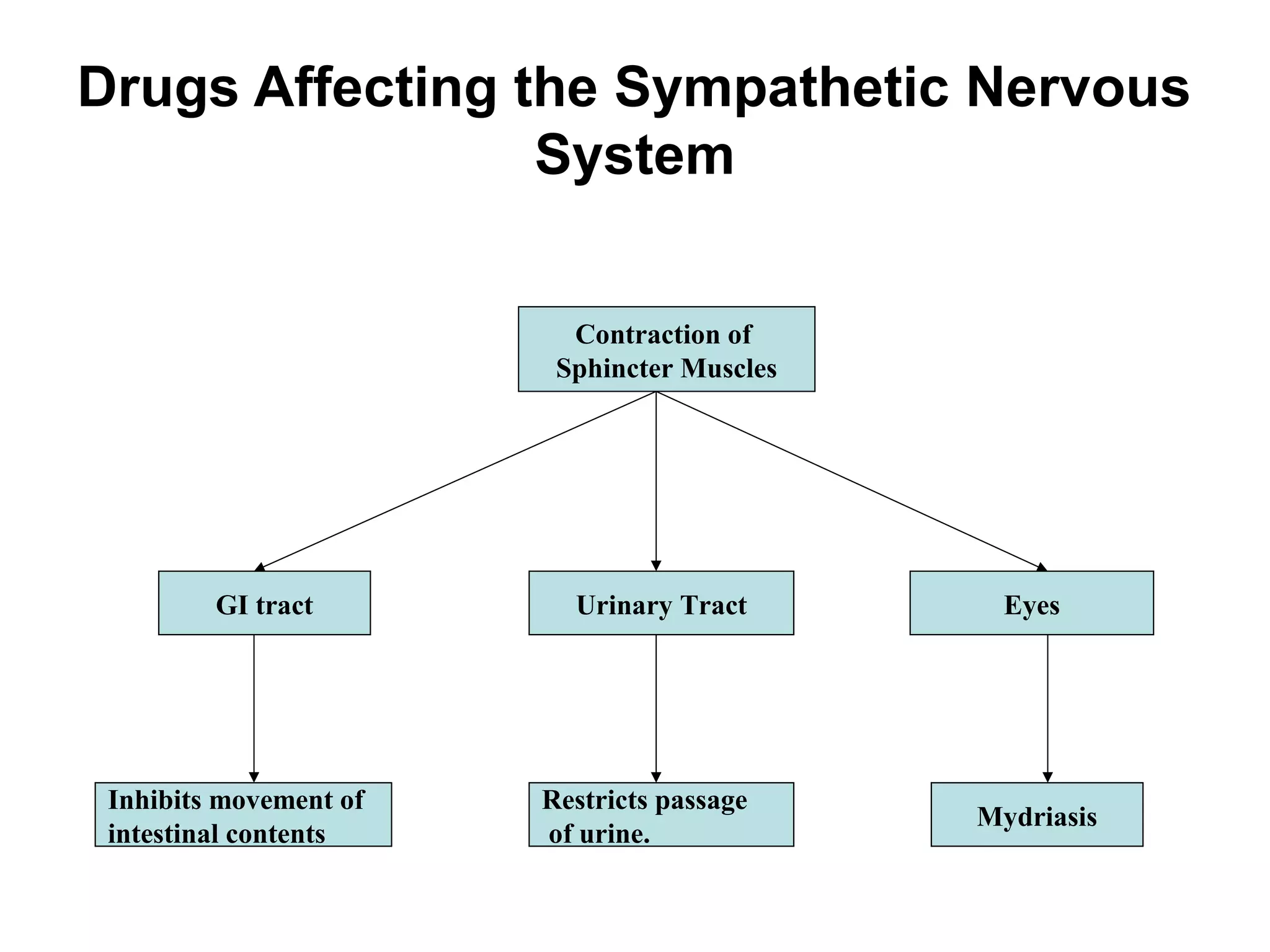
                          Contraction of
                         Sphincter Muscles


         GI tract         Urinary Tract        Eyes


 Inhibits movement of   Restricts passage
                                             Mydriasis
 intestinal contents    of urine.
Drugs Affecting the Sympathetic Nervous
                 System

       Alpha-adrenergic Drugs

       Clinical Indications

       •   Hypotensive states

       •   Decongestion

       •   Pupillary dilation
Drugs Affecting the Sympathetic Nervous
                 System

       Adverse Effects

       •   Hypertensive crisis

       •   Cerebral hemorrhage

       •   Cardiac arrhythmias

       •   Irritation of the nasal sinuses or eye.
Drugs Affecting the Sympathetic Nervous
                 System


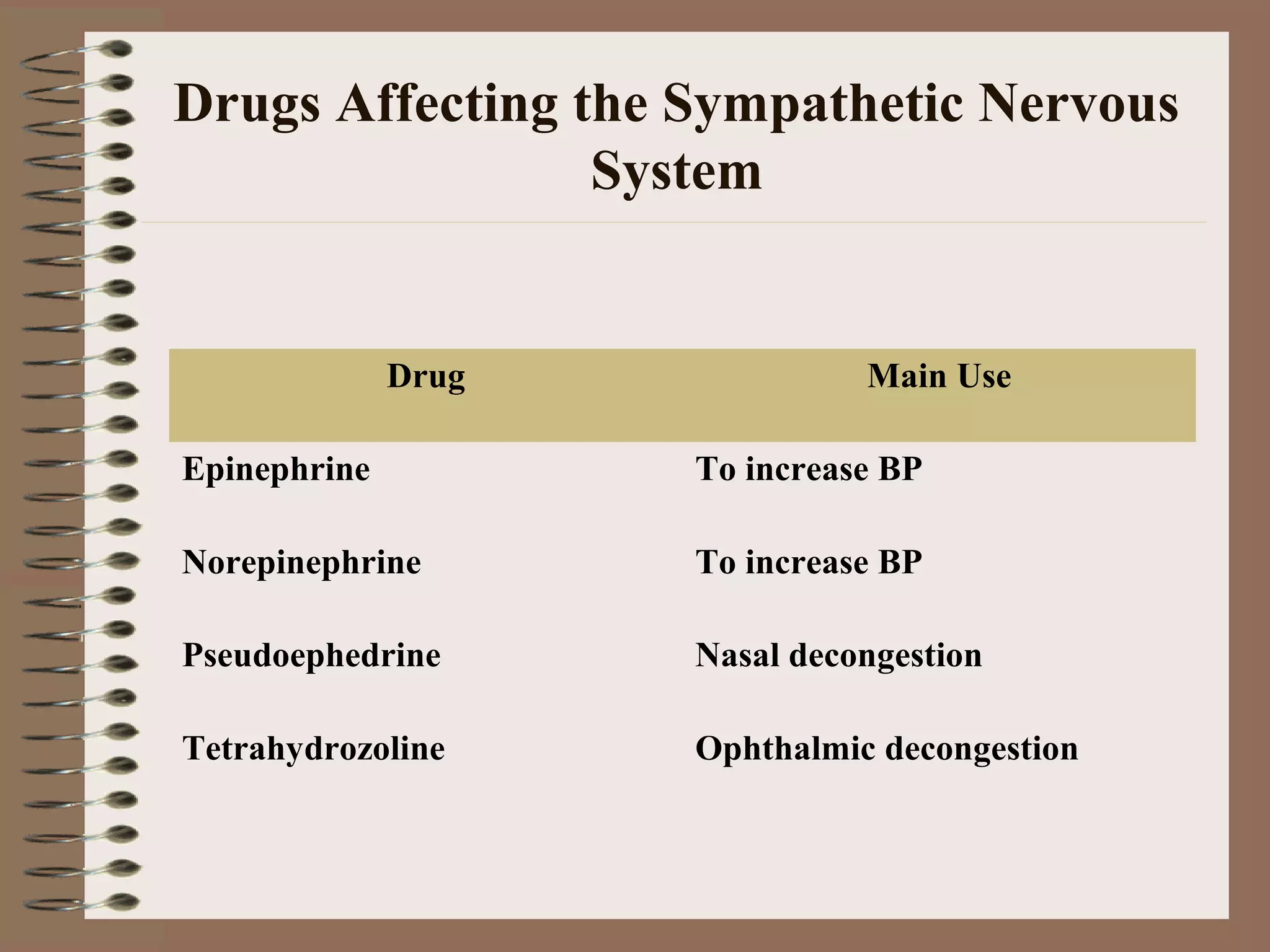
              Drug             Main Use

Epinephrine          To increase BP

Norepinephrine       To increase BP

Pseudoephedrine      Nasal decongestion

Tetrahydrozoline     Ophthalmic decongestion
Drugs Affecting the Sympathetic Nervous
                 System

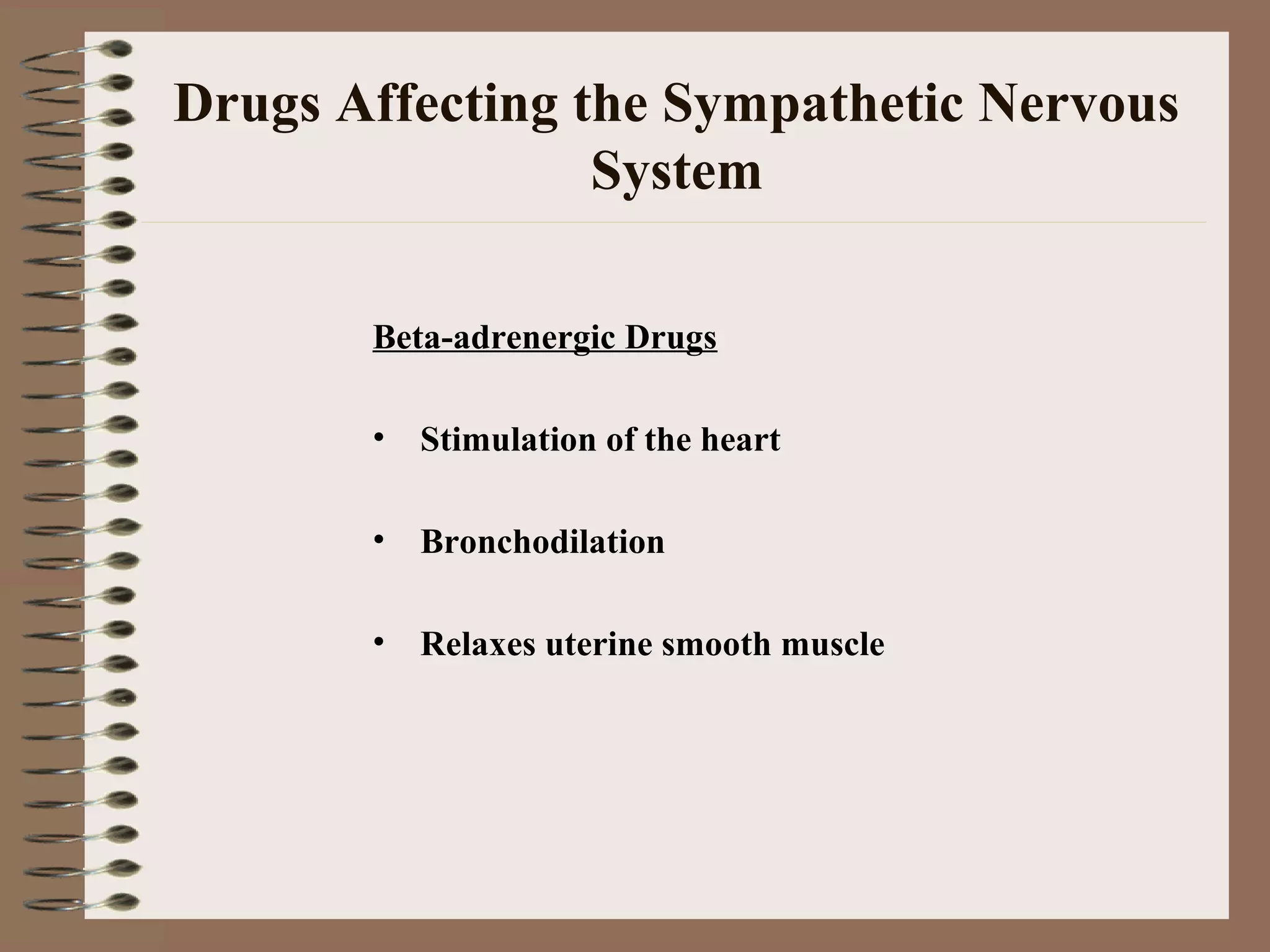
       Beta-adrenergic Drugs

       •   Stimulation of the heart

       •   Bronchodilation

       •   Relaxes uterine smooth muscle
Drugs Affecting the Sympathetic Nervous
                 System


    Drugs         Classification            Main Use
Epinephrine     Alpha, Beta-1      Vasopressor, Cardiac
                and Beta-2         stimulant, bronchodilator.
Isoproterenol   Beta-1 and Beta-   Cardiac stimulant,
                2                  bronchodilator.


Albuterol       Beta-2             Bronchodilator.

Ritodrine       Beta-2             Arrest preterm labor.
Drugs Affecting the Sympathetic Nervous
                 System
      Epinephrine

      •   DOC for allergic reactions

      •   Use in combination with local anesthetics.

      •   Used as a cardiac stimulant in emergencies.

      •   Use in the treatment of asthma.
Drugs Affecting the Sympathetic Nervous
                 System
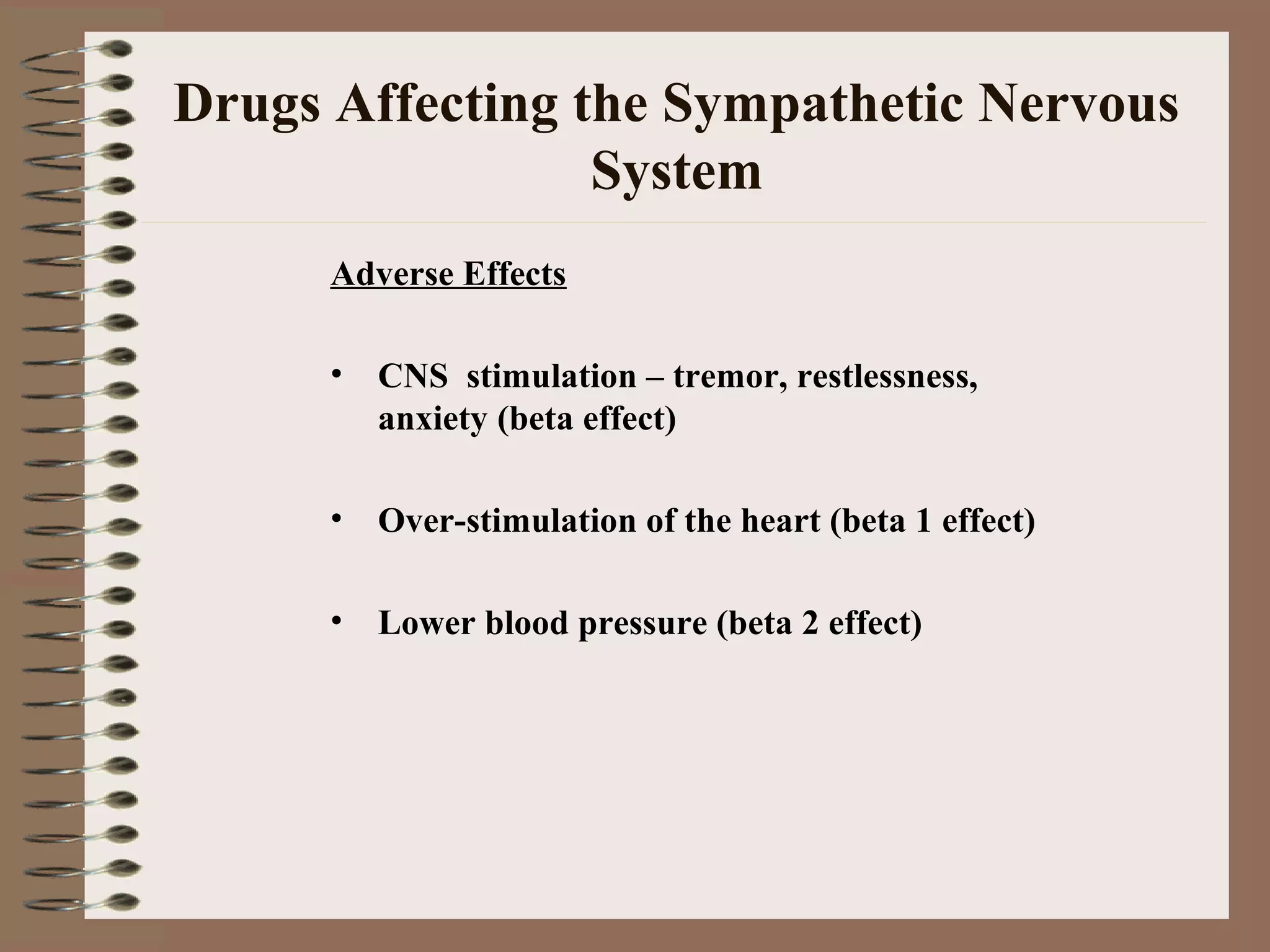
      Adverse Effects

      •   CNS stimulation – tremor, restlessness,
          anxiety (beta effect)

      •   Over-stimulation of the heart (beta 1 effect)

      •   Lower blood pressure (beta 2 effect)
Drugs Affecting the Sympathetic Nervous
                 System
     Dopamine

     • Neurotransmitter in the brain.

     • Precursor in the synthesis of NE

     • Stimulates dopaminergic, beta-1 and alpha-
       receptors.

     • Use as a drug.

     • Dobutamine similar to dopamine but with
       more Beta-1 effect.
Drugs Affecting the Sympathetic Nervous
                 System


                                     NE
                             NE
                                          NE
                    MAO
      Tyrosine   DOPA     Dopamine
                                          NE
                                     NE
Drugs Affecting the Sympathetic Nervous
                 System

 DOPAMINE             RECEPTORS                      EFFECTS
   DOSE              STIMULATED


Low dose        Stimulate dopaminergic     Increased renal blood flow
                receptors in the renal and and vasodilatation.
                mesenteric blood vessels.

Moderate dose   Stimulates beta-1          Increase myocardial
                receptors in the heart.    contractility.


Higher dose     Stimulate alpha-receptors Produces vasoconstriction.
Drugs Affecting the Sympathetic Nervous
                 System

   Alpha-adrenergic blocking drugs

   •   Binds to Alpha receptors

   •   Antagonizes the effects of NE and EPI

   •   Leads to a decrease in sympathetic response

   •   Resulting in vasodilatation and thus decrease in BP.
Drugs Affecting the Sympathetic Nervous
                 System

  Alpha-adrenergic blocking drugs.

  Clinical Indications

  •   Treatment of hypertension.

  •   Vasodilator in treatment of Raynaud’s disease.

  •   Diagnosis of Pheochromocytoma.
Drugs Affecting the Sympathetic Nervous
                 System
   Alpha-adrenergic blocking drugs.

   Adverse Effects

   •   Constriction of pupils

   •   Increased GI activity

   •   Nasal congestion

   •   Reflex tachycardia ( if BP is lowered too much).
Drugs Affecting the Sympathetic Nervous
                 System


            Drugs             Main Use

Doxazosin           Treatment of Hypertension

Prazosin            Treatment of Hypertension


Phentolamine        Diagnosis of pheochromocytoma.
                    Treatment of vascular disease.
Drugs Affecting the Sympathetic Nervous
                 System
   Beta-adrenergic blocking drugs.

   •   Binds to beta receptors

   •   Antagonizes the effects of NE and EPI

   •   Leads to a decrease in sympathetic response.

   •   Resulting in decrease heart rate and force of
       contraction.
Drugs Affecting the Sympathetic Nervous
                 System
                      Beta-blocking
                         Drugs


      Non-selective                   Selective Beta-1
Drugs Affecting the Sympathetic Nervous
                 System
     Nonselective Blockers              Main Use

Labetalol                    Hypertension

Nadolol                      Hypertension, Angina Pectoris

Pindolol                     Hypertension


Propanolol                   Hypertension, Angina Pectoris,
                             arrhythmhias, migraine


Timolol                      Hypertension, post myocardial
                             infarction.
Drugs Affecting the Sympathetic Nervous
                 System

       Selective Blockers              Main Use

Acebutolol                  Hypertension, ventricular
                            arrhythmias.
Atenolol                    Hypertension, Angina Pectoris

Bisoprolol                  Hypertension


Esmolol                     Supraventricular tachycardia

Metoprolol                  Hypertension, Angina Pectoris
Drugs Affecting the Sympathetic Nervous
                 System
    Propranolol

    •   Decrease heart rate

    •   Decrease force of contraction

    •   Decrease rate of conduction

    •   Resulting decrease in effort and work of the heart
        causes a decrease in oxygen consumption.
Drugs Affecting the Sympathetic Nervous
                 System
• Oral and iv preparation

• Drug is carried directly to the liver by the portal system.

• Significant first pass metabolism.

• Lipid soluble and passes into the brain.

• Causes CNS sedation, depression and decreased central
  sympathetic activity.
Drugs Affecting the Sympathetic Nervous
                 System

    •   Used in the treatment of angina, and various
        cardiac arrhythmia.

    •   Adverse effects include nausea, vomiting and
        diarrhea, bradycardia with resulting reduced
        cardiac function, bronchoconstriction.

    •   Most serious drug interactions involve therapy
        of beta blockers with other drugs that decrease
        cardiac function (cardiac glycosides, anti-
        arrhythmic drugs and calcium blockers).
Drugs Affecting the Sympathetic Nervous
                 System
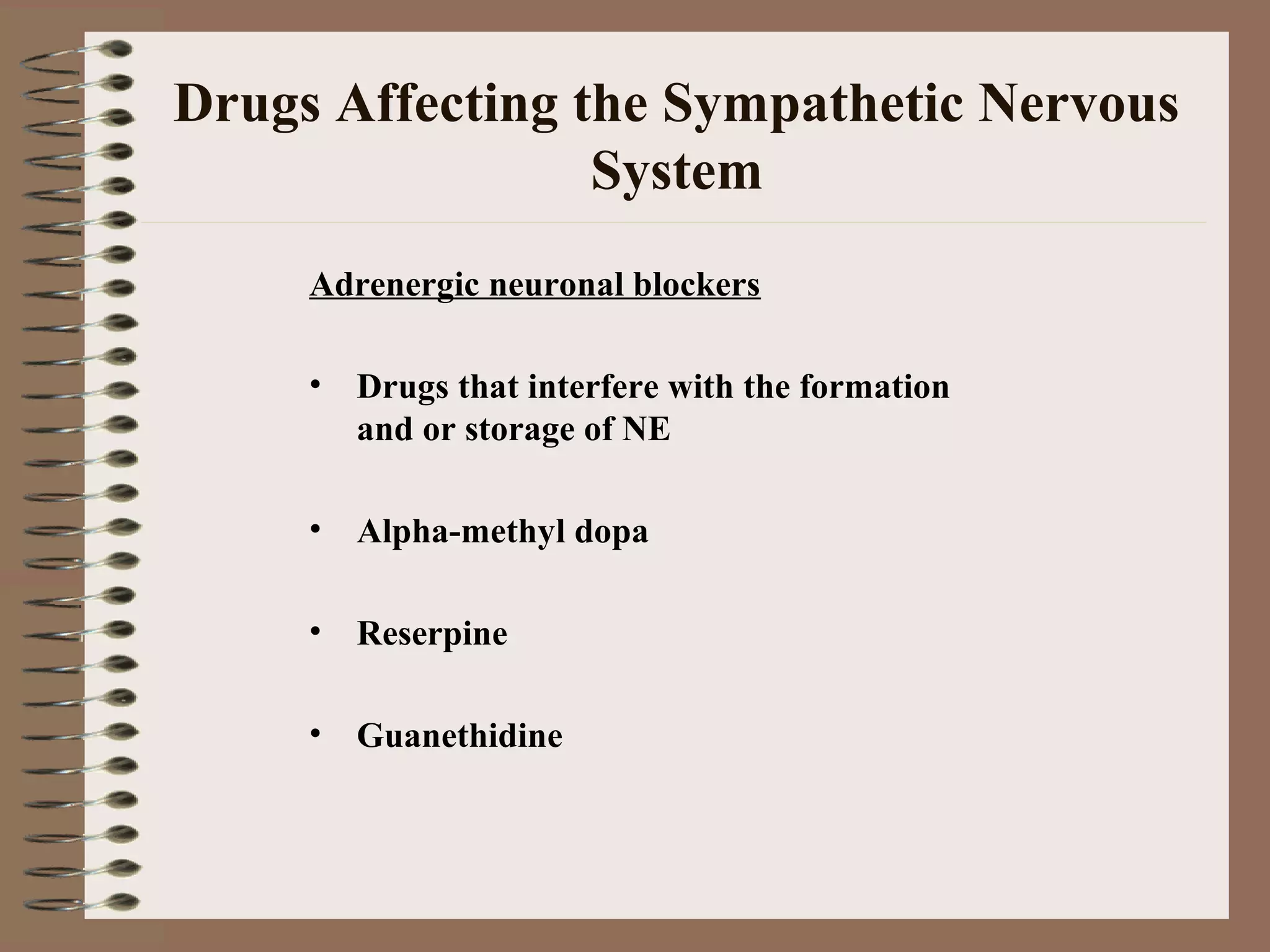
     Adrenergic neuronal blockers

     •   Drugs that interfere with the formation
         and or storage of NE

     •   Alpha-methyl dopa

     •   Reserpine

     •   Guanethidine
Drugs Affecting the Sympathetic Nervous
                 System
                                    Reserpine


                                    NE
                             NE
                                         NE
                  MAO
   Tyrosine   DOPA       Dopamine
                                         NE
                                    NE
                                                Guanethidine
              Alpha-methyl dopa
Drugs Affecting the Sympathetic Nervous
                 System

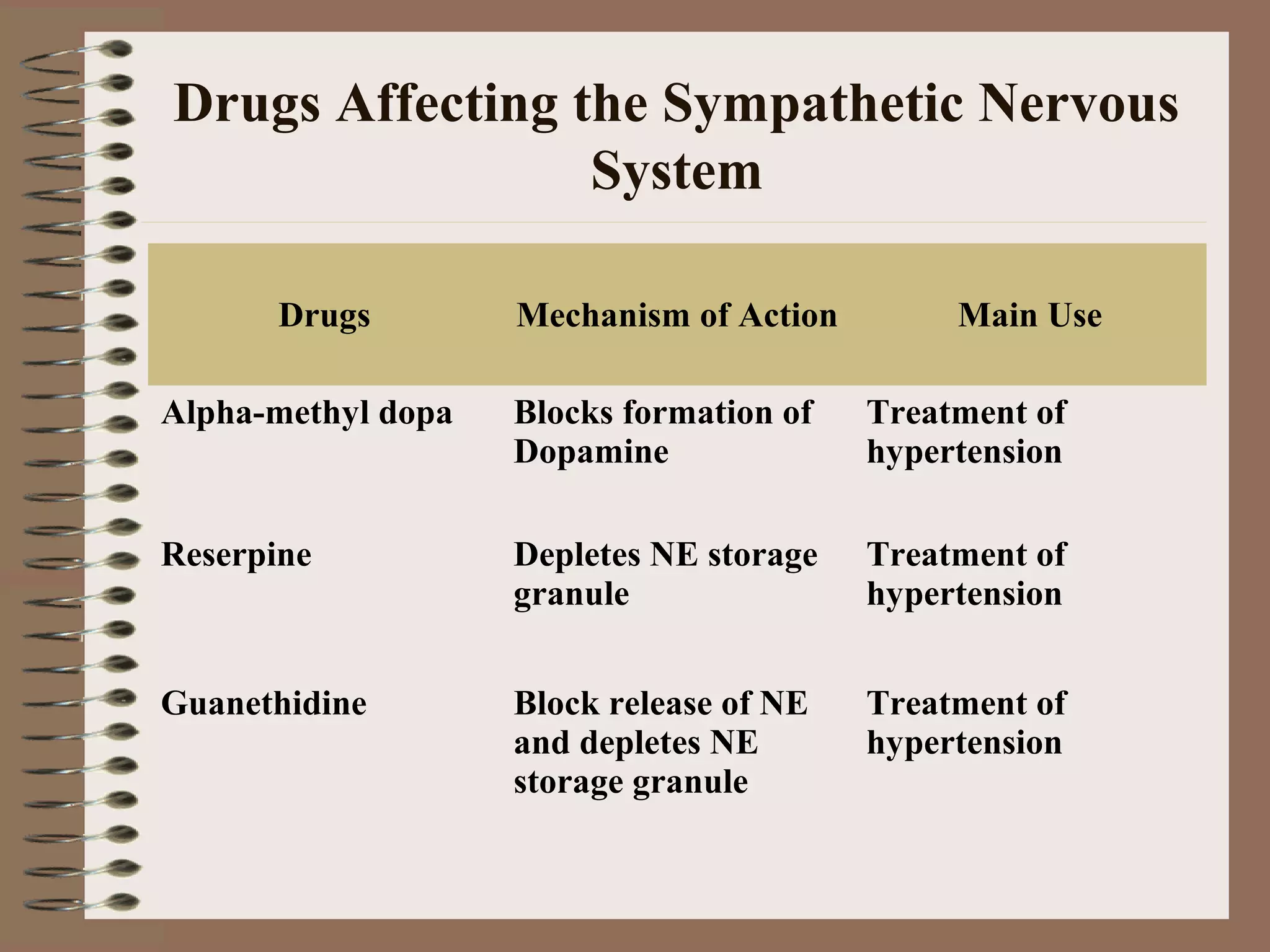
       Drugs        Mechanism of Action        Main Use

Alpha-methyl dopa   Blocks formation of   Treatment of
                    Dopamine              hypertension

Reserpine           Depletes NE storage   Treatment of
                    granule               hypertension


Guanethidine        Block release of NE   Treatment of
                    and depletes NE       hypertension
                    storage granule
ANS - Adrenergic Drugs
        Nursing Implications
 Assess for allergies and history of hypertension, cardiac
  dysrhythmias, or other cardiovascular disease
 Assess renal, hepatic, and cardiac function before treatment
 Perform baseline assessment of vital signs, peripheral
  pulses, skin color, temperature; include postural blood
  pressure and pulse
 Follow administration guidelines carefully
Intravenous administration
 Check IV site often for infiltration
 Use clear IV solutions / Use an infusion pump
 Infuse drug slowly to avoid dangerous cardiovascular effects
 Monitor cardiac rhythm
ANS - Adrenergic Drugs
   Nursing Implications (cont’d)
With chronic lung disease:


Instruct patients to avoid factors that exacerbate
 their condition
Encourage fluid intake
 (up to 3000 mL per day) if permitted
Educate about proper dosing, use of equipment
 (MDI, spacer, nebulizer), and equipment care
ANS - Adrenergic Drugs
  Nursing Implications (cont’d)

 Salmeterol is indicated for prevention of
bronchospasms, not management of acute symptoms
 Overuse of nasal decongestants may cause rebound
nasal congestion or ulcerations
 Avoid OTC or other medications because of possible
  interactions
Administering two adrenergic drugs together
may precipitate severe cardiovascular effects such
as tachycardia or hypertension
ANS - Adrenergic Drugs
 Nursing Implications (cont’d)
Monitor for therapeutic effects:
(cardiovascular uses)

 Decreased edema
 Increased urinary output
 Return to normal vital signs
 Improved skin color and temperature
 Increased LOC
ANS - Adrenergic Drugs
    Nursing Implications (cont’d)
Monitor for therapeutic effects
(bronchospasm/asthma):

•   Return to normal respiratory rate
•   Improved breath sounds, fewer rales
•   Increased air exchange
•   Decreased cough
•   Less dyspnea
•   Improved blood gases
•   Increased activity tolerance
Let’s take a break!

Drugs affecting the_sympathetic_nervous_system

  • 1.
    AUTONOMIC NERVOUS SYSTEM AGENTS Nelia B. Perez RN, MSN PCU – Mary Johnston College of Nursing
  • 2.
    1. Drugs thatstimulate the sympathetic nervous system are called a. adrenergics b. Cholinergics c. Analeptics d. benzodiazepines
  • 3.
    2. The sympatheticneurotransmitters are norepinephrine and epinephrine. a. true b. false
  • 4.
    3. These receptorsare found predominantly in the smooth muscle membrane. a. alpha adrenergic receptors b. Alpha 2 adrenergic receptors c. Beta adrenergic receptors d. Beta2 adrenergic receptors
  • 5.
    4. The mostimportant clinical effect of this drug is contraction of smooth muscles. a. beta adrenergic drugs b. Anxiolitics c. Alpha-adrenergic Drugs b. Anticholinergics
  • 6.
    5. A beta2adrenergic drug which is primarily used as a bronchodilator. a. Epinephrine b. Norepinephrine c. albuterol d. ephedrine
  • 7.
    6. When usedas a Beta1 Adrenergic drug, it causes over-stimulation of the heart. a. Norepinephrine b. Epinephrine c. Ephedrine d. isoetharine
  • 8.
    7. It isa Neurotransmitter in the brain and serves as a precursor in the synthesis of norepinephrine. a. Dopamine b. Dobutamine c. Epinephrine d. Ephedrine
  • 9.
    8. It antagonizesthe effect of Norepinephrine and epinephrine which results in vasodilatation and thus decrease in BP. a. Alpha-adrenergic blocking drugs b. Alpha2-adrenergic blocking drugs c. Beta-adrenergic blocking drugs d. Beta2-adrenergic blocking drugs
  • 10.
    9. It leadsto a decrease in sympathetic response resulting in decrease heart rate and force of contraction. a. Alpha-adrenergic blocking drugs b. Alpha2-adrenergic blocking drugs c. Beta-adrenergic blocking drugs d. Beta2-adrenergic blocking drugs
  • 11.
    10. Adrenergic neuronalblockers are those which a. interfere with the formation and or storage of NE b. Blocks the synthesis of epinephrine c. Dilates blood vessels in hypertension d. Serves as bronchodilators
  • 12.
  • 13.
    Drugs Affecting theSympathetic Nervous System Release Adrenergic Receptor NE NE NE MAO NE NE Involuntary Muscle Membrane Metabolism Reuptake NE Adrenergic nerve ending
  • 14.
    Drugs Affecting theSympathetic Nervous System Adrenergic Receptors Alpha Beta Receptors Receptors Beta 1 Beta 2 Receptors Receptors
  • 15.
    Drugs Affecting theSympathetic Nervous System Alpha-adrenergic Receptors • Found predominantly on smooth muscle membrane. • When stimulated by NE or EPI produce contraction. • Produces vasoconstriction of most blood vessels.
  • 16.
    Drugs Affecting theSympathetic Nervous System Beta-adrenergic Receptors • Found on both cardiac and some smooth muscle membranes. • In the heart, beta 1 receptors predominates. • When stimulated by NE or EPI, they increase heart rate and force of contraction.
  • 17.
    Drugs Affecting theSympathetic Nervous System Beta-adrenergic Receptors • Found on smooth muscle in the bronchus and smooth muscles of blood vessels supplying muscle and the heart. • Stimulated with EPI result in relaxation.
  • 18.
    Drugs Affecting theSympathetic Nervous System Beta-adrenergic Receptors • In smooth muscle, beta 2 receptors predominates. • When stimulated by EPI, they produces muscle relaxation. • Found in smooth muscles of blood vessels supplying skeletal muscle and the coronary arteries. • Found on smooth muscle in the bronchial tree.
  • 19.
    Drugs Affecting theSympathetic Nervous System Beta 1 Receptors Found on smooth muscle in the heart Increase heart rate and force of contraction.
  • 20.
    Drugs Affecting theSympathetic Nervous System Beta 2 Receptors Found on smooth Found on smooth muscle muscle in the of blood vessels supplying bronchial tree. skeletal muscle and the heart. Vasodilatation. Bronchodilation.
  • 21.
    Drugs Affecting theSympathetic Nervous System Sympathetic Drugs Sympathomimetic Sympatholytic Drugs Drugs
  • 22.
    Drugs Affecting theSympathetic Nervous System Sympathomimetic Drugs Alpha-adrenergic Beta- adrenergic Selective Beta 1 Selective Beta 2 Adrenergic. Adrenergic.
  • 23.
    Drugs Affecting theSympathetic Nervous System Alpha-adrenergic Drugs • NE prototype • Most important clinical effect is contraction of smooth muscles. • Vasoconstriction of most blood vessels leading to increase in blood pressure. • Contraction of sphincter muscles.
  • 24.
    Drugs Affecting theSympathetic Nervous System Contraction of Sphincter Muscles GI tract Urinary Tract Eyes Inhibits movement of Restricts passage Mydriasis intestinal contents of urine.
  • 25.
    Drugs Affecting theSympathetic Nervous System Alpha-adrenergic Drugs Clinical Indications • Hypotensive states • Decongestion • Pupillary dilation
  • 26.
    Drugs Affecting theSympathetic Nervous System Adverse Effects • Hypertensive crisis • Cerebral hemorrhage • Cardiac arrhythmias • Irritation of the nasal sinuses or eye.
  • 27.
    Drugs Affecting theSympathetic Nervous System Drug Main Use Epinephrine To increase BP Norepinephrine To increase BP Pseudoephedrine Nasal decongestion Tetrahydrozoline Ophthalmic decongestion
  • 28.
    Drugs Affecting theSympathetic Nervous System Beta-adrenergic Drugs • Stimulation of the heart • Bronchodilation • Relaxes uterine smooth muscle
  • 29.
    Drugs Affecting theSympathetic Nervous System Drugs Classification Main Use Epinephrine Alpha, Beta-1 Vasopressor, Cardiac and Beta-2 stimulant, bronchodilator. Isoproterenol Beta-1 and Beta- Cardiac stimulant, 2 bronchodilator. Albuterol Beta-2 Bronchodilator. Ritodrine Beta-2 Arrest preterm labor.
  • 30.
    Drugs Affecting theSympathetic Nervous System Epinephrine • DOC for allergic reactions • Use in combination with local anesthetics. • Used as a cardiac stimulant in emergencies. • Use in the treatment of asthma.
  • 31.
    Drugs Affecting theSympathetic Nervous System Adverse Effects • CNS stimulation – tremor, restlessness, anxiety (beta effect) • Over-stimulation of the heart (beta 1 effect) • Lower blood pressure (beta 2 effect)
  • 32.
    Drugs Affecting theSympathetic Nervous System Dopamine • Neurotransmitter in the brain. • Precursor in the synthesis of NE • Stimulates dopaminergic, beta-1 and alpha- receptors. • Use as a drug. • Dobutamine similar to dopamine but with more Beta-1 effect.
  • 33.
    Drugs Affecting theSympathetic Nervous System NE NE NE MAO Tyrosine DOPA Dopamine NE NE
  • 34.
    Drugs Affecting theSympathetic Nervous System DOPAMINE RECEPTORS EFFECTS DOSE STIMULATED Low dose Stimulate dopaminergic Increased renal blood flow receptors in the renal and and vasodilatation. mesenteric blood vessels. Moderate dose Stimulates beta-1 Increase myocardial receptors in the heart. contractility. Higher dose Stimulate alpha-receptors Produces vasoconstriction.
  • 35.
    Drugs Affecting theSympathetic Nervous System Alpha-adrenergic blocking drugs • Binds to Alpha receptors • Antagonizes the effects of NE and EPI • Leads to a decrease in sympathetic response • Resulting in vasodilatation and thus decrease in BP.
  • 36.
    Drugs Affecting theSympathetic Nervous System Alpha-adrenergic blocking drugs. Clinical Indications • Treatment of hypertension. • Vasodilator in treatment of Raynaud’s disease. • Diagnosis of Pheochromocytoma.
  • 37.
    Drugs Affecting theSympathetic Nervous System Alpha-adrenergic blocking drugs. Adverse Effects • Constriction of pupils • Increased GI activity • Nasal congestion • Reflex tachycardia ( if BP is lowered too much).
  • 38.
    Drugs Affecting theSympathetic Nervous System Drugs Main Use Doxazosin Treatment of Hypertension Prazosin Treatment of Hypertension Phentolamine Diagnosis of pheochromocytoma. Treatment of vascular disease.
  • 39.
    Drugs Affecting theSympathetic Nervous System Beta-adrenergic blocking drugs. • Binds to beta receptors • Antagonizes the effects of NE and EPI • Leads to a decrease in sympathetic response. • Resulting in decrease heart rate and force of contraction.
  • 40.
    Drugs Affecting theSympathetic Nervous System Beta-blocking Drugs Non-selective Selective Beta-1
  • 41.
    Drugs Affecting theSympathetic Nervous System Nonselective Blockers Main Use Labetalol Hypertension Nadolol Hypertension, Angina Pectoris Pindolol Hypertension Propanolol Hypertension, Angina Pectoris, arrhythmhias, migraine Timolol Hypertension, post myocardial infarction.
  • 42.
    Drugs Affecting theSympathetic Nervous System Selective Blockers Main Use Acebutolol Hypertension, ventricular arrhythmias. Atenolol Hypertension, Angina Pectoris Bisoprolol Hypertension Esmolol Supraventricular tachycardia Metoprolol Hypertension, Angina Pectoris
  • 43.
    Drugs Affecting theSympathetic Nervous System Propranolol • Decrease heart rate • Decrease force of contraction • Decrease rate of conduction • Resulting decrease in effort and work of the heart causes a decrease in oxygen consumption.
  • 44.
    Drugs Affecting theSympathetic Nervous System • Oral and iv preparation • Drug is carried directly to the liver by the portal system. • Significant first pass metabolism. • Lipid soluble and passes into the brain. • Causes CNS sedation, depression and decreased central sympathetic activity.
  • 45.
    Drugs Affecting theSympathetic Nervous System • Used in the treatment of angina, and various cardiac arrhythmia. • Adverse effects include nausea, vomiting and diarrhea, bradycardia with resulting reduced cardiac function, bronchoconstriction. • Most serious drug interactions involve therapy of beta blockers with other drugs that decrease cardiac function (cardiac glycosides, anti- arrhythmic drugs and calcium blockers).
  • 46.
    Drugs Affecting theSympathetic Nervous System Adrenergic neuronal blockers • Drugs that interfere with the formation and or storage of NE • Alpha-methyl dopa • Reserpine • Guanethidine
  • 47.
    Drugs Affecting theSympathetic Nervous System Reserpine NE NE NE MAO Tyrosine DOPA Dopamine NE NE Guanethidine Alpha-methyl dopa
  • 48.
    Drugs Affecting theSympathetic Nervous System Drugs Mechanism of Action Main Use Alpha-methyl dopa Blocks formation of Treatment of Dopamine hypertension Reserpine Depletes NE storage Treatment of granule hypertension Guanethidine Block release of NE Treatment of and depletes NE hypertension storage granule
  • 49.
    ANS - AdrenergicDrugs Nursing Implications  Assess for allergies and history of hypertension, cardiac dysrhythmias, or other cardiovascular disease  Assess renal, hepatic, and cardiac function before treatment  Perform baseline assessment of vital signs, peripheral pulses, skin color, temperature; include postural blood pressure and pulse  Follow administration guidelines carefully Intravenous administration  Check IV site often for infiltration  Use clear IV solutions / Use an infusion pump  Infuse drug slowly to avoid dangerous cardiovascular effects  Monitor cardiac rhythm
  • 50.
    ANS - AdrenergicDrugs Nursing Implications (cont’d) With chronic lung disease: Instruct patients to avoid factors that exacerbate their condition Encourage fluid intake (up to 3000 mL per day) if permitted Educate about proper dosing, use of equipment (MDI, spacer, nebulizer), and equipment care
  • 51.
    ANS - AdrenergicDrugs Nursing Implications (cont’d)  Salmeterol is indicated for prevention of bronchospasms, not management of acute symptoms  Overuse of nasal decongestants may cause rebound nasal congestion or ulcerations  Avoid OTC or other medications because of possible interactions Administering two adrenergic drugs together may precipitate severe cardiovascular effects such as tachycardia or hypertension
  • 52.
    ANS - AdrenergicDrugs Nursing Implications (cont’d) Monitor for therapeutic effects: (cardiovascular uses)  Decreased edema  Increased urinary output  Return to normal vital signs  Improved skin color and temperature  Increased LOC
  • 53.
    ANS - AdrenergicDrugs Nursing Implications (cont’d) Monitor for therapeutic effects (bronchospasm/asthma): • Return to normal respiratory rate • Improved breath sounds, fewer rales • Increased air exchange • Decreased cough • Less dyspnea • Improved blood gases • Increased activity tolerance
  • 54.