Key developments in
HIV/TB research
Zeena Nackerdien
STOP
TB
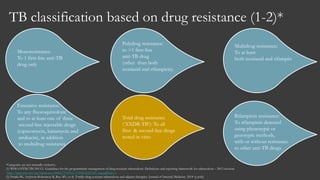
TB classification based on drug resistance (1-2)*
*Categories are not mutually exclusive..
(1) WHO/HTM/TB/2013.2. Guidelines for the programmatic management of drug-resistant tuberculosis: Definitions and reporting framework for tuberculosis – 2013 revision
http://apps.who.int/iris/bitstream/10665/79199/1/9789241505345_eng.pdf?ua=1.
(2) Parida SK, Axelsson-Robertson R, Rao MV, et al. Totally-drug resistant tuberculosis and adjunct therapies. Journal of Internal Medicine. 2014 (e-pub).
Director
Polydrug resistance:
to >1 first-line
anti-TB drug
(other than both
isoniazid and rifampicin)
Monoresistance:
To 1 first-line anti-TB
drug only
Multidrug resistance:
To at least
both isoniazid and rifampin
Extensive resistance:
To any fluoroquinolone
and to at least one of three
second-line injectable drugs
(capreomycin, kanamycin and
amikacin), in addition
to multidrug resistance
Rifampicin resistance:
To rifampicin detected
using phenotypic or
genotypic methods,
with or without resistance
to other anti-TB drugs
Total drug resistance
(‘XXDR-TB’): To all
first- & second-line drugs
tested in vitro
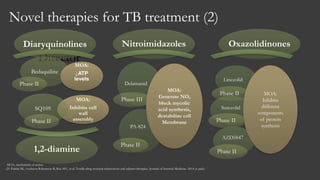
MOA:
Inhibits cell
wall
assembly
Novel therapies for TB treatment (2)
MOA, mechanism of action
(21 Parida SK, Axelsson-Robertson R, Rao MV, et al. Totally-drug resistant tuberculosis and adjunct therapies. Journal of Internal Medicine. 2014 (e-pub).
Director
Bedaquiline
Phase II
MOA:
↓ATP
levels
Diaryquinolines
SQ109
Phase II
1,2-diamine
Nitroimidazoles Oxazolidinones
Delamanid
PA-824
Phase III
Phase II
MOA:
Generate NO,
block mycolic
acid synthesis,
destabilize cell
Membrane
Linezolid
Phase II
Phase II
Phase II
Sutezolid
AZD5847
MOA:
Inhibits
different
components
of protein
synthesis
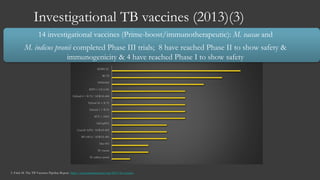
Investigational TB vaccines (2013)(3)
3. Frick M. The TB Vaccines Pipeline Report. http://www.pipelinereport.org/2013/tb-vaccine.
.
M. indicus pranii
M. vaccae
Dar-901
MVA85A/ AERAS-485
Crucell Ad35/ AERAS-402
Ad5Ag85A
M72 + AS01
Hybrid 1 + IC31
Hybrid 56 + IC31
Hybrid 4 + IC31/ AERAS-404
ID93 + GLA-SE
VPM1002
RUTI
MTBVAC
14 investigational vaccines (Prime-boost/immunotherapeutic): M. vaccae and
M. indicus pranii completed Phase III trials; 8 have reached Phase II to show safety &
immunogenicity & 4 have reached Phase I to show safety
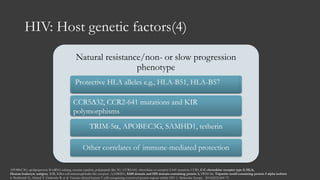
HIV: Host genetic factors(4)
Natural resistance/non- or slow progression
phenotype
Protective HLA alleles e.g., HLA-B51, HLA-B57
CCR532, CCR2-641 mutations and KIR
polymorphisms
TRIM-5, APOBEC3G, SAMHD1, tetherin
Other correlates of immune-mediated protection
APOBEC3G, apolipoprotein B mRNA-editing, enzyme-catalytic, polypeptide-like 3G ; CCR2-641, chemokine co-receptor 2-641 mutation; CCR5, C-C chemokine receptor type 5; HLA,
Human leukocyte antigen; KIR, Killer-cell immunoglobulin-like receptor ; S;AMHD1, SAM domain and HD domain-containing protein 1; TRIM-5, Tripartite motif-containing protein 5 alpha isoform
4. Borthwick N, Ahmed T, Ondondo B, et al. Vaccine-elicited human T cells recognizing conserved protein regions inhibit HIV-1. Molecular therapy 2014;22(2):464-75.
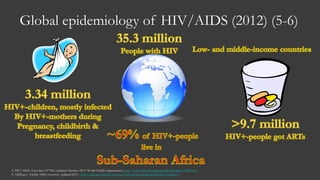
Global epidemiology of HIV/AIDS (2012) (5-6)
5. HIV/AIDS, Fact sheet N°360, Updated October 2013: World Health Organization: http://www.who.int/mediacentre/factsheets/fs360/en/
6. AIDS.gov. Global AIDS overview. updated 2013 : http://aids.gov/federal-resources/around-the-world/global-aids-overview/.
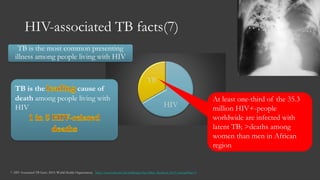
HIV-associated TB facts(7)
7. HIV-Associated TB Facts. 2013: World Health Organization; http://www.who.int/tb/challenges/hiv/tbhiv_factsheet_2013_web.pdf?ua=1.
HIV
TB
TB is the most common presenting
illness among people living with HIV
TB is the cause of
death among people living with
HIV
At least one-third of the 35.3
million HIV+-people
worldwide are infected with
latent TB; >deaths among
women than men in African
region
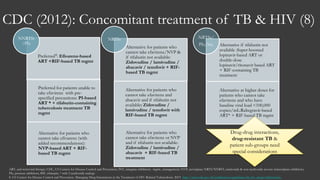
CDC (2012): Concomitant treatment of TB & HIV (8)
Preferred: Efivarenz-based
ART +RIF-based TB mgmt
Preferred for patients unable to
take efavirenz with pre-
specified precautions: PI-based
ART * + rifabutin-containing
tuberculosis treatment TB
mgmt
Alternative for patients who
cannot take efivarenz (with
added recommendations):
NVP-based ART + RIF-
based TB mgmt
NNRTIs
/PIs
Alternative for patients who
cannot take efavirenz/NVP &
if rifabutin not available:
Zidovudine / lamivudine /
abacavir / tenofovir + RIF-
based TB mgmt
Alternative for patients who
cannot take efavirenz and
abacavir and if rifabutin not
available: Zidovudine /
lamivudine / tenofovir with
RIF-based TB mgmt
Alternative for patients who
cannot take efavirenz or NVP
and if rifabutin not available:
Zidovudine / lamivudine /
abacavir + RIF-based TB
treatment
NRTIs
Alternative if rifabutin not
available :Super-boosted
lopinavir-based ART or
double-dose
lopinavir/ritonavir based ART
+ RIF-containing TB
treatment
Alternative at higher doses for
patients who cannot take
efavirenz and who have
baseline viral load <100,000
copies/mL:Raltegravir-based
ART* + RIF-based TB mgmt
NRTSs/
PIs/Int.
ART, anti-retroviral therapy; CDC, US Centers for Disease Control and Prevention; INT, integrase inhibitors; mgmt., management; NVP, nevaripine; NRTI/NNRTI, nucleoside & non-nucleoside reverse transcriptase inhibitors;
PIs, protease inhibitors; RIF, rifampin; * with 2 nucleoside analogs
8. US Centers for Disease Control and Prevention. Managing Drug Interactions in the Treatment of HIV-Related Tuberculosis. 2013 http://www.cdc.gov/tb/publications/guidelines/tb_hiv_drugs/table1a.htm.
Drug-drug interactions,
drug-resistant TB &
patient sub-groups need
special considerations
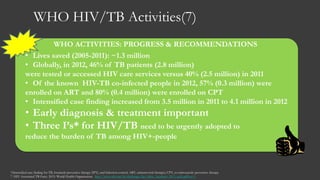
WHO HIV/TB Activities(7)
*(Intensified case finding for TB, Isoniazid preventive therapy (IPT), and Infection control; ART, antiretroviral therapy); CPT, co-trimoxazole preventive therapy
7. HIV-Associated TB Facts. 2013: World Health Organization; http://www.who.int/tb/challenges/hiv/tbhiv_factsheet_2013_web.pdf?ua=1.
• Lives saved (2005-2011): ~1.3 million
• Globally, in 2012, 46% of TB patients (2.8 million)
were tested or accessed HIV care services versus 40% (2.5 million) in 2011
• Of the known HIV-TB co-infected people in 2012, 57% (0.3 million) were
enrolled on ART and 80% (0.4 million) were enrolled on CPT
• Intensified case finding increased from 3.5 million in 2011 to 4.1 million in 2012
• Early diagnosis & treatment important
• Three I’s* for HIV/TB need to be urgently adopted to
reduce the burden of TB among HIV+-people
WHO ACTIVITIES: PROGRESS & RECOMMENDATIONS
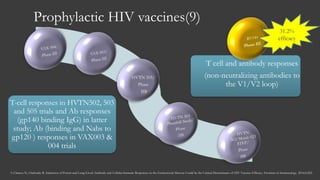
T cell and antibody responses
(non-neutralizing antibodies to
the V1/V2 loop)
Prophylactic HIV vaccines(9)
9..Chanzu N, Ondondo B. Induction of Potent and Long-Lived Antibody and Cellular Immune Responses in the Genitorectal Mucosa Could be the Critical Determinant of HIV Vaccine Efficacy. Frontiers in Immunology. 2014;5:202.
.
HVTN 505/
Phase
IIB
T-cell responses in HVTN502, 503
and 505 trials and Ab responses
(gp140 binding IgG) in latter
study; Ab (binding and Nabs to
gp120 ) responses in VAX003 &
004 trials
31.2%
efficacy
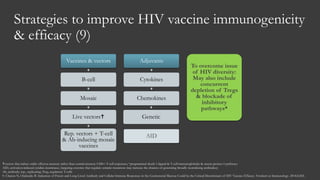
Strategies to improve HIV vaccine immunogenicity
& efficacy (9)
Vaccines & vectors
B-cell
Mosaic
Live vectors
Rep. vectors + T-cell
& Ab-inducing mosaic
vaccines
Adjuvants
Cytokines
Chemokines
Genetic
To overcome issue
of HIV diversity:
May also include
concurrent
depletion of Tregs
& blockade of
inhibitory
pathways*
AID
vectors that induce stable effector memory rather than central memory CD8+-T-cell responses; *programmed death-1-ligand & T-cell immunoglobulin & mucin protein-3 pathways
AID, activation-induced cytidine deaminase; (targeting enzymes that regulate somatic mutations may increase the chances of generating broadly neutralizing antibodies)
Ab, antibody; rep., replicating; Treg, regulatory T-cells
9. Chanzu N, Ondondo B. Induction of Potent and Long-Lived Antibody and Cellular Immune Responses in the Genitorectal Mucosa Could be the Critical Determinant of HIV Vaccine Efficacy. Frontiers in Immunology. 2014;5:202.
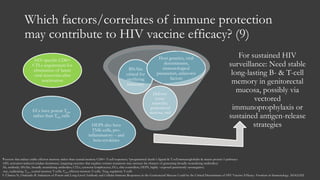
Which factors/correlates of immune protection
may contribute to HIV vaccine efficacy? (9)
vectors that induce stable effector memory rather than central memory CD8+-T-cell responses; *programmed death-1-ligand & T-cell immunoglobulin & mucin protein-3 pathways
AID, activation-induced cytidine deaminase; (targeting enzymes that regulate somatic mutations may increase the chances of generating broadly neutralizing antibodies)
Ab, antibody; bNAbs, broadly neutralizing antibodies; CTLs, cytotoxic lymphocytes; ECs, elite controllers; HEPS, highly –exposed persistently seronegative;
rep., replicating; Tcm , central memory T-cells; Tem, effector memory T-cells; Treg, regulatory T-cells
9. Chanzu N, Ondondo B. Induction of Potent and Long-Lived Antibody and Cellular Immune Responses in the Genitorectal Mucosa Could be the Critical Determinant of HIV Vaccine Efficacy. Frontiers in Immunology. 2014;5:202.
For sustained HIV
surveillance: Need stable
long-lasting B- & T-cell
memory in genitorectal
mucosa, possibly via
vectored
immunoprophylaxis or
sustained antigen-release
strategies
Delivery
route:
muscular,
genitorectal
mucosa, oral
BNAbs
critical for
sterilizing
immunity
Host genetics, viral
determinants,
immunological
parameters, unknown
factors
HIV-specific CD8+
CTLs requirement for
elimination of latent
viral reservoirs after
reactivation
ECs have potent Tem
rather than Tcm cells
HEPS also have
↑NK-cells, pro-
inflammatory – and
beta-cytokines

Key developments in HIV/TB research

  • 1.
    Key developments in HIV/TBresearch Zeena Nackerdien STOP TB
  • 2.
    TB classification basedon drug resistance (1-2)* *Categories are not mutually exclusive.. (1) WHO/HTM/TB/2013.2. Guidelines for the programmatic management of drug-resistant tuberculosis: Definitions and reporting framework for tuberculosis – 2013 revision http://apps.who.int/iris/bitstream/10665/79199/1/9789241505345_eng.pdf?ua=1. (2) Parida SK, Axelsson-Robertson R, Rao MV, et al. Totally-drug resistant tuberculosis and adjunct therapies. Journal of Internal Medicine. 2014 (e-pub). Director Polydrug resistance: to >1 first-line anti-TB drug (other than both isoniazid and rifampicin) Monoresistance: To 1 first-line anti-TB drug only Multidrug resistance: To at least both isoniazid and rifampin Extensive resistance: To any fluoroquinolone and to at least one of three second-line injectable drugs (capreomycin, kanamycin and amikacin), in addition to multidrug resistance Rifampicin resistance: To rifampicin detected using phenotypic or genotypic methods, with or without resistance to other anti-TB drugs Total drug resistance (‘XXDR-TB’): To all first- & second-line drugs tested in vitro
  • 3.
    MOA: Inhibits cell wall assembly Novel therapiesfor TB treatment (2) MOA, mechanism of action (21 Parida SK, Axelsson-Robertson R, Rao MV, et al. Totally-drug resistant tuberculosis and adjunct therapies. Journal of Internal Medicine. 2014 (e-pub). Director Bedaquiline Phase II MOA: ↓ATP levels Diaryquinolines SQ109 Phase II 1,2-diamine Nitroimidazoles Oxazolidinones Delamanid PA-824 Phase III Phase II MOA: Generate NO, block mycolic acid synthesis, destabilize cell Membrane Linezolid Phase II Phase II Phase II Sutezolid AZD5847 MOA: Inhibits different components of protein synthesis
  • 4.
    Investigational TB vaccines(2013)(3) 3. Frick M. The TB Vaccines Pipeline Report. http://www.pipelinereport.org/2013/tb-vaccine. . M. indicus pranii M. vaccae Dar-901 MVA85A/ AERAS-485 Crucell Ad35/ AERAS-402 Ad5Ag85A M72 + AS01 Hybrid 1 + IC31 Hybrid 56 + IC31 Hybrid 4 + IC31/ AERAS-404 ID93 + GLA-SE VPM1002 RUTI MTBVAC 14 investigational vaccines (Prime-boost/immunotherapeutic): M. vaccae and M. indicus pranii completed Phase III trials; 8 have reached Phase II to show safety & immunogenicity & 4 have reached Phase I to show safety
  • 5.
    HIV: Host geneticfactors(4) Natural resistance/non- or slow progression phenotype Protective HLA alleles e.g., HLA-B51, HLA-B57 CCR532, CCR2-641 mutations and KIR polymorphisms TRIM-5, APOBEC3G, SAMHD1, tetherin Other correlates of immune-mediated protection APOBEC3G, apolipoprotein B mRNA-editing, enzyme-catalytic, polypeptide-like 3G ; CCR2-641, chemokine co-receptor 2-641 mutation; CCR5, C-C chemokine receptor type 5; HLA, Human leukocyte antigen; KIR, Killer-cell immunoglobulin-like receptor ; S;AMHD1, SAM domain and HD domain-containing protein 1; TRIM-5, Tripartite motif-containing protein 5 alpha isoform 4. Borthwick N, Ahmed T, Ondondo B, et al. Vaccine-elicited human T cells recognizing conserved protein regions inhibit HIV-1. Molecular therapy 2014;22(2):464-75.
  • 6.
    Global epidemiology ofHIV/AIDS (2012) (5-6) 5. HIV/AIDS, Fact sheet N°360, Updated October 2013: World Health Organization: http://www.who.int/mediacentre/factsheets/fs360/en/ 6. AIDS.gov. Global AIDS overview. updated 2013 : http://aids.gov/federal-resources/around-the-world/global-aids-overview/.
  • 7.
    HIV-associated TB facts(7) 7.HIV-Associated TB Facts. 2013: World Health Organization; http://www.who.int/tb/challenges/hiv/tbhiv_factsheet_2013_web.pdf?ua=1. HIV TB TB is the most common presenting illness among people living with HIV TB is the cause of death among people living with HIV At least one-third of the 35.3 million HIV+-people worldwide are infected with latent TB; >deaths among women than men in African region
  • 8.
    CDC (2012): Concomitanttreatment of TB & HIV (8) Preferred: Efivarenz-based ART +RIF-based TB mgmt Preferred for patients unable to take efavirenz with pre- specified precautions: PI-based ART * + rifabutin-containing tuberculosis treatment TB mgmt Alternative for patients who cannot take efivarenz (with added recommendations): NVP-based ART + RIF- based TB mgmt NNRTIs /PIs Alternative for patients who cannot take efavirenz/NVP & if rifabutin not available: Zidovudine / lamivudine / abacavir / tenofovir + RIF- based TB mgmt Alternative for patients who cannot take efavirenz and abacavir and if rifabutin not available: Zidovudine / lamivudine / tenofovir with RIF-based TB mgmt Alternative for patients who cannot take efavirenz or NVP and if rifabutin not available: Zidovudine / lamivudine / abacavir + RIF-based TB treatment NRTIs Alternative if rifabutin not available :Super-boosted lopinavir-based ART or double-dose lopinavir/ritonavir based ART + RIF-containing TB treatment Alternative at higher doses for patients who cannot take efavirenz and who have baseline viral load <100,000 copies/mL:Raltegravir-based ART* + RIF-based TB mgmt NRTSs/ PIs/Int. ART, anti-retroviral therapy; CDC, US Centers for Disease Control and Prevention; INT, integrase inhibitors; mgmt., management; NVP, nevaripine; NRTI/NNRTI, nucleoside & non-nucleoside reverse transcriptase inhibitors; PIs, protease inhibitors; RIF, rifampin; * with 2 nucleoside analogs 8. US Centers for Disease Control and Prevention. Managing Drug Interactions in the Treatment of HIV-Related Tuberculosis. 2013 http://www.cdc.gov/tb/publications/guidelines/tb_hiv_drugs/table1a.htm. Drug-drug interactions, drug-resistant TB & patient sub-groups need special considerations
  • 9.
    WHO HIV/TB Activities(7) *(Intensifiedcase finding for TB, Isoniazid preventive therapy (IPT), and Infection control; ART, antiretroviral therapy); CPT, co-trimoxazole preventive therapy 7. HIV-Associated TB Facts. 2013: World Health Organization; http://www.who.int/tb/challenges/hiv/tbhiv_factsheet_2013_web.pdf?ua=1. • Lives saved (2005-2011): ~1.3 million • Globally, in 2012, 46% of TB patients (2.8 million) were tested or accessed HIV care services versus 40% (2.5 million) in 2011 • Of the known HIV-TB co-infected people in 2012, 57% (0.3 million) were enrolled on ART and 80% (0.4 million) were enrolled on CPT • Intensified case finding increased from 3.5 million in 2011 to 4.1 million in 2012 • Early diagnosis & treatment important • Three I’s* for HIV/TB need to be urgently adopted to reduce the burden of TB among HIV+-people WHO ACTIVITIES: PROGRESS & RECOMMENDATIONS
  • 10.
    T cell andantibody responses (non-neutralizing antibodies to the V1/V2 loop) Prophylactic HIV vaccines(9) 9..Chanzu N, Ondondo B. Induction of Potent and Long-Lived Antibody and Cellular Immune Responses in the Genitorectal Mucosa Could be the Critical Determinant of HIV Vaccine Efficacy. Frontiers in Immunology. 2014;5:202. . HVTN 505/ Phase IIB T-cell responses in HVTN502, 503 and 505 trials and Ab responses (gp140 binding IgG) in latter study; Ab (binding and Nabs to gp120 ) responses in VAX003 & 004 trials 31.2% efficacy
  • 11.
    Strategies to improveHIV vaccine immunogenicity & efficacy (9) Vaccines & vectors B-cell Mosaic Live vectors Rep. vectors + T-cell & Ab-inducing mosaic vaccines Adjuvants Cytokines Chemokines Genetic To overcome issue of HIV diversity: May also include concurrent depletion of Tregs & blockade of inhibitory pathways* AID vectors that induce stable effector memory rather than central memory CD8+-T-cell responses; *programmed death-1-ligand & T-cell immunoglobulin & mucin protein-3 pathways AID, activation-induced cytidine deaminase; (targeting enzymes that regulate somatic mutations may increase the chances of generating broadly neutralizing antibodies) Ab, antibody; rep., replicating; Treg, regulatory T-cells 9. Chanzu N, Ondondo B. Induction of Potent and Long-Lived Antibody and Cellular Immune Responses in the Genitorectal Mucosa Could be the Critical Determinant of HIV Vaccine Efficacy. Frontiers in Immunology. 2014;5:202.
  • 12.
    Which factors/correlates ofimmune protection may contribute to HIV vaccine efficacy? (9) vectors that induce stable effector memory rather than central memory CD8+-T-cell responses; *programmed death-1-ligand & T-cell immunoglobulin & mucin protein-3 pathways AID, activation-induced cytidine deaminase; (targeting enzymes that regulate somatic mutations may increase the chances of generating broadly neutralizing antibodies) Ab, antibody; bNAbs, broadly neutralizing antibodies; CTLs, cytotoxic lymphocytes; ECs, elite controllers; HEPS, highly –exposed persistently seronegative; rep., replicating; Tcm , central memory T-cells; Tem, effector memory T-cells; Treg, regulatory T-cells 9. Chanzu N, Ondondo B. Induction of Potent and Long-Lived Antibody and Cellular Immune Responses in the Genitorectal Mucosa Could be the Critical Determinant of HIV Vaccine Efficacy. Frontiers in Immunology. 2014;5:202. For sustained HIV surveillance: Need stable long-lasting B- & T-cell memory in genitorectal mucosa, possibly via vectored immunoprophylaxis or sustained antigen-release strategies Delivery route: muscular, genitorectal mucosa, oral BNAbs critical for sterilizing immunity Host genetics, viral determinants, immunological parameters, unknown factors HIV-specific CD8+ CTLs requirement for elimination of latent viral reservoirs after reactivation ECs have potent Tem rather than Tcm cells HEPS also have ↑NK-cells, pro- inflammatory – and beta-cytokines