denosine
denosine receptors
Dr. Jervin Mano, MD
A
Overview
Introduction
Adenosine
Purinergic receptors
Adenosine receptors
Classification
Therapeutic targets
Drugs in clinic
Drugs under CT
Summary
Purinergic receptors
Present in most organ systems
Extracellular purines (Adenosine, ADP, ATP)
Extracellular pyrimidines (Uridine, UDP, UTP)
Mediate biological effects via P rs
 Classification :
Purinergic receptorsPurinergicreceptors
P1(Adenosine)
A1
A2
A2A
A2B
A3
P2 (ATP, ADP, UDP, UTP)
P2X
P2Y(ATP)
GPCR
Ligand gated ion
channel
Adenosine
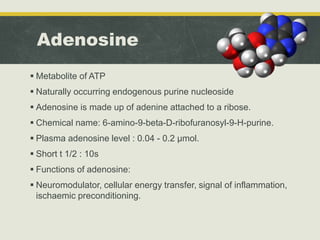
 Metabolite of ATP
 Naturally occurring endogenous purine nucleoside
 Adenosine is made up of adenine attached to a ribose.
 Chemical name: 6-amino-9-beta-D-ribofuranosyl-9-H-purine.
 Plasma adenosine level : 0.04 - 0.2 µmol.
 Short t 1/2 : 10s
 Functions of adenosine:
 Neuromodulator, cellular energy transfer, signal of inflammation,
ischaemic preconditioning.
Adenosine-
Neurotransmitter??
 It is neither stored in synaptic vesicles nor it acts exclusively on
synapses
 Release & uptake: mediated by bidirectional nucleoside transporter
 Neuromodulator:
 Presynaptic: controls NT release
 Postsynaptic: hyper/depolarizes the neurons
 Non synaptic: regulates the effect on glial cells
 Characteristics of NT:
 Adenosine producing enzymes present in synapse
 Actions via interaction with Rs
 Actions can be blocked by specific antagonist
 Actions can be terminated by reuptake and metabolic syndrome
Metabolism
Adenosine receptors (P1)
GPCR
Endogenous ligand – Adenosine
Classification:
A 1
A2A
A2B
A 3
A1 receptors
 Distribution: Brain, SC, atria
 Superclass: GPCR – Gi
 Effector mechanism:
 Inhibition of cAMP
 Increased K+ permeability
 Inhibition of Ca2+ channels
 Activation of phospholipase C
 Agonist: N6-Cyclopentyladenosine, N(6)-cyclohexyladenosine
 Antagonist:
 Non-specific: Caffeine, Theophylline
 Specific: Bamifylline, Rolofylline
Effects of the receptors
CVS:
 Negative dromotropy
 Negative chronotropy
 Negative inotropy
 Inhibits pacemaker and L-type calcium currents
CNS:
 Decrease neurotransmitter release
 Sedation
 Anticonvulsant effects
Effects of the receptors
RENAL:
 Inhibits renin release
 Increase Na reabsorption in PCT
 Vasoconstriction of afferent arteriole-reduces GFR
Metabolic:
 Inhibits lipolysis
 Increases insulin sensitivity
A2A receptors
Distribution: Brain, Heart, Blood.
Superclass: GPCR – Gs
Effector mechanisms:
Activates adenylate cyclase → ↑ cAMP
Activates phospholipases C
↓Intracellular Ca levels
Agonist: Regadenoson, Limonene
Antagonist: Preladenant, Istradefylline, Vipadenant
Effects of the receptors
CVS:
Coronary and peripheral vasodilation
Inhibits platelet aggregation
CNS:
Modulate the neurotransmission of GABA,
Ach, glutamate → Motor activity
A2B receptors
 Distribution: GIT, GUT, lungs
 Superclass: GPCR – Gs
 Effector mechanisms:
 Activates adenylate cyclase → ↑ cAMP
 ↑Intracellular Ca levels
 Adenosine has low affinity
 Agonist: N-ethylcarboxamidoadenosine,
 Antagonist: MRS-1706
Pulmonary:
Vasodilation
Mast cell release of IL-8
A3 receptors
Distribution: Kidney, testis, mast cells, eosinophills
Superclass: GPCR – Gi/Gq
 Effector mechanisms:
 Inhibits adenylate cyclase → cAMP
 Activates phospholipases C&D
 Influx of Ca & release from stores
Agonist: N methyl adenosine, IB-MECA, Inosine
Antagonist: Theophylline, KF- 26777
Effects of the receptors
Pulmonary:
Mast cell release of allergic mediators
Distribution and expression of P1 receptors
Expression
level
A1 receptors A2A
receptors
A2B receptors A3 receptors
High
expression
Brain (cortex,
hippocampus,
cerebellum),
spinal cord, eye,
adrenal gland,
atria
Blood
platelets,
olfactory bulb
Spleen,
thymus,
leukocytes
Cecum, colon,
bladder
Testis (rat),
mast cells (rat)
Intermediat
e
expression
Other brain
regions, skeletal
muscles, liver,
kidney, adipose
tissue
Heart, lung,
blood vessels,
peripheral
nerves
Lung, blood
vessels, eye,
mast cells
Cerebellum,
hippocampus
Low
expression
Lungs (but
probably higher in
bronchi),
pancreas
Other brain
regions
Adipose tissue,
adrenal gland,
brain, kidney
Thyroid, most
of brain
adrenal gland,
spleen, liver,
Adenosine receptors
RECEP
TOR
GENE MECHANISM AGONIST ANTAGONIST
A 1 ADORA 1 G i - ↓cAMP N 6
Cyclopentoaden
osine
Caffeine,
theophylline
A 2 a ADORA 2 a G s - ↑cAMP Regadenoson Caffeine,
theophylline,
istradefylline
A 2 b ADORA 2 b G s - ↑cAMP 5 N
Ethylcarboxamid
oadenosine
Theophylline,
CVT-6883, MRS-
1706
A 3 ADORA 3 G i - ↓cAMP N methyl
adenosine,
IB-MECA
Theophylline,
MRS-1191,
1220,1334
Therapeutic
interventions
Respiratory system
Bronchial asthma:
Stable form of adenosine – AMP - broncho
constriction
Adenosine levels increased in BAL fluid and cause
hyperresponsiveness in airways
Adenosine receptor antagonist-theophylline &
selective A1 receptor antagonist- bamiphylline
Respiratory system
Refractory primary pulmonary hypertension:
Routine treatment
Adenosine infusion for refractory cases
Mechanism-Pulmonary vasodilation by A2
receptors
Increase AMP-vascular smooth muscle relaxation
Stimulation of K+ ATPase channel
CNS
Anaesthesia and intensive care:
Adenosine blocks nociceptive transmission
IV adenosine infusion-analgesia at 50-70 mg/kg/min
Reduces ischaemic pain
Adenosine infusion during GA- good recovery and
sustained post op pain relief
Superior to remifentanil
CNS
Epilepsy:
 Astrogliosis - hallmark of epileptogenesis
 Adenosine-inhibitory modulator of brain activity
 Activation of A1 receptors
 Adenosine kinase- major metabolic enzyme
predominantly expressed in adult brain
 ADK inhibitor GP 515 tested-reduced kindled seizures in
rats
CNS
Parkinsons disease:
A2a receptor antagonist-
Istradefylline in phase III trial
KF 17837
KW 6002
CVS
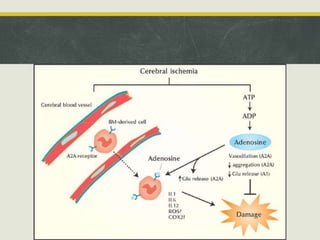
Ischaemia/reperfusion injury:
Ischaemic preconditioning(IPC)
Adenosine theory-
 After 5 min of cardiac ischaemia interstitial adenosine rises
double the time
 Adenosine receptor stimulation reduces myocardial damage
following ischaemia
Adenosine reduces ischaemia by-
 Improved tissue perfusion
 Anti inflammatory action
 Direct intracellular effect
CVS
Hypolipidemic agent:
Elevated TG levels-independent risk factor of CAD
RPR 749-potent and selective A1 agonist for
hypertriglyceridemia
Platelet
Platelets are rich in A2A receptors
Adenosine -> increases cAMP -> decreased plt
aggregation
Dipyridamole inhibits adenosine reuptake –
increased levels – decreased plt aggregation,
vasodilation
GIT
Inflammatory bowel disease:
 Role of adenosine in inflammation
 A2a and A3 receptors
 Reduces leucocyte infiltration and proinflammatory
cytokines
 IB-MECA - A3 agonist tested in DNBS induced colitis in
mice
Bacterial Sepsis:
Acadesine, adenosine precursor injected iv in
mongrel pigs following soft tissue injury and shock
72 hrs later E.coli 0111:B4 endotoxin given, effects
observed were:
Reduction in endotoxin induced hypoxia and
pulmonary hypertension
Reduction in fluid requirement
Reduction in mortality and prolonged survival time
Immunity
Adenosine accumulation and stimulation of (?A2)
receptors has been implicated in the
immunosuppression seen in critical illness
A3 receptor stimulation may inhibit tumour growth,
perhaps melanomas, colon or prostate carcinoma,
and lymphomas. Peripheral blood monocytes
produce G-CSF when stimulated by adenosine
Disease susceptibility
 Single nucleotide polymorphisms in the A1: Aspirin intolerant
asthma
 Alterations in ADORA1 gene: Change in infarct size in patients
with ischaemic infarct size
 SNPs in ADORA2A gene: Anxiety disoroders
 SNPs in ADORA2A gene: Stopping Mtx Rx for RhA due to
ADR(GIT) but not efficacy
 High expression of A2A Rs : Pts with unexplained syncope
 Up regulation of A2A Rs in endothelial cells: Lung cancer
 Dysfunctional A2B Rs : impotence
Drugs in clinic
Acupuncture
 Mechanical deformation of the skin by acupuncture needles
appears to result in the release of adenosine.
 A 2014 Nature Reviews Cancer review journal found that the
key mouse studies that suggested acupuncture relieves pain
via the local release of adenosine, which then triggered
close-by A1 receptors .
 The anti-nociceptive effect of acupuncture may be mediated
by the adenosine A1 receptor.
Methotrexate
 Methotrexate, which has strong anti-inflammatory properties,
inhibits the action of dihydrofolate reductase, leading to an
accumulation of adenosine.
 Adenosine-receptor antagonist caffeine reverses the anti-
inflammatory effects of methotrexate.
Adenosine
 Marked hyperpolarization and suppression of calcium-
dependent action potentials
 inhibits AV nodal conduction and increases the AV nodal
refractory period
 Use: paroxysmal supraventricular tachycardia
 Half life: 10 seconds
 ADR: Metallic taste, flushing, rashes, apprehension
Dipyridamole
 Dipyridamole inhibits the phosphodiesterase
 Adenosine reuptake inhibitor
 Uses:
 adjunct to coumarin anticoagulants in the prevention of
postoperative thromboembolic complications of cardiac valve
replacement
 Pulmonary hypertension
 Overdose: Rx – Xanthine derivatives
Caffeine
 Nonspecific adenosine Rs antagonist
 competitive nonselective phosphodiesterase inhibitor
 Bronchodilator, CNS stimulant, cardiac muscle stimulant and
a diuretic.
 Ischemic preconditioning
 Caffeine for apnoea of prematurity
Aminophylline
 Nonselective adenosine receptor antagonist.
 Competitive nonselective phosphodiesterase inhibitor
 Uses: Bronchodilator, Dipyrimadole overdose, anaphylactic
shock.
Drugs in trial
A1 partial agonists
 A1 agonists: Heart block, reduce pain, lipolysis
 Partial agonists: without heart block
 DRUGs:
 GW493838 – Peripheral neuropathic pain
 GS9667 – hypertriglyceridemia ass with DM
 Capadenoson – Phase II – AF
A2A agonists
 Vasodilation, reduce inflammation
 DRUGS
 Regadenoson: FDA 2008,
 Apadenoson
 BVT.115959: diabetic neuropathic pain
A3 agonists
 CF 101 (IB-MECA)
 Rheumatoid arthritis
 Glaucoma: phase II
 Dry eye disease: Phase III
 CF102
 Advanced HCC
 Chronic hepatitis C genotype 1
 Phase1-2
Selective A1 antagonists
 Rolofylline: PROTECT-2 : Heart failure
 Tonafylline
 KFM-19: Dementia, cognitive deficits
 8-cyclopentyl-1,3-dipropylxanthine(CFX) : Diuresis (K
sparing)
Selective A2a antagonists
Parkinson’s disease, drug addiction
Stimulate D2 receptors
Istradefylline: Phase III
Vipadenant: Parkinson’s : Monotherapy, adjunct:
{reclinical toxicological studies issues: Phase I
Preladenant: phase II
Selective A2B antagonists
Reversal insulin resistance in Type II DM
Inhibition of degranulation of human mast cells,
release of cytokines
Under development
Adenosine modulators
 Allosteric modulators for adenosine receptors may have potential
therapeutic advantage.
A1
 Allosteric enhancers - Antiarrhythmic and antilipolytic activity.
A2
 Not yet been developed
 Amiloride and analogues were demonstrated to be allosteric
inhibitors at A2A receptor
A3
 Allosteric enhancers are -useful against ischemic conditions or as
antitumor agents.
Adenosine precursors
5-AICAR
Precursor of adenosine
Protective effects in myocardial infarction
Acadesine - adenosine precursor

Adenosine

  • 1.
  • 2.
  • 3.
    Purinergic receptors Present inmost organ systems Extracellular purines (Adenosine, ADP, ATP) Extracellular pyrimidines (Uridine, UDP, UTP) Mediate biological effects via P rs  Classification :
  • 4.
    Purinergic receptorsPurinergicreceptors P1(Adenosine) A1 A2 A2A A2B A3 P2 (ATP,ADP, UDP, UTP) P2X P2Y(ATP) GPCR Ligand gated ion channel
  • 5.
    Adenosine  Metabolite ofATP  Naturally occurring endogenous purine nucleoside  Adenosine is made up of adenine attached to a ribose.  Chemical name: 6-amino-9-beta-D-ribofuranosyl-9-H-purine.  Plasma adenosine level : 0.04 - 0.2 µmol.  Short t 1/2 : 10s  Functions of adenosine:  Neuromodulator, cellular energy transfer, signal of inflammation, ischaemic preconditioning.
  • 6.
    Adenosine- Neurotransmitter??  It isneither stored in synaptic vesicles nor it acts exclusively on synapses  Release & uptake: mediated by bidirectional nucleoside transporter  Neuromodulator:  Presynaptic: controls NT release  Postsynaptic: hyper/depolarizes the neurons  Non synaptic: regulates the effect on glial cells  Characteristics of NT:  Adenosine producing enzymes present in synapse  Actions via interaction with Rs  Actions can be blocked by specific antagonist  Actions can be terminated by reuptake and metabolic syndrome
  • 7.
  • 8.
    Adenosine receptors (P1) GPCR Endogenousligand – Adenosine Classification: A 1 A2A A2B A 3
  • 9.
    A1 receptors  Distribution:Brain, SC, atria  Superclass: GPCR – Gi  Effector mechanism:  Inhibition of cAMP  Increased K+ permeability  Inhibition of Ca2+ channels  Activation of phospholipase C  Agonist: N6-Cyclopentyladenosine, N(6)-cyclohexyladenosine  Antagonist:  Non-specific: Caffeine, Theophylline  Specific: Bamifylline, Rolofylline
  • 10.
    Effects of thereceptors CVS:  Negative dromotropy  Negative chronotropy  Negative inotropy  Inhibits pacemaker and L-type calcium currents CNS:  Decrease neurotransmitter release  Sedation  Anticonvulsant effects
  • 11.
    Effects of thereceptors RENAL:  Inhibits renin release  Increase Na reabsorption in PCT  Vasoconstriction of afferent arteriole-reduces GFR Metabolic:  Inhibits lipolysis  Increases insulin sensitivity
  • 12.
    A2A receptors Distribution: Brain,Heart, Blood. Superclass: GPCR – Gs Effector mechanisms: Activates adenylate cyclase → ↑ cAMP Activates phospholipases C ↓Intracellular Ca levels Agonist: Regadenoson, Limonene Antagonist: Preladenant, Istradefylline, Vipadenant
  • 13.
    Effects of thereceptors CVS: Coronary and peripheral vasodilation Inhibits platelet aggregation CNS: Modulate the neurotransmission of GABA, Ach, glutamate → Motor activity
  • 15.
    A2B receptors  Distribution:GIT, GUT, lungs  Superclass: GPCR – Gs  Effector mechanisms:  Activates adenylate cyclase → ↑ cAMP  ↑Intracellular Ca levels  Adenosine has low affinity  Agonist: N-ethylcarboxamidoadenosine,  Antagonist: MRS-1706
  • 16.
  • 18.
    A3 receptors Distribution: Kidney,testis, mast cells, eosinophills Superclass: GPCR – Gi/Gq  Effector mechanisms:  Inhibits adenylate cyclase → cAMP  Activates phospholipases C&D  Influx of Ca & release from stores Agonist: N methyl adenosine, IB-MECA, Inosine Antagonist: Theophylline, KF- 26777
  • 19.
    Effects of thereceptors Pulmonary: Mast cell release of allergic mediators
  • 20.
    Distribution and expressionof P1 receptors Expression level A1 receptors A2A receptors A2B receptors A3 receptors High expression Brain (cortex, hippocampus, cerebellum), spinal cord, eye, adrenal gland, atria Blood platelets, olfactory bulb Spleen, thymus, leukocytes Cecum, colon, bladder Testis (rat), mast cells (rat) Intermediat e expression Other brain regions, skeletal muscles, liver, kidney, adipose tissue Heart, lung, blood vessels, peripheral nerves Lung, blood vessels, eye, mast cells Cerebellum, hippocampus Low expression Lungs (but probably higher in bronchi), pancreas Other brain regions Adipose tissue, adrenal gland, brain, kidney Thyroid, most of brain adrenal gland, spleen, liver,
  • 21.
    Adenosine receptors RECEP TOR GENE MECHANISMAGONIST ANTAGONIST A 1 ADORA 1 G i - ↓cAMP N 6 Cyclopentoaden osine Caffeine, theophylline A 2 a ADORA 2 a G s - ↑cAMP Regadenoson Caffeine, theophylline, istradefylline A 2 b ADORA 2 b G s - ↑cAMP 5 N Ethylcarboxamid oadenosine Theophylline, CVT-6883, MRS- 1706 A 3 ADORA 3 G i - ↓cAMP N methyl adenosine, IB-MECA Theophylline, MRS-1191, 1220,1334
  • 22.
  • 23.
    Respiratory system Bronchial asthma: Stableform of adenosine – AMP - broncho constriction Adenosine levels increased in BAL fluid and cause hyperresponsiveness in airways Adenosine receptor antagonist-theophylline & selective A1 receptor antagonist- bamiphylline
  • 24.
    Respiratory system Refractory primarypulmonary hypertension: Routine treatment Adenosine infusion for refractory cases Mechanism-Pulmonary vasodilation by A2 receptors Increase AMP-vascular smooth muscle relaxation Stimulation of K+ ATPase channel
  • 25.
    CNS Anaesthesia and intensivecare: Adenosine blocks nociceptive transmission IV adenosine infusion-analgesia at 50-70 mg/kg/min Reduces ischaemic pain Adenosine infusion during GA- good recovery and sustained post op pain relief Superior to remifentanil
  • 26.
    CNS Epilepsy:  Astrogliosis -hallmark of epileptogenesis  Adenosine-inhibitory modulator of brain activity  Activation of A1 receptors  Adenosine kinase- major metabolic enzyme predominantly expressed in adult brain  ADK inhibitor GP 515 tested-reduced kindled seizures in rats
  • 27.
    CNS Parkinsons disease: A2a receptorantagonist- Istradefylline in phase III trial KF 17837 KW 6002
  • 28.
    CVS Ischaemia/reperfusion injury: Ischaemic preconditioning(IPC) Adenosinetheory-  After 5 min of cardiac ischaemia interstitial adenosine rises double the time  Adenosine receptor stimulation reduces myocardial damage following ischaemia Adenosine reduces ischaemia by-  Improved tissue perfusion  Anti inflammatory action  Direct intracellular effect
  • 29.
    CVS Hypolipidemic agent: Elevated TGlevels-independent risk factor of CAD RPR 749-potent and selective A1 agonist for hypertriglyceridemia
  • 30.
    Platelet Platelets are richin A2A receptors Adenosine -> increases cAMP -> decreased plt aggregation Dipyridamole inhibits adenosine reuptake – increased levels – decreased plt aggregation, vasodilation
  • 31.
    GIT Inflammatory bowel disease: Role of adenosine in inflammation  A2a and A3 receptors  Reduces leucocyte infiltration and proinflammatory cytokines  IB-MECA - A3 agonist tested in DNBS induced colitis in mice
  • 32.
    Bacterial Sepsis: Acadesine, adenosineprecursor injected iv in mongrel pigs following soft tissue injury and shock 72 hrs later E.coli 0111:B4 endotoxin given, effects observed were: Reduction in endotoxin induced hypoxia and pulmonary hypertension Reduction in fluid requirement Reduction in mortality and prolonged survival time
  • 33.
    Immunity Adenosine accumulation andstimulation of (?A2) receptors has been implicated in the immunosuppression seen in critical illness A3 receptor stimulation may inhibit tumour growth, perhaps melanomas, colon or prostate carcinoma, and lymphomas. Peripheral blood monocytes produce G-CSF when stimulated by adenosine
  • 34.
    Disease susceptibility  Singlenucleotide polymorphisms in the A1: Aspirin intolerant asthma  Alterations in ADORA1 gene: Change in infarct size in patients with ischaemic infarct size  SNPs in ADORA2A gene: Anxiety disoroders  SNPs in ADORA2A gene: Stopping Mtx Rx for RhA due to ADR(GIT) but not efficacy  High expression of A2A Rs : Pts with unexplained syncope  Up regulation of A2A Rs in endothelial cells: Lung cancer  Dysfunctional A2B Rs : impotence
  • 35.
  • 36.
    Acupuncture  Mechanical deformationof the skin by acupuncture needles appears to result in the release of adenosine.  A 2014 Nature Reviews Cancer review journal found that the key mouse studies that suggested acupuncture relieves pain via the local release of adenosine, which then triggered close-by A1 receptors .  The anti-nociceptive effect of acupuncture may be mediated by the adenosine A1 receptor.
  • 37.
    Methotrexate  Methotrexate, whichhas strong anti-inflammatory properties, inhibits the action of dihydrofolate reductase, leading to an accumulation of adenosine.  Adenosine-receptor antagonist caffeine reverses the anti- inflammatory effects of methotrexate.
  • 38.
    Adenosine  Marked hyperpolarizationand suppression of calcium- dependent action potentials  inhibits AV nodal conduction and increases the AV nodal refractory period  Use: paroxysmal supraventricular tachycardia  Half life: 10 seconds  ADR: Metallic taste, flushing, rashes, apprehension
  • 39.
    Dipyridamole  Dipyridamole inhibitsthe phosphodiesterase  Adenosine reuptake inhibitor  Uses:  adjunct to coumarin anticoagulants in the prevention of postoperative thromboembolic complications of cardiac valve replacement  Pulmonary hypertension  Overdose: Rx – Xanthine derivatives
  • 40.
    Caffeine  Nonspecific adenosineRs antagonist  competitive nonselective phosphodiesterase inhibitor  Bronchodilator, CNS stimulant, cardiac muscle stimulant and a diuretic.  Ischemic preconditioning  Caffeine for apnoea of prematurity
  • 41.
    Aminophylline  Nonselective adenosinereceptor antagonist.  Competitive nonselective phosphodiesterase inhibitor  Uses: Bronchodilator, Dipyrimadole overdose, anaphylactic shock.
  • 42.
  • 43.
    A1 partial agonists A1 agonists: Heart block, reduce pain, lipolysis  Partial agonists: without heart block  DRUGs:  GW493838 – Peripheral neuropathic pain  GS9667 – hypertriglyceridemia ass with DM  Capadenoson – Phase II – AF
  • 44.
    A2A agonists  Vasodilation,reduce inflammation  DRUGS  Regadenoson: FDA 2008,  Apadenoson  BVT.115959: diabetic neuropathic pain
  • 45.
    A3 agonists  CF101 (IB-MECA)  Rheumatoid arthritis  Glaucoma: phase II  Dry eye disease: Phase III  CF102  Advanced HCC  Chronic hepatitis C genotype 1  Phase1-2
  • 46.
    Selective A1 antagonists Rolofylline: PROTECT-2 : Heart failure  Tonafylline  KFM-19: Dementia, cognitive deficits  8-cyclopentyl-1,3-dipropylxanthine(CFX) : Diuresis (K sparing)
  • 47.
    Selective A2a antagonists Parkinson’sdisease, drug addiction Stimulate D2 receptors Istradefylline: Phase III Vipadenant: Parkinson’s : Monotherapy, adjunct: {reclinical toxicological studies issues: Phase I Preladenant: phase II
  • 48.
    Selective A2B antagonists Reversalinsulin resistance in Type II DM Inhibition of degranulation of human mast cells, release of cytokines Under development
  • 49.
    Adenosine modulators  Allostericmodulators for adenosine receptors may have potential therapeutic advantage. A1  Allosteric enhancers - Antiarrhythmic and antilipolytic activity. A2  Not yet been developed  Amiloride and analogues were demonstrated to be allosteric inhibitors at A2A receptor A3  Allosteric enhancers are -useful against ischemic conditions or as antitumor agents.
  • 50.
    Adenosine precursors 5-AICAR Precursor ofadenosine Protective effects in myocardial infarction Acadesine - adenosine precursor

Editor's Notes

  • #7 Levels rise rapidly in ischaemic tissue due to adenosine kinase inhibition, and mediate ischaemic pre-conditioning, where a prior, brief episode of organ ischaemia protects against subsequent ischaemia!Inflamed tissues also release adenine nucleotides which are converted to adenosine. Cells that release these nucleotides include platelets, mast cells, nerves and the endothelium. Ecto-nucleotidases (CD39, CD73) then turn the nucleotides into adenosine.
  • #9 S-Adnenosine homocystine
  • #26 Bamiphylline - xanthines
  • #28 Remifentanil – opioid analgesic used as adjunct in GA
  • #34 DNBS- DiNitroBenzeneSulfoicAcid
  • #43 It inhibits the cellular reuptake of adenosine into platelets, red blood cells and endothelial cells leading to increased extracellular concentrations of adenosine.