ANS Pharmacology
Lecture 1
Drugs Affecting
The Autonomic Nervous System
Dr. Hiwa K. Saaed
College of Pharmacy/University of Sulaimani
1
General considerations
Autonomic Drugs:
Drugs that produce their primary
therapeutic effect by Mimicking or
altering the functions of the ANS.
2
AUTOMATIC NERVOUS SYSTEM (ANS)
The ANS
is the major involuntary portion of the NS
is responsible for automatic, unconscious
bodily function, such as control of
HR and BP and both GIT and GUT functions.
3
Nervous System
Two main divisions
I. CNS
• Brain & spinal cord
II. PNS
1. Afferent (sensory)
2. Efferent (motor)
• Somatic & ANS
4
CENTRAL NERVOUS SYSTEM (CNS)
Brain and spinal cord:
receives and processes incoming
sensory information and responds by
sending out signals that initiate or
modify a process
5
Peripheral Nervous System or PNS
• Includes all the neurons and ganglia
found outside the CNS
1. Afferent: sensory input to CNS
Afferent neurons carry sensory input from the periphery to the
CNS and modify motor output through the reflex arc.
2. Efferent: motor output from CNS
Efferent neurons carry motor signals from the CNS to the
peripheral areas of the body.
6
Efferent Neurons
The efferent portion of the PNS is further divided
into two major functional subdivisions,
1. somatic (SNS): one motor neuron innervates
the skeletal muscles and control voluntary
(consciously) functions; movement, respiration
and posture.
2. automatic nervous system (ANS).
7
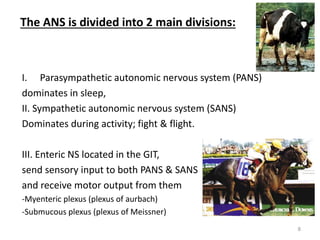
The ANS is divided into 2 main divisions:
I. Parasympathetic autonomic nervous system (PANS)
dominates in sleep,
II. Sympathetic autonomic nervous system (SANS)
Dominates during activity; fight & flight.
III. Enteric NS located in the GIT,
send sensory input to both PANS & SANS
and receive motor output from them
-Myenteric plexus (plexus of aurbach)
-Submucous plexus (plexus of Meissner)
8
Location of Ganglia
 Both the PANS and SANS have
relay station, or ganglia,
between the CNS and the end
organ, but the somatic system
does not;
 The ANS, carries nerve
impulses by
1. a preganglionic fiber that
leaves the CNS,
2. a postganglionic fiber that
innervates the effector.
9
Central roots of origin
Parasympathetic Division– also
called the craniosacral division
• The preganglionic fibers arise
from the cranial nerve nuclei III,
VII, IX, and X and sacral region
(usually S2-S4) of the spinal
cord, and synapse in ganglia
close to the effector organ.
• Thus, in contrast to the
sympathetic system, the
preganglionic fibers are long,
and the postganglionic ones
are short.
Sympathetic Division – also called
the thoracolumbar division
• The preganglionic fibers
arise from the thoracic
(T1-T12) and lumbar (L1-
L5) regions of the spinal
cord, and they synapse in
paravertebral ganglia
close and parallel to the
vertebral column.
Postganglionic axons lead
to an effector organ.
10
Adrenal medulla
the adrenal medulla,
• like the sympathetic ganglia, receives
preganglionic fibers from the sympathetic
system.
• Lacking the axons,
• in response to stimulation by Ach, influences
other organs by secreting the epinephrine and
lesser amounts of NEP into the blood.
11
SYMPATHETIC AND PARASYMPATHETIC NS & EFFECTOR ORGANS
12
13
Functions of the Sympathetic Nervous System
• Is normally active, even at rest; however, it assumes a
dominant role when the body becomes stressed (trauma, fear,
hypoglycemia cold or exercise).
• Fight or Flight – Protective mechanisms designed to help
person cope with the stress or get away from it.
• For example, if you sense danger: Your heart rate increase,
BP rises, eyes dilates, blood sugar rises, bronchioles expand,
and blood flow shift from skin to skeletal muscles.
14
Functions of the Parasympathetic Nervous System
1. Rest and digest: maintains essential body functions; digestive
process and elimination of wastes.
2. Save energy.
3. Dilation of blood vessels in skin.
4. Decrease heart rate (bradycardia).
5. Increase secretion of digestive enzymes.
6. Constriction of smooth muscle of bronchi.
7. Increase in sweat glands.
8. Contraction of smooth muscles of urinary bladder.
15
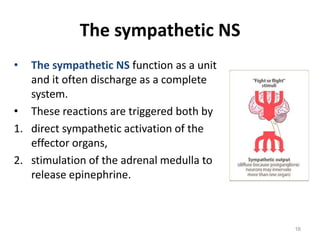
The sympathetic NS
• The sympathetic NS function as a unit
and it often discharge as a complete
system.
• These reactions are triggered both by
1. direct sympathetic activation of the
effector organs,
2. stimulation of the adrenal medulla to
release epinephrine.
16
is not a functional entity as such,
and never discharges as a complete
system. If it did it would produce
massive, undesirable and
unpleasant symptoms.
Instead, discrete parasympathetic
fibers are activated separately, and
the system functions to affect
specific organs, such as stomach or
eye.
17
The Parasympathetic NS
I. Opposite effects on...
• Myocardium: Sympathetic= tachycardia:
Parasympathetic= bradycardia
• Intestinal smooth muscle: Sympathetic= decreased
motility: Parasympathetic= increased motility
• Pupil muscles of iris: Sympathetic= dilator pupil
(radial muscle) which dilates pupil (mydriasis)
• Parasympathetic= sphincter pupil (circular muscle)
which constricts pupil (miosis)
18
II. Innervated by one division of ANS…
• Blood vessels: Sympathetic= Constriction
• Sweat glands: Sympathetic= increased secretion
• Ciliary muscle: Parasympathetic= accommodation
reflex
• Pancreas and Stomach: Parasympathetic= increased
secretion
19
20
21
Hormonal Feedback Loop
22
Similarities between ANS & endocrine system:
 The ANS, along with the endocrine system, coordinates
the regulation and integration of body function.
Nervous system has several properties in common with the
endocrine system:
1. High level integration in the brain
2. The ability to influence processes in distant regions of
the body
3. Extensive use of negative feedback
4. Both systems use chemical for the transmission of
information
23
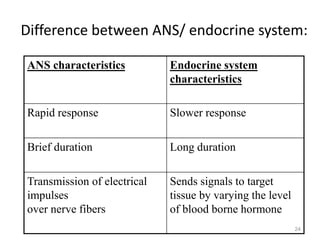
Difference between ANS/ endocrine system:
ANS characteristics Endocrine system
characteristics
Rapid response Slower response
Brief duration Long duration
Transmission of electrical
impulses
over nerve fibers
Sends signals to target
tissue by varying the level
of blood borne hormone
24
Drugs affecting the ANS
• are divided into two groups according to
the type of neuron.
• The cholinergic drugs act on receptors
activated by acetyl choline.
• The adrenergic drugs act on receptors
stimulated by norepinephrine or
epinephrine.
25
26
The cholinergic neuron
• All preganglionic fibers of both sympathetic and
parasympathetic divisions.
• All parasympathetic postganglionic.
• Few sympathetic postganglionic fibers (sweat gland).
• All Somatic (non autonomic) fibers to skeletal muscle
27
The adrenergic neuron
• Most sympathetic postganglionic fibers release
norepinephrine; are noradrenergic or simply
adrenergic.
• Some peripheral sympathetic fibers release dopamine
(dopaminergic).
• The adrenal medulla, a modified sympathetic
ganglion, receives sympathetic preganglionic fibers
and releases epinephrine (~85%) and to a lesser
amount norepinephrine (15%) into the blood.
28
Receptor types
• Parasympathetic – cholinergic receptors:
– muscarinic (M1 to M5)
– and nicotinic receptors
• Sympathetic – adrenergic receptors:
– alpha (α1, α 2),
– beta (β1 to β 3),
– and dopamine (D1 to D5) receptors.
29
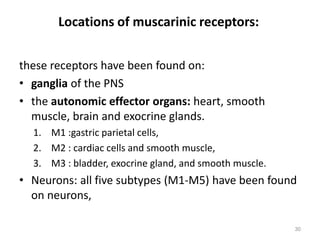
Locations of muscarinic receptors:
these receptors have been found on:
• ganglia of the PNS
• the autonomic effector organs: heart, smooth
muscle, brain and exocrine glands.
1. M1 :gastric parietal cells,
2. M2 : cardiac cells and smooth muscle,
3. M3 : bladder, exocrine gland, and smooth muscle.
• Neurons: all five subtypes (M1-M5) have been found
on neurons,
30
Mechanisms of Ach signal transduction:
• M1, M3 & M5:
interacts with a G protein, designated Gq, which in turn
activates phospholipase C this leads to the hydrolysis of
PIP2 to yield IP3, DAG, which cause an increase in
intracellular Ca+2 this cation can then interact to:
stimulate or inhibit enzymes, or cause hyperpolarization,
secretion, or contraction.
• M2 :
stimulates a Gi that inhibits adenylyl cyclase and increase
K+ conductance.
31
32
Nicotinic receptors: (NN, NM)
Locations of nicotinic receptors: nicotinic
receptors are located in the:
– CNS,
– adrenal medulla,
– autonomic ganglia,
– neuromuscular junction.
33
Mechanisms of action:
• Ligand-gated ion channel.
• Binding of two Ach molecules elicits a
conformational change that allows the entry of
Na+ ions, resulting in the depolarization of the
effector cells.
• Nicotine initially stimulates and then blocks the
receptors
34
Mechanisms of action:
35
Cholinergic Neurotransmission
36
1.synthesis
2.storage
3.release
4.binding
5.degradation
6.recycling of choline
Key steps in neurotransmission
37
38
Thank you
39

L1: Drugs acting on the ANS

  • 1.
    ANS Pharmacology Lecture 1 DrugsAffecting The Autonomic Nervous System Dr. Hiwa K. Saaed College of Pharmacy/University of Sulaimani 1
  • 2.
    General considerations Autonomic Drugs: Drugsthat produce their primary therapeutic effect by Mimicking or altering the functions of the ANS. 2
  • 3.
    AUTOMATIC NERVOUS SYSTEM(ANS) The ANS is the major involuntary portion of the NS is responsible for automatic, unconscious bodily function, such as control of HR and BP and both GIT and GUT functions. 3
  • 4.
    Nervous System Two maindivisions I. CNS • Brain & spinal cord II. PNS 1. Afferent (sensory) 2. Efferent (motor) • Somatic & ANS 4
  • 5.
    CENTRAL NERVOUS SYSTEM(CNS) Brain and spinal cord: receives and processes incoming sensory information and responds by sending out signals that initiate or modify a process 5
  • 6.
    Peripheral Nervous Systemor PNS • Includes all the neurons and ganglia found outside the CNS 1. Afferent: sensory input to CNS Afferent neurons carry sensory input from the periphery to the CNS and modify motor output through the reflex arc. 2. Efferent: motor output from CNS Efferent neurons carry motor signals from the CNS to the peripheral areas of the body. 6
  • 7.
    Efferent Neurons The efferentportion of the PNS is further divided into two major functional subdivisions, 1. somatic (SNS): one motor neuron innervates the skeletal muscles and control voluntary (consciously) functions; movement, respiration and posture. 2. automatic nervous system (ANS). 7
  • 8.
    The ANS isdivided into 2 main divisions: I. Parasympathetic autonomic nervous system (PANS) dominates in sleep, II. Sympathetic autonomic nervous system (SANS) Dominates during activity; fight & flight. III. Enteric NS located in the GIT, send sensory input to both PANS & SANS and receive motor output from them -Myenteric plexus (plexus of aurbach) -Submucous plexus (plexus of Meissner) 8
  • 9.
    Location of Ganglia Both the PANS and SANS have relay station, or ganglia, between the CNS and the end organ, but the somatic system does not;  The ANS, carries nerve impulses by 1. a preganglionic fiber that leaves the CNS, 2. a postganglionic fiber that innervates the effector. 9
  • 10.
    Central roots oforigin Parasympathetic Division– also called the craniosacral division • The preganglionic fibers arise from the cranial nerve nuclei III, VII, IX, and X and sacral region (usually S2-S4) of the spinal cord, and synapse in ganglia close to the effector organ. • Thus, in contrast to the sympathetic system, the preganglionic fibers are long, and the postganglionic ones are short. Sympathetic Division – also called the thoracolumbar division • The preganglionic fibers arise from the thoracic (T1-T12) and lumbar (L1- L5) regions of the spinal cord, and they synapse in paravertebral ganglia close and parallel to the vertebral column. Postganglionic axons lead to an effector organ. 10
  • 11.
    Adrenal medulla the adrenalmedulla, • like the sympathetic ganglia, receives preganglionic fibers from the sympathetic system. • Lacking the axons, • in response to stimulation by Ach, influences other organs by secreting the epinephrine and lesser amounts of NEP into the blood. 11
  • 12.
    SYMPATHETIC AND PARASYMPATHETICNS & EFFECTOR ORGANS 12
  • 13.
  • 14.
    Functions of theSympathetic Nervous System • Is normally active, even at rest; however, it assumes a dominant role when the body becomes stressed (trauma, fear, hypoglycemia cold or exercise). • Fight or Flight – Protective mechanisms designed to help person cope with the stress or get away from it. • For example, if you sense danger: Your heart rate increase, BP rises, eyes dilates, blood sugar rises, bronchioles expand, and blood flow shift from skin to skeletal muscles. 14
  • 15.
    Functions of theParasympathetic Nervous System 1. Rest and digest: maintains essential body functions; digestive process and elimination of wastes. 2. Save energy. 3. Dilation of blood vessels in skin. 4. Decrease heart rate (bradycardia). 5. Increase secretion of digestive enzymes. 6. Constriction of smooth muscle of bronchi. 7. Increase in sweat glands. 8. Contraction of smooth muscles of urinary bladder. 15
  • 16.
    The sympathetic NS •The sympathetic NS function as a unit and it often discharge as a complete system. • These reactions are triggered both by 1. direct sympathetic activation of the effector organs, 2. stimulation of the adrenal medulla to release epinephrine. 16
  • 17.
    is not afunctional entity as such, and never discharges as a complete system. If it did it would produce massive, undesirable and unpleasant symptoms. Instead, discrete parasympathetic fibers are activated separately, and the system functions to affect specific organs, such as stomach or eye. 17 The Parasympathetic NS
  • 18.
    I. Opposite effectson... • Myocardium: Sympathetic= tachycardia: Parasympathetic= bradycardia • Intestinal smooth muscle: Sympathetic= decreased motility: Parasympathetic= increased motility • Pupil muscles of iris: Sympathetic= dilator pupil (radial muscle) which dilates pupil (mydriasis) • Parasympathetic= sphincter pupil (circular muscle) which constricts pupil (miosis) 18
  • 19.
    II. Innervated byone division of ANS… • Blood vessels: Sympathetic= Constriction • Sweat glands: Sympathetic= increased secretion • Ciliary muscle: Parasympathetic= accommodation reflex • Pancreas and Stomach: Parasympathetic= increased secretion 19
  • 20.
  • 21.
  • 22.
  • 23.
    Similarities between ANS& endocrine system:  The ANS, along with the endocrine system, coordinates the regulation and integration of body function. Nervous system has several properties in common with the endocrine system: 1. High level integration in the brain 2. The ability to influence processes in distant regions of the body 3. Extensive use of negative feedback 4. Both systems use chemical for the transmission of information 23
  • 24.
    Difference between ANS/endocrine system: ANS characteristics Endocrine system characteristics Rapid response Slower response Brief duration Long duration Transmission of electrical impulses over nerve fibers Sends signals to target tissue by varying the level of blood borne hormone 24
  • 25.
    Drugs affecting theANS • are divided into two groups according to the type of neuron. • The cholinergic drugs act on receptors activated by acetyl choline. • The adrenergic drugs act on receptors stimulated by norepinephrine or epinephrine. 25
  • 26.
  • 27.
    The cholinergic neuron •All preganglionic fibers of both sympathetic and parasympathetic divisions. • All parasympathetic postganglionic. • Few sympathetic postganglionic fibers (sweat gland). • All Somatic (non autonomic) fibers to skeletal muscle 27
  • 28.
    The adrenergic neuron •Most sympathetic postganglionic fibers release norepinephrine; are noradrenergic or simply adrenergic. • Some peripheral sympathetic fibers release dopamine (dopaminergic). • The adrenal medulla, a modified sympathetic ganglion, receives sympathetic preganglionic fibers and releases epinephrine (~85%) and to a lesser amount norepinephrine (15%) into the blood. 28
  • 29.
    Receptor types • Parasympathetic– cholinergic receptors: – muscarinic (M1 to M5) – and nicotinic receptors • Sympathetic – adrenergic receptors: – alpha (α1, α 2), – beta (β1 to β 3), – and dopamine (D1 to D5) receptors. 29
  • 30.
    Locations of muscarinicreceptors: these receptors have been found on: • ganglia of the PNS • the autonomic effector organs: heart, smooth muscle, brain and exocrine glands. 1. M1 :gastric parietal cells, 2. M2 : cardiac cells and smooth muscle, 3. M3 : bladder, exocrine gland, and smooth muscle. • Neurons: all five subtypes (M1-M5) have been found on neurons, 30
  • 31.
    Mechanisms of Achsignal transduction: • M1, M3 & M5: interacts with a G protein, designated Gq, which in turn activates phospholipase C this leads to the hydrolysis of PIP2 to yield IP3, DAG, which cause an increase in intracellular Ca+2 this cation can then interact to: stimulate or inhibit enzymes, or cause hyperpolarization, secretion, or contraction. • M2 : stimulates a Gi that inhibits adenylyl cyclase and increase K+ conductance. 31
  • 32.
  • 33.
    Nicotinic receptors: (NN,NM) Locations of nicotinic receptors: nicotinic receptors are located in the: – CNS, – adrenal medulla, – autonomic ganglia, – neuromuscular junction. 33
  • 34.
    Mechanisms of action: •Ligand-gated ion channel. • Binding of two Ach molecules elicits a conformational change that allows the entry of Na+ ions, resulting in the depolarization of the effector cells. • Nicotine initially stimulates and then blocks the receptors 34
  • 35.
  • 36.
  • 37.
    Key steps inneurotransmission 37
  • 38.
  • 39.