Dr Damodar Sharma
Notes
ADRENERGICPharmacology
Drugs that facilitate or mimic some or all the actions of endogenously released
catecholamines from sympathetic nerve endings Sympathomimetics
(Adrenergic Drugs)
ADRENERGIC transmission
Adrenergic (more precisely ‘Noradrenergic’) transmission is restricted to the
sympathetic division of the ANS. There are three closely related endogenous
catecholamines (CAs)
Noradrenaline (NA, Norepinephrine, NE)
Adrenaline (Adr, Epinephrine, Epi)
Dopamine (DA)
Adrenergic Receptors
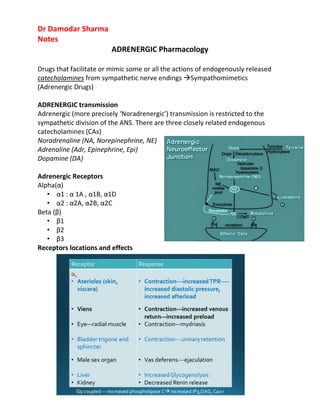
Alpha(α)
• α1 : α 1A , α1B, α1D
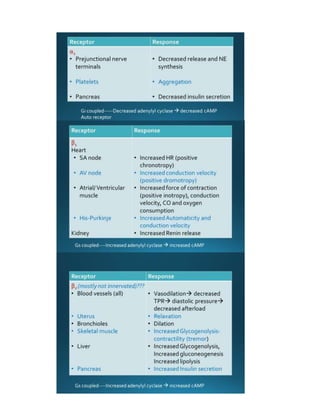
• α2 : α2A, α2B, α2C
Beta (β)
• β1
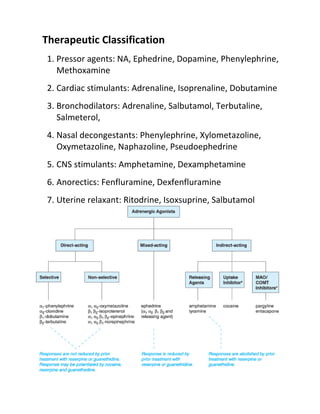
• β2
• β3
Receptors locations and effects
Actions
Heart
• ↑ HR
•Force of cardiac contraction - ↑
• Cardiac output and oxygen consumption of the heart are markedly - ↑
• Conduction velocity through A-V node, bundle of His, atrial, ventricular
fibres - ↑
• When BP rises markedly – reflex bradycardia due to vagal stimulation.
Blood Vessels
• Constriction- α1 action
• Vasodilatation – β2 action
• Constriction predominates in cutaneous, mucous membrane, renal beds
• Dilatation predominates in skeletal muscle, liver and coronaries.
• Action is most marked in arterioles, larger arteries and veins at higher
doses.
• Complex action on BP
Blood Pressure
Respiration
• Adr and Iso but not NA are potent bronchodilators- β2 receptors
• Adr can directly stimulate respiratory center
• Very high dose of Adr causes pulmonary edema by shifting blood from
systemic to pulmonary circuit.
Eye
Mydriasis occurs due to contraction of radial muscle
(dilator pupillae) muscle of iris (α1 action).
Has complex effects on aqueous humor.
α: Vasoconstriction of ciliary vesselsReduced aqueous formation (?):
Augmentation of uveo - scleral outflow. IOP – fall
β: Enhanced secretory activity of ciliary epithelium
5.
Genitourinary tract
Bladder: Detrusor– Relaxed (β) and trigone is constricted (α)- Tend to
hinder micturition.
Uterus:
• Nonpregnant – contraction (α1 > β2)
• Pregnant - Relaxation (β2)
CNS
• No CNS effect because of poor penetration in brain
• Restlessness, apprehension and tremor may occur (high dose)
• Injected in brain, it produces excitation followed by depression.
• Activation of α2 receptors in the brain stem results in decreased
sympathomimetic out flow Fall in BP and Bradycardia.
Metabolic
• Adr produces glycogenolysis – hyperglycemia, hyperlactacidemia (β2),
lypolysis- rise in FFA, calorigenesis (β2 + β3) and transient hyperkalemia
followed by hypokalemia due to direct action on liver, muscle and adipose
tissue cells.
• β2 receptors ↑ and α2 receptors ↓ insulin secretion; end effect--- ↑
insulin secretion
• Specific sympathomimetics: Adrenaline
• Potent vasoconstrictor & cardiac stimulant
• Positive inotropic & chronotropic effect on heart
• Stimulates β2 receptors in skeletal muscle blood vessels; fall in diastolic BP,
↑ blood flow during exercise
Specific sympathomimetics:
Adrenaline
• Potent vasoconstrictor & cardiac stimulant
• Positive inotropic & chronotropic effect on heart
• Stimulates β2 receptors in skeletal muscle blood vessels; fall in diastolic BP,
↑ blood flow during exercise
Noradrenaline
• Similar effect on β1 receptors and similar potency at α receptors as
epinephrine
• Minimal/no effect on β2 receptors
• PR, systolic & diastolic BP ↑ed
Isoprenaline
• Very potent β receptor agonist and less effect on α receptors
• Positve inotropic & chronotropic effect on heart
• ↑se in CO and ↓se in diastolic BP
6.
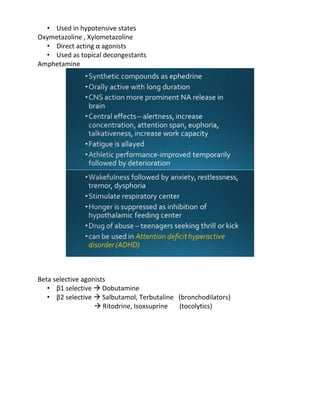
Dopamine
Dobutamine
• Derivative ofDA but not D1 & D2 agonist
• Actions on both β1 and α1 receptors
• Relatively selective β1 agonist
• Clinically employed dose – Increase cardiac contraction & CO without
significant change in HR & BP
• Use as inotropic agent in pump failure MI, cardiac surgery, severe CHF
Ephedrine
• Alkaloid obtained from Ephedra vulgaris
• Mainly acts indirectly but has some direct action on alpha & beta receptor
• Repeated inj. – Tachyphylaxis as neuronal mobile pool is small
• Resistant to MAO – Oral route
• Can cross BBB – CNS stimulation
• Use in mild chronic BA & hypotension during anaesthesia
• Pseudoephedrine nasal decongestant
Phenylephrine
• Selective α1 agonist
• Raise BP by vasocontriction
• Reflex bradycardia
• Not inactivated by COMT; longer duration of action
• Used as mydriatic agent
• Reduce IO tension
• Nasal decongestant
Methoxamine
• Predominantly direct acting α1 agonist
• Available for parenteral use
• Effects similar as phenylephrine
7.
• Used inhypotensive states
Oxymetazoline , Xylometazoline
• Direct acting α agonists
• Used as topical decongestants
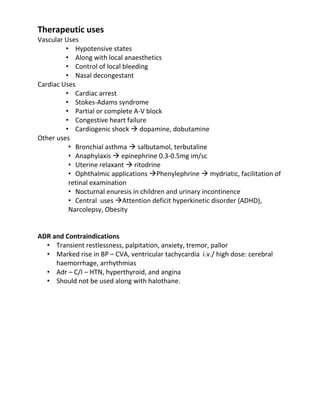
Amphetamine
Beta selective agonists
• β1 selective Dobutamine
• β2 selective Salbutamol, Terbutaline (bronchodilators)
Ritodrine, Isoxsuprine (tocolytics)
8.
Therapeutic uses
Vascular Uses
•Hypotensive states
• Along with local anaesthetics
• Control of local bleeding
• Nasal decongestant
Cardiac Uses
• Cardiac arrest
• Stokes-Adams syndrome
• Partial or complete A-V block
• Congestive heart failure
• Cardiogenic shock dopamine, dobutamine
Other uses
• Bronchial asthma salbutamol, terbutaline
• Anaphylaxis epinephrine 0.3-0.5mg im/sc
• Uterine relaxant ritodrine
• Ophthalmic applications Phenylephrine mydriatic, facilitation of
retinal examination
• Nocturnal enuresis in children and urinary incontinence
• Central uses Attention deficit hyperkinetic disorder (ADHD),
Narcolepsy, Obesity
ADR and Contraindications
• Transient restlessness, palpitation, anxiety, tremor, pallor
• Marked rise in BP – CVA, ventricular tachycardia i.v./ high dose: cerebral
haemorrhage, arrhythmias
• Adr – C/I – HTN, hyperthyroid, and angina
• Should not be used along with halothane.