Driver drowsiness detection
system
OBJECTIVE
• The aim of this paper is to develop a technique for drowsiness
detection system. Our whole focus and concentration will be placed
on designing the system that will accurately monitor the open and
closed state of the person’s eye. By constantly monitoring the eyes, it
can be seen that the symptoms of person fatigue can be detected
early enough to avoid an accident. This detection can be done using a
sequence of images of eyes as well as face. The observation of eye
movements and its edges for the detection will be used.
ABSTRACT:
• A new approach towards automobile safety and security with
autonomous region based automatic car system is proposed in this
concept. We propose three distinct but closely related concepts viz. a
Drowsy Driver Detection system and a traffic detection system with
external vehicle intrusion avoidance based concept. In recent time's
automobile fatigue related crashes have really magnified. In order to
minimize these issues, we have incorporated driver alert system by
monitoring both the driver's eyes as well as sensing as well as the
driver situation based local environment recognition based AI system
is proposed.
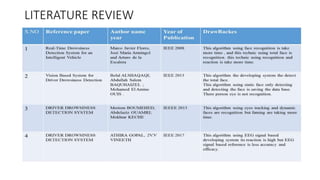
LITERATURE REVIEW
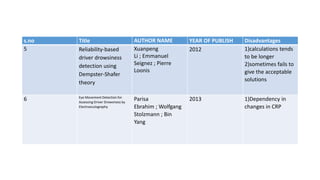
s.no Title AUTHOR NAME YEAR OF PUBLISH Disadvantages
5 Reliability-based
driver drowsiness
detection using
Dempster-Shafer
theory
Xuanpeng
Li ; Emmanuel
Seignez ; Pierre
Loonis
2012 1)calculations tends
to be longer
2)sometimes fails to
give the acceptable
solutions
6 Eye Movement Detection for
Assessing Driver Drowsiness by
Electrooculography
Parisa
Ebrahim ; Wolfgang
Stolzmann ; Bin
Yang
2013 1)Dependency in
changes in CRP
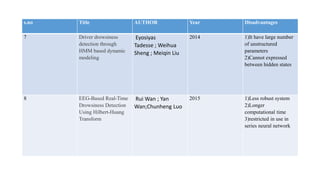
s.no Title AUTHOR Year Disadvantages
7 Driver drowsiness
detection through
HMM based dynamic
modeling
Eyosiyas
Tadesse ; Weihua
Sheng ; Meiqin Liu
2014 1)It have large number
of unstructured
parameters
2)Cannot expressed
between hidden states
8 EEG-Based Real-Time
Drowsiness Detection
Using Hilbert-Huang
Transform
Rui Wan ; Yan
Wan;Chunheng Luo
2015 1)Less robust system
2)Longer
computational time
3)restricted in use in
series neural network
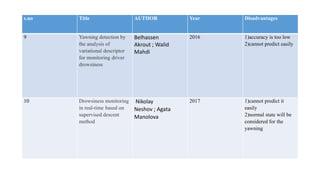
s.no Title AUTHOR Year Disadvantages
9 Yawning detection by
the analysis of
variational descriptor
for monitoring driver
drowsiness
Belhassen
Akrout ; Walid
Mahdi
2016 1)accuracy is too low
2)cannot predict easily
10 Drowsiness monitoring
in real-time based on
supervised descent
method
Nikolay
Neshov ; Agata
Manolova
2017 1)cannot predict it
easily
2)normal state will be
considered for the
yawning
EXISTING SYSTEM:
• Physical parameter measurement
• Detection possible in eye close state
• Sensor based techniques
• No self control
PROPOSED SYSTEM:
• Driver Assistance system with camera
• Vehicle external vehicle availability detection
• Human detection based attention
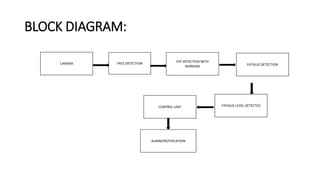
BLOCK DIAGRAM:
CAMERA FACE DETECTION
EYE DETECTION WITH
MARKING FATIGUE DETECTION
ALARM/NOTIFICATION
FATIGUE LEVEL DETECTED
CONTROL UNIT
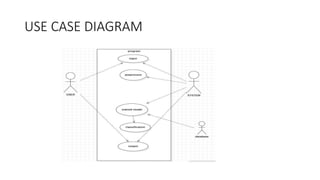
USE CASE DIAGRAM
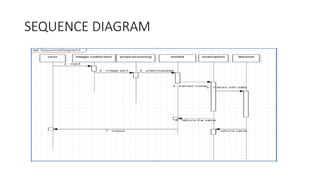
SEQUENCE DIAGRAM
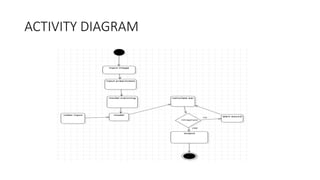
ACTIVITY DIAGRAM
MODULE:1
• FACE DETECTION:
The input video has been captured by using either ipcam or webcam ,
From this the face is detected.
Here we are using haar cascades ,The main use of haar cascades is to
detect the face in the input image or video.
Eye Detection
• For detection of eye the face is get identified.
• By the use of facial landmarks the eye is get detected
• After getting the markings of the eye ,it is get tracked
• By fixing the points in the eye it is achieved
• Based on the value between the marking points in the eye it is get
alerted when its get below the threshold value
ADVANTAGES:
• Driver Assistance system with cameras focusing user hash free user
assistance provided
• M2M communication systems
APPLICATIONS:
• Automobile Applications
• Robotic application
• Home applications
• Monitoring device applications
• Remote control applications
SOFTWARE REQUIREMENTS
• Python
• Open Cv
REFERENCES:
• [1] H. Cheng, N. Zheng, X. Zhang, J. Qin, and H. V. D. Wetering, “Interactive road situation analysis for driver assistance and safety
warning systems: Framework and algorithms,” IEEE Trans. Intell. Transp. Syst., vol. 8, no. 1, pp. 157–167, Mar. 2007.
• [2] L. Li, J. Song, F.-Y. Wang, W. Niehsen, and N.-N. Zheng, “IVS 05: New developments and research trends for intelligent vehicles,”
IEEE Intell. Syst., vol. 20, no. 4, pp. 10–14, Jul. 2005.
• [3] R. Labayrade, J. Douret, J. Laneurit, and R. Chapuis, “A reliable and robust lane detection system based on the parallel use of
three algorithms for driving safety assistance,” IEICE Trans. Inf. Syst., vol. 89-D, no. 7, pp. 2092–2100, 2006.
• [4] OpenCV. Open Source Computer Vision Library Reference Manual, 2001.
• [5] S. Vitabile, A. Paola and F. Sorbello, "Bright Pupil Detection in an Embedded, Real-time Drowsiness Monitoring System", in 24th
IEEE International Conference on Advanced Information Networking and Applications, 2010.
• [6] B. Bhowmick and C. Kumar, "Detection and Classification of Eye State in IR Camera for Driver Drowsiness Identification", in
Proceeding of the IEEE International Conference on Signal and Image Processing Applications, 2009.
• [7] N. Otsu, "A Threshold Selection Method from Gray-Level Histograms", IEEE Transactions on Systems,Man and Cybernatics, pp.
62-66, 1979.
• [8] T. Hong, H. Qin and Q. Sun, "An Improved Real Time Eye State Identification System in Driver Drowsiness Detection", in
proceeding of the IEEE International Conference on Control and Automation, Guangzhou, CHINA, 2007.
• [9] Z. Tian et H. Qin, "Real-time Driver's Eye State Detection", in Proceedings of the IEEE International Conference on Vehicular
Electronics and Safety, October 2005. [10] M. S. Nixon and A. S. Aguado, Feature Extraction and Image Processing, 2nd ed., Jordan
Hill, Oxford OX2 8DP, UK, 2008.

Drowsi(1).pptx

  • 1.
  • 2.
    OBJECTIVE • The aimof this paper is to develop a technique for drowsiness detection system. Our whole focus and concentration will be placed on designing the system that will accurately monitor the open and closed state of the person’s eye. By constantly monitoring the eyes, it can be seen that the symptoms of person fatigue can be detected early enough to avoid an accident. This detection can be done using a sequence of images of eyes as well as face. The observation of eye movements and its edges for the detection will be used.
  • 3.
    ABSTRACT: • A newapproach towards automobile safety and security with autonomous region based automatic car system is proposed in this concept. We propose three distinct but closely related concepts viz. a Drowsy Driver Detection system and a traffic detection system with external vehicle intrusion avoidance based concept. In recent time's automobile fatigue related crashes have really magnified. In order to minimize these issues, we have incorporated driver alert system by monitoring both the driver's eyes as well as sensing as well as the driver situation based local environment recognition based AI system is proposed.
  • 4.
  • 5.
    s.no Title AUTHORNAME YEAR OF PUBLISH Disadvantages 5 Reliability-based driver drowsiness detection using Dempster-Shafer theory Xuanpeng Li ; Emmanuel Seignez ; Pierre Loonis 2012 1)calculations tends to be longer 2)sometimes fails to give the acceptable solutions 6 Eye Movement Detection for Assessing Driver Drowsiness by Electrooculography Parisa Ebrahim ; Wolfgang Stolzmann ; Bin Yang 2013 1)Dependency in changes in CRP
  • 6.
    s.no Title AUTHORYear Disadvantages 7 Driver drowsiness detection through HMM based dynamic modeling Eyosiyas Tadesse ; Weihua Sheng ; Meiqin Liu 2014 1)It have large number of unstructured parameters 2)Cannot expressed between hidden states 8 EEG-Based Real-Time Drowsiness Detection Using Hilbert-Huang Transform Rui Wan ; Yan Wan;Chunheng Luo 2015 1)Less robust system 2)Longer computational time 3)restricted in use in series neural network
  • 7.
    s.no Title AUTHORYear Disadvantages 9 Yawning detection by the analysis of variational descriptor for monitoring driver drowsiness Belhassen Akrout ; Walid Mahdi 2016 1)accuracy is too low 2)cannot predict easily 10 Drowsiness monitoring in real-time based on supervised descent method Nikolay Neshov ; Agata Manolova 2017 1)cannot predict it easily 2)normal state will be considered for the yawning
  • 8.
    EXISTING SYSTEM: • Physicalparameter measurement • Detection possible in eye close state • Sensor based techniques • No self control
  • 9.
    PROPOSED SYSTEM: • DriverAssistance system with camera • Vehicle external vehicle availability detection • Human detection based attention
  • 10.
    BLOCK DIAGRAM: CAMERA FACEDETECTION EYE DETECTION WITH MARKING FATIGUE DETECTION ALARM/NOTIFICATION FATIGUE LEVEL DETECTED CONTROL UNIT
  • 11.
  • 12.
  • 13.
  • 14.
    MODULE:1 • FACE DETECTION: Theinput video has been captured by using either ipcam or webcam , From this the face is detected. Here we are using haar cascades ,The main use of haar cascades is to detect the face in the input image or video.
  • 15.
    Eye Detection • Fordetection of eye the face is get identified. • By the use of facial landmarks the eye is get detected • After getting the markings of the eye ,it is get tracked • By fixing the points in the eye it is achieved • Based on the value between the marking points in the eye it is get alerted when its get below the threshold value
  • 16.
    ADVANTAGES: • Driver Assistancesystem with cameras focusing user hash free user assistance provided • M2M communication systems
  • 17.
    APPLICATIONS: • Automobile Applications •Robotic application • Home applications • Monitoring device applications • Remote control applications
  • 18.
  • 19.
    REFERENCES: • [1] H.Cheng, N. Zheng, X. Zhang, J. Qin, and H. V. D. Wetering, “Interactive road situation analysis for driver assistance and safety warning systems: Framework and algorithms,” IEEE Trans. Intell. Transp. Syst., vol. 8, no. 1, pp. 157–167, Mar. 2007. • [2] L. Li, J. Song, F.-Y. Wang, W. Niehsen, and N.-N. Zheng, “IVS 05: New developments and research trends for intelligent vehicles,” IEEE Intell. Syst., vol. 20, no. 4, pp. 10–14, Jul. 2005. • [3] R. Labayrade, J. Douret, J. Laneurit, and R. Chapuis, “A reliable and robust lane detection system based on the parallel use of three algorithms for driving safety assistance,” IEICE Trans. Inf. Syst., vol. 89-D, no. 7, pp. 2092–2100, 2006. • [4] OpenCV. Open Source Computer Vision Library Reference Manual, 2001. • [5] S. Vitabile, A. Paola and F. Sorbello, "Bright Pupil Detection in an Embedded, Real-time Drowsiness Monitoring System", in 24th IEEE International Conference on Advanced Information Networking and Applications, 2010. • [6] B. Bhowmick and C. Kumar, "Detection and Classification of Eye State in IR Camera for Driver Drowsiness Identification", in Proceeding of the IEEE International Conference on Signal and Image Processing Applications, 2009. • [7] N. Otsu, "A Threshold Selection Method from Gray-Level Histograms", IEEE Transactions on Systems,Man and Cybernatics, pp. 62-66, 1979. • [8] T. Hong, H. Qin and Q. Sun, "An Improved Real Time Eye State Identification System in Driver Drowsiness Detection", in proceeding of the IEEE International Conference on Control and Automation, Guangzhou, CHINA, 2007. • [9] Z. Tian et H. Qin, "Real-time Driver's Eye State Detection", in Proceedings of the IEEE International Conference on Vehicular Electronics and Safety, October 2005. [10] M. S. Nixon and A. S. Aguado, Feature Extraction and Image Processing, 2nd ed., Jordan Hill, Oxford OX2 8DP, UK, 2008.