COPYRIGHT
LAW
D M E T 1 6 0
WHAT IS COPYRIGHT?
• the exclusive legal right, given to an originator or an
assignee to print, publish, perform, film, or record
literary, artistic, or musical material, and to authorize
others to do the same.
WHO OWNS COPYRIGHT?
•a freelance artist who created the copyrighted
work;
•an employer who hires employees who create
copyrighted works as part of their job.
FUNDAMENTALLY, COPYRIGHT IS A LAW THAT GIVES
YOU OWNERSHIP OVER THE THINGS YOU CREATE.
The ownership that copyright law grants comes with several rights that you, as the
owner, have exclusively. Those rights include:
• The right to reproduce the work
• to prepare derivative works
• to distribute copies
• to perform the work
• and to display the work publicly
THOSE ARE YOUR RIGHTS,
AND YOUR RIGHTS ALONE!
ETHICAL CONCEPT OF COPYRIGHT
• Copyright provides you with the protection of your own work, but it also prevents you
from unlawfully using someone else’s work! The respect is mutual.
BUT WHAT IF I WANT TO ALLOW
OTHERS TO USE MY WORK?!
WHAT IS CREATIVE COMMONS?
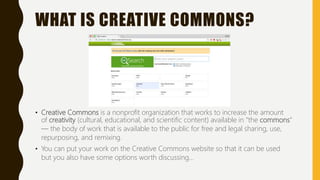
• Creative Commons is a nonprofit organization that works to increase the amount
of creativity (cultural, educational, and scientific content) available in “the commons”
— the body of work that is available to the public for free and legal sharing, use,
repurposing, and remixing.
• You can put your work on the Creative Commons website so that it can be used
but you also have some options worth discussing…
NOT EVERYTHING IS TOTALLY FREE ON
CREATIVE COMMONS!
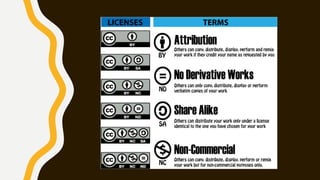
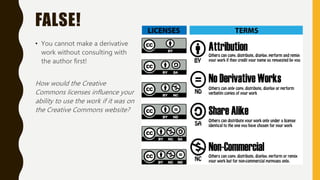
• There are 4 licenses that you
can attain from Creative
Commons and there are a
number of combinations that
you can make from them.
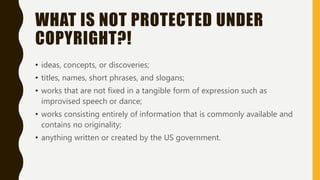
WHAT IS NOT PROTECTED UNDER
COPYRIGHT?!
• ideas, concepts, or discoveries;
• titles, names, short phrases, and slogans;
• works that are not fixed in a tangible form of expression such as
improvised speech or dance;
• works consisting entirely of information that is commonly available and
contains no originality;
• anything written or created by the US government.
HOWEVER…
•There are other laws that may protect these
categories, for example, short phrases could
have trademark protection.
B U T WA I T ! ! !
What about
using copyright
protected
materials for
school?!
FAIR USE IS…
•(in US copyright law) the doctrine that brief
excerpts of copyright material may, under
certain circumstances, be quoted verbatim for
purposes such as criticism, news reporting,
teaching, and research, without the need for
permission from or payment to the copyright
holder.
EXAMPLES:
• class handouts of very short excerpts from a book;
• quoting for purposes of reporting the news or criticizing or
commenting on a particular work of art, writing, speech or
scholarship.
• class studying an artist using samples to critique and analyze
his/her work;
• making a collage for a school project;
• manipulating an image to learn Photoshop or other software.
WHAT IS NOT FAIR USE?
• using a photograph or other image to illustrate a newsworthy
story (because the subject of the story is newsworthy it does
not make the image newsworthy)
• If you want an example, when a celebrity dies, the death is
newsworthy, but any photograph of them is only descriptive
and must be licensed.
• However, if a famous artist’s dies, the news media could show
a few samples of his or her most recognized artworks without
permission.
WHAT IS INFRINGEMENT?
• use of whole or part of an image without permission;
• use beyond the scope of a license;
• adapting an image without permission
(art rendering, collage);
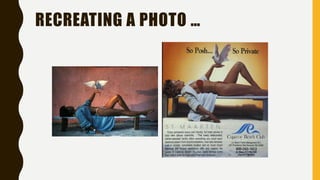
• asking another photographer to recreate the image.
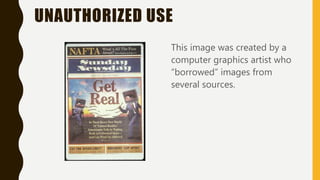
UNAUTHORIZED USE
This image was created by a
computer graphics artist who
“borrowed” images from
several sources.
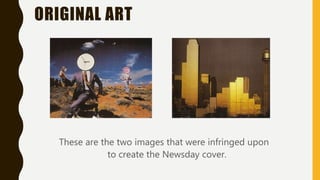
ORIGINAL ART
These are the two images that were infringed upon
to create the Newsday cover.
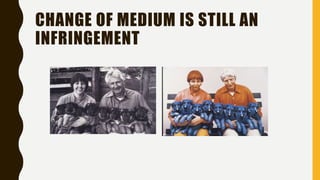
CHANGE OF MEDIUM IS STILL AN
INFRINGEMENT
RECREATING A PHOTO …
WHO IS RESPONSIBLE?
• the company that directly infringed;
• employees who participated in the infringement or should
have supervised;
• anyone who publishes the infringing image whether they had
knowledge or not.
HOW TO AVOID INFRINGEMENT
• obtain a license for all the uses that will be needed;
• obtain a license to create a derivative (spin-off) image;
• obtain an art rendering or art reference license to change the
medium.
POPULAR COPYRIGHT MYTHS
• if it’s on the internet it is in the public domain and therefore
free;
• if there is no copyright notice, I can use the image;
• if I alter the image I don’t need permission;
• if I don’t profit from it, I can use it;
• if I only use a part of the image I don’t need permission.
WHAT ABOUT STOCK PHOTOS?
Stock images break down into two main types, royalty-free and rights-managed.
• For royalty-free images, you get nearly unlimited use. You can use the image in
virtually any application, for as long as you like, in as many different projects as you
like, as long as you comply with the terms of the license agreement. The image is
available to use from when you purchase a license. Following payment of the license
fee, no additional royalty payments are owed.
• With rights-managed images, your right to use the image is typically restricted, with
limitations placed on things such as duration of use, geographic region, industry, etc.,
as established by your license agreement.
ARE THERE SITES THAT HAVE PHOTOS
I CAN USE?
• YES! However, you must make sure to read the fine print!
Some sites will state that the photos are protected under a
creative commons license, but not all are!
• Check out this website for more details:
http://www.stockphotorights.com/faq/
PUBLIC DOMAIN
WHAT’S PUBLIC DOMAIN
A public domain work is a creative work that is not protected by copyright and
which may be freely used by everyone. The reasons that the work is not protected
include:
• (1) the term of copyright for the work has expired;
• (2) the author failed to satisfy statutory
formalities to perfect the copyright or
• (3) the work is a work of the U.S. Government.
COPYRIGHT TERM
•Copyright term is the length of
time copyright subsists in a work before it
passes into the public domain.
•In the U.S., any work published before January
1, 1923 anywhere in the world is in the public
domain.
•When a work has not been published in the
but in some other country, that other country's
PUBLIC DOMAIN
• All works published in the United States before 1923 are in the public domain.
• Works published after 1922, but before 1978 are protected for 95 years from the date
of publication.
• If the work was created, but not published, before 1978, the copyright lasts for the life
of the author plus 70 years.
PUBLIC DOMAIN IS CONFUSING!
•If you aren’t sure if the work you are using
is public domain either DON’T USE IT or
DO SOME RESEARCH!
•http://copyright.cornell.edu/resources/publ
icdomain.cfm
PENALTIES
W H AT H A P P E N S I F Y O U I N F R I N G E ? !
WHAT’S THE PENALTY?
•Infringer pays the actual dollar amount of
damages and profits.
•The law provides a range from $200 to
$150,000 for each work infringed.
•The infringer can go to jail.
TEST YOUR
KNOWLEDGE!
A N S W E R T H E Q U E S T I O N S
IT DOES NOT VIOLATE COPYRIGHT WHEN YOU
CREATE A FILM THAT IS DERIVED FROM A BOOK.
True False
FALSE!
• You cannot make a derivative
work without consulting with
the author first!
How would the Creative
Commons licenses influence your
ability to use the work if it was on
the Creative Commons website?
ANYTHING I USE FOR SCHOOLWORK IS FAIR USE
True False
FALSE!
• It is legal to use a small portion or copyrighted material
for educational purposes such as teaching materials,
media projects and/or research documents and non-
educational purposes. Including material used for a
discussion piece or comment section. (Fair Use).
• If you are going to use the work for personal gain, like in a
portfolio or for an advertisement for a school event, it is
NOT Fair Use.
IF AN ARTICLE ONLINE DOESN’T HAVE THE
COPYRIGHT SYMBOL, THEN IT’S NOT CONSIDERED
COPYRIGHTED MATERIAL.
True False
FALSE!
• This was true until the revision of the 1989 copyright law,
which states that it is not necessary to indicate a
copyright symbol and/or statement on "original works" in
order for it to be protected by copyright law.
COPYRIGHT LAW PROTECTS AN ONLINE WEB PAGE
DOCUMENT…
True False
TRUE
• Copyright protects original works of authorship that are
fixed in a tangible form of expression. An on-line web
page is considered a tangible form.
IT’S OKAY TO USE THE WORK IF I DON’T GET A
FINANCIAL GAIN FROM IT…
True False
FALSE!
• Whether you make money or not, the image is protected
and you cannot use it without permission.
IF I USE AN PHOTOGRAPH FOR MY SCHOOL PROJECT
THAT IS PROTECTED UNDER COPYRIGHT IT’S OKAY
BECAUSE IT’S FOR A SCHOOL PROJECT
True False
FALSE!
• It would be okay to use a photo from the internet if you
were learning a technique in Photoshop or another
software.
• If you are using the image for something like a logo or a
project that you will use in your portfolio you CAN NOT
use someone else’s copyrighted work!
VIDEOS
• https://www.youtube.com/watch?v=Uiq42O6rhW4
• https://www.youtube.com/watch?v=8YkbeycRa2A
RESOURCES
• Modified content from Beth Sockman’s PPT from DMET 160
• https://creativecommons.org/
• https://en.wikipedia.org/wiki/Copyright_law_of_the_United_States
• https://en.wikipedia.org/wiki/Fair_use
• https://www.youtube.com/watch?v=Uiq42O6rhW4
• https://www.youtube.com/watch?v=8YkbeycRa2A

Copyright law

  • 1.
  • 2.
    WHAT IS COPYRIGHT? •the exclusive legal right, given to an originator or an assignee to print, publish, perform, film, or record literary, artistic, or musical material, and to authorize others to do the same.
  • 3.
    WHO OWNS COPYRIGHT? •afreelance artist who created the copyrighted work; •an employer who hires employees who create copyrighted works as part of their job.
  • 4.
    FUNDAMENTALLY, COPYRIGHT ISA LAW THAT GIVES YOU OWNERSHIP OVER THE THINGS YOU CREATE. The ownership that copyright law grants comes with several rights that you, as the owner, have exclusively. Those rights include: • The right to reproduce the work • to prepare derivative works • to distribute copies • to perform the work • and to display the work publicly THOSE ARE YOUR RIGHTS, AND YOUR RIGHTS ALONE!
  • 5.
    ETHICAL CONCEPT OFCOPYRIGHT • Copyright provides you with the protection of your own work, but it also prevents you from unlawfully using someone else’s work! The respect is mutual.
  • 6.
    BUT WHAT IFI WANT TO ALLOW OTHERS TO USE MY WORK?!
  • 7.
    WHAT IS CREATIVECOMMONS? • Creative Commons is a nonprofit organization that works to increase the amount of creativity (cultural, educational, and scientific content) available in “the commons” — the body of work that is available to the public for free and legal sharing, use, repurposing, and remixing. • You can put your work on the Creative Commons website so that it can be used but you also have some options worth discussing…
  • 8.
    NOT EVERYTHING ISTOTALLY FREE ON CREATIVE COMMONS! • There are 4 licenses that you can attain from Creative Commons and there are a number of combinations that you can make from them.
  • 10.
    WHAT IS NOTPROTECTED UNDER COPYRIGHT?! • ideas, concepts, or discoveries; • titles, names, short phrases, and slogans; • works that are not fixed in a tangible form of expression such as improvised speech or dance; • works consisting entirely of information that is commonly available and contains no originality; • anything written or created by the US government.
  • 11.
    HOWEVER… •There are otherlaws that may protect these categories, for example, short phrases could have trademark protection.
  • 12.
    B U TWA I T ! ! ! What about using copyright protected materials for school?!
  • 13.
    FAIR USE IS… •(inUS copyright law) the doctrine that brief excerpts of copyright material may, under certain circumstances, be quoted verbatim for purposes such as criticism, news reporting, teaching, and research, without the need for permission from or payment to the copyright holder.
  • 14.
    EXAMPLES: • class handoutsof very short excerpts from a book; • quoting for purposes of reporting the news or criticizing or commenting on a particular work of art, writing, speech or scholarship. • class studying an artist using samples to critique and analyze his/her work; • making a collage for a school project; • manipulating an image to learn Photoshop or other software.
  • 15.
    WHAT IS NOTFAIR USE? • using a photograph or other image to illustrate a newsworthy story (because the subject of the story is newsworthy it does not make the image newsworthy) • If you want an example, when a celebrity dies, the death is newsworthy, but any photograph of them is only descriptive and must be licensed. • However, if a famous artist’s dies, the news media could show a few samples of his or her most recognized artworks without permission.
  • 16.
    WHAT IS INFRINGEMENT? •use of whole or part of an image without permission; • use beyond the scope of a license; • adapting an image without permission (art rendering, collage); • asking another photographer to recreate the image.
  • 17.
    UNAUTHORIZED USE This imagewas created by a computer graphics artist who “borrowed” images from several sources.
  • 18.
    ORIGINAL ART These arethe two images that were infringed upon to create the Newsday cover.
  • 19.
    CHANGE OF MEDIUMIS STILL AN INFRINGEMENT
  • 20.
  • 21.
    WHO IS RESPONSIBLE? •the company that directly infringed; • employees who participated in the infringement or should have supervised; • anyone who publishes the infringing image whether they had knowledge or not.
  • 22.
    HOW TO AVOIDINFRINGEMENT • obtain a license for all the uses that will be needed; • obtain a license to create a derivative (spin-off) image; • obtain an art rendering or art reference license to change the medium.
  • 23.
    POPULAR COPYRIGHT MYTHS •if it’s on the internet it is in the public domain and therefore free; • if there is no copyright notice, I can use the image; • if I alter the image I don’t need permission; • if I don’t profit from it, I can use it; • if I only use a part of the image I don’t need permission.
  • 24.
    WHAT ABOUT STOCKPHOTOS? Stock images break down into two main types, royalty-free and rights-managed. • For royalty-free images, you get nearly unlimited use. You can use the image in virtually any application, for as long as you like, in as many different projects as you like, as long as you comply with the terms of the license agreement. The image is available to use from when you purchase a license. Following payment of the license fee, no additional royalty payments are owed. • With rights-managed images, your right to use the image is typically restricted, with limitations placed on things such as duration of use, geographic region, industry, etc., as established by your license agreement.
  • 25.
    ARE THERE SITESTHAT HAVE PHOTOS I CAN USE? • YES! However, you must make sure to read the fine print! Some sites will state that the photos are protected under a creative commons license, but not all are! • Check out this website for more details: http://www.stockphotorights.com/faq/
  • 26.
  • 27.
    WHAT’S PUBLIC DOMAIN Apublic domain work is a creative work that is not protected by copyright and which may be freely used by everyone. The reasons that the work is not protected include: • (1) the term of copyright for the work has expired; • (2) the author failed to satisfy statutory formalities to perfect the copyright or • (3) the work is a work of the U.S. Government.
  • 28.
    COPYRIGHT TERM •Copyright termis the length of time copyright subsists in a work before it passes into the public domain. •In the U.S., any work published before January 1, 1923 anywhere in the world is in the public domain. •When a work has not been published in the but in some other country, that other country's
  • 29.
    PUBLIC DOMAIN • Allworks published in the United States before 1923 are in the public domain. • Works published after 1922, but before 1978 are protected for 95 years from the date of publication. • If the work was created, but not published, before 1978, the copyright lasts for the life of the author plus 70 years.
  • 30.
    PUBLIC DOMAIN ISCONFUSING! •If you aren’t sure if the work you are using is public domain either DON’T USE IT or DO SOME RESEARCH! •http://copyright.cornell.edu/resources/publ icdomain.cfm
  • 31.
    PENALTIES W H ATH A P P E N S I F Y O U I N F R I N G E ? !
  • 32.
    WHAT’S THE PENALTY? •Infringerpays the actual dollar amount of damages and profits. •The law provides a range from $200 to $150,000 for each work infringed. •The infringer can go to jail.
  • 33.
    TEST YOUR KNOWLEDGE! A NS W E R T H E Q U E S T I O N S
  • 34.
    IT DOES NOTVIOLATE COPYRIGHT WHEN YOU CREATE A FILM THAT IS DERIVED FROM A BOOK. True False
  • 35.
    FALSE! • You cannotmake a derivative work without consulting with the author first! How would the Creative Commons licenses influence your ability to use the work if it was on the Creative Commons website?
  • 36.
    ANYTHING I USEFOR SCHOOLWORK IS FAIR USE True False
  • 37.
    FALSE! • It islegal to use a small portion or copyrighted material for educational purposes such as teaching materials, media projects and/or research documents and non- educational purposes. Including material used for a discussion piece or comment section. (Fair Use). • If you are going to use the work for personal gain, like in a portfolio or for an advertisement for a school event, it is NOT Fair Use.
  • 38.
    IF AN ARTICLEONLINE DOESN’T HAVE THE COPYRIGHT SYMBOL, THEN IT’S NOT CONSIDERED COPYRIGHTED MATERIAL. True False
  • 39.
    FALSE! • This wastrue until the revision of the 1989 copyright law, which states that it is not necessary to indicate a copyright symbol and/or statement on "original works" in order for it to be protected by copyright law.
  • 40.
    COPYRIGHT LAW PROTECTSAN ONLINE WEB PAGE DOCUMENT… True False
  • 41.
    TRUE • Copyright protectsoriginal works of authorship that are fixed in a tangible form of expression. An on-line web page is considered a tangible form.
  • 42.
    IT’S OKAY TOUSE THE WORK IF I DON’T GET A FINANCIAL GAIN FROM IT… True False
  • 43.
    FALSE! • Whether youmake money or not, the image is protected and you cannot use it without permission.
  • 44.
    IF I USEAN PHOTOGRAPH FOR MY SCHOOL PROJECT THAT IS PROTECTED UNDER COPYRIGHT IT’S OKAY BECAUSE IT’S FOR A SCHOOL PROJECT True False
  • 45.
    FALSE! • It wouldbe okay to use a photo from the internet if you were learning a technique in Photoshop or another software. • If you are using the image for something like a logo or a project that you will use in your portfolio you CAN NOT use someone else’s copyrighted work!
  • 46.
  • 47.
    RESOURCES • Modified contentfrom Beth Sockman’s PPT from DMET 160 • https://creativecommons.org/ • https://en.wikipedia.org/wiki/Copyright_law_of_the_United_States • https://en.wikipedia.org/wiki/Fair_use • https://www.youtube.com/watch?v=Uiq42O6rhW4 • https://www.youtube.com/watch?v=8YkbeycRa2A