Copyright in Teaching &
Research
Melanie T. Kowalski, MLIS
Copyright & Scholarly Communications Librarian
TPC+R 2016
January 21, 2016
This work is licensed under a Creative Commons Attribution-ShareAlike 4.0 International License.
DISCLAIMER
This presentation contains legal information. It in no way
constitutes legal advice. Should you feel you need legal
advice, please seek the counsel of an attorney experienced
in Intellectual Property Law.
2
By the end of this session you should…
• Have a basic understanding of copyright
• Know how to seek copyright permission
• Know what copyright exemptions apply to
scholarly work and teaching
• Know how to find works licensed under the
Creative Commons
• Know how to apply a Creative Commons
License to your own work
3
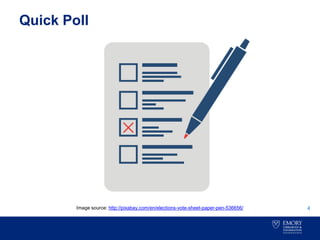
Quick Poll
4Image source: http://pixabay.com/en/elections-vote-sheet-paper-pen-536656/
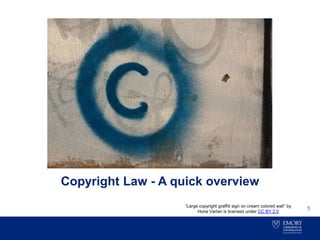
Copyright Law - A quick overview
5“Large copyright graffiti sign on cream colored wall” by
Horia Varlan is licensed under CC BY 2.0
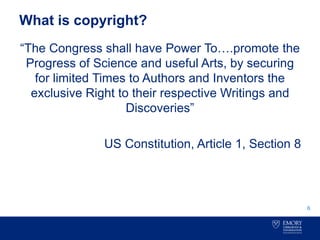
What is copyright?
“The Congress shall have Power To….promote the
Progress of Science and useful Arts, by securing
for limited Times to Authors and Inventors the
exclusive Right to their respective Writings and
Discoveries”
US Constitution, Article 1, Section 8
6
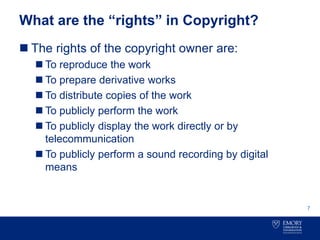
What are the “rights” in Copyright?
 The rights of the copyright owner are:
 To reproduce the work
 To prepare derivative works
 To distribute copies of the work
 To publicly perform the work
 To publicly display the work directly or by
telecommunication
 To publicly perform a sound recording by digital
means
7
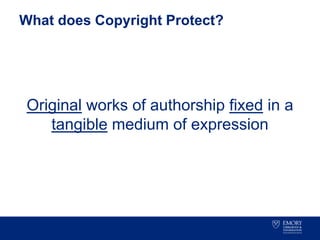
Original works of authorship fixed in a
tangible medium of expression
What does Copyright Protect?
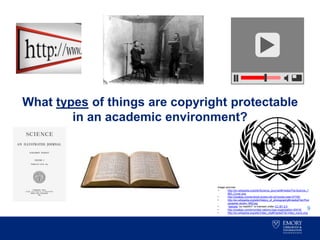
What types of things are copyright protectable
in an academic environment?
9
Image sources:
• http://en.wikipedia.org/wiki/Science_(journal)#/media/File:Science_1
883_Cover.png
• http://pixabay.com/en/book-books-old-old-books-read-97709/
• http://en.wikipedia.org/wiki/History_of_photography#/media/File:Phot
ographer-studio-1893.jpg
• “website” by medithIT is licensed under CC BY 2.0
• http://pixabay.com/en/united-nations-logo-organization-40418/
• http://en.wikipedia.org/wiki/Video_clip#/media/File:Video_icon2.png
What doesn’t Copyright Protect?
• Titles, names, short phrases, slogans
• Facts, news and discoveries
• Ideas, procedures, methods, systems,
processes
• Works lacking a modicum of originality
• Works created by the U.S. Federal government
• Useful articles/Items of Utility
For more a fun explanation see New Media Rights video: https://youtu.be/P4LG95nWNa4
10
Duration of the Copyright protection
• Copyright law grants exclusive rights to
copyright owners
– Vest @ moment of creation
– Term = life of the author + 70 years
– Copyright notice ( © ) not required
– When copyright expires, work enters the public
domain
• Anything published in the US pre-1923
• Anything published in a foreign country pre-1909
11
Registering Copyright
• Registration with Copyright Office = not required
since 1976
• Might be a good idea if….
– you want a public claim to ownership
– you might sue someone some day
• Procedural step – must register before you can file suit
• Want statutory damages and/or attorneys fees – must
register within 3 months of publication or prior to infringement
Copyright Basics Exercise
Scenario: You are conducting research for a book
about Sir Flinders Petrie. You come across an
image of Sir Flinders that you want to use as your
book cover. The image was originally created in
the UK in 1910 and published in 1913. It was later
published in the US in 1917.
Do you need to get permission to use the image
on your book cover?
13
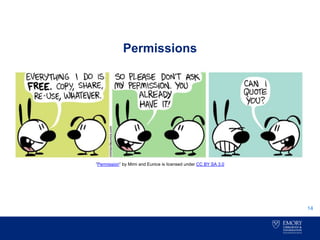
Permissions
14
“Permission” by Mimi and Eunice is licensed under CC BY SA 3.0
Types of Permission
• Copyright Permission
– Legal requirement to avoid copyright infringement
liability
• Archival “Use” or “Publication” Permissions
– Institutional requirement
– Grants permission to access
– Outlines citation/attribution requirements
15
How to Obtain Permission
• Identify the © owner
– Start with a licensing organization
– http://www.copylaw.com/new_articles/permission.html
• Contact the © owner in writing and include:
– Exact material to be used
– Intended use of the material
– Form of publication
16
Permissions
• Example Permissions Letters:
– Columbia
University:http://copyright.columbia.edu/copyright/per
missions/requesting-permission/model-forms/
– University of Michigan:
http://guides.lib.umich.edu/content.php?pid=289569&
sid=2380205
– Cornell
University:https://copyright.cornell.edu/services/
17
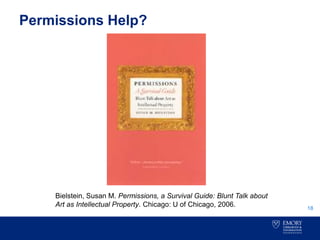
Permissions Help?
18
Bielstein, Susan M. Permissions, a Survival Guide: Blunt Talk about
Art as Intellectual Property. Chicago: U of Chicago, 2006.
Again, When Permission Isn’t Needed
• Work is in the public domain
• Creative Commons licensed material
• When you are the creator and have retained the
rights to re-publish
• When you can apply a Copyright Exemption (Fair
Use, Section 108, Classroom Teaching, etc.)
19
The Copyright Exemptions
20
Copyright Exemptions
• Classroom Use Exemption – Section 110 (1)
• TEACH Act Exemption – Section 110 (2)
• Fair Use – Section 107
21
Copyright Exemption – Classroom Teaching
• All performance and displays (including
music, images, videos) of a work are not an
infringement of copyright, as long as:
– In the course of face-to-face teaching
– It takes place in a classroom or similar place devoted
to instruction
– The work is lawfully obtained
22
Copyright Exemptions Exercise
Scenario: You are teaching a class on the ecology
of Africa. You want to show a National Geographic
documentary on Zimbabwe in your class. The
library does not have a copy, but you bought one
from PBS.
Are there any copyright issues to be aware of?
23
Copyright Exemptions Exercise – Follow-Up
Scenario: You realize that you don’t have time in
your syllabus to take a whole class period to watch
the National Geographic Video about Zimbabwe.
You decide you’ll just assign the video to your
class as homework. You digitize the video and put
in on Blackboard.
Are there any copyright issues to be aware of?
24
Copyright Exemptions Exercise – Follow-Up
Scenario: In preparation for your Wednesday class, you
find an article in the New York Times Sunday edition about
the varied flora on the African Continent. You want your
class to read the article together in class and discuss it in
relation to your central topic for that week of class.
– Could you make physical copies of the article and distribute
them in your class without permission?
– Could you post the article on your class’s public Scholar Blogs
site?
– Could you email the article as a pdf to your students?
– If you want to include the article as reading material for next
semester’s class, does anything change?
25
Reserves vs. Blackboard vs. Wordpress
• From Emory’s Blackboard Site:
If you’re interested in posting content…for which you do
not own the copyright, please work through the
Reserves Direct system, and library staff will assist you
with permissions, fair use, public domain, and other
issues. It is a university requirement that copyrighted
content for course reserves be managed through the
Reserves Direct
26
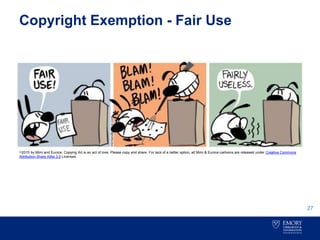
Copyright Exemption - Fair Use
27
♡2015 by Mimi and Eunice. Copying Art is an act of love. Please copy and share. For lack of a better option, all Mimi & Eunice cartoons are released under Creative Commons
Attribution-Share Alike 3.0 Licenses.
“It’s educational, so it’s a fair use.”
28
Copyright Exemption - Fair Use
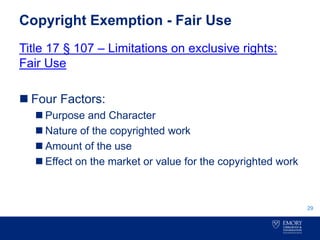
Title 17 § 107 – Limitations on exclusive rights:
Fair Use
 Four Factors:
 Purpose and Character
 Nature of the copyrighted work
 Amount of the use
 Effect on the market or value for the copyrighted work
29
Fair Use – Case Study
A researcher is publishing a scholarly article about the lyrical
references to love and marriage in the popular music of 1960s. In order
to successfully make her argument, she analyzes the lyrical content of
Rolling Stone Readers’ Top 10 Songs of the Sixties. To successfully
make her argument, she needs to include quotes from the lyrics of five
songs:
• “Like A Rolling Stone” by Bob Dylan
• “Satisfaction” by The Rolling Stones
• “Light My Fire” by The Doors
• “Whole Lotta Love” by Led Zeppelin
• “God Only Knows” by The Beach Boys
She is only using the part of the lyrics necessary to convey her
scholarly point. She attributes lyrics appropriately, consistent with the
journal’s citation style guidelines.
Could she argue fair use for this use? 30
Copyright Exemption - Fair Use
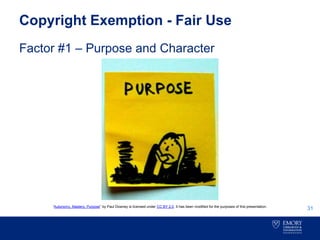
Factor #1 – Purpose and Character
31“Autonomy, Mastery, Purpose” by Paul Downey is licensed under CC BY 2.0. It has been modified for the purposes of this presentation.
Copyright Exemption - Fair Use
What do we mean when we talk about
transformative fair use?
32
Transformative Fair Use Variance:
http://www.nolo.com/legal-encyclopedia/fair-use-what-
transformative.html
Fair Use – Case Study
A researcher is publishing a scholarly article about the lyrical
references to love and marriage in the popular music of 1960s. In order
to successfully make her argument, she analyzes the lyrical content of
Rolling Stone Readers’ Top 10 Songs of the Sixties. To successfully
make her argument, she needs to include quotes from the lyrics of five
songs:
• “Like A Rolling Stone” by Bob Dylan
• “Satisfaction” by The Rolling Stones
• “Light My Fire” by The Doors
• “Whole Lotta Love” by Led Zeppelin
• “God Only Knows” by The Beach Boys
She is only using the part of the lyrics necessary to convey her
scholarly point. She attributes lyrics appropriately, consistent with the
journal’s citation style guidelines.
Could she argue fair use for this use? 33
Copyright Exemption - Fair Use
Factor #2 – Nature of the copyrighted work
34“Rossville Boardwalk Wolf River” by Gary Bridgman is licensed under CC-BY 2.5.
Fair Use – Case Study
A researcher is publishing a scholarly article about the lyrical
references to love and marriage in the popular music of 1960s. In order
to successfully make her argument, she analyzes the lyrical content of
Rolling Stone Readers’ Top 10 Songs of the Sixties. To successfully
make her argument, she needs to include quotes from the lyrics of five
songs:
• “Like A Rolling Stone” by Bob Dylan
• “Satisfaction” by The Rolling Stones
• “Light My Fire” by The Doors
• “Whole Lotta Love” by Led Zeppelin
• “God Only Knows” by The Beach Boys
She is only using the part of the lyrics necessary to convey her
scholarly point. She attributes lyrics appropriately, consistent with the
journal’s citation style guidelines.
Could she argue fair use for this use? 35
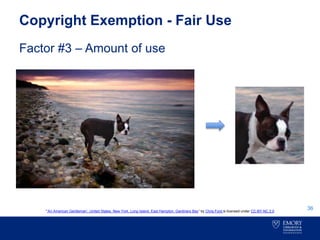
Copyright Exemption - Fair Use
Factor #3 – Amount of use
36“’An American Gentleman’, United States, New York, Long Island, East Hampton, Gardiners Bay” by Chris Ford is licensed under CC-BY-NC 2.0
Fair Use – Case Study
A researcher is publishing a scholarly article about the lyrical
references to love and marriage in the popular music of 1960s. In order
to successfully make her argument, she analyzes the lyrical content of
Rolling Stone Readers’ Top 10 Songs of the Sixties. To successfully
make her argument, she needs to include quotes from the lyrics of five
songs:
• “Like A Rolling Stone” by Bob Dylan
• “Satisfaction” by The Rolling Stones
• “Light My Fire” by The Doors
• “Whole Lotta Love” by Led Zeppelin
• “God Only Knows” by The Beach Boys
She is only using the part of the lyrics necessary to convey her
scholarly point. She attributes lyrics appropriately, consistent with the
journal’s citation style guidelines.
Could she argue fair use for this use? 37
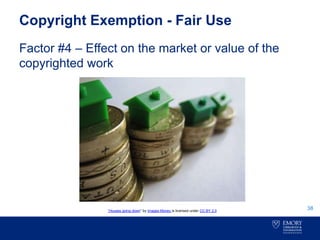
Copyright Exemption - Fair Use
Factor #4 – Effect on the market or value of the
copyrighted work
38“Houses going down” by Images Money is licensed under CC-BY 2.0
Fair Use – Case Study
A researcher is publishing a scholarly article about the lyrical
references to love and marriage in the popular music of 1960s. In order
to successfully make her argument, she analyzes the lyrical content of
Rolling Stone Readers’ Top 10 Songs of the Sixties. To successfully
make her argument, she needs to include quotes from the lyrics of five
songs:
• “Like A Rolling Stone” by Bob Dylan
• “Satisfaction” by The Rolling Stones
• “Light My Fire” by The Doors
• “Whole Lotta Love” by Led Zeppelin
• “God Only Knows” by The Beach Boys
She is only using the part of the lyrics necessary to convey her
scholarly point. She attributes lyrics appropriately, consistent with the
journal’s citation style guidelines.
Could she argue fair use for this use? 39
Fair Use – Case Study Re-cap
• Factor #1 - Favors Fair Use
– Scholarly, non-commercial, transformative in nature
• Factor #2 – Neutral to Favors Fair Use
– Published, highly creative
• Factor #3 – Favors Fair Use
– Small quantitative amount, likely small qualitative
amount
• Factor #4 – Favors Fair Use
– Use stimulates market for original work, use doesn’t
substitute for sale of the original, many copies made
40
Codes of Best Practices in Fair Use
• Code of Best Practices in Fair Use for Academic and Research
Libraries
• Documentary Filmmakers’ Statement of Best Practices in Fair Use
• Code of Best Practices in Fair Use for Media Literacy Education
• Code of Best Practices in Fair Use for Scholarly Research in
Communication
• Code of Best Practices in Fair Use for Online Video
• Orphan Works: Statement of Best Practices
• Code of Best Practices in Fair Use for Poetry
• Code of Best Practices in Fair Use for the Visual Arts
41
The Creative Commons License
42
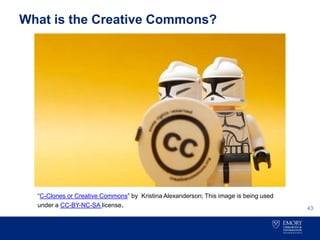
What is the Creative Commons?
43
“C-Clones or Creative Commons” by Kristina Alexanderson; This image is being used
under a CC-BY-NC-SA license.
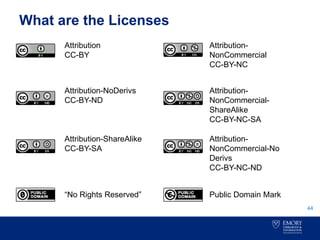
What are the Licenses
44
Attribution
CC-BY
Attribution-NoDerivs
CC-BY-ND
Attribution-ShareAlike
CC-BY-SA
Attribution-
NonCommercial
CC-BY-NC
Attribution-
NonCommercial-
ShareAlike
CC-BY-NC-SA
Attribution-
NonCommercial-No
Derivs
CC-BY-NC-ND
“No Rights Reserved” Public Domain Mark
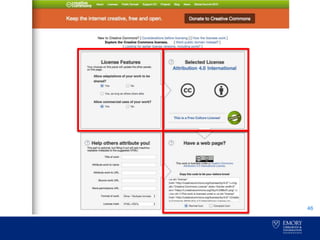
Selecting a CC License for your Content
https://creativecommons.org/choose/
45
46
Creative Commons Exercise
creativecommons.org/choose/
Scenario: Sue has created a video for her website. The
video includes original content that she created. She wants
to share the video with the world using a Creative
Commons License. She wants people to be able to remix it,
quote it, or create other works with it, as long as they also
share their work openly too. She does not care if someone
profits from their use of the video.
Which CC License should Sue choose??
47
Using CC Licensed Content
• Proper Creative Commons attribution should
include:
– The name or user ID of the creator
– The title of the work, if any
– The Creative Commons license under which the
original work is available
– A reproduction of any copyright notices the creator
included
– If you’ve made a derivative work, an identification that
your work is derivative
48
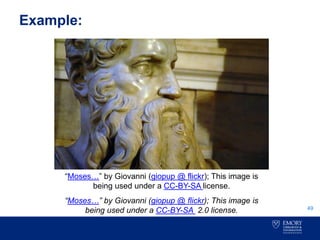
Example:
49
“Moses…” by Giovanni (giopup @ flickr); This image is
being used under a CC-BY-SA license.
“Moses…” by Giovanni (giopup @ flickr); This image is
being used under a CC-BY-SA 2.0 license.
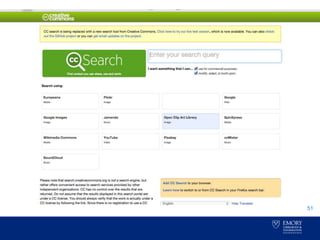
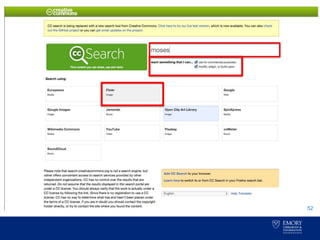
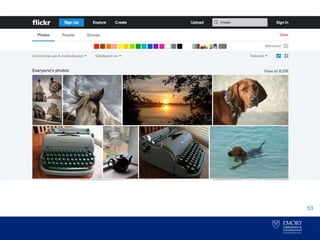
Searching for CC Licensed Content
search.creativecommons.org
50
51
52
53
Exercise - Finding CC Content
Scenario:
You are creating an openly available online
textbook about the representation of God. You
would like to include images on the site. You want
to make sure that you can edit and modify the
images to your liking.
Find three images with CC-licenses that would
allow you to use them on the site.
54
Applying a CC License to your work
• If your original content, use CC Choose a
License Tool
http://creativecommons.org/choose/
• If remix of content, use OER IPR Support
Creative Commons License Compatibility
Wizards -
http://www.web2rights.com/OERIPRSupport/cre
ativecommons/
55
56“The Hatchy Question Mark” by EarWaxKid is licensed under CC BY 3.0
BONUS SLIDES:
So you want to publish?
57
Authors Rights
REMINDER
• The rights of the copyright owner are:
• To reproduce
• To prepare derivatives
• To distribute copies
• To publicly perform the work
• To publicly display the work directly or by
telecommunication
• To publicly perform a sound recording by digital
means
58
Author Rights
Author/Creator is the copyright owner until, and
unless, he/she sign away those rights.
Copyright ownership can only be transferred in
writing or by inheritance, which is why authors are
asked to sign Author Agreements.
59
Authors Rights
• Which of these rights do publishers need?
• To reproduce
• To prepare derivative
• To distribute copies
• To publicly perform/display the work
• Which of these rights do publishers traditionally
include in author agreements? – Let’s look at
some examples!
60
Author Agreements - Journals
Journal: Obstetrics and Gynecology
Full agreement and repository requirements
available at:
http://edmgr.ovid.com/ong/accounts/agreementfor
m.pdf
61
Author Agreement - Journals
Journal: Nature
Full agreement available at:
http://npg.nature.com/pdf/05_news.pdf
62
Author Agreement - Journals
Helpful tips for academic authors BEFORE YOU
SIGN:
• Read the agreement thoroughly
• Anticipate your future needs
– Right to use your work in classroom, lectures, professional
activities
• Negotiate
– Amend the publisher’s agreement
• Author Addenda can provide guidance on preferred terms for
Author Agreements
– SPARC Author Addendum -
http://www.sparc.arl.org/resources/authors/addendum
– Science Commons Scholar’s Copyright Addendum Engine -
http://scholars.sciencecommons.org
Author Agreements - Books
• Still most commonly a transfer of copyright from
the author to the publisher
• Not as common for author to have re-use rights
• Much more common for publishers to be willing
to negotiate
64

Copyright in Teaching and Research

  • 1.
    Copyright in Teaching& Research Melanie T. Kowalski, MLIS Copyright & Scholarly Communications Librarian TPC+R 2016 January 21, 2016 This work is licensed under a Creative Commons Attribution-ShareAlike 4.0 International License.
  • 2.
    DISCLAIMER This presentation containslegal information. It in no way constitutes legal advice. Should you feel you need legal advice, please seek the counsel of an attorney experienced in Intellectual Property Law. 2
  • 3.
    By the endof this session you should… • Have a basic understanding of copyright • Know how to seek copyright permission • Know what copyright exemptions apply to scholarly work and teaching • Know how to find works licensed under the Creative Commons • Know how to apply a Creative Commons License to your own work 3
  • 4.
    Quick Poll 4Image source:http://pixabay.com/en/elections-vote-sheet-paper-pen-536656/
  • 5.
    Copyright Law -A quick overview 5“Large copyright graffiti sign on cream colored wall” by Horia Varlan is licensed under CC BY 2.0
  • 6.
    What is copyright? “TheCongress shall have Power To….promote the Progress of Science and useful Arts, by securing for limited Times to Authors and Inventors the exclusive Right to their respective Writings and Discoveries” US Constitution, Article 1, Section 8 6
  • 7.
    What are the“rights” in Copyright?  The rights of the copyright owner are:  To reproduce the work  To prepare derivative works  To distribute copies of the work  To publicly perform the work  To publicly display the work directly or by telecommunication  To publicly perform a sound recording by digital means 7
  • 8.
    Original works ofauthorship fixed in a tangible medium of expression What does Copyright Protect?
  • 9.
    What types ofthings are copyright protectable in an academic environment? 9 Image sources: • http://en.wikipedia.org/wiki/Science_(journal)#/media/File:Science_1 883_Cover.png • http://pixabay.com/en/book-books-old-old-books-read-97709/ • http://en.wikipedia.org/wiki/History_of_photography#/media/File:Phot ographer-studio-1893.jpg • “website” by medithIT is licensed under CC BY 2.0 • http://pixabay.com/en/united-nations-logo-organization-40418/ • http://en.wikipedia.org/wiki/Video_clip#/media/File:Video_icon2.png
  • 10.
    What doesn’t CopyrightProtect? • Titles, names, short phrases, slogans • Facts, news and discoveries • Ideas, procedures, methods, systems, processes • Works lacking a modicum of originality • Works created by the U.S. Federal government • Useful articles/Items of Utility For more a fun explanation see New Media Rights video: https://youtu.be/P4LG95nWNa4 10
  • 11.
    Duration of theCopyright protection • Copyright law grants exclusive rights to copyright owners – Vest @ moment of creation – Term = life of the author + 70 years – Copyright notice ( © ) not required – When copyright expires, work enters the public domain • Anything published in the US pre-1923 • Anything published in a foreign country pre-1909 11
  • 12.
    Registering Copyright • Registrationwith Copyright Office = not required since 1976 • Might be a good idea if…. – you want a public claim to ownership – you might sue someone some day • Procedural step – must register before you can file suit • Want statutory damages and/or attorneys fees – must register within 3 months of publication or prior to infringement
  • 13.
    Copyright Basics Exercise Scenario:You are conducting research for a book about Sir Flinders Petrie. You come across an image of Sir Flinders that you want to use as your book cover. The image was originally created in the UK in 1910 and published in 1913. It was later published in the US in 1917. Do you need to get permission to use the image on your book cover? 13
  • 14.
    Permissions 14 “Permission” by Mimiand Eunice is licensed under CC BY SA 3.0
  • 15.
    Types of Permission •Copyright Permission – Legal requirement to avoid copyright infringement liability • Archival “Use” or “Publication” Permissions – Institutional requirement – Grants permission to access – Outlines citation/attribution requirements 15
  • 16.
    How to ObtainPermission • Identify the © owner – Start with a licensing organization – http://www.copylaw.com/new_articles/permission.html • Contact the © owner in writing and include: – Exact material to be used – Intended use of the material – Form of publication 16
  • 17.
    Permissions • Example PermissionsLetters: – Columbia University:http://copyright.columbia.edu/copyright/per missions/requesting-permission/model-forms/ – University of Michigan: http://guides.lib.umich.edu/content.php?pid=289569& sid=2380205 – Cornell University:https://copyright.cornell.edu/services/ 17
  • 18.
    Permissions Help? 18 Bielstein, SusanM. Permissions, a Survival Guide: Blunt Talk about Art as Intellectual Property. Chicago: U of Chicago, 2006.
  • 19.
    Again, When PermissionIsn’t Needed • Work is in the public domain • Creative Commons licensed material • When you are the creator and have retained the rights to re-publish • When you can apply a Copyright Exemption (Fair Use, Section 108, Classroom Teaching, etc.) 19
  • 20.
  • 21.
    Copyright Exemptions • ClassroomUse Exemption – Section 110 (1) • TEACH Act Exemption – Section 110 (2) • Fair Use – Section 107 21
  • 22.
    Copyright Exemption –Classroom Teaching • All performance and displays (including music, images, videos) of a work are not an infringement of copyright, as long as: – In the course of face-to-face teaching – It takes place in a classroom or similar place devoted to instruction – The work is lawfully obtained 22
  • 23.
    Copyright Exemptions Exercise Scenario:You are teaching a class on the ecology of Africa. You want to show a National Geographic documentary on Zimbabwe in your class. The library does not have a copy, but you bought one from PBS. Are there any copyright issues to be aware of? 23
  • 24.
    Copyright Exemptions Exercise– Follow-Up Scenario: You realize that you don’t have time in your syllabus to take a whole class period to watch the National Geographic Video about Zimbabwe. You decide you’ll just assign the video to your class as homework. You digitize the video and put in on Blackboard. Are there any copyright issues to be aware of? 24
  • 25.
    Copyright Exemptions Exercise– Follow-Up Scenario: In preparation for your Wednesday class, you find an article in the New York Times Sunday edition about the varied flora on the African Continent. You want your class to read the article together in class and discuss it in relation to your central topic for that week of class. – Could you make physical copies of the article and distribute them in your class without permission? – Could you post the article on your class’s public Scholar Blogs site? – Could you email the article as a pdf to your students? – If you want to include the article as reading material for next semester’s class, does anything change? 25
  • 26.
    Reserves vs. Blackboardvs. Wordpress • From Emory’s Blackboard Site: If you’re interested in posting content…for which you do not own the copyright, please work through the Reserves Direct system, and library staff will assist you with permissions, fair use, public domain, and other issues. It is a university requirement that copyrighted content for course reserves be managed through the Reserves Direct 26
  • 27.
    Copyright Exemption -Fair Use 27 ♡2015 by Mimi and Eunice. Copying Art is an act of love. Please copy and share. For lack of a better option, all Mimi & Eunice cartoons are released under Creative Commons Attribution-Share Alike 3.0 Licenses.
  • 28.
    “It’s educational, soit’s a fair use.” 28
  • 29.
    Copyright Exemption -Fair Use Title 17 § 107 – Limitations on exclusive rights: Fair Use  Four Factors:  Purpose and Character  Nature of the copyrighted work  Amount of the use  Effect on the market or value for the copyrighted work 29
  • 30.
    Fair Use –Case Study A researcher is publishing a scholarly article about the lyrical references to love and marriage in the popular music of 1960s. In order to successfully make her argument, she analyzes the lyrical content of Rolling Stone Readers’ Top 10 Songs of the Sixties. To successfully make her argument, she needs to include quotes from the lyrics of five songs: • “Like A Rolling Stone” by Bob Dylan • “Satisfaction” by The Rolling Stones • “Light My Fire” by The Doors • “Whole Lotta Love” by Led Zeppelin • “God Only Knows” by The Beach Boys She is only using the part of the lyrics necessary to convey her scholarly point. She attributes lyrics appropriately, consistent with the journal’s citation style guidelines. Could she argue fair use for this use? 30
  • 31.
    Copyright Exemption -Fair Use Factor #1 – Purpose and Character 31“Autonomy, Mastery, Purpose” by Paul Downey is licensed under CC BY 2.0. It has been modified for the purposes of this presentation.
  • 32.
    Copyright Exemption -Fair Use What do we mean when we talk about transformative fair use? 32 Transformative Fair Use Variance: http://www.nolo.com/legal-encyclopedia/fair-use-what- transformative.html
  • 33.
    Fair Use –Case Study A researcher is publishing a scholarly article about the lyrical references to love and marriage in the popular music of 1960s. In order to successfully make her argument, she analyzes the lyrical content of Rolling Stone Readers’ Top 10 Songs of the Sixties. To successfully make her argument, she needs to include quotes from the lyrics of five songs: • “Like A Rolling Stone” by Bob Dylan • “Satisfaction” by The Rolling Stones • “Light My Fire” by The Doors • “Whole Lotta Love” by Led Zeppelin • “God Only Knows” by The Beach Boys She is only using the part of the lyrics necessary to convey her scholarly point. She attributes lyrics appropriately, consistent with the journal’s citation style guidelines. Could she argue fair use for this use? 33
  • 34.
    Copyright Exemption -Fair Use Factor #2 – Nature of the copyrighted work 34“Rossville Boardwalk Wolf River” by Gary Bridgman is licensed under CC-BY 2.5.
  • 35.
    Fair Use –Case Study A researcher is publishing a scholarly article about the lyrical references to love and marriage in the popular music of 1960s. In order to successfully make her argument, she analyzes the lyrical content of Rolling Stone Readers’ Top 10 Songs of the Sixties. To successfully make her argument, she needs to include quotes from the lyrics of five songs: • “Like A Rolling Stone” by Bob Dylan • “Satisfaction” by The Rolling Stones • “Light My Fire” by The Doors • “Whole Lotta Love” by Led Zeppelin • “God Only Knows” by The Beach Boys She is only using the part of the lyrics necessary to convey her scholarly point. She attributes lyrics appropriately, consistent with the journal’s citation style guidelines. Could she argue fair use for this use? 35
  • 36.
    Copyright Exemption -Fair Use Factor #3 – Amount of use 36“’An American Gentleman’, United States, New York, Long Island, East Hampton, Gardiners Bay” by Chris Ford is licensed under CC-BY-NC 2.0
  • 37.
    Fair Use –Case Study A researcher is publishing a scholarly article about the lyrical references to love and marriage in the popular music of 1960s. In order to successfully make her argument, she analyzes the lyrical content of Rolling Stone Readers’ Top 10 Songs of the Sixties. To successfully make her argument, she needs to include quotes from the lyrics of five songs: • “Like A Rolling Stone” by Bob Dylan • “Satisfaction” by The Rolling Stones • “Light My Fire” by The Doors • “Whole Lotta Love” by Led Zeppelin • “God Only Knows” by The Beach Boys She is only using the part of the lyrics necessary to convey her scholarly point. She attributes lyrics appropriately, consistent with the journal’s citation style guidelines. Could she argue fair use for this use? 37
  • 38.
    Copyright Exemption -Fair Use Factor #4 – Effect on the market or value of the copyrighted work 38“Houses going down” by Images Money is licensed under CC-BY 2.0
  • 39.
    Fair Use –Case Study A researcher is publishing a scholarly article about the lyrical references to love and marriage in the popular music of 1960s. In order to successfully make her argument, she analyzes the lyrical content of Rolling Stone Readers’ Top 10 Songs of the Sixties. To successfully make her argument, she needs to include quotes from the lyrics of five songs: • “Like A Rolling Stone” by Bob Dylan • “Satisfaction” by The Rolling Stones • “Light My Fire” by The Doors • “Whole Lotta Love” by Led Zeppelin • “God Only Knows” by The Beach Boys She is only using the part of the lyrics necessary to convey her scholarly point. She attributes lyrics appropriately, consistent with the journal’s citation style guidelines. Could she argue fair use for this use? 39
  • 40.
    Fair Use –Case Study Re-cap • Factor #1 - Favors Fair Use – Scholarly, non-commercial, transformative in nature • Factor #2 – Neutral to Favors Fair Use – Published, highly creative • Factor #3 – Favors Fair Use – Small quantitative amount, likely small qualitative amount • Factor #4 – Favors Fair Use – Use stimulates market for original work, use doesn’t substitute for sale of the original, many copies made 40
  • 41.
    Codes of BestPractices in Fair Use • Code of Best Practices in Fair Use for Academic and Research Libraries • Documentary Filmmakers’ Statement of Best Practices in Fair Use • Code of Best Practices in Fair Use for Media Literacy Education • Code of Best Practices in Fair Use for Scholarly Research in Communication • Code of Best Practices in Fair Use for Online Video • Orphan Works: Statement of Best Practices • Code of Best Practices in Fair Use for Poetry • Code of Best Practices in Fair Use for the Visual Arts 41
  • 42.
  • 43.
    What is theCreative Commons? 43 “C-Clones or Creative Commons” by Kristina Alexanderson; This image is being used under a CC-BY-NC-SA license.
  • 44.
    What are theLicenses 44 Attribution CC-BY Attribution-NoDerivs CC-BY-ND Attribution-ShareAlike CC-BY-SA Attribution- NonCommercial CC-BY-NC Attribution- NonCommercial- ShareAlike CC-BY-NC-SA Attribution- NonCommercial-No Derivs CC-BY-NC-ND “No Rights Reserved” Public Domain Mark
  • 45.
    Selecting a CCLicense for your Content https://creativecommons.org/choose/ 45
  • 46.
  • 47.
    Creative Commons Exercise creativecommons.org/choose/ Scenario:Sue has created a video for her website. The video includes original content that she created. She wants to share the video with the world using a Creative Commons License. She wants people to be able to remix it, quote it, or create other works with it, as long as they also share their work openly too. She does not care if someone profits from their use of the video. Which CC License should Sue choose?? 47
  • 48.
    Using CC LicensedContent • Proper Creative Commons attribution should include: – The name or user ID of the creator – The title of the work, if any – The Creative Commons license under which the original work is available – A reproduction of any copyright notices the creator included – If you’ve made a derivative work, an identification that your work is derivative 48
  • 49.
    Example: 49 “Moses…” by Giovanni(giopup @ flickr); This image is being used under a CC-BY-SA license. “Moses…” by Giovanni (giopup @ flickr); This image is being used under a CC-BY-SA 2.0 license.
  • 50.
    Searching for CCLicensed Content search.creativecommons.org 50
  • 51.
  • 52.
  • 53.
  • 54.
    Exercise - FindingCC Content Scenario: You are creating an openly available online textbook about the representation of God. You would like to include images on the site. You want to make sure that you can edit and modify the images to your liking. Find three images with CC-licenses that would allow you to use them on the site. 54
  • 55.
    Applying a CCLicense to your work • If your original content, use CC Choose a License Tool http://creativecommons.org/choose/ • If remix of content, use OER IPR Support Creative Commons License Compatibility Wizards - http://www.web2rights.com/OERIPRSupport/cre ativecommons/ 55
  • 56.
    56“The Hatchy QuestionMark” by EarWaxKid is licensed under CC BY 3.0
  • 57.
    BONUS SLIDES: So youwant to publish? 57
  • 58.
    Authors Rights REMINDER • Therights of the copyright owner are: • To reproduce • To prepare derivatives • To distribute copies • To publicly perform the work • To publicly display the work directly or by telecommunication • To publicly perform a sound recording by digital means 58
  • 59.
    Author Rights Author/Creator isthe copyright owner until, and unless, he/she sign away those rights. Copyright ownership can only be transferred in writing or by inheritance, which is why authors are asked to sign Author Agreements. 59
  • 60.
    Authors Rights • Whichof these rights do publishers need? • To reproduce • To prepare derivative • To distribute copies • To publicly perform/display the work • Which of these rights do publishers traditionally include in author agreements? – Let’s look at some examples! 60
  • 61.
    Author Agreements -Journals Journal: Obstetrics and Gynecology Full agreement and repository requirements available at: http://edmgr.ovid.com/ong/accounts/agreementfor m.pdf 61
  • 62.
    Author Agreement -Journals Journal: Nature Full agreement available at: http://npg.nature.com/pdf/05_news.pdf 62
  • 63.
    Author Agreement -Journals Helpful tips for academic authors BEFORE YOU SIGN: • Read the agreement thoroughly • Anticipate your future needs – Right to use your work in classroom, lectures, professional activities • Negotiate – Amend the publisher’s agreement • Author Addenda can provide guidance on preferred terms for Author Agreements – SPARC Author Addendum - http://www.sparc.arl.org/resources/authors/addendum – Science Commons Scholar’s Copyright Addendum Engine - http://scholars.sciencecommons.org
  • 64.
    Author Agreements -Books • Still most commonly a transfer of copyright from the author to the publisher • Not as common for author to have re-use rights • Much more common for publishers to be willing to negotiate 64

Editor's Notes

  • #5 Scale of 1-5: how comfortable are you with copyright law as it applies to research and teaching?
  • #10 List them in the chat function together Points to try to include: Journal articles Books Images, including those found online Websites Logos Videos, even those found on Vine/YouTube
  • #14 Step one: Determine if the work is protected by copyright. Step two: Can you apply an exemption to use the work without permission? Step three: Is there a license that covers your use? Step four: Is your use covered by fair use? Step five: Do you need permission?
  • #17 Discuss permission requirements with your publisher/collaborator Contact copyright owner in writing Specify the work you want to use Describe in detail the permission you seek How many copies of the book? Print and digital? Fees? If you need a copy of the work, specify what format 300 DPI or greater Color or black and white Keep a log of permissions requests and answers Keep copies of written permissions
  • #23 QUESTION FOR THE GROUP: Does this mean you can make photocopies of a poem and hand them out to your students?
  • #28 Educational intent or purpose = preamble “Notwithstanding the provisions of sections 106 and 106A, the fair use of a copyrighted work, including such use by reproduction in copies or phonorecords or by any other means specified by that section, for purposes such as criticism, comment, news reporting, teaching (including multiple copies for classroom use), scholarship, or research, is not an infringement of copyright.” FLEXIBLE Fair use determinations – made by judges in federal court
  • #29 Raise your hand if you have ever heard a researcher, student, or colleague say “It’s education, so it’s a fair use.” Though education has something to do with fair use, “educational purpose” is not a stand alone fair use defense.
  • #30 In determining whether the use made of a work in any particular case is a fair use the factors to be considered shall include— (1) the purpose and character of the use, including whether such use is of a commercial nature or is for nonprofit educational purposes; (2) the nature of the copyrighted work; (3) the amount and substantiality of the portion used in relation to the copyrighted work as a whole; and (4) the effect of the use upon the potential market for or value of the copyrighted work. The fact that a work is unpublished shall not itself bar a finding of fair use if such finding is made upon consideration of all the above factors. Fair use determinations based on judicial interpretation of this statute in the context of precedent. Fair use is more like an essay test than a multiple choice test Very subjective analysis – must weigh all 4 factors against one another
  • #33 The use adds new expression or meaning to the original work The use adds value to the original work by creating new information, new aesthetics, new insights, and understandings Transformative Fair Use is often challenging – Harry Potter encyclopedia example – slightly transformative, but the transformative quality was not enough to justify fair use in light of the extensive verbatim use of the text from the HP books Transformative Fair Use is shifting sands – it’s not codified, so it is dependent upon precedent and judicial interpretation, which can vary from circuit to circuit; link with examples to different transformative cases and their outcomes
  • #34 POLL: Factor One – Purpose and Character – Favors Fair Use/Neutral/Disfavors Fair Use
  • #35 Published vs. unpublished Factual/non-fiction vs. creative/artistic/fiction
  • #36 POLL: Factor #2 – Nature of the work -- Favors Fair Use/Neutral/Disfavors Fair Use
  • #37 Small quantitative amount – only as much as is necessary Small qualitative amount – heart or essence of the work
  • #38 POLL: Factor #3 – Amount & Substantiality -- Favors Fair Use/Neutral/Disfavors Fair Use
  • #40 POLL #4 – Factor #4 – Effect on the Market -- Favors Fair Use/Neutral/Disfavors Fair Use
  • #48 POLL: Which CC License is most appropriate for this scenario?
  • #50 Attribution Example -- CHAT: What is missing?
  • #61 Copyright ownership can only be transferred in writing, which is why authors are asked by publishers to sign Author Agreements (sometimes called Publication Agreements) Since copyright is a bundle of rights, authors can transfer all or some of these rights or license some of these rights
  • #62 Give participants 2-3 minutes to read Ask them to identify the following (if signed): Who is the copyright owner? What rights did the author retain?
  • #63 Give participants 2-3 minutes to read Ask them to identify the following (if signed): Who is the copyright owner? What rights did the author retain?