Images, music, video footage - copyright issues Presentation by Mrs Caroline Loh for IS Tech Module  “Flash Applications” (Mr Lek Ngee Seng/ECE Div) 23 Jan 2006 Ngee Ann Polytechnic Library © 2006
Scope Copyright basics What is copyright ? What does it protect and not protect? Who owns © ? Legal rights of © owners Fair dealing
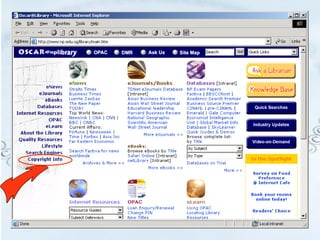
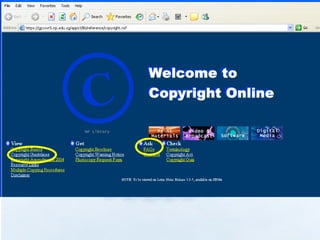
Scope © Duration Using Images of People, Places, Buildings, Things Images produced by Government Bodies Public Domain images Infringement Rights Management Information Circumvention of Technological Measures Copyright Online Database
What is Copyright Form of protection given by S’pore laws to authors of original works such as literary, dramatic, musical, artistic and certain other intellectual works Confers on author the right to make and sell his own works Infringement is illegal
Copyright Copyright Act 1987 Amended 1999 to incorporate  © in the digital environment Amended 2004 to keep pace with new Internet technologies
Nature of Copyright Protection is almost worldwide Berne Convention –© treaty adhered to almost internationally Berne Convention for the Protection of Literary and Artistic Works – 21 Sep 1998  Works first published in S’pore, or by S’pore citizens/residents entitled to © protection in > 100 countries party to Convention. Citizens  from member countries reciprocally enjoy copyright protection in Singapore for their works. © symbol unnecessary   Practical significance – alerts user of a copyright claim
What does Copyright Protect ? Literary works  – books, articles … Compilations  – directories, databases Computer programs   Dramatic works  –  choreography, screenplays,  plays and mime
Artistic works   include “graphic works”  paintings, drawings, diagrams, maps, charts, plans,  engravings, etchings, lithographs, woodcuts or similar works Photographs (includes slides, negatives, microfilm, exclude stills from movies), cartoons, collages, craft work, sculpture, buildings and model of buildings, maps and plans Films  – separate protection for : visual images  sounds  Other components, such as script and music What does Copyright Protect ?
What does Copyright Protect ? Sound recordings  – CDs, cassettes the music the story  the particular recording itself
What is not protected ? Information, ideas, styles or techniques Free to research material and take info, facts or ideas for a topic Copying another person’s words – no acknowledgement – plagiarism  – non-ethical -- copyright infringement
Who owns copyright ? General rule  – creator owns copyright – students own copyright in material they create Exceptions: Material created by employees as part of their job – copyright owned by employer Some commissioned material Material created for government
Legal rights of copyright owners Exclusive rights to do certain things with their material.  Anyone who wants to use copyright material in any of these ways needs permission.
Legal rights of copyright owners This includes: To “reproduce” the work (such as making photocopies, digitising it, or printing a file) To “communicate” the work to the public, eg. putting onto a website, broadcasting or faxing it or emailing digital files containing the work Perform the work in public Publish the work Modify, create derivations such as make a translation, dramatised version or a picture version of a work, eg. a cartoon, or arrange a piece of music
Fair Dealing & Reasonable Portion Fair dealing for research or study  reasonable portion  : For a work of more than 10 pages : 10% of the number of pages in that edition 1 chapter  Electronic works 10% of the total number of bytes in that edition, or Contains only the whole or part of a single chapter of the work  Copying more than entitlement – obtain permission from © owner
Fair Dealing Allows reasonable extent of copying without infringing copyright for following purpose : Research or study  reasonable portion Criticism, review, comment, opinion Of works.  Reporting news In newspaper, magazine or periodical Via broadcasting/cable programme service/film celebrities / ordinary people, living / dead are allowed Sufficient acknowledgment of item Obtain permission if you need to copy whole work
Fair Dealing The courts will consider the following : the  purpose  and  character  of the use, including whether it is for  commercial  or  non-profit educational purposes ; the  nature  of the work; the  amount  and  substantiality  of the part copied taken in relation to the whole work or adaptation;  the  effect   of the use upon the  potential market  of the copyrighted work.
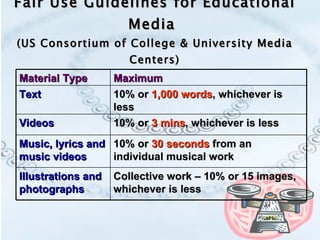
Fair Use Guidelines for Educational Media  (US Consortium of College & University Media Centers) 10% or  1,000 words , whichever is less Text Collective work – 10% or 15 images, whichever is less Illustrations and photographs 10% or  30 seconds  from an individual musical work Music, lyrics and music videos 10% or  3 mins , whichever is less Videos Maximum Material Type
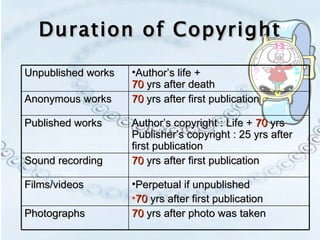
Duration of Copyright 70  yrs after photo was taken Photographs Perpetual if unpublished 70  yrs after first publication Films/videos 70  yrs after first publication Sound recording Author’s copyright : Life +  70  yrs Publisher’s copyright : 25 yrs after first publication Published works 70  yrs after first publication Anonymous works Author’s life +  70  yrs after death Unpublished works
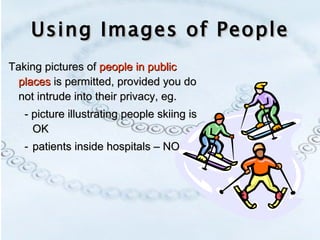
Using Images of People Taking pictures of  people in public places  is permitted, provided you do not intrude into their privacy, eg. - picture illustrating people skiing is OK patients inside hospitals – NO
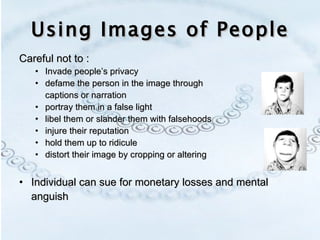
Using Images of People Careful not to : Invade people’s privacy defame the person in the image through  captions or narration portray them in a false light  libel them or slander them with falsehoods  injure their reputation  hold them up to ridicule  distort their image by cropping or altering  Individual can sue for monetary losses and mental anguish
Using Images of People Presidents / politicians – normally permissible if there is no suggestion of endorsement of a commercial product, service or enterprise. However, best to seek permission
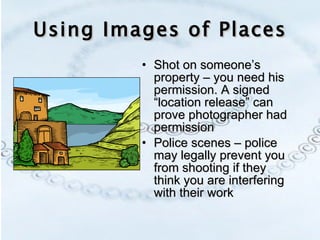
Using Images of Places Shot on someone’s property – you need his permission. A signed “location release” can prove photographer had permission Police scenes – police may legally prevent you from shooting if they think you are interfering with their work
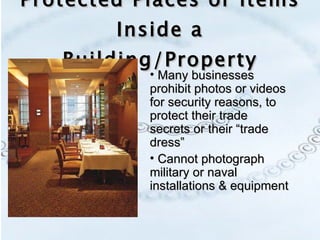
Protected Places or Items Inside a Building/Property Many businesses prohibit photos or videos for security reasons, to protect their trade secrets or their “trade dress” Cannot photograph military or naval installations & equipment
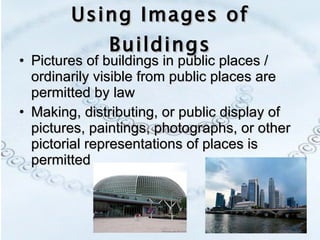
Using Images of Buildings Pictures of buildings in public places / ordinarily visible from public places are permitted by law Making, distributing, or public display of pictures, paintings, photographs, or other pictorial representations of places is permitted
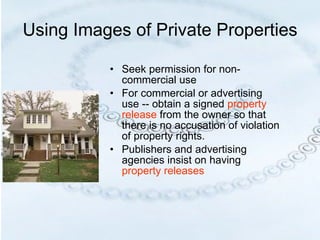
Using Images of Private Properties Seek permission for non-commercial use For commercial or advertising use -- obtain a signed  property release  from the owner so that there is no accusation of violation of property rights.  Publishers and advertising agencies insist on having  property releases
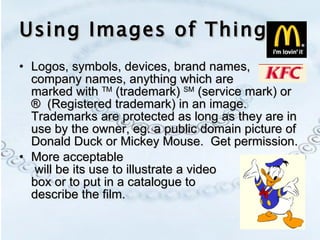
Using Images of Things Logos, symbols, devices, brand names, company names, anything which are  marked with  TM  (trademark)  SM  (service mark) or ®  (Registered trademark) in an image.  Trademarks are protected as long as they are in use by the owner, eg. a public domain picture of Donald Duck or Mickey Mouse.  Get permission. More acceptable  will be its use to illustrate a video  box or to put in a catalogue to  describe the film.
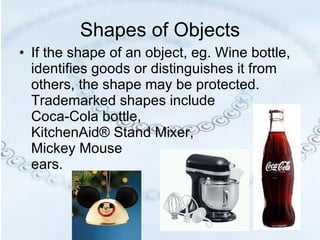
Shapes of Objects If the shape of an object, eg. Wine bottle, identifies goods or distinguishes it from others, the shape may be protected.  Trademarked shapes include  Coca-Cola bottle,  KitchenAid® Stand Mixer,  Mickey Mouse  ears.
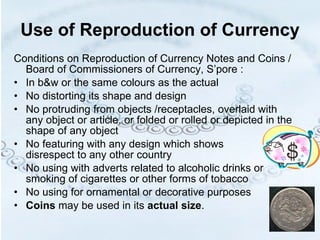
Use of Reproduction of Currency Conditions on Reproduction of Currency Notes and Coins / Board of Commissioners of Currency, S’pore :  In b&w or the same colours as the actual No distorting its shape and design No protruding from objects /receptacles, overlaid with any object or article, or folded or rolled or depicted in the shape of any object No featuring with any design which shows  disrespect to any other country No using with adverts related to alcoholic drinks or smoking of cigarettes or other forms of tobacco No using for ornamental or decorative purposes Coins  may be used in its  actual   size .
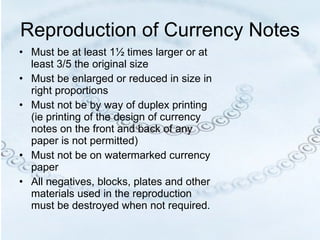
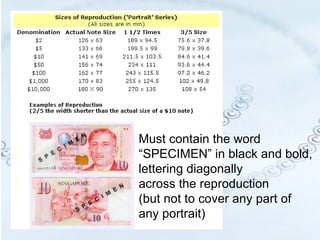
Reproduction of Currency Notes Must be at least 1½ times larger or at least 3/5 the original size Must be enlarged or reduced in size in right proportions Must not be by way of duplex printing (ie printing of the design of currency notes on the front and back of any paper is not permitted) Must not be on watermarked currency paper All negatives, blocks, plates and other materials used in the reproduction must be destroyed when not required.
Must contain the word  “SPECIMEN” in black and bold,  lettering diagonally  across the reproduction  (but not to cover any part of  any portrait)
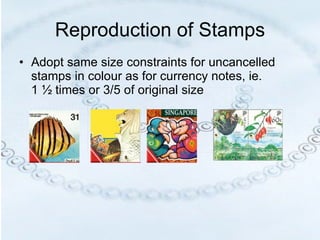
Reproduction of Stamps Adopt same size constraints for uncancelled stamps in colour as for currency notes, ie.  1 ½ times or 3/5 of original size                                                      
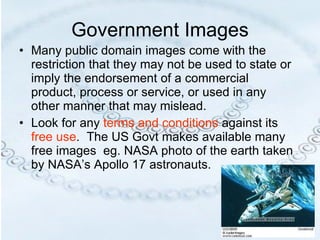
Government Images Many public domain images come with the restriction that they may not be used to state or imply the endorsement of a commercial product, process or service, or used in any other manner that may mislead. Look for any  terms and conditions  against its  free use .  The US Govt makes available many free images  eg. NASA photo of the earth taken by NASA’s Apollo 17 astronauts.
How to Tell if Images are in  Public Domain Published or © 1936 or earlier.  By law, copyright on these images would have expired
Public Domain Images If you take a public domain photo from a published book or on a Web page (ie. reproduction), you must : get permission from the publisher as he owns rights to the  reproduction . Otherwise, go to the original source and make a copy from there
Public Domain Images Anyone who makes copies of public domain images may claim  copyright to the reproduction  of them.  You may not use  reproduction without permission.  Users of another’s property may be sued for misappropriation. So, getting an original is crucial.
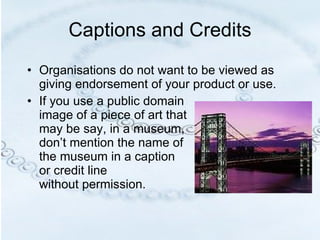
Captions and Credits Organisations do not want to be viewed as giving endorsement of your product or use.  If you use a public domain  image of a piece of art that  may be say, in a museum,  don’t mention the name of  the museum in a caption  or credit line  without permission.
People, Place, Things, Events People, place, things and events all have rights to consider when using an image. Know as much as you can about the who, what, when, where and why of the images you use or make Get releases and document facts as you go along Be sure to see everything in the images, even the fleeting or what is in the backgrounds, and think in terms of “underlying rights”.
Commercial/Advertising Use Seek permission at all times.  Cannot use : Celebrities Politicians The Singapore flag Someone’s property Someone’s things – property rights violation Prior written consent  (Model Release)  needed to use a living person’s name, portrait or picture. Avoid giving impression of implied endorsement T-shirts, posters or other merchandise -- commercial use Commercial magazine cover -- requires a model release just like an advertisement.  If you cannot get model release, modify image to make the people unrecognizable
Using Images, Sounds and Movie Clips  from Internet Illegal to use a © image without permission from © holder. Check © status of an image before using it Check © policy of original source of any sound file Graphics – look for royalty-free / free-to-use / non-commercial use / educational use of graphics Photos with people – copyrighted.  Look for  instructions, eg. must cite URL when  using their photographs.
Seeking Permission Consideration based on : territory of use Term of use (1 year / perpetual, etc) Exclusivity (you are the one and only user, or you share use with other users) How large it will be reproduced How many people will see it  Nature of your use (in a TV broadcast, a brochure, etc) Nature of your organisation (educational institution, not-for-profit organisation, etc)
Seeking Permission Copyright owners can charge a “permission fee”, eg. Singapore Press Holdings (SPH) charges reproduction fee of  $750 per image for 3 months  for posting on individual or corporate websites Copyright owners can dictate restrictions, eg. Works not to be used for “advertising or trade purposes”
Using Music Music is a problem in public domain films and videos, as it is an underlying work – there may not be copyright on the film itself but the soundtrack has an underlying rights problem, eg.  It’s a Wonderful Life; Over the Rainbow.  Clear copyright according to nature of use.
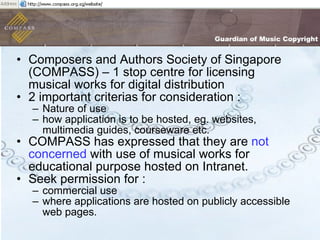
Composers and Authors Society of Singapore (COMPASS) – 1 stop centre for licensing musical works for digital distribution  2 important criterias for consideration : Nature of use  how application is to be hosted, eg. websites, multimedia guides, courseware etc.  COMPASS has expressed that they are  not concerned  with use of musical works for educational purpose hosted on Intranet.  Seek permission for : commercial use  where applications are hosted on publicly accessible web pages.
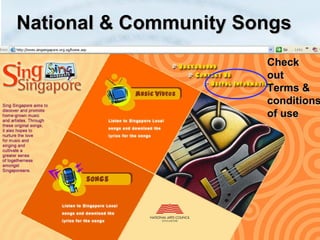
National & Community Songs Check  out Terms &  conditions of use
Bloggers &  Use of Music  Bloggers /personal website owners –  may soon have to license the background music used on their online journals / websites. Websites where song cannot be downloaded or with no advertising :  pay $1,000 a year for up to 10 songs; $5,000 for playing 11 to 49 songs; $10,000 for over 50 songs
Uploading songs on Net chat channel for people to download – distributing illegal digital music files on Internet Case involving 2 youths – trial in early Feb Sued by Recording Industry Association of S’pore (Rias) – represents music companies like Sony and Warner Music here.
Using Stock Footage Public domain films may contain stock footage, news footage and other elements licensed only to the producer for specific use in the film. Study the film credits to confirm if the segment you are interested has any third party proprietary rights
Using all / significant part of a copyright material requires permission, unless : © has expired Special exception applies, usually to educational institutions Where there is fair use Infringement
Actions for Infringement Types of relief court may grant includes: An injunction – court order Damages – compensation money An account of profit Where plaintiff elects for an award of statutory damages  $10,000 max for each work infringed $200,000 max in total, unless plaintiff proves his actual loss exceeds the amount Copyright owners may follow up on    infringements within 6 years
Consideration for  Statutory Damages Nature and purpose of infringing act, including whether commercial nature Flagrancy of infringement Whether defendant acted in bad faith Any loss suffered/will be suffered to plaintiff Any benefit to have accrued to defendant Conduct of parties before and during proceedings Need to deter other similar acts All other relevant matters
Presumption of Copyright  and Ownership In an issue before the court, presumption of copyright subsistence or ownership in the plaintiff applies. Defendant cannot satisfy court of his action, he is guilty
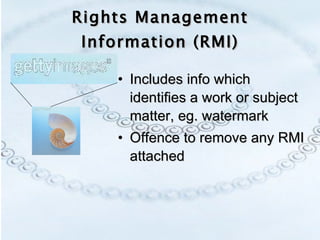
Rights Management Information (RMI) Includes info which identifies a work or subject matter, eg. watermark Offence to remove any RMI attached
Circumvention of Technological Measures Technological access control measure Technological protection measure  any technology, device or component that controls access, or prevents or limits doing of any act  Cracking of passwords Unscrambling encrypted info  (except: research on encryption technology) Removal of digital watermarks
Penalty fine : $20,000 or 2 yrs imprisonment Minister may exempt educational institutions from penalty Circumvention of Technological Measures
Infringements & Unauthorised Use Any infringements/unauthorised use before the amended Act will be dealt with according to the Act which was in force prior to 29 Nov 2004
Criminal Offence Wilful infringement of copyright Extent is significant There is commercial advantage in the process (substantial prejudicial impact) Criminal offence   fine $20,000 max and/or imprisonment 6 months max 2 nd  or subsequent offence, fine $50,000 and/or imprisonment 3 yrs
FAQs May I put unaltered images on Intranet? Yes, for educational use.  May I put unaltered images on my website? No, for advertising / commercial use on Internet  Yes, no advertisements, no sponsors, no charge, does not offer any products for sale
FAQs May I print images from this website for an assignment? Yes, for personal or academic work, not for publication How do I obtain permission for other forms of publication? Obtain prior written approval from relevant authority.  Usually case-by-case.  Usage fee may be involved
 
 
Scope Copyright basics What is copyright ? What does it protect and not protect? Who owns © ? Legal rights of © owners Fair dealing
Scope © Duration Using Images of People, Places, Buildings, Things Images produced by Government Bodies Public Domain images Infringement Rights Management Information Circumvention of Technological Measures Copyright Online Database
Images, music, video footage -  copyright issues The End Reference : Tambert, Scott.  How to Use Images Legally . Washington, D.C. Alexander Media LLC, 2002.  Source of Images : Microsoft.com;  www.pdimages.com/web9.htm © 2006 NP Library. Revised : 15 Jan 2006

Copyright multimedia resources

  • 1.
    Images, music, videofootage - copyright issues Presentation by Mrs Caroline Loh for IS Tech Module “Flash Applications” (Mr Lek Ngee Seng/ECE Div) 23 Jan 2006 Ngee Ann Polytechnic Library © 2006
  • 2.
    Scope Copyright basicsWhat is copyright ? What does it protect and not protect? Who owns © ? Legal rights of © owners Fair dealing
  • 3.
    Scope © DurationUsing Images of People, Places, Buildings, Things Images produced by Government Bodies Public Domain images Infringement Rights Management Information Circumvention of Technological Measures Copyright Online Database
  • 4.
    What is CopyrightForm of protection given by S’pore laws to authors of original works such as literary, dramatic, musical, artistic and certain other intellectual works Confers on author the right to make and sell his own works Infringement is illegal
  • 5.
    Copyright Copyright Act1987 Amended 1999 to incorporate © in the digital environment Amended 2004 to keep pace with new Internet technologies
  • 6.
    Nature of CopyrightProtection is almost worldwide Berne Convention –© treaty adhered to almost internationally Berne Convention for the Protection of Literary and Artistic Works – 21 Sep 1998 Works first published in S’pore, or by S’pore citizens/residents entitled to © protection in > 100 countries party to Convention. Citizens from member countries reciprocally enjoy copyright protection in Singapore for their works. © symbol unnecessary Practical significance – alerts user of a copyright claim
  • 7.
    What does CopyrightProtect ? Literary works – books, articles … Compilations – directories, databases Computer programs Dramatic works – choreography, screenplays, plays and mime
  • 8.
    Artistic works include “graphic works” paintings, drawings, diagrams, maps, charts, plans, engravings, etchings, lithographs, woodcuts or similar works Photographs (includes slides, negatives, microfilm, exclude stills from movies), cartoons, collages, craft work, sculpture, buildings and model of buildings, maps and plans Films – separate protection for : visual images sounds Other components, such as script and music What does Copyright Protect ?
  • 9.
    What does CopyrightProtect ? Sound recordings – CDs, cassettes the music the story the particular recording itself
  • 10.
    What is notprotected ? Information, ideas, styles or techniques Free to research material and take info, facts or ideas for a topic Copying another person’s words – no acknowledgement – plagiarism – non-ethical -- copyright infringement
  • 11.
    Who owns copyright? General rule – creator owns copyright – students own copyright in material they create Exceptions: Material created by employees as part of their job – copyright owned by employer Some commissioned material Material created for government
  • 12.
    Legal rights ofcopyright owners Exclusive rights to do certain things with their material. Anyone who wants to use copyright material in any of these ways needs permission.
  • 13.
    Legal rights ofcopyright owners This includes: To “reproduce” the work (such as making photocopies, digitising it, or printing a file) To “communicate” the work to the public, eg. putting onto a website, broadcasting or faxing it or emailing digital files containing the work Perform the work in public Publish the work Modify, create derivations such as make a translation, dramatised version or a picture version of a work, eg. a cartoon, or arrange a piece of music
  • 14.
    Fair Dealing &Reasonable Portion Fair dealing for research or study reasonable portion : For a work of more than 10 pages : 10% of the number of pages in that edition 1 chapter Electronic works 10% of the total number of bytes in that edition, or Contains only the whole or part of a single chapter of the work Copying more than entitlement – obtain permission from © owner
  • 15.
    Fair Dealing Allowsreasonable extent of copying without infringing copyright for following purpose : Research or study reasonable portion Criticism, review, comment, opinion Of works. Reporting news In newspaper, magazine or periodical Via broadcasting/cable programme service/film celebrities / ordinary people, living / dead are allowed Sufficient acknowledgment of item Obtain permission if you need to copy whole work
  • 16.
    Fair Dealing Thecourts will consider the following : the purpose and character of the use, including whether it is for commercial or non-profit educational purposes ; the nature of the work; the amount and substantiality of the part copied taken in relation to the whole work or adaptation; the effect of the use upon the potential market of the copyrighted work.
  • 17.
    Fair Use Guidelinesfor Educational Media (US Consortium of College & University Media Centers) 10% or 1,000 words , whichever is less Text Collective work – 10% or 15 images, whichever is less Illustrations and photographs 10% or 30 seconds from an individual musical work Music, lyrics and music videos 10% or 3 mins , whichever is less Videos Maximum Material Type
  • 18.
    Duration of Copyright70 yrs after photo was taken Photographs Perpetual if unpublished 70 yrs after first publication Films/videos 70 yrs after first publication Sound recording Author’s copyright : Life + 70 yrs Publisher’s copyright : 25 yrs after first publication Published works 70 yrs after first publication Anonymous works Author’s life + 70 yrs after death Unpublished works
  • 19.
    Using Images ofPeople Taking pictures of people in public places is permitted, provided you do not intrude into their privacy, eg. - picture illustrating people skiing is OK patients inside hospitals – NO
  • 20.
    Using Images ofPeople Careful not to : Invade people’s privacy defame the person in the image through captions or narration portray them in a false light libel them or slander them with falsehoods injure their reputation hold them up to ridicule distort their image by cropping or altering Individual can sue for monetary losses and mental anguish
  • 21.
    Using Images ofPeople Presidents / politicians – normally permissible if there is no suggestion of endorsement of a commercial product, service or enterprise. However, best to seek permission
  • 22.
    Using Images ofPlaces Shot on someone’s property – you need his permission. A signed “location release” can prove photographer had permission Police scenes – police may legally prevent you from shooting if they think you are interfering with their work
  • 23.
    Protected Places orItems Inside a Building/Property Many businesses prohibit photos or videos for security reasons, to protect their trade secrets or their “trade dress” Cannot photograph military or naval installations & equipment
  • 24.
    Using Images ofBuildings Pictures of buildings in public places / ordinarily visible from public places are permitted by law Making, distributing, or public display of pictures, paintings, photographs, or other pictorial representations of places is permitted
  • 25.
    Using Images ofPrivate Properties Seek permission for non-commercial use For commercial or advertising use -- obtain a signed property release from the owner so that there is no accusation of violation of property rights. Publishers and advertising agencies insist on having property releases
  • 26.
    Using Images ofThings Logos, symbols, devices, brand names, company names, anything which are marked with TM (trademark) SM (service mark) or ® (Registered trademark) in an image. Trademarks are protected as long as they are in use by the owner, eg. a public domain picture of Donald Duck or Mickey Mouse. Get permission. More acceptable will be its use to illustrate a video box or to put in a catalogue to describe the film.
  • 27.
    Shapes of ObjectsIf the shape of an object, eg. Wine bottle, identifies goods or distinguishes it from others, the shape may be protected. Trademarked shapes include Coca-Cola bottle, KitchenAid® Stand Mixer, Mickey Mouse ears.
  • 28.
    Use of Reproductionof Currency Conditions on Reproduction of Currency Notes and Coins / Board of Commissioners of Currency, S’pore : In b&w or the same colours as the actual No distorting its shape and design No protruding from objects /receptacles, overlaid with any object or article, or folded or rolled or depicted in the shape of any object No featuring with any design which shows disrespect to any other country No using with adverts related to alcoholic drinks or smoking of cigarettes or other forms of tobacco No using for ornamental or decorative purposes Coins may be used in its actual size .
  • 29.
    Reproduction of CurrencyNotes Must be at least 1½ times larger or at least 3/5 the original size Must be enlarged or reduced in size in right proportions Must not be by way of duplex printing (ie printing of the design of currency notes on the front and back of any paper is not permitted) Must not be on watermarked currency paper All negatives, blocks, plates and other materials used in the reproduction must be destroyed when not required.
  • 30.
    Must contain theword “SPECIMEN” in black and bold, lettering diagonally across the reproduction (but not to cover any part of any portrait)
  • 31.
    Reproduction of StampsAdopt same size constraints for uncancelled stamps in colour as for currency notes, ie. 1 ½ times or 3/5 of original size                                                      
  • 32.
    Government Images Manypublic domain images come with the restriction that they may not be used to state or imply the endorsement of a commercial product, process or service, or used in any other manner that may mislead. Look for any terms and conditions against its free use . The US Govt makes available many free images eg. NASA photo of the earth taken by NASA’s Apollo 17 astronauts.
  • 33.
    How to Tellif Images are in Public Domain Published or © 1936 or earlier. By law, copyright on these images would have expired
  • 34.
    Public Domain ImagesIf you take a public domain photo from a published book or on a Web page (ie. reproduction), you must : get permission from the publisher as he owns rights to the reproduction . Otherwise, go to the original source and make a copy from there
  • 35.
    Public Domain ImagesAnyone who makes copies of public domain images may claim copyright to the reproduction of them. You may not use reproduction without permission. Users of another’s property may be sued for misappropriation. So, getting an original is crucial.
  • 36.
    Captions and CreditsOrganisations do not want to be viewed as giving endorsement of your product or use. If you use a public domain image of a piece of art that may be say, in a museum, don’t mention the name of the museum in a caption or credit line without permission.
  • 37.
    People, Place, Things,Events People, place, things and events all have rights to consider when using an image. Know as much as you can about the who, what, when, where and why of the images you use or make Get releases and document facts as you go along Be sure to see everything in the images, even the fleeting or what is in the backgrounds, and think in terms of “underlying rights”.
  • 38.
    Commercial/Advertising Use Seekpermission at all times. Cannot use : Celebrities Politicians The Singapore flag Someone’s property Someone’s things – property rights violation Prior written consent (Model Release) needed to use a living person’s name, portrait or picture. Avoid giving impression of implied endorsement T-shirts, posters or other merchandise -- commercial use Commercial magazine cover -- requires a model release just like an advertisement. If you cannot get model release, modify image to make the people unrecognizable
  • 39.
    Using Images, Soundsand Movie Clips from Internet Illegal to use a © image without permission from © holder. Check © status of an image before using it Check © policy of original source of any sound file Graphics – look for royalty-free / free-to-use / non-commercial use / educational use of graphics Photos with people – copyrighted. Look for instructions, eg. must cite URL when using their photographs.
  • 40.
    Seeking Permission Considerationbased on : territory of use Term of use (1 year / perpetual, etc) Exclusivity (you are the one and only user, or you share use with other users) How large it will be reproduced How many people will see it Nature of your use (in a TV broadcast, a brochure, etc) Nature of your organisation (educational institution, not-for-profit organisation, etc)
  • 41.
    Seeking Permission Copyrightowners can charge a “permission fee”, eg. Singapore Press Holdings (SPH) charges reproduction fee of $750 per image for 3 months for posting on individual or corporate websites Copyright owners can dictate restrictions, eg. Works not to be used for “advertising or trade purposes”
  • 42.
    Using Music Musicis a problem in public domain films and videos, as it is an underlying work – there may not be copyright on the film itself but the soundtrack has an underlying rights problem, eg. It’s a Wonderful Life; Over the Rainbow. Clear copyright according to nature of use.
  • 43.
    Composers and AuthorsSociety of Singapore (COMPASS) – 1 stop centre for licensing musical works for digital distribution 2 important criterias for consideration : Nature of use how application is to be hosted, eg. websites, multimedia guides, courseware etc. COMPASS has expressed that they are not concerned with use of musical works for educational purpose hosted on Intranet. Seek permission for : commercial use where applications are hosted on publicly accessible web pages.
  • 44.
    National & CommunitySongs Check out Terms & conditions of use
  • 45.
    Bloggers & Use of Music Bloggers /personal website owners – may soon have to license the background music used on their online journals / websites. Websites where song cannot be downloaded or with no advertising : pay $1,000 a year for up to 10 songs; $5,000 for playing 11 to 49 songs; $10,000 for over 50 songs
  • 46.
    Uploading songs onNet chat channel for people to download – distributing illegal digital music files on Internet Case involving 2 youths – trial in early Feb Sued by Recording Industry Association of S’pore (Rias) – represents music companies like Sony and Warner Music here.
  • 47.
    Using Stock FootagePublic domain films may contain stock footage, news footage and other elements licensed only to the producer for specific use in the film. Study the film credits to confirm if the segment you are interested has any third party proprietary rights
  • 48.
    Using all /significant part of a copyright material requires permission, unless : © has expired Special exception applies, usually to educational institutions Where there is fair use Infringement
  • 49.
    Actions for InfringementTypes of relief court may grant includes: An injunction – court order Damages – compensation money An account of profit Where plaintiff elects for an award of statutory damages $10,000 max for each work infringed $200,000 max in total, unless plaintiff proves his actual loss exceeds the amount Copyright owners may follow up on infringements within 6 years
  • 50.
    Consideration for Statutory Damages Nature and purpose of infringing act, including whether commercial nature Flagrancy of infringement Whether defendant acted in bad faith Any loss suffered/will be suffered to plaintiff Any benefit to have accrued to defendant Conduct of parties before and during proceedings Need to deter other similar acts All other relevant matters
  • 51.
    Presumption of Copyright and Ownership In an issue before the court, presumption of copyright subsistence or ownership in the plaintiff applies. Defendant cannot satisfy court of his action, he is guilty
  • 52.
    Rights Management Information(RMI) Includes info which identifies a work or subject matter, eg. watermark Offence to remove any RMI attached
  • 53.
    Circumvention of TechnologicalMeasures Technological access control measure Technological protection measure any technology, device or component that controls access, or prevents or limits doing of any act Cracking of passwords Unscrambling encrypted info (except: research on encryption technology) Removal of digital watermarks
  • 54.
    Penalty fine :$20,000 or 2 yrs imprisonment Minister may exempt educational institutions from penalty Circumvention of Technological Measures
  • 55.
    Infringements & UnauthorisedUse Any infringements/unauthorised use before the amended Act will be dealt with according to the Act which was in force prior to 29 Nov 2004
  • 56.
    Criminal Offence Wilfulinfringement of copyright Extent is significant There is commercial advantage in the process (substantial prejudicial impact) Criminal offence fine $20,000 max and/or imprisonment 6 months max 2 nd or subsequent offence, fine $50,000 and/or imprisonment 3 yrs
  • 57.
    FAQs May Iput unaltered images on Intranet? Yes, for educational use. May I put unaltered images on my website? No, for advertising / commercial use on Internet Yes, no advertisements, no sponsors, no charge, does not offer any products for sale
  • 58.
    FAQs May Iprint images from this website for an assignment? Yes, for personal or academic work, not for publication How do I obtain permission for other forms of publication? Obtain prior written approval from relevant authority. Usually case-by-case. Usage fee may be involved
  • 59.
  • 60.
  • 61.
    Scope Copyright basicsWhat is copyright ? What does it protect and not protect? Who owns © ? Legal rights of © owners Fair dealing
  • 62.
    Scope © DurationUsing Images of People, Places, Buildings, Things Images produced by Government Bodies Public Domain images Infringement Rights Management Information Circumvention of Technological Measures Copyright Online Database
  • 63.
    Images, music, videofootage - copyright issues The End Reference : Tambert, Scott. How to Use Images Legally . Washington, D.C. Alexander Media LLC, 2002. Source of Images : Microsoft.com; www.pdimages.com/web9.htm © 2006 NP Library. Revised : 15 Jan 2006