Darcy’s Law
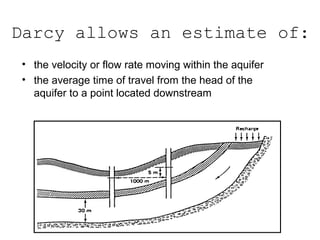
Darcy allows an estimate of:
• the velocity or flow rate moving within the aquifer
• the average time of travel from the head of the
aquifer to a point located downstream
Darcy’s Law
• Darcy’s law provides an
accurate description of the flow
of ground water in almost all
hydrogeologic environments.
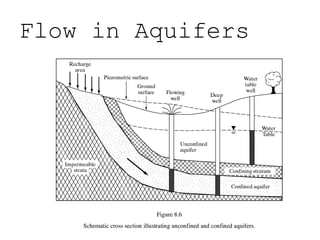
Flow in Aquifers
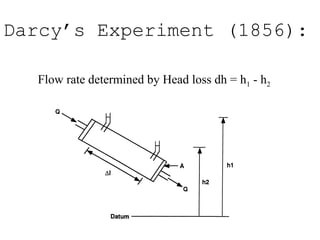
Darcy’s Experiment (1856):
Flow rate determined by Head loss dh = h1 - h2
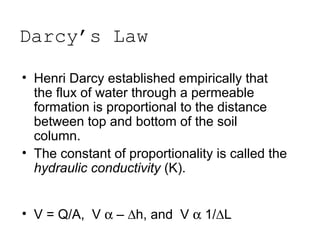
Darcy’s Law
• Henri Darcy established empirically that
the flux of water through a permeable
formation is proportional to the distance
between top and bottom of the soil
column.
• The constant of proportionality is called the
hydraulic conductivity (K).
• V = Q/A, V α – ∆h, and V α 1/∆L
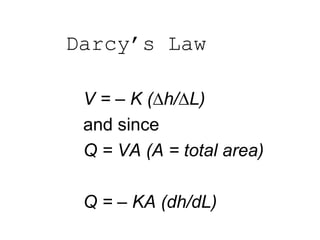
Darcy’s Law
V = – K (∆h/∆L)
and since
Q = VA (A = total area)
Q = – KA (dh/dL)
Hydraulic Conductivity
• K represents a measure of the ability for
flow through porous media:
• Gravels - 0.1 to 1 cm/sec
• Sands - 10-2
to 10-3
cm/sec
• Silts - 10-4
to 10-5
cm/sec
• Clays - 10-7
to 10-9
cm/sec
Conditions
• Darcy’s Law holds for:
1. Saturated flow and unsaturated flow
2. Steady-state and transient flow
3. Flow in aquifers and aquitards
4. Flow in homogeneous and heterogeneous
systems
5. Flow in isotropic or anisotropic media
6. Flow in rocks and granular media
Darcy Velocity
• V is the specific discharge (Darcy velocity).
• (–) indicates that V occurs in the direction of the decreasing
head.
• Specific discharge has units of velocity.
• The specific discharge is a macroscopic concept, and is easily
measured. It should be noted that Darcy’s velocity is different
from the microscopic velocities associated with the actual
paths of individual particles of water as they wind their way
through the grains of sand.
• The microscopic velocities are real, but are probably
impossible to measure.
Darcy & Seepage Velocity
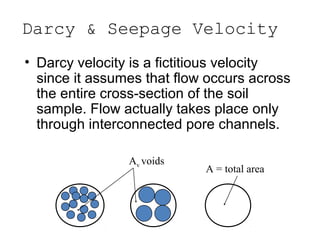
• Darcy velocity is a fictitious velocity
since it assumes that flow occurs across
the entire cross-section of the soil
sample. Flow actually takes place only
through interconnected pore channels.
A = total area
Av voids
Darcy & Seepage Velocity
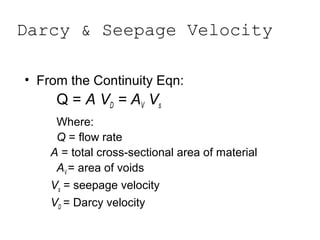
• From the Continuity Eqn:
Q = A VD = AV Vs
Where:
Q = flow rate
A = total cross-sectional area of material
AV = area of voids
Vs = seepage velocity
VD = Darcy velocity
Darcy & Seepage Velocity
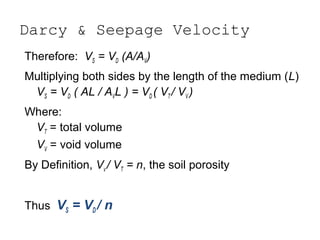
Therefore: VS = VD (A/AV)
Multiplying both sides by the length of the medium (L)
VS = VD ( AL / AVL ) = VD ( VT / VV )
Where:
VT = total volume
VV = void volume
By Definition, Vv / VT = n, the soil porosity
Thus VS = VD / n
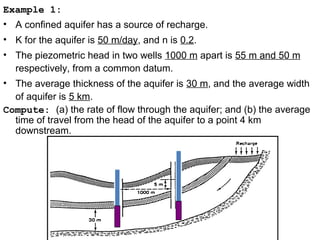
Example 1:
• A confined aquifer has a source of recharge.
• K for the aquifer is 50 m/day, and n is 0.2.
• The piezometric head in two wells 1000 m apart is 55 m and 50 m
respectively, from a common datum.
• The average thickness of the aquifer is 30 m, and the average width
of aquifer is 5 km.
Compute: (a) the rate of flow through the aquifer; and (b) the average
time of travel from the head of the aquifer to a point 4 km
downstream.
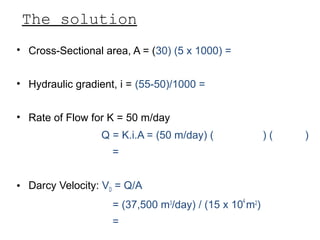
The solution
• Cross-Sectional area, A = (30) (5 x 1000) = 15 x 104
m2
• Hydraulic gradient, i = (55-50)/1000 = 5 x 10⁻³
• Rate of Flow for K = 50 m/day
Q = K.i.A = (50 m/day) (15 x 104
m2
) (5 x 10⁻³
)
= 37,500 m3
/day
• Darcy Velocity: VD = Q/A
= (37,500 m3
/day) / (15 x 104
m2
)
= 0.25 m/day
• Seepage Velocity:
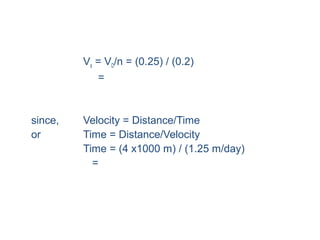
Vs = VD/n = (0.25) / (0.2)
= 1.25 m/day (about 4.1 ft/day)
• Time to travel 4 km downstream:
since, Velocity = Distance/Time
or Time = Distance/Velocity
Time = (4 x1000 m) / (1.25 m/day)
= 3200 days or 8.77 years
• This example shows that water moves very slowly
underground.
Limitations of the
Darcian Approach
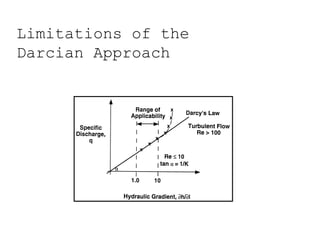
1. For Reynold’s Number, Re > 10 or where the flow is
turbulent, as in the immediate vicinity of pumped wells.
2. Where water flows through extremely fine-grained
materials (colloidal clay)
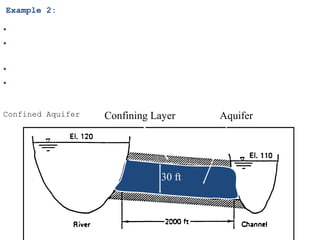
Confined Aquifer Confining Layer Aquifer
30 ft
Example 2:
• A channel runs almost parallel to a river, and they are 2000 ft apart.
• The water level in the river is at an elevation of 120 ft and 110 ft in the
channel.
• A pervious formation averaging 30 ft thick and with K of 0.25 ft/hr joins them.
• Determine the rate of seepage or flow from the river to the channel.
• Consider a 1-ft length of river (and channel).
Q = KA [(h1 – h2) / L]
• Where:
A = (30 x 1) = 30 ft2
K
= (0.25 ft/hr) (24 hr/day) = 6 ft/day
• Therefore,
Q = [(6) (30) (120 – 110)] / 2000
= 0.9 ft3
/day/ft length = 0.9 ft2
/day
The solution
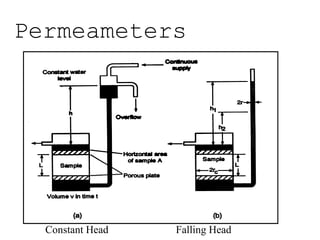
Permeameters
Constant Head Falling Head
Constant head
Permeameter
• Apply Darcy’s Law to find K:
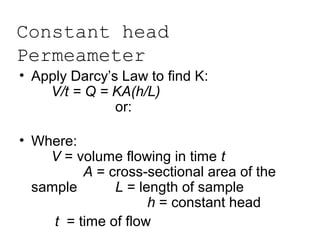
V/t = Q = KA(h/L)
or:
K = (VL) / (Ath)
• Where:
V = volume flowing in time t
A = cross-sectional area of the
sample L = length of sample
h = constant head
t = time of flow

Drainage Engineering (Darcy's law)

  • 1.
  • 2.
    Darcy allows anestimate of: • the velocity or flow rate moving within the aquifer • the average time of travel from the head of the aquifer to a point located downstream
  • 3.
    Darcy’s Law • Darcy’slaw provides an accurate description of the flow of ground water in almost all hydrogeologic environments.
  • 4.
  • 5.
    Darcy’s Experiment (1856): Flowrate determined by Head loss dh = h1 - h2
  • 6.
    Darcy’s Law • HenriDarcy established empirically that the flux of water through a permeable formation is proportional to the distance between top and bottom of the soil column. • The constant of proportionality is called the hydraulic conductivity (K). • V = Q/A, V α – ∆h, and V α 1/∆L
  • 7.
    Darcy’s Law V =– K (∆h/∆L) and since Q = VA (A = total area) Q = – KA (dh/dL)
  • 8.
    Hydraulic Conductivity • Krepresents a measure of the ability for flow through porous media: • Gravels - 0.1 to 1 cm/sec • Sands - 10-2 to 10-3 cm/sec • Silts - 10-4 to 10-5 cm/sec • Clays - 10-7 to 10-9 cm/sec
  • 9.
    Conditions • Darcy’s Lawholds for: 1. Saturated flow and unsaturated flow 2. Steady-state and transient flow 3. Flow in aquifers and aquitards 4. Flow in homogeneous and heterogeneous systems 5. Flow in isotropic or anisotropic media 6. Flow in rocks and granular media
  • 10.
    Darcy Velocity • Vis the specific discharge (Darcy velocity). • (–) indicates that V occurs in the direction of the decreasing head. • Specific discharge has units of velocity. • The specific discharge is a macroscopic concept, and is easily measured. It should be noted that Darcy’s velocity is different from the microscopic velocities associated with the actual paths of individual particles of water as they wind their way through the grains of sand. • The microscopic velocities are real, but are probably impossible to measure.
  • 11.
    Darcy & SeepageVelocity • Darcy velocity is a fictitious velocity since it assumes that flow occurs across the entire cross-section of the soil sample. Flow actually takes place only through interconnected pore channels. A = total area Av voids
  • 12.
    Darcy & SeepageVelocity • From the Continuity Eqn: Q = A VD = AV Vs Where: Q = flow rate A = total cross-sectional area of material AV = area of voids Vs = seepage velocity VD = Darcy velocity
  • 13.
    Darcy & SeepageVelocity Therefore: VS = VD (A/AV) Multiplying both sides by the length of the medium (L) VS = VD ( AL / AVL ) = VD ( VT / VV ) Where: VT = total volume VV = void volume By Definition, Vv / VT = n, the soil porosity Thus VS = VD / n
  • 14.
    Example 1: • Aconfined aquifer has a source of recharge. • K for the aquifer is 50 m/day, and n is 0.2. • The piezometric head in two wells 1000 m apart is 55 m and 50 m respectively, from a common datum. • The average thickness of the aquifer is 30 m, and the average width of aquifer is 5 km. Compute: (a) the rate of flow through the aquifer; and (b) the average time of travel from the head of the aquifer to a point 4 km downstream.
  • 15.
    The solution • Cross-Sectionalarea, A = (30) (5 x 1000) = 15 x 104 m2 • Hydraulic gradient, i = (55-50)/1000 = 5 x 10⁻³ • Rate of Flow for K = 50 m/day Q = K.i.A = (50 m/day) (15 x 104 m2 ) (5 x 10⁻³ ) = 37,500 m3 /day • Darcy Velocity: VD = Q/A = (37,500 m3 /day) / (15 x 104 m2 ) = 0.25 m/day
  • 16.
    • Seepage Velocity: Vs= VD/n = (0.25) / (0.2) = 1.25 m/day (about 4.1 ft/day) • Time to travel 4 km downstream: since, Velocity = Distance/Time or Time = Distance/Velocity Time = (4 x1000 m) / (1.25 m/day) = 3200 days or 8.77 years • This example shows that water moves very slowly underground.
  • 17.
    Limitations of the DarcianApproach 1. For Reynold’s Number, Re > 10 or where the flow is turbulent, as in the immediate vicinity of pumped wells. 2. Where water flows through extremely fine-grained materials (colloidal clay)
  • 18.
    Confined Aquifer ConfiningLayer Aquifer 30 ft Example 2: • A channel runs almost parallel to a river, and they are 2000 ft apart. • The water level in the river is at an elevation of 120 ft and 110 ft in the channel. • A pervious formation averaging 30 ft thick and with K of 0.25 ft/hr joins them. • Determine the rate of seepage or flow from the river to the channel.
  • 19.
    • Consider a1-ft length of river (and channel). Q = KA [(h1 – h2) / L] • Where: A = (30 x 1) = 30 ft2 K = (0.25 ft/hr) (24 hr/day) = 6 ft/day • Therefore, Q = [(6) (30) (120 – 110)] / 2000 = 0.9 ft3 /day/ft length = 0.9 ft2 /day The solution
  • 20.
  • 21.
    Constant head Permeameter • ApplyDarcy’s Law to find K: V/t = Q = KA(h/L) or: K = (VL) / (Ath) • Where: V = volume flowing in time t A = cross-sectional area of the sample L = length of sample h = constant head t = time of flow