DRAINAGE SYSTEM
Drainage systemsare designed to remove excess water from an area efficiently.
PRESENTED BY :
OLEVIA LAISHRAM , ARPIT , GUNJAN
2.
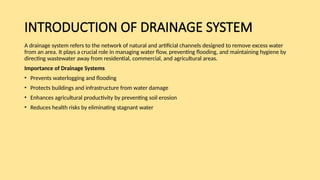
INTRODUCTION OF DRAINAGESYSTEM
A drainage system refers to the network of natural and artificial channels designed to remove excess water
from an area. It plays a crucial role in managing water flow, preventing flooding, and maintaining hygiene by
directing wastewater away from residential, commercial, and agricultural areas.
Importance of Drainage Systems
• Prevents waterlogging and flooding
• Protects buildings and infrastructure from water damage
• Enhances agricultural productivity by preventing soil erosion
• Reduces health risks by eliminating stagnant water
3.
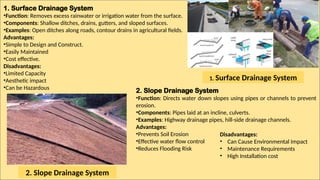
1. Surface DrainageSystem
•Function: Removes excess rainwater or irrigation water from the surface.
•Components: Shallow ditches, drains, gutters, and sloped surfaces.
•Examples: Open ditches along roads, contour drains in agricultural fields.
Advantages:
•Simple to Design and Construct.
•Easily Maintained
•Cost effective.
Disadvantages:
•Limited Capacity
•Aesthetic impact
•Can be Hazardous
1. Surface Drainage System
2. Slope Drainage System
•Function: Directs water down slopes using pipes or channels to prevent
erosion.
•Components: Pipes laid at an incline, culverts.
•Examples: Highway drainage pipes, hill-side drainage channels.
Advantages:
•Prevents Soil Erosion
•Effective water flow control
•Reduces Flooding Risk
2. Slope Drainage System
Disadvantages:
• Can Cause Environmental Impact
• Maintenance Requirements
• High Installation cost
4.
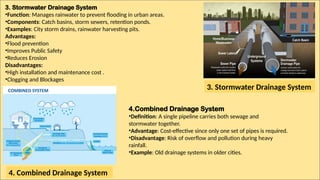
3. Stormwater DrainageSystem
•Function: Manages rainwater to prevent flooding in urban areas.
•Components: Catch basins, storm sewers, retention ponds.
•Examples: City storm drains, rainwater harvesting pits.
Advantages:
•Flood prevention
•Improves Public Safety
•Reduces Erosion
Disadvantages:
•High installation and maintenance cost .
•Clogging and Blockages
3. Stormwater Drainage System
4.Combined Drainage System
•Definition: A single pipeline carries both sewage and
stormwater together.
•Advantage: Cost-effective since only one set of pipes is required.
•Disadvantage: Risk of overflow and pollution during heavy
rainfall.
•Example: Old drainage systems in older cities.
4. Combined Drainage System
5.
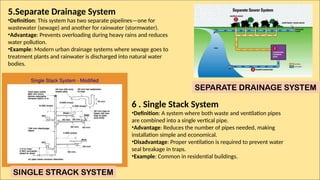
5.Separate Drainage System
•Definition:This system has two separate pipelines—one for
wastewater (sewage) and another for rainwater (stormwater).
•Advantage: Prevents overloading during heavy rains and reduces
water pollution.
•Example: Modern urban drainage systems where sewage goes to
treatment plants and rainwater is discharged into natural water
bodies.
6 . Single Stack System
•Definition: A system where both waste and ventilation pipes
are combined into a single vertical pipe.
•Advantage: Reduces the number of pipes needed, making
installation simple and economical.
•Disadvantage: Proper ventilation is required to prevent water
seal breakage in traps.
•Example: Common in residential buildings.
SEPARATE DRAINAGE SYSTEM
SINGLE STRACK SYSTEM
6.
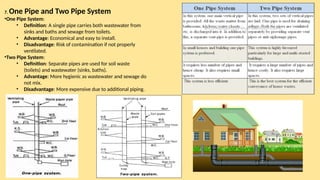
7. One Pipeand Two Pipe System
•One Pipe System:
• Definition: A single pipe carries both wastewater from
sinks and baths and sewage from toilets.
• Advantage: Economical and easy to install.
• Disadvantage: Risk of contamination if not properly
ventilated.
•Two Pipe System:
• Definition: Separate pipes are used for soil waste
(toilets) and wastewater (sinks, baths).
• Advantage: More hygienic as wastewater and sewage do
not mix.
• Disadvantage: More expensive due to additional piping.
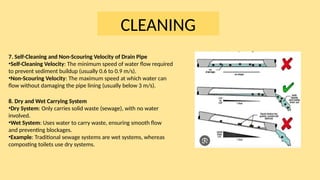
7. Self-Cleaning andNon-Scouring Velocity of Drain Pipe
•Self-Cleaning Velocity: The minimum speed of water flow required
to prevent sediment buildup (usually 0.6 to 0.9 m/s).
•Non-Scouring Velocity: The maximum speed at which water can
flow without damaging the pipe lining (usually below 3 m/s).
8. Dry and Wet Carrying System
•Dry System: Only carries solid waste (sewage), with no water
involved.
•Wet System: Uses water to carry waste, ensuring smooth flow
and preventing blockages.
•Example: Traditional sewage systems are wet systems, whereas
composting toilets use dry systems.
CLEANING
9.
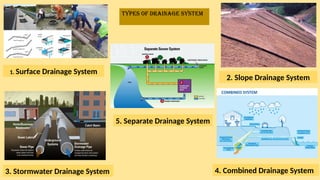
1. Surface DrainageSystem
2. Slope Drainage System
3. Stormwater Drainage System 4. Combined Drainage System
5. Separate Drainage System
TYPES OF DRAINAGE SYSTEM
10.
Types of DrainageMaterials
Permeable Materials – Allow water to pass through easily (e.g., gravel, sand, porous concrete).
Non-Permeable Materials – Prevent water penetration and require a drainage system (e.g.,
asphalt, clay).
Geotextiles and Geomembranes – Synthetic materials used in drainage to filter and direct water
flow.
Drainage Pipes and Channels – PVC, concrete, or metal pipes designed for water management.




![[DSC Europe 25] Danilo Djukanovic - From Vibes to KPIs: Turning Culture Into ...](https://cdn.slidesharecdn.com/ss_thumbnails/inqestws5wf0cik2glgv-3-danilo-djukanovic-from-vibes-to-kpis-presentation-260114111931-dacff81f-thumbnail.jpg?width=640&height=640&fit=bounds)
![[DSC Europe 25] Nikola Vasiljevic - Player segmentation by combat playstyles ...](https://cdn.slidesharecdn.com/ss_thumbnails/mnvbf0yvrwaqsipzrrv3-2-nikola-vasiljevic-player-segmentation-by-playstyles-in-action-shooter-games-260114111931-b4d766cd-thumbnail.jpg?width=640&height=640&fit=bounds)


![[DSC Europe 25] Srba Markovic - From Pilot to Production: Overcoming AI Deplo...](https://cdn.slidesharecdn.com/ss_thumbnails/yjjmrtytmwbalxlba7px-4-srba-markovic-from-pilot-to-production-overcoming-ai-deployment-blockers-with-260114111931-4a892d44-thumbnail.jpg?width=640&height=640&fit=bounds)
![[DSC Europe 25] Mijat Kustudic - Building Financial Intelligence with AI Agen...](https://cdn.slidesharecdn.com/ss_thumbnails/38y2lb5lse6wstegtvas-3-mijat-kustudic-building-financial-intelligence-with-ai-agents-260114111931-1a4783ce-thumbnail.jpg?width=640&height=640&fit=bounds)
