MAIN SOURCES
     OF
   WATER
NATURAL
RESOURCES
    OF
  WATER
PERCENTAGE
 OF WATER
 USED DAILY
WATER DISTRIBUTION SYSTEM
Water distribution system
WATER DISTRIBUTION SYSTEM
INDIRECT WATER SUPPLY
• Water going
  to overhead
  tank and
  then the
  water is
  supplied to
  different
  floors by
  gravity
TYPES OF FITTINGS
HOLLOW PIPES
GALVANISED IRON (G. I . PIPES)
LEAD PIPES
PVC PIPES
JOINTS
JOINTS
GATE VALVE
GLOBE VALVE
RELIEF AND FLOAT VALVE
TAP OR BIB COCK
STOP COCK
VARIOUS FITTINGS –GLOBE VALVE
STOP TAP
VARIOUS VALVES , TUBES AND PIPES


Copper Pipe      Copper Tube    Micro bore      Pegler Ball Valve
Clips 22mm      15mm × 20m     Copper Tube        Red 15mm
                               10mm × 25m


Pegler Double   Pegler Gate    Pegler Washing   PTFE Tape 12m
 Check Valve    Valve 22mm      Machine Tap        Pk of 10
   15mm                         15mm x ¾""
ELECTRICAL MOTORS
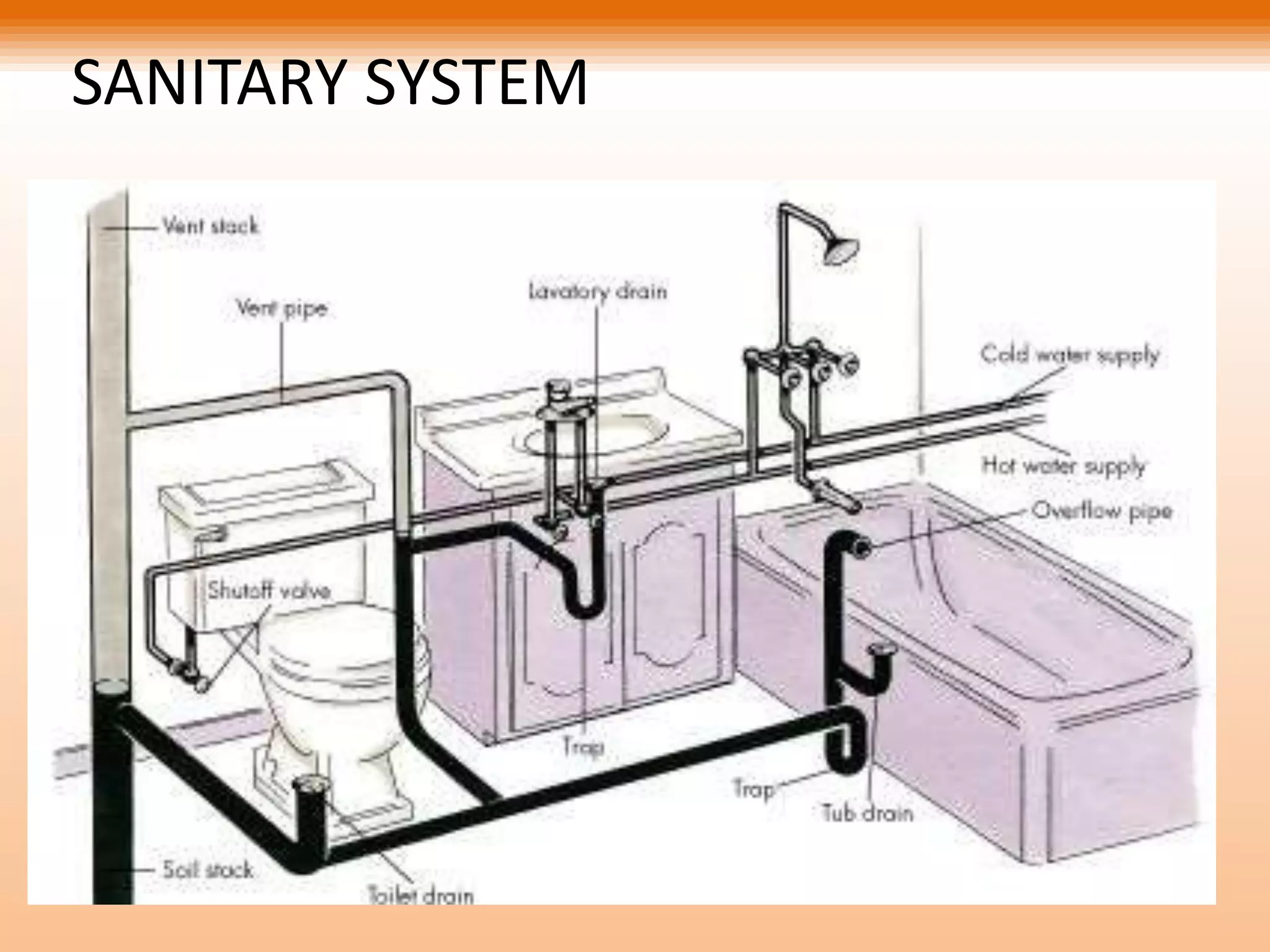
SANITARY SYSTEM
INTRODUCTION

It is the arrangement provided in a house or building
for collecting or conveying waste water through drain
pipes, by gravity, to join either a public sewer or a
domestic septic tank is termed as house drainage or
building drainage.
SANITARY SYSTEM
AIMS OF HOUSE
                   DRAINAGE
To maintain healthy conditions in the building
To dispose off waste water as early and quickly as
  possible
To avoid the entry of foul gases from the sewer or the
  septic tank
To facilitate quick removal of foul matter
To collect and remove waste matters systematically
SANITARY SYSTEM
PIPES
    Material                    Application                             Jointing

    Cast iron        50 mm and above vent and discharge   Lead caulking with molten or fibrous
                                  stacks                     lead; cold compound caulking

 Galvanised steel                Waste pipe                             Screwed

     Copper                 Waste pipes and traps         Compression, capillary, silver solder,
                                                           bronze weld or push-fit rings seal

      Lead            Waste pipes and discharge stacks          Soldered or lead welded

      ABS             Up to 50 mm waste and vent pipes    Solvent cement and push-fit ring seal
  (acrylonitrile
butadiene styrene)

  High-density        Up to 50 mm waste and ventilating    Push-fit ring seal and compression
  polyethylene                 pipes and traps                            fittings

 Polypropylene        Up to 50 mm waste and ventilating    Push-fit ring seal and compression
                               pipes and traps                          couplings

 Modified PVC         Up to 50 mm waste and vent pipes    Solvent cement and push-fit ring seal

  Unplasticized       Over 50 mm soil and vent stacks;    Solvent cement and push-fit ring seal
     PVC                  vent pipes under 50 mm

   Pitch fibre         Over 50 mm discharge and vent      Driven taper or polypropylene fitting
                                  stacks                        with a push-fit ring seal
PIPES
 Soil pipe: A soil pipe is a pipe Through which human excreta flows.

 Water Pipe: it is a pipe which carries only the liquid waste. It does not
   carry human excreta.

 Vent pipe; it is a pipe which is provided for the purpose of the
   ventilation of the system. A vent is open at top and bottom, to facilitate
   exit of foul gases. It is carried at least one meter higher than the roof
   level.

 Rain water pipe: it is a pipe which carries only the rain water.

 Anti-siphonage pipe: it is pipe which is installed in the house drainage
   to preserve the water seal of traps.
SIZES OF PIPES
 Soil pipe:                100mm
 Waste pipe: horizontal:   30-50mm
 Waste pipe: vertical :    75mm
 Rainwater pipe :          75mm
 Vent pipe:                50mm
 Anti siphoange pipe:
 Connecting soil pipe:     50mm
 Connecting waste pipe:    40mm
TRAPS
A trap is depressed or bent fitting that, when
provided in a drainage system, always
remains full of water, thus maintaining water
seal. It prevents the passage of foul air or
gas through it, though it allows the sewage or
waste water to flow through it. The depth of
water seal is the vertical distance between
the crown and dip of a trap. The depth of
water seal represents its strength or
effectiveness. Greater the depth of water seal
more effective is the trap. The depth of water
seal varies from 25mm to 75mm.
TYPES OF TRAPS
ACCORDING TO SHAPE:

1. ‘P’ TRAP
2. ‘Q’ TRAP
3. ‘S’ TRAP
ACCORDING TO USE:

1.   FLOOR TRAP
2.   GULLY TRAP
3.   INTERCEPTING TRAPS
4.   GREASE TRAPS
TRAPS ACCORDING TO
       SHAPE
TRAPS
EXAMPLES


           ‘P’ TRAP


                 ‘S’ TRAP
SANITARY FITTINGS

WASH BASINS
SINKS
BATH TUBS
WATER CLOSETS
URINALS
FLUSHING CISTERNS
BATH TUBS
WASH BASINS
WASH BASINS
SINK
  S
URINALS


     GENTS TOILETS   STREET URINALS


   LADIES TOILETS          PUBLIC TOILETS
WATER CLOSETS &
   CISTERNS


      EUROPEAN
WATER
CLOSETS


  INDIAN   ANGLO-INDIAN
PLUMBING
SYSTEMS
SINGLE STACK SYSTEM

FULLY VENTILATED STACK
 SYSTEM

ONE PIPE SYSTEM

DUAL PIPE SYSTEM

 MODIFIED SINGLE PIPE SYSTEM
ONE PIPE SYSTEM
In the system all soil
and waste water
discharge into one
common pipe and all
branch ventilating
pipes into one main
ventilating pipe. This
system largely
replaces the two pipe
system and lent itself
very well to use in multi
storey developments. It
is far more economical
than the two pipe
system.
TWO PIPE SYSTEM
 The waste stack received the
  discharge ablutionary fitments and
  conveyed this to the ground level
  where it was delivered above the
  water seal in a trapped gully
  connected to the drainage system.
 the soil stack receives the
  discharge from soil appliances and
  delivered it direct to the
  underground drainage system.
  The waste and soil water did not
  combine until they reached the
  below ground drainage system.
THE FULLY VENTILATED
ONE-PIPE SYSTEM
A large number of sanitary
appliances in ranges.

Each trap with an anti-
siphon or vent pipe
connected to the discharge
pipe in direction of the flow
of water at a point between
75 - 450 mm from trap
crown.

Vent stack connected to the
discharge stack near to the
bend to remove compressed
air at this point
The single stack system
Reduces the cost of soil and waste
systems.

Branch vent pipes are not required

To prevent loss of trap water seals:-

The trap water seals on the waste
traps must be 76 mm deep.

The slopes of the branch pipes are:
sink and bath, 18 to 19 mm/m;
basin 20-120 mm/m; WC 18 mm/m
(min.).

Vertical stack at 200 mm below the
centre of the WC branch
connection.
Modified single stack
 system

  Close grouping of the sanitary
  appliances  install the branch
  waste and soil pipes without the need
  for individual branch ventilating pipes.

  To prevent the loss of trap water
  seals
   WC branch pipe min. 100 mm
  bore and the angle θ = 90.5° to 95°.

  To prevent the loss of trap water
  seals
   basin main waste pipe min. 50 mm
  bore and the angle θ = 91° to 92.5°.

  Five basins or more / length of the
  main waste pipe exceeds 4.5 m  a
  25 mm bore vent pipe connected to
  main waste pipe at a point between
Sanitary and water supply

Sanitary and water supply

  • 3.
    MAIN SOURCES OF WATER
  • 4.
  • 5.
  • 6.
  • 7.
  • 8.
  • 9.
    INDIRECT WATER SUPPLY •Water going to overhead tank and then the water is supplied to different floors by gravity
  • 10.
  • 11.
  • 12.
  • 13.
  • 14.
  • 15.
  • 16.
  • 17.
  • 18.
  • 19.
  • 20.
  • 21.
  • 22.
  • 23.
  • 24.
    VARIOUS VALVES ,TUBES AND PIPES Copper Pipe Copper Tube Micro bore Pegler Ball Valve Clips 22mm 15mm × 20m Copper Tube Red 15mm 10mm × 25m Pegler Double Pegler Gate Pegler Washing PTFE Tape 12m Check Valve Valve 22mm Machine Tap Pk of 10 15mm 15mm x ¾""
  • 25.
  • 27.
  • 28.
    INTRODUCTION It is thearrangement provided in a house or building for collecting or conveying waste water through drain pipes, by gravity, to join either a public sewer or a domestic septic tank is termed as house drainage or building drainage.
  • 29.
  • 30.
    AIMS OF HOUSE DRAINAGE To maintain healthy conditions in the building To dispose off waste water as early and quickly as possible To avoid the entry of foul gases from the sewer or the septic tank To facilitate quick removal of foul matter To collect and remove waste matters systematically
  • 31.
  • 32.
    PIPES Material Application Jointing Cast iron 50 mm and above vent and discharge Lead caulking with molten or fibrous stacks lead; cold compound caulking Galvanised steel Waste pipe Screwed Copper Waste pipes and traps Compression, capillary, silver solder, bronze weld or push-fit rings seal Lead Waste pipes and discharge stacks Soldered or lead welded ABS Up to 50 mm waste and vent pipes Solvent cement and push-fit ring seal (acrylonitrile butadiene styrene) High-density Up to 50 mm waste and ventilating Push-fit ring seal and compression polyethylene pipes and traps fittings Polypropylene Up to 50 mm waste and ventilating Push-fit ring seal and compression pipes and traps couplings Modified PVC Up to 50 mm waste and vent pipes Solvent cement and push-fit ring seal Unplasticized Over 50 mm soil and vent stacks; Solvent cement and push-fit ring seal PVC vent pipes under 50 mm Pitch fibre Over 50 mm discharge and vent Driven taper or polypropylene fitting stacks with a push-fit ring seal
  • 33.
    PIPES  Soil pipe:A soil pipe is a pipe Through which human excreta flows.  Water Pipe: it is a pipe which carries only the liquid waste. It does not carry human excreta.  Vent pipe; it is a pipe which is provided for the purpose of the ventilation of the system. A vent is open at top and bottom, to facilitate exit of foul gases. It is carried at least one meter higher than the roof level.  Rain water pipe: it is a pipe which carries only the rain water.  Anti-siphonage pipe: it is pipe which is installed in the house drainage to preserve the water seal of traps.
  • 34.
    SIZES OF PIPES Soil pipe: 100mm  Waste pipe: horizontal: 30-50mm  Waste pipe: vertical : 75mm  Rainwater pipe : 75mm  Vent pipe: 50mm  Anti siphoange pipe:  Connecting soil pipe: 50mm  Connecting waste pipe: 40mm
  • 35.
    TRAPS A trap isdepressed or bent fitting that, when provided in a drainage system, always remains full of water, thus maintaining water seal. It prevents the passage of foul air or gas through it, though it allows the sewage or waste water to flow through it. The depth of water seal is the vertical distance between the crown and dip of a trap. The depth of water seal represents its strength or effectiveness. Greater the depth of water seal more effective is the trap. The depth of water seal varies from 25mm to 75mm.
  • 36.
    TYPES OF TRAPS ACCORDINGTO SHAPE: 1. ‘P’ TRAP 2. ‘Q’ TRAP 3. ‘S’ TRAP ACCORDING TO USE: 1. FLOOR TRAP 2. GULLY TRAP 3. INTERCEPTING TRAPS 4. GREASE TRAPS
  • 37.
  • 38.
    TRAPS EXAMPLES ‘P’ TRAP ‘S’ TRAP
  • 39.
    SANITARY FITTINGS WASH BASINS SINKS BATHTUBS WATER CLOSETS URINALS FLUSHING CISTERNS
  • 40.
  • 41.
  • 42.
  • 43.
  • 44.
    URINALS GENTS TOILETS STREET URINALS LADIES TOILETS PUBLIC TOILETS
  • 45.
    WATER CLOSETS & CISTERNS EUROPEAN
  • 46.
    WATER CLOSETS INDIAN ANGLO-INDIAN
  • 47.
    PLUMBING SYSTEMS SINGLE STACK SYSTEM FULLYVENTILATED STACK SYSTEM ONE PIPE SYSTEM DUAL PIPE SYSTEM  MODIFIED SINGLE PIPE SYSTEM
  • 48.
    ONE PIPE SYSTEM Inthe system all soil and waste water discharge into one common pipe and all branch ventilating pipes into one main ventilating pipe. This system largely replaces the two pipe system and lent itself very well to use in multi storey developments. It is far more economical than the two pipe system.
  • 49.
    TWO PIPE SYSTEM The waste stack received the discharge ablutionary fitments and conveyed this to the ground level where it was delivered above the water seal in a trapped gully connected to the drainage system.  the soil stack receives the discharge from soil appliances and delivered it direct to the underground drainage system. The waste and soil water did not combine until they reached the below ground drainage system.
  • 50.
    THE FULLY VENTILATED ONE-PIPESYSTEM A large number of sanitary appliances in ranges. Each trap with an anti- siphon or vent pipe connected to the discharge pipe in direction of the flow of water at a point between 75 - 450 mm from trap crown. Vent stack connected to the discharge stack near to the bend to remove compressed air at this point
  • 51.
    The single stacksystem Reduces the cost of soil and waste systems. Branch vent pipes are not required To prevent loss of trap water seals:- The trap water seals on the waste traps must be 76 mm deep. The slopes of the branch pipes are: sink and bath, 18 to 19 mm/m; basin 20-120 mm/m; WC 18 mm/m (min.). Vertical stack at 200 mm below the centre of the WC branch connection.
  • 52.
    Modified single stack system Close grouping of the sanitary appliances  install the branch waste and soil pipes without the need for individual branch ventilating pipes. To prevent the loss of trap water seals  WC branch pipe min. 100 mm bore and the angle θ = 90.5° to 95°. To prevent the loss of trap water seals  basin main waste pipe min. 50 mm bore and the angle θ = 91° to 92.5°. Five basins or more / length of the main waste pipe exceeds 4.5 m  a 25 mm bore vent pipe connected to main waste pipe at a point between