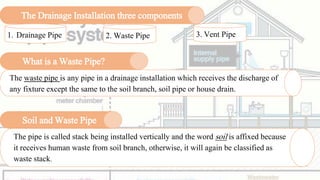
The waste pipe is any pipe in a drainage installation which receives the discharge of
any fixture except the same to the soil branch, soil pipe or house drain.
1. Drainage Pipe 2. Waste Pipe 3. Vent Pipe
The Drainage Installation three components
What is a Waste Pipe?
Soil and Waste Pipe
The pipe is called stack being installed vertically and the word soil is affixed because
it receives human waste from soil branch, otherwise, it will again be classified as
waste stack.
.
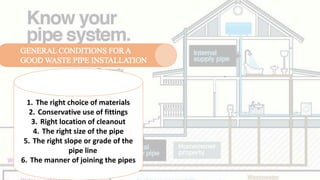
GENERAL CONDITIONS FOR A
GOOD WASTE PIPE INSTALLATION
1. The right choice of materials
2. Conservative use of fittings
3. Right location of cleanout
4. The right size of the pipe
5. The right slope or grade of the
pipe line
6. The manner of joining the pipes
1. The right choice of materials
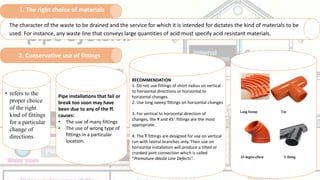
2. Conservative use of fittings
The character of the waste to be drained and the service for which it is intended for dictates the kind of materials to be
used. For instance, any waste line that conveys large quantities of acid must specify acid resistant materials.
• refers to the
proper choice
of the right
kind of fittings
for a particular
change of
directions.
RECOMMENDATION
1. Do not use fittings of short radius on vertical
to horizontal directions or horizontal to
horizontal changes.
2. Use long sweep fittings on horizontal changes
.
3. For vertical to horizontal direction of
changes, the Y and 45 fittings are the most
appropriate.
4. The T fittings are designed for use on vertical
run with lateral branches only. Their use on
horizontal installation will produce a tilted or
crooked joint connection which is called
“Premature Waste Line Defects”.
Pipe installations that fail or
break too soon may have
been due to any of the ff.
causes:
• The use of many fittings
• The use of wrong type of
fittings in a particular
location.
Long Sweep Tee
45 degree elbow Y fitting
3. LOCATION OF CLEANOUT
The ideal position of the horizontal waste pipe lines are
those installed at 2% slope. Meaning, the pipe is installed
with an inclination ratio of 2 centimeters per meter
length run. For instance, a 3 meters pipe as a waste line
will have an inclination of 6 centimeters.
Clean out is a receptacle of the plumbing system which should be accessible to the floor, walls or
ceiling. It is intended to be opened in case of pipe line trouble. It is equipped with a plug or flush plate
so designed as not to impair the aesthetic view of the room. It is also sized equal to the diameter of
the waste pipe line where it is to be connected to avoid interference in the rodding or cleaning.
4. THE RIGHT SLOPE OF THE PIPE
5. MANNER OF JOINING PIPES
Injudicious connection of fittings should not be permitted in any plumbing installation. Each kind of pipe has its
own manner of joining recommended and specified by the manufacturers.
6. THE RIGHT SIZE OF THE PIPE
The size of the pipe intended to receive fixture wastes must be of sufficient diameter to accommodate
velocity of flow making them as nearly scouring as necessary to prevent siltation of waste inside the pipe.
• Scouring means to flush or wash to remove dirt and grease by flowing through.
The Uniform Plumbing Code Committee
Conclusions are briefly enumerated as follows:
1. Increasing the size of the drainage pipe does not guarantee effective scouring action,
of the self-cleaning ability of the pipe wherein the liquid and waste inside the pipe flow
simultaneously together.
ANSWER
2. Water flow in a larger pipe is relatively shallow. Solid waste do not flow on shallow
water but tend to remain at the bottom of the pipe. This is practically the common cause
of the many clogging of drainage installation.
3. Drainage pipe must be proper size to have a liquid flow of about 50% of the pipe
diameter. Meaning, that the water flowing inside the pipe must have a depth equal to ½
the diameter of the pipe. For instance, if the pipe is 100 mm(4”) diameter the water flow
inside the pipe must have a depth of 50 mm(2”) to attain scouring action. This is where
the importance of the slopes comes in.
4. On the other hand, installations which are too small in size I subject to overtax by the
flow. The tendency is to create back pressure, siphon age and floor flooding
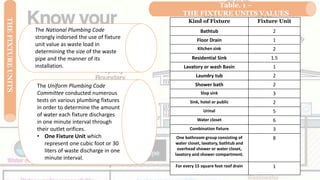
The National Plumbing Code
strongly indorsed the use of fixture
unit value as waste load in
determining the size of the waste
pipe and the manner of its
installation.
THEFIXTUREUNITS
The Uniform Plumbing Code
Committee conducted numerous
tests on various plumbing fixtures
in order to determine the amount
of water each fixture discharges
in one minute interval through
their outlet orifices.
• One Fixture Unit which
represent one cubic foot or 30
liters of waste discharge in one
minute interval.
Kind of Fixture Fixture Unit
Bathtub 2
Floor Drain 1
Kitchen sink 2
Residential Sink 1.5
Lavatory or wash Basin 1
Laundry tub 2
Shower bath 2
Slop sink 3
Sink, hotel or public 2
Urinal 5
Water closet 6
Combination fixture 3
One bathroom group consisting of
water closet, lavatory, bathtub and
overhead shower or water closet,
lavatory and shower compartment.
8
For every 15 square foot roof drain 1
Table. 1 –
THE FIXTURE UNITS VALUES
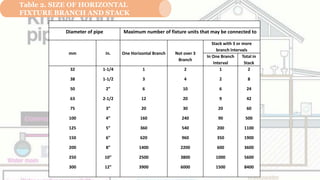
Diameter of pipe Maximum number of fixture units that may be connected to
mm In. One Horizontal Branch Not over 3
Branch
Stack with 3 or more
branch Intervals
In One Branch
Interval
Total in
Stack
32
38
50
63
75
100
125
150
200
250
300
1-1/4
1-1/2
2”
2-1/2
3”
4”
5”
6”
8”
10”
12”
1
3
6
12
20
160
360
620
1400
2500
3900
2
4
10
20
30
240
540
960
2200
3800
6000
1
2
6
9
20
90
200
350
600
1000
1500
2
8
24
42
60
500
1100
1900
3600
5600
8400
Table 2. SIZE OF HORIZONTAL
FIXTURE BRANCH AND STACK
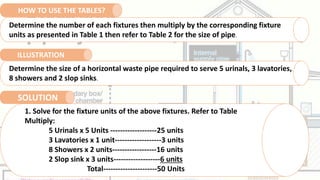
Determine the size of a horizontal waste pipe required to serve 5 urinals, 3 lavatories,
8 showers and 2 slop sinks.
ILLUSTRATION
SOLUTION
1. Solve for the fixture units of the above fixtures. Refer to Table
Multiply:
5 Urinals x 5 Units -------------------25 units
3 Lavatories x 1 unit-------------------3 units
8 Showers x 2 units------------------16 units
2 Slop sink x 3 units-------------------6 units
Total----------------------50 Units
HOW TO USE THE TABLES?
Determine the number of each fixtures then multiply by the corresponding fixture
units as presented in Table 1 then refer to Table 2 for the size of pipe.
EXERCISE
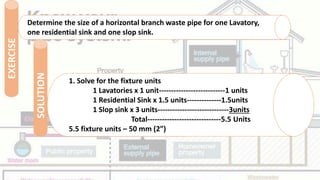
Determine the size of a horizontal branch waste pipe for one Lavatory,
one residential sink and one slop sink.
SOLUTION
1. Solve for the fixture units
1 Lavatories x 1 unit---------------------------1 units
1 Residential Sink x 1.5 units--------------1.5units
1 Slop sink x 3 units-----------------------------3units
Total------------------------------5.5 Units
5.5 fixture units – 50 mm (2”)
WASTE PIPE AND OTHER FIXTURES
Different Type of Fixtures Served
by DIRECT WASTE
• Direct Waste is one with terminal directly connected to the
plumbing system
1.Sink
• Kitchen
• Pantry
• Scullery
• Slop
2. Bathtub
• Seitz Foot
• Bidet
3. Lavatories
• Wall hung
• Pedestal
• Two Piece
4. Urinals
• Pedestal
• Stall
5. Showers –
• Single Stall
• Gang
6. Laundry
7. Drinking Fountain
8. Laboratory
9. Hospital Fixtures
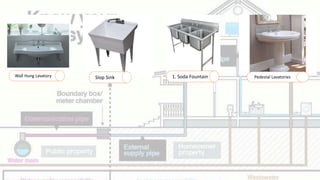
1. Direct Waste 2. Indirect Waste
Pedestal Lavatories1. Soda FountainSlop SinkWall Hung Lavatory
Different Type of Fixtures Served
by INDIRECT WASTE
Indirect Waste - Waste is one with a
terminal not directly connected to
the plumbing system connected to
the plumbing system
1. Soda Fountain
2. Bar waste
3. Refrigerator
4. Drinking fountain
1. Soda Fountain 4. Drinking fountain
Recommended Waste Pipe Size
For a particular fixture, either served by indirect or indirect waste recommend the following sizes.
1. Sink Waste- the minimum waste pipe size for a sink waste is 38 mm (1-1/2”) but because of the nature of the
materials suspended in it, the particle is to use 50 mm (2”) pipe. The National Plumbing Code provides that the waste
pipe must be short, direct free from offsets and provided with ample cleanouts accessible for repair.
2. Slop Sink- is tapped either in a floor or to the wall of buildings for janitorial services. Traps that are installed on the
floor requires a 75 mm (3”) or 100 mm (4”) diameter, while those that are installed on walls uses 50 mm(2”) pipe with
cleanout plug.
3. Scullery Sink 50 mm
4. Pantry Sink- 38mm
5. Factory wash up- 50mm
6. Bathtub- 38mm. min. to 50 mm
7. Lavatories- 50mm
8. Shower Bath- 50mm
9. Urinal- 50mm
10. Laundry- 38 to 50 mm
11. Drinking Fountain- 32mm
12. Lavatory Waste- 50mm
13. Hospital Fixtures- 50m
Plumbing presentation

Plumbing presentation

  • 2.
    The waste pipeis any pipe in a drainage installation which receives the discharge of any fixture except the same to the soil branch, soil pipe or house drain. 1. Drainage Pipe 2. Waste Pipe 3. Vent Pipe The Drainage Installation three components What is a Waste Pipe? Soil and Waste Pipe The pipe is called stack being installed vertically and the word soil is affixed because it receives human waste from soil branch, otherwise, it will again be classified as waste stack.
  • 3.
    . GENERAL CONDITIONS FORA GOOD WASTE PIPE INSTALLATION 1. The right choice of materials 2. Conservative use of fittings 3. Right location of cleanout 4. The right size of the pipe 5. The right slope or grade of the pipe line 6. The manner of joining the pipes
  • 4.
    1. The rightchoice of materials 2. Conservative use of fittings The character of the waste to be drained and the service for which it is intended for dictates the kind of materials to be used. For instance, any waste line that conveys large quantities of acid must specify acid resistant materials. • refers to the proper choice of the right kind of fittings for a particular change of directions. RECOMMENDATION 1. Do not use fittings of short radius on vertical to horizontal directions or horizontal to horizontal changes. 2. Use long sweep fittings on horizontal changes . 3. For vertical to horizontal direction of changes, the Y and 45 fittings are the most appropriate. 4. The T fittings are designed for use on vertical run with lateral branches only. Their use on horizontal installation will produce a tilted or crooked joint connection which is called “Premature Waste Line Defects”. Pipe installations that fail or break too soon may have been due to any of the ff. causes: • The use of many fittings • The use of wrong type of fittings in a particular location. Long Sweep Tee 45 degree elbow Y fitting
  • 5.
    3. LOCATION OFCLEANOUT The ideal position of the horizontal waste pipe lines are those installed at 2% slope. Meaning, the pipe is installed with an inclination ratio of 2 centimeters per meter length run. For instance, a 3 meters pipe as a waste line will have an inclination of 6 centimeters. Clean out is a receptacle of the plumbing system which should be accessible to the floor, walls or ceiling. It is intended to be opened in case of pipe line trouble. It is equipped with a plug or flush plate so designed as not to impair the aesthetic view of the room. It is also sized equal to the diameter of the waste pipe line where it is to be connected to avoid interference in the rodding or cleaning. 4. THE RIGHT SLOPE OF THE PIPE
  • 6.
    5. MANNER OFJOINING PIPES Injudicious connection of fittings should not be permitted in any plumbing installation. Each kind of pipe has its own manner of joining recommended and specified by the manufacturers. 6. THE RIGHT SIZE OF THE PIPE The size of the pipe intended to receive fixture wastes must be of sufficient diameter to accommodate velocity of flow making them as nearly scouring as necessary to prevent siltation of waste inside the pipe. • Scouring means to flush or wash to remove dirt and grease by flowing through.
  • 7.
    The Uniform PlumbingCode Committee Conclusions are briefly enumerated as follows: 1. Increasing the size of the drainage pipe does not guarantee effective scouring action, of the self-cleaning ability of the pipe wherein the liquid and waste inside the pipe flow simultaneously together. ANSWER 2. Water flow in a larger pipe is relatively shallow. Solid waste do not flow on shallow water but tend to remain at the bottom of the pipe. This is practically the common cause of the many clogging of drainage installation. 3. Drainage pipe must be proper size to have a liquid flow of about 50% of the pipe diameter. Meaning, that the water flowing inside the pipe must have a depth equal to ½ the diameter of the pipe. For instance, if the pipe is 100 mm(4”) diameter the water flow inside the pipe must have a depth of 50 mm(2”) to attain scouring action. This is where the importance of the slopes comes in. 4. On the other hand, installations which are too small in size I subject to overtax by the flow. The tendency is to create back pressure, siphon age and floor flooding
  • 8.
    The National PlumbingCode strongly indorsed the use of fixture unit value as waste load in determining the size of the waste pipe and the manner of its installation. THEFIXTUREUNITS The Uniform Plumbing Code Committee conducted numerous tests on various plumbing fixtures in order to determine the amount of water each fixture discharges in one minute interval through their outlet orifices. • One Fixture Unit which represent one cubic foot or 30 liters of waste discharge in one minute interval. Kind of Fixture Fixture Unit Bathtub 2 Floor Drain 1 Kitchen sink 2 Residential Sink 1.5 Lavatory or wash Basin 1 Laundry tub 2 Shower bath 2 Slop sink 3 Sink, hotel or public 2 Urinal 5 Water closet 6 Combination fixture 3 One bathroom group consisting of water closet, lavatory, bathtub and overhead shower or water closet, lavatory and shower compartment. 8 For every 15 square foot roof drain 1 Table. 1 – THE FIXTURE UNITS VALUES
  • 9.
    Diameter of pipeMaximum number of fixture units that may be connected to mm In. One Horizontal Branch Not over 3 Branch Stack with 3 or more branch Intervals In One Branch Interval Total in Stack 32 38 50 63 75 100 125 150 200 250 300 1-1/4 1-1/2 2” 2-1/2 3” 4” 5” 6” 8” 10” 12” 1 3 6 12 20 160 360 620 1400 2500 3900 2 4 10 20 30 240 540 960 2200 3800 6000 1 2 6 9 20 90 200 350 600 1000 1500 2 8 24 42 60 500 1100 1900 3600 5600 8400 Table 2. SIZE OF HORIZONTAL FIXTURE BRANCH AND STACK
  • 10.
    Determine the sizeof a horizontal waste pipe required to serve 5 urinals, 3 lavatories, 8 showers and 2 slop sinks. ILLUSTRATION SOLUTION 1. Solve for the fixture units of the above fixtures. Refer to Table Multiply: 5 Urinals x 5 Units -------------------25 units 3 Lavatories x 1 unit-------------------3 units 8 Showers x 2 units------------------16 units 2 Slop sink x 3 units-------------------6 units Total----------------------50 Units HOW TO USE THE TABLES? Determine the number of each fixtures then multiply by the corresponding fixture units as presented in Table 1 then refer to Table 2 for the size of pipe.
  • 11.
    EXERCISE Determine the sizeof a horizontal branch waste pipe for one Lavatory, one residential sink and one slop sink. SOLUTION 1. Solve for the fixture units 1 Lavatories x 1 unit---------------------------1 units 1 Residential Sink x 1.5 units--------------1.5units 1 Slop sink x 3 units-----------------------------3units Total------------------------------5.5 Units 5.5 fixture units – 50 mm (2”)
  • 12.
    WASTE PIPE ANDOTHER FIXTURES Different Type of Fixtures Served by DIRECT WASTE • Direct Waste is one with terminal directly connected to the plumbing system 1.Sink • Kitchen • Pantry • Scullery • Slop 2. Bathtub • Seitz Foot • Bidet 3. Lavatories • Wall hung • Pedestal • Two Piece 4. Urinals • Pedestal • Stall 5. Showers – • Single Stall • Gang 6. Laundry 7. Drinking Fountain 8. Laboratory 9. Hospital Fixtures 1. Direct Waste 2. Indirect Waste
  • 13.
    Pedestal Lavatories1. SodaFountainSlop SinkWall Hung Lavatory
  • 14.
    Different Type ofFixtures Served by INDIRECT WASTE Indirect Waste - Waste is one with a terminal not directly connected to the plumbing system connected to the plumbing system 1. Soda Fountain 2. Bar waste 3. Refrigerator 4. Drinking fountain 1. Soda Fountain 4. Drinking fountain
  • 15.
    Recommended Waste PipeSize For a particular fixture, either served by indirect or indirect waste recommend the following sizes. 1. Sink Waste- the minimum waste pipe size for a sink waste is 38 mm (1-1/2”) but because of the nature of the materials suspended in it, the particle is to use 50 mm (2”) pipe. The National Plumbing Code provides that the waste pipe must be short, direct free from offsets and provided with ample cleanouts accessible for repair. 2. Slop Sink- is tapped either in a floor or to the wall of buildings for janitorial services. Traps that are installed on the floor requires a 75 mm (3”) or 100 mm (4”) diameter, while those that are installed on walls uses 50 mm(2”) pipe with cleanout plug. 3. Scullery Sink 50 mm 4. Pantry Sink- 38mm 5. Factory wash up- 50mm 6. Bathtub- 38mm. min. to 50 mm 7. Lavatories- 50mm 8. Shower Bath- 50mm 9. Urinal- 50mm 10. Laundry- 38 to 50 mm 11. Drinking Fountain- 32mm 12. Lavatory Waste- 50mm 13. Hospital Fixtures- 50m