Introduction
The word plumbing derived from Latin word “Plumbum” means lead.
Efficient laying out of pipes and using befitting fittings is the art of plumbing.
Selecting appropriate pipe, equipments, accessories and its installation and
maintaining is the science.
Definition:
Plumbing is the art and science of designing, installing and maintanence of
pipes, fixtures, equipments and its accessories for controlled flow of fluids
(water, gas and water conveying waste) required in a building and its premises.
U G TANK
OH TANK
RISER
PIPE
LOW
PRESSURE
BRANCH
PIPE
UG-OH TANK
SYSTEM
U G TANK
NO OH TANK
RISER
PIPE
BRANCH
PIPE
UP-FEED/
PRESSURIZED
SYSTEM
Various
Water
Supply
System
in
Building
INDIRECT WATER SUPPLY
cvwb mieivne¨e¯’v
cvwbcv‡¤úigva¨‡gQv‡`iDc‡ii
U¨v‡¼hv‡e|
c‡iga¨vKl©Ye‡jiKvi‡bcvwb
wewfbœ†d¬v‡ihv‡e|
SANITARY SYSTEM(Two pipe)
eR© wb®‹vkb e¨e¯’v
cøvw¤^s Kv‡Ri gvjvgvj cwiwPwZt
UPVC cvBc:-BSTI standardcwjgvi gqjvcvwb †eiKivi Kv‡Re¨enviKi‡Z n‡e|
eª¨vÛt AvwRR, jxiv, b¨vkbvj cwjgvi A_ev mggv‡bi eª¨v‡Ûiwe‡MÖW UPVC cvBc
UPVC cvBc:-BSTI standardcwjgvi cvwbmvcøvBKivi Kv‡Re¨enviKi‡Z n‡e|
eª¨vÛt AvwRR, jxiv, b¨vkbvj cwjgvi A_ev mggv‡bi eª¨v‡Ûiwm/B ‡MÖW UPVC cvBc
wd·vi: BSTI standardI wmwWDj †gvZv‡eKjvMv‡Zn‡e|
eª¨vÛt bvRgv,kixd A_ev QvËvi eª¨v‡Ûiwee KK,÷cKK,wcjvi KK,G‡½j ÷c KKBZ¨vw` e¨envi
Ki‡Zn‡e|
mKj Porcelain/ wmivwgK `ªe¨mvgMÖxRAK A_ev Gimggv‡bi n‡Zn‡e|
Plastics are a family of man-made materials developed from synthetic
organic chemicals like oil, natural gas, coal and cellulose (from wood fibers).
These raw materials are made into resins.
Rigid type plastic pipe: Various types of rigid plastic pipes used in
plumbing system.
1. Unplastisized polyvinyle chloride (uPVC) pipe.
3. Clorinated polyvinyle chloride (CPVC) pipe.
4. Acrylonitrite Butadiene Styrene (ABS) pipe.
5. Poly propylene (PP) pipe.
6. Styrene Rubber (SR) pipe.
Plastic Pipes
Tests indicated that plastic pipe may last for 30 years under favorable
condition.
Working pressure range is 2.5 bar to 10 bar.
1 bar = 14.70 psi. 1 Mpa =145.038 psi
uPVC pipe: Manufactured by plastic resins extruded in special machines
under closed temperature control and manufacturing process. uPVC pipes
are suitable for temperature up to 60ºc ( ºF ). These pipes should not be
installed exposed to direct sunlight due to its high co-efficient of thermal
expansion which is 7 x 10.5 mm /m/ ºc and loss of strength. Rigidly fixed
pipes may deform due to high thermal expansion. As a result joint may start
leaking. So provision for pipe expansion should be kept in the piping system
Chlorinated polyvinyl chloride (CPVC) pipe :CPVC pipes are useful for
handing high temperature, corrosives fluids, having a maximum service
temperature of 99 ºc (210 ºF). It has good chemical resistance like PVC
pipes. These pipes are also recommended for hot and cold water lines and
for process piping for the hot corrosive liquids.
Acrylonitrile Butadiene Styrene (ABS) pipe: ABS pipes has high impact
strength, is very tough and can be used at temperatures up to 180º F. It has
lower chemical resistance and lower design strength than PVC pipes. These
pipes are generally used in conveying water for irrigation, gas transmission,
draining wastes and venting. Solvent welding and threading are the
recommended process for jointing these pipes.
Plastic Pipes (contd…)
Nominal
Size
Outside
Diameter
Wall Thickness
Class B
(6 Bar)
(87 psi)
Class C
(9 Bar)
(130.5 psi)
Class D
(12 Bar)
(174 psi)
Class E
(15 Bar)
(217.5 psi)
Inch Min. mm Max.
mm
Min. mm Max.
mm
Min. mm Max.
mm
Min. mm Max.
mm
Min. mm Max.
mm
1/2 21.2 21.5 - - - - - - 1.7 2.1
3/4 26.6 26.9 - - - - - - 1.9 2.5
1 33.3 33.8 - - - - - - 2.2 2.7
1.1/4 42.0 42.5 - - - - 2.2 2.7 2.7 3.2
1.1/2 48.0 48.5 - - - - 2.5 3.0 3.1 3.7
2 60.0 60.7 - - 2.5 3.0 3.1 3.7 3.9 4.9
3 88.4 89.4 2.9 3.4 3.5 4.1 4.6 5.3 5.7 6.6
4 113.7 114.9 3.4 4.0 4.5 5.2 6.0 6.9 7.3 8.4
5 139.4 141.0 3.8 4.4 5.5 6.4 7.3 8.4 9.0 10.4
6 167.4 169.1 4.5 5.2 6.5 7.6 8.8 10.2 10.8 12.5
8 218.0 220.2 5.3 6.1 7.5 9.0 10.3 11.9 12.6 14.5
10 271.6 274.4 6.6 7.6 9.7 11.2 12.8 14.8 15.7 18.1
12 322.2 325.5 7.8 9.0 11.5 13.3 15.2 17.5 18.7 21.6
14 353.7 357.3 8.5 9.8 12.6 14.5 16.7 19.2 - -
16 404.3 408.5 9.7 11.2 14.5 16.7 - - - -
uPVC Pipe Classification
Galvanized Iron (G.I) pipe: Galvanizing is done by dipping the clean surfaced
iron pipes into molten pure zinc. Galvanized iron pipes are used mainly for
preventing pipe from corrosion. In aggressive corrosive conditions, galvanized
iron pipes should not be used.
G.I.Pipe
Class of pipe available are A, B and C.
Pressure rating in Kg/cm2: ClassB: 30 at test and 20 at working;
Class C: 50 at test and 30 at working
GI pipes are connected mostly by threaded joints. Welding of galvanized pipe
shall be avoided since it results in emission of a toxic gas from the zinc coating.
Corrosion is the major problem. Zinc coating thickness
shall be ranged between 45µm to 100µm
 Soil pipe: A soil pipe is a pipe Through which human excreta flows.
 Water Pipe: it is a pipe which carries only the liquid waste. It does not
carry human excreta.
 Vent pipe; it is a pipe which is provided for the purpose of the
ventilation of the system. A vent is open at top and bottom, to facilitate
exit of foul gases. It is carried at least one meter higher than the roof
level.
 Rain water pipe: it is a pipe which carries only the rain water.
PIPES
G‡½j ÷c KK wee KK
UzBb Iqvb wee KK wcjvi KK mvIqvi †nW
Kbwmj ÷c KK
‡MÖwUs
µmWvej wU wc Uªvc
BDwbqb
cøvM
VARIOUS VALVES , CLIPS AND TAPE
Copper Pipe Clips Gate ValveBall Valve
Thread seal tape (also known as PTFE tape or plumber's tape) is a polytetrafluoroethylene
(PTFE) film for use in sealing pipe threads.
GATE VALVE
Pressure Reducing Valve (PRV)
For shut off or closing a pipe
Plug: Plug is used for closing the end of a pipe or a fitting having a female
thread.
Cap : Cap is used for closing the end of a pipe or fittings having a male thread.
cvBc jvBb_vwg‡q w`‡Z n‡j
Floor drains
The floor drain is a plumbing fixture, which provides an opening in the
floor to drain wastewater generated on the floor and discharged into the
plumbing system. In areas where there is chance of receiving
wastewater, a floor drain of adequate size should be provided.
Clean-outs ev †Wvi t mvavibZ †Kvb cvB‡ci g‡a¨ gqjv AvUwK‡q †M‡j Zv
cwi¯‹vi Kivi Rb¨ GwU e¨envi Kiv nq|
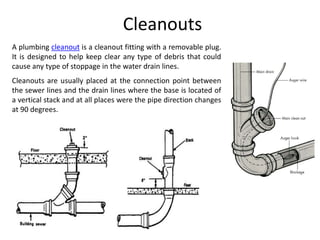
Cleanouts
A plumbing cleanout is a cleanout fitting with a removable plug.
It is designed to help keep clear any type of debris that could
cause any type of stoppage in the water drain lines.
Cleanouts are usually placed at the connection point between
the sewer lines and the drain lines where the base is located of
a vertical stack and at all places were the pipe direction changes
at 90 degrees.
Plumbing Trap
A plumbing trap is a curved pipe that is located underneath a plumbing
fixture. A plumbing trap is an essential part of a building’s plumbing for
two main reasons.
 trap prevents the entry of odors into a building.
 trap also catches items that may cause major clogs or blockages if allowed to
travel further into the drainage system.
In most municipalities, the installation of plumbing traps on all plumbing
fixtures is required.
TRAPS ACCORDING TO
SHAPE
TRAPS EXAMPLES
‘P’ TRAP
‘S’ TRAP
Kitchen sink
Water closets are water flushed plumbing fixtures that receive human
excrement and finally dispose off into drainage system using water as a
conveyance medium.
Siphon Jet
Water closet
Water closet
Water closet
Consume much Water
Water closet
Siphon Jet Flushing System
Water closet Flushing System
Float Valve
Water closet Flushing System
Conventional System
Water closet Flushing System
Squatting urinal Long Pan
LAVATORIES - বেসিন
The lavatory is a bowl or basin used for washing of the hands, face etc. The
bowl is usually oval in shape. Generally the bowl has a capacity of about
4.5 liter (1 gal) up to the overflow line.
PedestalWall HungVanity
1|cvBc e¨enviKivic~‡e©†KvbwW‡d±Av‡QwKbvZv †`‡Lwb‡Zn‡e|
2|Kgc‡ÿ `kw`bwKDwisbvn‡j†`qv‡jMÖæcKvUvïiæKivhv‡ebv|
3|MÖæf†mvRvGes‡gwkbØvivKvU‡Zn‡e|
4|cvBc †mvRvfv‡ejvMv‡Z n‡eGesnivBR›UvjGesfvwU©KvjG¨vjBb‡g›UwVK_vK‡Z
n‡e|
5|cvBc cvwbw`‡qf‡icøvM‡g‡i7w`bivL‡Zn‡e| cøvM2myZv†ein‡q_vK‡e|
6|50-60wc.Gm.AvB†cÖmviw`‡qcvB‡c †KvbwjKAv‡QwKbvZv †PKKi‡Zn‡e|
7|‡Kvb wjKcvIqv †M‡j†mB cvBccwieZ©bKi‡Zn‡e|
8|UvBj&mwdwUs‡mic~‡e©Gj‡ev wVKgZjvMv‡bvAv‡QwK bvZv †PKKi‡Zn‡e|
9|cÖ‡R±n¨vÛIfv‡ii c~‡e©Dc‡iiI bx‡PicvwbiU¨vsKcwi¯‹viK‡iw`‡Zn‡e|
10|mKjKjKvRKi‡Q wKbvZv †PKKi‡Zn‡e|
11|cvB‡ciDciwWªjKivhv‡ebv|
cvB‡ci Kv‡Rimgq Kibxq:
1| ‡mwbUvwi †nvjQv` XvjvB‡qi mgqivL‡Z n‡e|
2| ‡d¬vi cv cvB‡ci AvDUvi fvqv †_‡K 1″ eo n‡Zn‡e|
3| Waste Water or Soil cvBc wdwUsm Gi c~‡e©Iqvj cøv÷vi K‡i
wb‡Z n‡e|
4| Waste Water or Soil cvB‡ci KvRbx‡Pi†d¬vi †_‡K ïiæKi‡Zn‡e|
5| cvB‡ci gv_v wkwil KvMRØviv N‡lAgwkÖb K‡iwb‡Z n‡e|
6| cvB‡ci gv_vq IwdwUsm G mj‡f›Uwm‡g›U jvMv‡Z n‡e|
7| cvBc IwdwUsm G mj‡f›Uwm‡g›U jvMv‡bvi ci 4 †_‡K 5 wgwb‡Ui
wfZiR‡q›U w`‡Z n‡e|
8| cvBc †K¯’vqxfv‡e Kèvw¤ús Kivi Av‡M fvwU©KvjGjvBb†g›U wVK
Ki‡Zn‡e|
BD.wc.wf.wm cvB‡ci Kv‡Ri mgq Kibxq:
9| cvB‡ci bx‡PicÖvšÍ k³ A¯’vqx cøvUdg© Gi Dci ivL‡Z n‡ehv‡Z wbR¯^
IR‡bi Rb¨ R‡q›U Qz‡U bv hvq A_ev †f‡½ bv c‡o| K¬vw¤ús Kiv†kl n‡j
cieZx©‡ZGi A¯’vqx cøvUdg© mwi‡q†dj‡Z n‡e|
10| K¬vg¸wj¯’vqxfv‡e jvMv‡Z n‡e|
11| cvB‡ci KvRKivi mgq †÷wRs fvjfv‡e Ki‡Zn‡ehv‡Z KvRKi‡ZwM‡q
†Kvb `~N©Ubvbv N‡U †mw`‡K jÿ¨ ivL‡Z n‡e|
12| ‡d¬vi †Wª‡bi †¯øvc 100:1 n‡Z200: 1 Gi g‡a¨n‡Zn‡e|
13| cvB‡ci R‡q›U ¸wj wVK n‡q‡QwKbv Zv †PKKi‡Zn‡e|
14| cvB‡ci †nvj mgynwVK gZ eÜ Kivn‡q‡QwKbv Zv †PKKi‡Zn‡e|
BD.wc.wf.wm cvB‡ci Kv‡Ri mgq Kibxq:
15| ‡d¬vi †Wª‡bi cvBc I‡qó Uªv‡c wVKgZ wM‡q‡Q wKbv Zv †PKKi‡Z
n‡eGes Zv Aek¨B wU w`‡q jvMv‡Z n‡e|
16| ‡MÖwUs wdwUs Gi Av‡M E-I-CØviv jvBb wK¬qvi Av‡Q wK bv
Zv †PKKi‡Zn‡e|
17| ‡jv WvD‡bi d¬vwms wVK Av‡Q wKbv Zv †PKKi‡Zn‡e|
18| ‡Kwb‡b‡Ui Zjv cøv÷vi I †cB›U Kiv n‡q‡QwKbv Zv †PKKi‡Zn‡e|
BD.wc.wf.wm cvB‡ci Kv‡Ri mgq Kibxq:
1.`vM†`Iqv
2. cvBcKvUv
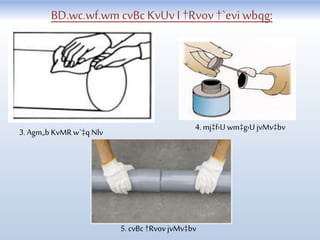
BD.wc.wf.wm cvBc KvUv I †Rvov †`evi wbqg:
3. Agm„b KvMRw`‡q Nlv 4. mj‡f›U wm‡g›U jvMv‡bv
5. cvBc†Rvov jvMv‡bv
BD.wc.wf.wm cvBc KvUv I †Rvov †`evi wbqg:
Av‡M cøv÷vi I wQ`ª¸‡jv XvjvB K‡i jvBb emv‡bv
`~e©j K¬vw¤ús fzjfv‡e emv‡bv UªvcI2′′ Kv‡bKmb
me©cÖ_g gvwU h_vh_fv‡e Compactionn‡q‡Q wKbvZv
wbwðZ n‡Z n‡e|
1| Wªwqs Abyhvqx cvBcjvB‡bi ga¨ †iLv eivei P‡Ki¸ov Øviv`vM
w`‡Zn‡e|
2| g¨vb‡nv‡ji Ae¯’vb wbY©q Ki‡Z n‡e|
3| cvB‡ciïiæ I †kl cÖv‡šÍi†j‡fj wba©vib Ki‡Z n‡e|
4| wbw`©ó g¨vb‡nv‡ii †j‡fj wba©vib Ki‡Zn‡e|
5| cvB‡ci †kl gv_v†_‡K gvwU KvUvi KvRïiæ Ki‡Z n‡e|
6| Lv‡`i gvwU KvUvicicvB‡ci†eW fvjfv‡e i¨vwgs, †Wªwms I
†j‡fwjs Ki‡Zn‡e|
7| cvBc‡KA¯’vqxfv‡e emv‡Zn‡e|
AvÛvi MÖvDÛ cvBc / wcU Gi KvR Kivimgq Kibxq:
8| cvB‡ci wb¤œZj GKB †iLvq Av‡Q wKbv Zvcixÿv Ki‡Zn‡e|
9| 5′-10′ cici KswµU ØvivXvjvB w`‡Zn‡e|
10| cvB‡ci wfZi †Kv_vI wQ`ª ev dvUj Av‡QwKbv Zvcixÿv Ki‡Z
n‡e|
11| cvB‡ci Lv` evjy ØvivfivU Ki‡Z n‡e|
12|byb¨Zg †¯øvc wb¤œiæc n‡e:
4″ cvBc80:1
6″ cvBc120:1
8″ cvBc150:1
14| wc‡Ui Pvicv‡kKgc‡ÿ 1′-0′′RvqMvRy‡o evjyØviv fivU K‡i
i¨vwgs, †Wªwms, Kgc¨vw±sI†j‡fwjs Ki‡Z n‡e|
15| wc‡Ui wb‡P Kgc‡ÿ0′-6′′ MfxiZv ch©šÍ evjyØviv fivU K‡i
Kgc¨vw±s Ki‡Zn‡e|
AvÛvi MÖvDÛ cvBc / wcU Gi KvR Kivimgq Kibxq:
8| cvB‡ci wb¤œZj GKB †iLvq Av‡Q wKbv Zvcixÿv Ki‡Zn‡e|
9| 5′-10′ cici KswµU ØvivXvjvB w`‡Zn‡e|
10| cvB‡ci wfZi †Kv_vI wQ`ª ev dvUj Av‡QwKbv Zvcixÿv Ki‡Z
n‡e|
11| cvB‡ci Lv` evjy ØvivfivU Ki‡Z n‡e|
12|byb¨Zg †¯øvc wb¤œiæc n‡e:
4″ cvBc80:1
6″ cvBc120:1
8″ cvBc150:1
14| wc‡Ui Pvicv‡kKgc‡ÿ 1′-0′′RvqMvRy‡o evjyØviv fivU K‡i
i¨vwgs, †Wªwms, Kgc¨vw±sI†j‡fwjs Ki‡Z n‡e|
15| wc‡Ui wb‡P Kgc‡ÿ2′-0′′ MfxiZv ch©šÍ evjyØviv fivU K‡i
Kgc¨vw±s Ki‡Zn‡e|
AvÛvi MÖvDÛ cvBc / wcU Gi KvR Kivimgq Kibxq:
1. Bib cock for commode 18″
2. Angle stop cock for combi closet 18″
3. Angle stop cock for lowdown 28″
4. Angle stop cock for wash basin 23″
5. Bib cock below shower 28″
6. Conceal stop cock 44″
7. Head shower 78″
8. Soap case 44″
9. Paper holder 24″
10. Towel rail 48″
11. Glass shelf 12″ (From Basin Top)
12. Mirror 15″ (From Basin Top)
Sanitary Fitting Standard Height
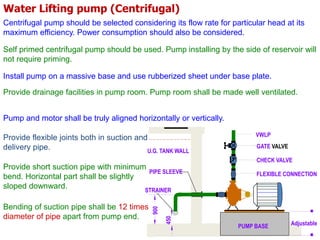
Water Lifting pump (Centrifugal)
Centrifugal pump should be selected considering its flow rate for particular head at its
maximum efficiency. Power consumption should also be considered.
Self primed centrifugal pump should be used. Pump installing by the side of reservoir will
not require priming.
Pump and motor shall be truly aligned horizontally or vertically.
Provide drainage facilities in pump room. Pump room shall be made well ventilated.
Provide short suction pipe with minimum
bend. Horizontal part shall be slightly
sloped downward.
Install pump on a massive base and use rubberized sheet under base plate.
Provide flexible joints both in suction and
delivery pipe.
Bending of suction pipe shall be 12 times
diameter of pipe apart from pump end.
VWLP
GATE VALVE
CHECK VALVE
FLEXIBLE CONNECTION
U.G. TANK WALL
PIPE SLEEVE
AdjustablePUMP BASE
STRAINER
450
900
Water Lifting pump (Submersible)
Water Lifting pump (Sump pump)
Over head Water Tank
Size of O.H. tank is primarily governed by; how many times in a day a pump and at what
capacity it will operate to fill the tank.
Position of water tank should be at the centroid of volume of water supply outlets.
Elevated position shall be based on pressure
needed to supply through top most faucet.
Electronic sensor can be used to
control inflow of water into the tank
Water reservoirs shall be cleaned at
least twice a year
Provide a drainage pipe at the floor of
reservoir.
The pressure is a function of water height and density of water i.e.
P = hD. where h = depth of water in ft and D = density of water
For 1 ft of water column, pressure exerted is
P = h D= [(1 ft) x (62.4) 1b /ft 3)] (1ft2 / 144 in2 ) = 0.433 h psi/ ft depth.
So p = 0.4333 h psi
So one psi pressure is developed for 1/0.433 = 2.304 ft of water column.
h = 2.304 p ft of water column.
Static water pressure
Absolute pressure is the gauge pressure plus 14.7 psi because at mean sea level where the
absolute atmospheric pressure is 14.7 psi. But the gauge reads zero pressure there.
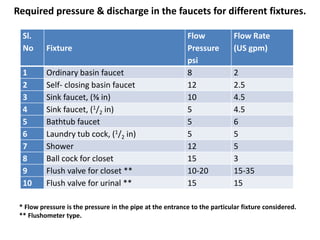
* Flow pressure is the pressure in the pipe at the entrance to the particular fixture considered.
** Flushometer type.
Required pressure & discharge in the faucets for different fixtures.
Sl.
No Fixture
Flow
Pressure
psi
Flow Rate
(US gpm)
1 Ordinary basin faucet 8 2
2 Self- closing basin faucet 12 2.5
3 Sink faucet, (⅜ in) 10 4.5
4 Sink faucet, (1/2 in) 5 4.5
5 Bathtub faucet 5 6
6 Laundry tub cock, (1/2 in) 5 5
7 Shower 12 5
8 Ball cock for closet 15 3
9 Flush valve for closet ** 10-20 15-35
10 Flush valve for urinal ** 15 15
Maintenance Tools & Checking
Source : http://www.ramonasplumber.com/dpatoollist.shtml
Pressure Test:
To test a pipe system increasing pressure in the system is
the best way to determine, either the system is ok or not.
Pressure given in the system must be one & half times than
actual design pressure.
Pressure Gauge
Manual Pressure Testing Device
Maintenance Tools & Checking
Source : http://www.ramonasplumber.com/dpatoollist.shtml
Pressure Test:
Mechanical Pressure Testing Device
Maintenance Tools & Checking
Flow Meter:
Ultrasonic Flow Meter
Tube Flow Meter Flow Meter cum regulator
Pipe Flow Meter
HAND OPERATED AUGERS FOR CLEANING WATER-
CLOSETS, PIPES AND SEWERS
Source : https://law.resource.org/pub/in/bis/S03/is.9110.1979.html
HAND OPERATED AUGERS FOR CLEANING WATER-
CLOSETS, PIPES AND SEWERS
Source : https://law.resource.org/pub/in/bis/S03/is.9110.1979.html
HAND OPERATED AUGERS FOR CLEANING WATER-
CLOSETS, PIPES AND SEWERS
Source : https://law.resource.org/pub/in/bis/S03/is.9110.1979.html
HAND OPERATED AUGERS FOR CLEANING WATER-
CLOSETS, PIPES AND SEWERS
Source : https://law.resource.org/pub/in/bis/S03/is.9110.1979.html
HAND OPERATED AUGERS FOR CLEANING WATER-
CLOSETS, PIPES AND SEWERS
Source : https://law.resource.org/pub/in/bis/S03/is.9110.1979.html
CLEANING WATER-CLOSETS, BASIN, PIPES AND SEWERS
BY USING PLUNGER
Source : http://www.familyhandyman.com/plumbing/drain-repair/how-to-clear-clogged-drains/view-all
ev¯Íe Kv‡Rimgm¨vImgvavb
‡Kvb †Wvi †eÛ bvB
ev¯Íe Kv‡Rimgm¨vImgvavb
fvj gv‡bi wR.AvB cvBce¨enviKi‡Zn‡e|
bZzev†iW A·vBW evGbv‡gj †cB›U Øvivis Ki‡Zn‡e|
ev¯Íe Kv‡Rimgm¨vImgvavb
‡h‡Kvbev_iæg evUq‡j‡U †Wvi wmj Avek¨K|
Ab¨_vq cvwb evB‡i P‡j hv‡e|
ev¯Íe Kv‡Rimgm¨vImgvavb
Db¥y³ cvB‡ciMv‡q †`qv‡ji is jv‡Mv‡Z
n‡e
ev¯Íe Kv‡Rimgm¨vImgvavb
Uq‡j‡Ui †ewm‡bi w`Kcvëv‡Zn‡e
ev¯Íe Kv‡Rimgm¨vImgvavb
c~‡e©
ev¯Íe Kv‡Rimgm¨vImgvavb
c‡i
ev¯Íe Kv‡Rimgm¨vImgvavb
cøvw÷‡Ki †MÖwUs e¨enviKivn‡q‡Q|w÷j ‡MÖwUs e¨enviKi‡Zn‡e|
†d¬vi Uªv‡ci cwRmbI wVK bvB|
ev¯Íe Kv‡Rimgm¨vImgvavb
AvMyb w`‡q cywo‡q jvMv‡bv
n‡q‡Q|
Aek¨B BDwbqb A_ev Kvcwjs w`‡q
jvMv‡Z n‡e|
ev¯Íe Kv‡Rimgm¨vImgvavb
Waste Water or Soil cvBc
wdwUsm Gi c~‡e© Iqvj cøv÷vi K‡i
wb‡Z n‡e|
ev¯Íe Kv‡Rimgm¨vImgvavb
GKUv 10 wdU j¤^v 4ÕÕWvqv cvB‡ci cvwbmn IRb25 †KwR|
ZvB mwVKfv‡e Kgc‡ÿ 3 Uv wRBK¬v¤ú bv w`‡j GUv †f‡½ co‡e|
Questions Please
Reference:
(1)Haque, S. Azizul, Plumbing Practice, 1st Endition.
(2)Bamgladesh National Building Code.
(3)R. D. Treloar, Plumbing Encyclopedia, 4th Edition.
(4)M. Feroze Ahmed, Md. Mujibur Rahman, Water
Supply and Sanitation for rural and low income
urban communities.
(5)Donald Watson, Michael J. Crosbie, John
Hancock Callender, Time-Saver Standards for
Architectural Design.
(6)Several web sites for different pictures
(7)International Plumbing Code(IPC)

Plumbing system for training, 22.01.2017

  • 3.
    Introduction The word plumbingderived from Latin word “Plumbum” means lead. Efficient laying out of pipes and using befitting fittings is the art of plumbing. Selecting appropriate pipe, equipments, accessories and its installation and maintaining is the science. Definition: Plumbing is the art and science of designing, installing and maintanence of pipes, fixtures, equipments and its accessories for controlled flow of fluids (water, gas and water conveying waste) required in a building and its premises.
  • 4.
    U G TANK OHTANK RISER PIPE LOW PRESSURE BRANCH PIPE UG-OH TANK SYSTEM U G TANK NO OH TANK RISER PIPE BRANCH PIPE UP-FEED/ PRESSURIZED SYSTEM Various Water Supply System in Building
  • 5.
    INDIRECT WATER SUPPLY cvwbmieivne¨e¯’v cvwbcv‡¤úigva¨‡gQv‡`iDc‡ii U¨v‡¼hv‡e| c‡iga¨vKl©Ye‡jiKvi‡bcvwb wewfbœ†d¬v‡ihv‡e|
  • 6.
    SANITARY SYSTEM(Two pipe) eR©wb®‹vkb e¨e¯’v
  • 7.
    cøvw¤^s Kv‡Ri gvjvgvjcwiwPwZt UPVC cvBc:-BSTI standardcwjgvi gqjvcvwb †eiKivi Kv‡Re¨enviKi‡Z n‡e| eª¨vÛt AvwRR, jxiv, b¨vkbvj cwjgvi A_ev mggv‡bi eª¨v‡Ûiwe‡MÖW UPVC cvBc UPVC cvBc:-BSTI standardcwjgvi cvwbmvcøvBKivi Kv‡Re¨enviKi‡Z n‡e| eª¨vÛt AvwRR, jxiv, b¨vkbvj cwjgvi A_ev mggv‡bi eª¨v‡Ûiwm/B ‡MÖW UPVC cvBc wd·vi: BSTI standardI wmwWDj †gvZv‡eKjvMv‡Zn‡e| eª¨vÛt bvRgv,kixd A_ev QvËvi eª¨v‡Ûiwee KK,÷cKK,wcjvi KK,G‡½j ÷c KKBZ¨vw` e¨envi Ki‡Zn‡e| mKj Porcelain/ wmivwgK `ªe¨mvgMÖxRAK A_ev Gimggv‡bi n‡Zn‡e|
  • 8.
    Plastics are afamily of man-made materials developed from synthetic organic chemicals like oil, natural gas, coal and cellulose (from wood fibers). These raw materials are made into resins. Rigid type plastic pipe: Various types of rigid plastic pipes used in plumbing system. 1. Unplastisized polyvinyle chloride (uPVC) pipe. 3. Clorinated polyvinyle chloride (CPVC) pipe. 4. Acrylonitrite Butadiene Styrene (ABS) pipe. 5. Poly propylene (PP) pipe. 6. Styrene Rubber (SR) pipe. Plastic Pipes Tests indicated that plastic pipe may last for 30 years under favorable condition. Working pressure range is 2.5 bar to 10 bar. 1 bar = 14.70 psi. 1 Mpa =145.038 psi
  • 9.
    uPVC pipe: Manufacturedby plastic resins extruded in special machines under closed temperature control and manufacturing process. uPVC pipes are suitable for temperature up to 60ºc ( ºF ). These pipes should not be installed exposed to direct sunlight due to its high co-efficient of thermal expansion which is 7 x 10.5 mm /m/ ºc and loss of strength. Rigidly fixed pipes may deform due to high thermal expansion. As a result joint may start leaking. So provision for pipe expansion should be kept in the piping system Chlorinated polyvinyl chloride (CPVC) pipe :CPVC pipes are useful for handing high temperature, corrosives fluids, having a maximum service temperature of 99 ºc (210 ºF). It has good chemical resistance like PVC pipes. These pipes are also recommended for hot and cold water lines and for process piping for the hot corrosive liquids. Acrylonitrile Butadiene Styrene (ABS) pipe: ABS pipes has high impact strength, is very tough and can be used at temperatures up to 180º F. It has lower chemical resistance and lower design strength than PVC pipes. These pipes are generally used in conveying water for irrigation, gas transmission, draining wastes and venting. Solvent welding and threading are the recommended process for jointing these pipes. Plastic Pipes (contd…)
  • 10.
    Nominal Size Outside Diameter Wall Thickness Class B (6Bar) (87 psi) Class C (9 Bar) (130.5 psi) Class D (12 Bar) (174 psi) Class E (15 Bar) (217.5 psi) Inch Min. mm Max. mm Min. mm Max. mm Min. mm Max. mm Min. mm Max. mm Min. mm Max. mm 1/2 21.2 21.5 - - - - - - 1.7 2.1 3/4 26.6 26.9 - - - - - - 1.9 2.5 1 33.3 33.8 - - - - - - 2.2 2.7 1.1/4 42.0 42.5 - - - - 2.2 2.7 2.7 3.2 1.1/2 48.0 48.5 - - - - 2.5 3.0 3.1 3.7 2 60.0 60.7 - - 2.5 3.0 3.1 3.7 3.9 4.9 3 88.4 89.4 2.9 3.4 3.5 4.1 4.6 5.3 5.7 6.6 4 113.7 114.9 3.4 4.0 4.5 5.2 6.0 6.9 7.3 8.4 5 139.4 141.0 3.8 4.4 5.5 6.4 7.3 8.4 9.0 10.4 6 167.4 169.1 4.5 5.2 6.5 7.6 8.8 10.2 10.8 12.5 8 218.0 220.2 5.3 6.1 7.5 9.0 10.3 11.9 12.6 14.5 10 271.6 274.4 6.6 7.6 9.7 11.2 12.8 14.8 15.7 18.1 12 322.2 325.5 7.8 9.0 11.5 13.3 15.2 17.5 18.7 21.6 14 353.7 357.3 8.5 9.8 12.6 14.5 16.7 19.2 - - 16 404.3 408.5 9.7 11.2 14.5 16.7 - - - - uPVC Pipe Classification
  • 11.
    Galvanized Iron (G.I)pipe: Galvanizing is done by dipping the clean surfaced iron pipes into molten pure zinc. Galvanized iron pipes are used mainly for preventing pipe from corrosion. In aggressive corrosive conditions, galvanized iron pipes should not be used. G.I.Pipe Class of pipe available are A, B and C. Pressure rating in Kg/cm2: ClassB: 30 at test and 20 at working; Class C: 50 at test and 30 at working GI pipes are connected mostly by threaded joints. Welding of galvanized pipe shall be avoided since it results in emission of a toxic gas from the zinc coating. Corrosion is the major problem. Zinc coating thickness shall be ranged between 45µm to 100µm
  • 12.
     Soil pipe:A soil pipe is a pipe Through which human excreta flows.  Water Pipe: it is a pipe which carries only the liquid waste. It does not carry human excreta.  Vent pipe; it is a pipe which is provided for the purpose of the ventilation of the system. A vent is open at top and bottom, to facilitate exit of foul gases. It is carried at least one meter higher than the roof level.  Rain water pipe: it is a pipe which carries only the rain water. PIPES
  • 13.
    G‡½j ÷c KKwee KK UzBb Iqvb wee KK wcjvi KK mvIqvi †nW Kbwmj ÷c KK
  • 15.
    ‡MÖwUs µmWvej wU wcUªvc BDwbqb cøvM
  • 16.
    VARIOUS VALVES ,CLIPS AND TAPE Copper Pipe Clips Gate ValveBall Valve Thread seal tape (also known as PTFE tape or plumber's tape) is a polytetrafluoroethylene (PTFE) film for use in sealing pipe threads.
  • 17.
  • 18.
  • 19.
  • 20.
    For shut offor closing a pipe Plug: Plug is used for closing the end of a pipe or a fitting having a female thread. Cap : Cap is used for closing the end of a pipe or fittings having a male thread. cvBc jvBb_vwg‡q w`‡Z n‡j
  • 21.
    Floor drains The floordrain is a plumbing fixture, which provides an opening in the floor to drain wastewater generated on the floor and discharged into the plumbing system. In areas where there is chance of receiving wastewater, a floor drain of adequate size should be provided.
  • 22.
    Clean-outs ev †Wvit mvavibZ †Kvb cvB‡ci g‡a¨ gqjv AvUwK‡q †M‡j Zv cwi¯‹vi Kivi Rb¨ GwU e¨envi Kiv nq|
  • 23.
    Cleanouts A plumbing cleanoutis a cleanout fitting with a removable plug. It is designed to help keep clear any type of debris that could cause any type of stoppage in the water drain lines. Cleanouts are usually placed at the connection point between the sewer lines and the drain lines where the base is located of a vertical stack and at all places were the pipe direction changes at 90 degrees.
  • 24.
    Plumbing Trap A plumbingtrap is a curved pipe that is located underneath a plumbing fixture. A plumbing trap is an essential part of a building’s plumbing for two main reasons.  trap prevents the entry of odors into a building.  trap also catches items that may cause major clogs or blockages if allowed to travel further into the drainage system. In most municipalities, the installation of plumbing traps on all plumbing fixtures is required.
  • 25.
  • 26.
  • 27.
  • 28.
    Water closets arewater flushed plumbing fixtures that receive human excrement and finally dispose off into drainage system using water as a conveyance medium. Siphon Jet Water closet
  • 29.
  • 30.
  • 31.
    Water closet Siphon JetFlushing System
  • 32.
    Water closet FlushingSystem Float Valve
  • 33.
    Water closet FlushingSystem Conventional System
  • 34.
  • 35.
  • 36.
    LAVATORIES - বেসিন Thelavatory is a bowl or basin used for washing of the hands, face etc. The bowl is usually oval in shape. Generally the bowl has a capacity of about 4.5 liter (1 gal) up to the overflow line. PedestalWall HungVanity
  • 37.
    1|cvBc e¨enviKivic~‡e©†KvbwW‡d±Av‡QwKbvZv †`‡Lwb‡Zn‡e| 2|Kgc‡ÿ`kw`bwKDwisbvn‡j†`qv‡jMÖæcKvUvïiæKivhv‡ebv| 3|MÖæf†mvRvGes‡gwkbØvivKvU‡Zn‡e| 4|cvBc †mvRvfv‡ejvMv‡Z n‡eGesnivBR›UvjGesfvwU©KvjG¨vjBb‡g›UwVK_vK‡Z n‡e| 5|cvBc cvwbw`‡qf‡icøvM‡g‡i7w`bivL‡Zn‡e| cøvM2myZv†ein‡q_vK‡e| 6|50-60wc.Gm.AvB†cÖmviw`‡qcvB‡c †KvbwjKAv‡QwKbvZv †PKKi‡Zn‡e| 7|‡Kvb wjKcvIqv †M‡j†mB cvBccwieZ©bKi‡Zn‡e| 8|UvBj&mwdwUs‡mic~‡e©Gj‡ev wVKgZjvMv‡bvAv‡QwK bvZv †PKKi‡Zn‡e| 9|cÖ‡R±n¨vÛIfv‡ii c~‡e©Dc‡iiI bx‡PicvwbiU¨vsKcwi¯‹viK‡iw`‡Zn‡e| 10|mKjKjKvRKi‡Q wKbvZv †PKKi‡Zn‡e| 11|cvB‡ciDciwWªjKivhv‡ebv| cvB‡ci Kv‡Rimgq Kibxq:
  • 38.
    1| ‡mwbUvwi †nvjQv`XvjvB‡qi mgqivL‡Z n‡e| 2| ‡d¬vi cv cvB‡ci AvDUvi fvqv †_‡K 1″ eo n‡Zn‡e| 3| Waste Water or Soil cvBc wdwUsm Gi c~‡e©Iqvj cøv÷vi K‡i wb‡Z n‡e| 4| Waste Water or Soil cvB‡ci KvRbx‡Pi†d¬vi †_‡K ïiæKi‡Zn‡e| 5| cvB‡ci gv_v wkwil KvMRØviv N‡lAgwkÖb K‡iwb‡Z n‡e| 6| cvB‡ci gv_vq IwdwUsm G mj‡f›Uwm‡g›U jvMv‡Z n‡e| 7| cvBc IwdwUsm G mj‡f›Uwm‡g›U jvMv‡bvi ci 4 †_‡K 5 wgwb‡Ui wfZiR‡q›U w`‡Z n‡e| 8| cvBc †K¯’vqxfv‡e Kèvw¤ús Kivi Av‡M fvwU©KvjGjvBb†g›U wVK Ki‡Zn‡e| BD.wc.wf.wm cvB‡ci Kv‡Ri mgq Kibxq:
  • 39.
    9| cvB‡ci bx‡PicÖvšÍk³ A¯’vqx cøvUdg© Gi Dci ivL‡Z n‡ehv‡Z wbR¯^ IR‡bi Rb¨ R‡q›U Qz‡U bv hvq A_ev †f‡½ bv c‡o| K¬vw¤ús Kiv†kl n‡j cieZx©‡ZGi A¯’vqx cøvUdg© mwi‡q†dj‡Z n‡e| 10| K¬vg¸wj¯’vqxfv‡e jvMv‡Z n‡e| 11| cvB‡ci KvRKivi mgq †÷wRs fvjfv‡e Ki‡Zn‡ehv‡Z KvRKi‡ZwM‡q †Kvb `~N©Ubvbv N‡U †mw`‡K jÿ¨ ivL‡Z n‡e| 12| ‡d¬vi †Wª‡bi †¯øvc 100:1 n‡Z200: 1 Gi g‡a¨n‡Zn‡e| 13| cvB‡ci R‡q›U ¸wj wVK n‡q‡QwKbv Zv †PKKi‡Zn‡e| 14| cvB‡ci †nvj mgynwVK gZ eÜ Kivn‡q‡QwKbv Zv †PKKi‡Zn‡e| BD.wc.wf.wm cvB‡ci Kv‡Ri mgq Kibxq:
  • 40.
    15| ‡d¬vi †Wª‡bicvBc I‡qó Uªv‡c wVKgZ wM‡q‡Q wKbv Zv †PKKi‡Z n‡eGes Zv Aek¨B wU w`‡q jvMv‡Z n‡e| 16| ‡MÖwUs wdwUs Gi Av‡M E-I-CØviv jvBb wK¬qvi Av‡Q wK bv Zv †PKKi‡Zn‡e| 17| ‡jv WvD‡bi d¬vwms wVK Av‡Q wKbv Zv †PKKi‡Zn‡e| 18| ‡Kwb‡b‡Ui Zjv cøv÷vi I †cB›U Kiv n‡q‡QwKbv Zv †PKKi‡Zn‡e| BD.wc.wf.wm cvB‡ci Kv‡Ri mgq Kibxq:
  • 41.
    1.`vM†`Iqv 2. cvBcKvUv BD.wc.wf.wm cvBcKvUv I †Rvov †`evi wbqg:
  • 42.
    3. Agm„b KvMRw`‡qNlv 4. mj‡f›U wm‡g›U jvMv‡bv 5. cvBc†Rvov jvMv‡bv BD.wc.wf.wm cvBc KvUv I †Rvov †`evi wbqg:
  • 43.
    BD.wc.wf.wm cvBc KvUvI †Rvov †`evi wbqg:
  • 44.
    Av‡M cøv÷vi IwQ`ª¸‡jv XvjvB K‡i jvBb emv‡bv `~e©j K¬vw¤ús fzjfv‡e emv‡bv UªvcI2′′ Kv‡bKmb
  • 45.
    me©cÖ_g gvwU h_vh_fv‡eCompactionn‡q‡Q wKbvZv wbwðZ n‡Z n‡e| 1| Wªwqs Abyhvqx cvBcjvB‡bi ga¨ †iLv eivei P‡Ki¸ov Øviv`vM w`‡Zn‡e| 2| g¨vb‡nv‡ji Ae¯’vb wbY©q Ki‡Z n‡e| 3| cvB‡ciïiæ I †kl cÖv‡šÍi†j‡fj wba©vib Ki‡Z n‡e| 4| wbw`©ó g¨vb‡nv‡ii †j‡fj wba©vib Ki‡Zn‡e| 5| cvB‡ci †kl gv_v†_‡K gvwU KvUvi KvRïiæ Ki‡Z n‡e| 6| Lv‡`i gvwU KvUvicicvB‡ci†eW fvjfv‡e i¨vwgs, †Wªwms I †j‡fwjs Ki‡Zn‡e| 7| cvBc‡KA¯’vqxfv‡e emv‡Zn‡e| AvÛvi MÖvDÛ cvBc / wcU Gi KvR Kivimgq Kibxq:
  • 46.
    8| cvB‡ci wb¤œZjGKB †iLvq Av‡Q wKbv Zvcixÿv Ki‡Zn‡e| 9| 5′-10′ cici KswµU ØvivXvjvB w`‡Zn‡e| 10| cvB‡ci wfZi †Kv_vI wQ`ª ev dvUj Av‡QwKbv Zvcixÿv Ki‡Z n‡e| 11| cvB‡ci Lv` evjy ØvivfivU Ki‡Z n‡e| 12|byb¨Zg †¯øvc wb¤œiæc n‡e: 4″ cvBc80:1 6″ cvBc120:1 8″ cvBc150:1 14| wc‡Ui Pvicv‡kKgc‡ÿ 1′-0′′RvqMvRy‡o evjyØviv fivU K‡i i¨vwgs, †Wªwms, Kgc¨vw±sI†j‡fwjs Ki‡Z n‡e| 15| wc‡Ui wb‡P Kgc‡ÿ0′-6′′ MfxiZv ch©šÍ evjyØviv fivU K‡i Kgc¨vw±s Ki‡Zn‡e| AvÛvi MÖvDÛ cvBc / wcU Gi KvR Kivimgq Kibxq:
  • 47.
    8| cvB‡ci wb¤œZjGKB †iLvq Av‡Q wKbv Zvcixÿv Ki‡Zn‡e| 9| 5′-10′ cici KswµU ØvivXvjvB w`‡Zn‡e| 10| cvB‡ci wfZi †Kv_vI wQ`ª ev dvUj Av‡QwKbv Zvcixÿv Ki‡Z n‡e| 11| cvB‡ci Lv` evjy ØvivfivU Ki‡Z n‡e| 12|byb¨Zg †¯øvc wb¤œiæc n‡e: 4″ cvBc80:1 6″ cvBc120:1 8″ cvBc150:1 14| wc‡Ui Pvicv‡kKgc‡ÿ 1′-0′′RvqMvRy‡o evjyØviv fivU K‡i i¨vwgs, †Wªwms, Kgc¨vw±sI†j‡fwjs Ki‡Z n‡e| 15| wc‡Ui wb‡P Kgc‡ÿ2′-0′′ MfxiZv ch©šÍ evjyØviv fivU K‡i Kgc¨vw±s Ki‡Zn‡e| AvÛvi MÖvDÛ cvBc / wcU Gi KvR Kivimgq Kibxq:
  • 48.
    1. Bib cockfor commode 18″ 2. Angle stop cock for combi closet 18″ 3. Angle stop cock for lowdown 28″ 4. Angle stop cock for wash basin 23″ 5. Bib cock below shower 28″ 6. Conceal stop cock 44″ 7. Head shower 78″ 8. Soap case 44″ 9. Paper holder 24″ 10. Towel rail 48″ 11. Glass shelf 12″ (From Basin Top) 12. Mirror 15″ (From Basin Top) Sanitary Fitting Standard Height
  • 49.
  • 50.
    Water Lifting pump(Centrifugal) Centrifugal pump should be selected considering its flow rate for particular head at its maximum efficiency. Power consumption should also be considered. Self primed centrifugal pump should be used. Pump installing by the side of reservoir will not require priming. Pump and motor shall be truly aligned horizontally or vertically. Provide drainage facilities in pump room. Pump room shall be made well ventilated. Provide short suction pipe with minimum bend. Horizontal part shall be slightly sloped downward. Install pump on a massive base and use rubberized sheet under base plate. Provide flexible joints both in suction and delivery pipe. Bending of suction pipe shall be 12 times diameter of pipe apart from pump end. VWLP GATE VALVE CHECK VALVE FLEXIBLE CONNECTION U.G. TANK WALL PIPE SLEEVE AdjustablePUMP BASE STRAINER 450 900
  • 51.
    Water Lifting pump(Submersible)
  • 52.
    Water Lifting pump(Sump pump)
  • 53.
    Over head WaterTank Size of O.H. tank is primarily governed by; how many times in a day a pump and at what capacity it will operate to fill the tank. Position of water tank should be at the centroid of volume of water supply outlets. Elevated position shall be based on pressure needed to supply through top most faucet. Electronic sensor can be used to control inflow of water into the tank Water reservoirs shall be cleaned at least twice a year Provide a drainage pipe at the floor of reservoir.
  • 54.
    The pressure isa function of water height and density of water i.e. P = hD. where h = depth of water in ft and D = density of water For 1 ft of water column, pressure exerted is P = h D= [(1 ft) x (62.4) 1b /ft 3)] (1ft2 / 144 in2 ) = 0.433 h psi/ ft depth. So p = 0.4333 h psi So one psi pressure is developed for 1/0.433 = 2.304 ft of water column. h = 2.304 p ft of water column. Static water pressure Absolute pressure is the gauge pressure plus 14.7 psi because at mean sea level where the absolute atmospheric pressure is 14.7 psi. But the gauge reads zero pressure there.
  • 55.
    * Flow pressureis the pressure in the pipe at the entrance to the particular fixture considered. ** Flushometer type. Required pressure & discharge in the faucets for different fixtures. Sl. No Fixture Flow Pressure psi Flow Rate (US gpm) 1 Ordinary basin faucet 8 2 2 Self- closing basin faucet 12 2.5 3 Sink faucet, (⅜ in) 10 4.5 4 Sink faucet, (1/2 in) 5 4.5 5 Bathtub faucet 5 6 6 Laundry tub cock, (1/2 in) 5 5 7 Shower 12 5 8 Ball cock for closet 15 3 9 Flush valve for closet ** 10-20 15-35 10 Flush valve for urinal ** 15 15
  • 56.
    Maintenance Tools &Checking Source : http://www.ramonasplumber.com/dpatoollist.shtml Pressure Test: To test a pipe system increasing pressure in the system is the best way to determine, either the system is ok or not. Pressure given in the system must be one & half times than actual design pressure. Pressure Gauge Manual Pressure Testing Device
  • 57.
    Maintenance Tools &Checking Source : http://www.ramonasplumber.com/dpatoollist.shtml Pressure Test: Mechanical Pressure Testing Device
  • 58.
    Maintenance Tools &Checking Flow Meter: Ultrasonic Flow Meter Tube Flow Meter Flow Meter cum regulator Pipe Flow Meter
  • 59.
    HAND OPERATED AUGERSFOR CLEANING WATER- CLOSETS, PIPES AND SEWERS Source : https://law.resource.org/pub/in/bis/S03/is.9110.1979.html
  • 60.
    HAND OPERATED AUGERSFOR CLEANING WATER- CLOSETS, PIPES AND SEWERS Source : https://law.resource.org/pub/in/bis/S03/is.9110.1979.html
  • 61.
    HAND OPERATED AUGERSFOR CLEANING WATER- CLOSETS, PIPES AND SEWERS Source : https://law.resource.org/pub/in/bis/S03/is.9110.1979.html
  • 62.
    HAND OPERATED AUGERSFOR CLEANING WATER- CLOSETS, PIPES AND SEWERS Source : https://law.resource.org/pub/in/bis/S03/is.9110.1979.html
  • 63.
    HAND OPERATED AUGERSFOR CLEANING WATER- CLOSETS, PIPES AND SEWERS Source : https://law.resource.org/pub/in/bis/S03/is.9110.1979.html
  • 64.
    CLEANING WATER-CLOSETS, BASIN,PIPES AND SEWERS BY USING PLUNGER Source : http://www.familyhandyman.com/plumbing/drain-repair/how-to-clear-clogged-drains/view-all
  • 65.
  • 66.
    ev¯Íe Kv‡Rimgm¨vImgvavb fvj gv‡biwR.AvB cvBce¨enviKi‡Zn‡e| bZzev†iW A·vBW evGbv‡gj †cB›U Øvivis Ki‡Zn‡e|
  • 67.
    ev¯Íe Kv‡Rimgm¨vImgvavb ‡h‡Kvbev_iæg evUq‡j‡U†Wvi wmj Avek¨K| Ab¨_vq cvwb evB‡i P‡j hv‡e|
  • 68.
  • 69.
  • 70.
  • 71.
  • 72.
    ev¯Íe Kv‡Rimgm¨vImgvavb cøvw÷‡Ki †MÖwUse¨enviKivn‡q‡Q|w÷j ‡MÖwUs e¨enviKi‡Zn‡e| †d¬vi Uªv‡ci cwRmbI wVK bvB|
  • 73.
    ev¯Íe Kv‡Rimgm¨vImgvavb AvMyb w`‡qcywo‡q jvMv‡bv n‡q‡Q| Aek¨B BDwbqb A_ev Kvcwjs w`‡q jvMv‡Z n‡e|
  • 74.
    ev¯Íe Kv‡Rimgm¨vImgvavb Waste Wateror Soil cvBc wdwUsm Gi c~‡e© Iqvj cøv÷vi K‡i wb‡Z n‡e|
  • 75.
    ev¯Íe Kv‡Rimgm¨vImgvavb GKUv 10wdU j¤^v 4ÕÕWvqv cvB‡ci cvwbmn IRb25 †KwR| ZvB mwVKfv‡e Kgc‡ÿ 3 Uv wRBK¬v¤ú bv w`‡j GUv †f‡½ co‡e|
  • 77.
  • 78.
    Reference: (1)Haque, S. Azizul,Plumbing Practice, 1st Endition. (2)Bamgladesh National Building Code. (3)R. D. Treloar, Plumbing Encyclopedia, 4th Edition. (4)M. Feroze Ahmed, Md. Mujibur Rahman, Water Supply and Sanitation for rural and low income urban communities. (5)Donald Watson, Michael J. Crosbie, John Hancock Callender, Time-Saver Standards for Architectural Design. (6)Several web sites for different pictures (7)International Plumbing Code(IPC)