


Operations Research in Health and Family Planning byProf V. K. Tiwari, NIHFW, N DelhiXIII Annual Conference of Indian Association of Preventive & Social Medicine, UP-UK Chapter, HIHT Dehradun25-9-2010
Background of OROR Used in second world war to precisely hit enemy targets by AmericansThereafter, focus shifted to Management problems in business and industriesDuring sixties, WHO and Population Council started OR applications in Health and Family Planning.
What is operations research?OR is the application of scientific methods, techniques and tools to problems involving the operations of a system so as to provide those in control of operations with optimum solutions to the problem.
Goals of operations research 	Provide program managers/policy makers with information to make decisions to improve program operations (to solve problems) eg:Increase efficiency, effectiveness and quality of service delivered by providers
Increase availability, accessibility and acceptability of services desired by usersFocus and Objectives of OR	Focuses on:Day-to-day activities or ‘operations’ of Health, FP and HIV/AIDS programs etc
Search for solutions	Objectives: To yield answers to perceived program problems
To seek practical solutions to problem situations
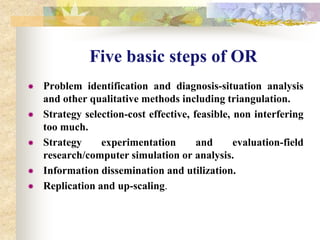
To provide information to improve/scale up existing services and plan future onesFive basic steps of ORProblem identification and diagnosis-situation analysis and other qualitative methods including triangulation.
Strategy selection-cost effective, feasible, non interfering too much.
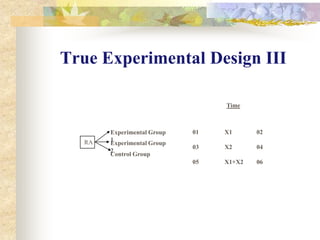
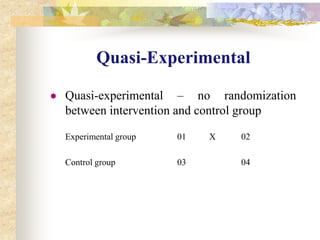
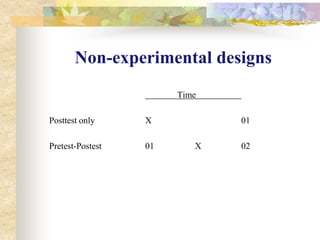
Strategy experimentation and evaluation-field research/computer simulation or analysis.
Information dissemination and utilization.
Replication and up-scaling.Step IProblem identification and diagnosis  
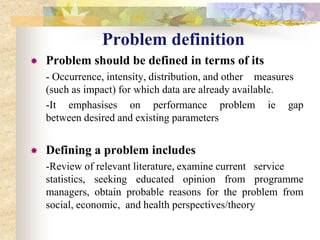
Problem definitionProblem should be defined in terms of its	- Occurrence, intensity, distribution, and other 	measures (such as impact) for which data are already available.      -It emphasises on performance problem ie gap           between desired and existing parametersDefining a problem includes	-Review of relevant literature, examine current 	service statistics, seeking educated opinion from programme managers, obtain probable reasons for the problem from social, economic,  and health perspectives/theory
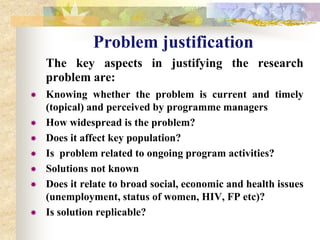
Problem justificationThe key aspects in justifying the research problem are:Knowing whether the problem is current and timely (topical) and perceived by programme managers
How widespread is the problem?
Does it affect key population?
Is  problem related to ongoing program activities?
Solutions not known
Does it relate to broad social, economic and health issues (unemployment, status of women, HIV, FP etc)?
Is solution replicable?Step IIStrategy selection
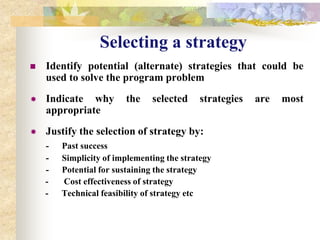
Selecting a strategyIdentify potential (alternate) strategies that could be used to solve the program problemIndicate why the selected strategies are most appropriate
Justify the selection of strategy by:-Past success	-	Simplicity of implementing the strategy	-	Potential for sustaining the strategy       -       Cost effectiveness of strategy       -      Technical feasibility of strategy etc
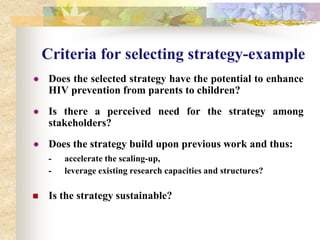
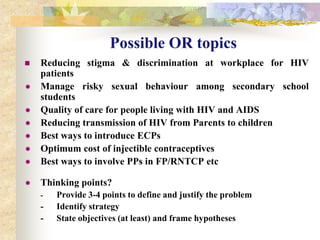
Criteria for selecting strategy-example Does the selected strategy have the potential to enhance HIV prevention from parents to children?
Is there a perceived need for the strategy among stakeholders?
Does the strategy build upon previous work and thus:-accelerate the scaling-up,	-	leverage existing research capacities and structures? Is the strategy sustainable?
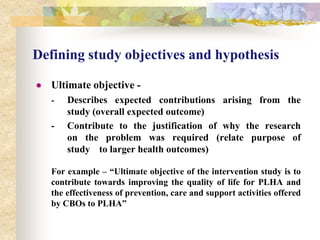
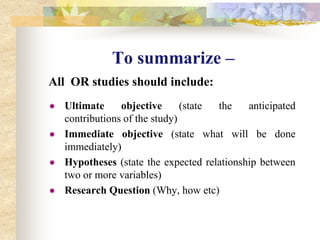
Defining study objectives and hypothesisUltimate objective -	-	Describes expected contributions arising from the 	study (overall expected outcome) 	-	Contribute to the justification of why the research 	on the problem was required (relate purpose of 	study 	to larger health outcomes)	For example – “Ultimate objective of the intervention study is to contribute towards improving the quality of life for PLHA and the effectiveness of prevention, care and support activities offered by CBOs to PLHA”
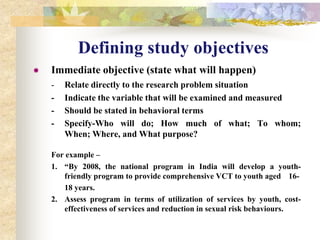
Defining study objectivesImmediate objective (state what will happen)         -	Relate directly to the research problem situation 	-	Indicate the variable that will be examined and measured 	-	Should be stated in behavioral terms	-	Specify-Who will do; How much of what; To whom; 	When; Where, and What purpose?For example – 	1.	“By 2008, the national program in India will develop a youth-	friendly program to provide comprehensive VCT to youth aged 	16-                  18 years. 	2.	Assess program in terms of utilization of services by youth, cost-	effectiveness of services and reduction in sexual risk behaviours.
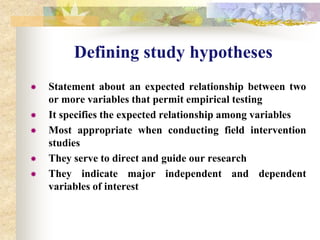
Defining study hypothesesStatement about an expected relationship between two or more variables that permit empirical testing
It specifies the expected relationship among variables
Most appropriate when conducting field intervention studies
They serve to direct and guide our research

Dr V K Tiwari

  • 1.
    Operations Research inHealth and Family Planning byProf V. K. Tiwari, NIHFW, N DelhiXIII Annual Conference of Indian Association of Preventive & Social Medicine, UP-UK Chapter, HIHT Dehradun25-9-2010
  • 2.
    Background of ORORUsed in second world war to precisely hit enemy targets by AmericansThereafter, focus shifted to Management problems in business and industriesDuring sixties, WHO and Population Council started OR applications in Health and Family Planning.
  • 3.
    What is operationsresearch?OR is the application of scientific methods, techniques and tools to problems involving the operations of a system so as to provide those in control of operations with optimum solutions to the problem.
  • 4.
    Goals of operationsresearch Provide program managers/policy makers with information to make decisions to improve program operations (to solve problems) eg:Increase efficiency, effectiveness and quality of service delivered by providers
  • 5.
    Increase availability, accessibilityand acceptability of services desired by usersFocus and Objectives of OR Focuses on:Day-to-day activities or ‘operations’ of Health, FP and HIV/AIDS programs etc
  • 6.
    Search for solutions Objectives:To yield answers to perceived program problems
  • 7.
    To seek practicalsolutions to problem situations
  • 8.
    To provide informationto improve/scale up existing services and plan future onesFive basic steps of ORProblem identification and diagnosis-situation analysis and other qualitative methods including triangulation.
  • 9.
    Strategy selection-cost effective,feasible, non interfering too much.
  • 10.
    Strategy experimentation andevaluation-field research/computer simulation or analysis.
  • 11.
  • 12.
    Replication and up-scaling.StepIProblem identification and diagnosis  
  • 13.
    Problem definitionProblem shouldbe defined in terms of its - Occurrence, intensity, distribution, and other measures (such as impact) for which data are already available. -It emphasises on performance problem ie gap between desired and existing parametersDefining a problem includes -Review of relevant literature, examine current service statistics, seeking educated opinion from programme managers, obtain probable reasons for the problem from social, economic, and health perspectives/theory
  • 14.
    Problem justificationThe keyaspects in justifying the research problem are:Knowing whether the problem is current and timely (topical) and perceived by programme managers
  • 15.
    How widespread isthe problem?
  • 16.
    Does it affectkey population?
  • 17.
    Is problemrelated to ongoing program activities?
  • 18.
  • 19.
    Does it relateto broad social, economic and health issues (unemployment, status of women, HIV, FP etc)?
  • 20.
    Is solution replicable?StepIIStrategy selection
  • 21.
    Selecting a strategyIdentifypotential (alternate) strategies that could be used to solve the program problemIndicate why the selected strategies are most appropriate
  • 22.
    Justify the selectionof strategy by:-Past success - Simplicity of implementing the strategy - Potential for sustaining the strategy - Cost effectiveness of strategy - Technical feasibility of strategy etc
  • 23.
    Criteria for selectingstrategy-example Does the selected strategy have the potential to enhance HIV prevention from parents to children?
  • 24.
    Is there aperceived need for the strategy among stakeholders?
  • 25.
    Does the strategybuild upon previous work and thus:-accelerate the scaling-up, - leverage existing research capacities and structures? Is the strategy sustainable?
  • 26.
    Defining study objectivesand hypothesisUltimate objective - - Describes expected contributions arising from the study (overall expected outcome) - Contribute to the justification of why the research on the problem was required (relate purpose of study to larger health outcomes) For example – “Ultimate objective of the intervention study is to contribute towards improving the quality of life for PLHA and the effectiveness of prevention, care and support activities offered by CBOs to PLHA”
  • 27.
    Defining study objectivesImmediateobjective (state what will happen)         - Relate directly to the research problem situation - Indicate the variable that will be examined and measured - Should be stated in behavioral terms - Specify-Who will do; How much of what; To whom; When; Where, and What purpose?For example – 1. “By 2008, the national program in India will develop a youth- friendly program to provide comprehensive VCT to youth aged 16- 18 years. 2. Assess program in terms of utilization of services by youth, cost- effectiveness of services and reduction in sexual risk behaviours.
  • 28.
    Defining study hypothesesStatementabout an expected relationship between two or more variables that permit empirical testing
  • 29.
    It specifies theexpected relationship among variables
  • 30.
    Most appropriate whenconducting field intervention studies
  • 31.
    They serve todirect and guide our research