Assessment Of Lipid Profile And Blood Glucose Levels In Cerebral Ischemic StrokeDr. Priti ChaturvediResidentDeptt. of BiochemistryHIHT University
IntroductionStroke is the third commonest cause of death worldwide Prevalence rate of stroke in India estimated at 203 per 100,000 population above 20 years (Anand K et al. 2001)Up to 85 % of all strokes are of ischemic origin. Atherosclerosis of the arteries, supplying  the brain is the most common cause of ischemic stroke.
In several studies, ischemic stroke was associated with hypercholesterolemia, hypertriglyceridemia and increased level of LDL-C. Whereas a low HDL-C level has been reported to be associated with ischemic stroke (Laloux et al. 2004; Sarkar et al. 2008 and Narang et al. 2009).
However, not all studies reported an association with hypercholesterolemia (Tilvis et al. 1987; Iso et al. 2002) or hypertriglyceridemia (Sidharam, 1992; Wannamethee et al. 2000; Sacco et al. 2001). While other studies reported an inconsistent association between ischemic stroke and T-Chol, LDL-C and HDL-C (Bowman at el. (2003); Shahar at el (2003).
Dalal PM (1997); in a multicentric, prospective, hospital-based case-control study in the West Central region of India revealed that diabetes mellitus, hypertension, tobacco use and low hemoglobin rather than cholesterol level were the most important risk factors of ischemic stroke.
Aims and objectivesTo estimate lipid profile and blood glucose levels in patients of ischemic stroke of less than 24 hours duration.To study an association of biochemical parameter with cerebral ischemic stroke.
Materials and Methods	Hospital based study was conducted on 50 diagnosed cases of cerebral ischemic stroke and compared with 25 healthy age matched controlsInclusion criteria:Age more than 18 yearsFirst onset of ischemic stroke (<24 hrs)Exclusion criteria:Stroke associated with MIStroke associated with CNS infectionBio chemical parameters :Lipid profileBlood glucose
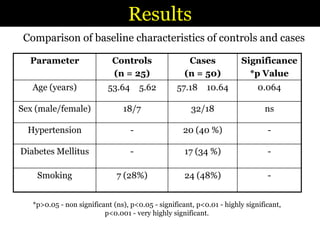
ResultsComparison of baseline characteristics of controls and cases*p>0.05 - non significant (ns), p<0.05 - significant, p<0.01 - highly significant,p<0.001 - very highly significant.
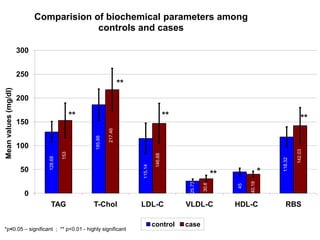
*********** *p<0.05 – significant  ;  ** p<0.01 - highly significant
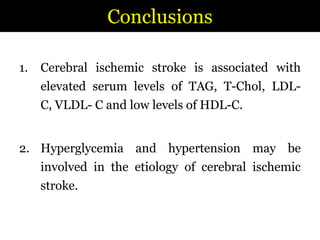
ConclusionsCerebral ischemic stroke is associated with elevated serum levels of TAG, T-Chol, LDL-C, VLDL- C and low levels of HDL-C. Hyperglycemia and hypertension may be involved in the etiology of cerebral ischemic stroke.

Dr Priti

  • 1.
    Assessment Of LipidProfile And Blood Glucose Levels In Cerebral Ischemic StrokeDr. Priti ChaturvediResidentDeptt. of BiochemistryHIHT University
  • 2.
    IntroductionStroke is thethird commonest cause of death worldwide Prevalence rate of stroke in India estimated at 203 per 100,000 population above 20 years (Anand K et al. 2001)Up to 85 % of all strokes are of ischemic origin. Atherosclerosis of the arteries, supplying the brain is the most common cause of ischemic stroke.
  • 3.
    In several studies,ischemic stroke was associated with hypercholesterolemia, hypertriglyceridemia and increased level of LDL-C. Whereas a low HDL-C level has been reported to be associated with ischemic stroke (Laloux et al. 2004; Sarkar et al. 2008 and Narang et al. 2009).
  • 4.
    However, not allstudies reported an association with hypercholesterolemia (Tilvis et al. 1987; Iso et al. 2002) or hypertriglyceridemia (Sidharam, 1992; Wannamethee et al. 2000; Sacco et al. 2001). While other studies reported an inconsistent association between ischemic stroke and T-Chol, LDL-C and HDL-C (Bowman at el. (2003); Shahar at el (2003).
  • 5.
    Dalal PM (1997);in a multicentric, prospective, hospital-based case-control study in the West Central region of India revealed that diabetes mellitus, hypertension, tobacco use and low hemoglobin rather than cholesterol level were the most important risk factors of ischemic stroke.
  • 6.
    Aims and objectivesToestimate lipid profile and blood glucose levels in patients of ischemic stroke of less than 24 hours duration.To study an association of biochemical parameter with cerebral ischemic stroke.
  • 7.
    Materials and Methods Hospitalbased study was conducted on 50 diagnosed cases of cerebral ischemic stroke and compared with 25 healthy age matched controlsInclusion criteria:Age more than 18 yearsFirst onset of ischemic stroke (<24 hrs)Exclusion criteria:Stroke associated with MIStroke associated with CNS infectionBio chemical parameters :Lipid profileBlood glucose
  • 8.
    ResultsComparison of baselinecharacteristics of controls and cases*p>0.05 - non significant (ns), p<0.05 - significant, p<0.01 - highly significant,p<0.001 - very highly significant.
  • 9.
    *********** *p<0.05 –significant ; ** p<0.01 - highly significant
  • 10.
    ConclusionsCerebral ischemic strokeis associated with elevated serum levels of TAG, T-Chol, LDL-C, VLDL- C and low levels of HDL-C. Hyperglycemia and hypertension may be involved in the etiology of cerebral ischemic stroke.