
Assessing Risk of Bias during
Systematic Review
Prabesh Ghimire
MPH
What is Bias?
• Systematic error
• Deviation from the truth (in results and
inferences)
• May be
– Trivial
– Substantial
• Can lead to
– Underestimation of effect
– Overestimation of effect
2
Significance of assessing bias in
systematic review
• Difference in risk of bias are related to
variation in the results of studies included in
systematic review.
• All results may be consistent among
themselves, but all studies could be flawed
due to bias.
3
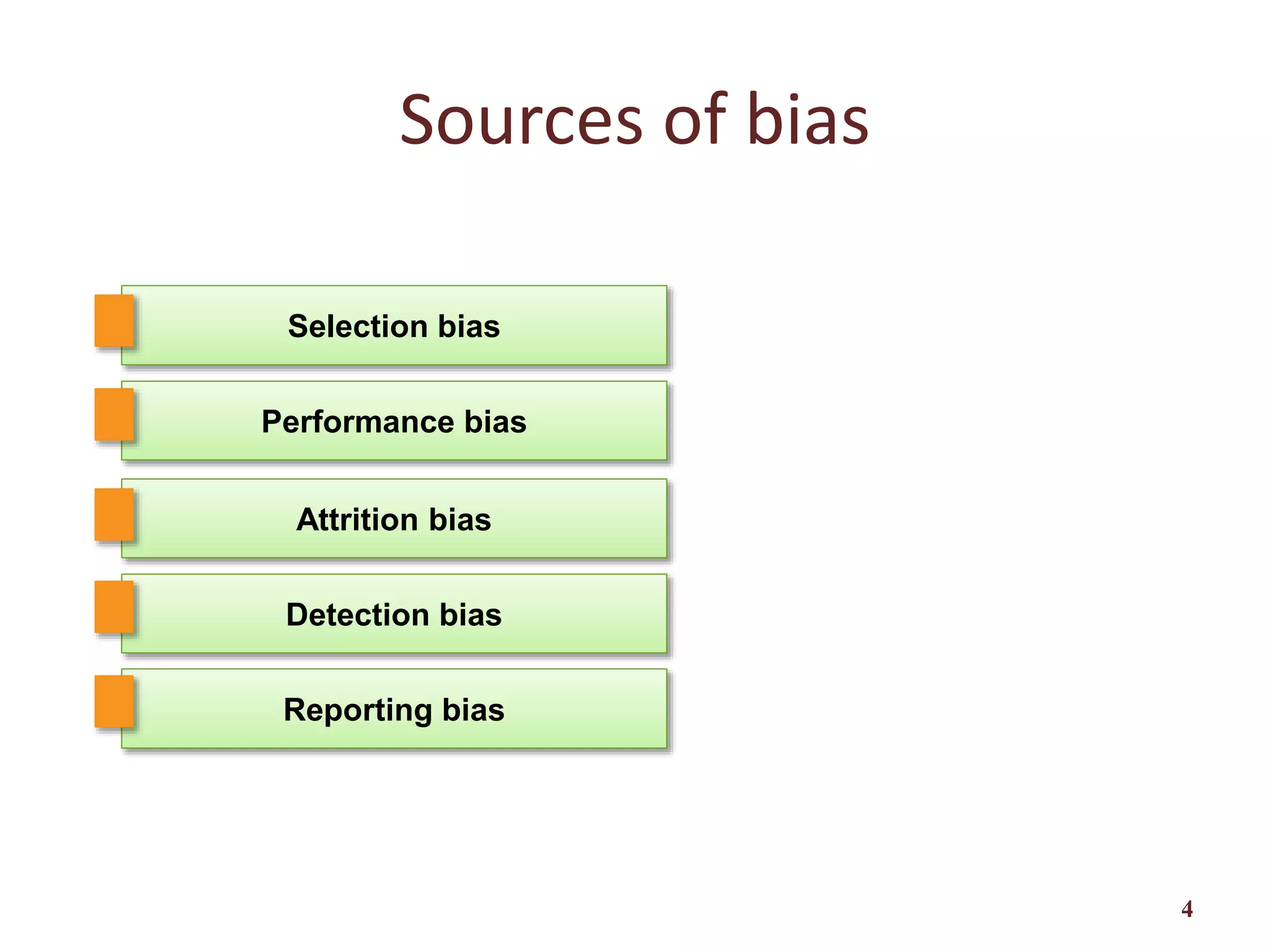
Sources of bias
Selection bias
Reporting bias
Attrition bias
Performance bias
Detection bias
4
Sources of bias
5
Selection bias
Reporting bias
Attrition bias
Performance bias
Detection bias
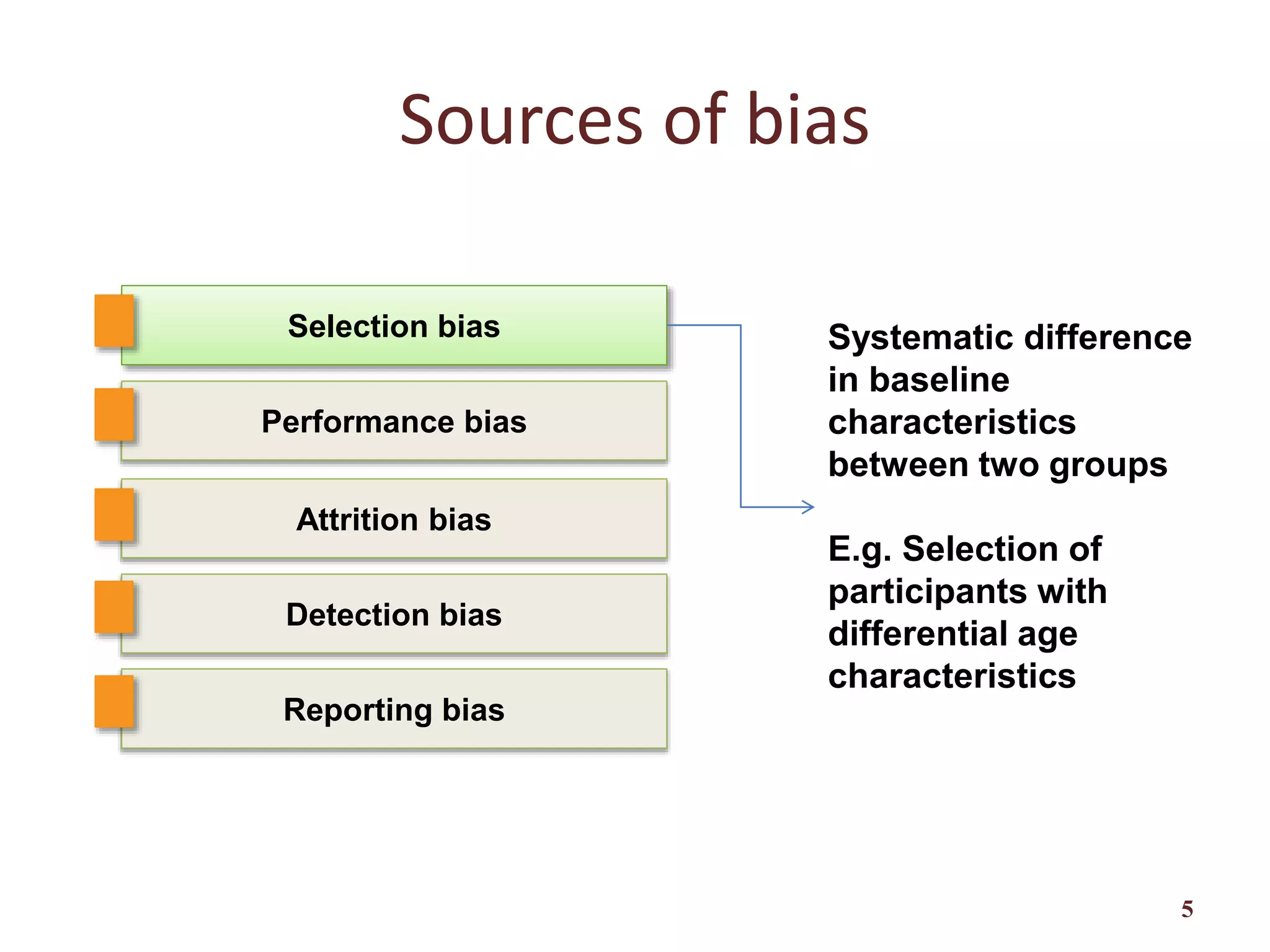
Systematic difference
in baseline
characteristics
between two groups
E.g. Selection of
participants with
differential age
characteristics
Sources of bias
6
Selection bias
Reporting bias
Attrition bias
Performance bias
Detection bias
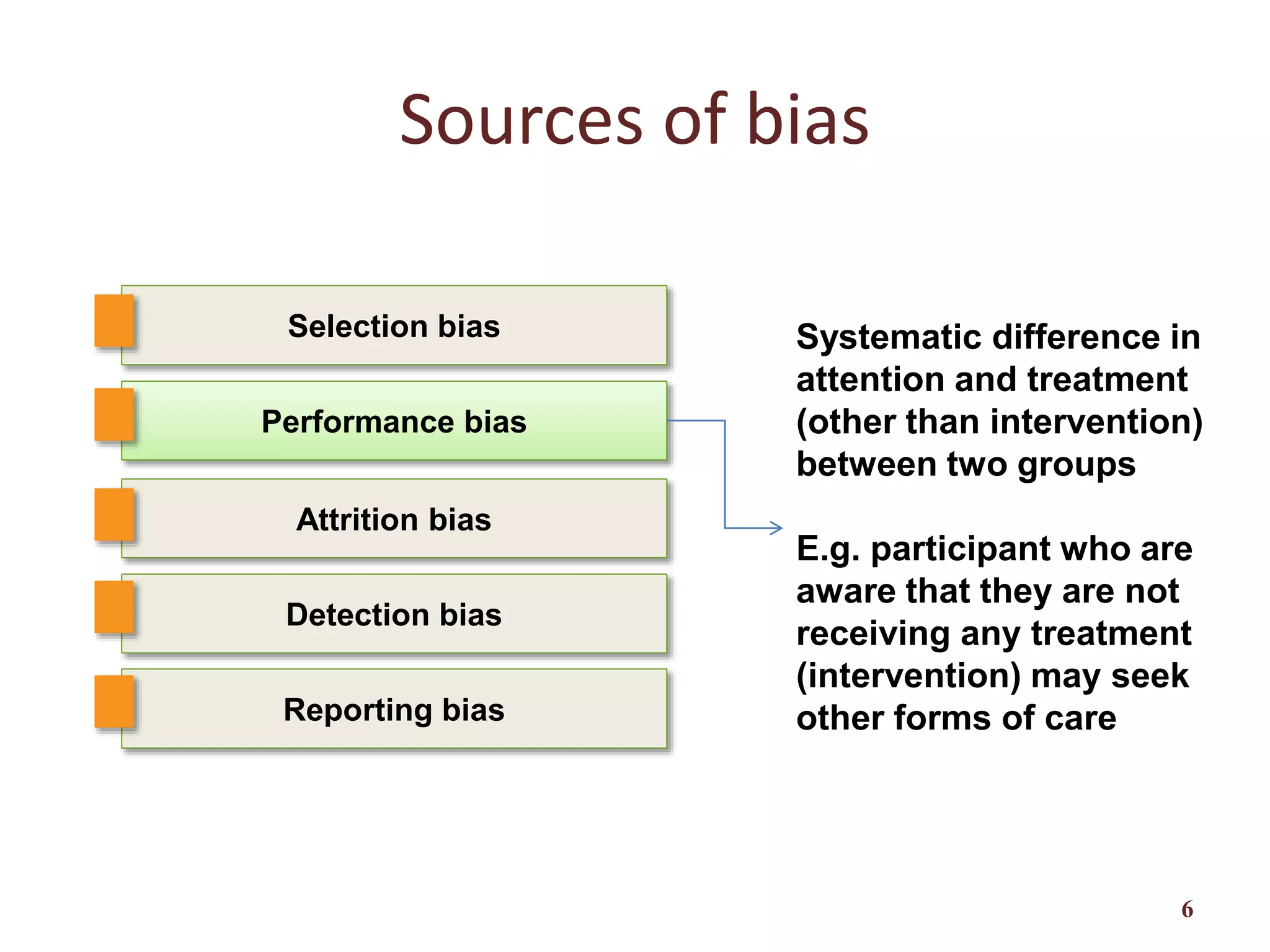
Systematic difference in
attention and treatment
(other than intervention)
between two groups
E.g. participant who are
aware that they are not
receiving any treatment
(intervention) may seek
other forms of care
Sources of bias
7
Selection bias
Reporting bias
Attrition bias
Performance bias
Detection bias
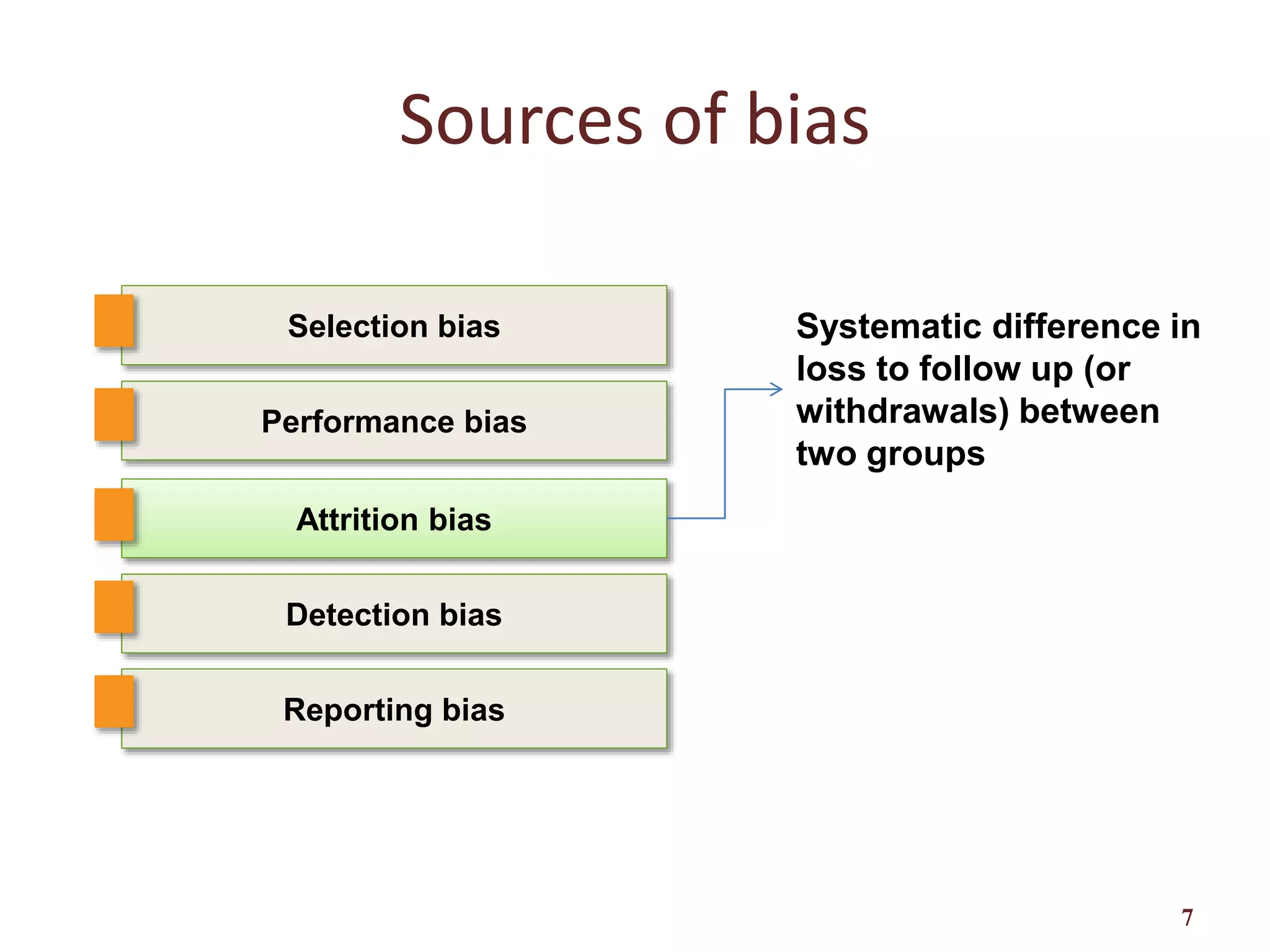
Systematic difference in
loss to follow up (or
withdrawals) between
two groups
Detection bias
Attrition bias
Sources of bias
8
Selection bias
Reporting bias
Performance bias
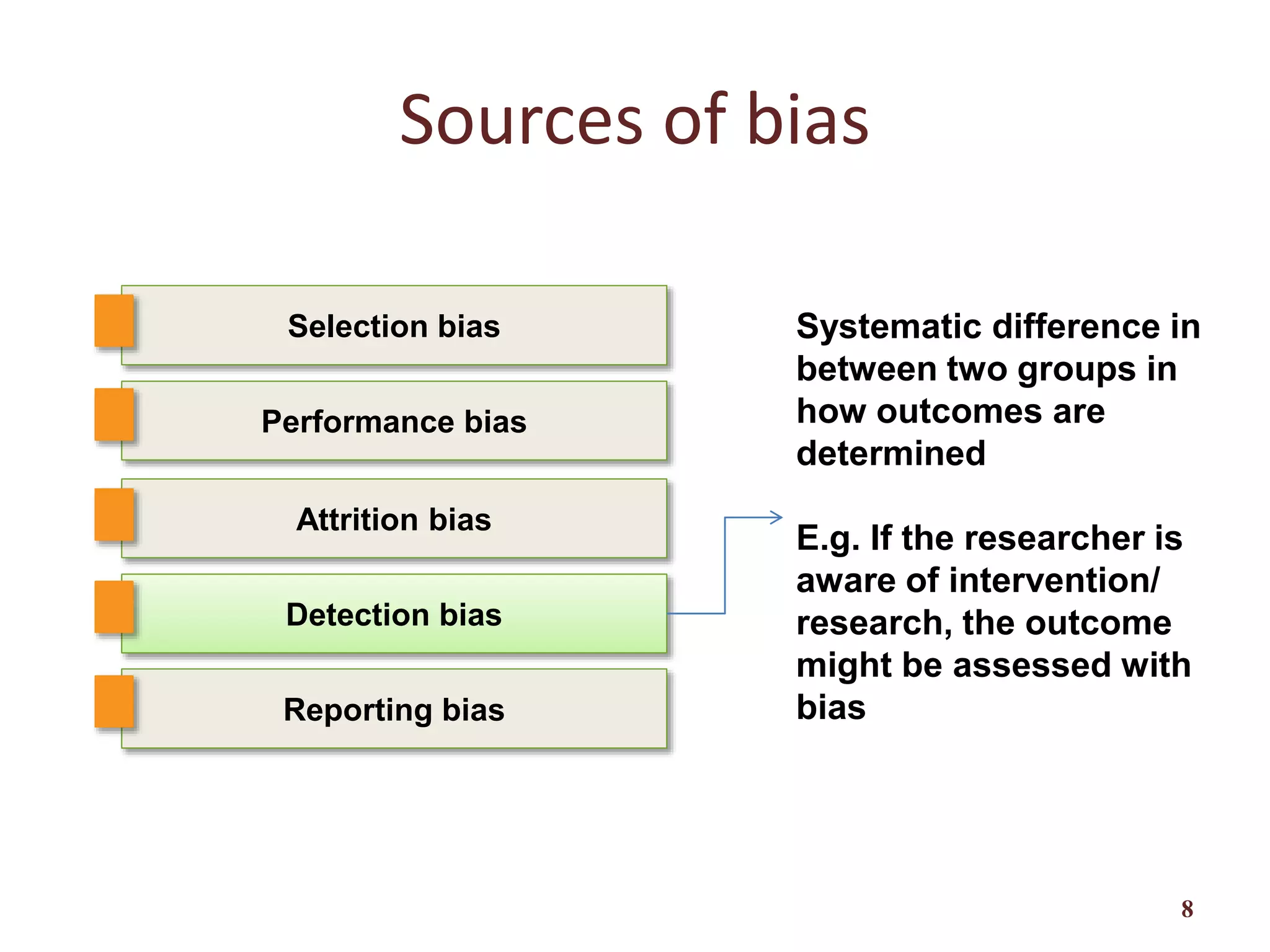
Systematic difference in
between two groups in
how outcomes are
determined
E.g. If the researcher is
aware of intervention/
research, the outcome
might be assessed with
bias
Sources of bias
9
Selection bias
Reporting bias
Attrition bias
Performance bias
Detection bias
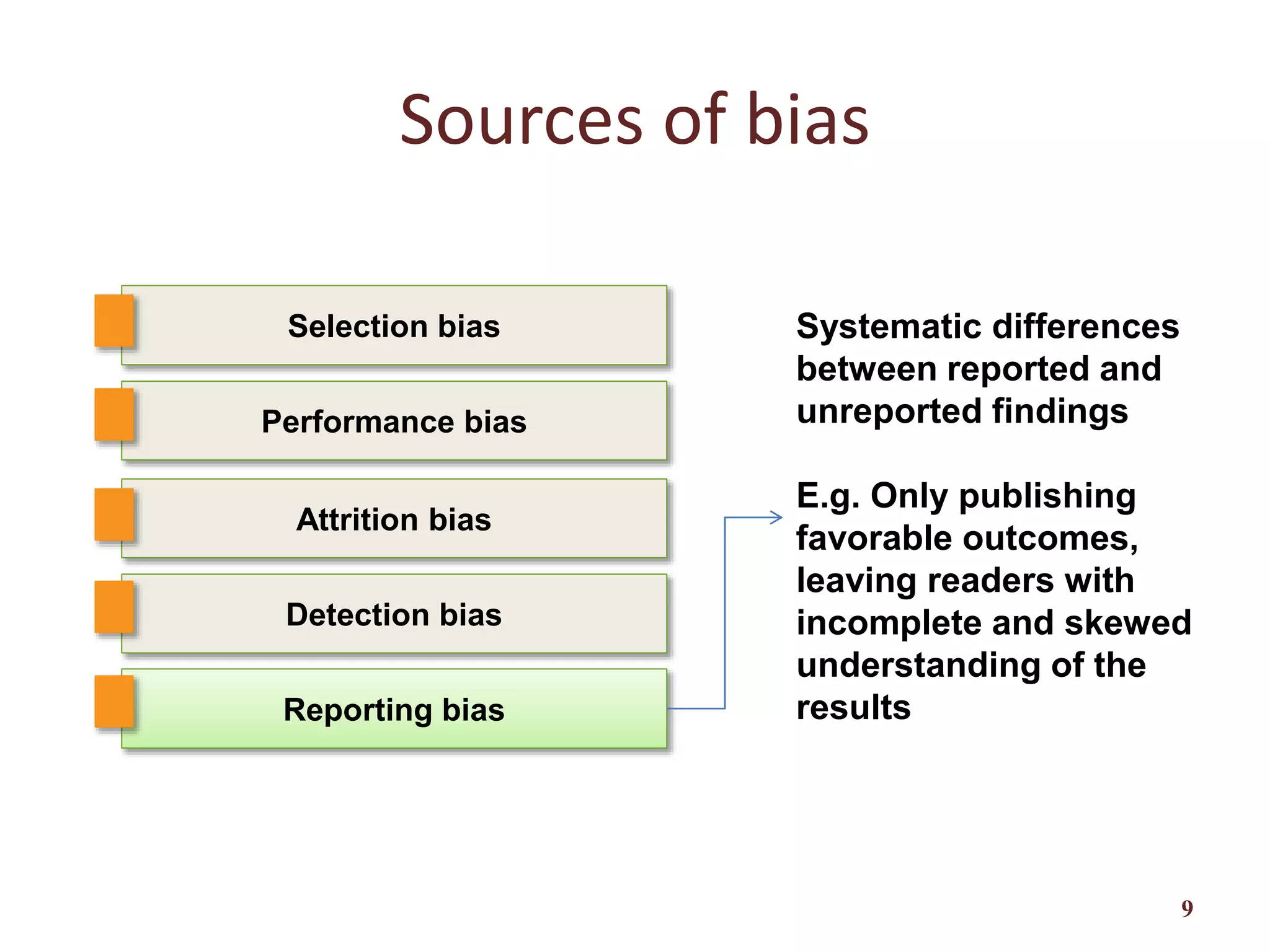
Systematic differences
between reported and
unreported findings
E.g. Only publishing
favorable outcomes,
leaving readers with
incomplete and skewed
understanding of the
results
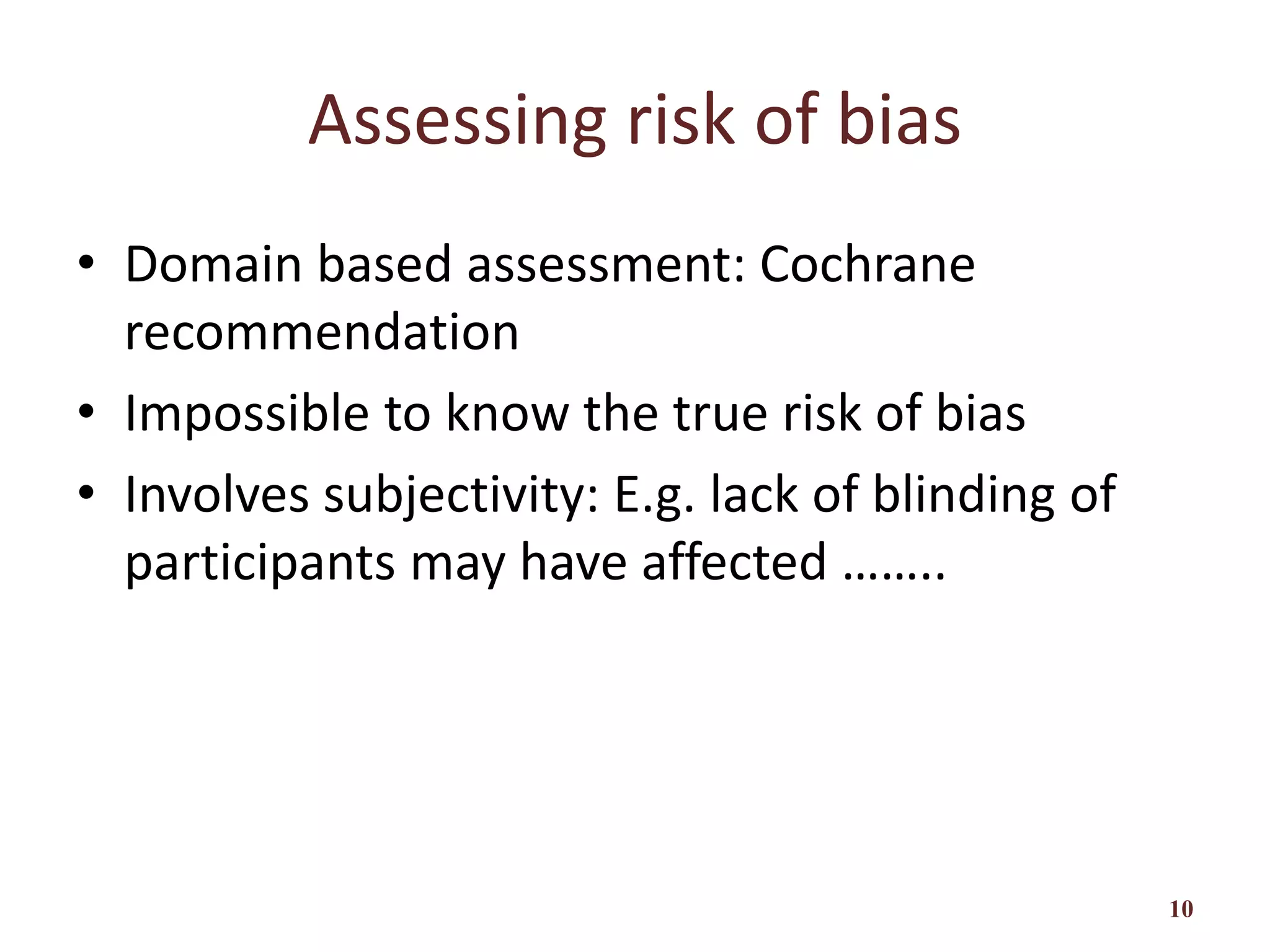
Assessing risk of bias
• Domain based assessment: Cochrane
recommendation
• Impossible to know the true risk of bias
• Involves subjectivity: E.g. lack of blinding of
participants may have affected ……..
10
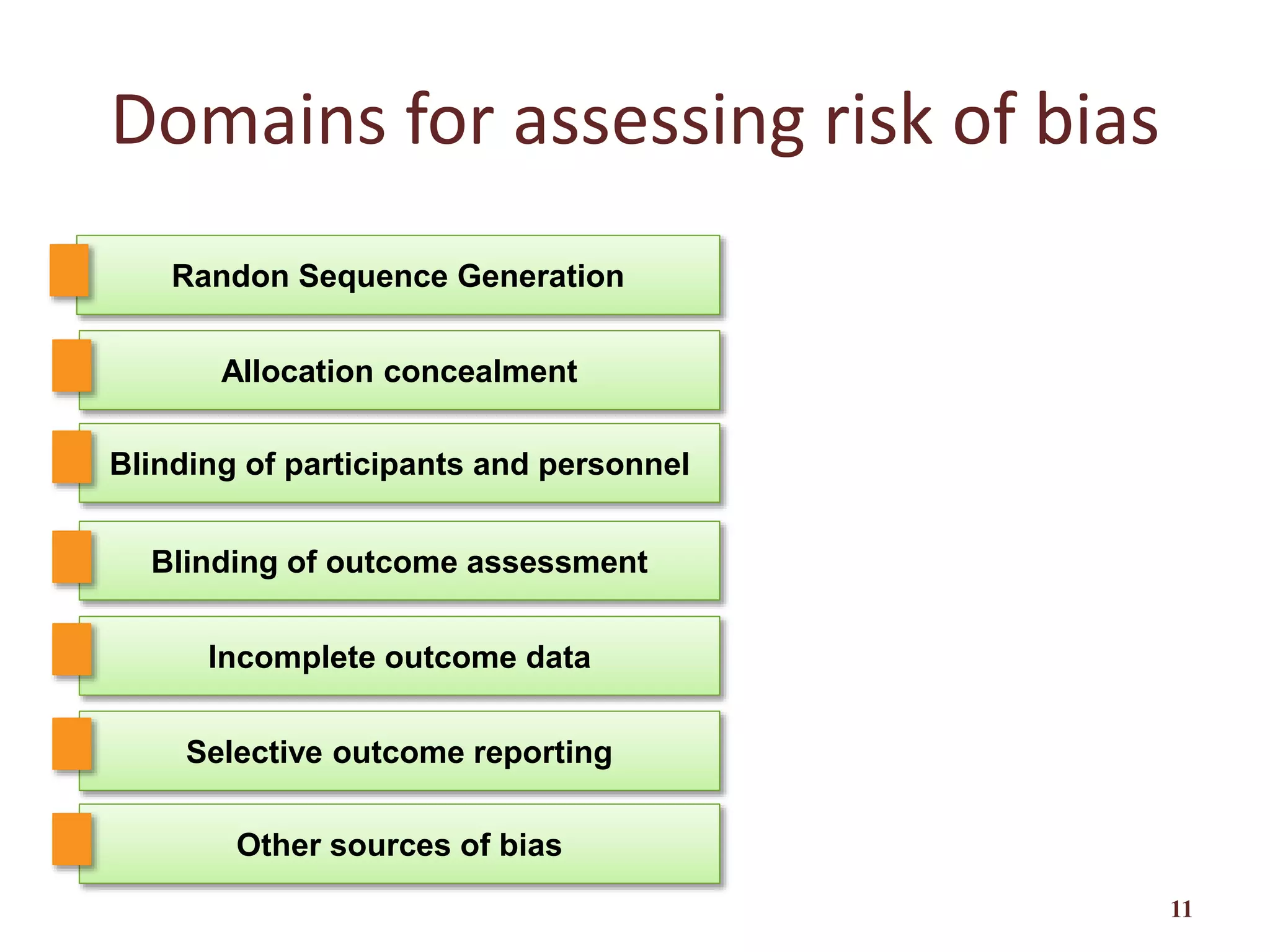
Domains for assessing risk of bias
11
Allocation concealment
Selective outcome reporting
Blinding of outcome assessment
Blinding of participants and personnel
Incomplete outcome data
Randon Sequence Generation
Other sources of bias
12
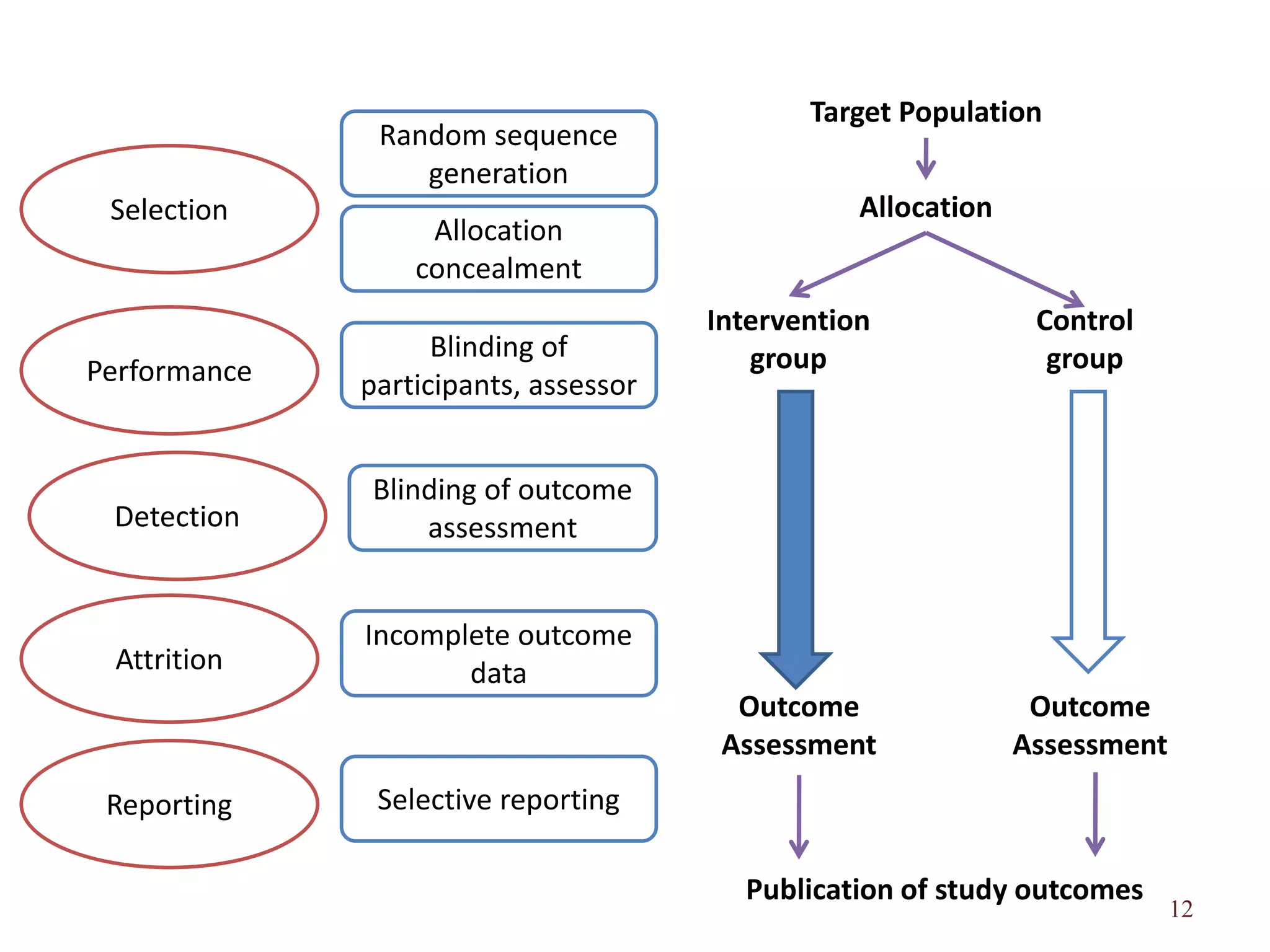
Selection
Allocation
concealment
Target Population
Allocation
Intervention
group
Control
group
Outcome
Assessment
Outcome
Assessment
Publication of study outcomes
Reporting Selective reporting
Attrition
Incomplete outcome
data
Detection
Blinding of outcome
assessment
Performance
Blinding of
participants, assessor
Random sequence
generation
How to assess risk of bias
• Reviewing author’s judgment in the article
• Searching for clues to bias
• Looking for missing information
– Reviewing study protocol
– Contacting authors
13
Random Sequence Generation
• Random assignment of people into intervention
and control groups
• Avoids selection bias and confounders (both
known and unknown)
Fundamental questions:
• Was the allocation sequence adequately
generated?
• What were the methods used to generate
allocation sequence?
14
Judgment:
Random Sequence Generation
• Low risk of bias if allocation done by
– Referring to a random number table
– Using Computer random number generator used
– Coin tossing
– Shuffling cards or envelopes
– Throwing dice
15
Judgment:
Random Sequence Generation
• High risk of bias if
– Sequence generated by odd or even date of birth,
day of visit, etc.
– Allocation by judgment of clinician, participant
– Allocation based on results of laboratory test
16
Allocation Concealment
• Concealing allocation sequence from those
assigning participants to intervention groups,
until the moment of assignment
• Ensures that patients enroll into a study without
knowing which group they will be assigned to.
• If the researcher knows the next patient will be
allocated to intervention, he/she may try to help
a certain patient whom he thinks will benefit
more from intervention.
17
Allocation concealment
Fundamental questions
• Was the allocation adequately concealed?
• What methods are used to conceal the
allocation sequence?
• Could intervention allocations have been
foreseen in advance of, or during enrolment?
18
Judgment:
Allocation Concealment
• Low risk of bias if
– Central allocation (including telephone, web-
based and pharmacy-controlled randomization)
– Sequentially numbered drug containers of
identical appearance
– Sequentially numbered, opaque, sealed
envelopes.
19
Judgment:
Allocation Concealment
• High risk of bias if
– Open random allocation schedule (e.g. list of
random numbers)
– Unsealed or non-opaque envelopes
– Date of birth
– Case record number
20
Blinding of participants, personnel &
outcome assessors
• Masking of participants & assessor from
knowledge about which intervention was
received.
• Ensures control group receive similar amount
of attention, ancillary treatment and
investigations
• Avoids performance and detection bias
21
Blinding of participants, personnel &
outcome assessors
Fundamental questions
• Was knowledge of the allocated intervention
adequately prevented during the study?
• What measures were used for blinding?
• Is it likely that blinding was broken?
22
Judgment: Blinding
• Low risk of bias if
– No blinding or incomplete blinding, but outcome
unlikely to be influenced
– Blinding done, and unlikely that the blinding could
have been broken
– No blinding, but outcome assessment blinded and
non-blinding unlikely to introduce bias
23
Judgment: Blinding
• High risk of bias if
– No blinding or incomplete blinding, and outcome
likely to be influenced
– Blinding done, but likely that the blinding could
have been broken
24
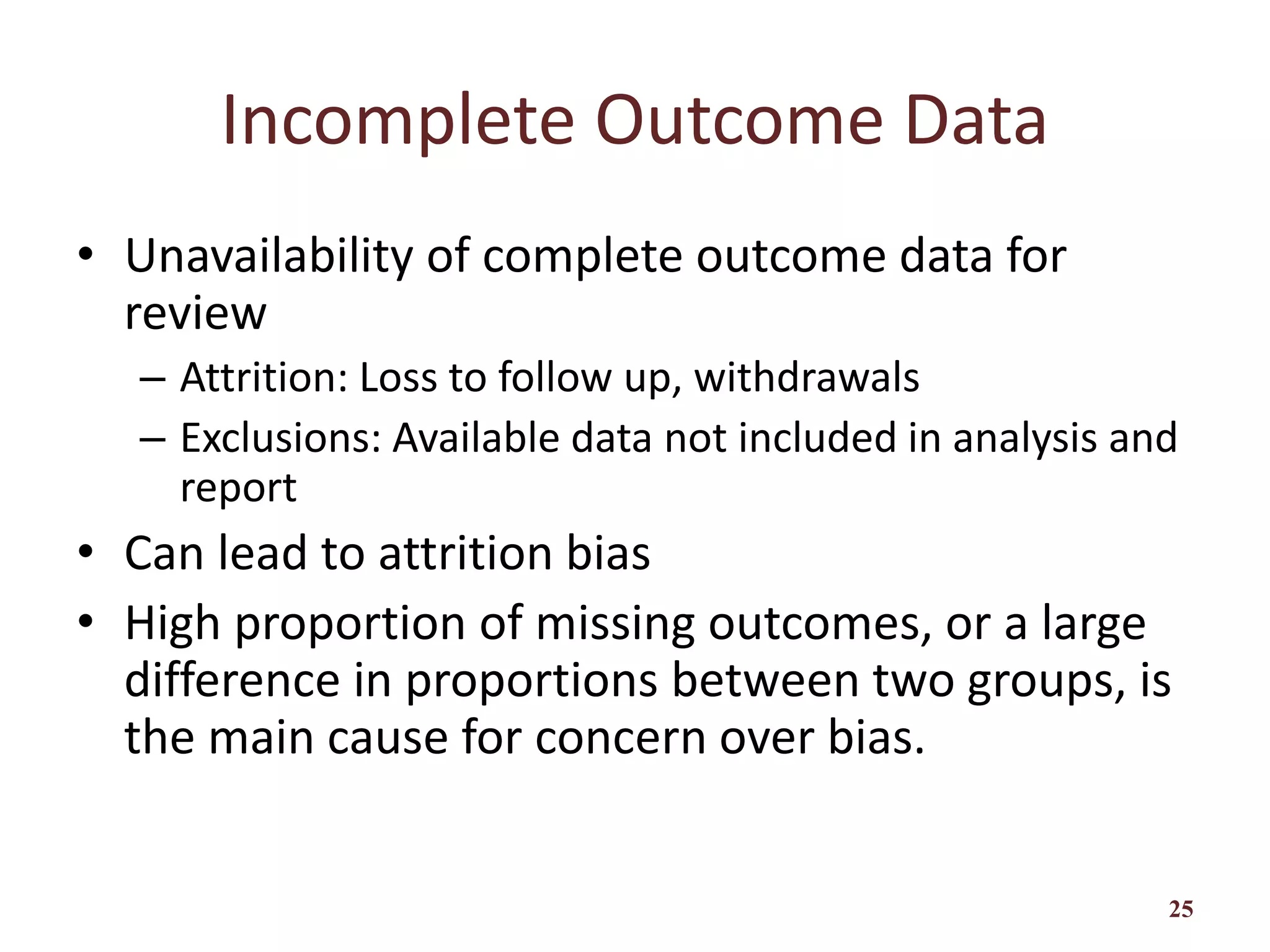
Incomplete Outcome Data
• Unavailability of complete outcome data for
review
– Attrition: Loss to follow up, withdrawals
– Exclusions: Available data not included in analysis and
report
• Can lead to attrition bias
• High proportion of missing outcomes, or a large
difference in proportions between two groups, is
the main cause for concern over bias.
25
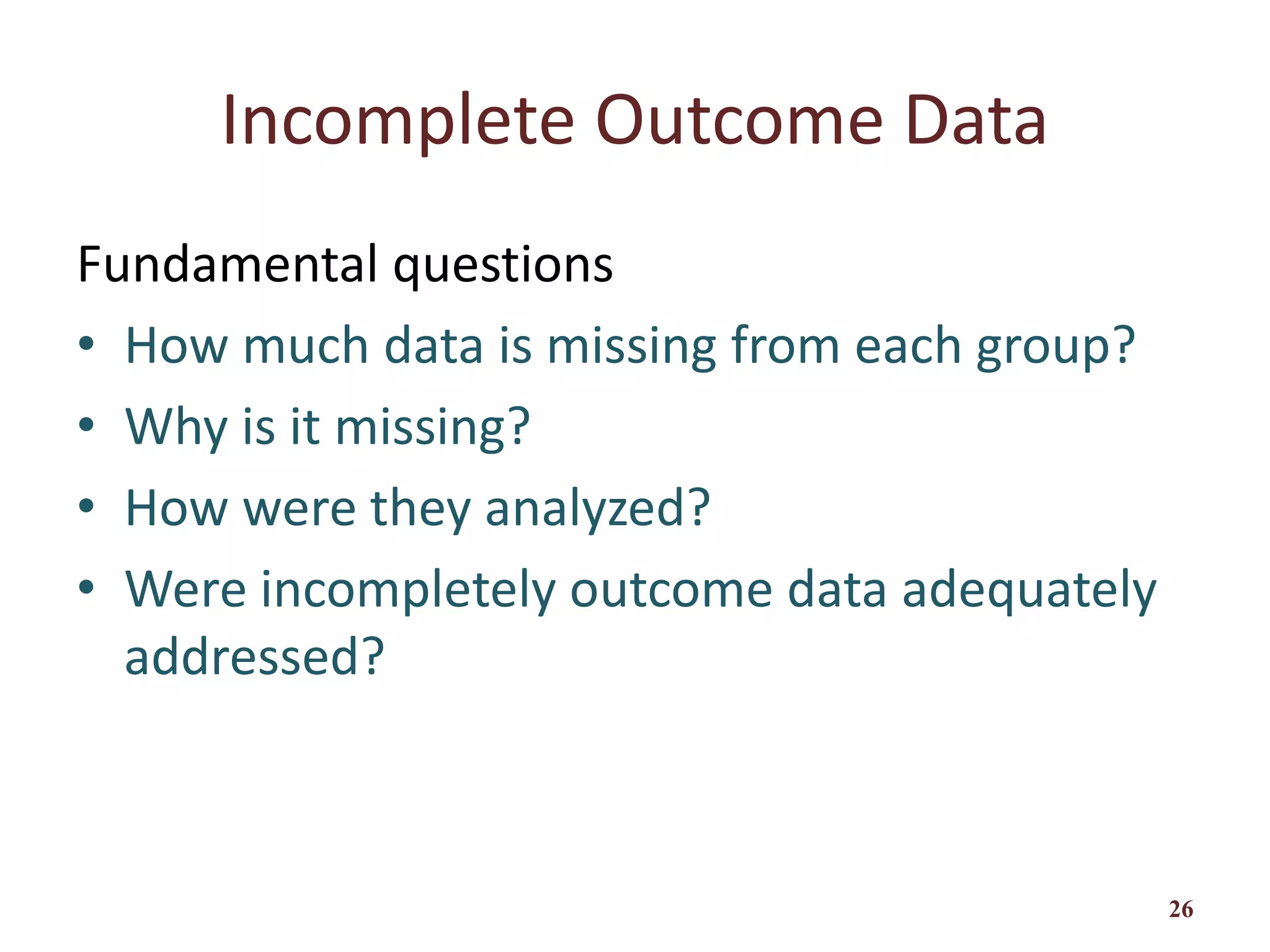
Incomplete Outcome Data
Fundamental questions
• How much data is missing from each group?
• Why is it missing?
• How were they analyzed?
• Were incompletely outcome data adequately
addressed?
26
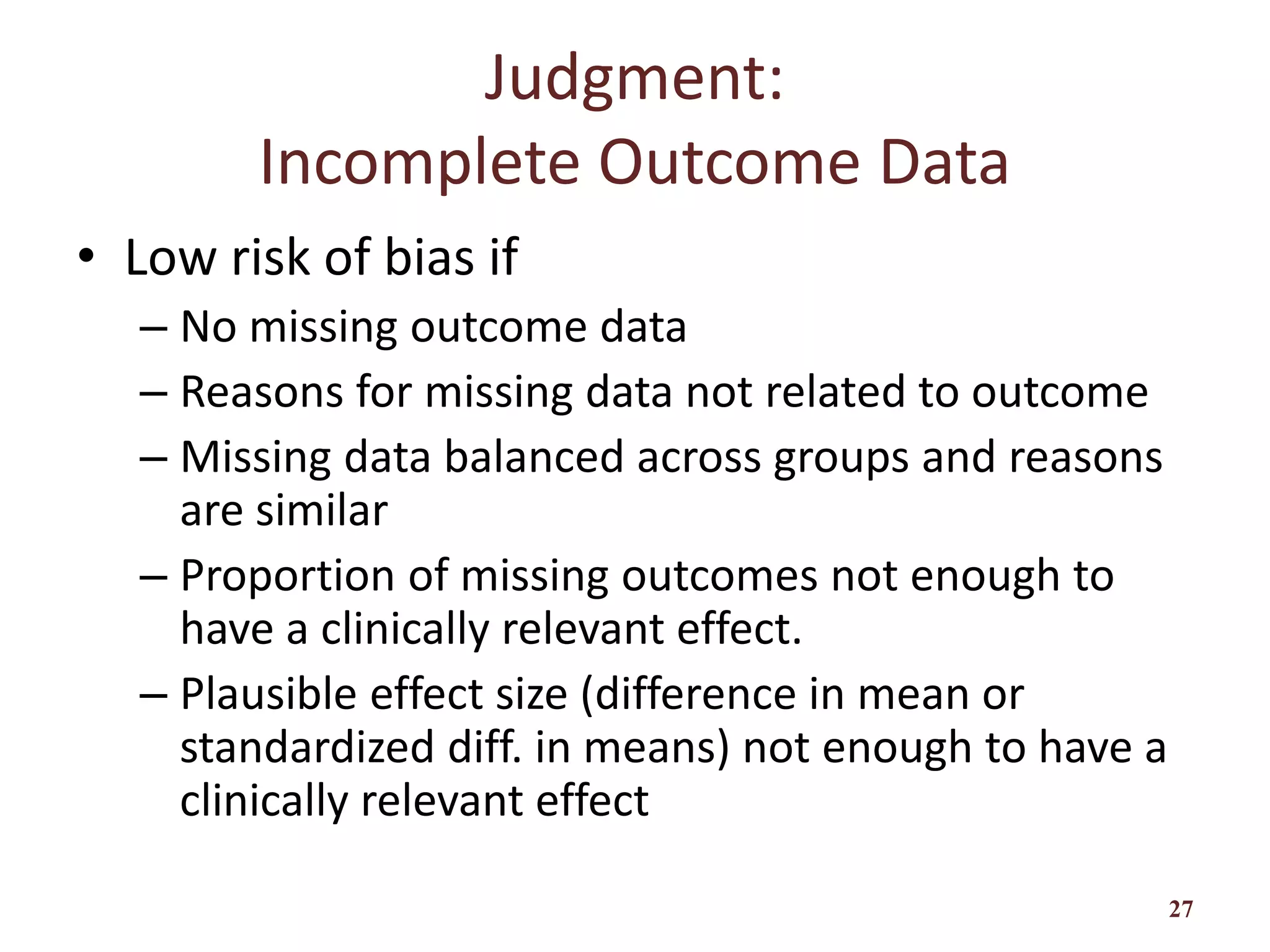
Judgment:
Incomplete Outcome Data
• Low risk of bias if
– No missing outcome data
– Reasons for missing data not related to outcome
– Missing data balanced across groups and reasons
are similar
– Proportion of missing outcomes not enough to
have a clinically relevant effect.
– Plausible effect size (difference in mean or
standardized diff. in means) not enough to have a
clinically relevant effect
27
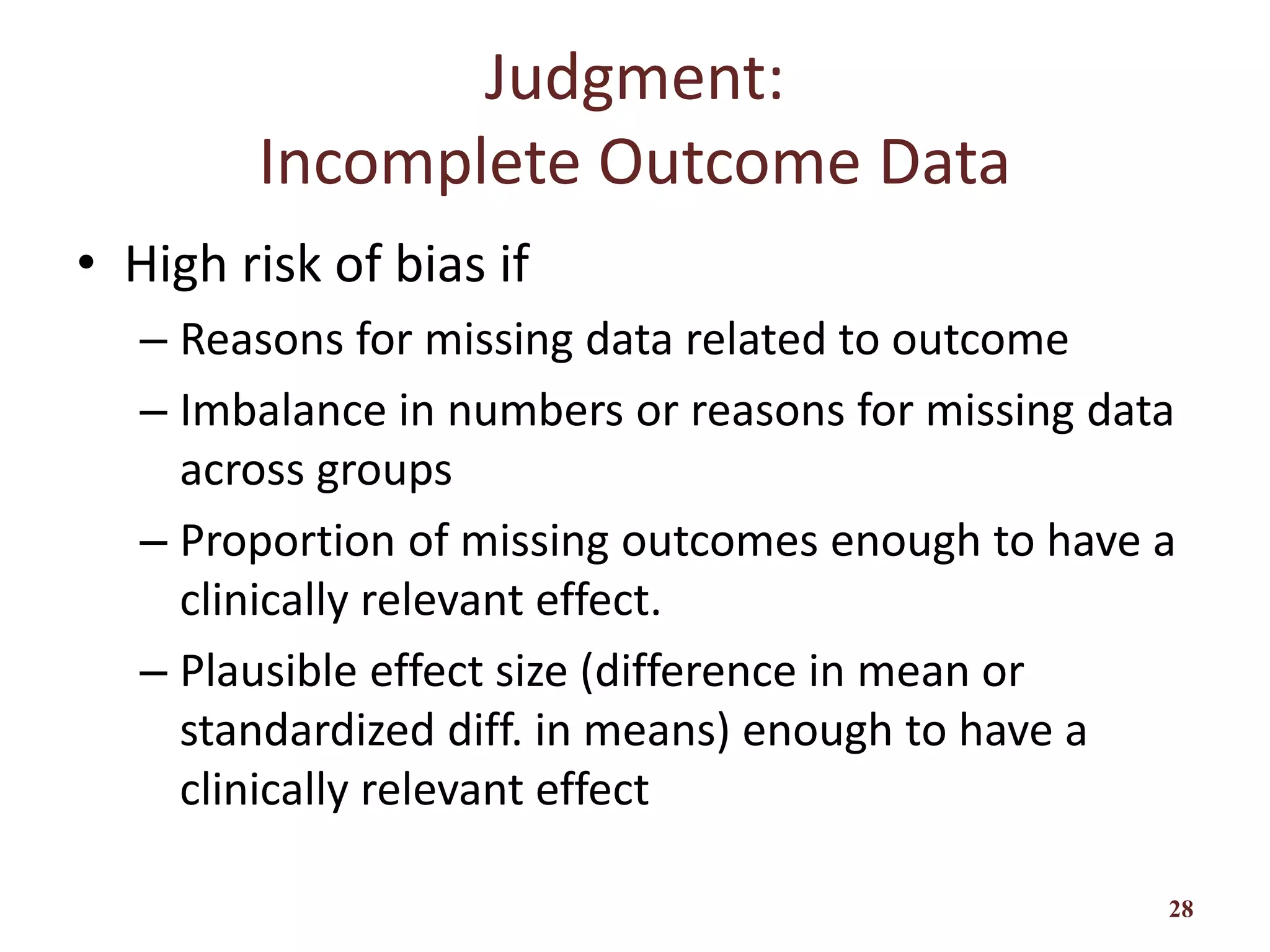
Judgment:
Incomplete Outcome Data
• High risk of bias if
– Reasons for missing data related to outcome
– Imbalance in numbers or reasons for missing data
across groups
– Proportion of missing outcomes enough to have a
clinically relevant effect.
– Plausible effect size (difference in mean or
standardized diff. in means) enough to have a
clinically relevant effect
28
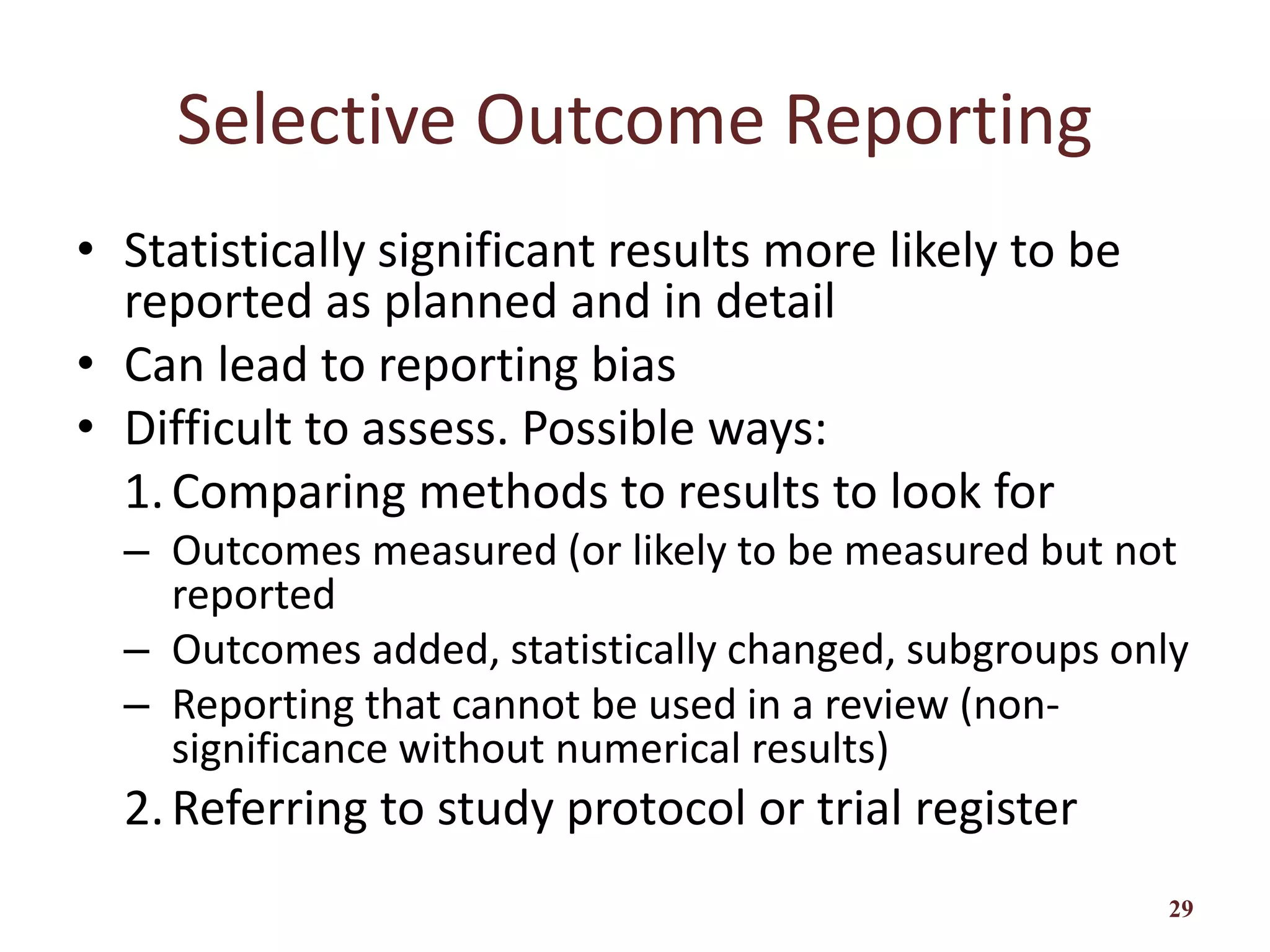
Selective Outcome Reporting
• Statistically significant results more likely to be
reported as planned and in detail
• Can lead to reporting bias
• Difficult to assess. Possible ways:
1.Comparing methods to results to look for
– Outcomes measured (or likely to be measured but not
reported
– Outcomes added, statistically changed, subgroups only
– Reporting that cannot be used in a review (non-
significance without numerical results)
2.Referring to study protocol or trial register
29
Selective Outcome Reporting
Fundamental Question
• Are reports of the study free of suggestion of
selective outcome reporting?
30
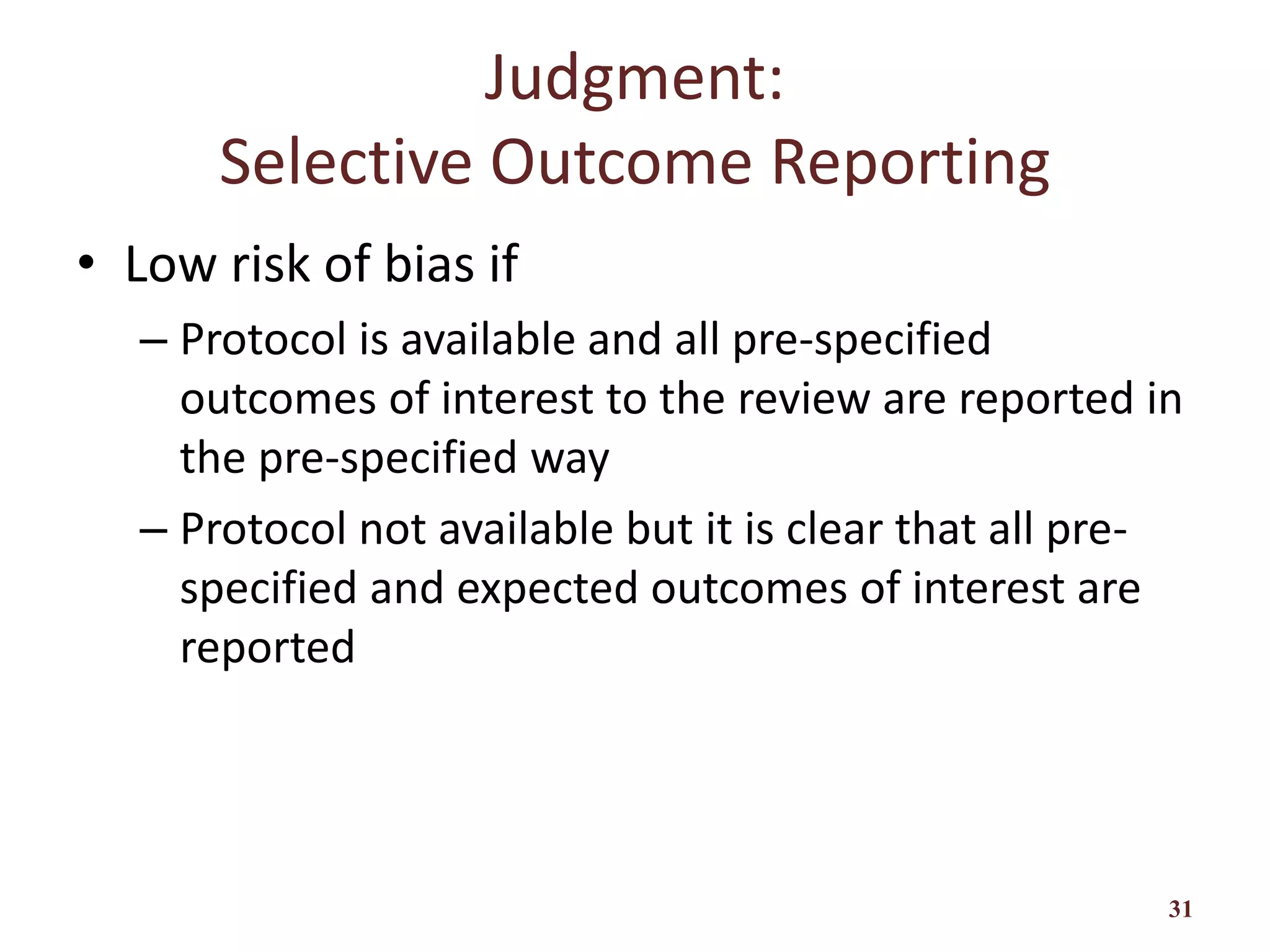
Judgment:
Selective Outcome Reporting
• Low risk of bias if
– Protocol is available and all pre-specified
outcomes of interest to the review are reported in
the pre-specified way
– Protocol not available but it is clear that all pre-
specified and expected outcomes of interest are
reported
31
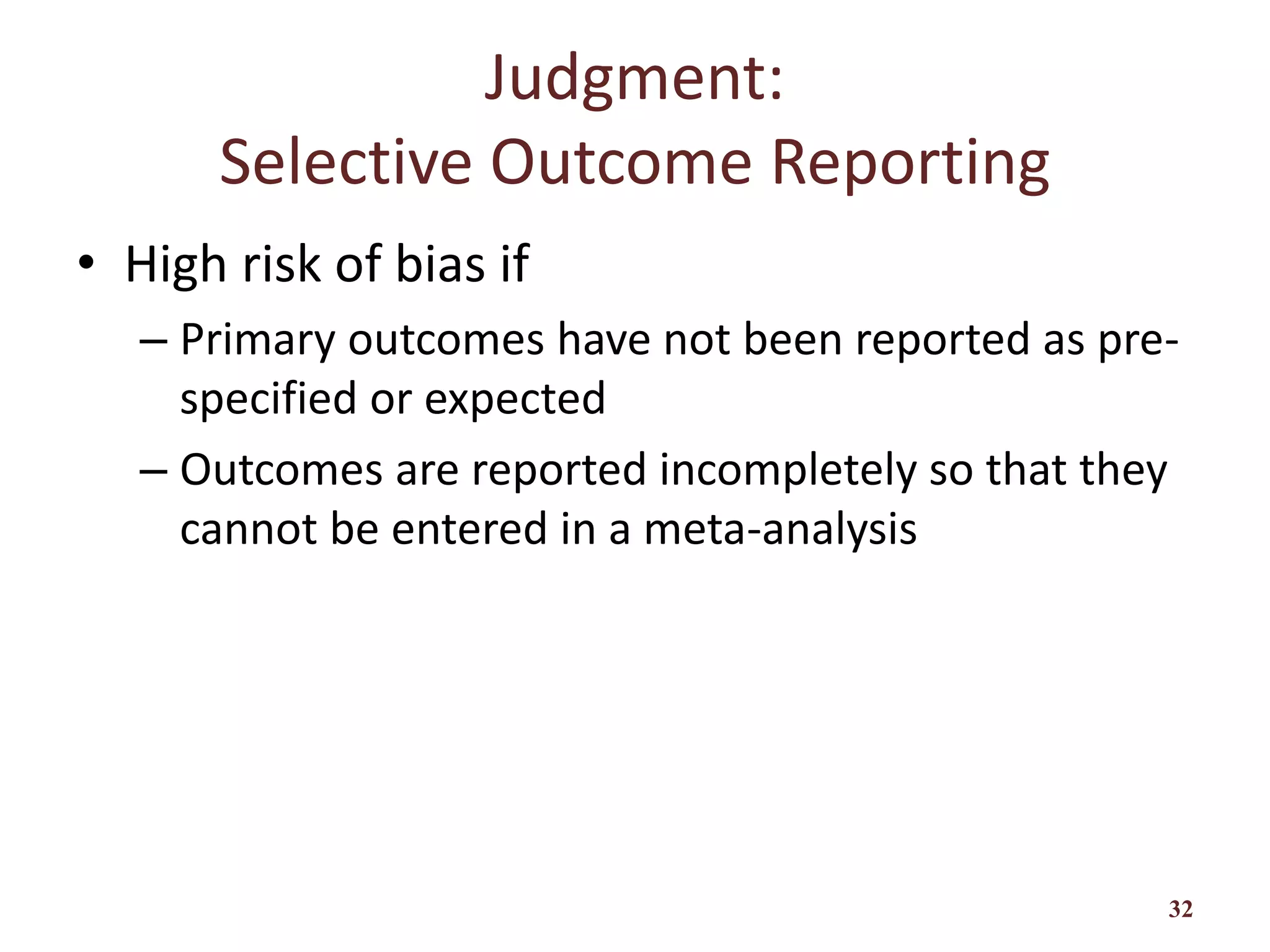
Judgment:
Selective Outcome Reporting
• High risk of bias if
– Primary outcomes have not been reported as pre-
specified or expected
– Outcomes are reported incompletely so that they
cannot be entered in a meta-analysis
32
Other threats to Validity
• Bias due to other problems not covered
elsewhere above.
33
Other threats to Validity
Fundamental Question
• Was the study prone to problems that could
put it at a high risk of bias?
34
Judgment:
Other threats to validity
• Low risk of bias if
– The study appears to be free of other sources of
bias
• High risk of bias if
– Has a potential source of bias related to the
specific design used
– Had extreme baseline imbalance
– Claimed to have been fraudulent
35
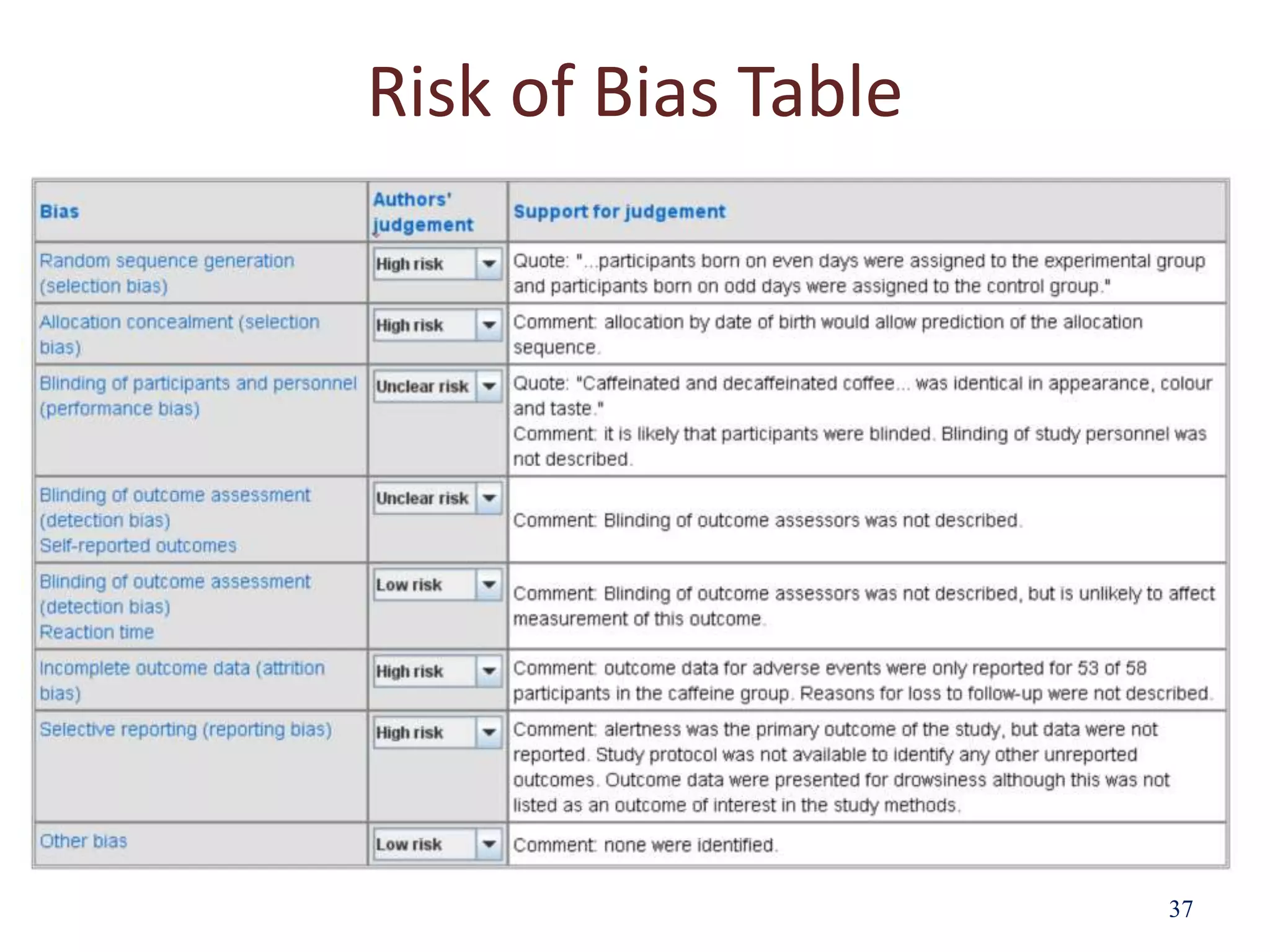
Tool for Assessment
Risk of bias table (RevMan)
• Categorizes each domain into
– Low risk
– High risk
– Unclear
• Support for judgment
– Direct quotes from article
– Additional comments with rationale
• One for each study reviewed
36
37
Risk of Bias Table
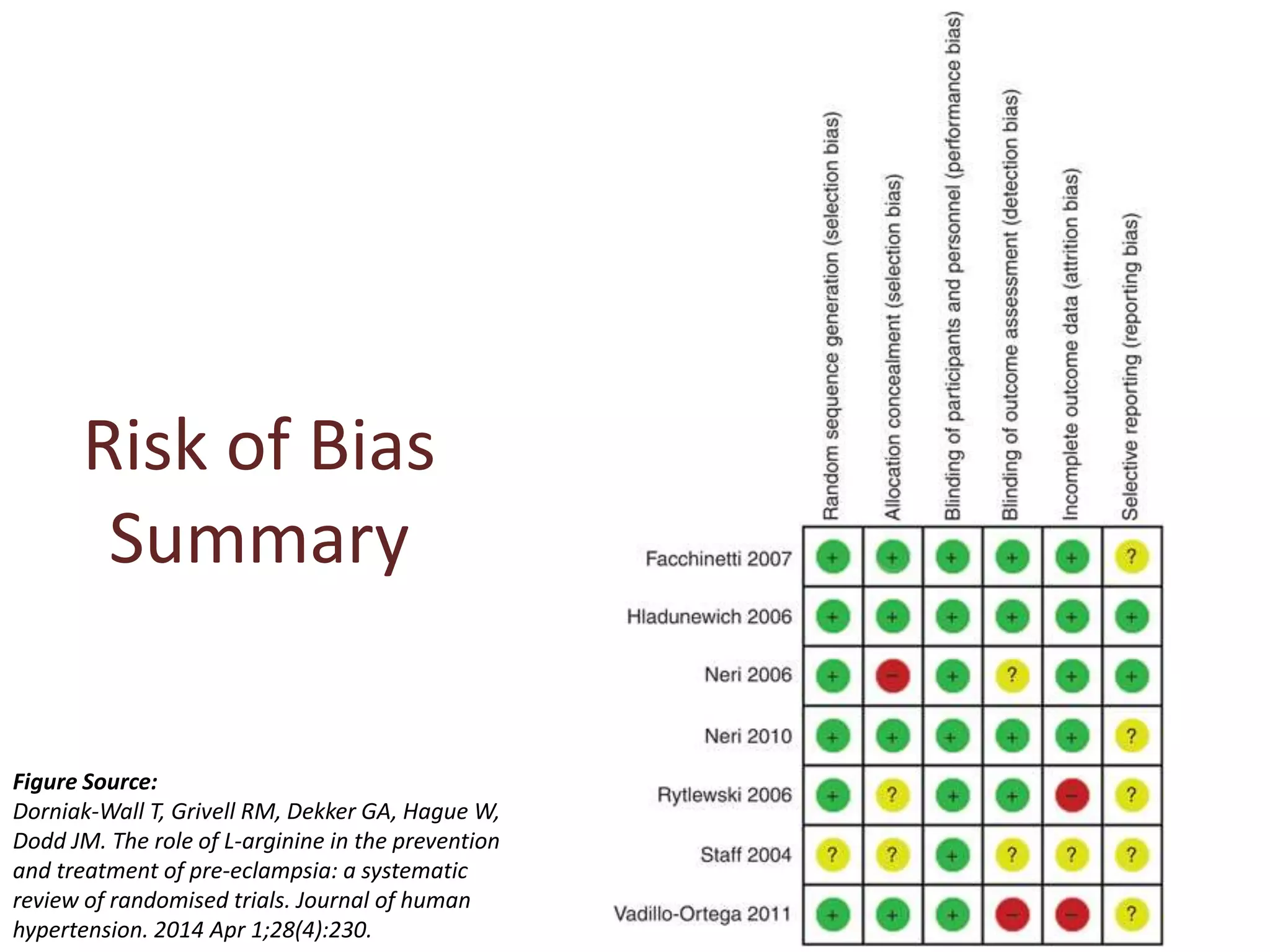
Risk of Bias
Summary
38
Figure Source:
Dorniak-Wall T, Grivell RM, Dekker GA, Hague W,
Dodd JM. The role of L-arginine in the prevention
and treatment of pre-eclampsia: a systematic
review of randomised trials. Journal of human
hypertension. 2014 Apr 1;28(4):230.
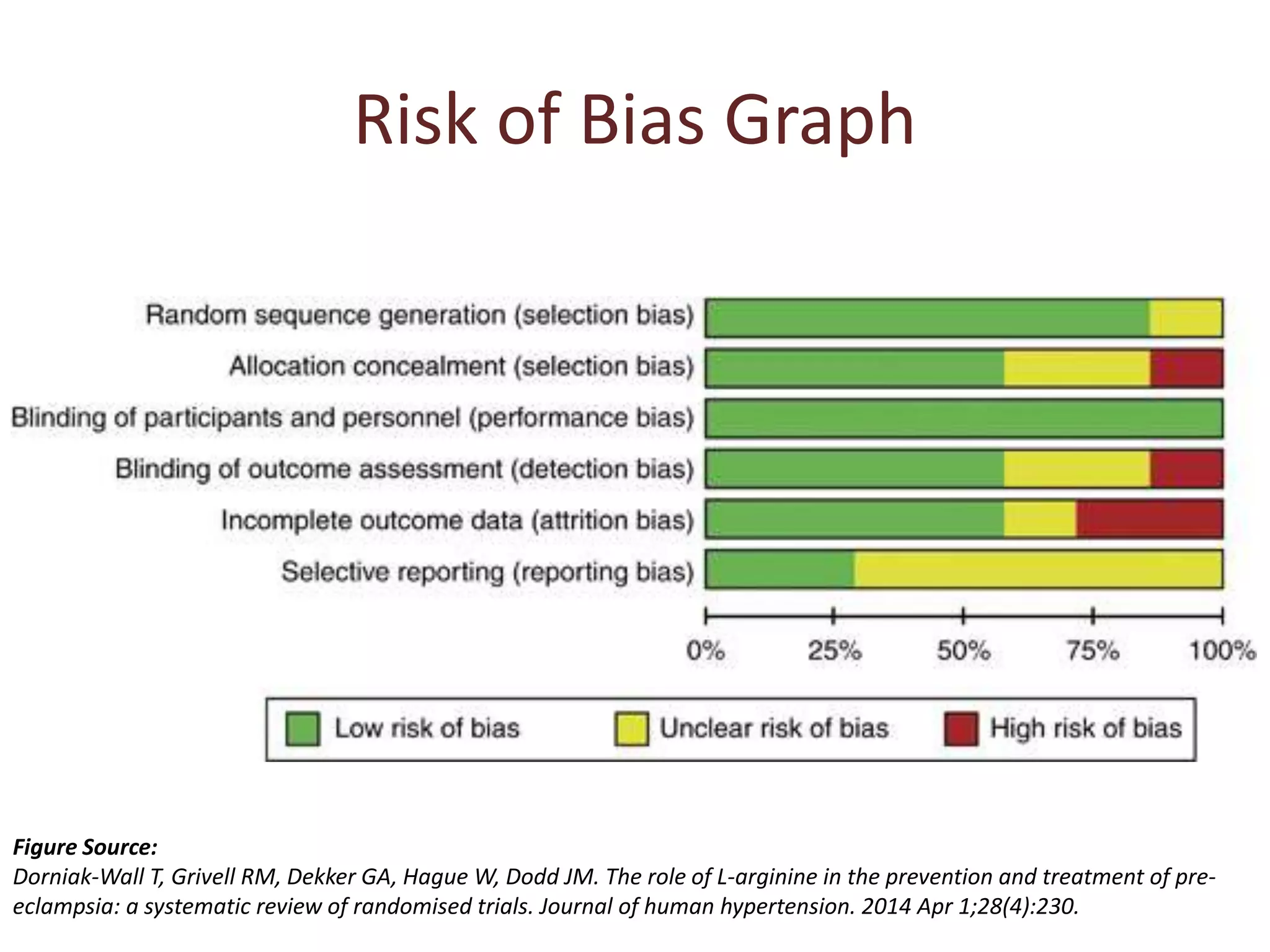
Risk of Bias Graph
39
Figure Source:
Dorniak-Wall T, Grivell RM, Dekker GA, Hague W, Dodd JM. The role of L-arginine in the prevention and treatment of pre-
eclampsia: a systematic review of randomised trials. Journal of human hypertension. 2014 Apr 1;28(4):230.
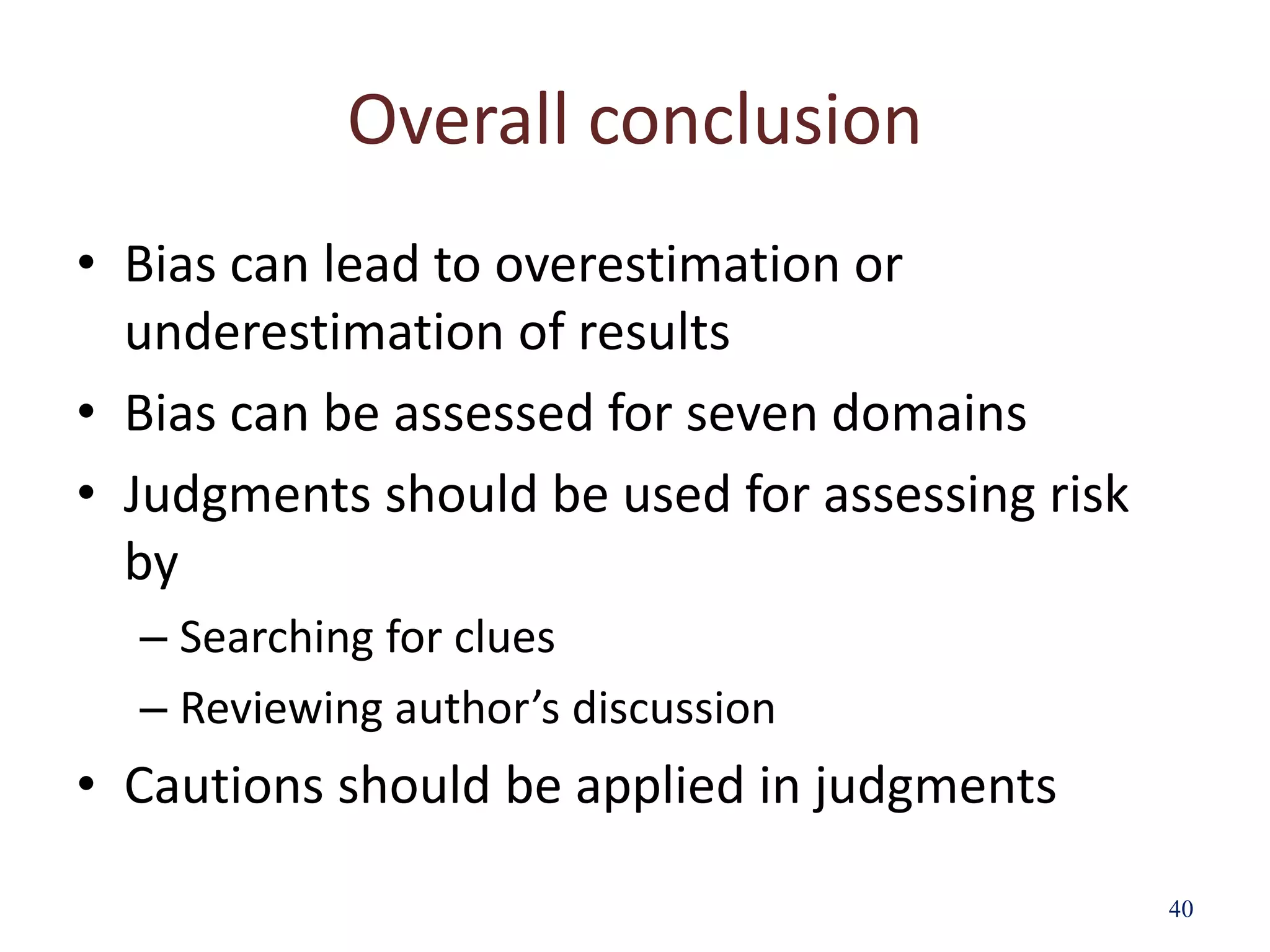
Overall conclusion
• Bias can lead to overestimation or
underestimation of results
• Bias can be assessed for seven domains
• Judgments should be used for assessing risk
by
– Searching for clues
– Reviewing author’s discussion
• Cautions should be applied in judgments
40
41
Open Discussion………
References
• Higgins JP, Green S, editors. Cochrane handbook for systematic
reviews of interventions. John Wiley & Sons; 2011 Aug 24.
• http://methods.cochrane.org/bias/assessing-risk-bias-included-
studies
• Eble A, Boone P. Risk and evidence of bias in randomized controlled
trials; 2012.
• Cochrane training powerpoint slide: Assessing risk of bias in
included studies.
• Dorniak-Wall T, Grivell RM, Dekker GA, Hague W, Dodd JM. The role
of L-arginine in the prevention and treatment of pre-eclampsia: a
systematic review of randomised trials. Journal of human
hypertension. 2014 Apr 1;28(4):230.
42

Risk of bias in systematic review

  • 1.
    Assessing Risk ofBias during Systematic Review Prabesh Ghimire MPH
  • 2.
    What is Bias? •Systematic error • Deviation from the truth (in results and inferences) • May be – Trivial – Substantial • Can lead to – Underestimation of effect – Overestimation of effect 2
  • 3.
    Significance of assessingbias in systematic review • Difference in risk of bias are related to variation in the results of studies included in systematic review. • All results may be consistent among themselves, but all studies could be flawed due to bias. 3
  • 4.
    Sources of bias Selectionbias Reporting bias Attrition bias Performance bias Detection bias 4
  • 5.
    Sources of bias 5 Selectionbias Reporting bias Attrition bias Performance bias Detection bias Systematic difference in baseline characteristics between two groups E.g. Selection of participants with differential age characteristics
  • 6.
    Sources of bias 6 Selectionbias Reporting bias Attrition bias Performance bias Detection bias Systematic difference in attention and treatment (other than intervention) between two groups E.g. participant who are aware that they are not receiving any treatment (intervention) may seek other forms of care
  • 7.
    Sources of bias 7 Selectionbias Reporting bias Attrition bias Performance bias Detection bias Systematic difference in loss to follow up (or withdrawals) between two groups
  • 8.
    Detection bias Attrition bias Sourcesof bias 8 Selection bias Reporting bias Performance bias Systematic difference in between two groups in how outcomes are determined E.g. If the researcher is aware of intervention/ research, the outcome might be assessed with bias
  • 9.
    Sources of bias 9 Selectionbias Reporting bias Attrition bias Performance bias Detection bias Systematic differences between reported and unreported findings E.g. Only publishing favorable outcomes, leaving readers with incomplete and skewed understanding of the results
  • 10.
    Assessing risk ofbias • Domain based assessment: Cochrane recommendation • Impossible to know the true risk of bias • Involves subjectivity: E.g. lack of blinding of participants may have affected …….. 10
  • 11.
    Domains for assessingrisk of bias 11 Allocation concealment Selective outcome reporting Blinding of outcome assessment Blinding of participants and personnel Incomplete outcome data Randon Sequence Generation Other sources of bias
  • 12.
    12 Selection Allocation concealment Target Population Allocation Intervention group Control group Outcome Assessment Outcome Assessment Publication ofstudy outcomes Reporting Selective reporting Attrition Incomplete outcome data Detection Blinding of outcome assessment Performance Blinding of participants, assessor Random sequence generation
  • 13.
    How to assessrisk of bias • Reviewing author’s judgment in the article • Searching for clues to bias • Looking for missing information – Reviewing study protocol – Contacting authors 13
  • 14.
    Random Sequence Generation •Random assignment of people into intervention and control groups • Avoids selection bias and confounders (both known and unknown) Fundamental questions: • Was the allocation sequence adequately generated? • What were the methods used to generate allocation sequence? 14
  • 15.
    Judgment: Random Sequence Generation •Low risk of bias if allocation done by – Referring to a random number table – Using Computer random number generator used – Coin tossing – Shuffling cards or envelopes – Throwing dice 15
  • 16.
    Judgment: Random Sequence Generation •High risk of bias if – Sequence generated by odd or even date of birth, day of visit, etc. – Allocation by judgment of clinician, participant – Allocation based on results of laboratory test 16
  • 17.
    Allocation Concealment • Concealingallocation sequence from those assigning participants to intervention groups, until the moment of assignment • Ensures that patients enroll into a study without knowing which group they will be assigned to. • If the researcher knows the next patient will be allocated to intervention, he/she may try to help a certain patient whom he thinks will benefit more from intervention. 17
  • 18.
    Allocation concealment Fundamental questions •Was the allocation adequately concealed? • What methods are used to conceal the allocation sequence? • Could intervention allocations have been foreseen in advance of, or during enrolment? 18
  • 19.
    Judgment: Allocation Concealment • Lowrisk of bias if – Central allocation (including telephone, web- based and pharmacy-controlled randomization) – Sequentially numbered drug containers of identical appearance – Sequentially numbered, opaque, sealed envelopes. 19
  • 20.
    Judgment: Allocation Concealment • Highrisk of bias if – Open random allocation schedule (e.g. list of random numbers) – Unsealed or non-opaque envelopes – Date of birth – Case record number 20
  • 21.
    Blinding of participants,personnel & outcome assessors • Masking of participants & assessor from knowledge about which intervention was received. • Ensures control group receive similar amount of attention, ancillary treatment and investigations • Avoids performance and detection bias 21
  • 22.
    Blinding of participants,personnel & outcome assessors Fundamental questions • Was knowledge of the allocated intervention adequately prevented during the study? • What measures were used for blinding? • Is it likely that blinding was broken? 22
  • 23.
    Judgment: Blinding • Lowrisk of bias if – No blinding or incomplete blinding, but outcome unlikely to be influenced – Blinding done, and unlikely that the blinding could have been broken – No blinding, but outcome assessment blinded and non-blinding unlikely to introduce bias 23
  • 24.
    Judgment: Blinding • Highrisk of bias if – No blinding or incomplete blinding, and outcome likely to be influenced – Blinding done, but likely that the blinding could have been broken 24
  • 25.
    Incomplete Outcome Data •Unavailability of complete outcome data for review – Attrition: Loss to follow up, withdrawals – Exclusions: Available data not included in analysis and report • Can lead to attrition bias • High proportion of missing outcomes, or a large difference in proportions between two groups, is the main cause for concern over bias. 25
  • 26.
    Incomplete Outcome Data Fundamentalquestions • How much data is missing from each group? • Why is it missing? • How were they analyzed? • Were incompletely outcome data adequately addressed? 26
  • 27.
    Judgment: Incomplete Outcome Data •Low risk of bias if – No missing outcome data – Reasons for missing data not related to outcome – Missing data balanced across groups and reasons are similar – Proportion of missing outcomes not enough to have a clinically relevant effect. – Plausible effect size (difference in mean or standardized diff. in means) not enough to have a clinically relevant effect 27
  • 28.
    Judgment: Incomplete Outcome Data •High risk of bias if – Reasons for missing data related to outcome – Imbalance in numbers or reasons for missing data across groups – Proportion of missing outcomes enough to have a clinically relevant effect. – Plausible effect size (difference in mean or standardized diff. in means) enough to have a clinically relevant effect 28
  • 29.
    Selective Outcome Reporting •Statistically significant results more likely to be reported as planned and in detail • Can lead to reporting bias • Difficult to assess. Possible ways: 1.Comparing methods to results to look for – Outcomes measured (or likely to be measured but not reported – Outcomes added, statistically changed, subgroups only – Reporting that cannot be used in a review (non- significance without numerical results) 2.Referring to study protocol or trial register 29
  • 30.
    Selective Outcome Reporting FundamentalQuestion • Are reports of the study free of suggestion of selective outcome reporting? 30
  • 31.
    Judgment: Selective Outcome Reporting •Low risk of bias if – Protocol is available and all pre-specified outcomes of interest to the review are reported in the pre-specified way – Protocol not available but it is clear that all pre- specified and expected outcomes of interest are reported 31
  • 32.
    Judgment: Selective Outcome Reporting •High risk of bias if – Primary outcomes have not been reported as pre- specified or expected – Outcomes are reported incompletely so that they cannot be entered in a meta-analysis 32
  • 33.
    Other threats toValidity • Bias due to other problems not covered elsewhere above. 33
  • 34.
    Other threats toValidity Fundamental Question • Was the study prone to problems that could put it at a high risk of bias? 34
  • 35.
    Judgment: Other threats tovalidity • Low risk of bias if – The study appears to be free of other sources of bias • High risk of bias if – Has a potential source of bias related to the specific design used – Had extreme baseline imbalance – Claimed to have been fraudulent 35
  • 36.
    Tool for Assessment Riskof bias table (RevMan) • Categorizes each domain into – Low risk – High risk – Unclear • Support for judgment – Direct quotes from article – Additional comments with rationale • One for each study reviewed 36
  • 37.
  • 38.
    Risk of Bias Summary 38 FigureSource: Dorniak-Wall T, Grivell RM, Dekker GA, Hague W, Dodd JM. The role of L-arginine in the prevention and treatment of pre-eclampsia: a systematic review of randomised trials. Journal of human hypertension. 2014 Apr 1;28(4):230.
  • 39.
    Risk of BiasGraph 39 Figure Source: Dorniak-Wall T, Grivell RM, Dekker GA, Hague W, Dodd JM. The role of L-arginine in the prevention and treatment of pre- eclampsia: a systematic review of randomised trials. Journal of human hypertension. 2014 Apr 1;28(4):230.
  • 40.
    Overall conclusion • Biascan lead to overestimation or underestimation of results • Bias can be assessed for seven domains • Judgments should be used for assessing risk by – Searching for clues – Reviewing author’s discussion • Cautions should be applied in judgments 40
  • 41.
  • 42.
    References • Higgins JP,Green S, editors. Cochrane handbook for systematic reviews of interventions. John Wiley & Sons; 2011 Aug 24. • http://methods.cochrane.org/bias/assessing-risk-bias-included- studies • Eble A, Boone P. Risk and evidence of bias in randomized controlled trials; 2012. • Cochrane training powerpoint slide: Assessing risk of bias in included studies. • Dorniak-Wall T, Grivell RM, Dekker GA, Hague W, Dodd JM. The role of L-arginine in the prevention and treatment of pre-eclampsia: a systematic review of randomised trials. Journal of human hypertension. 2014 Apr 1;28(4):230. 42