How are infant and young children fed in peri-urban areas? Saira Mehnaz, Ali JaferAbedi, Zulfia Khan, M. AtharAnsari, NajamKhalique.Department of Community Medicine, J. N.Medical College, 		Aligarh Muslim University,		Aligarh
introduction
INTRODUCTIONImpact on child survival.Critical to improved nutrition, health and development of children.
INTRODUCTIONTo evaluate the appropriateness of feeding , we can calculate certain indices in a simple manner. These indices can help us to manage the feeding of these children at the community level .Evidence base is the need of the hour
Aims and objectives
Aims and objectivesThe following study was carried out in a typical peri- urban area to: Assess the prevalence of appropriate of feeding pattern in infants.To assess the factors related to breast feeding pattern and appropriate complementary feeding practices in 12 to 24 months old children.
methodology
MethodologyWe used the indicators suggested by WHO  in ……    Indicators for assessing infant and young child feeding practices-Part 2 Measurement.A cross sectional house to house survey using PPS was conducted in the registerd families of UHTC, JNMC AMU, Aligarh.A preframed- pretested proforma was used for the study
Methodology56 infants and 45 children 12 to 24 months were included in the study .An oral consent was takenReason of study explained to mothers Mothers interviewed in friendly , non formal manner and care taken to give counseling regarding feeding and infant care where needed.
MethodologyTo calculate “IBF age in days”: Date of interview – date of birthIf IBF age in days is less than 730 (2 years) the observation can be included in calculating Indicator, Early initiation of breastfeeding, and Indicator, Children ever breastfed.
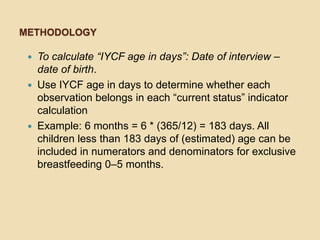
MethodologyTo calculate “IYCF age in days”: Date of interview – date of birth. Use IYCF age in days to determine whether each observation belongs in each “current status” indicator calculation Example: 6 months = 6 * (365/12) = 183 days. All children less than 183 days of (estimated) age can be included in numerators and denominators for exclusive breastfeeding 0–5 months.
results
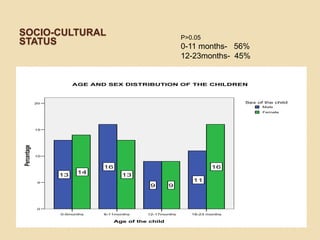
Socio-cultural statusP>0.050-11 months-   56%12-23months-  45%
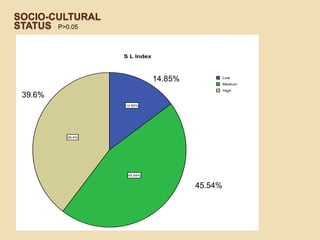
Socio-cultural statusP>0.0514.85%39.6%45.54%
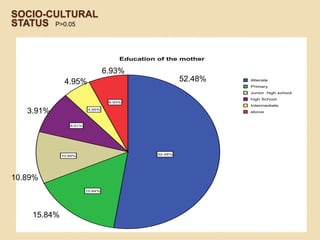
Socio-cultural statusP>0.056.93%52.48%4.95%3.91%10.89%15.84%
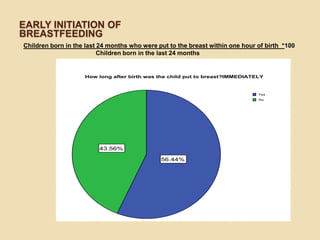
Early initiation of breastfeedingChildren born in the last 24 months who were put to the breast within one hour of birth  *100                                          Children born in the last 24 months
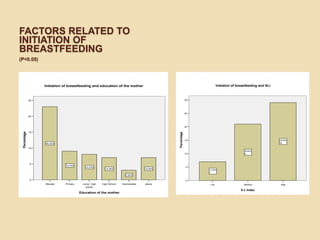
Factors related to Initiation ofbreastfeeding(p<0.05)
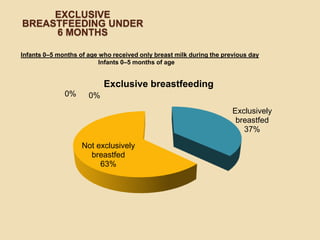
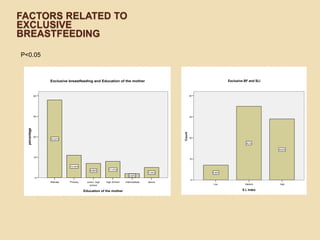
Exclusive breastfeeding under 6 monthsInfants 0–5 months of age who received only breast milk during the previous day                                             Infants 0–5 months of age
Factors related to Exclusive breastfeedingP<0.05
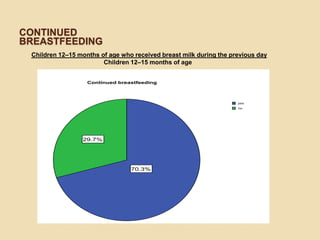
Continued breastfeedingChildren 12–15 months of age who received breast milk during the previous day                                          Children 12–15 months of age
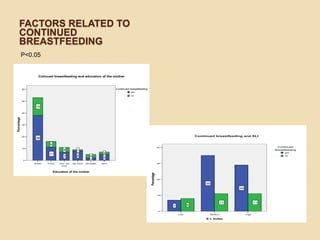
Factors related to Continued breastfeedingP<0.05
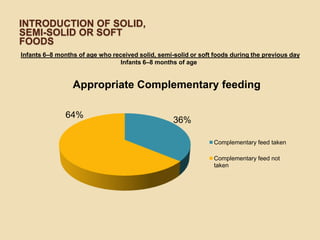
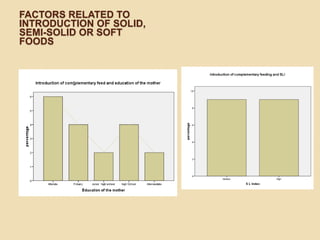
Introduction of solid, semi-solid or soft foodsInfants 6–8 months of age who received solid, semi-solid or soft foods during the previous day                                                          Infants 6–8 months of age
Factors related to Introduction of solid, semi-solid or soft foods
100% CHILDREN CAME IN THE CATEGORY OF EVERBREASTFED
CONCLUSIONSMost of the children belonged to the medium SLI56.4% children received breastmilk within 1st hour of life at the right time
CONCLUSIONS37% children were exclusively breastfedContinued breastfeeding was found in about 70% of children36% were introduced with the solid and semi solid soft food at the appropriate time. 
Most of the mothers following appropriate feeding practices came in the medium and high SLI group
THANKYOU

Dr saira

  • 1.
    How are infantand young children fed in peri-urban areas? Saira Mehnaz, Ali JaferAbedi, Zulfia Khan, M. AtharAnsari, NajamKhalique.Department of Community Medicine, J. N.Medical College, Aligarh Muslim University, Aligarh
  • 2.
  • 3.
    INTRODUCTIONImpact on childsurvival.Critical to improved nutrition, health and development of children.
  • 4.
    INTRODUCTIONTo evaluate theappropriateness of feeding , we can calculate certain indices in a simple manner. These indices can help us to manage the feeding of these children at the community level .Evidence base is the need of the hour
  • 5.
  • 6.
    Aims and objectivesThefollowing study was carried out in a typical peri- urban area to: Assess the prevalence of appropriate of feeding pattern in infants.To assess the factors related to breast feeding pattern and appropriate complementary feeding practices in 12 to 24 months old children.
  • 7.
  • 8.
    MethodologyWe used theindicators suggested by WHO in …… Indicators for assessing infant and young child feeding practices-Part 2 Measurement.A cross sectional house to house survey using PPS was conducted in the registerd families of UHTC, JNMC AMU, Aligarh.A preframed- pretested proforma was used for the study
  • 9.
    Methodology56 infants and45 children 12 to 24 months were included in the study .An oral consent was takenReason of study explained to mothers Mothers interviewed in friendly , non formal manner and care taken to give counseling regarding feeding and infant care where needed.
  • 10.
    MethodologyTo calculate “IBFage in days”: Date of interview – date of birthIf IBF age in days is less than 730 (2 years) the observation can be included in calculating Indicator, Early initiation of breastfeeding, and Indicator, Children ever breastfed.
  • 11.
    MethodologyTo calculate “IYCFage in days”: Date of interview – date of birth. Use IYCF age in days to determine whether each observation belongs in each “current status” indicator calculation Example: 6 months = 6 * (365/12) = 183 days. All children less than 183 days of (estimated) age can be included in numerators and denominators for exclusive breastfeeding 0–5 months.
  • 12.
  • 13.
  • 14.
  • 15.
  • 16.
    Early initiation ofbreastfeedingChildren born in the last 24 months who were put to the breast within one hour of birth *100 Children born in the last 24 months
  • 17.
    Factors related toInitiation ofbreastfeeding(p<0.05)
  • 18.
    Exclusive breastfeeding under6 monthsInfants 0–5 months of age who received only breast milk during the previous day Infants 0–5 months of age
  • 19.
    Factors related toExclusive breastfeedingP<0.05
  • 20.
    Continued breastfeedingChildren 12–15months of age who received breast milk during the previous day Children 12–15 months of age
  • 21.
    Factors related toContinued breastfeedingP<0.05
  • 22.
    Introduction of solid,semi-solid or soft foodsInfants 6–8 months of age who received solid, semi-solid or soft foods during the previous day Infants 6–8 months of age
  • 23.
    Factors related toIntroduction of solid, semi-solid or soft foods
  • 24.
    100% CHILDREN CAMEIN THE CATEGORY OF EVERBREASTFED
  • 25.
    CONCLUSIONSMost of thechildren belonged to the medium SLI56.4% children received breastmilk within 1st hour of life at the right time
  • 26.
    CONCLUSIONS37% children wereexclusively breastfedContinued breastfeeding was found in about 70% of children36% were introduced with the solid and semi solid soft food at the appropriate time. 
  • 27.
    Most of themothers following appropriate feeding practices came in the medium and high SLI group
  • 28.