








Basic Principles of Research By Edmund Lawrence S. Florendo
Research A careful, systematic study in a field of knowledge, undertaken to discover or establish facts or principles. (Webster) A systematic process of collecting and analyzing data to find an answer to a question or a solution to a problem, to validate or test an existing theory.
Research Functions Answers questions, solve problem and make decision See and understand  how and why a situation or a problem exists. Discover new things and ideas Validate existing theories or generate new ones Identify and understand the causes and effects of a situation or a phenomenon
Sources of Knowledge for Research Tradition  Experience  Logic/Reasoning Research/Scientific  Consulting An Expert  Trial And Error
Research as a Scientific Method Identification of a problem Formulation of hypothesis Data collection Data analysis Drawing of conclusions
Sample Research Problems A nurse who had been in the emergency room for ten years learned that orienting the patient to hospital set-up reduces anxiety. The head nurse invited the nursing scholars to discuss the modalities of nursing applicable to the ward set-up. Nurses assigned in the geriatric unit are alarmed about the increasing incidence of bedsores among the elderly. As a preventive measure in one instance they used banana leaves to line the bony areas of the patient and later they used gloves filed with water and find out which of the two is the best.
Sample Research Problems A nurse enrolled in the masteral program wants to determine the effect of yakult in the healing of bedsores. Similarly another nurse conducted an investigation on the effect of guava leaves decoction in the healing of episiorrhaphy wounds  If a is not equal to b then a>b or a<b.
Two Major Types of Research PURE/BASIC/THEORETICAL - conducted for the sake of knowing  CLINICAL/PRACTICAL/APPLIED - conducted for utilization of findings for real life situation.
SAMPLE TITLES /EXERCISES  Knowledge, Attitudes and Practices of Couples of Family Planning in Aklan Province  The Effect of Touch in the Pain reactions of Neonate who have Underwent Circumcision and Ear Boring At St. Paul’s Hospital, Iloilo City  Chromatic and Achromatic Pictures and Their  Effects on the Reading Performance of Mentally Retarded Children At the SPED School, Iloilo City
Coping Mechanisms of Single Mothers In the City of Iloilo  The Lifestyle of Aetas in the Mountains of Ibajay, Aklan
OTHER TYPES OF RESEARCH  ACCORDING TO RESEARCH DESIGN  PRE-EXPERIMENTAL  QUASI- EXPERIMENTAL  TRUE EXPERIMENTAL
PURPOSE:  DESCRIPTIVE  EXPLANATORY/CORRELATIONAL  EXPLORATORY  RELATIONAL/CASUAL  CAUSAL  EVALUATIVE  DEVELOPMENTAL
STAGES IN RESEARCH PROCESS  CONCEPTUAL PHASE  PLANNING/DESIGN PHASE  EMPIRICAL/IMPLEMENTATION PHASE  ANALYTIC PHASE  DISSEMINATION/UTILIZATION PHASE
Conceptual Phase:  problem identification  objectives and hypothesis formulation  identification of variables  review of literature  scope and delimitation  framework for the study
Planning/design Phase:  research methodology  research design  population and sampling  instrumentation
Empirical/Implementation Phase  data gathering and processing  editing and encoding  tabulating
Analytic phase= data analysis and interpretation using statistical treatment  Utilization and dissemination  = report findings to beneficiaries
CHARACTERISTICS OF RESEARCH  ORDER AND SYSTEM  CONTROL  EMPIRICISM  GENERALIZATION
ETHICS IN RESEARCH VOLUNTARY PARTICIPATION  INFORMED CONSENT BASED ON HELSINSKI DECLARATION  FREE FROM ANY PHYSICAL AND PSYCHOLOGICAL EXPLOITATION  ANONYMITY AND CONFIDENTIALITY
RESEARCH PROBLEMS  GAP BETWEEN WHAT IS AND WHAT SHOULD BE OR OUGHT TO BE&.. = TWO OR MORE PLAUSIBLE REASONS OR ANSWERS WHAT IS = PROBLEM SITUATION  ACTUAL SITUATION  EXISTING CONDITION  FACTS AND STATISTICS  REAL SITUATION THAT IS CURRENTLY OCCURING  Survey shows that>>>>>>>>. Statistics reveal that>>>>>>>. Global &. National & .local &..scenario
WHAT SHOULD BE= IDEAL SITUATION  EXPECTED OUTCOMES  BASED ON STANDARDS OR PROGRAMS  POLICIES/THRUSTS OF THE GOVERNMENT  WHAT SHOULD BE ENDEAVORED
SOURCES OF PROBLEMS  EXPERIENCES  NEW TECHNOLOGIES  CONFLICTING IDEAS AND IDEALS  THEORIES AND PRINCIPLES  CONFLICTING FINDINGS  PROBLEM AREAS IN NURSING
CRITERIA FOR RESEARCH PROBLEMS  EXTERNAL CRITERIA  NOVELTY  AVAILABILITY OF SUBJECTS  ETHICAL CONSIDERATIONS  FACILITIES/EQUIPMENTS  INSTITUTIONAL SUPPORT
INTERNAL CRITERIA:  MOTIVATION/INTEREST  EXPERIENCE/QUALIFICATIONS  TIME FACTOR  COSTS AND RETURNS  HAZARDS/ETC.
OTHER CRITERIA FOR RESEARCH PROBLEMS SIGNIFICANCE OF THE PROBLEM  PROBLEM RESEARCHABILITY  FEASIBILITY OF THE PROBLEM  POTENTIALS OF THE RESEARCHER
CHARACTERISTICS OF RESEARCHABLE PROBLEMS  ORIGINALITY  SIGNIFICANCE  MANAGEABILITY  MEASURABILITY  RESOURCE AVAILABILITY
TYPES OF PROBLEMS  ULTIMATE PROBLEMS  IMMEDIATE PROBLEMS  RESEARCH PROBLEMS
ULTIMATE PROBLEMS  SIGNIFICANCE OR IMPORTANCE OF THE STUDY  WHAT YOU HOPE TO ATTAIN OR DERIVE FROM THE STUDY  MENTION RECIPIENTS OF RESEARCH RESULTS  WHAT THEY CAN BENEFIT  HOW THEY CAN BENEFIT FROM THE RESULTS
IMMEDIATE PROBLEMS  GENERAL OBJECTIVES  MERELY STATES:  This study will be conducted to:  find out/determine/to answer:  then repeat the complete title of the research:
Specific objectives  Specific problems  Mention: Specifically this study will answer the following questions:  Or this study will specifically find out  Then one by one state the objectives or question for each variable in the study
RESEARCH AND VARIABLES  VARIABLES VS. CONSTANT  VARIABLES= CHARACTERISTICS THAT VARY  TWO OR MORE MUTUALLY EXCLUSIVE VALUES OR PROPERTIES
TYPES OF VARIABLES  THREE BASIC TYPES:  INDEPENDENT  INTERVENING  DEPENDENT  OTHER TYPES:  ANTECEDENT  EXTRANEOUS/CONFOUNDING/  ORGANISMIC/EXOGENOUS
INDEPENDENT VARIABLES:  PRESUMED CAUSE  INPUT/INTERVENTION  TESTS/MODALITIES  VARIABLE THAT CAN BE MANIPULATED
DEPENDENT VARIABLES:  PRESUMED EFFECT  OUTPUT/RESULT  OUTCOME CANNOT BE MANIPULATED
COMPARISON OF TWO VARIABLES  INDEPENDENT presumed cause--- input  intervention/tx.  can be manipulated-  can stand alone--- DEPENDENT  presumed effect  Output  Result or outcome  Cannot be manipulated  Cannot stand alone
INTERVENING VARIABLES:  MODERATOR  WEAKEN OR STRENGTHEN  MODIFIER  CONTROLLING FOR  CORRELATIONAL
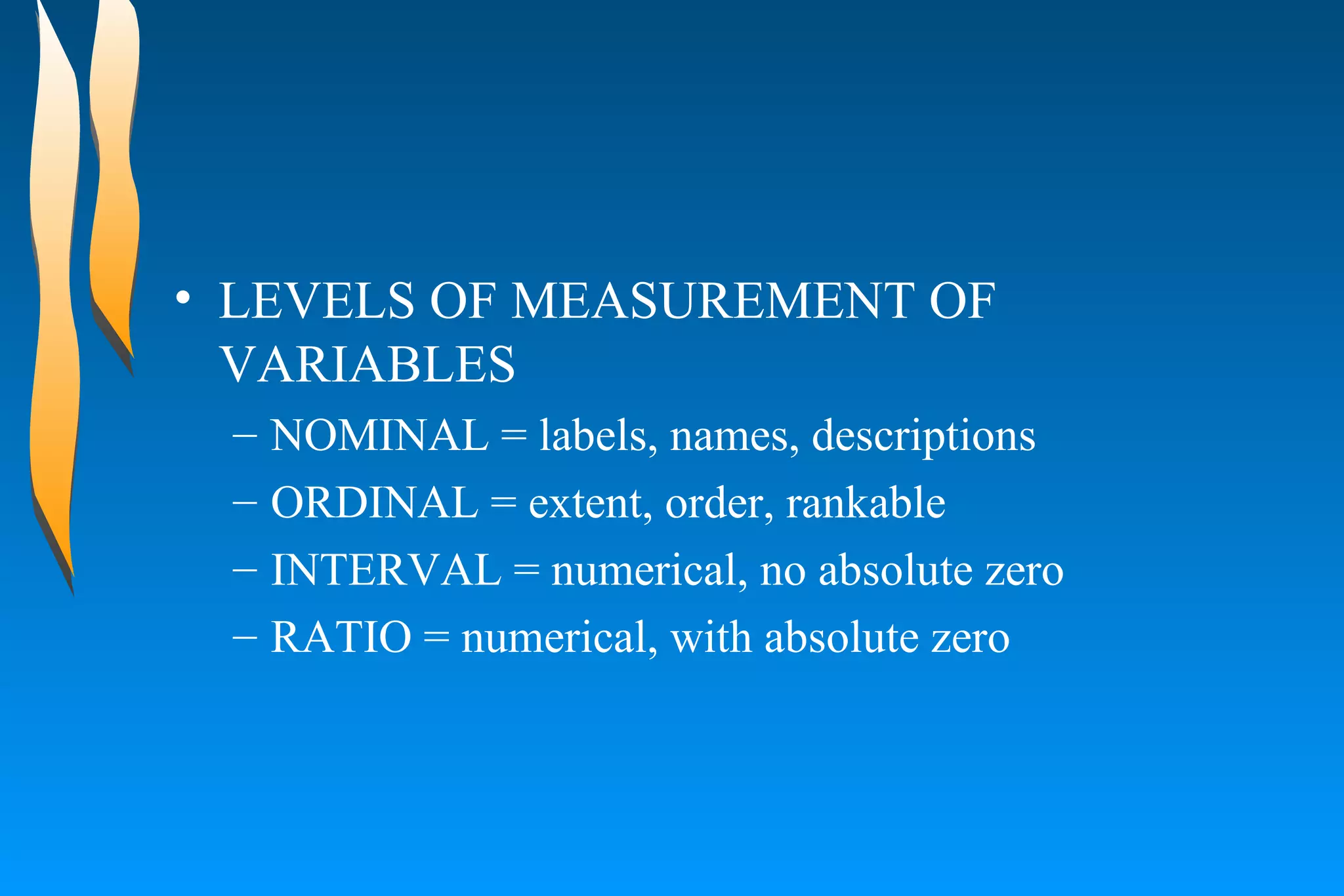
LEVELS OF MEASUREMENT OF VARIABLES NOMINAL = labels, names, descriptions ORDINAL = extent, order, rankable INTERVAL = numerical, no absolute zero RATIO = numerical, with absolute zero
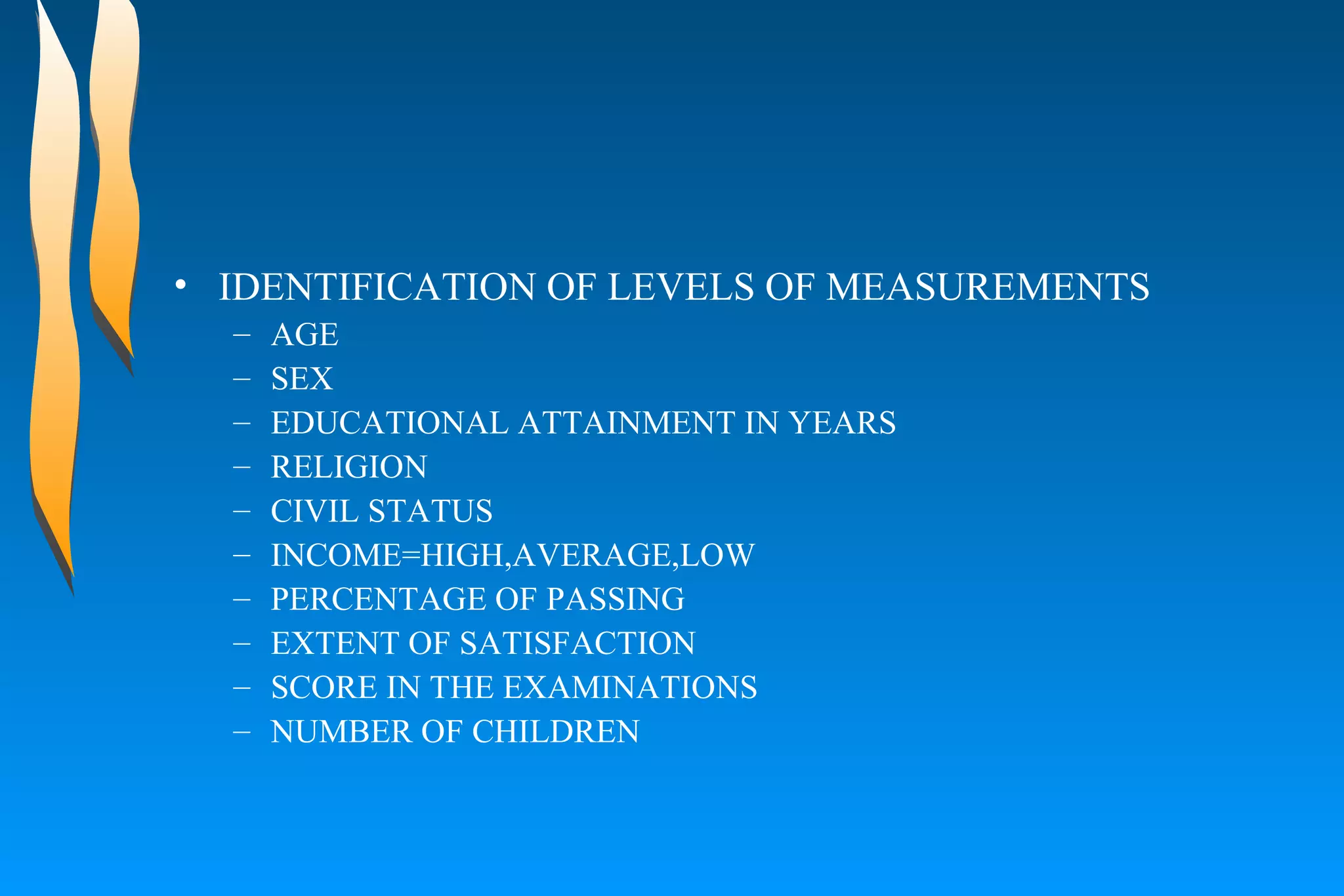
IDENTIFICATION OF LEVELS OF MEASUREMENTS AGE SEX EDUCATIONAL ATTAINMENT IN YEARS RELIGION CIVIL STATUS INCOME=HIGH,AVERAGE,LOW PERCENTAGE OF PASSING EXTENT OF SATISFACTION SCORE IN THE EXAMINATIONS NUMBER OF CHILDREN
RANK IN THE FAMILY FAMILY PLANNING PRACTICES ATTITUDE TOWARDS LIFE JOB SATISFACTION  PERFORMANCE RATING SEXUAL PRACTICES LIFESTYLE  BEHAVIORAL RESPONSES BELIEFS HEALING OF WOUNDS IN TERMS OF DAYS
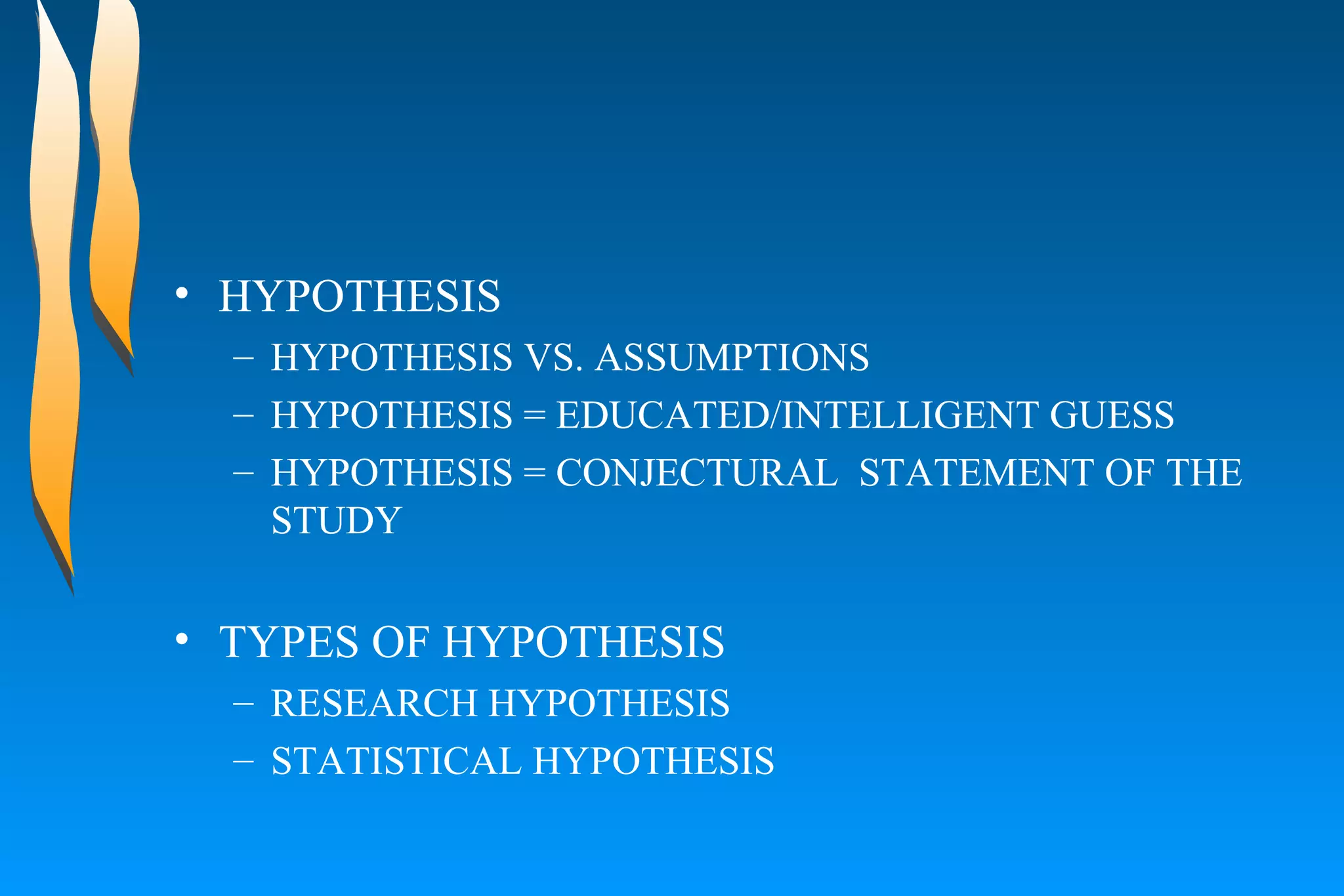
HYPOTHESIS HYPOTHESIS VS. ASSUMPTIONS HYPOTHESIS = EDUCATED/INTELLIGENT GUESS HYPOTHESIS = CONJECTURAL  STATEMENT OF THE STUDY TYPES OF HYPOTHESIS RESEARCH HYPOTHESIS STATISTICAL HYPOTHESIS
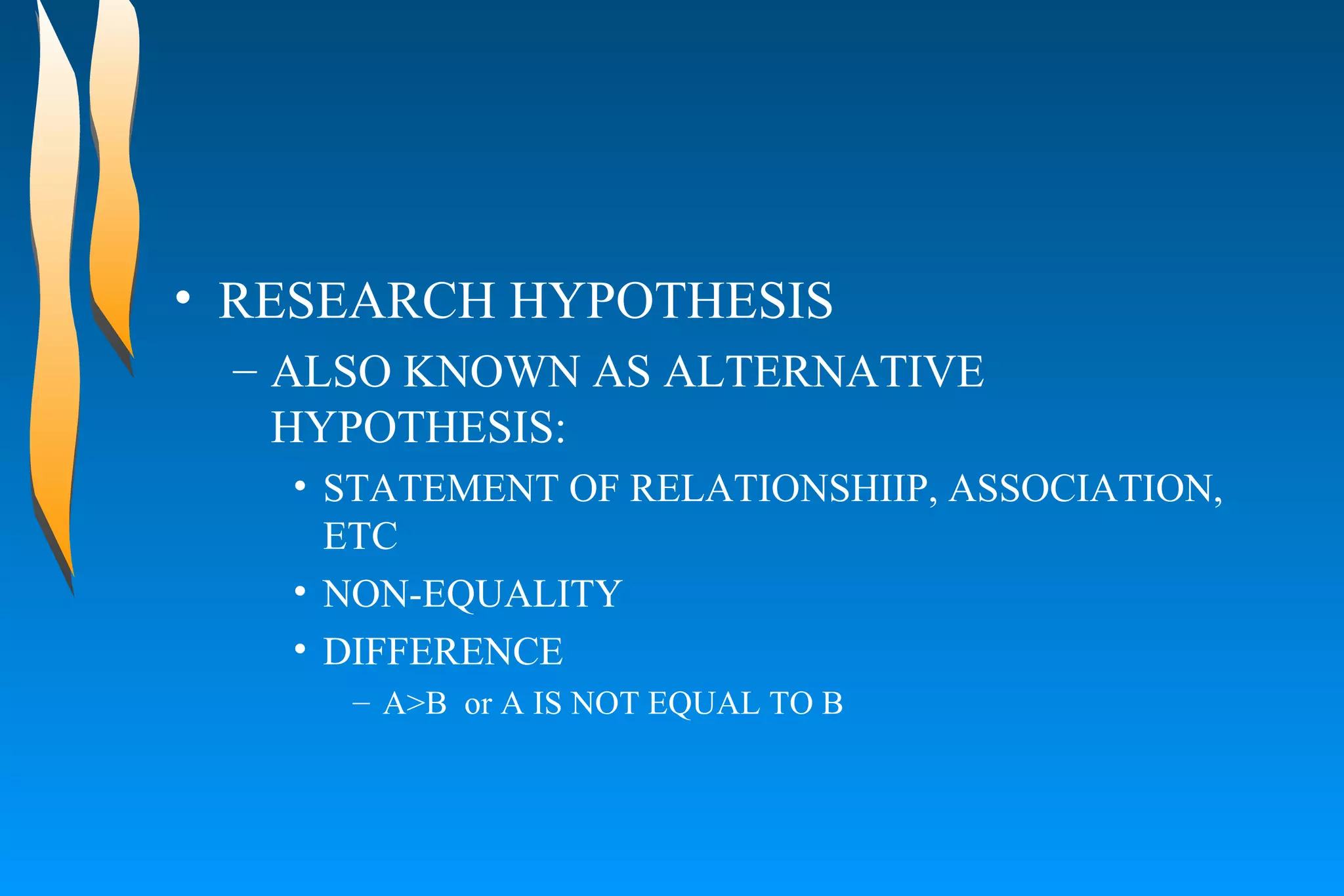
RESEARCH HYPOTHESIS ALSO KNOWN AS ALTERNATIVE HYPOTHESIS:  STATEMENT OF RELATIONSHIIP, ASSOCIATION, ETC  NON-EQUALITY  DIFFERENCE  A>B  or A IS NOT EQUAL TO B
TYPES OF ALTERNATIVE HYPOTHESIS DIRECTIONAL:  DIRECT INVERSE NON-DIRECTIONAL
IDENTIFICATION OF HYPOTHESIS Yakult is as effective as Betadine in the Healing of bedsores  Knowledge is associated with attitudes  There is no difference in the pain responses of infants who were touched and were not touched  Drug A is more effective than Drug B in the Healing of Leprosy  NSS gargle cannot kill streptococcus in the throat
There is no relationship between RLE Grade and Academic Grades  The higher the knowledge the safer the practice  Patients Who were Oriented to Hospital Set-up are less Anxious than those who were not oriented  Assignment of Primary Nurses does not affect Patients Satisfaction
FRAMEWORKS IN RESEARCH THEORETICAL FRAMEWORK  CONCEPTUAL FRAMEWORK  OPERATIONAL FRAMEWORK
Theoretical framework  Broad or abstract explanation of a phenomenom  (theories)  Start by saying: This study is anchored on the theory of_______________.  Then describe the theory briefly  Then explain how the theory is applied in your study
Conceptual Framework  Concrete explanation of phenomenon (concepts)  Also the schematic flow of the variables or paradigm of variables:  Enumerate the variables and diagram  Independent  ---- Dependent  ______________ -____________
Operational Framework Detailed or specific explanation of the variables Define each of the variables
TYPES OF DEFINITIONS THEORETICAL DEFINITIONS-books,dictionary,encyclopedia CONCEPTUAL AND OPERATIONAL DEFINITONS-as applied to your study with defined categories PARADIGM OR SCHEMATIC DIAGRAM OF VARIABLES
REVIEW OF LITERATURE  CONCEPTUAL LITERATURE  REVIEW OF RELATED STUDIES  IMPORTANCE  APPROACHES:  COUNTRY, THEME, CHRONOLOGICAL  WHEN CONDUCTED: BEFORE, DURING AND AFTER THE STUDY
METHODOLOGY  RESEARCH DESIGN  POPULATION AND SAMPLING  INSTRUMENTATION  DATA COLLECTION AND PROCESSING  DATA ANALYSIS AND INTERPREATION
RESEARCH DESIGNS  PRE-EXPERIMENTAL  SURVEY  HISTORICAL  CASE STUDY  FEASIBILITY  CONTENT ANALYSIS
QUASI-EXPERIMENTAL  NON-EQUIVALENT CONTROL GROUP DESIGN  TIME SERIES DESIGN  TRUE EXPERIMENTALY PRE-TEST POSTEST CONTROL GROUP  POST-TEST ONLY CONTROL GROUP  SOLOMON FOUR GROUP STUDY DESIGN
POPULATION AND SAMPLING  POPULATION STUDY VS. SAMPLE STUDY  ADVANTAGES OF SAMPLE STUDY  PARAMETRIC VS. INFERENTIAL
Population Universe Census Sample = representativeness  randomnization  inferential
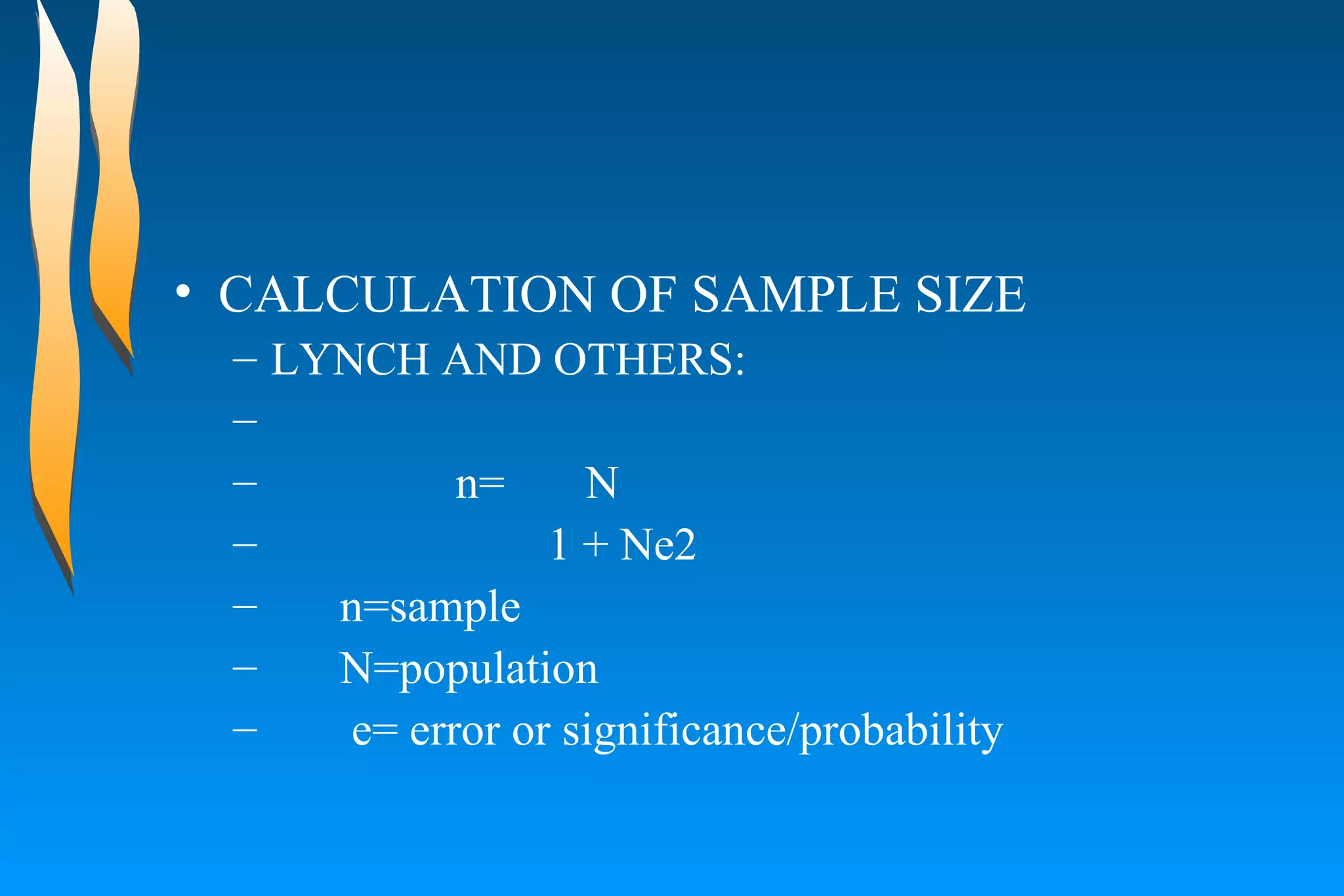
CALCULATION OF SAMPLE SIZE  LYNCH AND OTHERS:  n=  N  1 + Ne2  n=sample  N=population  e= error or significance/probability
TYPES OF SAMPLING TECHNIQUES  PROBABILITY SAMPLING =  randomnization  NONPROBABILTY SAMPLING = no randomnization
PROBABILITY SAMPLING  SIMPLE RANDOM SAMPLING=lottery technique  SYSTEMATIC RANDOM SAMPLING=sampling interval = N divide by n  STRATIFIED RANDOM SAMPLING  CLUSTER RANDOM SAMPLING  MULTISTAGE RANDOM SAMPLING
Stratified= percentage allocation in homogenous group  Cluster= random in heterogenous group  Multi-stage= in wide scale study using random in each strata
NONPROBABILITY SAMPLING SNOWBALL  PURPOSIVE  CRITERIA  JUDGMENTAL  QUOTA  INCIDENTAL/ACCIDENTAL
DATA COLLECTION TECHNIQUES PARTICIPANT OBSERAVTION  NON-PARTICIPANT OBSERVATION  QUESTIONNAIRE  INTERVIEW SCHEDULE  OBSERVATION CHECKLIST  FOCUS GROUP DISCUSSION
DATA PROCESSING  FIELD EDITING  OFFICE EDITING  ENCODING  TABULATING WITH DUMMY TABLES
Threats to validity:  a. selection=random  =halo effect  =hawthorne effect  b. testing  c. maturation/contamination  d. mortality  e. history
STATISTICAL TOOLS  MEASURES OF CENTRAL TENDENCIES  MEAN  MODE  MEDIAN  GIVEN TABLES FOR CENTRAL TENDENCIES
Nominal=mode, percentages  Ordinal=mode, median  Interval/ratio=mode ,median, mean and all measures of variability  Mean= best measure of central tendency
MEASURES OF ASSOCIATION  ASSOCIATION MATRIX TABLES  MEASURES OF DIFFERENCES  chi-square=nominal vs. nominal  gamma=ordinal vs. ordinal  pearsons r=interval vs. interval  t or z-test=differences in two means  comparative statistics
RESEARCH REPORT FORMAT  RESEARCH UTILIZATION  CONCLUSIONS/INFERENCES  RECOMMENDATIONS AND IM-PLICATIONS
END

Basic principles of research

  • 1.
    Basic Principles ofResearch By Edmund Lawrence S. Florendo
  • 2.
    Research A careful,systematic study in a field of knowledge, undertaken to discover or establish facts or principles. (Webster) A systematic process of collecting and analyzing data to find an answer to a question or a solution to a problem, to validate or test an existing theory.
  • 3.
    Research Functions Answersquestions, solve problem and make decision See and understand how and why a situation or a problem exists. Discover new things and ideas Validate existing theories or generate new ones Identify and understand the causes and effects of a situation or a phenomenon
  • 4.
    Sources of Knowledgefor Research Tradition Experience Logic/Reasoning Research/Scientific Consulting An Expert Trial And Error
  • 5.
    Research as aScientific Method Identification of a problem Formulation of hypothesis Data collection Data analysis Drawing of conclusions
  • 6.
    Sample Research ProblemsA nurse who had been in the emergency room for ten years learned that orienting the patient to hospital set-up reduces anxiety. The head nurse invited the nursing scholars to discuss the modalities of nursing applicable to the ward set-up. Nurses assigned in the geriatric unit are alarmed about the increasing incidence of bedsores among the elderly. As a preventive measure in one instance they used banana leaves to line the bony areas of the patient and later they used gloves filed with water and find out which of the two is the best.
  • 7.
    Sample Research ProblemsA nurse enrolled in the masteral program wants to determine the effect of yakult in the healing of bedsores. Similarly another nurse conducted an investigation on the effect of guava leaves decoction in the healing of episiorrhaphy wounds If a is not equal to b then a>b or a<b.
  • 8.
    Two Major Typesof Research PURE/BASIC/THEORETICAL - conducted for the sake of knowing CLINICAL/PRACTICAL/APPLIED - conducted for utilization of findings for real life situation.
  • 9.
    SAMPLE TITLES /EXERCISES Knowledge, Attitudes and Practices of Couples of Family Planning in Aklan Province The Effect of Touch in the Pain reactions of Neonate who have Underwent Circumcision and Ear Boring At St. Paul’s Hospital, Iloilo City Chromatic and Achromatic Pictures and Their Effects on the Reading Performance of Mentally Retarded Children At the SPED School, Iloilo City
  • 10.
    Coping Mechanisms ofSingle Mothers In the City of Iloilo The Lifestyle of Aetas in the Mountains of Ibajay, Aklan
  • 11.
    OTHER TYPES OFRESEARCH ACCORDING TO RESEARCH DESIGN PRE-EXPERIMENTAL QUASI- EXPERIMENTAL TRUE EXPERIMENTAL
  • 12.
    PURPOSE: DESCRIPTIVE EXPLANATORY/CORRELATIONAL EXPLORATORY RELATIONAL/CASUAL CAUSAL EVALUATIVE DEVELOPMENTAL
  • 13.
    STAGES IN RESEARCHPROCESS CONCEPTUAL PHASE PLANNING/DESIGN PHASE EMPIRICAL/IMPLEMENTATION PHASE ANALYTIC PHASE DISSEMINATION/UTILIZATION PHASE
  • 14.
    Conceptual Phase: problem identification objectives and hypothesis formulation identification of variables review of literature scope and delimitation framework for the study
  • 15.
    Planning/design Phase: research methodology research design population and sampling instrumentation
  • 16.
    Empirical/Implementation Phase data gathering and processing editing and encoding tabulating
  • 17.
    Analytic phase= dataanalysis and interpretation using statistical treatment Utilization and dissemination = report findings to beneficiaries
  • 18.
    CHARACTERISTICS OF RESEARCH ORDER AND SYSTEM CONTROL EMPIRICISM GENERALIZATION
  • 19.
    ETHICS IN RESEARCHVOLUNTARY PARTICIPATION INFORMED CONSENT BASED ON HELSINSKI DECLARATION FREE FROM ANY PHYSICAL AND PSYCHOLOGICAL EXPLOITATION ANONYMITY AND CONFIDENTIALITY
  • 20.
    RESEARCH PROBLEMS GAP BETWEEN WHAT IS AND WHAT SHOULD BE OR OUGHT TO BE&.. = TWO OR MORE PLAUSIBLE REASONS OR ANSWERS WHAT IS = PROBLEM SITUATION ACTUAL SITUATION EXISTING CONDITION FACTS AND STATISTICS REAL SITUATION THAT IS CURRENTLY OCCURING Survey shows that>>>>>>>>. Statistics reveal that>>>>>>>. Global &. National & .local &..scenario
  • 21.
    WHAT SHOULD BE=IDEAL SITUATION EXPECTED OUTCOMES BASED ON STANDARDS OR PROGRAMS POLICIES/THRUSTS OF THE GOVERNMENT WHAT SHOULD BE ENDEAVORED
  • 22.
    SOURCES OF PROBLEMS EXPERIENCES NEW TECHNOLOGIES CONFLICTING IDEAS AND IDEALS THEORIES AND PRINCIPLES CONFLICTING FINDINGS PROBLEM AREAS IN NURSING
  • 23.
    CRITERIA FOR RESEARCHPROBLEMS EXTERNAL CRITERIA NOVELTY AVAILABILITY OF SUBJECTS ETHICAL CONSIDERATIONS FACILITIES/EQUIPMENTS INSTITUTIONAL SUPPORT
  • 24.
    INTERNAL CRITERIA: MOTIVATION/INTEREST EXPERIENCE/QUALIFICATIONS TIME FACTOR COSTS AND RETURNS HAZARDS/ETC.
  • 25.
    OTHER CRITERIA FORRESEARCH PROBLEMS SIGNIFICANCE OF THE PROBLEM PROBLEM RESEARCHABILITY FEASIBILITY OF THE PROBLEM POTENTIALS OF THE RESEARCHER
  • 26.
    CHARACTERISTICS OF RESEARCHABLEPROBLEMS ORIGINALITY SIGNIFICANCE MANAGEABILITY MEASURABILITY RESOURCE AVAILABILITY
  • 27.
    TYPES OF PROBLEMS ULTIMATE PROBLEMS IMMEDIATE PROBLEMS RESEARCH PROBLEMS
  • 28.
    ULTIMATE PROBLEMS SIGNIFICANCE OR IMPORTANCE OF THE STUDY WHAT YOU HOPE TO ATTAIN OR DERIVE FROM THE STUDY MENTION RECIPIENTS OF RESEARCH RESULTS WHAT THEY CAN BENEFIT HOW THEY CAN BENEFIT FROM THE RESULTS
  • 29.
    IMMEDIATE PROBLEMS GENERAL OBJECTIVES MERELY STATES: This study will be conducted to: find out/determine/to answer: then repeat the complete title of the research:
  • 30.
    Specific objectives Specific problems Mention: Specifically this study will answer the following questions: Or this study will specifically find out Then one by one state the objectives or question for each variable in the study
  • 31.
    RESEARCH AND VARIABLES VARIABLES VS. CONSTANT VARIABLES= CHARACTERISTICS THAT VARY TWO OR MORE MUTUALLY EXCLUSIVE VALUES OR PROPERTIES
  • 32.
    TYPES OF VARIABLES THREE BASIC TYPES: INDEPENDENT INTERVENING DEPENDENT OTHER TYPES: ANTECEDENT EXTRANEOUS/CONFOUNDING/ ORGANISMIC/EXOGENOUS
  • 33.
    INDEPENDENT VARIABLES: PRESUMED CAUSE INPUT/INTERVENTION TESTS/MODALITIES VARIABLE THAT CAN BE MANIPULATED
  • 34.
    DEPENDENT VARIABLES: PRESUMED EFFECT OUTPUT/RESULT OUTCOME CANNOT BE MANIPULATED
  • 35.
    COMPARISON OF TWOVARIABLES INDEPENDENT presumed cause--- input intervention/tx. can be manipulated- can stand alone--- DEPENDENT presumed effect Output Result or outcome Cannot be manipulated Cannot stand alone
  • 36.
    INTERVENING VARIABLES: MODERATOR WEAKEN OR STRENGTHEN MODIFIER CONTROLLING FOR CORRELATIONAL
  • 37.
    LEVELS OF MEASUREMENTOF VARIABLES NOMINAL = labels, names, descriptions ORDINAL = extent, order, rankable INTERVAL = numerical, no absolute zero RATIO = numerical, with absolute zero
  • 38.
    IDENTIFICATION OF LEVELSOF MEASUREMENTS AGE SEX EDUCATIONAL ATTAINMENT IN YEARS RELIGION CIVIL STATUS INCOME=HIGH,AVERAGE,LOW PERCENTAGE OF PASSING EXTENT OF SATISFACTION SCORE IN THE EXAMINATIONS NUMBER OF CHILDREN
  • 39.
    RANK IN THEFAMILY FAMILY PLANNING PRACTICES ATTITUDE TOWARDS LIFE JOB SATISFACTION PERFORMANCE RATING SEXUAL PRACTICES LIFESTYLE BEHAVIORAL RESPONSES BELIEFS HEALING OF WOUNDS IN TERMS OF DAYS
  • 40.
    HYPOTHESIS HYPOTHESIS VS.ASSUMPTIONS HYPOTHESIS = EDUCATED/INTELLIGENT GUESS HYPOTHESIS = CONJECTURAL STATEMENT OF THE STUDY TYPES OF HYPOTHESIS RESEARCH HYPOTHESIS STATISTICAL HYPOTHESIS
  • 41.
    RESEARCH HYPOTHESIS ALSOKNOWN AS ALTERNATIVE HYPOTHESIS: STATEMENT OF RELATIONSHIIP, ASSOCIATION, ETC NON-EQUALITY DIFFERENCE A>B or A IS NOT EQUAL TO B
  • 42.
    TYPES OF ALTERNATIVEHYPOTHESIS DIRECTIONAL: DIRECT INVERSE NON-DIRECTIONAL
  • 43.
    IDENTIFICATION OF HYPOTHESISYakult is as effective as Betadine in the Healing of bedsores Knowledge is associated with attitudes There is no difference in the pain responses of infants who were touched and were not touched Drug A is more effective than Drug B in the Healing of Leprosy NSS gargle cannot kill streptococcus in the throat
  • 44.
    There is norelationship between RLE Grade and Academic Grades The higher the knowledge the safer the practice Patients Who were Oriented to Hospital Set-up are less Anxious than those who were not oriented Assignment of Primary Nurses does not affect Patients Satisfaction
  • 45.
    FRAMEWORKS IN RESEARCHTHEORETICAL FRAMEWORK CONCEPTUAL FRAMEWORK OPERATIONAL FRAMEWORK
  • 46.
    Theoretical framework Broad or abstract explanation of a phenomenom (theories) Start by saying: This study is anchored on the theory of_______________. Then describe the theory briefly Then explain how the theory is applied in your study
  • 47.
    Conceptual Framework Concrete explanation of phenomenon (concepts) Also the schematic flow of the variables or paradigm of variables: Enumerate the variables and diagram Independent ---- Dependent ______________ -____________
  • 48.
    Operational Framework Detailedor specific explanation of the variables Define each of the variables
  • 49.
    TYPES OF DEFINITIONSTHEORETICAL DEFINITIONS-books,dictionary,encyclopedia CONCEPTUAL AND OPERATIONAL DEFINITONS-as applied to your study with defined categories PARADIGM OR SCHEMATIC DIAGRAM OF VARIABLES
  • 50.
    REVIEW OF LITERATURE CONCEPTUAL LITERATURE REVIEW OF RELATED STUDIES IMPORTANCE APPROACHES: COUNTRY, THEME, CHRONOLOGICAL WHEN CONDUCTED: BEFORE, DURING AND AFTER THE STUDY
  • 51.
    METHODOLOGY RESEARCHDESIGN POPULATION AND SAMPLING INSTRUMENTATION DATA COLLECTION AND PROCESSING DATA ANALYSIS AND INTERPREATION
  • 52.
    RESEARCH DESIGNS PRE-EXPERIMENTAL SURVEY HISTORICAL CASE STUDY FEASIBILITY CONTENT ANALYSIS
  • 53.
    QUASI-EXPERIMENTAL NON-EQUIVALENTCONTROL GROUP DESIGN TIME SERIES DESIGN TRUE EXPERIMENTALY PRE-TEST POSTEST CONTROL GROUP POST-TEST ONLY CONTROL GROUP SOLOMON FOUR GROUP STUDY DESIGN
  • 54.
    POPULATION AND SAMPLING POPULATION STUDY VS. SAMPLE STUDY ADVANTAGES OF SAMPLE STUDY PARAMETRIC VS. INFERENTIAL
  • 55.
    Population Universe CensusSample = representativeness randomnization inferential
  • 56.
    CALCULATION OF SAMPLESIZE LYNCH AND OTHERS: n= N 1 + Ne2 n=sample N=population e= error or significance/probability
  • 57.
    TYPES OF SAMPLINGTECHNIQUES PROBABILITY SAMPLING = randomnization NONPROBABILTY SAMPLING = no randomnization
  • 58.
    PROBABILITY SAMPLING SIMPLE RANDOM SAMPLING=lottery technique SYSTEMATIC RANDOM SAMPLING=sampling interval = N divide by n STRATIFIED RANDOM SAMPLING CLUSTER RANDOM SAMPLING MULTISTAGE RANDOM SAMPLING
  • 59.
    Stratified= percentage allocationin homogenous group Cluster= random in heterogenous group Multi-stage= in wide scale study using random in each strata
  • 60.
    NONPROBABILITY SAMPLING SNOWBALL PURPOSIVE CRITERIA JUDGMENTAL QUOTA INCIDENTAL/ACCIDENTAL
  • 61.
    DATA COLLECTION TECHNIQUESPARTICIPANT OBSERAVTION NON-PARTICIPANT OBSERVATION QUESTIONNAIRE INTERVIEW SCHEDULE OBSERVATION CHECKLIST FOCUS GROUP DISCUSSION
  • 62.
    DATA PROCESSING FIELD EDITING OFFICE EDITING ENCODING TABULATING WITH DUMMY TABLES
  • 63.
    Threats to validity: a. selection=random =halo effect =hawthorne effect b. testing c. maturation/contamination d. mortality e. history
  • 64.
    STATISTICAL TOOLS MEASURES OF CENTRAL TENDENCIES MEAN MODE MEDIAN GIVEN TABLES FOR CENTRAL TENDENCIES
  • 65.
    Nominal=mode, percentages Ordinal=mode, median Interval/ratio=mode ,median, mean and all measures of variability Mean= best measure of central tendency
  • 66.
    MEASURES OF ASSOCIATION ASSOCIATION MATRIX TABLES MEASURES OF DIFFERENCES chi-square=nominal vs. nominal gamma=ordinal vs. ordinal pearsons r=interval vs. interval t or z-test=differences in two means comparative statistics
  • 67.
    RESEARCH REPORT FORMAT RESEARCH UTILIZATION CONCLUSIONS/INFERENCES RECOMMENDATIONS AND IM-PLICATIONS
  • 68.

Editor's Notes