1Socio-demographic predictors of Menstrual Hygiene Practices as key determinant of RTI among ever-married ‘in-migrant’ women of DehradunAuthors: Singh Sadhna,Kandpal SD,Roy D
2Background:Considering huge burden of RTI across community based study settings, menstrual hygiene practices by reproductive age group women have documented evidence of being a key determinant of RTI and bearing causal association with Socio-demographic attributes.
3Objectives:1. Study menstrual hygiene practices of ever-married ‘in-migrant’ women from Dehradun as a key determinant of RH needs. 2. Establish causal association between menstrual hygiene practices and (i) key socio-demographic attributes (ii) RTI
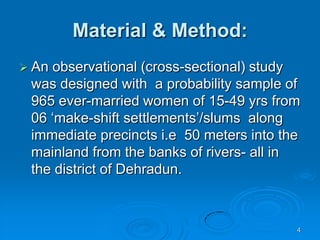
4Material & Method:An observational (cross-sectional) study was designed with  a probability sample of 965 ever-married women of 15-49 yrs from 06 ‘make-shift settlements’/slums  along immediate precincts i.e  50 meters into the mainland from the banks of rivers- all in the district of Dehradun.
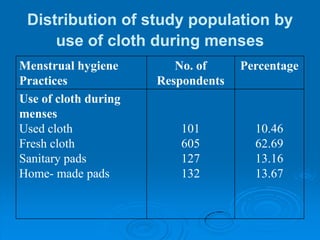
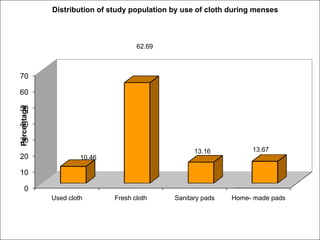
Distribution of study population by use of cloth during menses
6
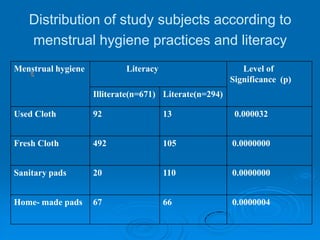
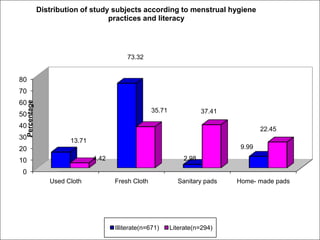
Distribution of study subjects according to menstrual hygiene practices and literacy
8
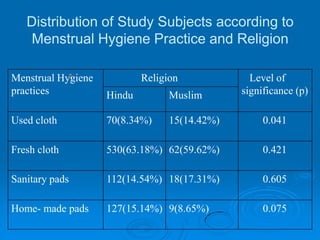
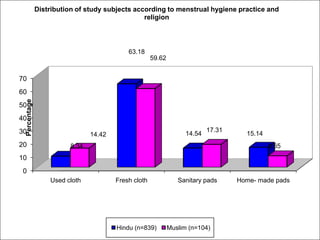
Distribution of Study Subjects according to Menstrual Hygiene Practice and Religion
10
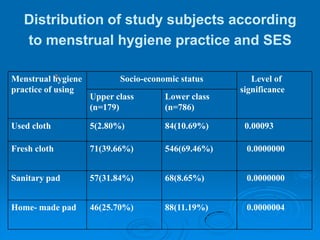
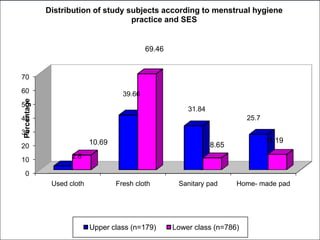
Distribution of study subjects according to menstrual hygiene practice and SES
12
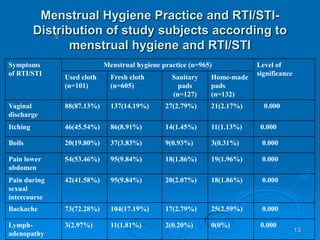
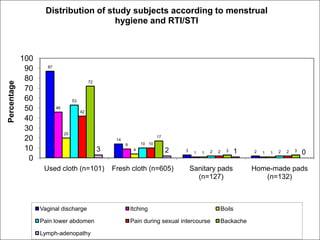
13Menstrual Hygiene Practice and RTI/STI- Distribution of study subjects according to menstrual hygiene and RTI/STI
14
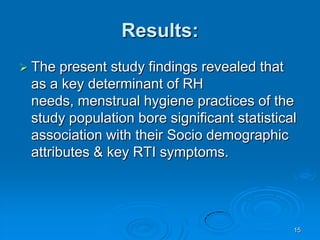
15Results:The present study findings revealed that as a key determinant of RH needs, menstrual hygiene practices of the study population bore significant statistical association with their Socio demographic attributes & key RTI symptoms.

Dr Sadhana Singh

  • 1.
    1Socio-demographic predictors ofMenstrual Hygiene Practices as key determinant of RTI among ever-married ‘in-migrant’ women of DehradunAuthors: Singh Sadhna,Kandpal SD,Roy D
  • 2.
    2Background:Considering huge burdenof RTI across community based study settings, menstrual hygiene practices by reproductive age group women have documented evidence of being a key determinant of RTI and bearing causal association with Socio-demographic attributes.
  • 3.
    3Objectives:1. Study menstrualhygiene practices of ever-married ‘in-migrant’ women from Dehradun as a key determinant of RH needs. 2. Establish causal association between menstrual hygiene practices and (i) key socio-demographic attributes (ii) RTI
  • 4.
    4Material & Method:Anobservational (cross-sectional) study was designed with a probability sample of 965 ever-married women of 15-49 yrs from 06 ‘make-shift settlements’/slums along immediate precincts i.e 50 meters into the mainland from the banks of rivers- all in the district of Dehradun.
  • 5.
    Distribution of studypopulation by use of cloth during menses
  • 6.
  • 7.
    Distribution of studysubjects according to menstrual hygiene practices and literacy
  • 8.
  • 9.
    Distribution of StudySubjects according to Menstrual Hygiene Practice and Religion
  • 10.
  • 11.
    Distribution of studysubjects according to menstrual hygiene practice and SES
  • 12.
  • 13.
    13Menstrual Hygiene Practiceand RTI/STI- Distribution of study subjects according to menstrual hygiene and RTI/STI
  • 14.
  • 15.
    15Results:The present studyfindings revealed that as a key determinant of RH needs, menstrual hygiene practices of the study population bore significant statistical association with their Socio demographic attributes & key RTI symptoms.