Patterns of Evolution
◼ Convergent evolution
◼ Divergent evolution
◼ Coevolution
Convergent Evolution
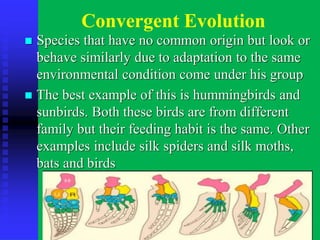
◼ Species that have no common origin but look or
behave similarly due to adaptation to the same
environmental condition come under his group
◼ The best example of this is hummingbirds and
sunbirds. Both these birds are from different
family but their feeding habit is the same. Other
examples include silk spiders and silk moths,
bats and birds
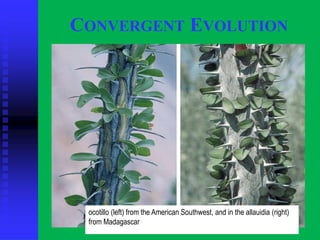
CONVERGENT EVOLUTION
ocotillo (left) from the American Southwest, and in the allauidia (right)
from Madagascar
Divergent Evolution
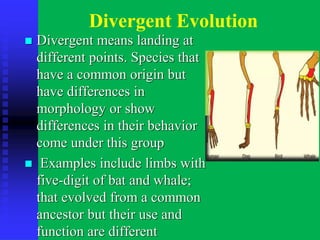
◼ Divergent means landing at
different points. Species that
have a common origin but
have differences in
morphology or show
differences in their behavior
come under this group
◼ Examples include limbs with
five-digit of bat and whale;
that evolved from a common
ancestor but their use and
function are different
Co-evolution
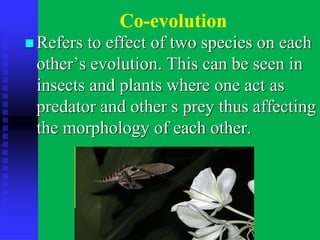
◼ Refers to effect of two species on each
other’s evolution. This can be seen in
insects and plants where one act as
predator and other s prey thus affecting
the morphology of each other.
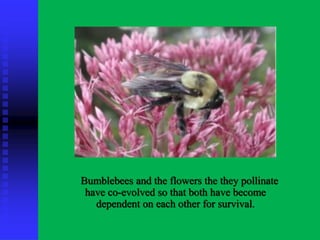
Bumblebees and the flowers the they pollinate
have co-evolved so that both have become
dependent on each other for survival.
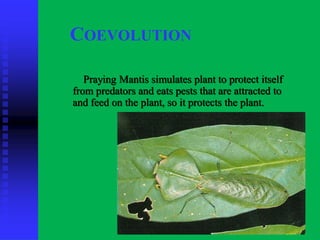
COEVOLUTION
Praying Mantis simulates plant to protect itself
from predators and eats pests that are attracted to
and feed on the plant, so it protects the plant.
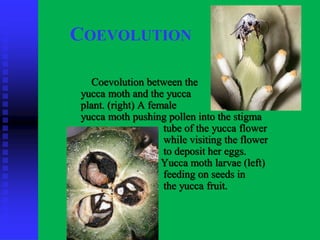
COEVOLUTION
Coevolution between the
yucca moth and the yucca
plant. (right) A female
yucca moth pushing pollen into the stigma
tube of the yucca flower
while visiting the flower
to deposit her eggs.
Yucca moth larvae (left)
feeding on seeds in
the yucca fruit.
Evolution
◼ Is defined as a change in the genetic
composition of a population over successive
generations.
◼ Evolutionary changes involve interaction
between available genetic variants and the
environment in which they exist. For
evolution to proceed, there are vital key
players: genetic variation, natural
selection, and genetic drift
Genetic Variation
◼ Heritable
◼ Transmittable traits are those encoded in
the genes
Sources of variation:
Mutation
❑ A change in the genomic DNA either by
random replication errors or by
environmental interaction with DNA
nucleotides
Genetic Variation
Sources of variation: Increase variation
Mutation
❑ Gene Flow - The introduction of new
mutations into a population by
individuals migrating from a different
population.
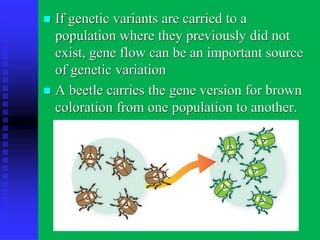
◼ If genetic variants are carried to a
population where they previously did not
exist, gene flow can be an important source
of genetic variation
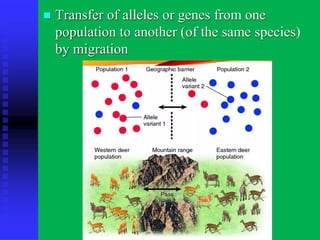
◼ A beetle carries the gene version for brown
coloration from one population to another.
◼ Transfer of alleles or genes from one
population to another (of the same species)
by migration
Genetic Variation
Sources of variation:
Increase variation
Recombination
❑ Is usually a consequence of
sexual reproduction in
eukaryotes.
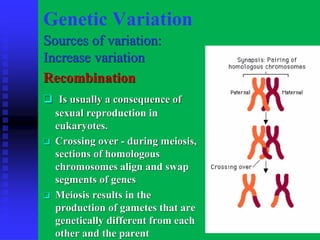
❑ Crossing over - during meiosis,
sections of homologous
chromosomes align and swap
segments of genes
❑ Meiosis results in the
production of gametes that are
genetically different from each
other and the parent
Sources of Variation: decrease variation
Genetic Drift
❑ Random change (due to "sampling
error" in selecting the alleles for the next
generation from the gene pool of the
current generation) in the variation or
allele frequency of a population
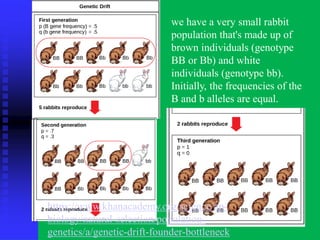
we have a very small rabbit
population that's made up of
brown individuals (genotype
BB or Bb) and white
individuals (genotype bb).
Initially, the frequencies of the
B and b alleles are equal.
https://www.khanacademy.org/science/ap-
biology/natural-selection/population-
genetics/a/genetic-drift-founder-bottleneck
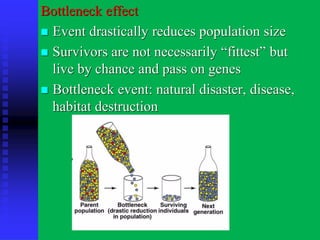
Bottleneck effect
◼ Event drastically reduces population size
◼ Survivors are not necessarily “fittest” but
live by chance and pass on genes
◼ Bottleneck event: natural disaster, disease,
habitat destruction
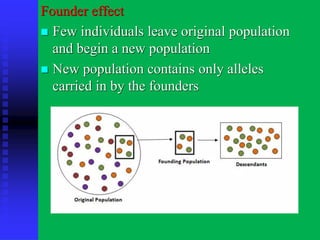
Founder effect
◼ Few individuals leave original population
and begin a new population
◼ New population contains only alleles
carried in by the founders
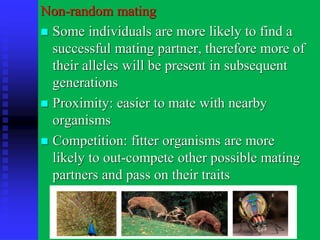
Non-random mating
◼ Some individuals are more likely to find a
successful mating partner, therefore more of
their alleles will be present in subsequent
generations
◼ Proximity: easier to mate with nearby
organisms
◼ Competition: fitter organisms are more
likely to out-compete other possible mating
partners and pass on their traits
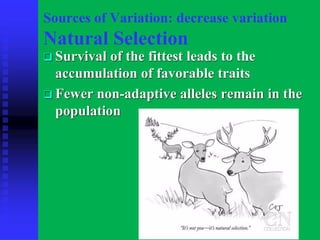
Sources of Variation: decrease variation
Natural Selection
❑ Survival of the fittest leads to the
accumulation of favorable traits
❑ Fewer non-adaptive alleles remain in the
population
9. patterns of evolution- Charles Darwin.pdf

9. patterns of evolution- Charles Darwin.pdf

  • 1.
    Patterns of Evolution ◼Convergent evolution ◼ Divergent evolution ◼ Coevolution
  • 2.
    Convergent Evolution ◼ Speciesthat have no common origin but look or behave similarly due to adaptation to the same environmental condition come under his group ◼ The best example of this is hummingbirds and sunbirds. Both these birds are from different family but their feeding habit is the same. Other examples include silk spiders and silk moths, bats and birds
  • 3.
    CONVERGENT EVOLUTION ocotillo (left)from the American Southwest, and in the allauidia (right) from Madagascar
  • 4.
    Divergent Evolution ◼ Divergentmeans landing at different points. Species that have a common origin but have differences in morphology or show differences in their behavior come under this group ◼ Examples include limbs with five-digit of bat and whale; that evolved from a common ancestor but their use and function are different
  • 5.
    Co-evolution ◼ Refers toeffect of two species on each other’s evolution. This can be seen in insects and plants where one act as predator and other s prey thus affecting the morphology of each other.
  • 6.
    Bumblebees and theflowers the they pollinate have co-evolved so that both have become dependent on each other for survival.
  • 7.
    COEVOLUTION Praying Mantis simulatesplant to protect itself from predators and eats pests that are attracted to and feed on the plant, so it protects the plant.
  • 8.
    COEVOLUTION Coevolution between the yuccamoth and the yucca plant. (right) A female yucca moth pushing pollen into the stigma tube of the yucca flower while visiting the flower to deposit her eggs. Yucca moth larvae (left) feeding on seeds in the yucca fruit.
  • 9.
    Evolution ◼ Is definedas a change in the genetic composition of a population over successive generations. ◼ Evolutionary changes involve interaction between available genetic variants and the environment in which they exist. For evolution to proceed, there are vital key players: genetic variation, natural selection, and genetic drift
  • 10.
    Genetic Variation ◼ Heritable ◼Transmittable traits are those encoded in the genes Sources of variation: Mutation ❑ A change in the genomic DNA either by random replication errors or by environmental interaction with DNA nucleotides
  • 11.
    Genetic Variation Sources ofvariation: Increase variation Mutation ❑ Gene Flow - The introduction of new mutations into a population by individuals migrating from a different population.
  • 12.
    ◼ If geneticvariants are carried to a population where they previously did not exist, gene flow can be an important source of genetic variation ◼ A beetle carries the gene version for brown coloration from one population to another.
  • 13.
    ◼ Transfer ofalleles or genes from one population to another (of the same species) by migration
  • 14.
    Genetic Variation Sources ofvariation: Increase variation Recombination ❑ Is usually a consequence of sexual reproduction in eukaryotes. ❑ Crossing over - during meiosis, sections of homologous chromosomes align and swap segments of genes ❑ Meiosis results in the production of gametes that are genetically different from each other and the parent
  • 15.
    Sources of Variation:decrease variation Genetic Drift ❑ Random change (due to "sampling error" in selecting the alleles for the next generation from the gene pool of the current generation) in the variation or allele frequency of a population
  • 16.
    we have avery small rabbit population that's made up of brown individuals (genotype BB or Bb) and white individuals (genotype bb). Initially, the frequencies of the B and b alleles are equal. https://www.khanacademy.org/science/ap- biology/natural-selection/population- genetics/a/genetic-drift-founder-bottleneck
  • 17.
    Bottleneck effect ◼ Eventdrastically reduces population size ◼ Survivors are not necessarily “fittest” but live by chance and pass on genes ◼ Bottleneck event: natural disaster, disease, habitat destruction
  • 18.
    Founder effect ◼ Fewindividuals leave original population and begin a new population ◼ New population contains only alleles carried in by the founders
  • 19.
    Non-random mating ◼ Someindividuals are more likely to find a successful mating partner, therefore more of their alleles will be present in subsequent generations ◼ Proximity: easier to mate with nearby organisms ◼ Competition: fitter organisms are more likely to out-compete other possible mating partners and pass on their traits
  • 20.
    Sources of Variation:decrease variation Natural Selection ❑ Survival of the fittest leads to the accumulation of favorable traits ❑ Fewer non-adaptive alleles remain in the population