Department of orthodontics
Surgical Orthodontic Treatment Planning:
Profile Analysis and Mandibular Surgery
FRANK W. WORMS, ROBERT J. ISAACSON and T. MICHAEL
SPEIDEL
The Angle Orthodontics Jan 1976, Vol. 46, No. 1 (January
1976) pp. 1-25
โ€ข Charles J. Burstone et al (1978) developed an
analysis specially designed for patients
requiring Orthognathic surgery.
โ€ข They used the landmarks and the
measurements that can be altered by
common surgical procedures.
โ€ข This analysis is also called as Cephalometrics
for Orthognathic Surgery (COGS)
โ€ข COGS system describes the horizontal and
vertical positions of the facial bones by the
use of constant coordinate systems as follows:
โ€ข Size of the bone are represented by direct
linear measurements.
โ€ข Shape of the bones are represented by the
angular measurements.
Skeletal And Dental Analysis
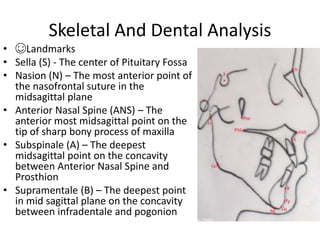
โ€ข โ˜บLandmarks
โ€ข Sella (S) - The center of Pituitary Fossa
โ€ข Nasion (N) โ€“ The most anterior point of
the nasofrontal suture in the
midsagittal plane
โ€ข Anterior Nasal Spine (ANS) โ€“ The
anterior most midsagittal point on the
tip of sharp bony process of maxilla
โ€ข Subspinale (A) โ€“ The deepest
midsagittal point on the concavity
between Anterior Nasal Spine and
Prosthion
โ€ข Supramentale (B) โ€“ The deepest point
in mid sagittal plane on the concavity
between infradentale and pogonion
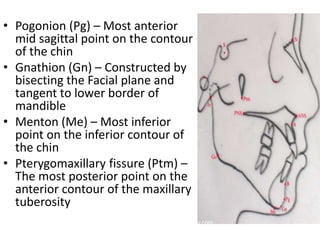
โ€ข Pogonion (Pg) โ€“ Most anterior
mid sagittal point on the contour
of the chin
โ€ข Gnathion (Gn) โ€“ Constructed by
bisecting the Facial plane and
tangent to lower border of
mandible
โ€ข Menton (Me) โ€“ Most inferior
point on the inferior contour of
the chin
โ€ข Pterygomaxillary fissure (Ptm) โ€“
The most posterior point on the
anterior contour of the maxillary
tuberosity
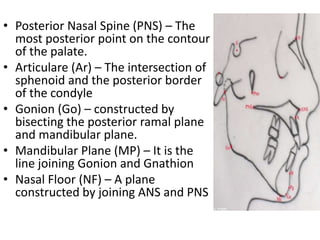
โ€ข Posterior Nasal Spine (PNS) โ€“ The
most posterior point on the contour
of the palate.
โ€ข Articulare (Ar) โ€“ The intersection of
sphenoid and the posterior border
of the condyle
โ€ข Gonion (Go) โ€“ constructed by
bisecting the posterior ramal plane
and mandibular plane.
โ€ข Mandibular Plane (MP) โ€“ It is the
line joining Gonion and Gnathion
โ€ข Nasal Floor (NF) โ€“ A plane
constructed by joining ANS and PNS
Reference plane
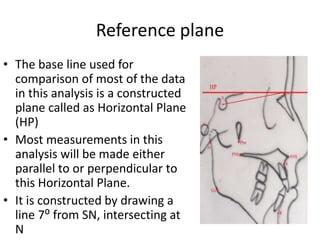
โ€ข The base line used for
comparison of most of the data
in this analysis is a constructed
plane called as Horizontal Plane
(HP)
โ€ข Most measurements in this
analysis will be made either
parallel to or perpendicular to
this Horizontal Plane.
โ€ข It is constructed by drawing a
line 7โฐ from SN, intersecting at
N
โ˜บParameters
Cranial Base
โ˜บAr-Ptm (linear)
โ˜บPtm-N (linear)
Horizontal Skeletal Profile
โ˜บN-A-Pg (angle)
โ˜บN-A (linear)
โ˜บN-B (linear)
โ˜บN-Pg (linear)
Vertical Skeletal
โ˜บN-ANS (linear)
โ˜บANS-Gn (linear)
โ˜บPNS-N (linear)
โ˜บMP-HP (linear
Vertical Dental
โ˜บUpper 1 โ€“ NF (linear)
โ˜บLower 1 โ€“ MP (linear)
โ˜บUpper 6 โ€“ NF (linear)
โ˜บLower 6 โ€“ MP (linear)
Maxilla and Mandible
โ˜บPNS-ANS (linear)
โ˜บAr-Go (linear)
โ˜บGo-Pg (linear)
โ˜บB-PG (linear)
โ˜บAr-Go-Gn (angle)
Dental
โ˜บOP-HP (angle)
โ˜บA-B parallel to OP (linear)
โ˜บUpper 1 โ€“ NF (angle)
โ˜บLower 1 โ€“ MP (angle)
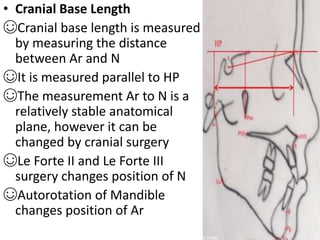
โ€ข Cranial Base Length
โ˜บCranial base length is measured
by measuring the distance
between Ar and N
โ˜บIt is measured parallel to HP
โ˜บThe measurement Ar to N is a
relatively stable anatomical
plane, however it can be
changed by cranial surgery
โ˜บLe Forte II and Le Forte III
surgery changes position of N
โ˜บAutorotation of Mandible
changes position of Ar
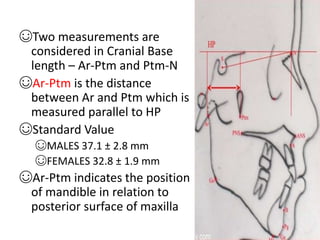
โ˜บTwo measurements are
considered in Cranial Base
length โ€“ Ar-Ptm and Ptm-N
โ˜บAr-Ptm is the distance
between Ar and Ptm which is
measured parallel to HP
โ˜บStandard Value
โ˜บMALES 37.1 ยฑ 2.8 mm
โ˜บFEMALES 32.8 ยฑ 1.9 mm
โ˜บAr-Ptm indicates the position
of mandible in relation to
posterior surface of maxilla
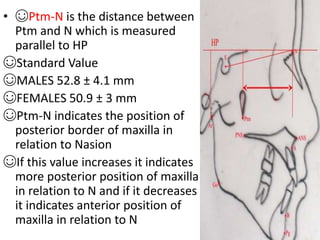
โ€ข โ˜บPtm-N is the distance between
Ptm and N which is measured
parallel to HP
โ˜บStandard Value
โ˜บMALES 52.8 ยฑ 4.1 mm
โ˜บFEMALES 50.9 ยฑ 3 mm
โ˜บPtm-N indicates the position of
posterior border of maxilla in
relation to Nasion
โ˜บIf this value increases it indicates
more posterior position of maxilla
in relation to N and if it decreases
it indicates anterior position of
maxilla in relation to N
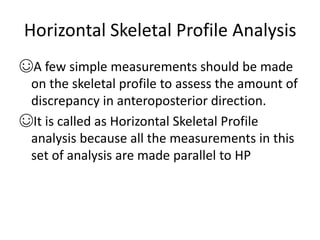
Horizontal Skeletal Profile Analysis
โ˜บA few simple measurements should be made
on the skeletal profile to assess the amount of
discrepancy in anteroposterior direction.
โ˜บIt is called as Horizontal Skeletal Profile
analysis because all the measurements in this
set of analysis are made parallel to HP
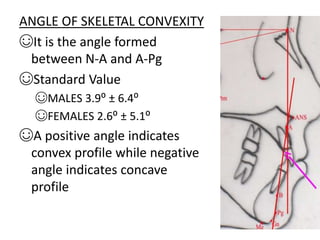
ANGLE OF SKELETAL CONVEXITY
โ˜บIt is the angle formed
between N-A and A-Pg
โ˜บStandard Value
โ˜บMALES 3.9โฐ ยฑ 6.4โฐ
โ˜บFEMALES 2.6โฐ ยฑ 5.1โฐ
โ˜บA positive angle indicates
convex profile while negative
angle indicates concave
profile
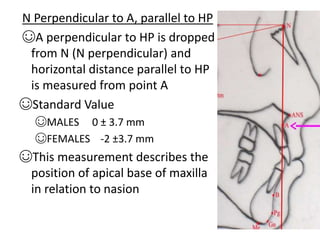
N Perpendicular to A, parallel to HP
โ˜บA perpendicular to HP is dropped
from N (N perpendicular) and
horizontal distance parallel to HP
is measured from point A
โ˜บStandard Value
โ˜บMALES 0 ยฑ 3.7 mm
โ˜บFEMALES -2 ยฑ3.7 mm
โ˜บThis measurement describes the
position of apical base of maxilla
in relation to nasion
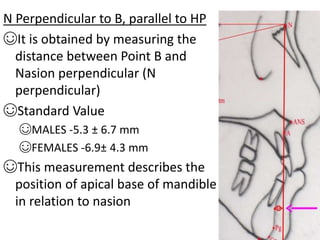
N Perpendicular to B, parallel to HP
โ˜บIt is obtained by measuring the
distance between Point B and
Nasion perpendicular (N
perpendicular)
โ˜บStandard Value
โ˜บMALES -5.3 ยฑ 6.7 mm
โ˜บFEMALES -6.9ยฑ 4.3 mm
โ˜บThis measurement describes the
position of apical base of mandible
in relation to nasion
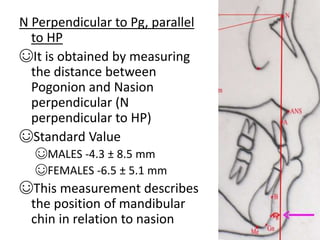
N Perpendicular to Pg, parallel
to HP
โ˜บIt is obtained by measuring
the distance between
Pogonion and Nasion
perpendicular (N
perpendicular to HP)
โ˜บStandard Value
โ˜บMALES -4.3 ยฑ 8.5 mm
โ˜บFEMALES -6.5 ยฑ 5.1 mm
โ˜บThis measurement describes
the position of mandibular
chin in relation to nasion
Vertical Skeletal Analysis
โ˜บA Vertical skeletal discrepancy may reflect an
anterior, posterior or complex dysplasia of the
face
โ˜บIt is divided into two components
โ˜บAnterior component
โ˜บPosterior component
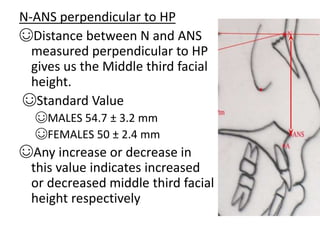
N-ANS perpendicular to HP
โ˜บDistance between N and ANS
measured perpendicular to HP
gives us the Middle third facial
height.
โ˜บStandard Value
โ˜บMALES 54.7 ยฑ 3.2 mm
โ˜บFEMALES 50 ยฑ 2.4 mm
โ˜บAny increase or decrease in
this value indicates increased
or decreased middle third facial
height respectively
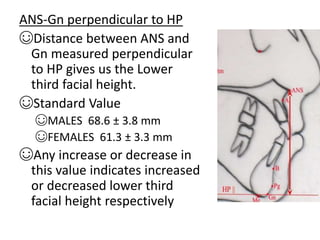
ANS-Gn perpendicular to HP
โ˜บDistance between ANS and
Gn measured perpendicular
to HP gives us the Lower
third facial height.
โ˜บStandard Value
โ˜บMALES 68.6 ยฑ 3.8 mm
โ˜บFEMALES 61.3 ยฑ 3.3 mm
โ˜บAny increase or decrease in
this value indicates increased
or decreased lower third
facial height respectively
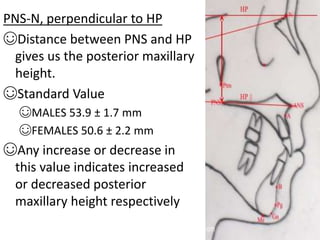
PNS-N, perpendicular to HP
โ˜บDistance between PNS and HP
gives us the posterior maxillary
height.
โ˜บStandard Value
โ˜บMALES 53.9 ยฑ 1.7 mm
โ˜บFEMALES 50.6 ยฑ 2.2 mm
โ˜บAny increase or decrease in
this value indicates increased
or decreased posterior
maxillary height respectively
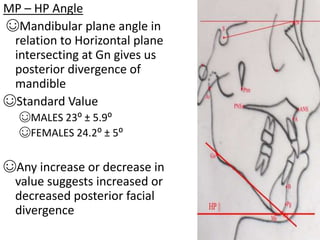
MP โ€“ HP Angle
โ˜บMandibular plane angle in
relation to Horizontal plane
intersecting at Gn gives us
posterior divergence of
mandible
โ˜บStandard Value
โ˜บMALES 23โฐ ยฑ 5.9โฐ
โ˜บFEMALES 24.2โฐ ยฑ 5โฐ
โ˜บAny increase or decrease in
value suggests increased or
decreased posterior facial
divergence
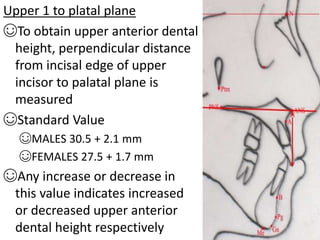
Upper 1 to platal plane
โ˜บTo obtain upper anterior dental
height, perpendicular distance
from incisal edge of upper
incisor to palatal plane is
measured
โ˜บStandard Value
โ˜บMALES 30.5 + 2.1 mm
โ˜บFEMALES 27.5 + 1.7 mm
โ˜บAny increase or decrease in
this value indicates increased
or decreased upper anterior
dental height respectively
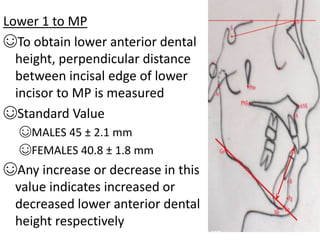
Lower 1 to MP
โ˜บTo obtain lower anterior dental
height, perpendicular distance
between incisal edge of lower
incisor to MP is measured
โ˜บStandard Value
โ˜บMALES 45 ยฑ 2.1 mm
โ˜บFEMALES 40.8 ยฑ 1.8 mm
โ˜บAny increase or decrease in this
value indicates increased or
decreased lower anterior dental
height respectively
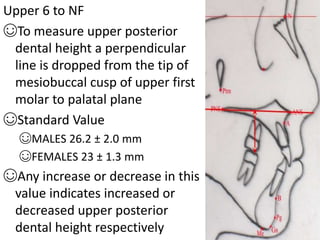
Upper 6 to NF
โ˜บTo measure upper posterior
dental height a perpendicular
line is dropped from the tip of
mesiobuccal cusp of upper first
molar to palatal plane
โ˜บStandard Value
โ˜บMALES 26.2 ยฑ 2.0 mm
โ˜บFEMALES 23 ยฑ 1.3 mm
โ˜บAny increase or decrease in this
value indicates increased or
decreased upper posterior
dental height respectively
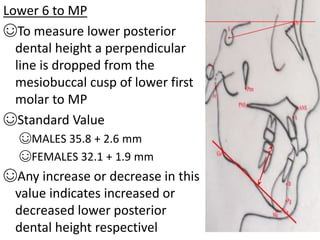
Lower 6 to MP
โ˜บTo measure lower posterior
dental height a perpendicular
line is dropped from the
mesiobuccal cusp of lower first
molar to MP
โ˜บStandard Value
โ˜บMALES 35.8 + 2.6 mm
โ˜บFEMALES 32.1 + 1.9 mm
โ˜บAny increase or decrease in this
value indicates increased or
decreased lower posterior
dental height respectivel
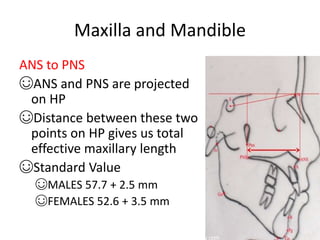
Maxilla and Mandible
ANS to PNS
โ˜บANS and PNS are projected
on HP
โ˜บDistance between these two
points on HP gives us total
effective maxillary length
โ˜บStandard Value
โ˜บMALES 57.7 + 2.5 mm
โ˜บFEMALES 52.6 + 3.5 mm
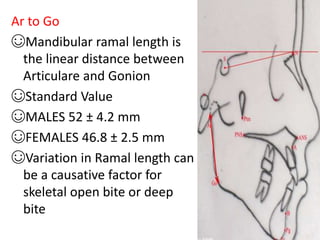
Ar to Go
โ˜บMandibular ramal length is
the linear distance between
Articulare and Gonion
โ˜บStandard Value
โ˜บMALES 52 ยฑ 4.2 mm
โ˜บFEMALES 46.8 ยฑ 2.5 mm
โ˜บVariation in Ramal length can
be a causative factor for
skeletal open bite or deep
bite
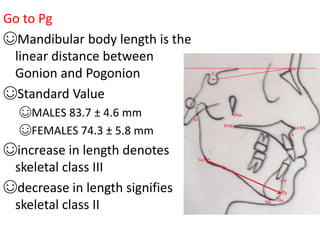
Go to Pg
โ˜บMandibular body length is the
linear distance between
Gonion and Pogonion
โ˜บStandard Value
โ˜บMALES 83.7 ยฑ 4.6 mm
โ˜บFEMALES 74.3 ยฑ 5.8 mm
โ˜บincrease in length denotes
skeletal class III
โ˜บdecrease in length signifies
skeletal class II
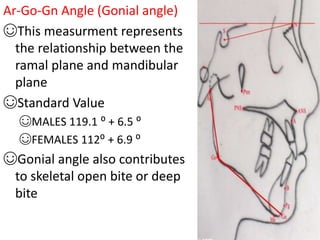
Ar-Go-Gn Angle (Gonial angle)
โ˜บThis measurment represents
the relationship between the
ramal plane and mandibular
plane
โ˜บStandard Value
โ˜บMALES 119.1 โฐ + 6.5 โฐ
โ˜บFEMALES 112โฐ + 6.9 โฐ
โ˜บGonial angle also contributes
to skeletal open bite or deep
bite
Dental parameters
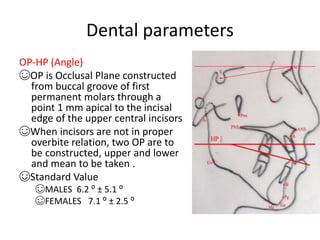
OP-HP (Angle)
โ˜บOP is Occlusal Plane constructed
from buccal groove of first
permanent molars through a
point 1 mm apical to the incisal
edge of the upper central incisors
โ˜บWhen incisors are not in proper
overbite relation, two OP are to
be constructed, upper and lower
and mean to be taken .
โ˜บStandard Value
โ˜บMALES 6.2 โฐ ยฑ 5.1 โฐ
โ˜บFEMALES 7.1 โฐ ยฑ 2.5 โฐ
โ˜บAn increased OP-HP angle may be associated
with skeletal open bite, lip incompetence and
increased anterior facial height
โ˜บAn decreased OP-HP angle may be associated
with skeletal deep bite, decreased anterior
facial height and lip redundancy
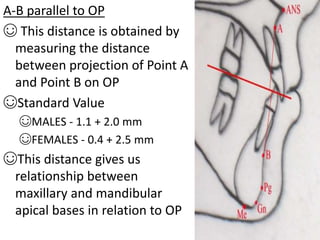
A-B parallel to OP
โ˜บ This distance is obtained by
measuring the distance
between projection of Point A
and Point B on OP
โ˜บStandard Value
โ˜บMALES - 1.1 + 2.0 mm
โ˜บFEMALES - 0.4 + 2.5 mm
โ˜บThis distance gives us
relationship between
maxillary and mandibular
apical bases in relation to OP
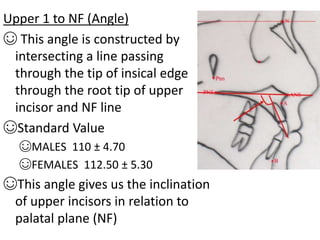
Upper 1 to NF (Angle)
โ˜บ This angle is constructed by
intersecting a line passing
through the tip of insical edge
through the root tip of upper
incisor and NF line
โ˜บStandard Value
โ˜บMALES 110 ยฑ 4.70
โ˜บFEMALES 112.50 ยฑ 5.30
โ˜บThis angle gives us the inclination
of upper incisors in relation to
palatal plane (NF)
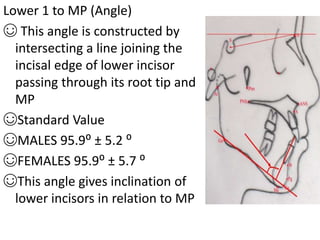
Lower 1 to MP (Angle)
โ˜บ This angle is constructed by
intersecting a line joining the
incisal edge of lower incisor
passing through its root tip and
MP
โ˜บStandard Value
โ˜บMALES 95.9โฐ ยฑ 5.2 โฐ
โ˜บFEMALES 95.9โฐ ยฑ 5.7 โฐ
โ˜บThis angle gives inclination of
lower incisors in relation to MP
SOFT TISSUE ANALYSIS
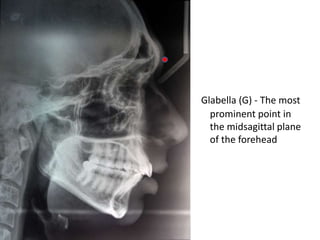
Glabella (G) - The most
prominent point in
the midsagittal plane
of the forehead
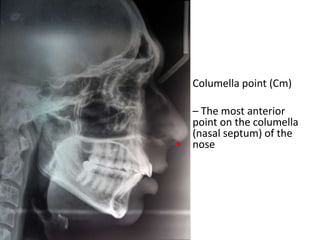
Columella point (Cm)
โ€“ The most anterior
point on the columella
(nasal septum) of the
nose
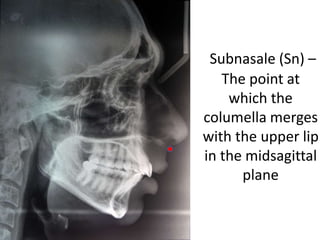
Subnasale (Sn) โ€“
The point at
which the
columella merges
with the upper lip
in the midsagittal
plane
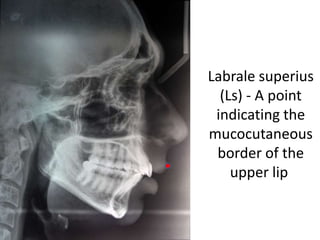
Labrale superius
(Ls) - A point
indicating the
mucocutaneous
border of the
upper lip
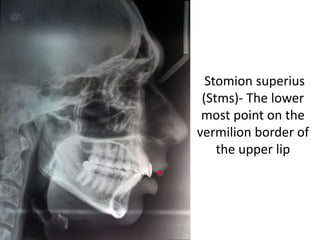
Stomion superius
(Stms)- The lower
most point on the
vermilion border of
the upper lip
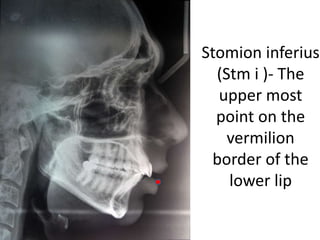
Stomion inferius
(Stm i )- The
upper most
point on the
vermilion
border of the
lower lip
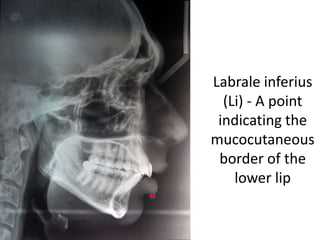
Labrale inferius
(Li) - A point
indicating the
mucocutaneous
border of the
lower lip
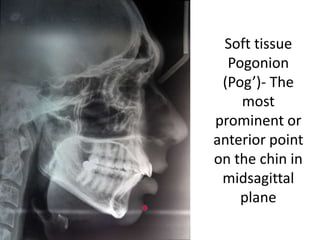
Soft tissue
Pogonion
(Pogโ€™)- The
most
prominent or
anterior point
on the chin in
midsagittal
plane
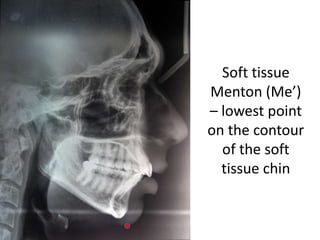
Soft tissue
Menton (Meโ€™)
โ€“ lowest point
on the contour
of the soft
tissue chin
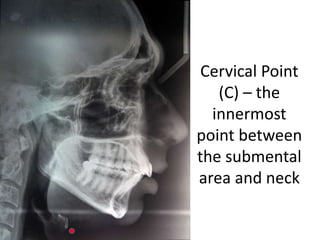
Cervical Point
(C) โ€“ the
innermost
point between
the submental
area and neck
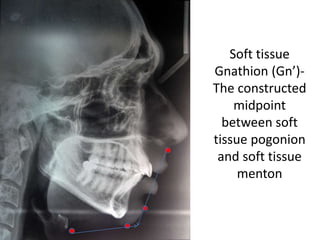
Soft tissue
Gnathion (Gnโ€™)-
The constructed
midpoint
between soft
tissue pogonion
and soft tissue
menton
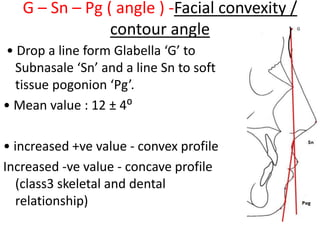
G โ€“ Sn โ€“ Pg ( angle ) -Facial convexity /
contour angle
โ€ข Drop a line form Glabella โ€˜Gโ€™ to
Subnasale โ€˜Snโ€™ and a line Sn to soft
tissue pogonion โ€˜Pgโ€™.
โ€ข Mean value : 12 ยฑ 4โฐ
โ€ข increased +ve value - convex profile
Increased -ve value - concave profile
(class3 skeletal and dental
relationship)
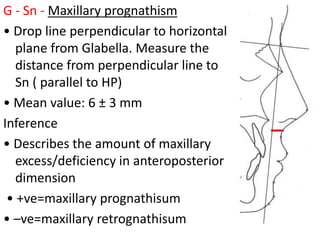
G - Sn - Maxillary prognathism
โ€ข Drop line perpendicular to horizontal
plane from Glabella. Measure the
distance from perpendicular line to
Sn ( parallel to HP)
โ€ข Mean value: 6 ยฑ 3 mm
Inference
โ€ข Describes the amount of maxillary
excess/deficiency in anteroposterior
dimension
โ€ข +ve=maxillary prognathisum
โ€ข โ€“ve=maxillary retrognathisum
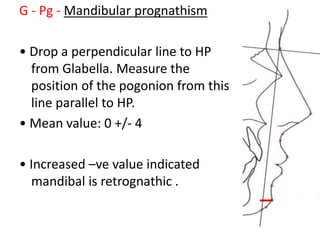
G - Pg - Mandibular prognathism
โ€ข Drop a perpendicular line to HP
from Glabella. Measure the
position of the pogonion from this
line parallel to HP.
โ€ข Mean value: 0 +/- 4
โ€ข Increased โ€“ve value indicated
mandibal is retrognathic .
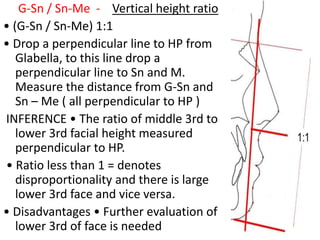
G-Sn / Sn-Me - Vertical height ratio
โ€ข (G-Sn / Sn-Me) 1:1
โ€ข Drop a perpendicular line to HP from
Glabella, to this line drop a
perpendicular line to Sn and M.
Measure the distance from G-Sn and
Sn โ€“ Me ( all perpendicular to HP )
INFERENCE โ€ข The ratio of middle 3rd to
lower 3rd facial height measured
perpendicular to HP.
โ€ข Ratio less than 1 = denotes
disproportionality and there is large
lower 3rd face and vice versa.
โ€ข Disadvantages โ€ข Further evaluation of
lower 3rd of face is needed
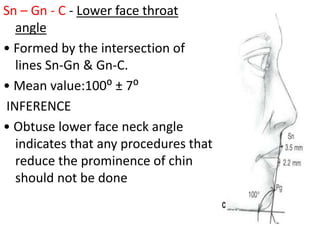
Sn โ€“ Gn - C - Lower face throat
angle
โ€ข Formed by the intersection of
lines Sn-Gn & Gn-C.
โ€ข Mean value:100โฐ ยฑ 7โฐ
INFERENCE
โ€ข Obtuse lower face neck angle
indicates that any procedures that
reduce the prominence of chin
should not be done
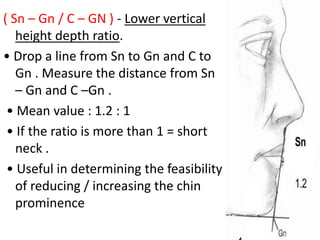
( Sn โ€“ Gn / C โ€“ GN ) - Lower vertical
height depth ratio.
โ€ข Drop a line from Sn to Gn and C to
Gn . Measure the distance from Sn
โ€“ Gn and C โ€“Gn .
โ€ข Mean value : 1.2 : 1
โ€ข If the ratio is more than 1 = short
neck .
โ€ข Useful in determining the feasibility
of reducing / increasing the chin
prominence
LIP POSITION AND FORM
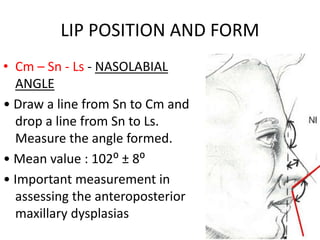
โ€ข Cm โ€“ Sn - Ls - NASOLABIAL
ANGLE
โ€ข Draw a line from Sn to Cm and
drop a line from Sn to Ls.
Measure the angle formed.
โ€ข Mean value : 102โฐ ยฑ 8โฐ
โ€ข Important measurement in
assessing the anteroposterior
maxillary dysplasias
โ€ข ACUTE nasolabial angle = treated by retracting
the maxilla / maxillary incisors / both.
โ€ข OBTUSE nasolabial angle = suggests the
degree of maxillary hypoplasia and indicates
for maxillary advancement or orthodontic
proclination of maxillary incisors.
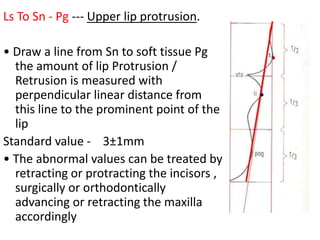
Ls To Sn - Pg --- Upper lip protrusion.
โ€ข Draw a line from Sn to soft tissue Pg
the amount of lip Protrusion /
Retrusion is measured with
perpendicular linear distance from
this line to the prominent point of the
lip
Standard value - 3ยฑ1mm
โ€ข The abnormal values can be treated by
retracting or protracting the incisors ,
surgically or orthodontically
advancing or retracting the maxilla
accordingly
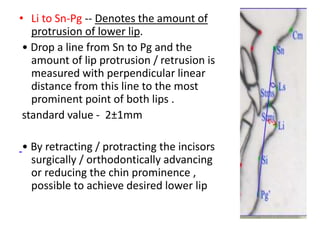
โ€ข Li to Sn-Pg -- Denotes the amount of
protrusion of lower lip.
โ€ข Drop a line from Sn to Pg and the
amount of lip protrusion / retrusion is
measured with perpendicular linear
distance from this line to the most
prominent point of both lips .
standard value - 2ยฑ1mm
โ€ข By retracting / protracting the incisors
surgically / orthodontically advancing
or reducing the chin prominence ,
possible to achieve desired lower lip
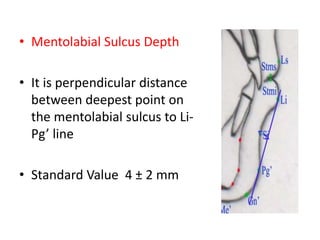
โ€ข Mentolabial Sulcus Depth
โ€ข It is perpendicular distance
between deepest point on
the mentolabial sulcus to Li-
Pgโ€™ line
โ€ข Standard Value 4 ยฑ 2 mm
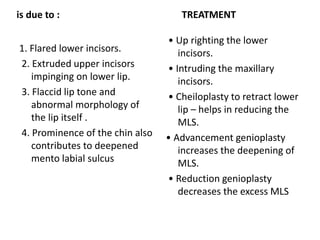
is due to :
1. Flared lower incisors.
2. Extruded upper incisors
impinging on lower lip.
3. Flaccid lip tone and
abnormal morphology of
the lip itself .
4. Prominence of the chin also
contributes to deepened
mento labial sulcus
TREATMENT
โ€ข Up righting the lower
incisors.
โ€ข Intruding the maxillary
incisors.
โ€ข Cheiloplasty to retract lower
lip โ€“ helps in reducing the
MLS.
โ€ข Advancement genioplasty
increases the deepening of
MLS.
โ€ข Reduction genioplasty
decreases the excess MLS
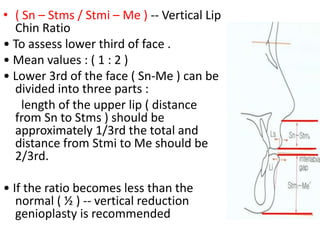
โ€ข ( Sn โ€“ Stms / Stmi โ€“ Me ) -- Vertical Lip
Chin Ratio
โ€ข To assess lower third of face .
โ€ข Mean values : ( 1 : 2 )
โ€ข Lower 3rd of the face ( Sn-Me ) can be
divided into three parts :
length of the upper lip ( distance
from Sn to Stms ) should be
approximately 1/3rd the total and
distance from Stmi to Me should be
2/3rd.
โ€ข If the ratio becomes less than the
normal ( ยฝ ) -- vertical reduction
genioplasty is recommended
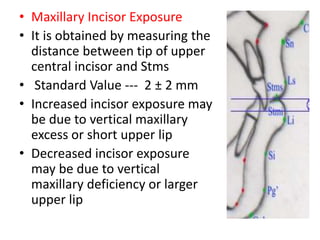
โ€ข Maxillary Incisor Exposure
โ€ข It is obtained by measuring the
distance between tip of upper
central incisor and Stms
โ€ข Standard Value --- 2 ยฑ 2 mm
โ€ข Increased incisor exposure may
be due to vertical maxillary
excess or short upper lip
โ€ข Decreased incisor exposure
may be due to vertical
maxillary deficiency or larger
upper lip
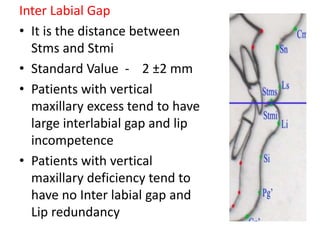
Inter Labial Gap
โ€ข It is the distance between
Stms and Stmi
โ€ข Standard Value - 2 ยฑ2 mm
โ€ข Patients with vertical
maxillary excess tend to have
large interlabial gap and lip
incompetence
โ€ข Patients with vertical
maxillary deficiency tend to
have no Inter labial gap and
Lip redundancy
Thank you

Burstone analysis

  • 1.
    Department of orthodontics SurgicalOrthodontic Treatment Planning: Profile Analysis and Mandibular Surgery FRANK W. WORMS, ROBERT J. ISAACSON and T. MICHAEL SPEIDEL The Angle Orthodontics Jan 1976, Vol. 46, No. 1 (January 1976) pp. 1-25
  • 2.
    โ€ข Charles J.Burstone et al (1978) developed an analysis specially designed for patients requiring Orthognathic surgery. โ€ข They used the landmarks and the measurements that can be altered by common surgical procedures. โ€ข This analysis is also called as Cephalometrics for Orthognathic Surgery (COGS)
  • 3.
    โ€ข COGS systemdescribes the horizontal and vertical positions of the facial bones by the use of constant coordinate systems as follows: โ€ข Size of the bone are represented by direct linear measurements. โ€ข Shape of the bones are represented by the angular measurements.
  • 4.
    Skeletal And DentalAnalysis โ€ข โ˜บLandmarks โ€ข Sella (S) - The center of Pituitary Fossa โ€ข Nasion (N) โ€“ The most anterior point of the nasofrontal suture in the midsagittal plane โ€ข Anterior Nasal Spine (ANS) โ€“ The anterior most midsagittal point on the tip of sharp bony process of maxilla โ€ข Subspinale (A) โ€“ The deepest midsagittal point on the concavity between Anterior Nasal Spine and Prosthion โ€ข Supramentale (B) โ€“ The deepest point in mid sagittal plane on the concavity between infradentale and pogonion
  • 5.
    โ€ข Pogonion (Pg)โ€“ Most anterior mid sagittal point on the contour of the chin โ€ข Gnathion (Gn) โ€“ Constructed by bisecting the Facial plane and tangent to lower border of mandible โ€ข Menton (Me) โ€“ Most inferior point on the inferior contour of the chin โ€ข Pterygomaxillary fissure (Ptm) โ€“ The most posterior point on the anterior contour of the maxillary tuberosity
  • 6.
    โ€ข Posterior NasalSpine (PNS) โ€“ The most posterior point on the contour of the palate. โ€ข Articulare (Ar) โ€“ The intersection of sphenoid and the posterior border of the condyle โ€ข Gonion (Go) โ€“ constructed by bisecting the posterior ramal plane and mandibular plane. โ€ข Mandibular Plane (MP) โ€“ It is the line joining Gonion and Gnathion โ€ข Nasal Floor (NF) โ€“ A plane constructed by joining ANS and PNS
  • 7.
    Reference plane โ€ข Thebase line used for comparison of most of the data in this analysis is a constructed plane called as Horizontal Plane (HP) โ€ข Most measurements in this analysis will be made either parallel to or perpendicular to this Horizontal Plane. โ€ข It is constructed by drawing a line 7โฐ from SN, intersecting at N
  • 8.
    โ˜บParameters Cranial Base โ˜บAr-Ptm (linear) โ˜บPtm-N(linear) Horizontal Skeletal Profile โ˜บN-A-Pg (angle) โ˜บN-A (linear) โ˜บN-B (linear) โ˜บN-Pg (linear) Vertical Skeletal โ˜บN-ANS (linear) โ˜บANS-Gn (linear) โ˜บPNS-N (linear) โ˜บMP-HP (linear Vertical Dental โ˜บUpper 1 โ€“ NF (linear) โ˜บLower 1 โ€“ MP (linear) โ˜บUpper 6 โ€“ NF (linear) โ˜บLower 6 โ€“ MP (linear) Maxilla and Mandible โ˜บPNS-ANS (linear) โ˜บAr-Go (linear) โ˜บGo-Pg (linear) โ˜บB-PG (linear) โ˜บAr-Go-Gn (angle) Dental โ˜บOP-HP (angle) โ˜บA-B parallel to OP (linear) โ˜บUpper 1 โ€“ NF (angle) โ˜บLower 1 โ€“ MP (angle)
  • 9.
    โ€ข Cranial BaseLength โ˜บCranial base length is measured by measuring the distance between Ar and N โ˜บIt is measured parallel to HP โ˜บThe measurement Ar to N is a relatively stable anatomical plane, however it can be changed by cranial surgery โ˜บLe Forte II and Le Forte III surgery changes position of N โ˜บAutorotation of Mandible changes position of Ar
  • 10.
    โ˜บTwo measurements are consideredin Cranial Base length โ€“ Ar-Ptm and Ptm-N โ˜บAr-Ptm is the distance between Ar and Ptm which is measured parallel to HP โ˜บStandard Value โ˜บMALES 37.1 ยฑ 2.8 mm โ˜บFEMALES 32.8 ยฑ 1.9 mm โ˜บAr-Ptm indicates the position of mandible in relation to posterior surface of maxilla
  • 11.
    โ€ข โ˜บPtm-N isthe distance between Ptm and N which is measured parallel to HP โ˜บStandard Value โ˜บMALES 52.8 ยฑ 4.1 mm โ˜บFEMALES 50.9 ยฑ 3 mm โ˜บPtm-N indicates the position of posterior border of maxilla in relation to Nasion โ˜บIf this value increases it indicates more posterior position of maxilla in relation to N and if it decreases it indicates anterior position of maxilla in relation to N
  • 12.
    Horizontal Skeletal ProfileAnalysis โ˜บA few simple measurements should be made on the skeletal profile to assess the amount of discrepancy in anteroposterior direction. โ˜บIt is called as Horizontal Skeletal Profile analysis because all the measurements in this set of analysis are made parallel to HP
  • 13.
    ANGLE OF SKELETALCONVEXITY โ˜บIt is the angle formed between N-A and A-Pg โ˜บStandard Value โ˜บMALES 3.9โฐ ยฑ 6.4โฐ โ˜บFEMALES 2.6โฐ ยฑ 5.1โฐ โ˜บA positive angle indicates convex profile while negative angle indicates concave profile
  • 14.
    N Perpendicular toA, parallel to HP โ˜บA perpendicular to HP is dropped from N (N perpendicular) and horizontal distance parallel to HP is measured from point A โ˜บStandard Value โ˜บMALES 0 ยฑ 3.7 mm โ˜บFEMALES -2 ยฑ3.7 mm โ˜บThis measurement describes the position of apical base of maxilla in relation to nasion
  • 15.
    N Perpendicular toB, parallel to HP โ˜บIt is obtained by measuring the distance between Point B and Nasion perpendicular (N perpendicular) โ˜บStandard Value โ˜บMALES -5.3 ยฑ 6.7 mm โ˜บFEMALES -6.9ยฑ 4.3 mm โ˜บThis measurement describes the position of apical base of mandible in relation to nasion
  • 16.
    N Perpendicular toPg, parallel to HP โ˜บIt is obtained by measuring the distance between Pogonion and Nasion perpendicular (N perpendicular to HP) โ˜บStandard Value โ˜บMALES -4.3 ยฑ 8.5 mm โ˜บFEMALES -6.5 ยฑ 5.1 mm โ˜บThis measurement describes the position of mandibular chin in relation to nasion
  • 17.
    Vertical Skeletal Analysis โ˜บAVertical skeletal discrepancy may reflect an anterior, posterior or complex dysplasia of the face โ˜บIt is divided into two components โ˜บAnterior component โ˜บPosterior component
  • 18.
    N-ANS perpendicular toHP โ˜บDistance between N and ANS measured perpendicular to HP gives us the Middle third facial height. โ˜บStandard Value โ˜บMALES 54.7 ยฑ 3.2 mm โ˜บFEMALES 50 ยฑ 2.4 mm โ˜บAny increase or decrease in this value indicates increased or decreased middle third facial height respectively
  • 19.
    ANS-Gn perpendicular toHP โ˜บDistance between ANS and Gn measured perpendicular to HP gives us the Lower third facial height. โ˜บStandard Value โ˜บMALES 68.6 ยฑ 3.8 mm โ˜บFEMALES 61.3 ยฑ 3.3 mm โ˜บAny increase or decrease in this value indicates increased or decreased lower third facial height respectively
  • 20.
    PNS-N, perpendicular toHP โ˜บDistance between PNS and HP gives us the posterior maxillary height. โ˜บStandard Value โ˜บMALES 53.9 ยฑ 1.7 mm โ˜บFEMALES 50.6 ยฑ 2.2 mm โ˜บAny increase or decrease in this value indicates increased or decreased posterior maxillary height respectively
  • 21.
    MP โ€“ HPAngle โ˜บMandibular plane angle in relation to Horizontal plane intersecting at Gn gives us posterior divergence of mandible โ˜บStandard Value โ˜บMALES 23โฐ ยฑ 5.9โฐ โ˜บFEMALES 24.2โฐ ยฑ 5โฐ โ˜บAny increase or decrease in value suggests increased or decreased posterior facial divergence
  • 22.
    Upper 1 toplatal plane โ˜บTo obtain upper anterior dental height, perpendicular distance from incisal edge of upper incisor to palatal plane is measured โ˜บStandard Value โ˜บMALES 30.5 + 2.1 mm โ˜บFEMALES 27.5 + 1.7 mm โ˜บAny increase or decrease in this value indicates increased or decreased upper anterior dental height respectively
  • 23.
    Lower 1 toMP โ˜บTo obtain lower anterior dental height, perpendicular distance between incisal edge of lower incisor to MP is measured โ˜บStandard Value โ˜บMALES 45 ยฑ 2.1 mm โ˜บFEMALES 40.8 ยฑ 1.8 mm โ˜บAny increase or decrease in this value indicates increased or decreased lower anterior dental height respectively
  • 24.
    Upper 6 toNF โ˜บTo measure upper posterior dental height a perpendicular line is dropped from the tip of mesiobuccal cusp of upper first molar to palatal plane โ˜บStandard Value โ˜บMALES 26.2 ยฑ 2.0 mm โ˜บFEMALES 23 ยฑ 1.3 mm โ˜บAny increase or decrease in this value indicates increased or decreased upper posterior dental height respectively
  • 25.
    Lower 6 toMP โ˜บTo measure lower posterior dental height a perpendicular line is dropped from the mesiobuccal cusp of lower first molar to MP โ˜บStandard Value โ˜บMALES 35.8 + 2.6 mm โ˜บFEMALES 32.1 + 1.9 mm โ˜บAny increase or decrease in this value indicates increased or decreased lower posterior dental height respectivel
  • 26.
    Maxilla and Mandible ANSto PNS โ˜บANS and PNS are projected on HP โ˜บDistance between these two points on HP gives us total effective maxillary length โ˜บStandard Value โ˜บMALES 57.7 + 2.5 mm โ˜บFEMALES 52.6 + 3.5 mm
  • 27.
    Ar to Go โ˜บMandibularramal length is the linear distance between Articulare and Gonion โ˜บStandard Value โ˜บMALES 52 ยฑ 4.2 mm โ˜บFEMALES 46.8 ยฑ 2.5 mm โ˜บVariation in Ramal length can be a causative factor for skeletal open bite or deep bite
  • 28.
    Go to Pg โ˜บMandibularbody length is the linear distance between Gonion and Pogonion โ˜บStandard Value โ˜บMALES 83.7 ยฑ 4.6 mm โ˜บFEMALES 74.3 ยฑ 5.8 mm โ˜บincrease in length denotes skeletal class III โ˜บdecrease in length signifies skeletal class II
  • 29.
    Ar-Go-Gn Angle (Gonialangle) โ˜บThis measurment represents the relationship between the ramal plane and mandibular plane โ˜บStandard Value โ˜บMALES 119.1 โฐ + 6.5 โฐ โ˜บFEMALES 112โฐ + 6.9 โฐ โ˜บGonial angle also contributes to skeletal open bite or deep bite
  • 30.
    Dental parameters OP-HP (Angle) โ˜บOPis Occlusal Plane constructed from buccal groove of first permanent molars through a point 1 mm apical to the incisal edge of the upper central incisors โ˜บWhen incisors are not in proper overbite relation, two OP are to be constructed, upper and lower and mean to be taken . โ˜บStandard Value โ˜บMALES 6.2 โฐ ยฑ 5.1 โฐ โ˜บFEMALES 7.1 โฐ ยฑ 2.5 โฐ
  • 31.
    โ˜บAn increased OP-HPangle may be associated with skeletal open bite, lip incompetence and increased anterior facial height โ˜บAn decreased OP-HP angle may be associated with skeletal deep bite, decreased anterior facial height and lip redundancy
  • 32.
    A-B parallel toOP โ˜บ This distance is obtained by measuring the distance between projection of Point A and Point B on OP โ˜บStandard Value โ˜บMALES - 1.1 + 2.0 mm โ˜บFEMALES - 0.4 + 2.5 mm โ˜บThis distance gives us relationship between maxillary and mandibular apical bases in relation to OP
  • 33.
    Upper 1 toNF (Angle) โ˜บ This angle is constructed by intersecting a line passing through the tip of insical edge through the root tip of upper incisor and NF line โ˜บStandard Value โ˜บMALES 110 ยฑ 4.70 โ˜บFEMALES 112.50 ยฑ 5.30 โ˜บThis angle gives us the inclination of upper incisors in relation to palatal plane (NF)
  • 34.
    Lower 1 toMP (Angle) โ˜บ This angle is constructed by intersecting a line joining the incisal edge of lower incisor passing through its root tip and MP โ˜บStandard Value โ˜บMALES 95.9โฐ ยฑ 5.2 โฐ โ˜บFEMALES 95.9โฐ ยฑ 5.7 โฐ โ˜บThis angle gives inclination of lower incisors in relation to MP
  • 35.
  • 36.
    Glabella (G) -The most prominent point in the midsagittal plane of the forehead
  • 37.
    Columella point (Cm) โ€“The most anterior point on the columella (nasal septum) of the nose
  • 38.
    Subnasale (Sn) โ€“ Thepoint at which the columella merges with the upper lip in the midsagittal plane
  • 39.
    Labrale superius (Ls) -A point indicating the mucocutaneous border of the upper lip
  • 40.
    Stomion superius (Stms)- Thelower most point on the vermilion border of the upper lip
  • 41.
    Stomion inferius (Stm i)- The upper most point on the vermilion border of the lower lip
  • 42.
    Labrale inferius (Li) -A point indicating the mucocutaneous border of the lower lip
  • 43.
    Soft tissue Pogonion (Pogโ€™)- The most prominentor anterior point on the chin in midsagittal plane
  • 44.
    Soft tissue Menton (Meโ€™) โ€“lowest point on the contour of the soft tissue chin
  • 45.
    Cervical Point (C) โ€“the innermost point between the submental area and neck
  • 46.
    Soft tissue Gnathion (Gnโ€™)- Theconstructed midpoint between soft tissue pogonion and soft tissue menton
  • 47.
    G โ€“ Snโ€“ Pg ( angle ) -Facial convexity / contour angle โ€ข Drop a line form Glabella โ€˜Gโ€™ to Subnasale โ€˜Snโ€™ and a line Sn to soft tissue pogonion โ€˜Pgโ€™. โ€ข Mean value : 12 ยฑ 4โฐ โ€ข increased +ve value - convex profile Increased -ve value - concave profile (class3 skeletal and dental relationship)
  • 48.
    G - Sn- Maxillary prognathism โ€ข Drop line perpendicular to horizontal plane from Glabella. Measure the distance from perpendicular line to Sn ( parallel to HP) โ€ข Mean value: 6 ยฑ 3 mm Inference โ€ข Describes the amount of maxillary excess/deficiency in anteroposterior dimension โ€ข +ve=maxillary prognathisum โ€ข โ€“ve=maxillary retrognathisum
  • 49.
    G - Pg- Mandibular prognathism โ€ข Drop a perpendicular line to HP from Glabella. Measure the position of the pogonion from this line parallel to HP. โ€ข Mean value: 0 +/- 4 โ€ข Increased โ€“ve value indicated mandibal is retrognathic .
  • 50.
    G-Sn / Sn-Me- Vertical height ratio โ€ข (G-Sn / Sn-Me) 1:1 โ€ข Drop a perpendicular line to HP from Glabella, to this line drop a perpendicular line to Sn and M. Measure the distance from G-Sn and Sn โ€“ Me ( all perpendicular to HP ) INFERENCE โ€ข The ratio of middle 3rd to lower 3rd facial height measured perpendicular to HP. โ€ข Ratio less than 1 = denotes disproportionality and there is large lower 3rd face and vice versa. โ€ข Disadvantages โ€ข Further evaluation of lower 3rd of face is needed
  • 51.
    Sn โ€“ Gn- C - Lower face throat angle โ€ข Formed by the intersection of lines Sn-Gn & Gn-C. โ€ข Mean value:100โฐ ยฑ 7โฐ INFERENCE โ€ข Obtuse lower face neck angle indicates that any procedures that reduce the prominence of chin should not be done
  • 52.
    ( Sn โ€“Gn / C โ€“ GN ) - Lower vertical height depth ratio. โ€ข Drop a line from Sn to Gn and C to Gn . Measure the distance from Sn โ€“ Gn and C โ€“Gn . โ€ข Mean value : 1.2 : 1 โ€ข If the ratio is more than 1 = short neck . โ€ข Useful in determining the feasibility of reducing / increasing the chin prominence
  • 53.
    LIP POSITION ANDFORM โ€ข Cm โ€“ Sn - Ls - NASOLABIAL ANGLE โ€ข Draw a line from Sn to Cm and drop a line from Sn to Ls. Measure the angle formed. โ€ข Mean value : 102โฐ ยฑ 8โฐ โ€ข Important measurement in assessing the anteroposterior maxillary dysplasias
  • 54.
    โ€ข ACUTE nasolabialangle = treated by retracting the maxilla / maxillary incisors / both. โ€ข OBTUSE nasolabial angle = suggests the degree of maxillary hypoplasia and indicates for maxillary advancement or orthodontic proclination of maxillary incisors.
  • 55.
    Ls To Sn- Pg --- Upper lip protrusion. โ€ข Draw a line from Sn to soft tissue Pg the amount of lip Protrusion / Retrusion is measured with perpendicular linear distance from this line to the prominent point of the lip Standard value - 3ยฑ1mm โ€ข The abnormal values can be treated by retracting or protracting the incisors , surgically or orthodontically advancing or retracting the maxilla accordingly
  • 56.
    โ€ข Li toSn-Pg -- Denotes the amount of protrusion of lower lip. โ€ข Drop a line from Sn to Pg and the amount of lip protrusion / retrusion is measured with perpendicular linear distance from this line to the most prominent point of both lips . standard value - 2ยฑ1mm โ€ข By retracting / protracting the incisors surgically / orthodontically advancing or reducing the chin prominence , possible to achieve desired lower lip
  • 57.
    โ€ข Mentolabial SulcusDepth โ€ข It is perpendicular distance between deepest point on the mentolabial sulcus to Li- Pgโ€™ line โ€ข Standard Value 4 ยฑ 2 mm
  • 58.
    is due to: 1. Flared lower incisors. 2. Extruded upper incisors impinging on lower lip. 3. Flaccid lip tone and abnormal morphology of the lip itself . 4. Prominence of the chin also contributes to deepened mento labial sulcus TREATMENT โ€ข Up righting the lower incisors. โ€ข Intruding the maxillary incisors. โ€ข Cheiloplasty to retract lower lip โ€“ helps in reducing the MLS. โ€ข Advancement genioplasty increases the deepening of MLS. โ€ข Reduction genioplasty decreases the excess MLS
  • 59.
    โ€ข ( Snโ€“ Stms / Stmi โ€“ Me ) -- Vertical Lip Chin Ratio โ€ข To assess lower third of face . โ€ข Mean values : ( 1 : 2 ) โ€ข Lower 3rd of the face ( Sn-Me ) can be divided into three parts : length of the upper lip ( distance from Sn to Stms ) should be approximately 1/3rd the total and distance from Stmi to Me should be 2/3rd. โ€ข If the ratio becomes less than the normal ( ยฝ ) -- vertical reduction genioplasty is recommended
  • 60.
    โ€ข Maxillary IncisorExposure โ€ข It is obtained by measuring the distance between tip of upper central incisor and Stms โ€ข Standard Value --- 2 ยฑ 2 mm โ€ข Increased incisor exposure may be due to vertical maxillary excess or short upper lip โ€ข Decreased incisor exposure may be due to vertical maxillary deficiency or larger upper lip
  • 61.
    Inter Labial Gap โ€ขIt is the distance between Stms and Stmi โ€ข Standard Value - 2 ยฑ2 mm โ€ข Patients with vertical maxillary excess tend to have large interlabial gap and lip incompetence โ€ข Patients with vertical maxillary deficiency tend to have no Inter labial gap and Lip redundancy
  • 62.