DOWNS
ANALYSIS
www.indiandentalacademy.
com
Introduction
• “Variations in Facial Relationship: Their
Significance in Treatment and Prognosis”
• William B. Downs ( Aurora, Illinois)
• At the Graduate Department of Orthodontia,
University of Illinois, Chicago.
• First prize winner, Essay Contest of the
American Association of Orthodontia,1948.
• Published in American Journal of
Orthodontia, Oct., 1948 & reprinted in 1949
www.indiandentalacademy.
com
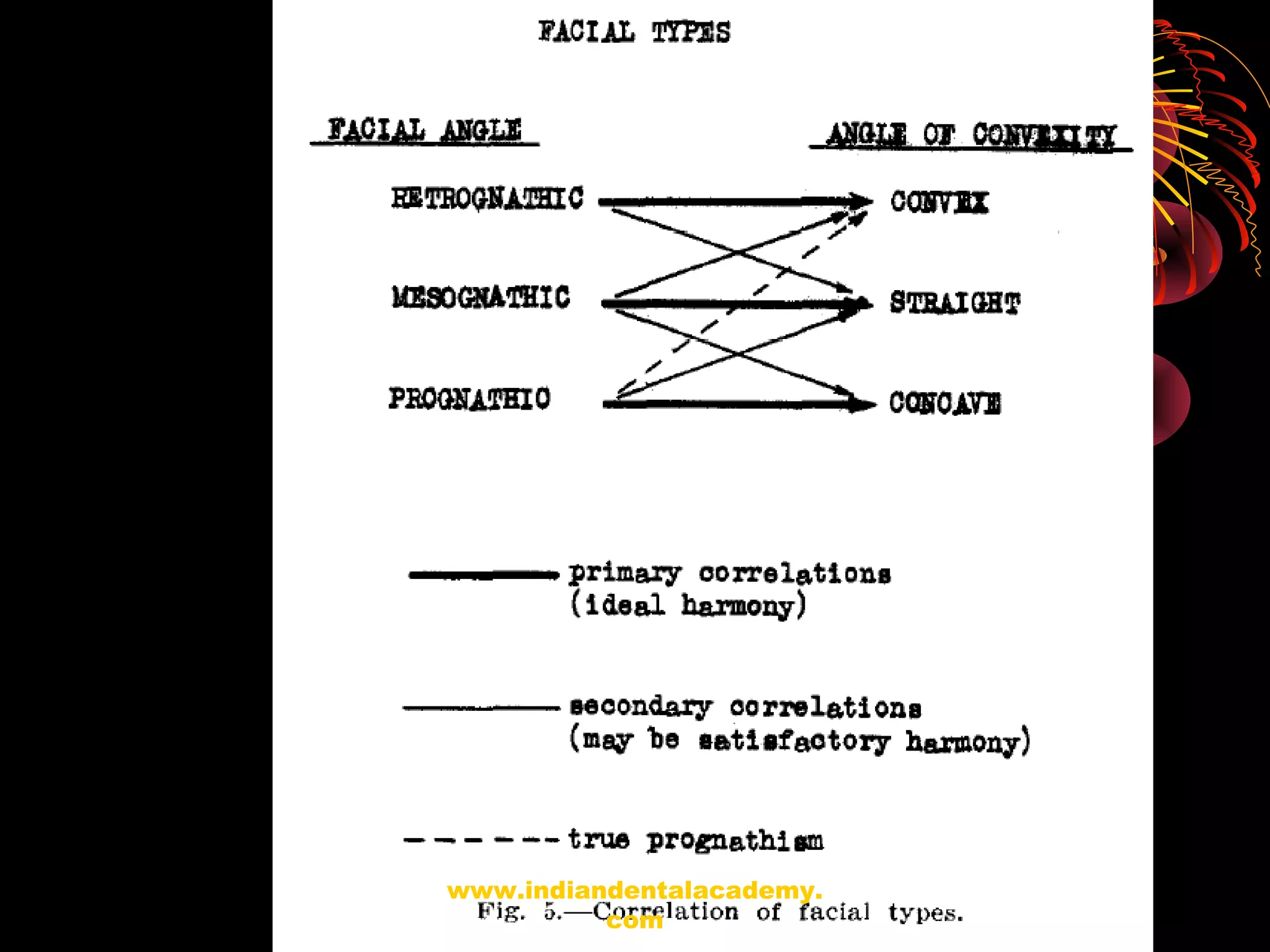
Basic facial types
• Downs noted that the position of the
mandible could be used in
determining whether or not faces
were balanced.
• He recognized that facial profiles
could be retrusive or protrusive yet
still be harmonious in proportion.
www.indiandentalacademy.
com
www.indiandentalacademy.
com
Variations in Facial Relationship: Their
Significance in Treatment and
Prognosis
W. B. Downs
1948www.indiandentalacademy.
com
Purpose Of Study
• To determine the range of dental and
skeletal pattern within which one
might expect to find the normal.
• To discover whether any usable
correlation existed in such normals.
www.indiandentalacademy.
com
Materials and Methods
• 20 individuals with clinically
excellent occlusion (12-17yrs)
• Equally divided in male and female
• Models
• Photographs
• Cephalometric &
• Intraoral roentgenogramwww.indiandentalacademy.
com
www.indiandentalacademy.
com
• For the purpose of the study the head
is divided into cranium and face
• The face is further divided into upper
face
• Teeth & alveolar area
• Lower face or mandible
www.indiandentalacademy.
com
Observations
• Skeletal pattern:-
1. Facial angle
2. Angle of convexity
3. Anterio posterior relationship of the
denture base
4. Mandibular plane angle
5. Y – axis
www.indiandentalacademy.
com
Facial angle (82-950
)
Mean = 87.80
www.indiandentalacademy.
com
Angle of Convexity (-8.5 to +100
)
Mean - 00
-
+
www.indiandentalacademy.
com
A-B Plane (0 to -9)
Mean = -4.6
www.indiandentalacademy.
com
Mandibular Plane angle
(17-280
)
Mean = 21.90
www.indiandentalacademy.
com
Y-axis (53-660
)
Mean = 59.4www.indiandentalacademy.
com
The teeth and alveolar
process
1. Cant of occlusion plane
2. Axial inclination of the upper and lower
incisor to each other.
3. Axial inclination of the lower incisor to
the mandibular plane.
4. Axial inclination of the lower incisor to
the occlusal plane.
5. The amount of protrusion of maxillary
incisor.
www.indiandentalacademy.
com
Cant of Occlusal plane
www.indiandentalacademy.
com
Axial inclination of the upper
and lower incisor to each other
www.indiandentalacademy.
com
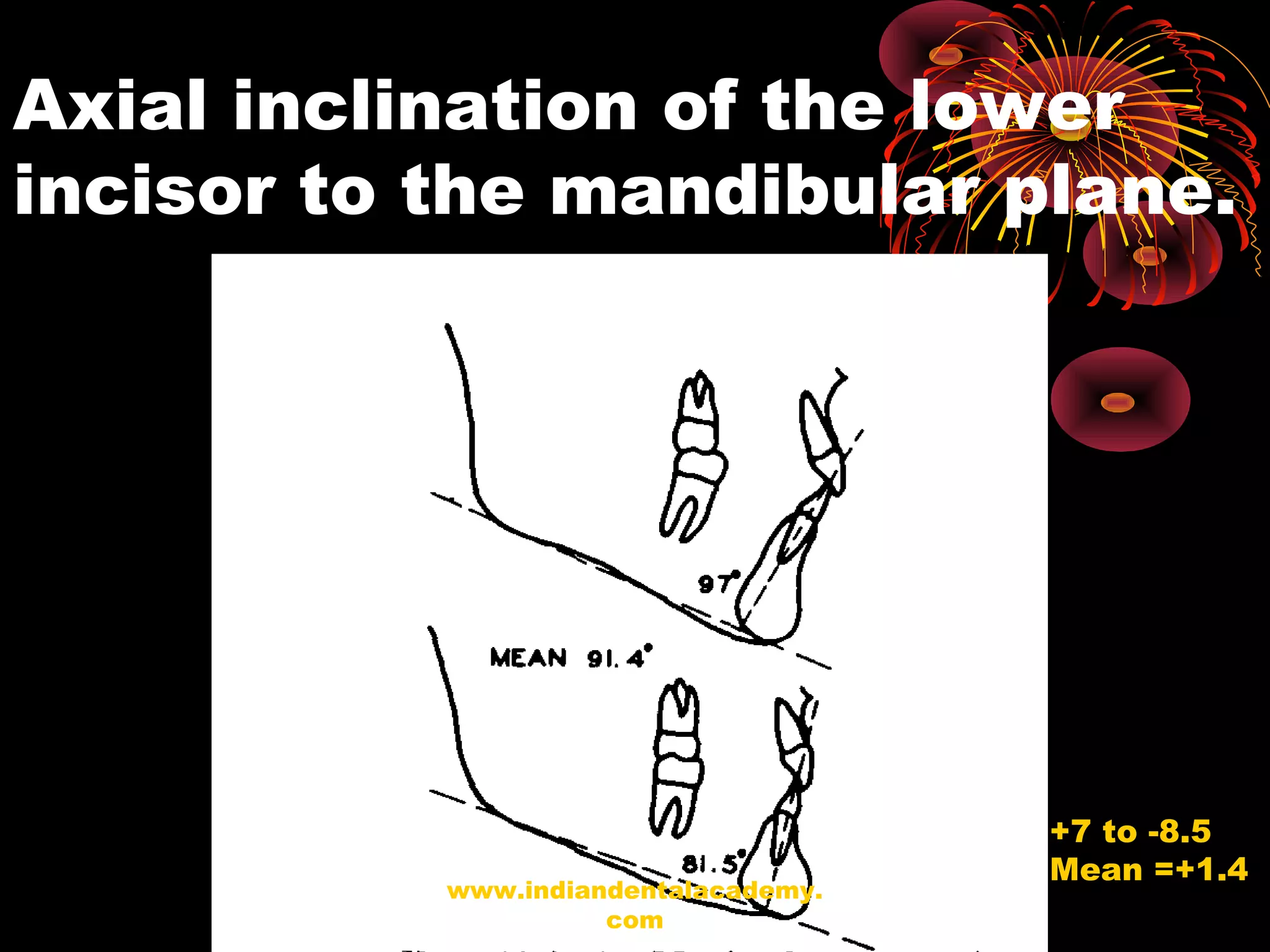
Axial inclination of the lower
incisor to the mandibular plane.
+7 to -8.5
Mean =+1.4
www.indiandentalacademy.
com
Axial inclination of the lower
incisor to the occlusal plane.
+3.5 to +20
Mean = 14.50
www.indiandentalacademy.
com
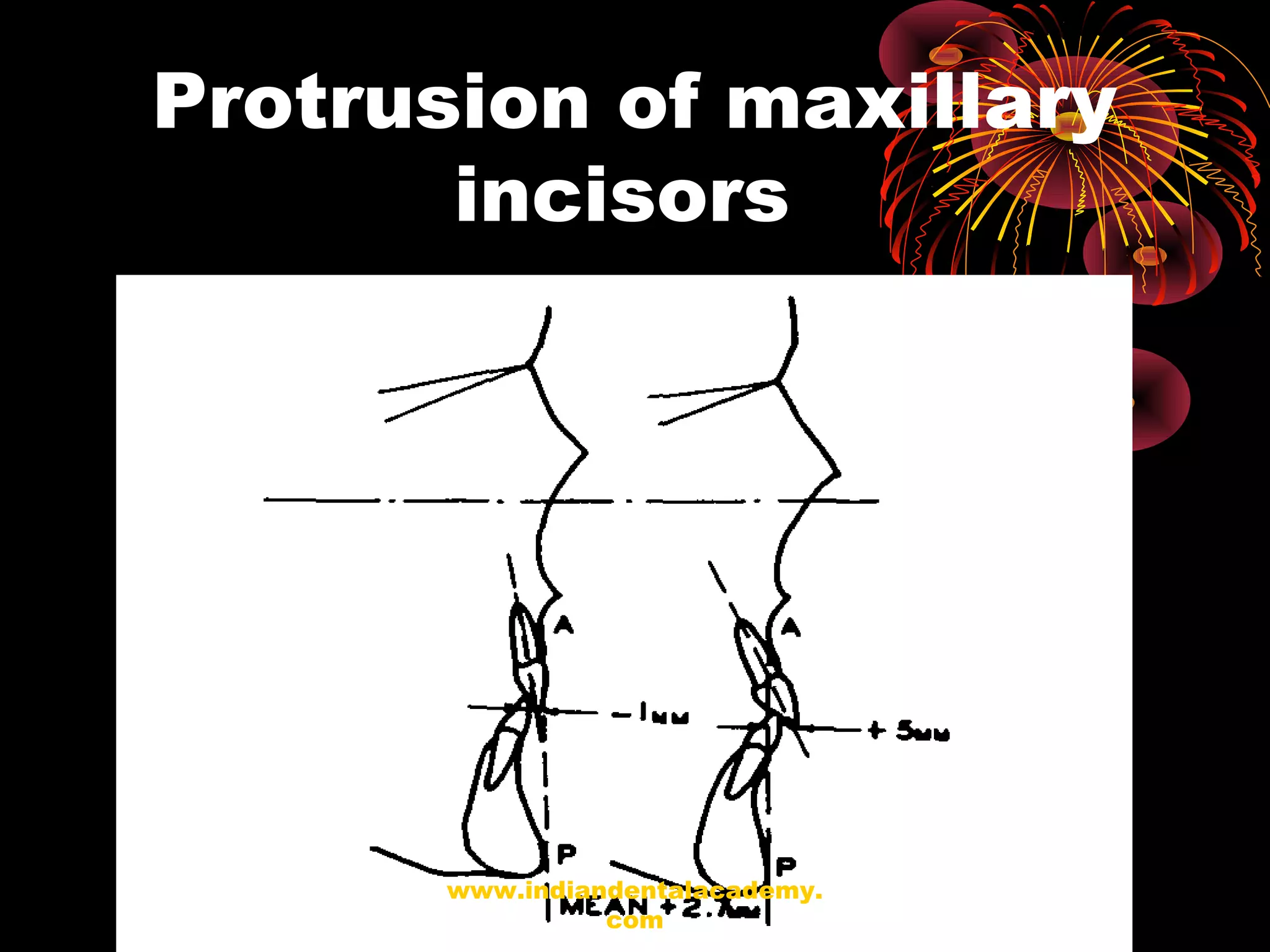
Protrusion of maxillary
incisors
www.indiandentalacademy.
com
Polygonic interpretation of
cephalometric findings3
• “Wiggle” by Hellman in 1937.
• He used anthropometric measurements
of 62 males with normal occlusion
• It was developed by Vorhies & Adams
in 1951 which is also called as
“wiggle” that represents the large
group of cephalometric readings
graphically
www.indiandentalacademy.
com
www.indiandentalacademy.
com
www.indiandentalacademy.
com
Advantages
1. Graphs offer effective means of comparing
values & expressing mathematical
relations.
2. Much time is lost arbitrating the angular
readings from a mathematical standard.
3. The value of serial study & interpretation
is more apparent.
4. Great aid in case presentation because the
parents may more adequately understand a
graphical description.
5. More comprehensive & impressive than
verbal description.www.indiandentalacademy.
com
Shortcomings5
• Comparisons were made only with
patients with excellent occlusion &
facial proportions.
• Facial types are known to differ
racially and the study is limited to
white race.
www.indiandentalacademy.
com
Indian cephalometric
norms 6
• By Dr. D. N. kapoor
• Sample size = 50
• 25 males 25 females
• 17- 25 yrs
• Lucknow Hindus
www.indiandentalacademy.
com
Downs
82to 95o
-8.5 +10
0 to -90
17to 280
53 to660
1.5 to14
7 to -8.5
3.5to 20
130-150.5
-1 to +5
www.indiandentalacademy.com
Summary
www.indiandentalacademy.
com
References
1. Downs, W. B , The Role of Cephalometrics in
Orthodontic Case analysis. Am. J. of Ortho. 38:162-
182.
2. Downs, W. B.: Variations in Facial Relationship:
Their Significance in Treatment and Prognosis, AM.
J. ORTHODONTICS 34: 812, 1948.
3. Jack. M. Vorhies, William Adams. Polygonic
interpretation of cephalometric findings Angle
Orthodontist 1951 : 194-197.
4.Downs, W. B. Analysis of Dentofacila profile. Angle
Orthodontist 1956 : 191-212.
www.indiandentalacademy.
com
5. William R Proffit. Contemporary
Orthodontics 4th edition; Mosby Elsevier
publication pg 174-176.
6. Indian Cephalometric Norms. Indian
orthodontic Society, Dental department
CMC Hospital Vellore.
7. Alexander Jacobson; Radiography
Cephalometry ;Quintessence Co,1995
www.indiandentalacademy.
com
www.indiandentalacademy.
com

Downs analysis/ dental crown & bridge courses

  • 1.
  • 2.
    Introduction • “Variations inFacial Relationship: Their Significance in Treatment and Prognosis” • William B. Downs ( Aurora, Illinois) • At the Graduate Department of Orthodontia, University of Illinois, Chicago. • First prize winner, Essay Contest of the American Association of Orthodontia,1948. • Published in American Journal of Orthodontia, Oct., 1948 & reprinted in 1949 www.indiandentalacademy. com
  • 3.
    Basic facial types •Downs noted that the position of the mandible could be used in determining whether or not faces were balanced. • He recognized that facial profiles could be retrusive or protrusive yet still be harmonious in proportion. www.indiandentalacademy. com
  • 4.
  • 5.
    Variations in FacialRelationship: Their Significance in Treatment and Prognosis W. B. Downs 1948www.indiandentalacademy. com
  • 6.
    Purpose Of Study •To determine the range of dental and skeletal pattern within which one might expect to find the normal. • To discover whether any usable correlation existed in such normals. www.indiandentalacademy. com
  • 7.
    Materials and Methods •20 individuals with clinically excellent occlusion (12-17yrs) • Equally divided in male and female • Models • Photographs • Cephalometric & • Intraoral roentgenogramwww.indiandentalacademy. com
  • 8.
  • 9.
    • For thepurpose of the study the head is divided into cranium and face • The face is further divided into upper face • Teeth & alveolar area • Lower face or mandible www.indiandentalacademy. com
  • 10.
    Observations • Skeletal pattern:- 1.Facial angle 2. Angle of convexity 3. Anterio posterior relationship of the denture base 4. Mandibular plane angle 5. Y – axis www.indiandentalacademy. com
  • 11.
    Facial angle (82-950 ) Mean= 87.80 www.indiandentalacademy. com
  • 12.
    Angle of Convexity(-8.5 to +100 ) Mean - 00 - + www.indiandentalacademy. com
  • 13.
    A-B Plane (0to -9) Mean = -4.6 www.indiandentalacademy. com
  • 14.
    Mandibular Plane angle (17-280 ) Mean= 21.90 www.indiandentalacademy. com
  • 15.
    Y-axis (53-660 ) Mean =59.4www.indiandentalacademy. com
  • 16.
    The teeth andalveolar process 1. Cant of occlusion plane 2. Axial inclination of the upper and lower incisor to each other. 3. Axial inclination of the lower incisor to the mandibular plane. 4. Axial inclination of the lower incisor to the occlusal plane. 5. The amount of protrusion of maxillary incisor. www.indiandentalacademy. com
  • 17.
    Cant of Occlusalplane www.indiandentalacademy. com
  • 18.
    Axial inclination ofthe upper and lower incisor to each other www.indiandentalacademy. com
  • 19.
    Axial inclination ofthe lower incisor to the mandibular plane. +7 to -8.5 Mean =+1.4 www.indiandentalacademy. com
  • 20.
    Axial inclination ofthe lower incisor to the occlusal plane. +3.5 to +20 Mean = 14.50 www.indiandentalacademy. com
  • 21.
  • 22.
    Polygonic interpretation of cephalometricfindings3 • “Wiggle” by Hellman in 1937. • He used anthropometric measurements of 62 males with normal occlusion • It was developed by Vorhies & Adams in 1951 which is also called as “wiggle” that represents the large group of cephalometric readings graphically www.indiandentalacademy. com
  • 23.
  • 24.
  • 25.
    Advantages 1. Graphs offereffective means of comparing values & expressing mathematical relations. 2. Much time is lost arbitrating the angular readings from a mathematical standard. 3. The value of serial study & interpretation is more apparent. 4. Great aid in case presentation because the parents may more adequately understand a graphical description. 5. More comprehensive & impressive than verbal description.www.indiandentalacademy. com
  • 26.
    Shortcomings5 • Comparisons weremade only with patients with excellent occlusion & facial proportions. • Facial types are known to differ racially and the study is limited to white race. www.indiandentalacademy. com
  • 27.
    Indian cephalometric norms 6 •By Dr. D. N. kapoor • Sample size = 50 • 25 males 25 females • 17- 25 yrs • Lucknow Hindus www.indiandentalacademy. com
  • 28.
    Downs 82to 95o -8.5 +10 0to -90 17to 280 53 to660 1.5 to14 7 to -8.5 3.5to 20 130-150.5 -1 to +5 www.indiandentalacademy.com
  • 29.
  • 30.
    References 1. Downs, W.B , The Role of Cephalometrics in Orthodontic Case analysis. Am. J. of Ortho. 38:162- 182. 2. Downs, W. B.: Variations in Facial Relationship: Their Significance in Treatment and Prognosis, AM. J. ORTHODONTICS 34: 812, 1948. 3. Jack. M. Vorhies, William Adams. Polygonic interpretation of cephalometric findings Angle Orthodontist 1951 : 194-197. 4.Downs, W. B. Analysis of Dentofacila profile. Angle Orthodontist 1956 : 191-212. www.indiandentalacademy. com
  • 31.
    5. William RProffit. Contemporary Orthodontics 4th edition; Mosby Elsevier publication pg 174-176. 6. Indian Cephalometric Norms. Indian orthodontic Society, Dental department CMC Hospital Vellore. 7. Alexander Jacobson; Radiography Cephalometry ;Quintessence Co,1995 www.indiandentalacademy. com
  • 32.