McNamara analysis
By,
STANLY SELVA KUMAR
INTRODUCTION :
Dr James A. McNamara , in
1984 described a method of
cephalometric analysis which
is used in the evaluation and
treatment planning of
orthodontic and orthognathic
surgery patients
Dr McNamara
James A McNamara, is a graduate of the university of California, Berkeley.
He attended dental school at the University of California, San Francisco and
continued on to a postgraduate residency in orthodontics at the same
institution. He then attended the University of Michigan, where he received a
doctorate in anatomy in 1972.
McNamara currently serves as the Thomas M. and Doris Graber Endowed
Professor of Dentistry in the Department of Orthodontics and Pediatric Dentistry
at the University of Michigan School of Dentistry.
Standards for this analysis were derived from 3 sources :
- Lateral cephalograms of children comprising the Bolton standards
- Selected values from a group of untreated children from the Burlington
orthodontic research center
- 111 young adults from Ann Arbor , Michigan, having good to excellent facial
configurations.
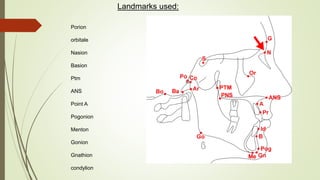
Landmarks used:
Porion
orbitale
Nasion
Basion
Ptm
ANS
Point A
Pogonion
Menton
Gonion
Gnathion
condylion
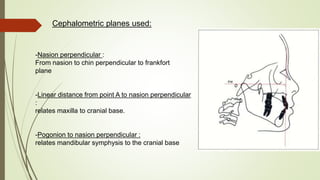
Cephalometric planes used:
-Nasion perpendicular :
From nasion to chin perpendicular to frankfort
plane
-Linear distance from point A to nasion perpendicular
:
relates maxilla to cranial base.
-Pogonion to nasion perpendicular :
relates mandibular symphysis to the cranial base
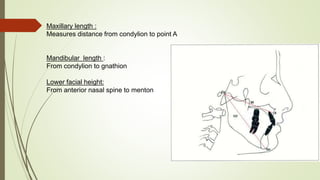
Maxillary length :
Measures distance from condylion to point A
Mandibular length :
From condylion to gnathion
Lower facial height:
From anterior nasal spine to menton
The craniofacial skeletal compex is divided into five major secations :
1. Maxilla to the cranial base
2. Maxilla to mandible
3. Mandible to cranial base
4. Dentition
5. Airway
1. Maxilla to the cranial base
The position of the maxilla in the skull first should be
assessed clinically by observing the soft tissue profile
Then evaluated by comparing various lateral cephalometric
measurements to normative standards.
-Soft tissue evaluation:
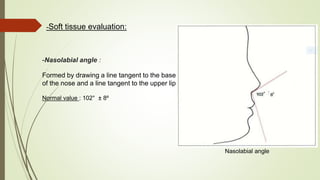
-Nasolabial angle :
Formed by drawing a line tangent to the base
of the nose and a line tangent to the upper lip
Normal value : 102° ± 8º
Nasolabial angle
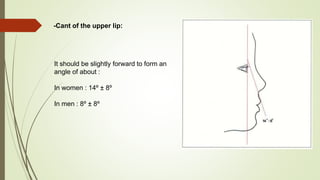
-Cant of the upper lip:
It should be slightly forward to form an
angle of about :
In women : 14º ± 8º
In men : 8º ± 8º
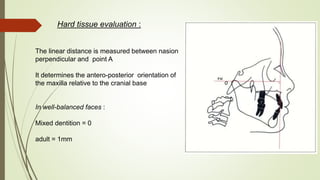
Hard tissue evaluation :
The linear distance is measured between nasion
perpendicular and point A
It determines the antero-posterior orientation of
the maxilla relative to the cranial base
In well-balanced faces :
Mixed dentition = 0
adult = 1mm
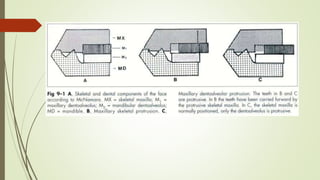
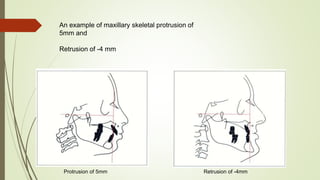
An example of maxillary skeletal protrusion of
5mm and
Retrusion of -4 mm
Protrusion of 5mm Retrusion of -4mm
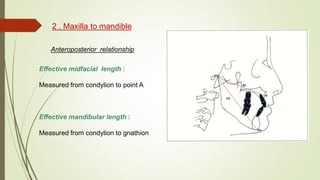
2 . Maxilla to mandible
Anteroposterior relationship
Effective midfacial length :
Measured from condylion to point A
Effective mandibular length :
Measured from condylion to gnathion
The effective length of the midface and the mandible are not age or sex
dependent but are related only to the size of the component parts.
Thus the term “small” , “medium” , “large” are used
Maxillomandibular difference = midfacial length – mandibular length
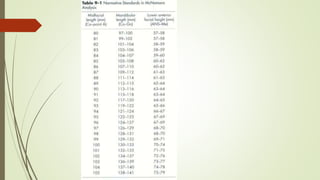
In small individuals the difference should be between 20 and 23 mm
In medium sized persons the difference should be between 27 and 30mm
In large individuals the difference should be 30 and 33mm
If the discrepency is greater or smaller than the normative values ,
Then next step is to identify which jaw is small or large or both
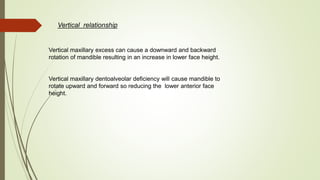
Vertical relationship
Vertical maxillary excess can cause a downward and backward
rotation of mandible resulting in an increase in lower face height.
Vertical maxillary dentoalveolar deficiency will cause mandible to
rotate upward and forward so reducing the lower anterior face
height.
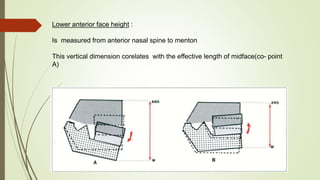
Lower anterior face height :
Is measured from anterior nasal spine to menton
This vertical dimension corelates with the effective length of midface(co- point
A)
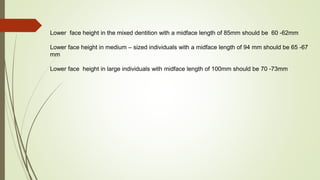
Lower face height in the mixed dentition with a midface length of 85mm should be 60 -62mm
Lower face height in medium – sized individuals with a midface length of 94 mm should be 65 -67
mm
Lower face height in large individuals with midface length of 100mm should be 70 -73mm
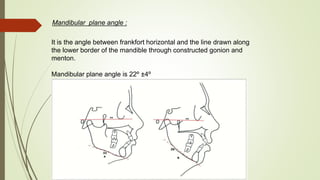
Mandibular plane angle :
It is the angle between frankfort horizontal and the line drawn along
the lower border of the mandible through constructed gonion and
menton.
Mandibular plane angle is 22º ±4º
Higher mandibular plane angle is suggestive of excessive lower face
hieght
Lesser mandibular plane angle would tend to indicate a deficiency in
lower face height
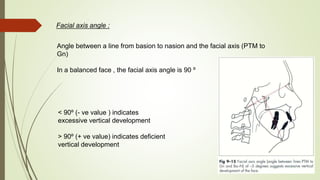
Facial axis angle :
Angle between a line from basion to nasion and the facial axis (PTM to
Gn)
In a balanced face , the facial axis angle is 90 º
< 90º (- ve value ) indicates
excessive vertical development
> 90º (+ ve value) indicates deficient
vertical development
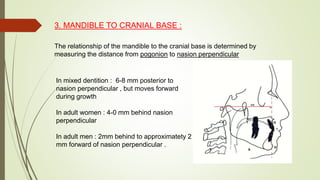
3. MANDIBLE TO CRANIAL BASE :
The relationship of the mandible to the cranial base is determined by
measuring the distance from pogonion to nasion perpendicular
In mixed dentition : 6-8 mm posterior to
nasion perpendicular , but moves forward
during growth
In adult women : 4-0 mm behind nasion
perpendicular
In adult men : 2mm behind to approximatety 2
mm forward of nasion perpendicular .
4. DENTITION :
In plannnig orthodontic treatment (orthodontic ,orthopedic, or surgical purpose
) one must determine the anteroposterior position of both upper and lower
incisors.
We need to know the relationship dentition in the both the jaw to the underlying
basal bone .
The dentition can be neutral , protrusive or retrusive
-MAXILLARY INCISOR POSITION
-MANDIBULAR INCISOR POSITION
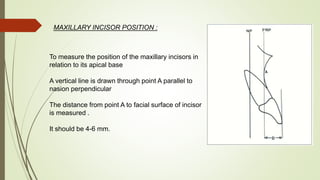
MAXILLARY INCISOR POSITION :
To measure the position of the maxillary incisors in
relation to its apical base
A vertical line is drawn through point A parallel to
nasion perpendicular
The distance from point A to facial surface of incisor
is measured .
It should be 4-6 mm.
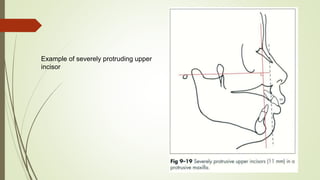
Example of severely protruding upper
incisor
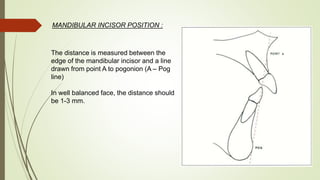
MANDIBULAR INCISOR POSITION :
The distance is measured between the
edge of the mandibular incisor and a line
drawn from point A to pogonion (A – Pog
line)
In well balanced face, the distance should
be 1-3 mm.
Assessment of vertical position of lower incisor:
-If the curve of spee is excessive , a decision must be made whether the
lower incisor should be intruded or molars erupted.
The determining factor is the lower anterior facial height.
If the lower facial height is normal or excessive the lower incisor should
be intruded.
If the lower anterior facial height is deficient then the lower incisor
should be extruded or the buccal segments further erupted.
5. AIRWAY ANALYSIS
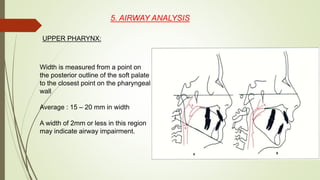
UPPER PHARYNX:
Width is measured from a point on
the posterior outline of the soft palate
to the closest point on the pharyngeal
wall
Average : 15 – 20 mm in width
A width of 2mm or less in this region
may indicate airway impairment.
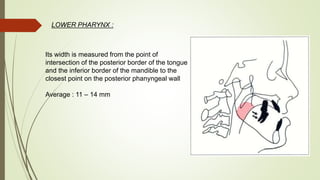
LOWER PHARYNX :
Its width is measured from the point of
intersection of the posterior border of the tongue
and the inferior border of the mandible to the
closest point on the posterior phanyngeal wall
Average : 11 – 14 mm
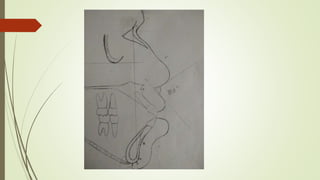
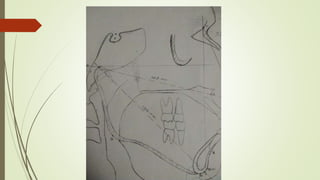
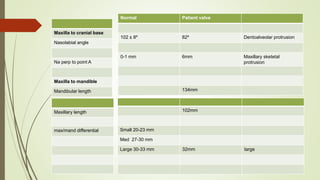
Normal Patient valve
102 ± 8º 82º Dentoalveolar protrusion
0-1 mm 6mm Maxillary sketetal
protrusion
134mm
Maxilla to cranial base
Nasolabial angle
Na perp to point A
Maxilla to mandible
Mandibular length
Maxillary length
max/mand differential
102mm
Small 20-23 mm
Med 27-30 mm
Large 30-33 mm 32mm large
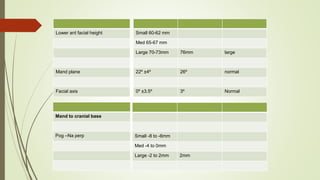
Small 60-62 mm
Med 65-67 mm
Large 70-73mm 76mm large
22º ±4º 26º normal
0º ±3.5º 3º Normal
Lower ant facial height
Mand plane
Facial axis
Small -8 to -6mm
Med -4 to 0mm
Large -2 to 2mm 2mm
Mand to cranial base
Pog –Na perp
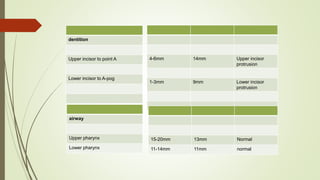
4-6mm 14mm Upper incisor
protrusion
1-3mm 9mm Lower incisor
protrusion
dentition
Upper incisor to point A
Lower incisor to A-pog
airway
Upper pharynx
Lower pharynx
15-20mm 13mm Normal
11-14mm 11mm normal
Advantages :
-This method depends primarily upon linear measurements rather than angles , so
treatment planning is made easier.
-more sensitive to vertical changes
-provides guidelines with respect to normally occuring growth increments.
-can be easily explained to nonspecialists and to lay persons such as patients and
parents.
REFERENCE:
Radiograhic cephalometry by ALEXANDER JACOBSON
A method of cephalometric evaluation by Dr JAMES A MCNAMARA , American
journal of Orthodontics vol 86 . Dec 1984
THANK YOU

Mc namara analysis

  • 1.
  • 2.
    INTRODUCTION : Dr JamesA. McNamara , in 1984 described a method of cephalometric analysis which is used in the evaluation and treatment planning of orthodontic and orthognathic surgery patients Dr McNamara
  • 3.
    James A McNamara,is a graduate of the university of California, Berkeley. He attended dental school at the University of California, San Francisco and continued on to a postgraduate residency in orthodontics at the same institution. He then attended the University of Michigan, where he received a doctorate in anatomy in 1972. McNamara currently serves as the Thomas M. and Doris Graber Endowed Professor of Dentistry in the Department of Orthodontics and Pediatric Dentistry at the University of Michigan School of Dentistry.
  • 5.
    Standards for thisanalysis were derived from 3 sources : - Lateral cephalograms of children comprising the Bolton standards - Selected values from a group of untreated children from the Burlington orthodontic research center - 111 young adults from Ann Arbor , Michigan, having good to excellent facial configurations.
  • 6.
  • 7.
    Cephalometric planes used: -Nasionperpendicular : From nasion to chin perpendicular to frankfort plane -Linear distance from point A to nasion perpendicular : relates maxilla to cranial base. -Pogonion to nasion perpendicular : relates mandibular symphysis to the cranial base
  • 8.
    Maxillary length : Measuresdistance from condylion to point A Mandibular length : From condylion to gnathion Lower facial height: From anterior nasal spine to menton
  • 9.
    The craniofacial skeletalcompex is divided into five major secations : 1. Maxilla to the cranial base 2. Maxilla to mandible 3. Mandible to cranial base 4. Dentition 5. Airway
  • 10.
    1. Maxilla tothe cranial base The position of the maxilla in the skull first should be assessed clinically by observing the soft tissue profile Then evaluated by comparing various lateral cephalometric measurements to normative standards.
  • 12.
    -Soft tissue evaluation: -Nasolabialangle : Formed by drawing a line tangent to the base of the nose and a line tangent to the upper lip Normal value : 102° ± 8º Nasolabial angle
  • 13.
    -Cant of theupper lip: It should be slightly forward to form an angle of about : In women : 14º ± 8º In men : 8º ± 8º
  • 14.
    Hard tissue evaluation: The linear distance is measured between nasion perpendicular and point A It determines the antero-posterior orientation of the maxilla relative to the cranial base In well-balanced faces : Mixed dentition = 0 adult = 1mm
  • 15.
    An example ofmaxillary skeletal protrusion of 5mm and Retrusion of -4 mm Protrusion of 5mm Retrusion of -4mm
  • 16.
    2 . Maxillato mandible Anteroposterior relationship Effective midfacial length : Measured from condylion to point A Effective mandibular length : Measured from condylion to gnathion
  • 17.
    The effective lengthof the midface and the mandible are not age or sex dependent but are related only to the size of the component parts. Thus the term “small” , “medium” , “large” are used Maxillomandibular difference = midfacial length – mandibular length In small individuals the difference should be between 20 and 23 mm In medium sized persons the difference should be between 27 and 30mm In large individuals the difference should be 30 and 33mm
  • 18.
    If the discrepencyis greater or smaller than the normative values , Then next step is to identify which jaw is small or large or both
  • 20.
    Vertical relationship Vertical maxillaryexcess can cause a downward and backward rotation of mandible resulting in an increase in lower face height. Vertical maxillary dentoalveolar deficiency will cause mandible to rotate upward and forward so reducing the lower anterior face height.
  • 21.
    Lower anterior faceheight : Is measured from anterior nasal spine to menton This vertical dimension corelates with the effective length of midface(co- point A)
  • 22.
    Lower face heightin the mixed dentition with a midface length of 85mm should be 60 -62mm Lower face height in medium – sized individuals with a midface length of 94 mm should be 65 -67 mm Lower face height in large individuals with midface length of 100mm should be 70 -73mm
  • 23.
    Mandibular plane angle: It is the angle between frankfort horizontal and the line drawn along the lower border of the mandible through constructed gonion and menton. Mandibular plane angle is 22º ±4º
  • 24.
    Higher mandibular planeangle is suggestive of excessive lower face hieght Lesser mandibular plane angle would tend to indicate a deficiency in lower face height
  • 25.
    Facial axis angle: Angle between a line from basion to nasion and the facial axis (PTM to Gn) In a balanced face , the facial axis angle is 90 º < 90º (- ve value ) indicates excessive vertical development > 90º (+ ve value) indicates deficient vertical development
  • 26.
    3. MANDIBLE TOCRANIAL BASE : The relationship of the mandible to the cranial base is determined by measuring the distance from pogonion to nasion perpendicular In mixed dentition : 6-8 mm posterior to nasion perpendicular , but moves forward during growth In adult women : 4-0 mm behind nasion perpendicular In adult men : 2mm behind to approximatety 2 mm forward of nasion perpendicular .
  • 27.
    4. DENTITION : Inplannnig orthodontic treatment (orthodontic ,orthopedic, or surgical purpose ) one must determine the anteroposterior position of both upper and lower incisors. We need to know the relationship dentition in the both the jaw to the underlying basal bone . The dentition can be neutral , protrusive or retrusive -MAXILLARY INCISOR POSITION -MANDIBULAR INCISOR POSITION
  • 28.
    MAXILLARY INCISOR POSITION: To measure the position of the maxillary incisors in relation to its apical base A vertical line is drawn through point A parallel to nasion perpendicular The distance from point A to facial surface of incisor is measured . It should be 4-6 mm.
  • 29.
    Example of severelyprotruding upper incisor
  • 30.
    MANDIBULAR INCISOR POSITION: The distance is measured between the edge of the mandibular incisor and a line drawn from point A to pogonion (A – Pog line) In well balanced face, the distance should be 1-3 mm.
  • 31.
    Assessment of verticalposition of lower incisor: -If the curve of spee is excessive , a decision must be made whether the lower incisor should be intruded or molars erupted. The determining factor is the lower anterior facial height. If the lower facial height is normal or excessive the lower incisor should be intruded. If the lower anterior facial height is deficient then the lower incisor should be extruded or the buccal segments further erupted.
  • 32.
    5. AIRWAY ANALYSIS UPPERPHARYNX: Width is measured from a point on the posterior outline of the soft palate to the closest point on the pharyngeal wall Average : 15 – 20 mm in width A width of 2mm or less in this region may indicate airway impairment.
  • 33.
    LOWER PHARYNX : Itswidth is measured from the point of intersection of the posterior border of the tongue and the inferior border of the mandible to the closest point on the posterior phanyngeal wall Average : 11 – 14 mm
  • 37.
    Normal Patient valve 102± 8º 82º Dentoalveolar protrusion 0-1 mm 6mm Maxillary sketetal protrusion 134mm Maxilla to cranial base Nasolabial angle Na perp to point A Maxilla to mandible Mandibular length Maxillary length max/mand differential 102mm Small 20-23 mm Med 27-30 mm Large 30-33 mm 32mm large
  • 38.
    Small 60-62 mm Med65-67 mm Large 70-73mm 76mm large 22º ±4º 26º normal 0º ±3.5º 3º Normal Lower ant facial height Mand plane Facial axis Small -8 to -6mm Med -4 to 0mm Large -2 to 2mm 2mm Mand to cranial base Pog –Na perp
  • 39.
    4-6mm 14mm Upperincisor protrusion 1-3mm 9mm Lower incisor protrusion dentition Upper incisor to point A Lower incisor to A-pog airway Upper pharynx Lower pharynx 15-20mm 13mm Normal 11-14mm 11mm normal
  • 40.
    Advantages : -This methoddepends primarily upon linear measurements rather than angles , so treatment planning is made easier. -more sensitive to vertical changes -provides guidelines with respect to normally occuring growth increments. -can be easily explained to nonspecialists and to lay persons such as patients and parents.
  • 41.
    REFERENCE: Radiograhic cephalometry byALEXANDER JACOBSON A method of cephalometric evaluation by Dr JAMES A MCNAMARA , American journal of Orthodontics vol 86 . Dec 1984
  • 42.