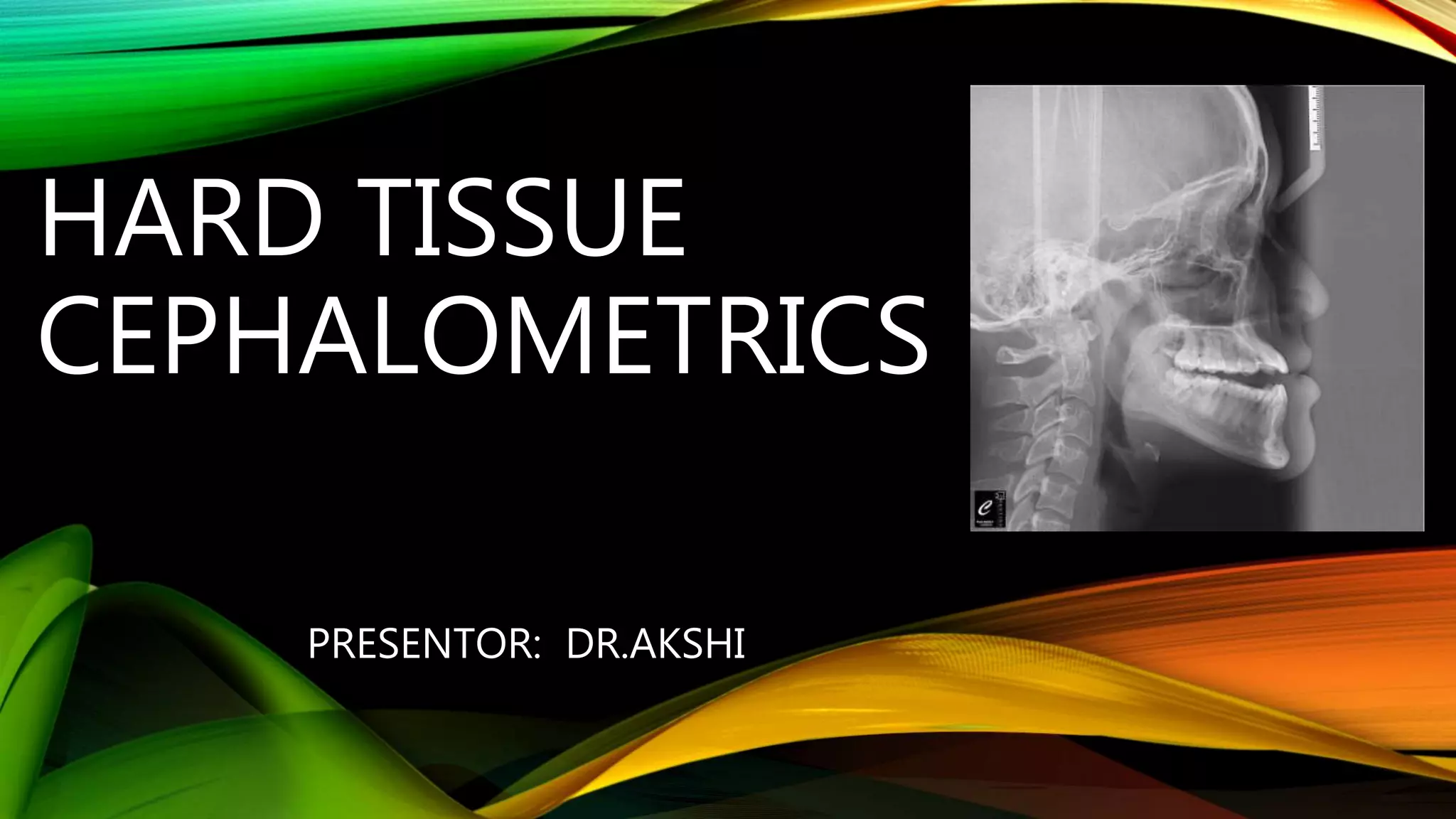
HARD TISSUE
CEPHALOMETRICS
PRESENTOR: DR.AKSHI
1
CONTENTS
• Introduction
• Cephalostat
• Cephalometric landmarks
• Downs analysis
• Steiners analysis
• Tweeds analysis
• Wits appraisal
• Mcnamara analysis
• Ricketts analysis
• Rakosi-jarabak analysis
• Cogs analysis
• Pitchfork analysis
• Grummons analysis
• Quadrilateral analysis
2
INTRODUCTION
• Cephalometric analysis is a process of evaluating the skeletal, dental and soft
tissue relationships of a patient by comparing measurements performed on
the patient’s cephalometric tracing with population norms for respective
measurements to come to a diagnosis of the patient’s orthodontic problem.
3
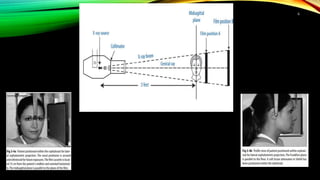
CEPHALOSTAT
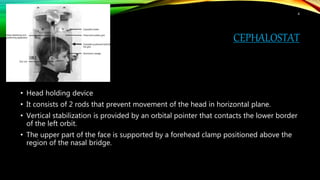
• Head holding device
• It consists of 2 rods that prevent movement of the head in horizontal plane.
• Vertical stabilization is provided by an orbital pointer that contacts the lower border
of the left orbit.
• The upper part of the face is supported by a forehead clamp positioned above the
region of the nasal bridge.
4
• The distance between X- ray source and mid sagittal plane of the patient is fixed at
5 feet (152.4 cm).
• The distance between mid sagittal plane of cephalostat and film is 15 cm.
PATIENT POSITIONING
• Patient is positioned in a upright position with :
1. FH plane is parallel to the floor.
2. Mid sagittal plane of patient is perpendicular to X-ray beam and parallel to the
film and perpendicular to the floor.
5
6
USE OF CEPHALOMETRY
• For gross inspection
• Growth analysis
• To diagnose anomalies
• To forecast future relationships
• To plan the treatment
• To evaluate treatment outcome
7
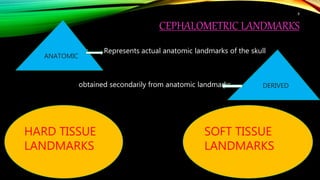
CEPHALOMETRIC LANDMARKS
repr Represents actual anatomic landmarks of the skull
obtained secondarily from anatomic landmarks
8
SOFT TISSUE
LANDMARKS
HARD TISSUE
LANDMARKS
ANATOMIC
DERIVED
9
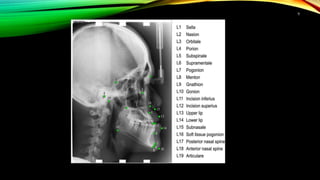
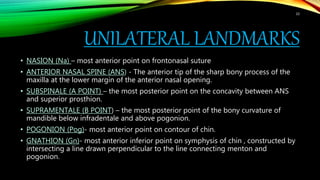
UNILATERAL LANDMARKS
• NASION (Na) – most anterior point on frontonasal suture
• ANTERIOR NASAL SPINE (ANS) - The anterior tip of the sharp bony process of the
maxilla at the lower margin of the anterior nasal opening.
• SUBSPINALE (A POINT) – the most posterior point on the concavity between ANS
and superior prosthion.
• SUPRAMENTALE (B POINT) – the most posterior point of the bony curvature of
mandible below infradentale and above pogonion.
• POGONION (Pog)- most anterior point on contour of chin.
• GNATHION (Gn)- most anterior inferior point on symphysis of chin , constructed by
intersecting a line drawn perpendicular to the line connecting menton and
pogonion.
10
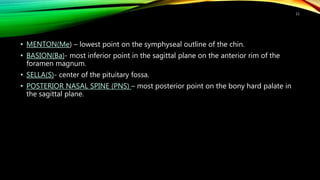
• MENTON(Me) – lowest point on the symphyseal outline of the chin.
• BASION(Ba)- most inferior point in the sagittal plane on the anterior rim of the
foramen magnum.
• SELLA(S)- center of the pituitary fossa.
• POSTERIOR NASAL SPINE (PNS) – most posterior point on the bony hard palate in
the sagittal plane.
11
BILATERAL LANDMARKS
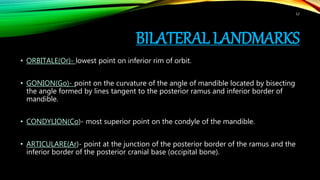
• ORBITALE(Or)- lowest point on inferior rim of orbit.
• GONION(Go)- point on the curvature of the angle of mandible located by bisecting
the angle formed by lines tangent to the posterior ramus and inferior border of
mandible.
• CONDYLION(Co)- most superior point on the condyle of the mandible.
• ARTICULARE(Ar)- point at the junction of the posterior border of the ramus and the
inferior border of the posterior cranial base (occipital bone).
12
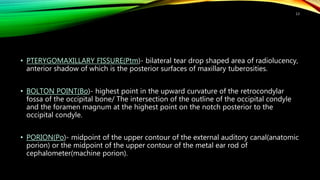
• PTERYGOMAXILLARY FISSURE(Ptm)- bilateral tear drop shaped area of radiolucency,
anterior shadow of which is the posterior surfaces of maxillary tuberosities.
• BOLTON POINT(Bo)- highest point in the upward curvature of the retrocondylar
fossa of the occipital bone/ The intersection of the outline of the occipital condyle
and the foramen magnum at the highest point on the notch posterior to the
occipital condyle.
• PORION(Po)- midpoint of the upper contour of the external auditory canal(anatomic
porion) or the midpoint of the upper contour of the metal ear rod of
cephalometer(machine porion).
13
14
DOWN’S ANALYSIS
DOWN’S ANALYSIS
• 1948
• Control material – 20 white subjects [age: 12-17 yrs] with equal no. of boys and
girls
• Reference plane : FRANKFORT HORIZONTAL PLANE {FH}
• Four basic facial types:
1. Retrognathic
2. Orthognathic
3. Prognathic
4. True prognathism
• Parameters of analysis :
skeletal and dental
Dental parameters
Cant of occlusal plane
Interincisal angle
Incisor - OP angle
Incisor – MP angle
Incisor to A-pog
15
FACIAL ANGLE
• to measure the degree of retrusion and
protrusion of mandible
• Inferior inside angle ; facial line [ nasion-
pogonion] intersects FH
• Mean reading : 87.8˚
• Range : 82 ˚ - 95 ˚
• > 87.8˚ = prominent chin
• < 87.8˚ = retrusive chin
16
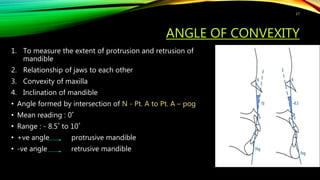
ANGLE OF CONVEXITY
1. To measure the extent of protrusion and retrusion of
mandible
2. Relationship of jaws to each other
3. Convexity of maxilla
4. Inclination of mandible
• Angle formed by intersection of N - Pt. A to Pt. A – pog
• Mean reading : 0˚
• Range : - 8.5˚ to 10˚
• +ve angle protrusive mandible
• -ve angle retrusive mandible
17
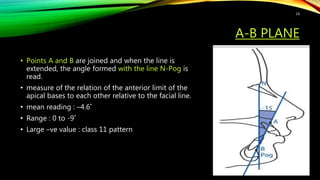
A-B PLANE
• Points A and B are joined and when the line is
extended, the angle formed with the line N-Pog is
read.
• measure of the relation of the anterior limit of the
apical bases to each other relative to the facial line.
• mean reading : –4.6˚
• Range : 0 to -9˚
• Large –ve value : class 11 pattern
18
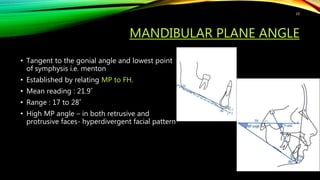
MANDIBULAR PLANE ANGLE
• Tangent to the gonial angle and lowest point
of symphysis i.e. menton
• Established by relating MP to FH.
• Mean reading : 21.9˚
• Range : 17 to 28˚
• High MP angle – in both retrusive and
protrusive faces- hyperdivergent facial pattern
19
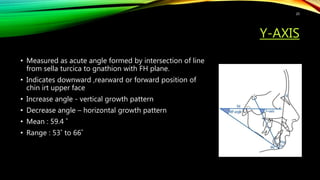
Y-AXIS
• Measured as acute angle formed by intersection of line
from sella turcica to gnathion with FH plane.
• Indicates downward ,rearward or forward position of
chin irt upper face
• Increase angle - vertical growth pattern
• Decrease angle – horizontal growth pattern
• Mean : 59.4 ˚
• Range : 53˚ to 66˚
20
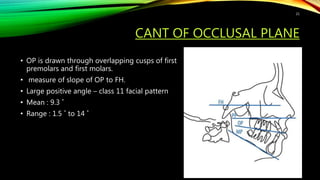
CANT OF OCCLUSAL PLANE
• OP is drawn through overlapping cusps of first
premolars and first molars.
• measure of slope of OP to FH.
• Large positive angle – class 11 facial pattern
• Mean : 9.3 ˚
• Range : 1.5 ˚ to 14 ˚
21
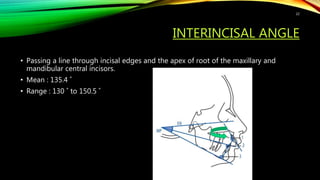
INTERINCISAL ANGLE
• Passing a line through incisal edges and the apex of root of the maxillary and
mandibular central incisors.
• Mean : 135.4 ˚
• Range : 130 ˚ to 150.5 ˚
22
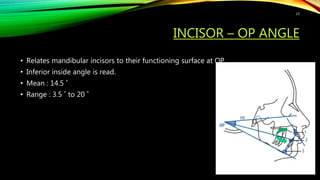
INCISOR – OP ANGLE
• Relates mandibular incisors to their functioning surface at OP.
• Inferior inside angle is read.
• Mean : 14.5 ˚
• Range : 3.5 ˚ to 20 ˚
23
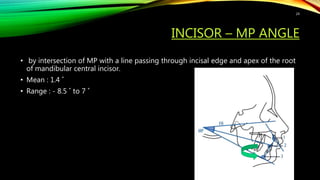
INCISOR – MP ANGLE
• by intersection of MP with a line passing through incisal edge and apex of the root
of mandibular central incisor.
• Mean : 1.4 ˚
• Range : - 8.5 ˚ to 7 ˚
24
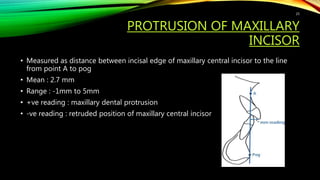
PROTRUSION OF MAXILLARY
INCISOR
• Measured as distance between incisal edge of maxillary central incisor to the line
from point A to pog
• Mean : 2.7 mm
• Range : -1mm to 5mm
• +ve reading : maxillary dental protrusion
• -ve reading : retruded position of maxillary central incisor
25
26
STEINER’S ANALYSIS
STEINER ANALYSIS
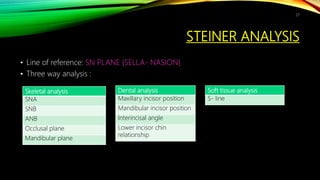
• Line of reference: SN PLANE {SELLA- NASION}
• Three way analysis :
Skeletal analysis
SNA
SNB
ANB
Occlusal plane
Mandibular plane
Dental analysis
Maxillary incisor position
Mandibular incisor position
Interincisal angle
Lower incisor chin
relationship
Soft tissue analysis
S- line
27
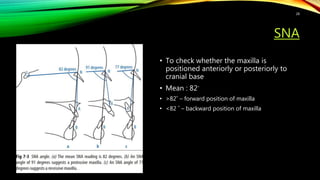
SNA
• To check whether the maxilla is
positioned anteriorly or posteriorly to
cranial base
• Mean : 82˚
• >82˚ – forward position of maxilla
• <82 ˚ – backward position of maxilla
28
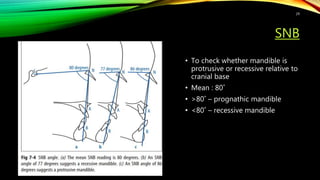
SNB
• To check whether mandible is
protrusive or recessive relative to
cranial base
• Mean : 80˚
• >80˚ – prognathic mandible
• <80˚ – recessive mandible
29
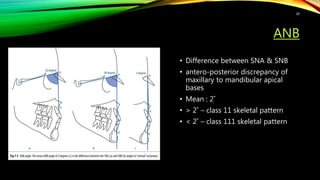
ANB
• Difference between SNA & SNB
• antero-posterior discrepancy of
maxillary to mandibular apical
bases
• Mean : 2˚
• > 2˚ – class 11 skeletal pattern
• < 2˚ – class 111 skeletal pattern
30
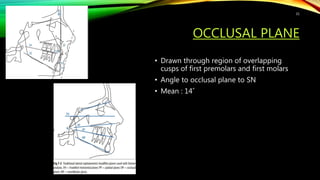
OCCLUSAL PLANE
• Drawn through region of overlapping
cusps of first premolars and first molars
• Angle to occlusal plane to SN
• Mean : 14˚
31
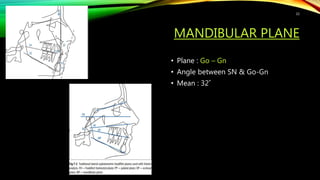
MANDIBULAR PLANE
• Plane : Go – Gn
• Angle between SN & Go-Gn
• Mean : 32˚
32
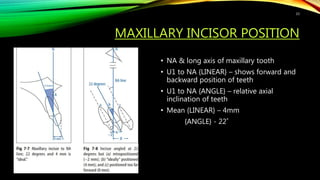
MAXILLARY INCISOR POSITION
• NA & long axis of maxillary tooth
• U1 to NA {LINEAR} – shows forward and
backward position of teeth
• U1 to NA {ANGLE} – relative axial
inclination of teeth
• Mean {LINEAR} – 4mm
{ANGLE} - 22˚
33
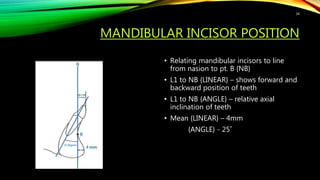
MANDIBULAR INCISOR POSITION
• Relating mandibular incisors to line
from nasion to pt. B {NB}
• L1 to NB {LINEAR} – shows forward and
backward position of teeth
• L1 to NB {ANGLE} – relative axial
inclination of teeth
• Mean {LINEAR} – 4mm
{ANGLE} - 25˚
34
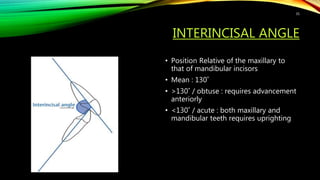
INTERINCISAL ANGLE
• Position Relative of the maxillary to
that of mandibular incisors
• Mean : 130˚
• >130˚ / obtuse : requires advancement
anteriorly
• <130˚ / acute : both maxillary and
mandibular teeth requires uprighting
35
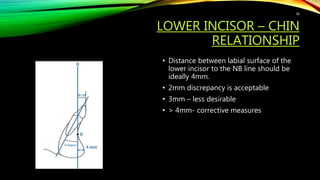
LOWER INCISOR – CHIN
RELATIONSHIP
• Distance between labial surface of the
lower incisor to the NB line should be
ideally 4mm.
• 2mm discrepancy is acceptable
• 3mm – less desirable
• > 4mm- corrective measures
36
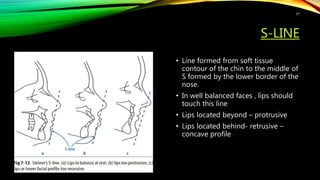
S-LINE
• Line formed from soft tissue
contour of the chin to the middle of
S formed by the lower border of the
nose.
• In well balanced faces , lips should
touch this line
• Lips located beyond – protrusive
• Lips located behind- retrusive –
concave profile
37
38
TWEED ANALYSIS
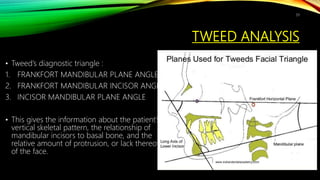
TWEED ANALYSIS
• Tweed’s diagnostic triangle :
1. FRANKFORT MANDIBULAR PLANE ANGLE
2. FRANKFORT MANDIBULAR INCISOR ANGLE
3. INCISOR MANDIBULAR PLANE ANGLE
• This gives the information about the patient’s
vertical skeletal pattern, the relationship of
mandibular incisors to basal bone, and the
relative amount of protrusion, or lack thereof,
of the face.
39
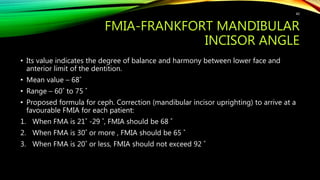
FMIA-FRANKFORT MANDIBULAR
INCISOR ANGLE
• Its value indicates the degree of balance and harmony between lower face and
anterior limit of the dentition.
• Mean value – 68˚
• Range – 60˚ to 75 ˚
• Proposed formula for ceph. Correction (mandibular incisor uprighting) to arrive at a

favourable FMIA for each patient:
1. When FMA is 21˚ -29 ˚, FMIA should be 68 ˚
2. When FMA is 30˚ or more , FMIA should be 65 ˚
3. When FMA is 20˚ or less, FMIA should not exceed 92 ˚
40
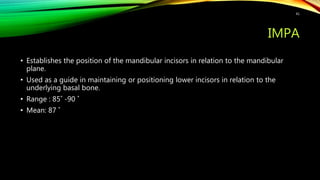
IMPA
• Establishes the position of the mandibular incisors in relation to the mandibular
plane.
• Used as a guide in maintaining or positioning lower incisors in relation to the
underlying basal bone.
• Range : 85˚ -90 ˚
• Mean: 87 ˚
41
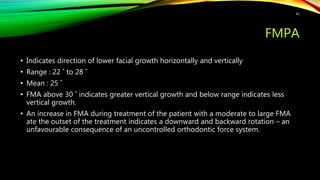
FMPA
• Indicates direction of lower facial growth horizontally and vertically
• Range : 22 ˚ to 28 ˚
• Mean : 25 ˚
• FMA above 30 ˚ indicates greater vertical growth and below range indicates less
vertical growth.
• An increase in FMA during treatment of the patient with a moderate to large FMA
ate the outset of the treatment indicates a downward and backward rotation – an
unfavourable consequence of an uncontrolled orthodontic force system.
42
43
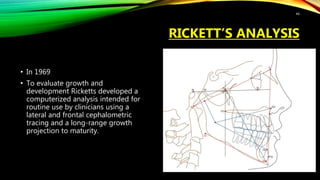
RICKETT’S ANALYSIS
RICKETT’S ANALYSIS
• In 1969
• To evaluate growth and
development Ricketts developed a
computerized analysis intended for
routine use by clinicians using a
lateral and frontal cephalometric
tracing and a long-range growth
projection to maturity.
44
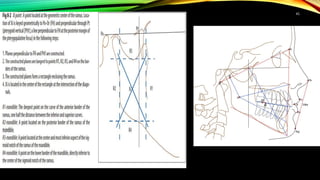
45
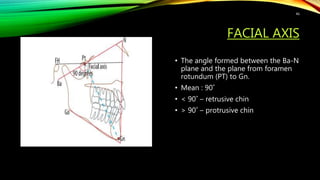
FACIAL AXIS
• The angle formed between the Ba-N
plane and the plane from foramen
rotundum (PT) to Gn.
• Mean : 90˚
• < 90˚ – retrusive chin
• > 90˚ – protrusive chin
46
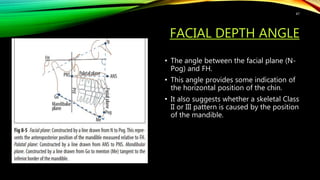
FACIAL DEPTH ANGLE
• The angle between the facial plane (N-
Pog) and FH.
• This angle provides some indication of
the horizontal position of the chin.
• It also suggests whether a skeletal Class
II or III pattern is caused by the position
of the mandible.
47
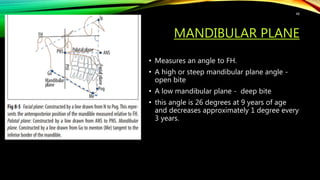
MANDIBULAR PLANE
• Measures an angle to FH.
• A high or steep mandibular plane angle -
open bite
• A low mandibular plane - deep bite
• this angle is 26 degrees at 9 years of age
and decreases approximately 1 degree every
3 years.
48
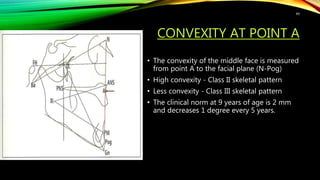
CONVEXITY AT POINT A
• The convexity of the middle face is measured
from point A to the facial plane (N-Pog)
• High convexity - Class II skeletal pattern
• Less convexity - Class III skeletal pattern
• The clinical norm at 9 years of age is 2 mm
and decreases 1 degree every 5 years.
49
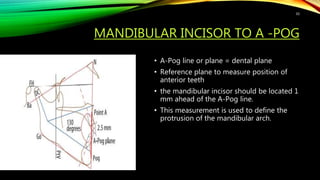
MANDIBULAR INCISOR TO A -POG
• A-Pog line or plane = dental plane
• Reference plane to measure position of
anterior teeth
• the mandibular incisor should be located 1
mm ahead of the A-Pog line.
• This measurement is used to define the
protrusion of the mandibular arch.
50
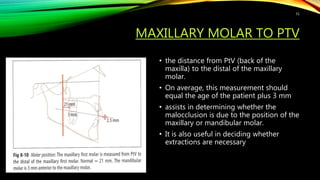
MAXILLARY MOLAR TO PTV
• the distance from PtV (back of the
maxilla) to the distal of the maxillary
molar.
• On average, this measurement should
equal the age of the patient plus 3 mm
• assists in determining whether the
malocclusion is due to the position of the
maxillary or mandibular molar.
• It is also useful in deciding whether
extractions are necessary
51
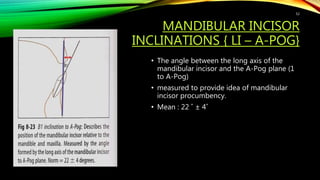
MANDIBULAR INCISOR
INCLINATIONS { LI – A-POG}
• The angle between the long axis of the
mandibular incisor and the A-Pog plane (1
to A-Pog)
• measured to provide idea of mandibular
incisor procumbency.
• Mean : 22 ˚ ± 4˚
52
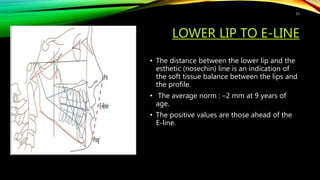
LOWER LIP TO E-LINE
• The distance between the lower lip and the
esthetic (nosechin) line is an indication of
the soft tissue balance between the lips and
the profile.
• The average norm : –2 mm at 9 years of
age.
• The positive values are those ahead of the
E-line.
53
54
MCNAMARA ANALYSIS
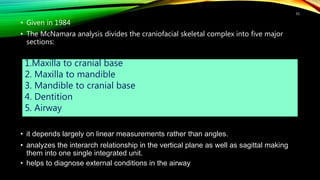
• Given in 1984
• The McNamara analysis divides the craniofacial skeletal complex into five major
sections:
• it depends largely on linear measurements rather than angles.
• analyzes the interarch relationship in the vertical plane as well as sagittal making
them into one single integrated unit.
• helps to diagnose external conditions in the airway
55
1.Maxilla to cranial base
2. Maxilla to mandible
3. Mandible to cranial base
4. Dentition
5. Airway
MAXILLA TO CRANIAL BASE
• Soft tissue evaluation : NASOLABIAL ANGLE
CANT OF UPPER LIP
• Hard tissue evaluation : NASION PERPENDICULAR TO POINT A
56
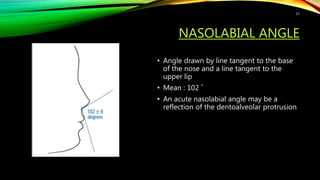
NASOLABIAL ANGLE
• Angle drawn by line tangent to the base
of the nose and a line tangent to the
upper lip
• Mean : 102 ˚
• An acute nasolabial angle may be a
reflection of the dentoalveolar protrusion
57
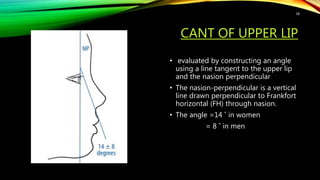
CANT OF UPPER LIP
• evaluated by constructing an angle
using a line tangent to the upper lip
and the nasion perpendicular
• The nasion-perpendicular is a vertical
line drawn perpendicular to Frankfort
horizontal (FH) through nasion.
• The angle =14 ˚ in women
= 8 ˚ in men
58
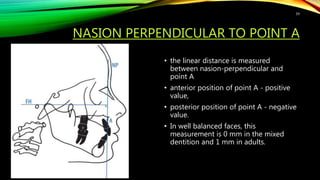
NASION PERPENDICULAR TO POINT A
• the linear distance is measured
between nasion-perpendicular and
point A
• anterior position of point A - positive
value,
• posterior position of point A - negative
value.
• In well balanced faces, this
measurement is 0 mm in the mixed
dentition and 1 mm in adults.
59
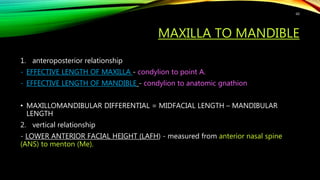
MAXILLA TO MANDIBLE
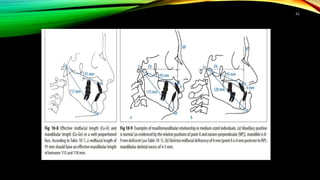
1. anteroposterior relationship
- EFFECTIVE LENGTH OF MAXILLA - condylion to point A.
- EFFECTIVE LENGTH OF MANDIBLE - condylion to anatomic gnathion
• MAXILLOMANDIBULAR DIFFERENTIAL = MIDFACIAL LENGTH – MANDIBULAR
LENGTH
2. vertical relationship
- LOWER ANTERIOR FACIAL HEIGHT (LAFH) - measured from anterior nasal spine
(ANS) to menton (Me).
60
61
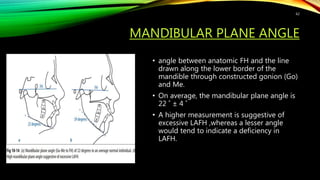
MANDIBULAR PLANE ANGLE
• angle between anatomic FH and the line
drawn along the lower border of the
mandible through constructed gonion (Go)
and Me.
• On average, the mandibular plane angle is
22 ˚ ± 4 ˚
• A higher measurement is suggestive of
excessive LAFH ,whereas a lesser angle
would tend to indicate a deficiency in
LAFH.
62
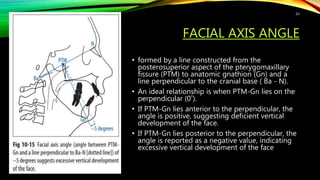
FACIAL AXIS ANGLE
• formed by a line constructed from the
posterosuperior aspect of the pterygomaxillary
fissure (PTM) to anatomic gnathion (Gn) and a
line perpendicular to the cranial base ( Ba - N).
• An ideal relationship is when PTM-Gn lies on the
perpendicular (0˚).
• If PTM-Gn lies anterior to the perpendicular, the
angle is positive, suggesting deficient vertical
development of the face.
• If PTM-Gn lies posterior to the perpendicular, the
angle is reported as a negative value, indicating
excessive vertical development of the face
63
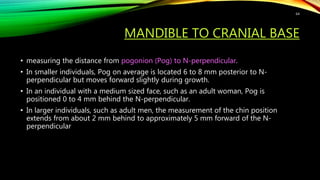
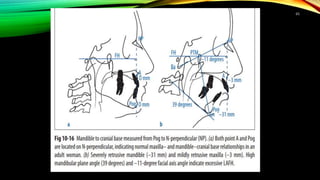
MANDIBLE TO CRANIAL BASE
• measuring the distance from pogonion (Pog) to N-perpendicular.
• In smaller individuals, Pog on average is located 6 to 8 mm posterior to N-
perpendicular but moves forward slightly during growth.
• In an individual with a medium sized face, such as an adult woman, Pog is
positioned 0 to 4 mm behind the N-perpendicular.
• In larger individuals, such as adult men, the measurement of the chin position
extends from about 2 mm behind to approximately 5 mm forward of the N-
perpendicular
64
65
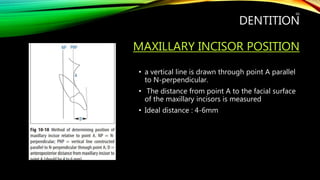
DENTITION
MAXILLARY INCISOR POSITION
• a vertical line is drawn through point A parallel
to N-perpendicular.
• The distance from point A to the facial surface
of the maxillary incisors is measured
• Ideal distance : 4-6mm
66
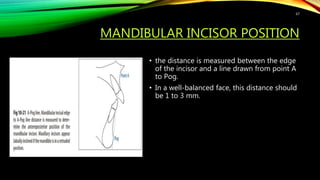
MANDIBULAR INCISOR POSITION
• the distance is measured between the edge
of the incisor and a line drawn from point A
to Pog.
• In a well-balanced face, this distance should
be 1 to 3 mm.
67
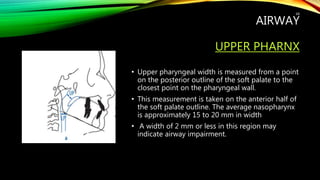
AIRWAY
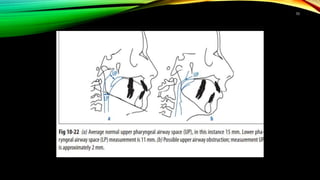
UPPER PHARNX
• Upper pharyngeal width is measured from a point
on the posterior outline of the soft palate to the
closest point on the pharyngeal wall.
• This measurement is taken on the anterior half of
the soft palate outline. The average nasopharynx
is approximately 15 to 20 mm in width
• A width of 2 mm or less in this region may
indicate airway impairment.
68
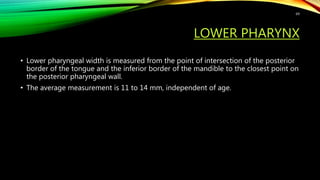
LOWER PHARYNX
• Lower pharyngeal width is measured from the point of intersection of the posterior
border of the tongue and the inferior border of the mandible to the closest point on
the posterior pharyngeal wall.
• The average measurement is 11 to 14 mm, independent of age.
69
70
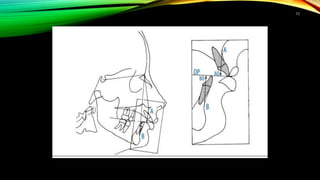
WITS APPRAISAL
• Linear measurement and not an analysis in itself.
• Measure to the extent to which the jaws are related to each other
• Used to identify instances in which the ANB reading does not accurately reflect the
extent of anteroposterior jaw dysplasia.
• drawing perpendicular lines on a lateral cephalometric headfilm tracing from points
A and B on the maxilla and mandible, respectively, onto the occlusal plane, which is
drawn through the region of the overlapping cusps of the first premolars and first
molars.
• The points of contact on the occlusal plane from points A and B are labeled AO and
BO, respectively
71
• Distance between AO and BO gives the AP relationship.
• Average jaw relationship is -1mm for men and 0 mm for women.
• Positive reading : BO behind AO – class 11
• Negative reading : BO ahead of AO - class 111
• greater the Wits reading deviation from –1.0 mm in men and 0 mm in women, the
greater the horizontal or anteroposterior jaw disharmony.
72
73
74
RAKOSI – JARABAK ANALYSIS
• Reference plane : 1) SN plane
2) Frankfort plane
3) palatal plane
4) occlusal plane
5)mandibular plane
• ANALYSIS OF FACIAL SKELETON
• ANALYSIS OF JAW BONES
• ANALYSIS OF DENTO-ALVEOLAR RELATIONSHIP
75
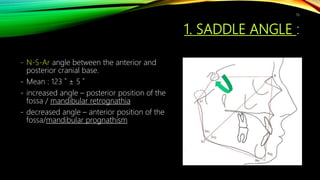
1. SADDLE ANGLE :
- N-S-Ar angle between the anterior and
posterior cranial base.
- Mean : 123 ˚ ± 5 ˚
- increased angle – posterior position of the
fossa / mandibular retrognathia
- decreased angle – anterior position of the
fossa/mandibular prognathism
76
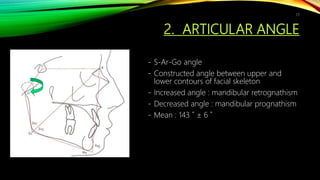
2. ARTICULAR ANGLE
- S-Ar-Go angle
- Constructed angle between upper and
lower contours of facial skeleton
- Increased angle : mandibular retrognathism
- Decreased angle : mandibular prognathism
- Mean : 143 ˚ ± 6 ˚
77
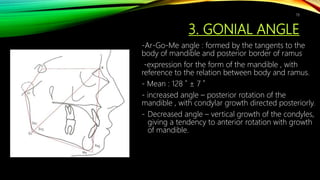
3. GONIAL ANGLE
-Ar-Go-Me angle : formed by the tangents to the
body of mandible and posterior border of ramus
-expression for the form of the mandible , with
reference to the relation between body and ramus.
- Mean : 128 ˚ ± 7 ˚
- increased angle – posterior rotation of the
mandible , with condylar growth directed posteriorly.
- Decreased angle – vertical growth of the condyles,
giving a tendency to anterior rotation with growth
of mandible.
78
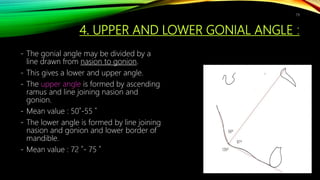
4. UPPER AND LOWER GONIAL ANGLE :
- The gonial angle may be divided by a
line drawn from nasion to gonion.
- This gives a lower and upper angle.
- The upper angle is formed by ascending
ramus and line joining nasion and
gonion.
- Mean value : 50˚-55 ˚
- The lower angle is formed by line joining
nasion and gonion and lower border of
mandible.
- Mean value : 72 ˚- 75 ˚
79
• Large upper angle – horizontal growth
• Small upper angle – caudal growth
• Large lower angle – vertical growth
• Small lower angle – sagittal growth
80
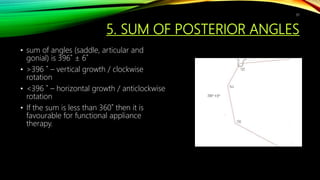
5. SUM OF POSTERIOR ANGLES
• sum of angles (saddle, articular and
gonial) is 396˚ ± 6˚
• >396 ˚ – vertical growth / clockwise
rotation
• <396 ˚ – horizontal growth / anticlockwise
rotation
• If the sum is less than 360˚ then it is
favourable for functional appliance
therapy.
81
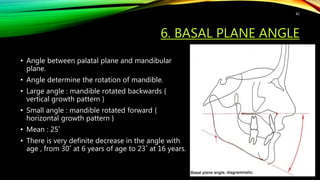
6. BASAL PLANE ANGLE
• Angle between palatal plane and mandibular
plane.
• Angle determine the rotation of mandible.
• Large angle : mandible rotated backwards {
vertical growth pattern }
• Small angle : mandible rotated forward {
horizontal growth pattern }
• Mean : 25˚
• There is very definite decrease in the angle with
age , from 30˚ at 6 years of age to 23˚ at 16 years.
82
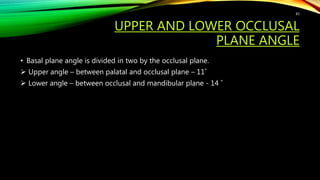
UPPER AND LOWER OCCLUSAL
PLANE ANGLE
• Basal plane angle is divided in two by the occlusal plane.
 Upper angle – between palatal and occlusal plane – 11˚
 Lower angle – between occlusal and mandibular plane - 14 ˚
83
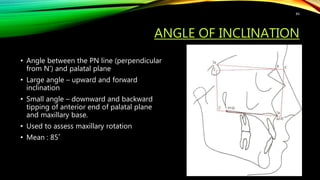
ANGLE OF INCLINATION
• Angle between the PN line (perpendicular
from N’) and palatal plane
• Large angle – upward and forward
inclination
• Small angle – downward and backward
tipping of anterior end of palatal plane
and maxillary base.
• Used to assess maxillary rotation
• Mean : 85˚
84
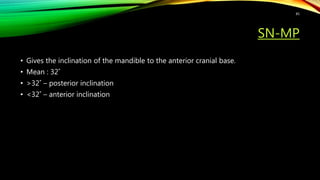
SN-MP
• Gives the inclination of the mandible to the anterior cranial base.
• Mean : 32˚
• >32˚ – posterior inclination
• <32˚ – anterior inclination
85
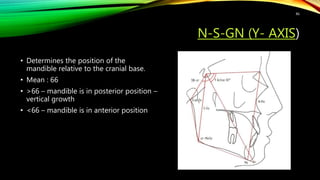
N-S-GN (Y- AXIS)
• Determines the position of the
mandible relative to the cranial base.
• Mean : 66
• >66 – mandible is in posterior position –
vertical growth
• <66 – mandible is in anterior position
86
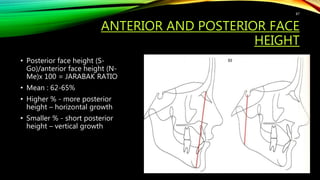
ANTERIOR AND POSTERIOR FACE
HEIGHT
• Posterior face height (S-
Go)/anterior face height (N-
Me)x 100 = JARABAK RATIO
• Mean : 62-65%
• Higher % - more posterior
height – horizontal growth
• Smaller % - short posterior
height – vertical growth
87
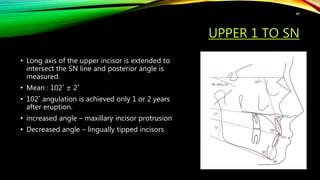
UPPER 1 TO SN
• Long axis of the upper incisor is extended to
intersect the SN line and posterior angle is
measured.
• Mean : 102˚ ± 2˚
• 102˚ angulation is achieved only 1 or 2 years
after eruption.
• increased angle – maxillary incisor protrusion
• Decreased angle – lingually tipped incisors
88
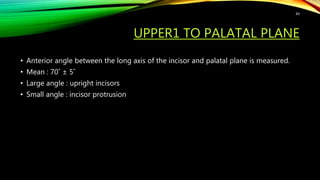
UPPER1 TO PALATAL PLANE
• Anterior angle between the long axis of the incisor and palatal plane is measured.
• Mean : 70˚ ± 5˚
• Large angle : upright incisors
• Small angle : incisor protrusion
89
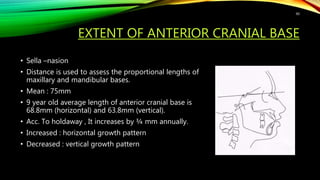
EXTENT OF ANTERIOR CRANIAL BASE
• Sella –nasion
• Distance is used to assess the proportional lengths of
maxillary and mandibular bases.
• Mean : 75mm
• 9 year old average length of anterior cranial base is
68.8mm (horizontal) and 63.8mm (vertical).
• Acc. To holdaway , It increases by ¾ mm annually.
• Increased : horizontal growth pattern
• Decreased : vertical growth pattern
90
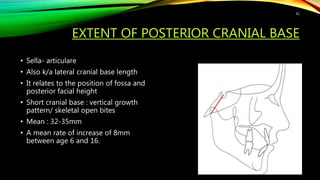
EXTENT OF POSTERIOR CRANIAL BASE
• Sella- articulare
• Also k/a lateral cranial base length
• It relates to the position of fossa and
posterior facial height
• Short cranial base : vertical growth
pattern/ skeletal open bites
• Mean : 32-35mm
• A mean rate of increase of 8mm
between age 6 and 16.
91
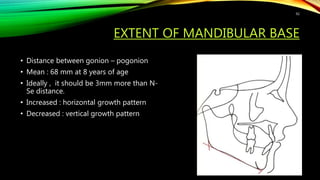
EXTENT OF MANDIBULAR BASE
• Distance between gonion – pogonion
• Mean : 68 mm at 8 years of age
• Ideally , it should be 3mm more than N-
Se distance.
• Increased : horizontal growth pattern
• Decreased : vertical growth pattern
92
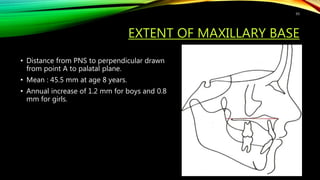
EXTENT OF MAXILLARY BASE
• Distance from PNS to perpendicular drawn
from point A to palatal plane.
• Mean : 45.5 mm at age 8 years.
• Annual increase of 1.2 mm for boys and 0.8
mm for girls.
93
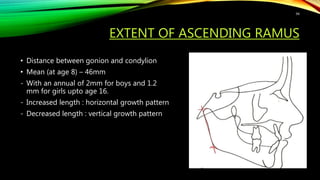
EXTENT OF ASCENDING RAMUS
• Distance between gonion and condylion
• Mean (at age 8) – 46mm
- With an annual of 2mm for boys and 1.2
mm for girls upto age 16.
- Increased length : horizontal growth pattern
- Decreased length : vertical growth pattern
94
95
COGS ANALYSIS
COGS ANALYSIS
- CEPHALOMETRICS FOR ORTHOGNATHIC SURGERY
• Developed at university of Connecticut
• Developed by : Charles Burstone et al
• Presented first in journal of oral surgery, April, 1978
• Followed by soft tissue ceph. Analysis for orthognathic surgery in journal of oral
surgery,1980.
96
• Data derived from samples obtained from child research centre , university of
Colorado school of medicine.
• Sample size : 27 (16 females , 11 males)
PLANE OF REFERENCE FOR COMPARISON
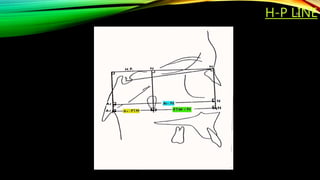
• horizontal plane (HP) which is surrogate Frankfort plane constructed by drawing a
line 7 ˚ from SN plane.
• Most measurements will be made from projections either parallel or perpendicular
to horizontal plane.
• Comprehensive appraisal includes all facial bones and a cranial base reference
• Rectilinear measurements can be readily transferred to a study cast for mock
surgery.
97
98
H-P LINE
CRANIAL BASE
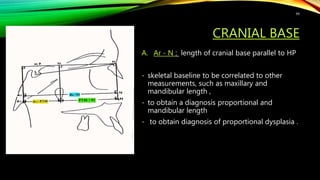
A. Ar - N : length of cranial base parallel to HP
- skeletal baseline to be correlated to other
measurements, such as maxillary and
mandibular length ,
- to obtain a diagnosis proportional and
mandibular length
- to obtain diagnosis of proportional dysplasia .
99
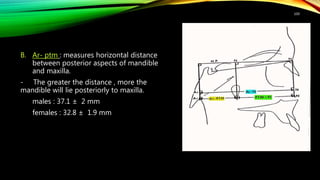
B. Ar- ptm : measures horizontal distance
between posterior aspects of mandible
and maxilla.
- The greater the distance , more the
mandible will lie posteriorly to maxilla.
males : 37.1 ± 2 mm
females : 32.8 ± 1.9 mm
100
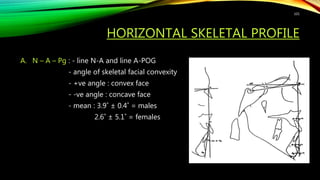
HORIZONTAL SKELETAL PROFILE
A. N – A – Pg : - line N-A and line A-POG
- angle of skeletal facial convexity
- +ve angle : convex face
- -ve angle : concave face
- mean : 3.9˚ ± 0.4˚ = males
2.6˚ ± 5.1˚ = females
101
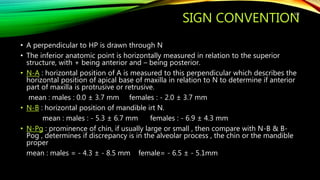
SIGN CONVENTION
• A perpendicular to HP is drawn through N
• The inferior anatomic point is horizontally measured in relation to the superior
structure, with + being anterior and – being posterior.
• N-A : horizontal position of A is measured to this perpendicular which describes the
horizontal position of apical base of maxilla in relation to N to determine if anterior
part of maxilla is protrusive or retrusive.
mean : males : 0.0 ± 3.7 mm females : - 2.0 ± 3.7 mm
• N-B : horizontal position of mandible irt N.
mean : males : - 5.3 ± 6.7 mm females : - 6.9 ± 4.3 mm
• N-Pg : prominence of chin, if usually large or small , then compare with N-B & B-
Pog , determines if discrepancy is in the alveolar process , the chin or the mandible
proper
mean : males = - 4.3 ± - 8.5 mm female= - 6.5 ± - 5.1mm
102
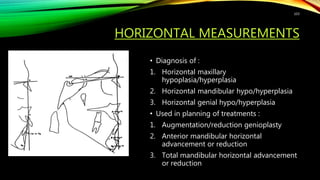
HORIZONTAL MEASUREMENTS
• Diagnosis of :
1. Horizontal maxillary
hypoplasia/hyperplasia
2. Horizontal mandibular hypo/hyperplasia
3. Horizontal genial hypo/hyperplasia
• Used in planning of treatments :
1. Augmentation/reduction genioplasty
2. Anterior mandibular horizontal
advancement or reduction
3. Total mandibular horizontal advancement
or reduction
103
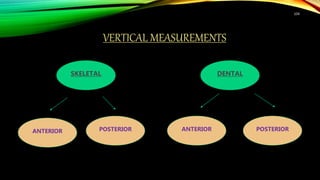
VERTICAL MEASUREMENTS
104
SKELETAL DENTAL
POSTERIOR
ANTERIOR
POSTERIOR
ANTERIOR
VERTICAL SKELETAL
DYSPLASIA- ANTERIOR
COMPONENT
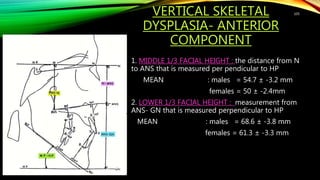
1. MIDDLE 1/3 FACIAL HEIGHT : the distance from N
to ANS that is measured per pendicular to HP
MEAN : males = 54.7 ± -3.2 mm
females = 50 ± -2.4mm
2. LOWER 1/3 FACIAL HEIGHT : measurement from
ANS- GN that is measured perpendicular to HP
MEAN : males = 68.6 ± -3.8 mm
females = 61.3 ± -3.3 mm
105
VERTICAL POSTERIOR COMPONENT
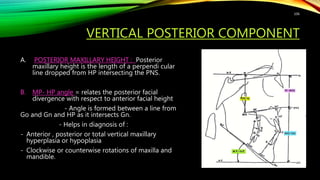
A. POSTERIOR MAXILLARY HEIGHT : Posterior
maxillary height is the length of a perpendi cular
line dropped from HP intersecting the PNS.
B. MP- HP angle = relates the posterior facial
divergence with respect to anterior facial height
- Angle is formed between a line from
Go and Gn and HP as it intersects Gn.
- Helps in diagnosis of :
- Anterior , posterior or total vertical maxillary
hyperplasia or hypoplasia
- Clockwise or counterwise rotations of maxilla and
mandible.
106
VERTICAL DENTAL DYSPLASIA
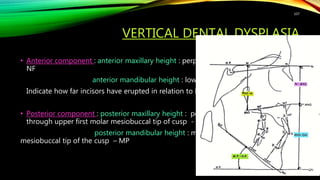
• Anterior component : anterior maxillary height : perpendicular line from upper1 –
NF
anterior mandibular height : lower1 – MP
Indicate how far incisors have erupted in relation to NF and MP.
• Posterior component : posterior maxillary height : perpendicular length of a line
through upper first molar mesiobuccal tip of cusp - NF
posterior mandibular height : mandibular first molar
mesiobuccal tip of the cusp – MP
107
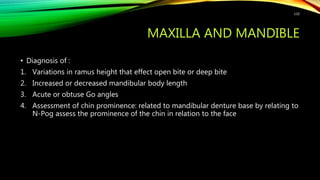
MAXILLA AND MANDIBLE
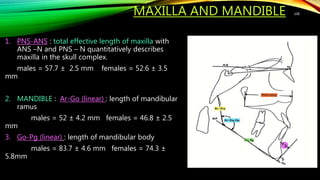
1. PNS-ANS : total effective length of maxilla with
ANS –N and PNS – N quantitatively describes
maxilla in the skull complex.
males = 57.7 ± 2.5 mm females = 52.6 ± 3.5
mm
2. MANDIBLE : Ar-Go (linear) : length of mandibular
ramus
males = 52 ± 4.2 mm females = 46.8 ± 2.5
mm
3. Go-Pg (linear) : length of mandibular body
males = 83.7 ± 4.6 mm females = 74.3 ±
5.8mm
108
109
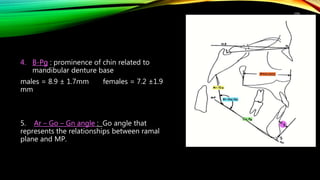
4. B-Pg : prominence of chin related to
mandibular denture base
males = 8.9 ± 1.7mm females = 7.2 ±1.9
mm
5. Ar – Go – Gn angle : Go angle that
represents the relationships between ramal
plane and MP.
MAXILLA AND MANDIBLE
• Diagnosis of :
1. Variations in ramus height that effect open bite or deep bite
2. Increased or decreased mandibular body length
3. Acute or obtuse Go angles
4. Assessment of chin prominence: related to mandibular denture base by relating to
N-Pog assess the prominence of the chin in relation to the face
110
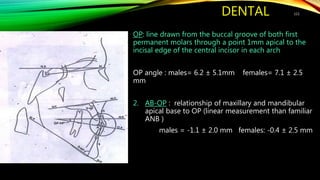
DENTAL
OP: line drawn from the buccal groove of both first
permanent molars through a point 1mm apical to the
incisal edge of the central incisor in each arch
OP angle : males= 6.2 ± 5.1mm females= 7.1 ± 2.5
mm
2. AB-OP : relationship of maxillary and mandibular
apical base to OP (linear measurement than familiar
ANB )
males = -1.1 ± 2.0 mm females: -0.4 ± 2.5 mm
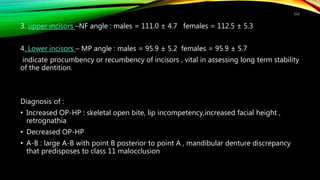
111
3. upper incisors –NF angle : males = 111.0 ± 4.7 females = 112.5 ± 5.3
4. Lower incisors – MP angle : males = 95.9 ± 5.2 females = 95.9 ± 5.7
indicate procumbency or recumbency of incisors , vital in assessing long term stability
of the dentition.
Diagnosis of :
• Increased OP-HP : skeletal open bite, lip incompetency,increased facial height ,
retrognathia
• Decreased OP-HP
• A-B : large A-B with point B posterior to point A , mandibular denture discrepancy
that predisposes to class 11 malocclusion
112
QUADRILATERAL ANALYSIS
113
QUADRILATERAL ANALYSIS
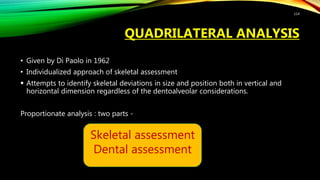
• Given by Di Paolo in 1962
• Individualized approach of skeletal assessment
 Attempts to identify skeletal deviations in size and position both in vertical and
horizontal dimension regardless of the dentoalveolar considerations.
Proportionate analysis : two parts -
114
Skeletal assessment
Dental assessment
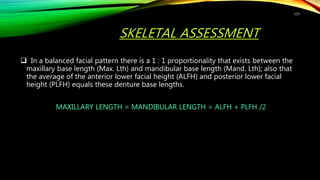
SKELETAL ASSESSMENT
 In a balanced facial pattern there is a 1 : 1 proportionality that exists between the
maxillary base length (Max. Lth) and mandibular base length (Mand. Lth); also that
the average of the anterior lower facial height (ALFH) and posterior lower facial
height (PLFH) equals these denture base lengths.
MAXILLARY LENGTH = MANDIBULAR LENGTH = ALFH + PLFH /2
115
CONSTRUCTION OF QUADRILATERAL
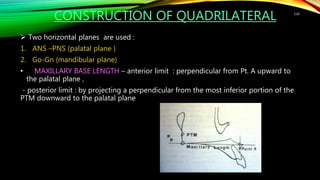
 Two horizontal planes are used :
1. ANS –PNS (palatal plane )
2. Go-Gn (mandibular plane)
• MAXILLARY BASE LENGTH – anterior limit : perpendicular from Pt. A upward to
the palatal plane ,
- posterior limit : by projecting a perpendicular from the most inferior portion of the
PTM downward to the palatal plane
116
117
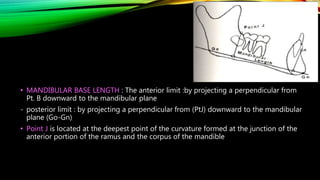
• MANDIBULAR BASE LENGTH : The anterior limit :by projecting a perpendicular from
Pt. B downward to the mandibular plane
- posterior limit : by projecting a perpendicular from (PtJ) downward to the mandibular
plane (Go-Gn)
• Point J is located at the deepest point of the curvature formed at the junction of the
anterior portion of the ramus and the corpus of the mandible
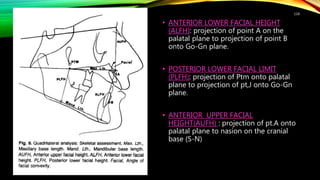
• ANTERIOR LOWER FACIAL HEIGHT
(ALFH): projection of point A on the
palatal plane to projection of point B
onto Go-Gn plane.
• POSTERIOR LOWER FACIAL LIMIT
(PLFH): projection of Ptm onto palatal
plane to projection of pt,J onto Go-Gn
plane.
• ANTERIOR UPPER FACIAL
HEIGHT(AUFH) : projection of pt.A onto
palatal plane to nasion on the cranial
base (S-N)
118
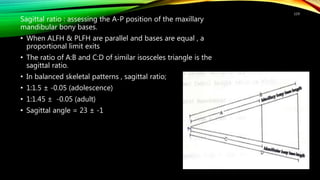
Sagittal ratio : assessing the A-P position of the maxillary
mandibular bony bases.
• When ALFH & PLFH are parallel and bases are equal , a
proportional limit exits
• The ratio of A:B and C:D of similar isosceles triangle is the
sagittal ratio.
• In balanced skeletal patterns , sagittal ratio;
• 1:1.5 ± -0.05 (adolescence)
• 1:1.45 ± -0.05 (adult)
• Sagittal angle = 23 ± -1
119
ANGLE OF FACIAL CONVEXITY : formed by
intersection of ALFH and AUFH at pt.A.
• This intersection forms an angle of convexity =
165˚ - 178˚
• It relates the quadrilateral to upper face &
cranial base = skeletal profile assessment
• The degree of facial convexity will vary
depending on the skeletal type and the
position of the quadrilateral as it relates to the
upper face.
120
DENTAL ASSESSMENT
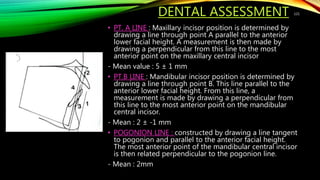
• PT. A LINE : Maxillary incisor position is determined by
drawing a line through point A parallel to the anterior
lower facial height. A measurement is then made by
drawing a perpendicular from this line to the most
anterior point on the maxillary central incisor
- Mean value : 5 ± 1 mm
• PT.B LINE : Mandibular incisor position is determined by
drawing a line through point B. This line parallel to the
anterior lower facial height. From this line, a
measurement is made by drawing a perpendicular from
this line to the most anterior point on the mandibular
central incisor.
- Mean : 2 ± -1 mm
• POGONION LINE : constructed by drawing a line tangent
to pogonion and parallel to the anterior facial height.
The most anterior point of the mandibular central incisor
is then related perpendicular to the pogonion line.
- Mean : 2mm
121
FACIAL TYPES
122
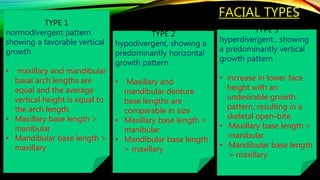
TYPE 1
normodivergent pattern
showing a favorable vertical
growth
• maxillary and mandibular
basal arch lengths are
equal and the average
vertical height is equal to
the arch length.
• Maxillary base length >
manibular
• Mandibular base length >
maxillary
TYPE 2
hypodivergent, showing a
predominantly horizontal
growth pattern
• Maxillary and
mandibular denture
base lengths are
comparable in size
• Maxillary base length >
manibular
• Mandibular base length
> maxillary
TYPE 3
hyperdivergent , showing
a predominantly vertical
growth pattern
• increase in lower face
height with an
undesirable growth
pattern, resulting in a
skeletal open-bite.
• Maxillary base length >
manibular
• Mandibular base length
> maxillary
BETA ANGLE
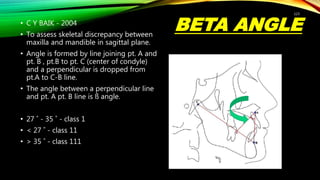
• C Y BAIK - 2004
• To assess skeletal discrepancy between
maxilla and mandible in sagittal plane.
• Angle is formed by line joining pt. A and
pt. B , pt.B to pt. C (center of condyle)
and a perpendicular is dropped from
pt.A to C-B line.
• The angle between a perpendicular line
and pt. A pt. B line is ß angle.
• 27 ˚ - 35 ˚ - class 1
• < 27 ˚ - class 11
• > 35 ˚ - class 111
123
W ANGLE
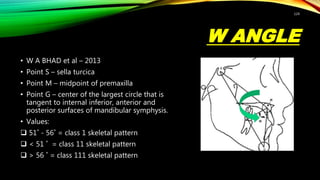
• W A BHAD et al – 2013
• Point S – sella turcica
• Point M – midpoint of premaxilla
• Point G – center of the largest circle that is
tangent to internal inferior, anterior and
posterior surfaces of mandibular symphysis.
• Values:
 51˚ - 56˚ = class 1 skeletal pattern
 < 51 ˚ = class 11 skeletal pattern
 > 56 ˚ = class 111 skeletal pattern
124
REFERENCES
• Orthodontic cephalometry – Athanasois E. Athanasois
• At atlas and manual of cephalometric radiography – Thomas Rakosi
• Radiographic cephalometry from basics to videoimaging – Alexander Jacobson
125
126
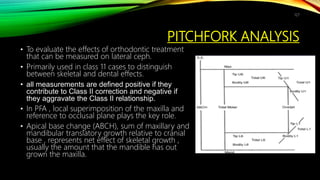
PITCHFORK ANALYSIS
• To evaluate the effects of orthodontic treatment
that can be measured on lateral ceph.
• Primarily used in class 11 cases to distinguish
between skeletal and dental effects.
• all measurements are defined positive if they
contribute to Class II correction and negative if
they aggravate the Class II relationship.
• In PFA , local superimposition of the maxilla and
reference to occlusal plane plays the key role.
• Apical base change (ABCH), sum of maxillary and
mandibular translatory growth relative to cranial
base , represents net effect of skeletal growth ,
usually the amount that the mandible has out
grown the maxilla.
127
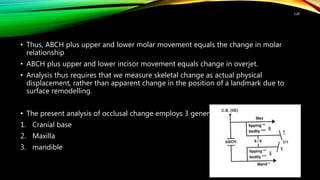
• Thus, ABCH plus upper and lower molar movement equals the change in molar
relationship
• ABCH plus upper and lower incisor movement equals change in overjet.
• Analysis thus requires that we measure skeletal change as actual physical
displacement, rather than apparent change in the position of a landmark due to
surface remodelling.
• The present analysis of occlusal change employs 3 general superimpositions :
1. Cranial base
2. Maxilla
3. mandible
128
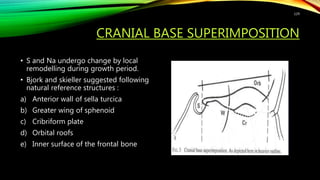
CRANIAL BASE SUPERIMPOSITION
• S and Na undergo change by local
remodelling during growth period.
• Bjork and skieller suggested following
natural reference structures :
a) Anterior wall of sella turcica
b) Greater wing of sphenoid
c) Cribriform plate
d) Orbital roofs
e) Inner surface of the frontal bone
129
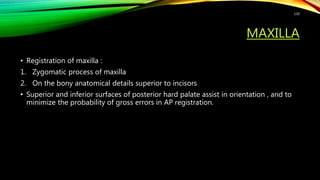
MAXILLA
• Registration of maxilla :
1. Zygomatic process of maxilla
2. On the bony anatomical details superior to incisors
• Superior and inferior surfaces of posterior hard palate assist in orientation , and to
minimize the probability of gross errors in AP registration.
130
MANDIBLE
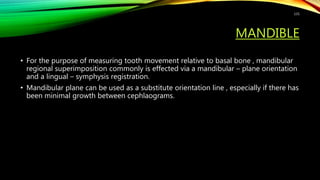
• For the purpose of measuring tooth movement relative to basal bone , mandibular
regional superimposition commonly is effected via a mandibular – plane orientation
and a lingual – symphysis registration.
• Mandibular plane can be used as a substitute orientation line , especially if there has
been minimal growth between cephlaograms.
131
132
THE PATTERN OF CRANIOFACIAL GROWTH
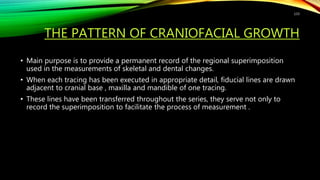
• Main purpose is to provide a permanent record of the regional superimposition
used in the measurements of skeletal and dental changes.
• When each tracing has been executed in appropriate detail, fiducial lines are drawn
adjacent to cranial base , maxilla and mandible of one tracing.
• These lines have been transferred throughout the series, they serve not only to
record the superimposition to facilitate the process of measurement .
133
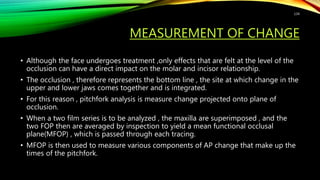
MEASUREMENT OF CHANGE
• Although the face undergoes treatment ,only effects that are felt at the level of the
occlusion can have a direct impact on the molar and incisor relationship.
• The occlusion , therefore represents the bottom line , the site at which change in the
upper and lower jaws comes together and is integrated.
• For this reason , pitchfork analysis is measure change projected onto plane of
occlusion.
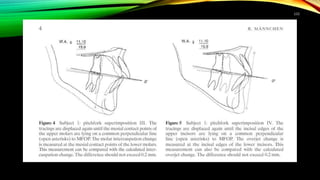
• When a two film series is to be analyzed , the maxilla are superimposed , and the
two FOP then are averaged by inspection to yield a mean functional occlusal
plane(MFOP) , which is passed through each tracing.
• MFOP is then used to measure various components of AP change that make up the
times of the pitchfork.
134
H
A) JAW GROWTH / DISPLACEMENT RELATIVE TO CRANIAL BASE
in the ant. Cranial base “wing point” commonly serves as a reg. point and is used
here as the cranial base reference point from which maxillary and mandibular
displacement are measured.
B) To measure displacement of the maxilla relative to cranial base (MAX) , the
maxillary fiducial lines are superimposed and the separation of the W points is
measured parallel to MFOP.
C) MANDIBLE : the separation of the D points is measured parallel to MFOP. This
measurement represents the mandible relative to maxillary basal bone.
135
• Since , the mandible outgrows the maxilla , ABCH commonly is positive.
• Note : displacement of D – point can be due to growth , a functional shift , or more
probably some mixture of two.
• So unfortunately , the cephalometric technique offers no reliable means of
differentiating between the two types of change .
• Whatever its sign , mandibular displacement relative to cranial base (MAND) then
can be estimated by subtraction: MAND = ABCH – MAX
• These three measurements abstract the sagittal growth of the jaws and together
with tooth movement account for change in molar relationship and overjet.
136
TOOTH MOVEMENT RELATIVE TO BASAL BONE
• The change in overjet and the molar relationship obtained from summing the
individual lines of the pitchfork should be compared with direct measurements
obtained form an MFOP superimposition.
• The change in molar relationship is measured by registering on the mesial contct
point of one molar and then measuring the separation of contact point of the other
:
- The change in overjet, by registering on the averaged incisal edge of the upper or
lower incisors and then measuring the displacement of the averaged incisal edge in
the other arch.
- If the individual components of growth and tooth movement do not add up to the
direct measurements of change executed at the occlusal plane, the measurements
are re done.
137
GRUMMONS ANALYSIS
• PA cephalogram offers an effective tool evaluating the craniofacial structures in
transverse and vertical dimensions.
• It allows us to look at the facial skeleton in relative view of the right – left face and
upper – lower face.
• Frontal and asymmetry information is vitally important in :
o Orthodontic surgery planning
o Differential tooth eruption with segmental TMJ splint therapy
o Functional jaw orthopaedics including three dimensional improvements in facial or
dental proportions or symmetry.
138
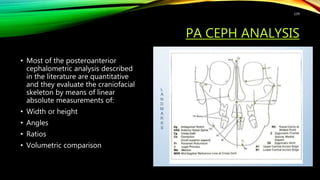
PA CEPH ANALYSIS
• Most of the posteroanterior
cephalometric analysis described
in the literature are quantitative
and they evaluate the craniofacial
skeleton by means of linear
absolute measurements of:
• Width or height
• Angles
• Ratios
• Volumetric comparison
139
• The different structures of the craniofacial complex can also be analysed using
qualitative methods.
• The analysis proposed by grummons contains quantitative assessment of vertical
dimensions and proportions.
• The analysis is presented in two forms :
- The comprehensive frontal asymmetry analysis
- Frontal asymmetry analysis
140
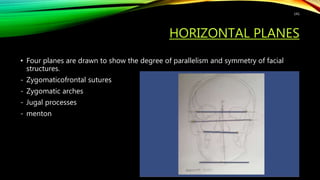
HORIZONTAL PLANES
• Four planes are drawn to show the degree of parallelism and symmetry of facial
structures.
- Zygomaticofrontal sutures
- Zygomatic arches
- Jugal processes
- menton
141
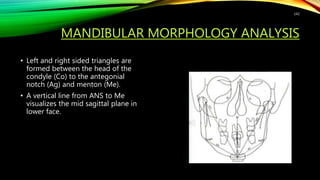
MANDIBULAR MORPHOLOGY ANALYSIS
• Left and right sided triangles are
formed between the head of the
condyle (Co) to the antegonial
notch (Ag) and menton (Me).
• A vertical line from ANS to Me
visualizes the mid sagittal plane in
lower face.
142
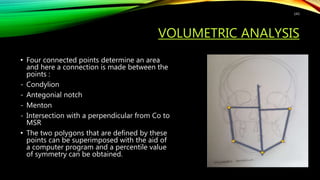
VOLUMETRIC ANALYSIS
• Four connected points determine an area
and here a connection is made between the
points :
- Condylion
- Antegonial notch
- Menton
- Intersection with a perpendicular from Co to
MSR
• The two polygons that are defined by these
points can be superimposed with the aid of
a computer program and a percentile value
of symmetry can be obtained.
143
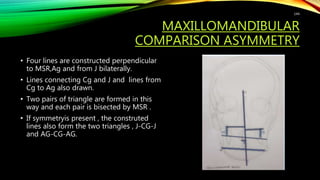
MAXILLOMANDIBULAR
COMPARISON ASYMMETRY
• Four lines are constructed perpendicular
to MSR,Ag and from J bilaterally.
• Lines connecting Cg and J and lines from
Cg to Ag also drawn.
• Two pairs of triangle are formed in this
way and each pair is bisected by MSR .
• If symmetryis present , the construted
lines also form the two triangles , J-CG-J
and AG-CG-AG.
144
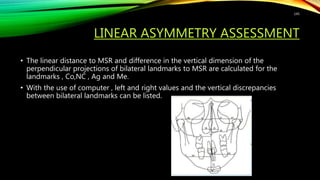
LINEAR ASYMMETRY ASSESSMENT
• The linear distance to MSR and difference in the vertical dimension of the
perpendicular projections of bilateral landmarks to MSR are calculated for the
landmarks , Co,NC , Ag and Me.
• With the use of computer , left and right values and the vertical discrepancies
between bilateral landmarks can be listed.
145
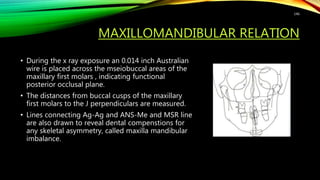
MAXILLOMANDIBULAR RELATION
• During the x ray exposure an 0.014 inch Australian
wire is placed across the mseiobuccal areas of the
maxillary first molars , indicating functional
posterior occlusal plane.
• The distances from buccal cusps of the maxillary
first molars to the J perpendiculars are measured.
• Lines connecting Ag-Ag and ANS-Me and MSR line
are also drawn to reveal dental compenstions for
any skeletal asymmetry, called maxilla mandibular
imbalance.
146
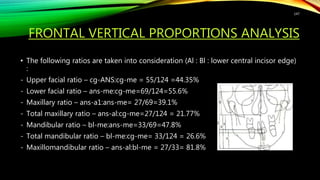
FRONTAL VERTICAL PROPORTIONS ANALYSIS
• The following ratios are taken into consideration (Al : Bl : lower central incisor edge)
:
- Upper facial ratio – cg-ANS:cg-me = 55/124 =44.35%
- Lower facial ratio – ans-me:cg-me=69/124=55.6%
- Maxillary ratio – ans-a1:ans-me= 27/69=39.1%
- Total maxillary ratio – ans-al:cg-me=27/124 = 21.77%
- Mandibular ratio – bl-me:ans-me=33/69=47.8%
- Total mandibular ratio – bl-me:cg-me= 33/124 = 26.6%
- Maxillomandibular ratio – ans-al:bl-me = 27/33= 81.8%
147

Hard tissue cephalometrics

  • 1.
  • 2.
    CONTENTS • Introduction • Cephalostat •Cephalometric landmarks • Downs analysis • Steiners analysis • Tweeds analysis • Wits appraisal • Mcnamara analysis • Ricketts analysis • Rakosi-jarabak analysis • Cogs analysis • Pitchfork analysis • Grummons analysis • Quadrilateral analysis 2
  • 3.
    INTRODUCTION • Cephalometric analysisis a process of evaluating the skeletal, dental and soft tissue relationships of a patient by comparing measurements performed on the patient’s cephalometric tracing with population norms for respective measurements to come to a diagnosis of the patient’s orthodontic problem. 3
  • 4.
    CEPHALOSTAT • Head holdingdevice • It consists of 2 rods that prevent movement of the head in horizontal plane. • Vertical stabilization is provided by an orbital pointer that contacts the lower border of the left orbit. • The upper part of the face is supported by a forehead clamp positioned above the region of the nasal bridge. 4
  • 5.
    • The distancebetween X- ray source and mid sagittal plane of the patient is fixed at 5 feet (152.4 cm). • The distance between mid sagittal plane of cephalostat and film is 15 cm. PATIENT POSITIONING • Patient is positioned in a upright position with : 1. FH plane is parallel to the floor. 2. Mid sagittal plane of patient is perpendicular to X-ray beam and parallel to the film and perpendicular to the floor. 5
  • 6.
  • 7.
    USE OF CEPHALOMETRY •For gross inspection • Growth analysis • To diagnose anomalies • To forecast future relationships • To plan the treatment • To evaluate treatment outcome 7
  • 8.
    CEPHALOMETRIC LANDMARKS repr Representsactual anatomic landmarks of the skull obtained secondarily from anatomic landmarks 8 SOFT TISSUE LANDMARKS HARD TISSUE LANDMARKS ANATOMIC DERIVED
  • 9.
  • 10.
    UNILATERAL LANDMARKS • NASION(Na) – most anterior point on frontonasal suture • ANTERIOR NASAL SPINE (ANS) - The anterior tip of the sharp bony process of the maxilla at the lower margin of the anterior nasal opening. • SUBSPINALE (A POINT) – the most posterior point on the concavity between ANS and superior prosthion. • SUPRAMENTALE (B POINT) – the most posterior point of the bony curvature of mandible below infradentale and above pogonion. • POGONION (Pog)- most anterior point on contour of chin. • GNATHION (Gn)- most anterior inferior point on symphysis of chin , constructed by intersecting a line drawn perpendicular to the line connecting menton and pogonion. 10
  • 11.
    • MENTON(Me) –lowest point on the symphyseal outline of the chin. • BASION(Ba)- most inferior point in the sagittal plane on the anterior rim of the foramen magnum. • SELLA(S)- center of the pituitary fossa. • POSTERIOR NASAL SPINE (PNS) – most posterior point on the bony hard palate in the sagittal plane. 11
  • 12.
    BILATERAL LANDMARKS • ORBITALE(Or)-lowest point on inferior rim of orbit. • GONION(Go)- point on the curvature of the angle of mandible located by bisecting the angle formed by lines tangent to the posterior ramus and inferior border of mandible. • CONDYLION(Co)- most superior point on the condyle of the mandible. • ARTICULARE(Ar)- point at the junction of the posterior border of the ramus and the inferior border of the posterior cranial base (occipital bone). 12
  • 13.
    • PTERYGOMAXILLARY FISSURE(Ptm)-bilateral tear drop shaped area of radiolucency, anterior shadow of which is the posterior surfaces of maxillary tuberosities. • BOLTON POINT(Bo)- highest point in the upward curvature of the retrocondylar fossa of the occipital bone/ The intersection of the outline of the occipital condyle and the foramen magnum at the highest point on the notch posterior to the occipital condyle. • PORION(Po)- midpoint of the upper contour of the external auditory canal(anatomic porion) or the midpoint of the upper contour of the metal ear rod of cephalometer(machine porion). 13
  • 14.
  • 15.
    DOWN’S ANALYSIS • 1948 •Control material – 20 white subjects [age: 12-17 yrs] with equal no. of boys and girls • Reference plane : FRANKFORT HORIZONTAL PLANE {FH} • Four basic facial types: 1. Retrognathic 2. Orthognathic 3. Prognathic 4. True prognathism • Parameters of analysis : skeletal and dental Dental parameters Cant of occlusal plane Interincisal angle Incisor - OP angle Incisor – MP angle Incisor to A-pog 15
  • 16.
    FACIAL ANGLE • tomeasure the degree of retrusion and protrusion of mandible • Inferior inside angle ; facial line [ nasion- pogonion] intersects FH • Mean reading : 87.8˚ • Range : 82 ˚ - 95 ˚ • > 87.8˚ = prominent chin • < 87.8˚ = retrusive chin 16
  • 17.
    ANGLE OF CONVEXITY 1.To measure the extent of protrusion and retrusion of mandible 2. Relationship of jaws to each other 3. Convexity of maxilla 4. Inclination of mandible • Angle formed by intersection of N - Pt. A to Pt. A – pog • Mean reading : 0˚ • Range : - 8.5˚ to 10˚ • +ve angle protrusive mandible • -ve angle retrusive mandible 17
  • 18.
    A-B PLANE • PointsA and B are joined and when the line is extended, the angle formed with the line N-Pog is read. • measure of the relation of the anterior limit of the apical bases to each other relative to the facial line. • mean reading : –4.6˚ • Range : 0 to -9˚ • Large –ve value : class 11 pattern 18
  • 19.
    MANDIBULAR PLANE ANGLE •Tangent to the gonial angle and lowest point of symphysis i.e. menton • Established by relating MP to FH. • Mean reading : 21.9˚ • Range : 17 to 28˚ • High MP angle – in both retrusive and protrusive faces- hyperdivergent facial pattern 19
  • 20.
    Y-AXIS • Measured asacute angle formed by intersection of line from sella turcica to gnathion with FH plane. • Indicates downward ,rearward or forward position of chin irt upper face • Increase angle - vertical growth pattern • Decrease angle – horizontal growth pattern • Mean : 59.4 ˚ • Range : 53˚ to 66˚ 20
  • 21.
    CANT OF OCCLUSALPLANE • OP is drawn through overlapping cusps of first premolars and first molars. • measure of slope of OP to FH. • Large positive angle – class 11 facial pattern • Mean : 9.3 ˚ • Range : 1.5 ˚ to 14 ˚ 21
  • 22.
    INTERINCISAL ANGLE • Passinga line through incisal edges and the apex of root of the maxillary and mandibular central incisors. • Mean : 135.4 ˚ • Range : 130 ˚ to 150.5 ˚ 22
  • 23.
    INCISOR – OPANGLE • Relates mandibular incisors to their functioning surface at OP. • Inferior inside angle is read. • Mean : 14.5 ˚ • Range : 3.5 ˚ to 20 ˚ 23
  • 24.
    INCISOR – MPANGLE • by intersection of MP with a line passing through incisal edge and apex of the root of mandibular central incisor. • Mean : 1.4 ˚ • Range : - 8.5 ˚ to 7 ˚ 24
  • 25.
    PROTRUSION OF MAXILLARY INCISOR •Measured as distance between incisal edge of maxillary central incisor to the line from point A to pog • Mean : 2.7 mm • Range : -1mm to 5mm • +ve reading : maxillary dental protrusion • -ve reading : retruded position of maxillary central incisor 25
  • 26.
  • 27.
    STEINER ANALYSIS • Lineof reference: SN PLANE {SELLA- NASION} • Three way analysis : Skeletal analysis SNA SNB ANB Occlusal plane Mandibular plane Dental analysis Maxillary incisor position Mandibular incisor position Interincisal angle Lower incisor chin relationship Soft tissue analysis S- line 27
  • 28.
    SNA • To checkwhether the maxilla is positioned anteriorly or posteriorly to cranial base • Mean : 82˚ • >82˚ – forward position of maxilla • <82 ˚ – backward position of maxilla 28
  • 29.
    SNB • To checkwhether mandible is protrusive or recessive relative to cranial base • Mean : 80˚ • >80˚ – prognathic mandible • <80˚ – recessive mandible 29
  • 30.
    ANB • Difference betweenSNA & SNB • antero-posterior discrepancy of maxillary to mandibular apical bases • Mean : 2˚ • > 2˚ – class 11 skeletal pattern • < 2˚ – class 111 skeletal pattern 30
  • 31.
    OCCLUSAL PLANE • Drawnthrough region of overlapping cusps of first premolars and first molars • Angle to occlusal plane to SN • Mean : 14˚ 31
  • 32.
    MANDIBULAR PLANE • Plane: Go – Gn • Angle between SN & Go-Gn • Mean : 32˚ 32
  • 33.
    MAXILLARY INCISOR POSITION •NA & long axis of maxillary tooth • U1 to NA {LINEAR} – shows forward and backward position of teeth • U1 to NA {ANGLE} – relative axial inclination of teeth • Mean {LINEAR} – 4mm {ANGLE} - 22˚ 33
  • 34.
    MANDIBULAR INCISOR POSITION •Relating mandibular incisors to line from nasion to pt. B {NB} • L1 to NB {LINEAR} – shows forward and backward position of teeth • L1 to NB {ANGLE} – relative axial inclination of teeth • Mean {LINEAR} – 4mm {ANGLE} - 25˚ 34
  • 35.
    INTERINCISAL ANGLE • PositionRelative of the maxillary to that of mandibular incisors • Mean : 130˚ • >130˚ / obtuse : requires advancement anteriorly • <130˚ / acute : both maxillary and mandibular teeth requires uprighting 35
  • 36.
    LOWER INCISOR –CHIN RELATIONSHIP • Distance between labial surface of the lower incisor to the NB line should be ideally 4mm. • 2mm discrepancy is acceptable • 3mm – less desirable • > 4mm- corrective measures 36
  • 37.
    S-LINE • Line formedfrom soft tissue contour of the chin to the middle of S formed by the lower border of the nose. • In well balanced faces , lips should touch this line • Lips located beyond – protrusive • Lips located behind- retrusive – concave profile 37
  • 38.
  • 39.
    TWEED ANALYSIS • Tweed’sdiagnostic triangle : 1. FRANKFORT MANDIBULAR PLANE ANGLE 2. FRANKFORT MANDIBULAR INCISOR ANGLE 3. INCISOR MANDIBULAR PLANE ANGLE • This gives the information about the patient’s vertical skeletal pattern, the relationship of mandibular incisors to basal bone, and the relative amount of protrusion, or lack thereof, of the face. 39
  • 40.
    FMIA-FRANKFORT MANDIBULAR INCISOR ANGLE •Its value indicates the degree of balance and harmony between lower face and anterior limit of the dentition. • Mean value – 68˚ • Range – 60˚ to 75 ˚ • Proposed formula for ceph. Correction (mandibular incisor uprighting) to arrive at a favourable FMIA for each patient: 1. When FMA is 21˚ -29 ˚, FMIA should be 68 ˚ 2. When FMA is 30˚ or more , FMIA should be 65 ˚ 3. When FMA is 20˚ or less, FMIA should not exceed 92 ˚ 40
  • 41.
    IMPA • Establishes theposition of the mandibular incisors in relation to the mandibular plane. • Used as a guide in maintaining or positioning lower incisors in relation to the underlying basal bone. • Range : 85˚ -90 ˚ • Mean: 87 ˚ 41
  • 42.
    FMPA • Indicates directionof lower facial growth horizontally and vertically • Range : 22 ˚ to 28 ˚ • Mean : 25 ˚ • FMA above 30 ˚ indicates greater vertical growth and below range indicates less vertical growth. • An increase in FMA during treatment of the patient with a moderate to large FMA ate the outset of the treatment indicates a downward and backward rotation – an unfavourable consequence of an uncontrolled orthodontic force system. 42
  • 43.
  • 44.
    RICKETT’S ANALYSIS • In1969 • To evaluate growth and development Ricketts developed a computerized analysis intended for routine use by clinicians using a lateral and frontal cephalometric tracing and a long-range growth projection to maturity. 44
  • 45.
  • 46.
    FACIAL AXIS • Theangle formed between the Ba-N plane and the plane from foramen rotundum (PT) to Gn. • Mean : 90˚ • < 90˚ – retrusive chin • > 90˚ – protrusive chin 46
  • 47.
    FACIAL DEPTH ANGLE •The angle between the facial plane (N- Pog) and FH. • This angle provides some indication of the horizontal position of the chin. • It also suggests whether a skeletal Class II or III pattern is caused by the position of the mandible. 47
  • 48.
    MANDIBULAR PLANE • Measuresan angle to FH. • A high or steep mandibular plane angle - open bite • A low mandibular plane - deep bite • this angle is 26 degrees at 9 years of age and decreases approximately 1 degree every 3 years. 48
  • 49.
    CONVEXITY AT POINTA • The convexity of the middle face is measured from point A to the facial plane (N-Pog) • High convexity - Class II skeletal pattern • Less convexity - Class III skeletal pattern • The clinical norm at 9 years of age is 2 mm and decreases 1 degree every 5 years. 49
  • 50.
    MANDIBULAR INCISOR TOA -POG • A-Pog line or plane = dental plane • Reference plane to measure position of anterior teeth • the mandibular incisor should be located 1 mm ahead of the A-Pog line. • This measurement is used to define the protrusion of the mandibular arch. 50
  • 51.
    MAXILLARY MOLAR TOPTV • the distance from PtV (back of the maxilla) to the distal of the maxillary molar. • On average, this measurement should equal the age of the patient plus 3 mm • assists in determining whether the malocclusion is due to the position of the maxillary or mandibular molar. • It is also useful in deciding whether extractions are necessary 51
  • 52.
    MANDIBULAR INCISOR INCLINATIONS {LI – A-POG} • The angle between the long axis of the mandibular incisor and the A-Pog plane (1 to A-Pog) • measured to provide idea of mandibular incisor procumbency. • Mean : 22 ˚ ± 4˚ 52
  • 53.
    LOWER LIP TOE-LINE • The distance between the lower lip and the esthetic (nosechin) line is an indication of the soft tissue balance between the lips and the profile. • The average norm : –2 mm at 9 years of age. • The positive values are those ahead of the E-line. 53
  • 54.
  • 55.
    • Given in1984 • The McNamara analysis divides the craniofacial skeletal complex into five major sections: • it depends largely on linear measurements rather than angles. • analyzes the interarch relationship in the vertical plane as well as sagittal making them into one single integrated unit. • helps to diagnose external conditions in the airway 55 1.Maxilla to cranial base 2. Maxilla to mandible 3. Mandible to cranial base 4. Dentition 5. Airway
  • 56.
    MAXILLA TO CRANIALBASE • Soft tissue evaluation : NASOLABIAL ANGLE CANT OF UPPER LIP • Hard tissue evaluation : NASION PERPENDICULAR TO POINT A 56
  • 57.
    NASOLABIAL ANGLE • Angledrawn by line tangent to the base of the nose and a line tangent to the upper lip • Mean : 102 ˚ • An acute nasolabial angle may be a reflection of the dentoalveolar protrusion 57
  • 58.
    CANT OF UPPERLIP • evaluated by constructing an angle using a line tangent to the upper lip and the nasion perpendicular • The nasion-perpendicular is a vertical line drawn perpendicular to Frankfort horizontal (FH) through nasion. • The angle =14 ˚ in women = 8 ˚ in men 58
  • 59.
    NASION PERPENDICULAR TOPOINT A • the linear distance is measured between nasion-perpendicular and point A • anterior position of point A - positive value, • posterior position of point A - negative value. • In well balanced faces, this measurement is 0 mm in the mixed dentition and 1 mm in adults. 59
  • 60.
    MAXILLA TO MANDIBLE 1.anteroposterior relationship - EFFECTIVE LENGTH OF MAXILLA - condylion to point A. - EFFECTIVE LENGTH OF MANDIBLE - condylion to anatomic gnathion • MAXILLOMANDIBULAR DIFFERENTIAL = MIDFACIAL LENGTH – MANDIBULAR LENGTH 2. vertical relationship - LOWER ANTERIOR FACIAL HEIGHT (LAFH) - measured from anterior nasal spine (ANS) to menton (Me). 60
  • 61.
  • 62.
    MANDIBULAR PLANE ANGLE •angle between anatomic FH and the line drawn along the lower border of the mandible through constructed gonion (Go) and Me. • On average, the mandibular plane angle is 22 ˚ ± 4 ˚ • A higher measurement is suggestive of excessive LAFH ,whereas a lesser angle would tend to indicate a deficiency in LAFH. 62
  • 63.
    FACIAL AXIS ANGLE •formed by a line constructed from the posterosuperior aspect of the pterygomaxillary fissure (PTM) to anatomic gnathion (Gn) and a line perpendicular to the cranial base ( Ba - N). • An ideal relationship is when PTM-Gn lies on the perpendicular (0˚). • If PTM-Gn lies anterior to the perpendicular, the angle is positive, suggesting deficient vertical development of the face. • If PTM-Gn lies posterior to the perpendicular, the angle is reported as a negative value, indicating excessive vertical development of the face 63
  • 64.
    MANDIBLE TO CRANIALBASE • measuring the distance from pogonion (Pog) to N-perpendicular. • In smaller individuals, Pog on average is located 6 to 8 mm posterior to N- perpendicular but moves forward slightly during growth. • In an individual with a medium sized face, such as an adult woman, Pog is positioned 0 to 4 mm behind the N-perpendicular. • In larger individuals, such as adult men, the measurement of the chin position extends from about 2 mm behind to approximately 5 mm forward of the N- perpendicular 64
  • 65.
  • 66.
    DENTITION MAXILLARY INCISOR POSITION •a vertical line is drawn through point A parallel to N-perpendicular. • The distance from point A to the facial surface of the maxillary incisors is measured • Ideal distance : 4-6mm 66
  • 67.
    MANDIBULAR INCISOR POSITION •the distance is measured between the edge of the incisor and a line drawn from point A to Pog. • In a well-balanced face, this distance should be 1 to 3 mm. 67
  • 68.
    AIRWAY UPPER PHARNX • Upperpharyngeal width is measured from a point on the posterior outline of the soft palate to the closest point on the pharyngeal wall. • This measurement is taken on the anterior half of the soft palate outline. The average nasopharynx is approximately 15 to 20 mm in width • A width of 2 mm or less in this region may indicate airway impairment. 68
  • 69.
    LOWER PHARYNX • Lowerpharyngeal width is measured from the point of intersection of the posterior border of the tongue and the inferior border of the mandible to the closest point on the posterior pharyngeal wall. • The average measurement is 11 to 14 mm, independent of age. 69
  • 70.
  • 71.
    WITS APPRAISAL • Linearmeasurement and not an analysis in itself. • Measure to the extent to which the jaws are related to each other • Used to identify instances in which the ANB reading does not accurately reflect the extent of anteroposterior jaw dysplasia. • drawing perpendicular lines on a lateral cephalometric headfilm tracing from points A and B on the maxilla and mandible, respectively, onto the occlusal plane, which is drawn through the region of the overlapping cusps of the first premolars and first molars. • The points of contact on the occlusal plane from points A and B are labeled AO and BO, respectively 71
  • 72.
    • Distance betweenAO and BO gives the AP relationship. • Average jaw relationship is -1mm for men and 0 mm for women. • Positive reading : BO behind AO – class 11 • Negative reading : BO ahead of AO - class 111 • greater the Wits reading deviation from –1.0 mm in men and 0 mm in women, the greater the horizontal or anteroposterior jaw disharmony. 72
  • 73.
  • 74.
  • 75.
    RAKOSI – JARABAKANALYSIS • Reference plane : 1) SN plane 2) Frankfort plane 3) palatal plane 4) occlusal plane 5)mandibular plane • ANALYSIS OF FACIAL SKELETON • ANALYSIS OF JAW BONES • ANALYSIS OF DENTO-ALVEOLAR RELATIONSHIP 75
  • 76.
    1. SADDLE ANGLE: - N-S-Ar angle between the anterior and posterior cranial base. - Mean : 123 ˚ ± 5 ˚ - increased angle – posterior position of the fossa / mandibular retrognathia - decreased angle – anterior position of the fossa/mandibular prognathism 76
  • 77.
    2. ARTICULAR ANGLE -S-Ar-Go angle - Constructed angle between upper and lower contours of facial skeleton - Increased angle : mandibular retrognathism - Decreased angle : mandibular prognathism - Mean : 143 ˚ ± 6 ˚ 77
  • 78.
    3. GONIAL ANGLE -Ar-Go-Meangle : formed by the tangents to the body of mandible and posterior border of ramus -expression for the form of the mandible , with reference to the relation between body and ramus. - Mean : 128 ˚ ± 7 ˚ - increased angle – posterior rotation of the mandible , with condylar growth directed posteriorly. - Decreased angle – vertical growth of the condyles, giving a tendency to anterior rotation with growth of mandible. 78
  • 79.
    4. UPPER ANDLOWER GONIAL ANGLE : - The gonial angle may be divided by a line drawn from nasion to gonion. - This gives a lower and upper angle. - The upper angle is formed by ascending ramus and line joining nasion and gonion. - Mean value : 50˚-55 ˚ - The lower angle is formed by line joining nasion and gonion and lower border of mandible. - Mean value : 72 ˚- 75 ˚ 79
  • 80.
    • Large upperangle – horizontal growth • Small upper angle – caudal growth • Large lower angle – vertical growth • Small lower angle – sagittal growth 80
  • 81.
    5. SUM OFPOSTERIOR ANGLES • sum of angles (saddle, articular and gonial) is 396˚ ± 6˚ • >396 ˚ – vertical growth / clockwise rotation • <396 ˚ – horizontal growth / anticlockwise rotation • If the sum is less than 360˚ then it is favourable for functional appliance therapy. 81
  • 82.
    6. BASAL PLANEANGLE • Angle between palatal plane and mandibular plane. • Angle determine the rotation of mandible. • Large angle : mandible rotated backwards { vertical growth pattern } • Small angle : mandible rotated forward { horizontal growth pattern } • Mean : 25˚ • There is very definite decrease in the angle with age , from 30˚ at 6 years of age to 23˚ at 16 years. 82
  • 83.
    UPPER AND LOWEROCCLUSAL PLANE ANGLE • Basal plane angle is divided in two by the occlusal plane.  Upper angle – between palatal and occlusal plane – 11˚  Lower angle – between occlusal and mandibular plane - 14 ˚ 83
  • 84.
    ANGLE OF INCLINATION •Angle between the PN line (perpendicular from N’) and palatal plane • Large angle – upward and forward inclination • Small angle – downward and backward tipping of anterior end of palatal plane and maxillary base. • Used to assess maxillary rotation • Mean : 85˚ 84
  • 85.
    SN-MP • Gives theinclination of the mandible to the anterior cranial base. • Mean : 32˚ • >32˚ – posterior inclination • <32˚ – anterior inclination 85
  • 86.
    N-S-GN (Y- AXIS) •Determines the position of the mandible relative to the cranial base. • Mean : 66 • >66 – mandible is in posterior position – vertical growth • <66 – mandible is in anterior position 86
  • 87.
    ANTERIOR AND POSTERIORFACE HEIGHT • Posterior face height (S- Go)/anterior face height (N- Me)x 100 = JARABAK RATIO • Mean : 62-65% • Higher % - more posterior height – horizontal growth • Smaller % - short posterior height – vertical growth 87
  • 88.
    UPPER 1 TOSN • Long axis of the upper incisor is extended to intersect the SN line and posterior angle is measured. • Mean : 102˚ ± 2˚ • 102˚ angulation is achieved only 1 or 2 years after eruption. • increased angle – maxillary incisor protrusion • Decreased angle – lingually tipped incisors 88
  • 89.
    UPPER1 TO PALATALPLANE • Anterior angle between the long axis of the incisor and palatal plane is measured. • Mean : 70˚ ± 5˚ • Large angle : upright incisors • Small angle : incisor protrusion 89
  • 90.
    EXTENT OF ANTERIORCRANIAL BASE • Sella –nasion • Distance is used to assess the proportional lengths of maxillary and mandibular bases. • Mean : 75mm • 9 year old average length of anterior cranial base is 68.8mm (horizontal) and 63.8mm (vertical). • Acc. To holdaway , It increases by ¾ mm annually. • Increased : horizontal growth pattern • Decreased : vertical growth pattern 90
  • 91.
    EXTENT OF POSTERIORCRANIAL BASE • Sella- articulare • Also k/a lateral cranial base length • It relates to the position of fossa and posterior facial height • Short cranial base : vertical growth pattern/ skeletal open bites • Mean : 32-35mm • A mean rate of increase of 8mm between age 6 and 16. 91
  • 92.
    EXTENT OF MANDIBULARBASE • Distance between gonion – pogonion • Mean : 68 mm at 8 years of age • Ideally , it should be 3mm more than N- Se distance. • Increased : horizontal growth pattern • Decreased : vertical growth pattern 92
  • 93.
    EXTENT OF MAXILLARYBASE • Distance from PNS to perpendicular drawn from point A to palatal plane. • Mean : 45.5 mm at age 8 years. • Annual increase of 1.2 mm for boys and 0.8 mm for girls. 93
  • 94.
    EXTENT OF ASCENDINGRAMUS • Distance between gonion and condylion • Mean (at age 8) – 46mm - With an annual of 2mm for boys and 1.2 mm for girls upto age 16. - Increased length : horizontal growth pattern - Decreased length : vertical growth pattern 94
  • 95.
  • 96.
    COGS ANALYSIS - CEPHALOMETRICSFOR ORTHOGNATHIC SURGERY • Developed at university of Connecticut • Developed by : Charles Burstone et al • Presented first in journal of oral surgery, April, 1978 • Followed by soft tissue ceph. Analysis for orthognathic surgery in journal of oral surgery,1980. 96
  • 97.
    • Data derivedfrom samples obtained from child research centre , university of Colorado school of medicine. • Sample size : 27 (16 females , 11 males) PLANE OF REFERENCE FOR COMPARISON • horizontal plane (HP) which is surrogate Frankfort plane constructed by drawing a line 7 ˚ from SN plane. • Most measurements will be made from projections either parallel or perpendicular to horizontal plane. • Comprehensive appraisal includes all facial bones and a cranial base reference • Rectilinear measurements can be readily transferred to a study cast for mock surgery. 97
  • 98.
  • 99.
    CRANIAL BASE A. Ar- N : length of cranial base parallel to HP - skeletal baseline to be correlated to other measurements, such as maxillary and mandibular length , - to obtain a diagnosis proportional and mandibular length - to obtain diagnosis of proportional dysplasia . 99
  • 100.
    B. Ar- ptm: measures horizontal distance between posterior aspects of mandible and maxilla. - The greater the distance , more the mandible will lie posteriorly to maxilla. males : 37.1 ± 2 mm females : 32.8 ± 1.9 mm 100
  • 101.
    HORIZONTAL SKELETAL PROFILE A.N – A – Pg : - line N-A and line A-POG - angle of skeletal facial convexity - +ve angle : convex face - -ve angle : concave face - mean : 3.9˚ ± 0.4˚ = males 2.6˚ ± 5.1˚ = females 101
  • 102.
    SIGN CONVENTION • Aperpendicular to HP is drawn through N • The inferior anatomic point is horizontally measured in relation to the superior structure, with + being anterior and – being posterior. • N-A : horizontal position of A is measured to this perpendicular which describes the horizontal position of apical base of maxilla in relation to N to determine if anterior part of maxilla is protrusive or retrusive. mean : males : 0.0 ± 3.7 mm females : - 2.0 ± 3.7 mm • N-B : horizontal position of mandible irt N. mean : males : - 5.3 ± 6.7 mm females : - 6.9 ± 4.3 mm • N-Pg : prominence of chin, if usually large or small , then compare with N-B & B- Pog , determines if discrepancy is in the alveolar process , the chin or the mandible proper mean : males = - 4.3 ± - 8.5 mm female= - 6.5 ± - 5.1mm 102
  • 103.
    HORIZONTAL MEASUREMENTS • Diagnosisof : 1. Horizontal maxillary hypoplasia/hyperplasia 2. Horizontal mandibular hypo/hyperplasia 3. Horizontal genial hypo/hyperplasia • Used in planning of treatments : 1. Augmentation/reduction genioplasty 2. Anterior mandibular horizontal advancement or reduction 3. Total mandibular horizontal advancement or reduction 103
  • 104.
  • 105.
    VERTICAL SKELETAL DYSPLASIA- ANTERIOR COMPONENT 1.MIDDLE 1/3 FACIAL HEIGHT : the distance from N to ANS that is measured per pendicular to HP MEAN : males = 54.7 ± -3.2 mm females = 50 ± -2.4mm 2. LOWER 1/3 FACIAL HEIGHT : measurement from ANS- GN that is measured perpendicular to HP MEAN : males = 68.6 ± -3.8 mm females = 61.3 ± -3.3 mm 105
  • 106.
    VERTICAL POSTERIOR COMPONENT A.POSTERIOR MAXILLARY HEIGHT : Posterior maxillary height is the length of a perpendi cular line dropped from HP intersecting the PNS. B. MP- HP angle = relates the posterior facial divergence with respect to anterior facial height - Angle is formed between a line from Go and Gn and HP as it intersects Gn. - Helps in diagnosis of : - Anterior , posterior or total vertical maxillary hyperplasia or hypoplasia - Clockwise or counterwise rotations of maxilla and mandible. 106
  • 107.
    VERTICAL DENTAL DYSPLASIA •Anterior component : anterior maxillary height : perpendicular line from upper1 – NF anterior mandibular height : lower1 – MP Indicate how far incisors have erupted in relation to NF and MP. • Posterior component : posterior maxillary height : perpendicular length of a line through upper first molar mesiobuccal tip of cusp - NF posterior mandibular height : mandibular first molar mesiobuccal tip of the cusp – MP 107
  • 108.
    MAXILLA AND MANDIBLE 1.PNS-ANS : total effective length of maxilla with ANS –N and PNS – N quantitatively describes maxilla in the skull complex. males = 57.7 ± 2.5 mm females = 52.6 ± 3.5 mm 2. MANDIBLE : Ar-Go (linear) : length of mandibular ramus males = 52 ± 4.2 mm females = 46.8 ± 2.5 mm 3. Go-Pg (linear) : length of mandibular body males = 83.7 ± 4.6 mm females = 74.3 ± 5.8mm 108
  • 109.
    109 4. B-Pg :prominence of chin related to mandibular denture base males = 8.9 ± 1.7mm females = 7.2 ±1.9 mm 5. Ar – Go – Gn angle : Go angle that represents the relationships between ramal plane and MP.
  • 110.
    MAXILLA AND MANDIBLE •Diagnosis of : 1. Variations in ramus height that effect open bite or deep bite 2. Increased or decreased mandibular body length 3. Acute or obtuse Go angles 4. Assessment of chin prominence: related to mandibular denture base by relating to N-Pog assess the prominence of the chin in relation to the face 110
  • 111.
    DENTAL OP: line drawnfrom the buccal groove of both first permanent molars through a point 1mm apical to the incisal edge of the central incisor in each arch OP angle : males= 6.2 ± 5.1mm females= 7.1 ± 2.5 mm 2. AB-OP : relationship of maxillary and mandibular apical base to OP (linear measurement than familiar ANB ) males = -1.1 ± 2.0 mm females: -0.4 ± 2.5 mm 111
  • 112.
    3. upper incisors–NF angle : males = 111.0 ± 4.7 females = 112.5 ± 5.3 4. Lower incisors – MP angle : males = 95.9 ± 5.2 females = 95.9 ± 5.7 indicate procumbency or recumbency of incisors , vital in assessing long term stability of the dentition. Diagnosis of : • Increased OP-HP : skeletal open bite, lip incompetency,increased facial height , retrognathia • Decreased OP-HP • A-B : large A-B with point B posterior to point A , mandibular denture discrepancy that predisposes to class 11 malocclusion 112
  • 113.
  • 114.
    QUADRILATERAL ANALYSIS • Givenby Di Paolo in 1962 • Individualized approach of skeletal assessment  Attempts to identify skeletal deviations in size and position both in vertical and horizontal dimension regardless of the dentoalveolar considerations. Proportionate analysis : two parts - 114 Skeletal assessment Dental assessment
  • 115.
    SKELETAL ASSESSMENT  Ina balanced facial pattern there is a 1 : 1 proportionality that exists between the maxillary base length (Max. Lth) and mandibular base length (Mand. Lth); also that the average of the anterior lower facial height (ALFH) and posterior lower facial height (PLFH) equals these denture base lengths. MAXILLARY LENGTH = MANDIBULAR LENGTH = ALFH + PLFH /2 115
  • 116.
    CONSTRUCTION OF QUADRILATERAL Two horizontal planes are used : 1. ANS –PNS (palatal plane ) 2. Go-Gn (mandibular plane) • MAXILLARY BASE LENGTH – anterior limit : perpendicular from Pt. A upward to the palatal plane , - posterior limit : by projecting a perpendicular from the most inferior portion of the PTM downward to the palatal plane 116
  • 117.
    117 • MANDIBULAR BASELENGTH : The anterior limit :by projecting a perpendicular from Pt. B downward to the mandibular plane - posterior limit : by projecting a perpendicular from (PtJ) downward to the mandibular plane (Go-Gn) • Point J is located at the deepest point of the curvature formed at the junction of the anterior portion of the ramus and the corpus of the mandible
  • 118.
    • ANTERIOR LOWERFACIAL HEIGHT (ALFH): projection of point A on the palatal plane to projection of point B onto Go-Gn plane. • POSTERIOR LOWER FACIAL LIMIT (PLFH): projection of Ptm onto palatal plane to projection of pt,J onto Go-Gn plane. • ANTERIOR UPPER FACIAL HEIGHT(AUFH) : projection of pt.A onto palatal plane to nasion on the cranial base (S-N) 118
  • 119.
    Sagittal ratio :assessing the A-P position of the maxillary mandibular bony bases. • When ALFH & PLFH are parallel and bases are equal , a proportional limit exits • The ratio of A:B and C:D of similar isosceles triangle is the sagittal ratio. • In balanced skeletal patterns , sagittal ratio; • 1:1.5 ± -0.05 (adolescence) • 1:1.45 ± -0.05 (adult) • Sagittal angle = 23 ± -1 119
  • 120.
    ANGLE OF FACIALCONVEXITY : formed by intersection of ALFH and AUFH at pt.A. • This intersection forms an angle of convexity = 165˚ - 178˚ • It relates the quadrilateral to upper face & cranial base = skeletal profile assessment • The degree of facial convexity will vary depending on the skeletal type and the position of the quadrilateral as it relates to the upper face. 120
  • 121.
    DENTAL ASSESSMENT • PT.A LINE : Maxillary incisor position is determined by drawing a line through point A parallel to the anterior lower facial height. A measurement is then made by drawing a perpendicular from this line to the most anterior point on the maxillary central incisor - Mean value : 5 ± 1 mm • PT.B LINE : Mandibular incisor position is determined by drawing a line through point B. This line parallel to the anterior lower facial height. From this line, a measurement is made by drawing a perpendicular from this line to the most anterior point on the mandibular central incisor. - Mean : 2 ± -1 mm • POGONION LINE : constructed by drawing a line tangent to pogonion and parallel to the anterior facial height. The most anterior point of the mandibular central incisor is then related perpendicular to the pogonion line. - Mean : 2mm 121
  • 122.
    FACIAL TYPES 122 TYPE 1 normodivergentpattern showing a favorable vertical growth • maxillary and mandibular basal arch lengths are equal and the average vertical height is equal to the arch length. • Maxillary base length > manibular • Mandibular base length > maxillary TYPE 2 hypodivergent, showing a predominantly horizontal growth pattern • Maxillary and mandibular denture base lengths are comparable in size • Maxillary base length > manibular • Mandibular base length > maxillary TYPE 3 hyperdivergent , showing a predominantly vertical growth pattern • increase in lower face height with an undesirable growth pattern, resulting in a skeletal open-bite. • Maxillary base length > manibular • Mandibular base length > maxillary
  • 123.
    BETA ANGLE • CY BAIK - 2004 • To assess skeletal discrepancy between maxilla and mandible in sagittal plane. • Angle is formed by line joining pt. A and pt. B , pt.B to pt. C (center of condyle) and a perpendicular is dropped from pt.A to C-B line. • The angle between a perpendicular line and pt. A pt. B line is ß angle. • 27 ˚ - 35 ˚ - class 1 • < 27 ˚ - class 11 • > 35 ˚ - class 111 123
  • 124.
    W ANGLE • WA BHAD et al – 2013 • Point S – sella turcica • Point M – midpoint of premaxilla • Point G – center of the largest circle that is tangent to internal inferior, anterior and posterior surfaces of mandibular symphysis. • Values:  51˚ - 56˚ = class 1 skeletal pattern  < 51 ˚ = class 11 skeletal pattern  > 56 ˚ = class 111 skeletal pattern 124
  • 125.
    REFERENCES • Orthodontic cephalometry– Athanasois E. Athanasois • At atlas and manual of cephalometric radiography – Thomas Rakosi • Radiographic cephalometry from basics to videoimaging – Alexander Jacobson 125
  • 126.
  • 127.
    PITCHFORK ANALYSIS • Toevaluate the effects of orthodontic treatment that can be measured on lateral ceph. • Primarily used in class 11 cases to distinguish between skeletal and dental effects. • all measurements are defined positive if they contribute to Class II correction and negative if they aggravate the Class II relationship. • In PFA , local superimposition of the maxilla and reference to occlusal plane plays the key role. • Apical base change (ABCH), sum of maxillary and mandibular translatory growth relative to cranial base , represents net effect of skeletal growth , usually the amount that the mandible has out grown the maxilla. 127
  • 128.
    • Thus, ABCHplus upper and lower molar movement equals the change in molar relationship • ABCH plus upper and lower incisor movement equals change in overjet. • Analysis thus requires that we measure skeletal change as actual physical displacement, rather than apparent change in the position of a landmark due to surface remodelling. • The present analysis of occlusal change employs 3 general superimpositions : 1. Cranial base 2. Maxilla 3. mandible 128
  • 129.
    CRANIAL BASE SUPERIMPOSITION •S and Na undergo change by local remodelling during growth period. • Bjork and skieller suggested following natural reference structures : a) Anterior wall of sella turcica b) Greater wing of sphenoid c) Cribriform plate d) Orbital roofs e) Inner surface of the frontal bone 129
  • 130.
    MAXILLA • Registration ofmaxilla : 1. Zygomatic process of maxilla 2. On the bony anatomical details superior to incisors • Superior and inferior surfaces of posterior hard palate assist in orientation , and to minimize the probability of gross errors in AP registration. 130
  • 131.
    MANDIBLE • For thepurpose of measuring tooth movement relative to basal bone , mandibular regional superimposition commonly is effected via a mandibular – plane orientation and a lingual – symphysis registration. • Mandibular plane can be used as a substitute orientation line , especially if there has been minimal growth between cephlaograms. 131
  • 132.
  • 133.
    THE PATTERN OFCRANIOFACIAL GROWTH • Main purpose is to provide a permanent record of the regional superimposition used in the measurements of skeletal and dental changes. • When each tracing has been executed in appropriate detail, fiducial lines are drawn adjacent to cranial base , maxilla and mandible of one tracing. • These lines have been transferred throughout the series, they serve not only to record the superimposition to facilitate the process of measurement . 133
  • 134.
    MEASUREMENT OF CHANGE •Although the face undergoes treatment ,only effects that are felt at the level of the occlusion can have a direct impact on the molar and incisor relationship. • The occlusion , therefore represents the bottom line , the site at which change in the upper and lower jaws comes together and is integrated. • For this reason , pitchfork analysis is measure change projected onto plane of occlusion. • When a two film series is to be analyzed , the maxilla are superimposed , and the two FOP then are averaged by inspection to yield a mean functional occlusal plane(MFOP) , which is passed through each tracing. • MFOP is then used to measure various components of AP change that make up the times of the pitchfork. 134
  • 135.
    H A) JAW GROWTH/ DISPLACEMENT RELATIVE TO CRANIAL BASE in the ant. Cranial base “wing point” commonly serves as a reg. point and is used here as the cranial base reference point from which maxillary and mandibular displacement are measured. B) To measure displacement of the maxilla relative to cranial base (MAX) , the maxillary fiducial lines are superimposed and the separation of the W points is measured parallel to MFOP. C) MANDIBLE : the separation of the D points is measured parallel to MFOP. This measurement represents the mandible relative to maxillary basal bone. 135
  • 136.
    • Since ,the mandible outgrows the maxilla , ABCH commonly is positive. • Note : displacement of D – point can be due to growth , a functional shift , or more probably some mixture of two. • So unfortunately , the cephalometric technique offers no reliable means of differentiating between the two types of change . • Whatever its sign , mandibular displacement relative to cranial base (MAND) then can be estimated by subtraction: MAND = ABCH – MAX • These three measurements abstract the sagittal growth of the jaws and together with tooth movement account for change in molar relationship and overjet. 136
  • 137.
    TOOTH MOVEMENT RELATIVETO BASAL BONE • The change in overjet and the molar relationship obtained from summing the individual lines of the pitchfork should be compared with direct measurements obtained form an MFOP superimposition. • The change in molar relationship is measured by registering on the mesial contct point of one molar and then measuring the separation of contact point of the other : - The change in overjet, by registering on the averaged incisal edge of the upper or lower incisors and then measuring the displacement of the averaged incisal edge in the other arch. - If the individual components of growth and tooth movement do not add up to the direct measurements of change executed at the occlusal plane, the measurements are re done. 137
  • 138.
    GRUMMONS ANALYSIS • PAcephalogram offers an effective tool evaluating the craniofacial structures in transverse and vertical dimensions. • It allows us to look at the facial skeleton in relative view of the right – left face and upper – lower face. • Frontal and asymmetry information is vitally important in : o Orthodontic surgery planning o Differential tooth eruption with segmental TMJ splint therapy o Functional jaw orthopaedics including three dimensional improvements in facial or dental proportions or symmetry. 138
  • 139.
    PA CEPH ANALYSIS •Most of the posteroanterior cephalometric analysis described in the literature are quantitative and they evaluate the craniofacial skeleton by means of linear absolute measurements of: • Width or height • Angles • Ratios • Volumetric comparison 139
  • 140.
    • The differentstructures of the craniofacial complex can also be analysed using qualitative methods. • The analysis proposed by grummons contains quantitative assessment of vertical dimensions and proportions. • The analysis is presented in two forms : - The comprehensive frontal asymmetry analysis - Frontal asymmetry analysis 140
  • 141.
    HORIZONTAL PLANES • Fourplanes are drawn to show the degree of parallelism and symmetry of facial structures. - Zygomaticofrontal sutures - Zygomatic arches - Jugal processes - menton 141
  • 142.
    MANDIBULAR MORPHOLOGY ANALYSIS •Left and right sided triangles are formed between the head of the condyle (Co) to the antegonial notch (Ag) and menton (Me). • A vertical line from ANS to Me visualizes the mid sagittal plane in lower face. 142
  • 143.
    VOLUMETRIC ANALYSIS • Fourconnected points determine an area and here a connection is made between the points : - Condylion - Antegonial notch - Menton - Intersection with a perpendicular from Co to MSR • The two polygons that are defined by these points can be superimposed with the aid of a computer program and a percentile value of symmetry can be obtained. 143
  • 144.
    MAXILLOMANDIBULAR COMPARISON ASYMMETRY • Fourlines are constructed perpendicular to MSR,Ag and from J bilaterally. • Lines connecting Cg and J and lines from Cg to Ag also drawn. • Two pairs of triangle are formed in this way and each pair is bisected by MSR . • If symmetryis present , the construted lines also form the two triangles , J-CG-J and AG-CG-AG. 144
  • 145.
    LINEAR ASYMMETRY ASSESSMENT •The linear distance to MSR and difference in the vertical dimension of the perpendicular projections of bilateral landmarks to MSR are calculated for the landmarks , Co,NC , Ag and Me. • With the use of computer , left and right values and the vertical discrepancies between bilateral landmarks can be listed. 145
  • 146.
    MAXILLOMANDIBULAR RELATION • Duringthe x ray exposure an 0.014 inch Australian wire is placed across the mseiobuccal areas of the maxillary first molars , indicating functional posterior occlusal plane. • The distances from buccal cusps of the maxillary first molars to the J perpendiculars are measured. • Lines connecting Ag-Ag and ANS-Me and MSR line are also drawn to reveal dental compenstions for any skeletal asymmetry, called maxilla mandibular imbalance. 146
  • 147.
    FRONTAL VERTICAL PROPORTIONSANALYSIS • The following ratios are taken into consideration (Al : Bl : lower central incisor edge) : - Upper facial ratio – cg-ANS:cg-me = 55/124 =44.35% - Lower facial ratio – ans-me:cg-me=69/124=55.6% - Maxillary ratio – ans-a1:ans-me= 27/69=39.1% - Total maxillary ratio – ans-al:cg-me=27/124 = 21.77% - Mandibular ratio – bl-me:ans-me=33/69=47.8% - Total mandibular ratio – bl-me:cg-me= 33/124 = 26.6% - Maxillomandibular ratio – ans-al:bl-me = 27/33= 81.8% 147

Editor's Notes

  • #95 Location of condylion may present difficulties, and therefore constructed an ideal Frankfort horizontal and intersect this with the tangent to the ascending ramus. The point of intersection thus represent the constructed condylion.