ARUNESH VERMA
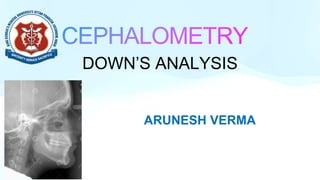
DOWN’S ANALYSIS
CONTENTS
• INTRODUCTION
• CEPHALOMETRIC LANDMARKS
• REFERENCE PLANE
• DOWN’S ANALYSIS
• Skeletal analysis
• Dental analysis
INTRODUCTION
• Origin : “cephalo” means head and “metric” is measurement.
• The science of study and analysis of cephalogram is called
cephalometry.
• In 1931 Herbert Hofrath in Germany and Broadbent in the United
States simultaneously but separately published articles in which they
had refined the technique of cephalogram.
Uses of cephalometry
• For aid in treatment planning for orthodontics .
• For differentiating skeletal from dental malocclusion.
• For assessment of treatment related changes.
• For planning of orthognathic surgery.
• For assessing growth status of child.
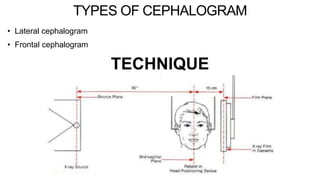
TYPES OF CEPHALOGRAM
• Lateral cephalogram
• Frontal cephalogram
TECHNIQUE
CEPHALOMETRIC LANDMARKS
• Anatomical landmarks
• Derived landmarks
• Unilateral landmarks
• Nasion
• Sella
• Basion
• Articulare
• Anterior nasal spine
• Posterior nasal spine
• Subspinale
• Supramentale (point B)
• Pogonion
• Gnathion
• Menton
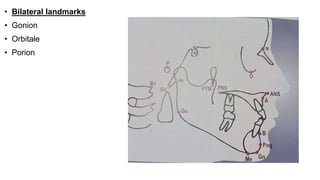
• Bilateral landmarks
• Gonion
• Orbitale
• Porion
DOWN’S ANALYSIS
• William B Down introduced a method
of recording the skeletal and dental
pattern to measure facial form on a
cephalogram in 1948.
• According to Down “balance of face
is determined by position of
mandible”.
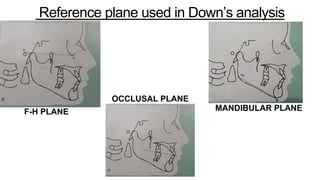
Reference plane used in Down’s analysis
F-H PLANE
OCCLUSAL PLANE
MANDIBULAR PLANE
Skeletal parameters
1.Facial Angle
• Mean value 87.8°
• Range 82° to 95°
• This angle gives us an indication of the
anteroposterior positioning of mandible in
relation to Upper face.
• In class 3 Case : angle will increases.
• In class 2case :angle will decreases.
2. Angle of convexity
• Mean value 0°
• Range -8.5° to 10°
• Measure the placement of maxillary
basal arch relative to total facial profile
• Positive angle-convex profile (class2)
• Negative angle - concave profile (
class3)
3. A-B plane angle
• Formed by line joining Point A to Point B and
line joining N to Pg.
• It indicates the maxillomandibular relationship in
relation to facial plane.
• Mean value -4.6°
• Range 0° to -9°
• Large negative angle - clsss 2
• Positive angle- class 3
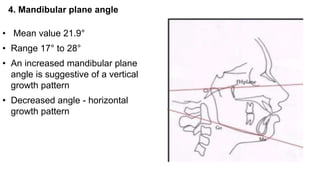
4. Mandibular plane angle
• Mean value 21.9°
• Range 17° to 28°
• An increased mandibular plane
angle is suggestive of a vertical
growth pattern
• Decreased angle - horizontal
growth pattern
5. Y axis( Growth Axis)
• Formed by the line joining Sella to Gnathion
and F-H plane.
• Mean value 59.4°
• Range 53° to 66°
• If angle increases = indicates greater vertical
growth of mandible
• If angle degrees = it indicates greater
horizontal growth of mandible
Dental parameters
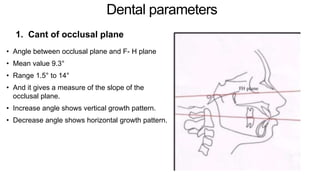
1. Cant of occlusal plane
• Angle between occlusal plane and F- H plane
• Mean value 9.3°
• Range 1.5° to 14°
• And it gives a measure of the slope of the
occlusal plane.
• Increase angle shows vertical growth pattern.
• Decrease angle shows horizontal growth pattern.
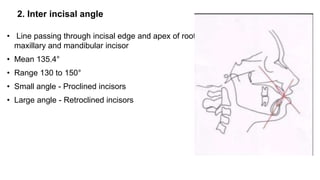
2. Inter incisal angle
• Line passing through incisal edge and apex of root of
maxillary and mandibular incisor
• Mean 135.4°
• Range 130 to 150°
• Small angle - Proclined incisors
• Large angle - Retroclined incisors
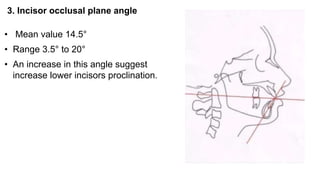
3. Incisor occlusal plane angle
• Mean value 14.5°
• Range 3.5° to 20°
• An increase in this angle suggest
increase lower incisors proclination.
4. Incisor mandibular plane angle
• Mean value 1.4°
• Range -8.5° to 7°
• An increase in this angle indicates
lower incisors proclination.
5. Upper Incisor to A Pog line
• Linear measurement between the incisal
edge of maxillary central incisor and line
joining point A and pogonion
• Mean value: 2.7 mm
• Range: -1.0 to +5 mm
• The upper incisor proclined, the
measurement will be more.
• Contemporary Orthodontics by William R. Proffit
• Orthodontics-Principles And Practice by Thomas
M. Graber
• Textbook of Orthodontics:Gurkeerat Singh
References
DOWNS ANALYSISS AK VERMA.pptx

DOWNS ANALYSISS AK VERMA.pptx

  • 1.
  • 2.
    CONTENTS • INTRODUCTION • CEPHALOMETRICLANDMARKS • REFERENCE PLANE • DOWN’S ANALYSIS • Skeletal analysis • Dental analysis
  • 3.
    INTRODUCTION • Origin :“cephalo” means head and “metric” is measurement. • The science of study and analysis of cephalogram is called cephalometry. • In 1931 Herbert Hofrath in Germany and Broadbent in the United States simultaneously but separately published articles in which they had refined the technique of cephalogram.
  • 4.
    Uses of cephalometry •For aid in treatment planning for orthodontics . • For differentiating skeletal from dental malocclusion. • For assessment of treatment related changes. • For planning of orthognathic surgery. • For assessing growth status of child.
  • 5.
    TYPES OF CEPHALOGRAM •Lateral cephalogram • Frontal cephalogram TECHNIQUE
  • 6.
    CEPHALOMETRIC LANDMARKS • Anatomicallandmarks • Derived landmarks • Unilateral landmarks • Nasion • Sella • Basion • Articulare • Anterior nasal spine • Posterior nasal spine • Subspinale • Supramentale (point B) • Pogonion • Gnathion • Menton
  • 7.
    • Bilateral landmarks •Gonion • Orbitale • Porion
  • 8.
    DOWN’S ANALYSIS • WilliamB Down introduced a method of recording the skeletal and dental pattern to measure facial form on a cephalogram in 1948. • According to Down “balance of face is determined by position of mandible”.
  • 9.
    Reference plane usedin Down’s analysis F-H PLANE OCCLUSAL PLANE MANDIBULAR PLANE
  • 10.
    Skeletal parameters 1.Facial Angle •Mean value 87.8° • Range 82° to 95° • This angle gives us an indication of the anteroposterior positioning of mandible in relation to Upper face. • In class 3 Case : angle will increases. • In class 2case :angle will decreases.
  • 11.
    2. Angle ofconvexity • Mean value 0° • Range -8.5° to 10° • Measure the placement of maxillary basal arch relative to total facial profile • Positive angle-convex profile (class2) • Negative angle - concave profile ( class3)
  • 12.
    3. A-B planeangle • Formed by line joining Point A to Point B and line joining N to Pg. • It indicates the maxillomandibular relationship in relation to facial plane. • Mean value -4.6° • Range 0° to -9° • Large negative angle - clsss 2 • Positive angle- class 3
  • 13.
    4. Mandibular planeangle • Mean value 21.9° • Range 17° to 28° • An increased mandibular plane angle is suggestive of a vertical growth pattern • Decreased angle - horizontal growth pattern
  • 14.
    5. Y axis(Growth Axis) • Formed by the line joining Sella to Gnathion and F-H plane. • Mean value 59.4° • Range 53° to 66° • If angle increases = indicates greater vertical growth of mandible • If angle degrees = it indicates greater horizontal growth of mandible
  • 15.
    Dental parameters 1. Cantof occlusal plane • Angle between occlusal plane and F- H plane • Mean value 9.3° • Range 1.5° to 14° • And it gives a measure of the slope of the occlusal plane. • Increase angle shows vertical growth pattern. • Decrease angle shows horizontal growth pattern.
  • 16.
    2. Inter incisalangle • Line passing through incisal edge and apex of root of maxillary and mandibular incisor • Mean 135.4° • Range 130 to 150° • Small angle - Proclined incisors • Large angle - Retroclined incisors
  • 17.
    3. Incisor occlusalplane angle • Mean value 14.5° • Range 3.5° to 20° • An increase in this angle suggest increase lower incisors proclination.
  • 18.
    4. Incisor mandibularplane angle • Mean value 1.4° • Range -8.5° to 7° • An increase in this angle indicates lower incisors proclination.
  • 19.
    5. Upper Incisorto A Pog line • Linear measurement between the incisal edge of maxillary central incisor and line joining point A and pogonion • Mean value: 2.7 mm • Range: -1.0 to +5 mm • The upper incisor proclined, the measurement will be more.
  • 20.
    • Contemporary Orthodonticsby William R. Proffit • Orthodontics-Principles And Practice by Thomas M. Graber • Textbook of Orthodontics:Gurkeerat Singh References