Y2 1-
   IS OM WN
TR      DO E
       DROM
  SYN
                     z
              u b zz
         Dr. R
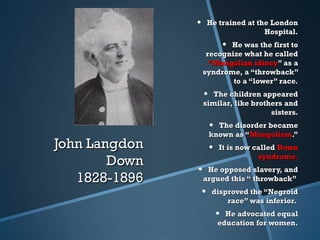
•       He trained at the London
                                       Hospital.
                               •
                          He was the first to
                    recognize what he called
                     “Mongolian idiocy” as a
                   syndrome, a “throwback”
                           to a “lower” race.
                   •  The children appeared
                   similar, like brothers and
                                      sisters.
                       • The disorder became
                       known as “Mongolism.”
John Langdon           •   It is now called Down

        Down                          syndrome.
               •    He opposed slavery, and
   1828-1896       argued this “ throwback”
                   •    disproved the “Negroid
                            race” was inferior.
                           • He advocated equal
                           education for women.
en ce
     Inc id              -1000
                   in 800 irths.
                one ive b
      xim ately      l
A ppro
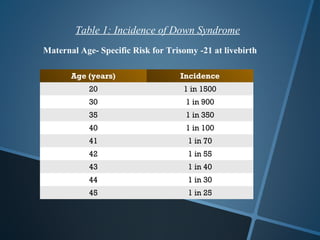
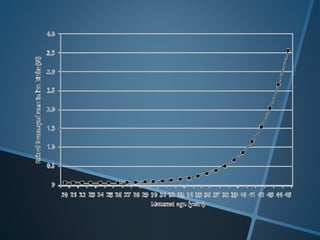
Table 1: Incidence of Down Syndrome
Maternal Age- Specific Risk for Trisomy -21 at livebirth

       Age (years)                 Incidence
            20                      1 in 1500
            30                       1 in 900
            35                       1 in 350
            40                       1 in 100
            41                       1 in 70
            42                       1 in 55
            43                       1 in 40
            44                       1 in 30
            45                       1 in 25
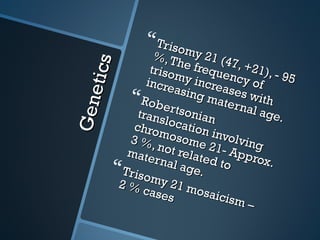
 Trisom
                   %, T my 21 (4
                        h
                  triso e freque 7, +21), -

      t ic s
                        my i
                 incre       ncre ncy of         95
G en e                  asing ases w
              Robe            mate
                                      r n al
                                             ith
               trans   rtson                 age.
                             ia n
              chro location
                    moso         invol
             3 %,                      v
             mate   not r me 21- A ing
                          e
                   r nal lated to pprox.
           Trisom age.
           2%        y 21
                case mosai
                      s            cism
                                          –
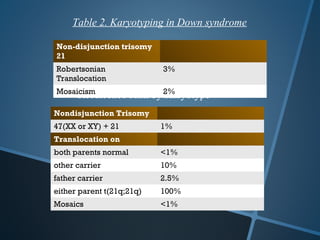
Table 2. Karyotyping in Down syndrome

Non-disjunction trisomy
21
Robertsonian               3%
Translocation
Mosaicism
      Recurrence Risk by 2%
                         Karyotype
Nondisjunction Trisomy
47(XX or XY) + 21          1%
Translocation on
both parents normal        <1%
other carrier              10%
father carrier             2.5%
either parent t(21q;21q)   100%
Mosaics                    <1%
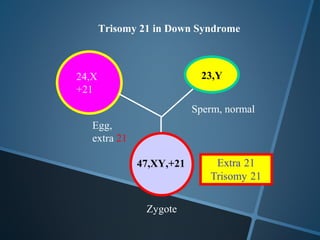
Trisomy 21 in Down Syndrome


24,X                       23,Y
+21
                          Sperm, normal
   Egg,
   extra 21

              47,XY,+21


                Zygote
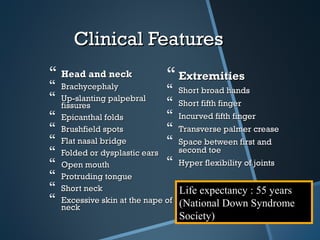
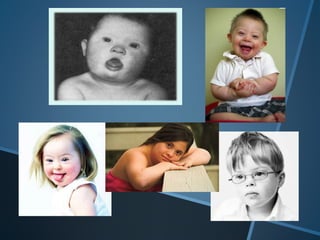
Clinical Features
 Head and neck                 Extremities
   Brachycephaly
                                   Short broad hands
   Up-slanting palpebral
    fissures                       Short fifth finger
   Epicanthal folds               Incurved fifth finger
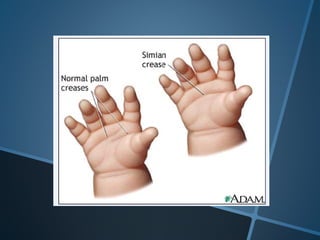
   Brushfield spots               Transverse palmer crease
   Flat nasal bridge              Space between first and
   Folded or dysplastic ears       second toe
   Open mouth                     Hyper flexibility of joints
   Protruding tongue
   Short neck                      Life expectancy : 55 years
   Excessive skin at the nape of
    neck                            (National Down Syndrome
                                    Society)
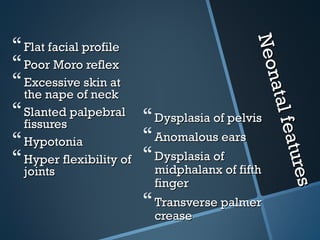
Neon
 Flat facial profile


                                            Neon
 Poor Moro reflex
 Excessive skin at


                                                at al f
                                                 at al f
  the nape of neck
 Slanted palpebral  Dysplasia of pelvis
  fissures


                                                        eatu
                                                         eatur
 Hypotonia             Anomalous ears
 Hyper flexibility of  Dysplasia of of fifth


                                                             res
  joints                 midphalanx


                                                               es
                         finger
                        Transverse palmer
                         crease
Medical
Problem
Newborn

• cardiac defects (50% ): AVSD [most
common], VSD, ASD, TOF or PDA
• gastrointestinal (12%): duodenal atresia
[commonest], tracheo-oesophageal
fistula, anorectal malformation, pyloric
stenosis and Hirshsprung disease.
• vision: congenital cataracts (3%),
glaucoma.
• hypotonia & joint laxity
• feeding problems. Usually
Resolve in few weeks.
• congenital hypothyroidism (1%)
• congenital dislocation of the hips
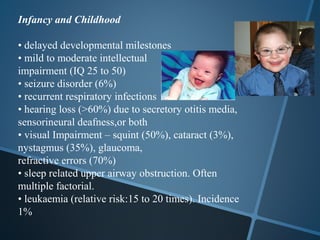
Infancy and Childhood

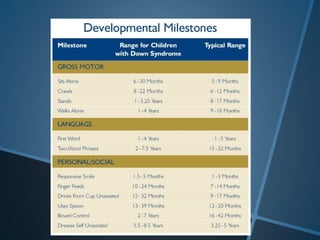
• delayed developmental milestones
• mild to moderate intellectual
impairment (IQ 25 to 50)
• seizure disorder (6%)
• recurrent respiratory infections
• hearing loss (>60%) due to secretory otitis media,
sensorineural deafness,or both
• visual Impairment – squint (50%), cataract (3%),
nystagmus (35%), glaucoma,
refractive errors (70%)
• sleep related upper airway obstruction. Often
multiple factorial.
• leukaemia (relative risk:15 to 20 times). Incidence
1%
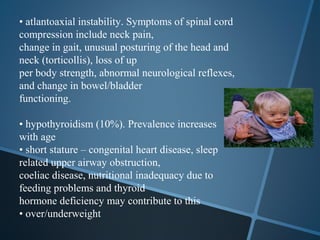
• atlantoaxial instability. Symptoms of spinal cord
compression include neck pain,
change in gait, unusual posturing of the head and
neck (torticollis), loss of up
per body strength, abnormal neurological reflexes,
and change in bowel/bladder
functioning.

• hypothyroidism (10%). Prevalence increases
with age
• short stature – congenital heart disease, sleep
related upper airway obstruction,
coeliac disease, nutritional inadequacy due to
feeding problems and thyroid
hormone deficiency may contribute to this
• over/underweight
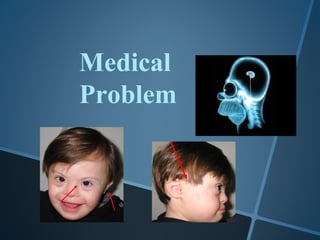
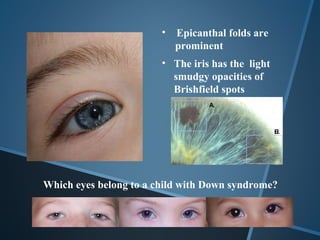
•   Epicanthal folds are
                            prominent
                        • The iris has the light
                          smudgy opacities of
                          Brishfield spots


Which eyes belong to a child with Down syndrome?
Adolescence and Adulthood

• puberty - in Girls menarche is only
slightly delayed. Fertility presumed
- in Boys are usually infertile due to low
testosterone levels

• increased risk of dementia /Alzheimer
disease in adult life

• shorter life expectancy
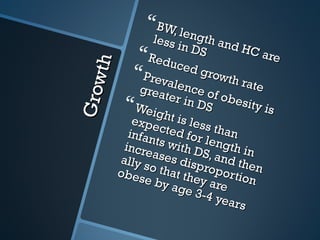
 BW, le
                  less ngth an
                       in DS       d HC
                Redu                     are


     th
                       ced
               Preva growth ra
G row          grea lence of
                     ter in      obes
                                        te
            Weig            DS        ity is
              expe ht is less
             infan cted for than
                   ts wi      leng
            incre        th D S    th in
           ally s ases disp , and the
          obes o that th roportio n
                e by        ey ar      n
                      age        e
                            3-4 y
                                  ears
Diagnosis

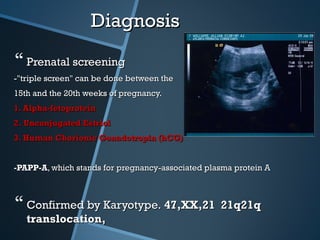
 Prenatal screening
-"triple screen" can be done between the
15th and the 20th weeks of pregnancy.
1. Alpha-fetoprotein
2. Unconjugated Estriol
3. Human Chorionic Gonadotropin (hCG)


-PAPP-A, which stands for pregnancy-associated plasma protein A


 Confirmed by Karyotype. 47,XX,21 21q21q
   translocation,
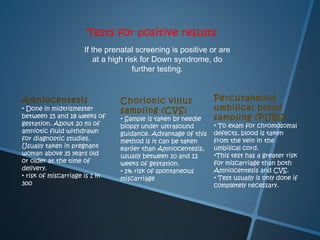
Tests for positive results
                     If the prenatal screening is positive or are
                         at a high risk for Down syndrome, do
                                      further testing.


Amniocentesis                   Chorionic villus              Percutaneous
• Done in midtrismester         sampling (CVS)                umbilical blood
between 15 and 18 weeks of      • Sample is taken by needle   sampling (PUBS)
gestation. About 20 ml of       biopsy under ultrasound       • To exam for chromosomal
amniotic fluid withdrawn        guidance. Advantage of this   defects, blood is taken
for diagnostic studies.         method is it can be taken     from the vein in the
Usually taken in pregnant       earlier than Amniocentesis,   umbilical cord.
woman above 35 years old        usually between 10 and 12     •This test has a greater risk
or older at the time of         weeks of gestation.           for miscarriage than both
delivery.                       • 1% risk of spontaneous      Amniocentesis and CVS.
• risk of miscarriage is 1 in                                 • Test usually is only done if
                                miscarriage
300                                                           completely necessary.
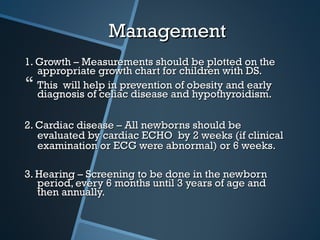
Management
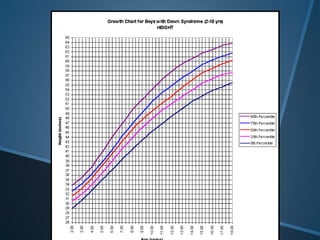
1. Growth – Measurements should be plotted on the
   appropriate growth chart for children with DS.
 This will help in preventionandobesity and early
   diagnosis of celiac disease
                               of
                                  hypothyroidism.

2. Cardiac disease – All newborns should be
   evaluated by cardiac ECHO by 2 weeks (if clinical
   examination or ECG were abnormal) or 6 weeks.

3. Hearing – Screening to be done in the newborn
   period, every 6 months until 3 years of age and
   then annually.
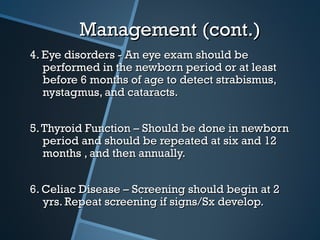
Management (cont.)
4. Eye disorders - An eye exam should be
   performed in the newborn period or at least
   before 6 months of age to detect strabismus,
   nystagmus, and cataracts.


5. Thyroid Function – Should be done in newborn
   period and should be repeated at six and 12
   months , and then annually.


6. Celiac Disease – Screening should begin at 2
   yrs. Repeat screening if signs/Sx develop.
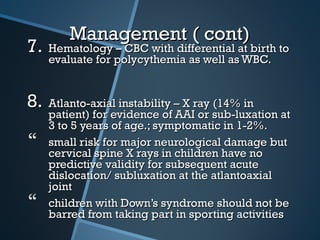
Management ( cont)
7. Hematology – CBC with differential at birth to
    evaluate for polycythemia as well as WBC.


8. Atlanto-axial instability – X ray (14% in
    patient) for evidence of AAI or sub-luxation at
    3 to 5 years of age.; symptomatic in 1-2%.
   small risk for major neurological damage but
    cervical spine X rays in children have no
    predictive validity for subsequent acute
    dislocation/ subluxation at the atlantoaxial
    joint
   children with Down’s syndrome should not be
    barred from taking part in sporting activities
Appropriate care of the neck
while under general anasthesia
or after road traffic accident is
advisable
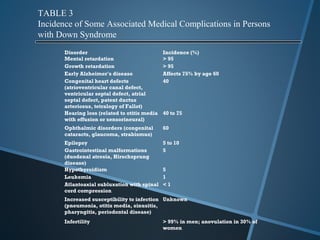
TABLE 3
Incidence of Some Associated Medical Complications in Persons
with Down Syndrome
      Disorder                                Incidence (%)
      Mental retardation                      > 95
      Growth retardation                      > 95
      Early Alzheimer's disease               Affects 75% by age 60
      Congenital heart defects                40
      (atrioventricular canal defect,
      ventricular septal defect, atrial
      septal defect, patent ductus
      arteriosus, tetralogy of Fallot)
      Hearing loss (related to otitis media   40 to 75
      with effusion or sensorineural)
      Ophthalmic disorders (congenital        60
      cataracts, glaucoma, strabismus)
      Epilepsy                                5 to 10
      Gastrointestinal malformations          5
      (duodenal atresia, Hirschsprung
      disease)
      Hypothyroidism                          5
      Leukemia                                1
      Atlantoaxial subluxation with spinal    <1
      cord compression
      Increased susceptibility to infection Unknown
      (pneumonia, otitis media, sinusitis,
      pharyngitis, periodontal disease)
      Infertility                             > 99% in men; anovulation in 30% of
                                              women
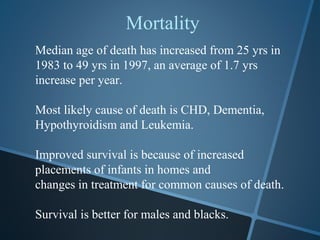
Mortality
Median age of death has increased from 25 yrs in
1983 to 49 yrs in 1997, an average of 1.7 yrs
increase per year.

Most likely cause of death is CHD, Dementia,
Hypothyroidism and Leukemia.

Improved survival is because of increased
placements of infants in homes and
changes in treatment for common causes of death.

Survival is better for males and blacks.
 May b
                           diag egin w
                               nosis     hen
                         Discu      is ma a pre


           ng
                                           de e. na    tal
                       varia ss the w
                       and bility in ide ran
    n se li                prog         m       g
                                    nosis anifest e of
                      M ed               .       ation
                     treat i ca l a
                    inter men nd edu
                          vent ts and cational
Co u

                   discu
                          ssedions shou
                 Initia         .         ld be
                 inter l referra
                 publ vention ls for ea
                grou ications , informa rly
                grou ps, and , parent tive
                      ps.        advo
                                       cacy
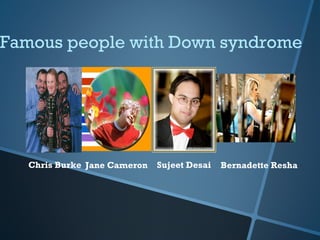
Famous people with Down syndrome


   Chris Burke Jane Cameron   Sujeet Desai   Bernadette Resha
1. P
                                 ediat
                                           r ic P
                                                 rotoc
                                           Hosp         ol fo
                                                   ital 2 nd r Malay


           es
                      2. P                                   Editi    si a n
                             a e d ia                              on
                                      t r ic a
      re nc
                          Editi                taG
                                 on                   lance n
                                                              2d
                  3. N
                          elson
                       Fifth Essentia
Re f e

                              Editi               l of P
                                      on.               ediat
                4. h                                           rics
                      ttp://
                             www
                   /topi
                         cs/do .nichd.ni
                                 wn_s               h.gov
                                           yndr            /
                                                  ome. health
                                                        cfm
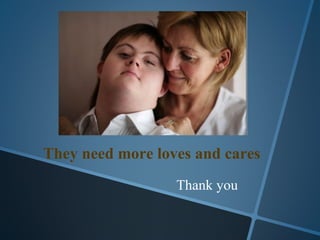
They need more loves and cares
                  Thank you

Down syndrome by Dr. Rubzzz

  • 1.
    Y2 1- IS OM WN TR DO E DROM SYN z u b zz Dr. R
  • 2.
    He trained at the London Hospital. • He was the first to recognize what he called “Mongolian idiocy” as a syndrome, a “throwback” to a “lower” race. • The children appeared similar, like brothers and sisters. • The disorder became known as “Mongolism.” John Langdon • It is now called Down Down syndrome. • He opposed slavery, and 1828-1896 argued this “ throwback” • disproved the “Negroid race” was inferior. • He advocated equal education for women.
  • 3.
    en ce Inc id -1000 in 800 irths. one ive b xim ately l A ppro
  • 4.
    Table 1: Incidenceof Down Syndrome Maternal Age- Specific Risk for Trisomy -21 at livebirth Age (years) Incidence 20 1 in 1500 30 1 in 900 35 1 in 350 40 1 in 100 41 1 in 70 42 1 in 55 43 1 in 40 44 1 in 30 45 1 in 25
  • 5.
     Trisom %, T my 21 (4 h triso e freque 7, +21), - t ic s my i incre ncre ncy of 95 G en e asing ases w  Robe mate r n al ith trans rtson age. ia n chro location moso invol 3 %, v mate not r me 21- A ing e r nal lated to pprox.  Trisom age. 2% y 21 case mosai s cism –
  • 6.
    Table 2. Karyotypingin Down syndrome Non-disjunction trisomy 21 Robertsonian 3% Translocation Mosaicism Recurrence Risk by 2% Karyotype Nondisjunction Trisomy 47(XX or XY) + 21 1% Translocation on both parents normal <1% other carrier 10% father carrier 2.5% either parent t(21q;21q) 100% Mosaics <1%
  • 9.
    Trisomy 21 inDown Syndrome 24,X 23,Y +21 Sperm, normal Egg, extra 21 47,XY,+21 Zygote
  • 12.
    Clinical Features  Headand neck  Extremities  Brachycephaly  Short broad hands  Up-slanting palpebral fissures  Short fifth finger  Epicanthal folds  Incurved fifth finger  Brushfield spots  Transverse palmer crease  Flat nasal bridge  Space between first and  Folded or dysplastic ears second toe  Open mouth  Hyper flexibility of joints  Protruding tongue  Short neck Life expectancy : 55 years  Excessive skin at the nape of neck (National Down Syndrome Society)
  • 15.
    Neon  Flat facialprofile Neon  Poor Moro reflex  Excessive skin at at al f at al f the nape of neck  Slanted palpebral  Dysplasia of pelvis fissures eatu eatur  Hypotonia  Anomalous ears  Hyper flexibility of  Dysplasia of of fifth res joints midphalanx es finger  Transverse palmer crease
  • 16.
  • 17.
    Newborn • cardiac defects(50% ): AVSD [most common], VSD, ASD, TOF or PDA • gastrointestinal (12%): duodenal atresia [commonest], tracheo-oesophageal fistula, anorectal malformation, pyloric stenosis and Hirshsprung disease. • vision: congenital cataracts (3%), glaucoma. • hypotonia & joint laxity • feeding problems. Usually Resolve in few weeks. • congenital hypothyroidism (1%) • congenital dislocation of the hips
  • 18.
    Infancy and Childhood •delayed developmental milestones • mild to moderate intellectual impairment (IQ 25 to 50) • seizure disorder (6%) • recurrent respiratory infections • hearing loss (>60%) due to secretory otitis media, sensorineural deafness,or both • visual Impairment – squint (50%), cataract (3%), nystagmus (35%), glaucoma, refractive errors (70%) • sleep related upper airway obstruction. Often multiple factorial. • leukaemia (relative risk:15 to 20 times). Incidence 1%
  • 19.
    • atlantoaxial instability.Symptoms of spinal cord compression include neck pain, change in gait, unusual posturing of the head and neck (torticollis), loss of up per body strength, abnormal neurological reflexes, and change in bowel/bladder functioning. • hypothyroidism (10%). Prevalence increases with age • short stature – congenital heart disease, sleep related upper airway obstruction, coeliac disease, nutritional inadequacy due to feeding problems and thyroid hormone deficiency may contribute to this • over/underweight
  • 20.
    Epicanthal folds are prominent • The iris has the light smudgy opacities of Brishfield spots Which eyes belong to a child with Down syndrome?
  • 21.
    Adolescence and Adulthood •puberty - in Girls menarche is only slightly delayed. Fertility presumed - in Boys are usually infertile due to low testosterone levels • increased risk of dementia /Alzheimer disease in adult life • shorter life expectancy
  • 22.
     BW, le less ngth an in DS d HC  Redu are th ced  Preva growth ra G row grea lence of ter in obes te  Weig DS ity is expe ht is less infan cted for than ts wi leng incre th D S th in ally s ases disp , and the obes o that th roportio n e by ey ar n age e 3-4 y ears
  • 25.
    Diagnosis  Prenatal screening -"triplescreen" can be done between the 15th and the 20th weeks of pregnancy. 1. Alpha-fetoprotein 2. Unconjugated Estriol 3. Human Chorionic Gonadotropin (hCG) -PAPP-A, which stands for pregnancy-associated plasma protein A  Confirmed by Karyotype. 47,XX,21 21q21q translocation,
  • 26.
    Tests for positiveresults If the prenatal screening is positive or are at a high risk for Down syndrome, do further testing. Amniocentesis Chorionic villus Percutaneous • Done in midtrismester sampling (CVS) umbilical blood between 15 and 18 weeks of • Sample is taken by needle sampling (PUBS) gestation. About 20 ml of biopsy under ultrasound • To exam for chromosomal amniotic fluid withdrawn guidance. Advantage of this defects, blood is taken for diagnostic studies. method is it can be taken from the vein in the Usually taken in pregnant earlier than Amniocentesis, umbilical cord. woman above 35 years old usually between 10 and 12 •This test has a greater risk or older at the time of weeks of gestation. for miscarriage than both delivery. • 1% risk of spontaneous Amniocentesis and CVS. • risk of miscarriage is 1 in • Test usually is only done if miscarriage 300 completely necessary.
  • 27.
    Management 1. Growth –Measurements should be plotted on the appropriate growth chart for children with DS.  This will help in preventionandobesity and early diagnosis of celiac disease of hypothyroidism. 2. Cardiac disease – All newborns should be evaluated by cardiac ECHO by 2 weeks (if clinical examination or ECG were abnormal) or 6 weeks. 3. Hearing – Screening to be done in the newborn period, every 6 months until 3 years of age and then annually.
  • 28.
    Management (cont.) 4. Eyedisorders - An eye exam should be performed in the newborn period or at least before 6 months of age to detect strabismus, nystagmus, and cataracts. 5. Thyroid Function – Should be done in newborn period and should be repeated at six and 12 months , and then annually. 6. Celiac Disease – Screening should begin at 2 yrs. Repeat screening if signs/Sx develop.
  • 29.
    Management ( cont) 7.Hematology – CBC with differential at birth to evaluate for polycythemia as well as WBC. 8. Atlanto-axial instability – X ray (14% in patient) for evidence of AAI or sub-luxation at 3 to 5 years of age.; symptomatic in 1-2%.  small risk for major neurological damage but cervical spine X rays in children have no predictive validity for subsequent acute dislocation/ subluxation at the atlantoaxial joint  children with Down’s syndrome should not be barred from taking part in sporting activities
  • 30.
    Appropriate care ofthe neck while under general anasthesia or after road traffic accident is advisable
  • 31.
    TABLE 3 Incidence ofSome Associated Medical Complications in Persons with Down Syndrome Disorder Incidence (%) Mental retardation > 95 Growth retardation > 95 Early Alzheimer's disease Affects 75% by age 60 Congenital heart defects 40 (atrioventricular canal defect, ventricular septal defect, atrial septal defect, patent ductus arteriosus, tetralogy of Fallot) Hearing loss (related to otitis media 40 to 75 with effusion or sensorineural) Ophthalmic disorders (congenital 60 cataracts, glaucoma, strabismus) Epilepsy 5 to 10 Gastrointestinal malformations 5 (duodenal atresia, Hirschsprung disease) Hypothyroidism 5 Leukemia 1 Atlantoaxial subluxation with spinal <1 cord compression Increased susceptibility to infection Unknown (pneumonia, otitis media, sinusitis, pharyngitis, periodontal disease) Infertility > 99% in men; anovulation in 30% of women
  • 32.
    Mortality Median age ofdeath has increased from 25 yrs in 1983 to 49 yrs in 1997, an average of 1.7 yrs increase per year. Most likely cause of death is CHD, Dementia, Hypothyroidism and Leukemia. Improved survival is because of increased placements of infants in homes and changes in treatment for common causes of death. Survival is better for males and blacks.
  • 33.
     May b diag egin w nosis hen  Discu is ma a pre ng de e. na tal varia ss the w and bility in ide ran n se li  prog m g nosis anifest e of M ed . ation treat i ca l a inter men nd edu vent ts and cational Co u discu ssedions shou  Initia . ld be inter l referra publ vention ls for ea grou ications , informa rly grou ps, and , parent tive ps. advo cacy
  • 34.
    Famous people withDown syndrome Chris Burke Jane Cameron Sujeet Desai Bernadette Resha
  • 35.
    1. P ediat r ic P rotoc Hosp ol fo ital 2 nd r Malay es 2. P Editi si a n a e d ia on t r ic a re nc Editi taG on lance n 2d 3. N elson Fifth Essentia Re f e Editi l of P on. ediat 4. h rics ttp:// www /topi cs/do .nichd.ni wn_s h.gov yndr / ome. health cfm
  • 36.
    They need moreloves and cares Thank you