BY
AAKTITI DHAKAL
BPT IVYEAR
Down syndrome is a condition in which a person
has an extra chromosome. Chromosomes are
small “packages” of genes in the body. They
determine how a baby’s body forms during
pregnancy and how the baby’s body functions as
it grows in the womb and after birth. Typically, a
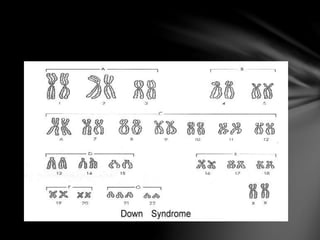
baby is born with 46 chromosomes. Babies with
Down syndrome have an extra copy of one of
these chromosomes, chromosome 21
Introduction
• Named after a physician, “John Langdon Down” in 18th
century.
• Described as Mongoloid child of European parentage-
”Mongolism”
• In 1959 a French doctor, named “Jerome Lejeune”,
discovered it was caused by the inheritance of an extra
chromosome 21.
• Also known as “trisomy 21”
Histology
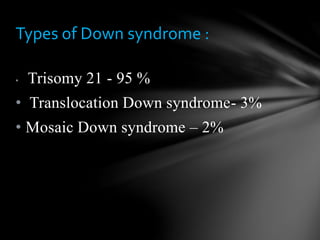
• Trisomy 21 - 95 %
• Translocation Down syndrome- 3%
• Mosaic Down syndrome – 2%
Types of Down syndrome :
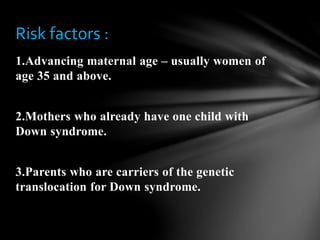
1.Advancing maternal age – usually women of
age 35 and above.
2.Mothers who already have one child with
Down syndrome.
3.Parents who are carriers of the genetic
translocation for Down syndrome.
Risk factors :
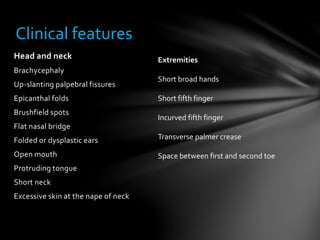
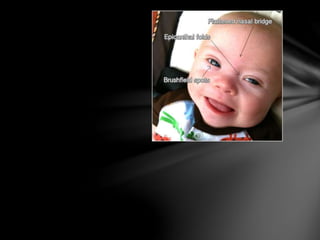
Head and neck
Brachycephaly
Up-slanting palpebral fissures
Epicanthal folds
Brushfield spots
Flat nasal bridge
Folded or dysplastic ears
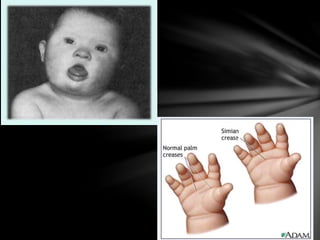
Open mouth
Protruding tongue
Short neck
Excessive skin at the nape of neck
Clinical features
Extremities
Short broad hands
Short fifth finger
Incurved fifth finger
Transverse palmer crease
Space between first and second toe
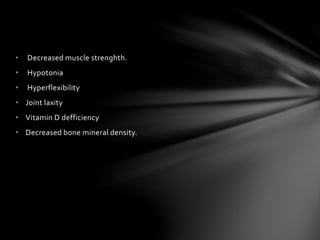
• Decreased muscle strenghth.
• Hypotonia
• Hyperflexibility
• Joint laxity
• Vitamin D defficiency
• Decreased bone mineral density.
• Cardiovascular problems
ventricular spetal defect, atrial septal defect, patent ductus arteriosus
• Endocrine problems
• thyroid problems, diabetes mellitus
• Gastrointestinal problems
• duodenal, esophageal and anal atresia,Hirschprung’s disease
• Haematological problems
• Acute leukemia, transient myeproliferative disease
• Neurological problems
• Epilepsy, severe behavioral problems, Alzheimer’s, memory problems
Other Health-related problems
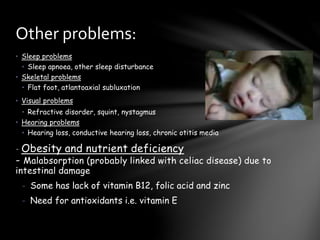
• Sleep problems
• Sleep apnoea, other sleep disturbance
• Skeletal problems
• Flat foot, atlantoaxial subluxation
• Visual problems
• Refractive disorder, squint, nystagmus
• Hearing problems
• Hearing loss, conductive hearing loss, chronic otitis media
- Obesity and nutrient deficiency
- Malabsorption (probably linked with celiac disease) due to
intestinal damage
- Some has lack of vitamin B12, folic acid and zinc
- Need for antioxidants i.e. vitamin E
Other problems:
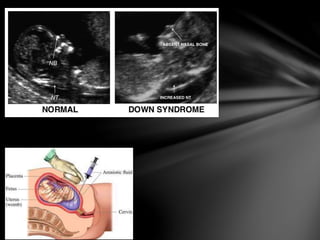
1 Prenatal screening
. Ultra sound
.Blood test
.Biochemical test
. Maternal serum screening
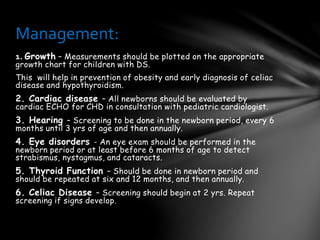
2.Diagnostic test
.Amniocentesis
.Villus Sampling
Diagnosis:
1. Growth – Measurements should be plotted on the appropriate
growth chart for children with DS.
This will help in prevention of obesity and early diagnosis of celiac
disease and hypothyroidism.
2. Cardiac disease – All newborns should be evaluated by
cardiac ECHO for CHD in consultation with pediatric cardiologist.
3. Hearing – Screening to be done in the newborn period, every 6
months until 3 yrs of age and then annually.
4. Eye disorders - An eye exam should be performed in the
newborn period or at least before 6 months of age to detect
strabismus, nystagmus, and cataracts.
5. Thyroid Function – Should be done in newborn period and
should be repeated at six and 12 months, and then annually.
6. Celiac Disease – Screening should begin at 2 yrs. Repeat
screening if signs develop.
Management:
7. Hematology – CBC with DLC at birth to evaluate for
polycythemia as well as leukemia.
8. Atlanto-axial instability – X ray for evidence of AAI or
sub-luxation at 3 to 5 years of age.
9. Alzheimer’s disease – Adult with a Down Syndrome has
earlier onset of symptoms. When diagnosis is considered,
thyroid disease and possible depression should be excluded.
10. Physiotherapy
-Minimize the development of the compensatory movement patterns that
children with Down syndrome are prone to develop.
- Promote achievement of gross motor skills such as sitting,crawling and
standing.
- Improve independence in functional activities.
- Improve muscle strength,posture and balance.
- Improve confidence and socialization with peers through improved motor
skills.
- Reduce the risk of secondary joint problems in later life as a result of lax
ligaments.
Goals of PT.
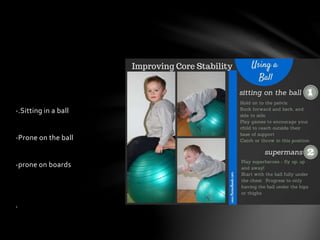
-.Sitting in a ball
-Prone on the ball
-prone on boards
.
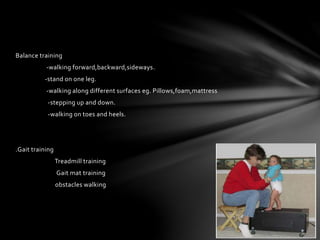
Balance training
-walking forward,backward,sideways.
-stand on one leg.
-walking along different surfaces eg. Pillows,foam,mattress
-stepping up and down.
-walking on toes and heels.
.Gait training
Treadmill training
Gait mat training
obstacles walking
.strengthening og muscles.
.Maintaining good posture.
.postural correction exercises.
.play therapy
.Assistive and adaptive devices.
.skill development
Downs syndrome

Downs syndrome

  • 1.
  • 2.
    Down syndrome isa condition in which a person has an extra chromosome. Chromosomes are small “packages” of genes in the body. They determine how a baby’s body forms during pregnancy and how the baby’s body functions as it grows in the womb and after birth. Typically, a baby is born with 46 chromosomes. Babies with Down syndrome have an extra copy of one of these chromosomes, chromosome 21 Introduction
  • 3.
    • Named aftera physician, “John Langdon Down” in 18th century. • Described as Mongoloid child of European parentage- ”Mongolism” • In 1959 a French doctor, named “Jerome Lejeune”, discovered it was caused by the inheritance of an extra chromosome 21. • Also known as “trisomy 21” Histology
  • 5.
    • Trisomy 21- 95 % • Translocation Down syndrome- 3% • Mosaic Down syndrome – 2% Types of Down syndrome :
  • 6.
    1.Advancing maternal age– usually women of age 35 and above. 2.Mothers who already have one child with Down syndrome. 3.Parents who are carriers of the genetic translocation for Down syndrome. Risk factors :
  • 7.
    Head and neck Brachycephaly Up-slantingpalpebral fissures Epicanthal folds Brushfield spots Flat nasal bridge Folded or dysplastic ears Open mouth Protruding tongue Short neck Excessive skin at the nape of neck Clinical features Extremities Short broad hands Short fifth finger Incurved fifth finger Transverse palmer crease Space between first and second toe
  • 8.
    • Decreased musclestrenghth. • Hypotonia • Hyperflexibility • Joint laxity • Vitamin D defficiency • Decreased bone mineral density.
  • 11.
    • Cardiovascular problems ventricularspetal defect, atrial septal defect, patent ductus arteriosus • Endocrine problems • thyroid problems, diabetes mellitus • Gastrointestinal problems • duodenal, esophageal and anal atresia,Hirschprung’s disease • Haematological problems • Acute leukemia, transient myeproliferative disease • Neurological problems • Epilepsy, severe behavioral problems, Alzheimer’s, memory problems Other Health-related problems
  • 12.
    • Sleep problems •Sleep apnoea, other sleep disturbance • Skeletal problems • Flat foot, atlantoaxial subluxation • Visual problems • Refractive disorder, squint, nystagmus • Hearing problems • Hearing loss, conductive hearing loss, chronic otitis media - Obesity and nutrient deficiency - Malabsorption (probably linked with celiac disease) due to intestinal damage - Some has lack of vitamin B12, folic acid and zinc - Need for antioxidants i.e. vitamin E Other problems:
  • 13.
    1 Prenatal screening .Ultra sound .Blood test .Biochemical test . Maternal serum screening 2.Diagnostic test .Amniocentesis .Villus Sampling Diagnosis:
  • 15.
    1. Growth –Measurements should be plotted on the appropriate growth chart for children with DS. This will help in prevention of obesity and early diagnosis of celiac disease and hypothyroidism. 2. Cardiac disease – All newborns should be evaluated by cardiac ECHO for CHD in consultation with pediatric cardiologist. 3. Hearing – Screening to be done in the newborn period, every 6 months until 3 yrs of age and then annually. 4. Eye disorders - An eye exam should be performed in the newborn period or at least before 6 months of age to detect strabismus, nystagmus, and cataracts. 5. Thyroid Function – Should be done in newborn period and should be repeated at six and 12 months, and then annually. 6. Celiac Disease – Screening should begin at 2 yrs. Repeat screening if signs develop. Management:
  • 16.
    7. Hematology –CBC with DLC at birth to evaluate for polycythemia as well as leukemia. 8. Atlanto-axial instability – X ray for evidence of AAI or sub-luxation at 3 to 5 years of age. 9. Alzheimer’s disease – Adult with a Down Syndrome has earlier onset of symptoms. When diagnosis is considered, thyroid disease and possible depression should be excluded. 10. Physiotherapy
  • 17.
    -Minimize the developmentof the compensatory movement patterns that children with Down syndrome are prone to develop. - Promote achievement of gross motor skills such as sitting,crawling and standing. - Improve independence in functional activities. - Improve muscle strength,posture and balance. - Improve confidence and socialization with peers through improved motor skills. - Reduce the risk of secondary joint problems in later life as a result of lax ligaments. Goals of PT.
  • 18.
    -.Sitting in aball -Prone on the ball -prone on boards .
  • 19.
    Balance training -walking forward,backward,sideways. -standon one leg. -walking along different surfaces eg. Pillows,foam,mattress -stepping up and down. -walking on toes and heels. .Gait training Treadmill training Gait mat training obstacles walking
  • 20.
    .strengthening og muscles. .Maintaininggood posture. .postural correction exercises. .play therapy .Assistive and adaptive devices. .skill development