INTRODUCTION
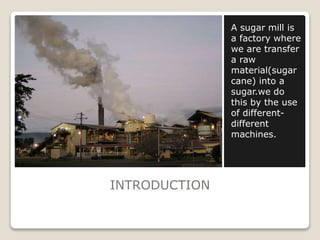
A sugar mill is
a factory where
we are transfer
a raw
material(sugar
cane) into a
sugar.we do
this by the use
of different-
different
machines.
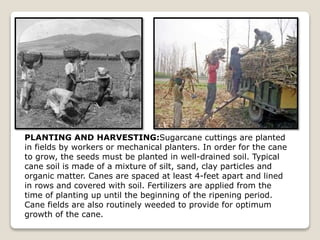
PLANTING AND HARVESTING:Sugarcane cuttings are planted
in fields by workers or mechanical planters. In order for the cane
to grow, the seeds must be planted in well-drained soil. Typical
cane soil is made of a mixture of silt, sand, clay particles and
organic matter. Canes are spaced at least 4-feet apart and lined
in rows and covered with soil. Fertilizers are applied from the
time of planting up until the beginning of the ripening period.
Cane fields are also routinely weeded to provide for optimum
growth of the cane.
PREPARATION AND PROCESSING:
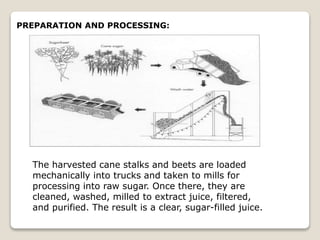
The harvested cane stalks and beets are loaded
mechanically into trucks and taken to mills for
processing into raw sugar. Once there, they are
cleaned, washed, milled to extract juice, filtered,
and purified. The result is a clear, sugar-filled juice.
After the cane arrives at the mill yards, it is mechanically
unloaded, and excessive soil and rocks are removed. The
cane is cleaned by flooding the carrier with warm water
(in the case of sparse rock and trash clutter) or by
spreading the cane on agitating conveyors that pass
through strong jets of water and combing drums (to
remove larger amounts of rocks, trash, and leaves, etc.).
At this point, the cane is clean and ready to be milled.
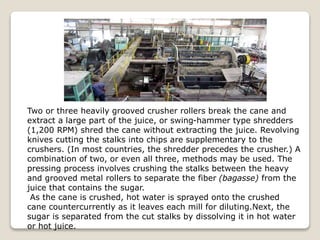
Two or three heavily grooved crusher rollers break the cane and
extract a large part of the juice, or swing-hammer type shredders
(1,200 RPM) shred the cane without extracting the juice. Revolving
knives cutting the stalks into chips are supplementary to the
crushers. (In most countries, the shredder precedes the crusher.) A
combination of two, or even all three, methods may be used. The
pressing process involves crushing the stalks between the heavy
and grooved metal rollers to separate the fiber (bagasse) from the
juice that contains the sugar.
As the cane is crushed, hot water is sprayed onto the crushed
cane countercurrently as it leaves each mill for diluting.Next, the
sugar is separated from the cut stalks by dissolving it in hot water
or hot juice.
PURIFICATION OF JUICE-CLLARIFICATION AND
EVAPORATION:
Carbon dioxide and the milk of a lime are added to the
liquid sugar mixture and it is heated to the boiling point,
as the process of clarifying begins. As the carbon dioxide
travels through the liquid it forms calcium carbonate,
which attracts non-sugar debris (fats, gums, and wax)
from the juice, and pulls them away from the sugar juice.
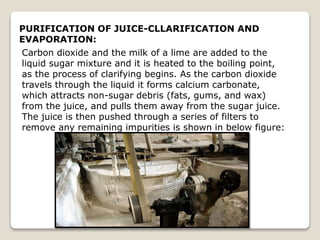
The juice is then pushed through a series of filters to
remove any remaining impurities is shown in below figure:
The muds separate from the clear juice through
sedimentation. The non-sugar impurities are removed by
continuous filtration. The final clarified juice contains
about 85 percent water and has the same composition as
the raw extracted juice except for the removed
impurities.
To concentrate this clarified juice, about two-thirds of the
water is removed through vacuum evaporation.
Generally, four vacuum-boiling cells or bodies are
arranged in series so that each succeeding body has a
higher vacuum (and therefore boils at a lower
temperature). The vapors from one body can thus boil
the juice in the next one—the steam introduced into the
first cell does what is called multiple-effect evaporation.
The vapor from the last cell goes to a condenser. The
syrup leaves the last body continuously with about 65
percent solids and 35 percent water.
CRYSTALIZATION:
Crystallization is the next step in the manufacture of sugar.
Crystallization takes place in a single-stage vacuum pan. The
syrup is evaporated until saturated with sugar. As soon as the
saturation point has been exceeded, small grains of sugar are
added to the pan, or "strike." These small grains, called seed,
serve as nuclei for the formation of sugar crystals.
CENTRIFUGALING:
The high-speed centrifugal action used to separate the
massecuite into raw sugar crystals and molasses is done in
revolving machines called centrifugals. A centrifugal
machine has a cylindrical basket suspended on a spindle,
with perforated sides lined with wire cloth, inside which
are metal sheets containing 400 to 600 perforations per
square inch.
DRYING AND PACKING:
Damp sugar crystals are dried by being tumbled through heated
air in a granulator. The dry sugar crystals are then sorted by size
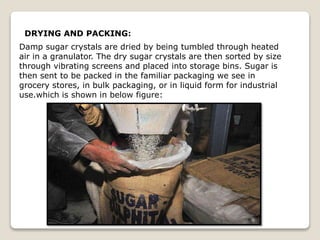
through vibrating screens and placed into storage bins. Sugar is
then sent to be packed in the familiar packaging we see in
grocery stores, in bulk packaging, or in liquid form for industrial
use.which is shown in below figure:

Sugar mill

  • 1.
    INTRODUCTION A sugar millis a factory where we are transfer a raw material(sugar cane) into a sugar.we do this by the use of different- different machines.
  • 2.
    PLANTING AND HARVESTING:Sugarcanecuttings are planted in fields by workers or mechanical planters. In order for the cane to grow, the seeds must be planted in well-drained soil. Typical cane soil is made of a mixture of silt, sand, clay particles and organic matter. Canes are spaced at least 4-feet apart and lined in rows and covered with soil. Fertilizers are applied from the time of planting up until the beginning of the ripening period. Cane fields are also routinely weeded to provide for optimum growth of the cane.
  • 3.
    PREPARATION AND PROCESSING: Theharvested cane stalks and beets are loaded mechanically into trucks and taken to mills for processing into raw sugar. Once there, they are cleaned, washed, milled to extract juice, filtered, and purified. The result is a clear, sugar-filled juice.
  • 4.
    After the canearrives at the mill yards, it is mechanically unloaded, and excessive soil and rocks are removed. The cane is cleaned by flooding the carrier with warm water (in the case of sparse rock and trash clutter) or by spreading the cane on agitating conveyors that pass through strong jets of water and combing drums (to remove larger amounts of rocks, trash, and leaves, etc.). At this point, the cane is clean and ready to be milled.
  • 5.
    Two or threeheavily grooved crusher rollers break the cane and extract a large part of the juice, or swing-hammer type shredders (1,200 RPM) shred the cane without extracting the juice. Revolving knives cutting the stalks into chips are supplementary to the crushers. (In most countries, the shredder precedes the crusher.) A combination of two, or even all three, methods may be used. The pressing process involves crushing the stalks between the heavy and grooved metal rollers to separate the fiber (bagasse) from the juice that contains the sugar. As the cane is crushed, hot water is sprayed onto the crushed cane countercurrently as it leaves each mill for diluting.Next, the sugar is separated from the cut stalks by dissolving it in hot water or hot juice.
  • 6.
    PURIFICATION OF JUICE-CLLARIFICATIONAND EVAPORATION: Carbon dioxide and the milk of a lime are added to the liquid sugar mixture and it is heated to the boiling point, as the process of clarifying begins. As the carbon dioxide travels through the liquid it forms calcium carbonate, which attracts non-sugar debris (fats, gums, and wax) from the juice, and pulls them away from the sugar juice. The juice is then pushed through a series of filters to remove any remaining impurities is shown in below figure:
  • 7.
    The muds separatefrom the clear juice through sedimentation. The non-sugar impurities are removed by continuous filtration. The final clarified juice contains about 85 percent water and has the same composition as the raw extracted juice except for the removed impurities. To concentrate this clarified juice, about two-thirds of the water is removed through vacuum evaporation. Generally, four vacuum-boiling cells or bodies are arranged in series so that each succeeding body has a higher vacuum (and therefore boils at a lower temperature). The vapors from one body can thus boil the juice in the next one—the steam introduced into the first cell does what is called multiple-effect evaporation. The vapor from the last cell goes to a condenser. The syrup leaves the last body continuously with about 65 percent solids and 35 percent water.
  • 8.
    CRYSTALIZATION: Crystallization is thenext step in the manufacture of sugar. Crystallization takes place in a single-stage vacuum pan. The syrup is evaporated until saturated with sugar. As soon as the saturation point has been exceeded, small grains of sugar are added to the pan, or "strike." These small grains, called seed, serve as nuclei for the formation of sugar crystals. CENTRIFUGALING: The high-speed centrifugal action used to separate the massecuite into raw sugar crystals and molasses is done in revolving machines called centrifugals. A centrifugal machine has a cylindrical basket suspended on a spindle, with perforated sides lined with wire cloth, inside which are metal sheets containing 400 to 600 perforations per square inch.
  • 9.
    DRYING AND PACKING: Dampsugar crystals are dried by being tumbled through heated air in a granulator. The dry sugar crystals are then sorted by size through vibrating screens and placed into storage bins. Sugar is then sent to be packed in the familiar packaging we see in grocery stores, in bulk packaging, or in liquid form for industrial use.which is shown in below figure: