Dr. Mohammed Niyaz
PG Resident
Department of Emergency Medicine
ASTER MIMS-K
 wounds whose depth exceeds the diameter of the visible
surface injury
 Involve plantar surface of foot
Cause :
 High-pressure injection equipment
 Animal bites
 Involving exposure to body fluids
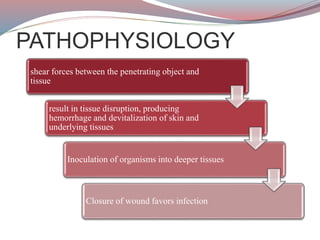
PATHOPHYSIOLOGY
shear forces between the penetrating object and
tissue
result in tissue disruption, producing
hemorrhage and devitalization of skin and
underlying tissues
Inoculation of organisms into deeper tissues
Closure of wound favors infection
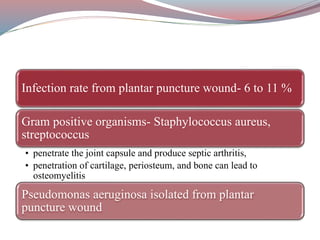
Infection rate from plantar puncture wound- 6 to 11 %
Gram positive organisms- Staphylococcus aureus,
streptococcus
• penetrate the joint capsule and produce septic arthritis,
• penetration of cartilage, periosteum, and bone can lead to
osteomyelitis
Pseudomonas aeruginosa isolated from plantar
puncture wound
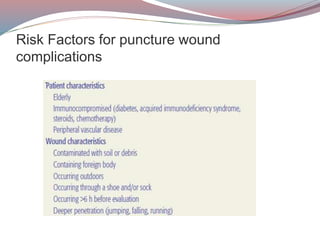
Risk Factors for puncture wound
complications
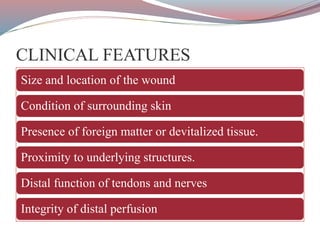
Size and location of the wound
Condition of surrounding skin
Presence of foreign matter or devitalized tissue.
Proximity to underlying structures.
Distal function of tendons and nerves
Integrity of distal perfusion
CLINICAL FEATURES
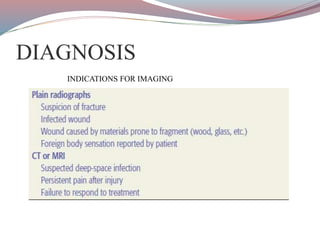
DIAGNOSIS
INDICATIONS FOR IMAGING
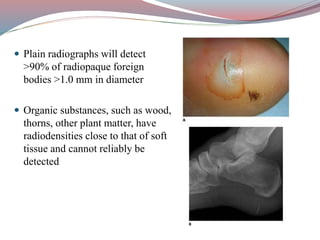
 Plain radiographs will detect
>90% of radiopaque foreign
bodies >1.0 mm in diameter
 Organic substances, such as wood,
thorns, other plant matter, have
radiodensities close to that of soft
tissue and cannot reliably be
detected
 USG can identify soft tissue foreign bodies, but the
ability to detect small objects is limited
 CT or MRI : patients with deep-space infection,
persistent pain after a puncture wound, or treatment
failure
TREATMENT
 Aggressive wound debridement and irrigation (no
evidence of reduction in rate or severity of post puncture
wound infections.)
 Uncomplicated clean punctures <6 hrs : superficial wound
cleansing and tetanus prophylaxis
 Low-pressure (e.g., approximately 0.5 psi) irrigation of
wounds : surface cleansing and allow visualization of the
entrance site.
 Prophylactic antibiotics in High risk cases :
 impaired host defenses, forefoot injuries and patients
sustaining punctures through athletic shoes
 first-generation oral cephalosporin, antistaphylococcal
penicillin, or macrolide.
COMPLICATIONS
 Pain >48 hours post injury should undergo an evaluation
for retained foreign body or infection
CELLULULITIS
• streptococcal and staphylococcal skin flora,
• 7- to 10-day course of a first-generation
cephalosporin, antistaphylococcal penicillin,
trimethoprim-sulfamethoxazole, or clindamycin
ABSCESS
• Standard incision and drainage.
• A short course of antibiotics is indicated if there is
surrounding cellulitis.
DEEP SOFT
TISSUE
INFECTION
• Parenteral antibiotics and surgical exploration with drainage of pus,
excision of necrotic tissue, and irrigation of infected areas
OSTEOMYELITIS
• Diagnosis : triple-phase radionuclide bone scan
• will demonstrate osteomyelitis within 72 hours of the onset of symptoms.
• Antibiotic administration after cultures
SKIN TATTOOING
Needle stick injury
 major concerns are the risk of infection with the hepatitis
viruses and the human immunodeficiency virus (HIV).
 Negligible for hepatitis A, 6% for hepatitis B, 2% for
hepatitis C, and 0.3% for HIV
 Postexposure prophylaxis is available for hepatitis B and
HIV
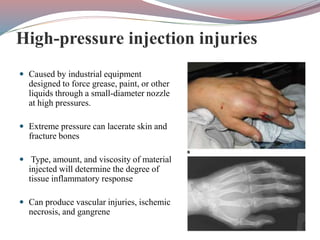
High-pressure injection injuries
 Caused by industrial equipment
designed to force grease, paint, or other
liquids through a small-diameter nozzle
at high pressures.
 Extreme pressure can lacerate skin and
fracture bones
 Type, amount, and viscosity of material
injected will determine the degree of
tissue inflammatory response
 Can produce vascular injuries, ischemic
necrosis, and gangrene
 Assessment of neurovascular integrity and tendon function
 Aggressive pain management using IV opioids
 Prophylactic antibiotic coverage against skin flora
 Tetanus prophylaxis as indicated
 Digital nerve blocks should be avoided, as they may further
increase pressure in finger compartments
 Risk of subsequent amputation is reduced if wide surgical
debridement is performed within 6 hours of the injury
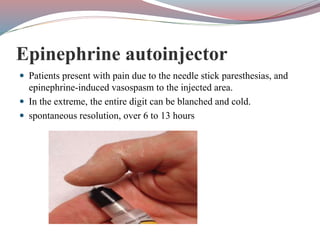
Epinephrine autoinjector
 Patients present with pain due to the needle stick paresthesias, and
epinephrine-induced vasospasm to the injected area.
 In the extreme, the entire digit can be blanched and cold.
 spontaneous resolution, over 6 to 13 hours
 subcutaneous phentolamine injection into the affected area
reverses digital ischemia
 A mixture of 0.5 mL of standard phentolamine solution (5
milligrams/mL concentration) and 0.5 mL of 1% lidocaine
solution will produce a 1 mL total volume containing 2.5
milligrams of phentolamine that can be subcutaneously injected
directly through the site of autoinjector puncture.
MAMMALIAN BITES
 GENERAL PRINCIPLES : Prevention or treatment of
local bacterial infection, and prevention, recognition, and
management of subsequent systemic illness.
 Aggressive irrigation and debridement of devitalized
tissue
 Determine the extent of underlying tissue damage, with
special attention to the potential for penetration into joint
spaces and tendon sheaths.
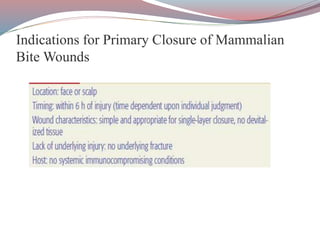
Indications for Primary Closure of Mammalian
Bite Wounds
MICROBIOLOGY AND THERAPY OF INFECTIONS
FROM CAT AND DOG BITES
 Bacterial proliferation in tissue can lead to serious
cellulitis, tenosynovitis, and septic arthritis
 5% of untreated dog bites will become infected
 80% of cat bites will become infected
 Infection after a cat bite is often due to Pasteurella
multocida, particularly if the infection has a rapid onset
Bite Wounds at High Risk of Infection
5- to 7-day course of an appropriate antimicrobial
Amoxicillin-clavulanate is the medication most commonly recommended
penicillin V or ampicillin should be adequate for Pasteurella multocida infections
Common Bites and First-Line Treatment
SYSTEMIC BACTERIAL INFECTIONS
AFTER DOG AND CAT BITES
 Capnocytophaga canimorsus produces a rare but fulminant
bacteremic illness after a dog bite.
 Fatal multi-organ failure in splenectomized patients or
alcoholic or with other immunosuppressive disorders.
 Diagnosis is confirmed with positive blood cultures.
 Broad-spectrum therapy with penicillin and other agents is
indicated in concert with aggressive resuscitation
Cat-scratch disease
 clinical syndrome of regional lymphadenopathy, caused by
Bartonella henselae
 7 to 12 days after a cat bite or scratch.
 painful, matted masses of lymph nodes. low-grade fever, malaise,
fatigue, headache, nausea, and anorexia.
 CNS (encephalopathy with headache, seizures, confusion, or AMS )
 Musculoskeletal (synovitis with joint pain and swelling)
 Lungs (pneumonitis with dyspnea and cough)
 Abdomen (granulomatous hepatitis or splenitis producing abdominal
pain)
 Eyes (retinitis with vision loss), and often with a prolonged fever.
Management
 Diagnosis- epidemiologic, clinical, histologic, and/or serologic
criteria
 Resolve in 2 to 5 months, and therapy is primarily pain relief and
reassurance.
 Large, painful, fluctuant nodes can be aspirated for symptomatic
relief.
 Patients with severe painful lymphadenopathy, a 5-day course of
azithromycin may speed resolution of adenopathy
 Immunodeficiencies- 7 to 10-day course of trimethoprim-
sulfamethoxazole, ciprofloxacin, or rifampin.
Human bites
 More serious than bites from domestic animals due to the
nature of the event, location of the bite, and potential
bacteria inoculated into the wound.
 staphylococcal and streptococcal species, gram-negative
rod Eikenella corrodens
 Amoxicillin-clavulanate is recommended for treatment
and prophylaxis
Herpes simplex virus
infection
 herpetic whitlow is a painful coalescence of vesicles,
typically on the distal phalanx
 Vesicles usually resolve in 3 to 4 weeks.
 Treatment with oral acyclovir for 7 to 10 days or topical
acyclovir ointment for 7 to 14 days may shorten the
duration of the symptoms
RODENTS, LIVESTOCK, EXOTIC AND WILD
ANIMALS
 Rat-bite fever consists of two similar febrile illnesses - either
Streptobacillus moniliformis (more common in North America) or Spirillum
minus/minor (more common in Asia).
 Incubation period 3 to 7 days.
 Rigors and fever that progresses to migratory polyarthralgia and a
maculopapular petechial or purpuric rash.
 Infection can spread to the heart, brain, arteries, liver, kidneys, and lungs.
Mortality rate -10% to 15%.
 Treatment is penicillin, or for penicillin-allergic patients, doxycycline or
tetracycline.
 Livestock and large game animals can inflict serious tissue
injury with their powerful jaws and grinding teeth.
 systemic illnesses, such as brucellosis, leptospirosis, or
tularemia.
 Aggressive wound care, imaging to detect fracture, and
prophylactic broad-spectrum antibiotics are recommended.
 Antibiotic therapy guided by blood culture results.
 Freshwater fish bites can harbor Aeromonas, streptococci,
and staphylococci
 Treatment includes a fluoroquinolone or
trimethoprimsulfamethoxazole.
 Saltwater fish bites require coverage for Vibrio, usually
with a fluoroquinolone.
SYSTEMIC INFECTIONS: SPIROCHETES,
RABIES, AND OTHER VIRUSES
 Disseminated spirochetal and viral illnesses that can result
from mammalian bites include syphilis, rabies, hepatitis,
herpes B virus, or HIV.
 In South Asia, monkeys are presumed to be at high risk
for carriage and transmission of rabies.
 North American reservoirs of animal rabies exist in bats,
skunks, raccoons, and foxes
.
 Herpes B virus, also called Cercopithecine herpesvirus 1,
can be transmitted by bites from monkeys and other
nonhuman primates.
 In humans, infection with herpes B causes myelitis and
hemorrhagic encephalitis with a case fatality rate of 70%.
 Immediate and thorough wound cleaning after a bite
reduces the chance of infection, and acyclovir or
valacyclovir given immediately after injury can prevent or
ameliorate this illness.

Puncture wounds and bites

  • 1.
    Dr. Mohammed Niyaz PGResident Department of Emergency Medicine ASTER MIMS-K
  • 2.
     wounds whosedepth exceeds the diameter of the visible surface injury  Involve plantar surface of foot Cause :  High-pressure injection equipment  Animal bites  Involving exposure to body fluids
  • 3.
    PATHOPHYSIOLOGY shear forces betweenthe penetrating object and tissue result in tissue disruption, producing hemorrhage and devitalization of skin and underlying tissues Inoculation of organisms into deeper tissues Closure of wound favors infection
  • 4.
    Infection rate fromplantar puncture wound- 6 to 11 % Gram positive organisms- Staphylococcus aureus, streptococcus • penetrate the joint capsule and produce septic arthritis, • penetration of cartilage, periosteum, and bone can lead to osteomyelitis Pseudomonas aeruginosa isolated from plantar puncture wound
  • 5.
    Risk Factors forpuncture wound complications
  • 6.
    Size and locationof the wound Condition of surrounding skin Presence of foreign matter or devitalized tissue. Proximity to underlying structures. Distal function of tendons and nerves Integrity of distal perfusion CLINICAL FEATURES
  • 7.
  • 8.
     Plain radiographswill detect >90% of radiopaque foreign bodies >1.0 mm in diameter  Organic substances, such as wood, thorns, other plant matter, have radiodensities close to that of soft tissue and cannot reliably be detected
  • 9.
     USG canidentify soft tissue foreign bodies, but the ability to detect small objects is limited  CT or MRI : patients with deep-space infection, persistent pain after a puncture wound, or treatment failure
  • 10.
    TREATMENT  Aggressive wounddebridement and irrigation (no evidence of reduction in rate or severity of post puncture wound infections.)  Uncomplicated clean punctures <6 hrs : superficial wound cleansing and tetanus prophylaxis  Low-pressure (e.g., approximately 0.5 psi) irrigation of wounds : surface cleansing and allow visualization of the entrance site.
  • 11.
     Prophylactic antibioticsin High risk cases :  impaired host defenses, forefoot injuries and patients sustaining punctures through athletic shoes  first-generation oral cephalosporin, antistaphylococcal penicillin, or macrolide.
  • 12.
    COMPLICATIONS  Pain >48hours post injury should undergo an evaluation for retained foreign body or infection CELLULULITIS • streptococcal and staphylococcal skin flora, • 7- to 10-day course of a first-generation cephalosporin, antistaphylococcal penicillin, trimethoprim-sulfamethoxazole, or clindamycin ABSCESS • Standard incision and drainage. • A short course of antibiotics is indicated if there is surrounding cellulitis.
  • 13.
    DEEP SOFT TISSUE INFECTION • Parenteralantibiotics and surgical exploration with drainage of pus, excision of necrotic tissue, and irrigation of infected areas OSTEOMYELITIS • Diagnosis : triple-phase radionuclide bone scan • will demonstrate osteomyelitis within 72 hours of the onset of symptoms. • Antibiotic administration after cultures SKIN TATTOOING
  • 14.
    Needle stick injury major concerns are the risk of infection with the hepatitis viruses and the human immunodeficiency virus (HIV).  Negligible for hepatitis A, 6% for hepatitis B, 2% for hepatitis C, and 0.3% for HIV  Postexposure prophylaxis is available for hepatitis B and HIV
  • 15.
    High-pressure injection injuries Caused by industrial equipment designed to force grease, paint, or other liquids through a small-diameter nozzle at high pressures.  Extreme pressure can lacerate skin and fracture bones  Type, amount, and viscosity of material injected will determine the degree of tissue inflammatory response  Can produce vascular injuries, ischemic necrosis, and gangrene
  • 16.
     Assessment ofneurovascular integrity and tendon function  Aggressive pain management using IV opioids  Prophylactic antibiotic coverage against skin flora  Tetanus prophylaxis as indicated  Digital nerve blocks should be avoided, as they may further increase pressure in finger compartments  Risk of subsequent amputation is reduced if wide surgical debridement is performed within 6 hours of the injury
  • 17.
    Epinephrine autoinjector  Patientspresent with pain due to the needle stick paresthesias, and epinephrine-induced vasospasm to the injected area.  In the extreme, the entire digit can be blanched and cold.  spontaneous resolution, over 6 to 13 hours
  • 18.
     subcutaneous phentolamineinjection into the affected area reverses digital ischemia  A mixture of 0.5 mL of standard phentolamine solution (5 milligrams/mL concentration) and 0.5 mL of 1% lidocaine solution will produce a 1 mL total volume containing 2.5 milligrams of phentolamine that can be subcutaneously injected directly through the site of autoinjector puncture.
  • 19.
    MAMMALIAN BITES  GENERALPRINCIPLES : Prevention or treatment of local bacterial infection, and prevention, recognition, and management of subsequent systemic illness.  Aggressive irrigation and debridement of devitalized tissue  Determine the extent of underlying tissue damage, with special attention to the potential for penetration into joint spaces and tendon sheaths.
  • 20.
    Indications for PrimaryClosure of Mammalian Bite Wounds
  • 21.
    MICROBIOLOGY AND THERAPYOF INFECTIONS FROM CAT AND DOG BITES  Bacterial proliferation in tissue can lead to serious cellulitis, tenosynovitis, and septic arthritis  5% of untreated dog bites will become infected  80% of cat bites will become infected  Infection after a cat bite is often due to Pasteurella multocida, particularly if the infection has a rapid onset
  • 22.
    Bite Wounds atHigh Risk of Infection 5- to 7-day course of an appropriate antimicrobial Amoxicillin-clavulanate is the medication most commonly recommended penicillin V or ampicillin should be adequate for Pasteurella multocida infections
  • 23.
    Common Bites andFirst-Line Treatment
  • 24.
    SYSTEMIC BACTERIAL INFECTIONS AFTERDOG AND CAT BITES  Capnocytophaga canimorsus produces a rare but fulminant bacteremic illness after a dog bite.  Fatal multi-organ failure in splenectomized patients or alcoholic or with other immunosuppressive disorders.  Diagnosis is confirmed with positive blood cultures.  Broad-spectrum therapy with penicillin and other agents is indicated in concert with aggressive resuscitation
  • 25.
    Cat-scratch disease  clinicalsyndrome of regional lymphadenopathy, caused by Bartonella henselae  7 to 12 days after a cat bite or scratch.  painful, matted masses of lymph nodes. low-grade fever, malaise, fatigue, headache, nausea, and anorexia.  CNS (encephalopathy with headache, seizures, confusion, or AMS )  Musculoskeletal (synovitis with joint pain and swelling)  Lungs (pneumonitis with dyspnea and cough)  Abdomen (granulomatous hepatitis or splenitis producing abdominal pain)  Eyes (retinitis with vision loss), and often with a prolonged fever.
  • 26.
    Management  Diagnosis- epidemiologic,clinical, histologic, and/or serologic criteria  Resolve in 2 to 5 months, and therapy is primarily pain relief and reassurance.  Large, painful, fluctuant nodes can be aspirated for symptomatic relief.  Patients with severe painful lymphadenopathy, a 5-day course of azithromycin may speed resolution of adenopathy  Immunodeficiencies- 7 to 10-day course of trimethoprim- sulfamethoxazole, ciprofloxacin, or rifampin.
  • 27.
    Human bites  Moreserious than bites from domestic animals due to the nature of the event, location of the bite, and potential bacteria inoculated into the wound.  staphylococcal and streptococcal species, gram-negative rod Eikenella corrodens  Amoxicillin-clavulanate is recommended for treatment and prophylaxis
  • 28.
    Herpes simplex virus infection herpetic whitlow is a painful coalescence of vesicles, typically on the distal phalanx  Vesicles usually resolve in 3 to 4 weeks.  Treatment with oral acyclovir for 7 to 10 days or topical acyclovir ointment for 7 to 14 days may shorten the duration of the symptoms
  • 29.
    RODENTS, LIVESTOCK, EXOTICAND WILD ANIMALS  Rat-bite fever consists of two similar febrile illnesses - either Streptobacillus moniliformis (more common in North America) or Spirillum minus/minor (more common in Asia).  Incubation period 3 to 7 days.  Rigors and fever that progresses to migratory polyarthralgia and a maculopapular petechial or purpuric rash.  Infection can spread to the heart, brain, arteries, liver, kidneys, and lungs. Mortality rate -10% to 15%.  Treatment is penicillin, or for penicillin-allergic patients, doxycycline or tetracycline.
  • 30.
     Livestock andlarge game animals can inflict serious tissue injury with their powerful jaws and grinding teeth.  systemic illnesses, such as brucellosis, leptospirosis, or tularemia.  Aggressive wound care, imaging to detect fracture, and prophylactic broad-spectrum antibiotics are recommended.  Antibiotic therapy guided by blood culture results.
  • 31.
     Freshwater fishbites can harbor Aeromonas, streptococci, and staphylococci  Treatment includes a fluoroquinolone or trimethoprimsulfamethoxazole.  Saltwater fish bites require coverage for Vibrio, usually with a fluoroquinolone.
  • 32.
    SYSTEMIC INFECTIONS: SPIROCHETES, RABIES,AND OTHER VIRUSES  Disseminated spirochetal and viral illnesses that can result from mammalian bites include syphilis, rabies, hepatitis, herpes B virus, or HIV.  In South Asia, monkeys are presumed to be at high risk for carriage and transmission of rabies.  North American reservoirs of animal rabies exist in bats, skunks, raccoons, and foxes
  • 33.
    .  Herpes Bvirus, also called Cercopithecine herpesvirus 1, can be transmitted by bites from monkeys and other nonhuman primates.  In humans, infection with herpes B causes myelitis and hemorrhagic encephalitis with a case fatality rate of 70%.  Immediate and thorough wound cleaning after a bite reduces the chance of infection, and acyclovir or valacyclovir given immediately after injury can prevent or ameliorate this illness.

Editor's Notes

  • #30 potential zoonotic systemic infections carried by mice and rats