Topic:
APPLICATion of Polymerase chain reaction
Mubaika seher
bsf1800548
bs zoology (6th )
Morning
BIOLogical Techniques
What is PCR?
Applications of PCR
Advantages of PCR
Limitations of PCR
PCR vs Cloning
Restrictions of PCR
Things to try if PCR does not work..
Conclusion
Contents
“Polymerase chain reaction (PCR) is a
technique used in molecular biology to
amplify a single copy or a few copies of a
segment of DNA across several orders of
magnitude, generating thousands to
millions of copies of a particular DNA
sequence”.
POLYMerase chainreaction
Advantages of PCR
 Quick
 Reliable
 Sensitive
 Relatively easy
 Specific
 Useful non-invasive procedure
 Simplicity of the procedure
 Increased ability to detect less common
organisms such as viruses
Advantages of PCR
• Cost-effective
Shown to be more cost-effective with
selective use than culture and staining
• Quickly performed in 4-8 hours
Disadvantages of PCR
 Need for equipment
 Taq polymerase is expensive
 Contamination
 False reactions
 Internal control
 Cross-reaction
 Capacity building needed
 Unspecific amplification
 Potentially lower specificity compared to culture and
staining
 Supply costs, machinery fees, training expenses
Cont.
• Error rate during amplification
• Sensitivity to inhibitors
• Setting up and Running requires high
technical skill
• High Sterile environment should be
provided
• Infidelity of DNA replication.
• Taq Pol – no Proof reading mech – Error
40% after 20 cycles
Applications of PCR
PCR in
 Molecular biology
 Clinical diagnosis
 DNA sequencing
 Forsenic Medicine
 Gene manipulation and expression studies
 Comparative study of genomics
 Comparison with gene cloning
 Environmental biology
 Anthropology
 Mycology and parasitology
 Animal research
 Sex determination
Application of PCR
• in molecular biology
• Used in molecular biology and
genetic disease research to
identify new genes; for
example, the sample containing
pathogenic DNA can be PCR
amplified using different known
specific primers. The
amplification indicates
presence of pathogenic DNA.
In Anthropology
• In fields such as anthropology and evolution,
sequences of degraded ancient DNAs can be
tracked after PCR amplification.
In Forensic Science
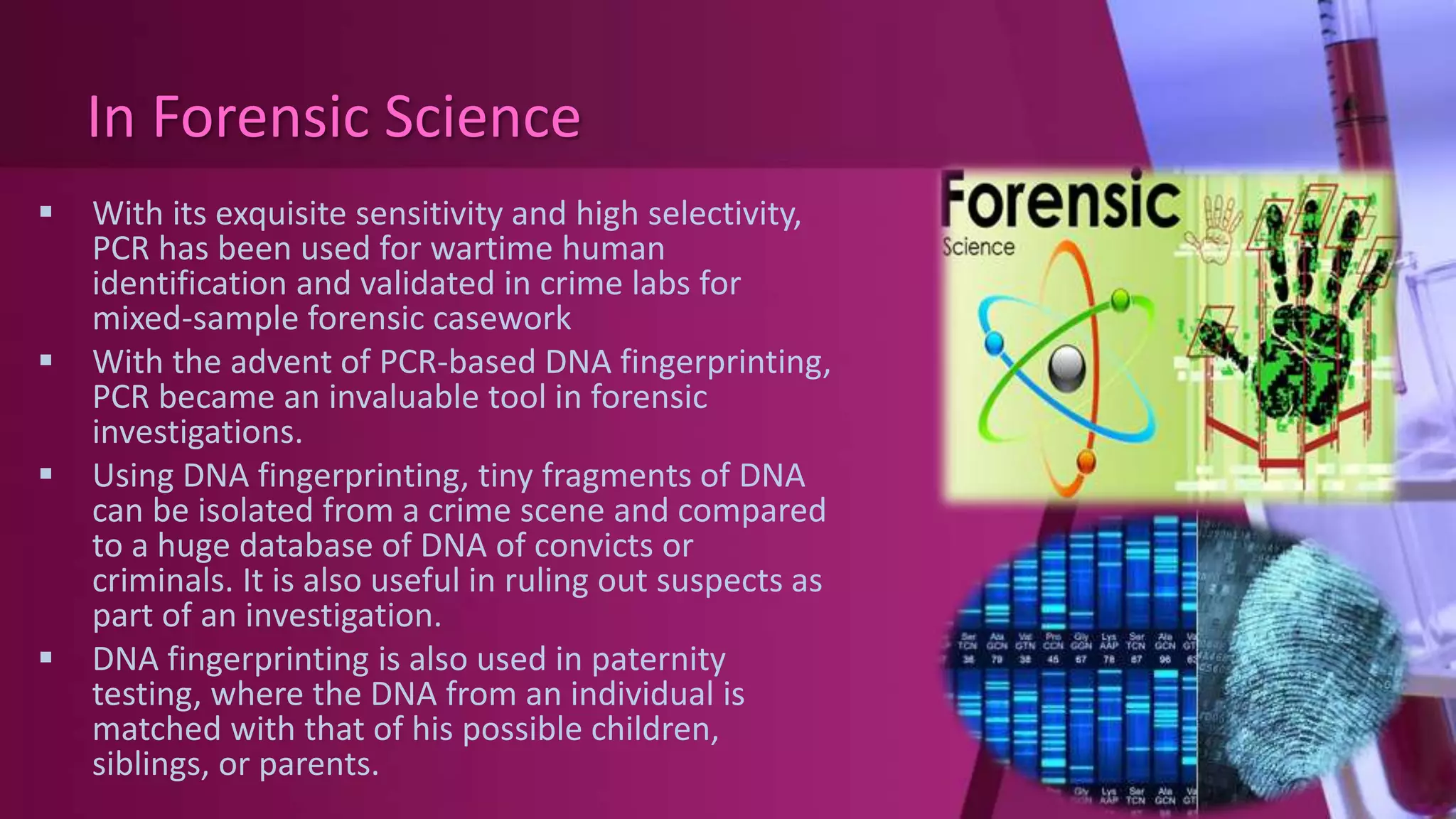
 With its exquisite sensitivity and high selectivity,
PCR has been used for wartime human
identification and validated in crime labs for
mixed-sample forensic casework
 With the advent of PCR-based DNA fingerprinting,
PCR became an invaluable tool in forensic
investigations.
 Using DNA fingerprinting, tiny fragments of DNA
can be isolated from a crime scene and compared
to a huge database of DNA of convicts or
criminals. It is also useful in ruling out suspects as
part of an investigation.
 DNA fingerprinting is also used in paternity
testing, where the DNA from an individual is
matched with that of his possible children,
siblings, or parents.
Mycology and Parasitology
• PCR technology has also found applications
in mycology and parasitology, by enabling
early identification of the microorganisms,
thus aiding efficient diagnosis and treatment
of fungal and parasitic infections.
PCR Diagnostics
 Viruses
• HIV, SARS, H5N1
• PCR can detect the COVID viruses
 Bacteria
• meningococcus, legionellosis
 Analysis for resistant genes
• MRSA, VRE
PCR -In Medical Diagnosis
• Polymerase chain reaction (PCR) is a broadly applied
laboratory test for the diagnosis of a wide variety of
• central nervous system (CNS) diseases,
• including genetic
• autoimmune diseases,
• malignant neoplasms,
• infections.
Diagnosis of Malignant DiseasesCancer
 PCR permits early diagnosis of malignant diseases such
as leukemia and lymphomas.
 PCR assays can be performed directly on genomic DNA
samples to detect translocation specific malignant cells,
infectious agents, like mycobacterium, anaerobic
bacteria, or viruses
 Breast cancer, cervical cancer, chronic myeloid leukemia
and other related cancer is detected using different PCR
assays. Further, the amount of the mutant gene or
oncogene can also be measured.
 Even the MRD (minimal residual disease) can also be
determined by the quantitative PCR.
 Interestingly, PCR is also used in cancer therapy
monitoring.
PCR –For site Directed Mutagenesis
• Inserting a mutation in a DNA
sequence (called artificial mutagenesis
or site-directed mutagenesis) can be
useful in removing restriction sites
during gene transfer experiments.
• This technique is used for introduction
of mutations at the desired place in a
DNA sequence.
Environmental Microbiology
• The PCR technique has been successfully used to explore many issues in
environmental microbiology. Some of its environmental applications are
listed below:
• Sensitive detection of degrading microorganisms in toxic waste and
pollutants can be achieved using PCR, which helps efficient
biodegradation and bioremediation at the polluted sites.
• A gene probe-based PCR method has been developed by researchers for
the detection of indicator bacteria such as coliforms in water supplies,
thus supporting measures that enhance water safety.
• PCR is also used to detect and monitor water-borne microbial
pathogens, which pose a major public health hazard.
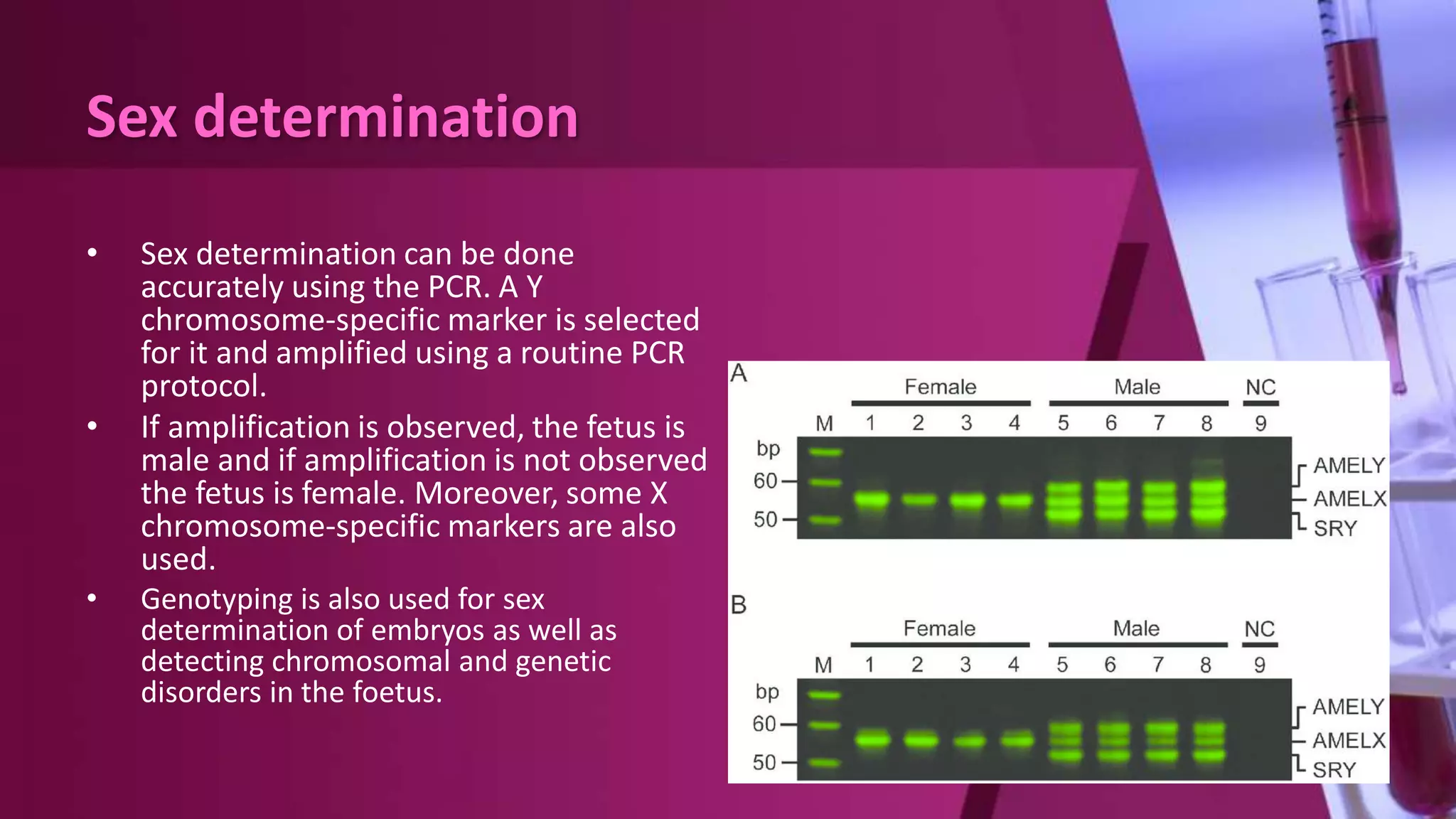
Sex determination
• Sex determination can be done
accurately using the PCR. A Y
chromosome-specific marker is selected
for it and amplified using a routine PCR
protocol.
• If amplification is observed, the fetus is
male and if amplification is not observed
the fetus is female. Moreover, some X
chromosome-specific markers are also
used.
• Genotyping is also used for sex
determination of embryos as well as
detecting chromosomal and genetic
disorders in the foetus.
PCR in animal research
• We are using PCR not only in human and plant
research and disease studies but also it is very
important for animal research and disease
studies. Inherited and infectious animal diseases
are being diagnosed using the present method.
• Some of the common applications of PCR in
animal genetics are:
• In the identification of MTM mutated gene in
dogs, responsible for X-linked Myotubular
myopathy.
• For Bursal disease virus in avian samples.
• Identification of canine parvovirus in dogs.
• Deletion study of Meq gene in chickens
Restrictions Of PCR
 Contamination of reagents or lab
results in false positive results
 Failure due to a mistake in the
protocol
 Different materials/parts of the
sample can inhibit the PRC process
PCR vs Cloning
PCR
• PCR enables scientists to produce billions of
copies of a piece of DNA within hour.
• PCR replicates DNA in an in vitro solution, free of
living cells
• Maximum 4 hours enough for an experiment
• The amplified DNA is put into many uses because
of less error possibility.
• A nanogram DNA is enough for amplification
• Automation is present
• Skilled labour is not required
• . Less expensive
Cloning
• Cloning is simply making one living organism from
another, creating two organisms with the same
exact gene
• Molecular cloning replicates DNA within in a living
cell,
• 2-4 days should be for an experiment.
• The amplified of DNA is put into limited number of
uses.
• At a microgram quantity of DNA is required for
amplification.
• Automation is absent
• Skilled labour is required
• Highly expensive
PCR Cloning
• Requirement
i. Restriction enzymes
ii. DNA ligase
iii. Vector DNA
iv. Bacterial cells
• Requirement
i. Taq DNA polymerase
ii. RNA primer
iii. Free deoxyriboneucleotides are
required along DNA segment to
be amplified
Things to try if PCR does not work..
 If no product(of correct size )produced:
• Check DNA quality
• Reduce annealing temperature
• Increase Mg concentration
• Add DMSO to assay
• Use different thermostable enzyme
• Throw out primers –make new stock
Investigation strategies and
methods
• Developed by the Department of Epidemic and
Pandemic Alert and Response of the World Health
Organization with assistance from:
European Program for Intervention
Epidemiology Training
Canadian Field Epidemiology Program
Thailand Ministry of Health
Instituet Pasteur
Conclusion
• PCR is a highly accurate and rapid
method for duplicating genetic material.
• The discovery of thermostable
polymerase enzymes has permitted the
automation of PCR, thus reducing the
manpower required to conduct these
experiments.
• With the advent of qPCR, amplified
products may also be quantified
accurately.
Applications of pcr

Applications of pcr

  • 2.
    Topic: APPLICATion of Polymerasechain reaction Mubaika seher bsf1800548 bs zoology (6th ) Morning BIOLogical Techniques
  • 3.
    What is PCR? Applicationsof PCR Advantages of PCR Limitations of PCR PCR vs Cloning Restrictions of PCR Things to try if PCR does not work.. Conclusion Contents
  • 4.
    “Polymerase chain reaction(PCR) is a technique used in molecular biology to amplify a single copy or a few copies of a segment of DNA across several orders of magnitude, generating thousands to millions of copies of a particular DNA sequence”. POLYMerase chainreaction
  • 5.
    Advantages of PCR Quick  Reliable  Sensitive  Relatively easy  Specific  Useful non-invasive procedure  Simplicity of the procedure  Increased ability to detect less common organisms such as viruses
  • 6.
    Advantages of PCR •Cost-effective Shown to be more cost-effective with selective use than culture and staining • Quickly performed in 4-8 hours
  • 7.
    Disadvantages of PCR Need for equipment  Taq polymerase is expensive  Contamination  False reactions  Internal control  Cross-reaction  Capacity building needed  Unspecific amplification  Potentially lower specificity compared to culture and staining  Supply costs, machinery fees, training expenses
  • 8.
    Cont. • Error rateduring amplification • Sensitivity to inhibitors • Setting up and Running requires high technical skill • High Sterile environment should be provided • Infidelity of DNA replication. • Taq Pol – no Proof reading mech – Error 40% after 20 cycles
  • 9.
    Applications of PCR PCRin  Molecular biology  Clinical diagnosis  DNA sequencing  Forsenic Medicine  Gene manipulation and expression studies  Comparative study of genomics  Comparison with gene cloning  Environmental biology  Anthropology  Mycology and parasitology  Animal research  Sex determination
  • 10.
    Application of PCR •in molecular biology • Used in molecular biology and genetic disease research to identify new genes; for example, the sample containing pathogenic DNA can be PCR amplified using different known specific primers. The amplification indicates presence of pathogenic DNA.
  • 11.
    In Anthropology • Infields such as anthropology and evolution, sequences of degraded ancient DNAs can be tracked after PCR amplification.
  • 12.
    In Forensic Science With its exquisite sensitivity and high selectivity, PCR has been used for wartime human identification and validated in crime labs for mixed-sample forensic casework  With the advent of PCR-based DNA fingerprinting, PCR became an invaluable tool in forensic investigations.  Using DNA fingerprinting, tiny fragments of DNA can be isolated from a crime scene and compared to a huge database of DNA of convicts or criminals. It is also useful in ruling out suspects as part of an investigation.  DNA fingerprinting is also used in paternity testing, where the DNA from an individual is matched with that of his possible children, siblings, or parents.
  • 13.
    Mycology and Parasitology •PCR technology has also found applications in mycology and parasitology, by enabling early identification of the microorganisms, thus aiding efficient diagnosis and treatment of fungal and parasitic infections.
  • 14.
    PCR Diagnostics  Viruses •HIV, SARS, H5N1 • PCR can detect the COVID viruses  Bacteria • meningococcus, legionellosis  Analysis for resistant genes • MRSA, VRE
  • 15.
    PCR -In MedicalDiagnosis • Polymerase chain reaction (PCR) is a broadly applied laboratory test for the diagnosis of a wide variety of • central nervous system (CNS) diseases, • including genetic • autoimmune diseases, • malignant neoplasms, • infections.
  • 16.
    Diagnosis of MalignantDiseasesCancer  PCR permits early diagnosis of malignant diseases such as leukemia and lymphomas.  PCR assays can be performed directly on genomic DNA samples to detect translocation specific malignant cells, infectious agents, like mycobacterium, anaerobic bacteria, or viruses  Breast cancer, cervical cancer, chronic myeloid leukemia and other related cancer is detected using different PCR assays. Further, the amount of the mutant gene or oncogene can also be measured.  Even the MRD (minimal residual disease) can also be determined by the quantitative PCR.  Interestingly, PCR is also used in cancer therapy monitoring.
  • 17.
    PCR –For siteDirected Mutagenesis • Inserting a mutation in a DNA sequence (called artificial mutagenesis or site-directed mutagenesis) can be useful in removing restriction sites during gene transfer experiments. • This technique is used for introduction of mutations at the desired place in a DNA sequence.
  • 18.
    Environmental Microbiology • ThePCR technique has been successfully used to explore many issues in environmental microbiology. Some of its environmental applications are listed below: • Sensitive detection of degrading microorganisms in toxic waste and pollutants can be achieved using PCR, which helps efficient biodegradation and bioremediation at the polluted sites. • A gene probe-based PCR method has been developed by researchers for the detection of indicator bacteria such as coliforms in water supplies, thus supporting measures that enhance water safety. • PCR is also used to detect and monitor water-borne microbial pathogens, which pose a major public health hazard.
  • 19.
    Sex determination • Sexdetermination can be done accurately using the PCR. A Y chromosome-specific marker is selected for it and amplified using a routine PCR protocol. • If amplification is observed, the fetus is male and if amplification is not observed the fetus is female. Moreover, some X chromosome-specific markers are also used. • Genotyping is also used for sex determination of embryos as well as detecting chromosomal and genetic disorders in the foetus.
  • 20.
    PCR in animalresearch • We are using PCR not only in human and plant research and disease studies but also it is very important for animal research and disease studies. Inherited and infectious animal diseases are being diagnosed using the present method. • Some of the common applications of PCR in animal genetics are: • In the identification of MTM mutated gene in dogs, responsible for X-linked Myotubular myopathy. • For Bursal disease virus in avian samples. • Identification of canine parvovirus in dogs. • Deletion study of Meq gene in chickens
  • 21.
    Restrictions Of PCR Contamination of reagents or lab results in false positive results  Failure due to a mistake in the protocol  Different materials/parts of the sample can inhibit the PRC process
  • 22.
    PCR vs Cloning PCR •PCR enables scientists to produce billions of copies of a piece of DNA within hour. • PCR replicates DNA in an in vitro solution, free of living cells • Maximum 4 hours enough for an experiment • The amplified DNA is put into many uses because of less error possibility. • A nanogram DNA is enough for amplification • Automation is present • Skilled labour is not required • . Less expensive Cloning • Cloning is simply making one living organism from another, creating two organisms with the same exact gene • Molecular cloning replicates DNA within in a living cell, • 2-4 days should be for an experiment. • The amplified of DNA is put into limited number of uses. • At a microgram quantity of DNA is required for amplification. • Automation is absent • Skilled labour is required • Highly expensive
  • 23.
    PCR Cloning • Requirement i.Restriction enzymes ii. DNA ligase iii. Vector DNA iv. Bacterial cells • Requirement i. Taq DNA polymerase ii. RNA primer iii. Free deoxyriboneucleotides are required along DNA segment to be amplified
  • 24.
    Things to tryif PCR does not work..  If no product(of correct size )produced: • Check DNA quality • Reduce annealing temperature • Increase Mg concentration • Add DMSO to assay • Use different thermostable enzyme • Throw out primers –make new stock
  • 25.
    Investigation strategies and methods •Developed by the Department of Epidemic and Pandemic Alert and Response of the World Health Organization with assistance from: European Program for Intervention Epidemiology Training Canadian Field Epidemiology Program Thailand Ministry of Health Instituet Pasteur
  • 26.
    Conclusion • PCR isa highly accurate and rapid method for duplicating genetic material. • The discovery of thermostable polymerase enzymes has permitted the automation of PCR, thus reducing the manpower required to conduct these experiments. • With the advent of qPCR, amplified products may also be quantified accurately.