DNA Replication Model
Nick Constant
5’

3’
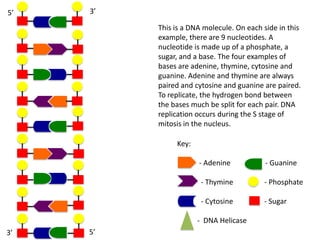
This is a DNA molecule. On each side in this
example, there are 9 nucleotides. A
nucleotide is made up of a phosphate, a
sugar, and a base. The four examples of
bases are adenine, thymine, cytosine and
guanine. Adenine and thymine are always
paired and cytosine and guanine are paired.
To replicate, the hydrogen bond between
the bases much be split for each pair. DNA
replication occurs during the S stage of
mitosis in the nucleus.
Key:
- Adenine

- Guanine

- Thymine

- Phosphate

- Cytosine

- Sugar

- DNA Helicase
3’

5’
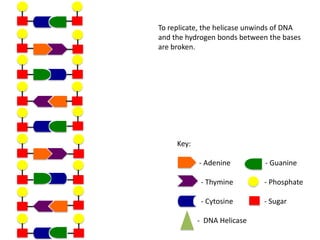
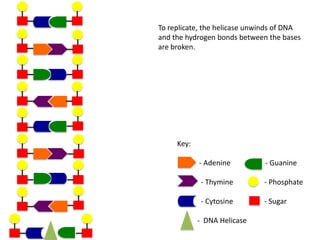
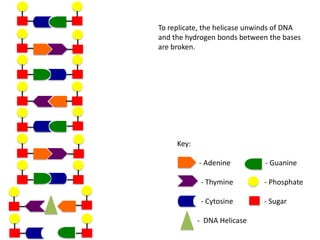
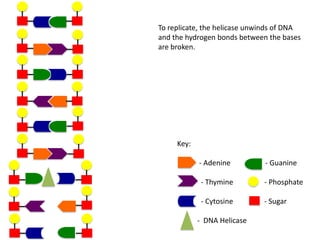
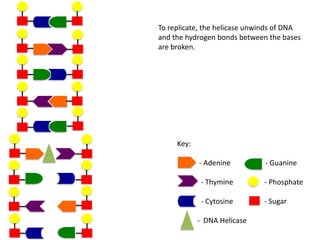
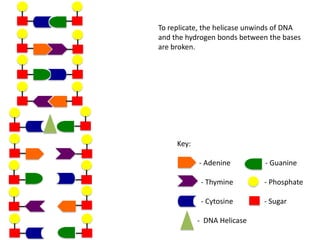
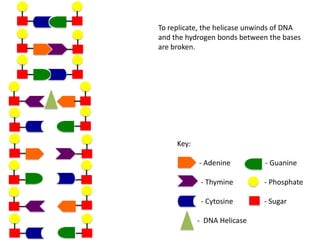
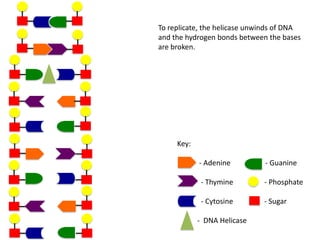
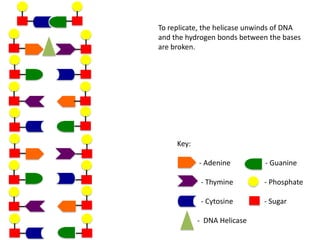
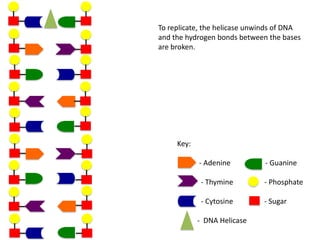
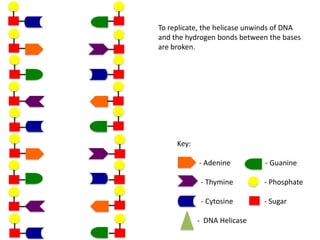
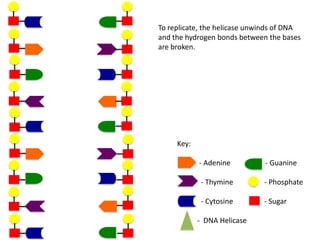
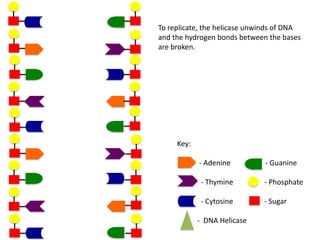
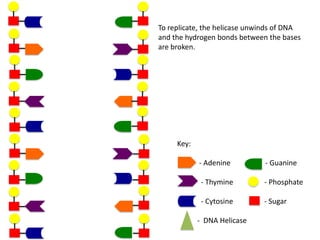
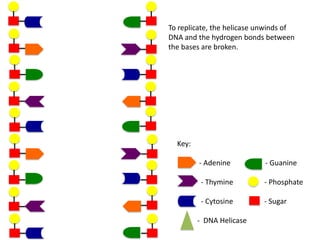
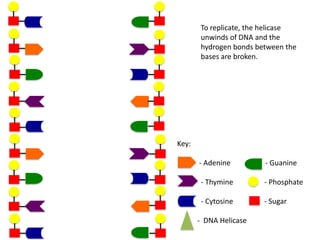
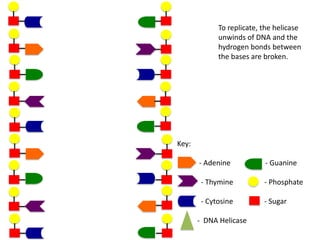
To replicate, the helicase unwinds of DNA
and the hydrogen bonds between the bases
are broken.

Key:
- Adenine

- Guanine

- Thymine

- Phosphate

- Cytosine

- Sugar

- DNA Helicase
To replicate, the helicase unwinds of DNA
and the hydrogen bonds between the bases
are broken.

Key:
- Adenine

- Guanine

- Thymine

- Phosphate

- Cytosine

- Sugar

- DNA Helicase
To replicate, the helicase unwinds of DNA
and the hydrogen bonds between the bases
are broken.

Key:
- Adenine

- Guanine

- Thymine

- Phosphate

- Cytosine

- Sugar

- DNA Helicase
To replicate, the helicase unwinds of DNA
and the hydrogen bonds between the bases
are broken.

Key:
- Adenine

- Guanine

- Thymine

- Phosphate

- Cytosine

- Sugar

- DNA Helicase
To replicate, the helicase unwinds of DNA
and the hydrogen bonds between the bases
are broken.

Key:
- Adenine

- Guanine

- Thymine

- Phosphate

- Cytosine

- Sugar

- DNA Helicase
To replicate, the helicase unwinds of DNA
and the hydrogen bonds between the bases
are broken.

Key:
- Adenine

- Guanine

- Thymine

- Phosphate

- Cytosine

- Sugar

- DNA Helicase
To replicate, the helicase unwinds of DNA
and the hydrogen bonds between the bases
are broken.

Key:
- Adenine

- Guanine

- Thymine

- Phosphate

- Cytosine

- Sugar

- DNA Helicase
To replicate, the helicase unwinds of DNA
and the hydrogen bonds between the bases
are broken.

Key:
- Adenine

- Guanine

- Thymine

- Phosphate

- Cytosine

- Sugar

- DNA Helicase
To replicate, the helicase unwinds of DNA
and the hydrogen bonds between the bases
are broken.

Key:
- Adenine

- Guanine

- Thymine

- Phosphate

- Cytosine

- Sugar

- DNA Helicase
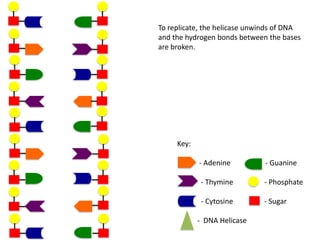
To replicate, the helicase unwinds of DNA
and the hydrogen bonds between the bases
are broken.

Key:
- Adenine

- Guanine

- Thymine

- Phosphate

- Cytosine

- Sugar

- DNA Helicase
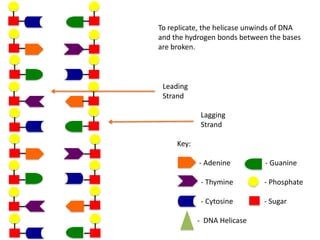
To replicate, the helicase unwinds of DNA
and the hydrogen bonds between the bases
are broken.

Leading
Strand
Lagging
Strand
Key:
- Adenine

- Guanine

- Thymine

- Phosphate

- Cytosine

- Sugar

- DNA Helicase
To replicate, the helicase unwinds of DNA
and the hydrogen bonds between the bases
are broken.

Key:
- Adenine

- Guanine

- Thymine

- Phosphate

- Cytosine

- Sugar

- DNA Helicase
To replicate, the helicase unwinds of DNA
and the hydrogen bonds between the bases
are broken.

Key:
- Adenine

- Guanine

- Thymine

- Phosphate

- Cytosine

- Sugar

- DNA Helicase
To replicate, the helicase unwinds of DNA
and the hydrogen bonds between the bases
are broken.

Key:
- Adenine

- Guanine

- Thymine

- Phosphate

- Cytosine

- Sugar

- DNA Helicase
To replicate, the helicase unwinds of DNA
and the hydrogen bonds between the bases
are broken.

Key:
- Adenine

- Guanine

- Thymine

- Phosphate

- Cytosine

- Sugar

- DNA Helicase
To replicate, the helicase unwinds of DNA
and the hydrogen bonds between the bases
are broken.

Key:
- Adenine

- Guanine

- Thymine

- Phosphate

- Cytosine

- Sugar

- DNA Helicase
To replicate, the helicase unwinds of DNA
and the hydrogen bonds between the bases
are broken.

Key:
- Adenine

- Guanine

- Thymine

- Phosphate

- Cytosine

- Sugar

- DNA Helicase
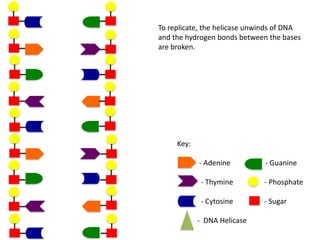
To replicate, the helicase unwinds of
DNA and the hydrogen bonds between
the bases are broken.

Key:
- Adenine

- Guanine

- Thymine

- Phosphate

- Cytosine

- Sugar

- DNA Helicase
To replicate, the helicase
unwinds of DNA and the
hydrogen bonds between the
bases are broken.

Key:
- Adenine

- Guanine

- Thymine

- Phosphate

- Cytosine

- Sugar

- DNA Helicase
To replicate, the helicase
unwinds of DNA and the
hydrogen bonds between
the bases are broken.

Key:
- Adenine

- Guanine

- Thymine

- Phosphate

- Cytosine

- Sugar

- DNA Helicase
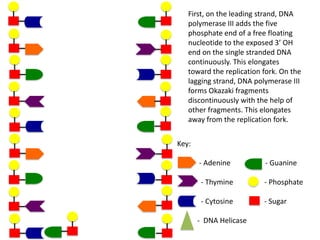
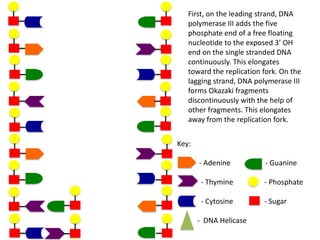
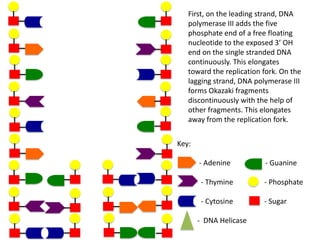
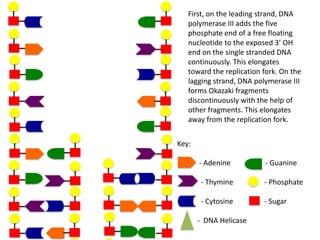
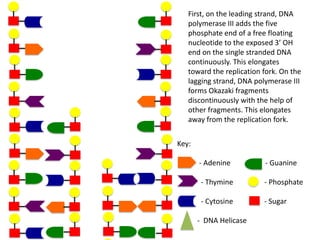
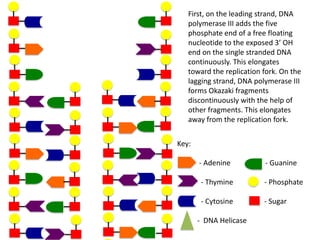
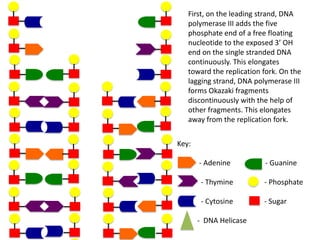
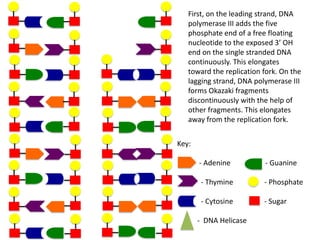
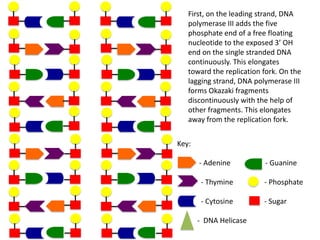
First, on the leading strand, DNA
polymerase III adds the five
phosphate end of a free floating
nucleotide to the exposed 3’ OH
end on the single stranded DNA
continuously. This elongates
toward the replication fork. On the
lagging strand, DNA polymerase III
forms Okazaki fragments
discontinuously with the help of
other fragments. This elongates
away from the replication fork.
Key:
- Adenine

- Guanine

- Thymine

- Phosphate

- Cytosine

- Sugar

- DNA Helicase
First, on the leading strand, DNA
polymerase III adds the five
phosphate end of a free floating
nucleotide to the exposed 3’ OH
end on the single stranded DNA
continuously. This elongates
toward the replication fork. On the
lagging strand, DNA polymerase III
forms Okazaki fragments
discontinuously with the help of
other fragments. This elongates
away from the replication fork.
Key:
- Adenine

- Guanine

- Thymine

- Phosphate

- Cytosine

- Sugar

- DNA Helicase
First, on the leading strand, DNA
polymerase III adds the five
phosphate end of a free floating
nucleotide to the exposed 3’ OH
end on the single stranded DNA
continuously. This elongates
toward the replication fork. On the
lagging strand, DNA polymerase III
forms Okazaki fragments
discontinuously with the help of
other fragments. This elongates
away from the replication fork.
Key:
- Adenine

- Guanine

- Thymine

- Phosphate

- Cytosine

- Sugar

- DNA Helicase
First, on the leading strand, DNA
polymerase III adds the five
phosphate end of a free floating
nucleotide to the exposed 3’ OH
end on the single stranded DNA
continuously. This elongates
toward the replication fork. On the
lagging strand, DNA polymerase III
forms Okazaki fragments
discontinuously with the help of
other fragments. This elongates
away from the replication fork.
Key:
- Adenine

- Guanine

- Thymine

- Phosphate

- Cytosine

- Sugar

- DNA Helicase
First, on the leading strand, DNA
polymerase III adds the five
phosphate end of a free floating
nucleotide to the exposed 3’ OH
end on the single stranded DNA
continuously. This elongates
toward the replication fork. On the
lagging strand, DNA polymerase III
forms Okazaki fragments
discontinuously with the help of
other fragments. This elongates
away from the replication fork.
Key:
- Adenine

- Guanine

- Thymine

- Phosphate

- Cytosine

- Sugar

- DNA Helicase
First, on the leading strand, DNA
polymerase III adds the five
phosphate end of a free floating
nucleotide to the exposed 3’ OH
end on the single stranded DNA
continuously. This elongates
toward the replication fork. On the
lagging strand, DNA polymerase III
forms Okazaki fragments
discontinuously with the help of
other fragments. This elongates
away from the replication fork.
Key:
- Adenine

- Guanine

- Thymine

- Phosphate

- Cytosine

- Sugar

- DNA Helicase
First, on the leading strand, DNA
polymerase III adds the five
phosphate end of a free floating
nucleotide to the exposed 3’ OH
end on the single stranded DNA
continuously. This elongates
toward the replication fork. On the
lagging strand, DNA polymerase III
forms Okazaki fragments
discontinuously with the help of
other fragments. This elongates
away from the replication fork.
Key:
- Adenine

- Guanine

- Thymine

- Phosphate

- Cytosine

- Sugar

- DNA Helicase
First, on the leading strand, DNA
polymerase III adds the five
phosphate end of a free floating
nucleotide to the exposed 3’ OH
end on the single stranded DNA
continuously. This elongates
toward the replication fork. On the
lagging strand, DNA polymerase III
forms Okazaki fragments
discontinuously with the help of
other fragments. This elongates
away from the replication fork.
Key:
- Adenine

- Guanine

- Thymine

- Phosphate

- Cytosine

- Sugar

- DNA Helicase
First, on the leading strand, DNA
polymerase III adds the five
phosphate end of a free floating
nucleotide to the exposed 3’ OH
end on the single stranded DNA
continuously. This elongates
toward the replication fork. On the
lagging strand, DNA polymerase III
forms Okazaki fragments
discontinuously with the help of
other fragments. This elongates
away from the replication fork.
Key:
- Adenine

- Guanine

- Thymine

- Phosphate

- Cytosine

- Sugar

- DNA Helicase
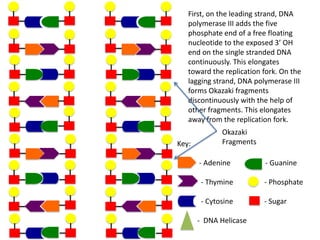
First, on the leading strand, DNA
polymerase III adds the five
phosphate end of a free floating
nucleotide to the exposed 3’ OH
end on the single stranded DNA
continuously. This elongates
toward the replication fork. On the
lagging strand, DNA polymerase III
forms Okazaki fragments
discontinuously with the help of
other fragments. This elongates
away from the replication fork.
Key:

Okazaki
Fragments
- Adenine

- Guanine

- Thymine

- Phosphate

- Cytosine

- Sugar

- DNA Helicase
5’

3’

5’

3’

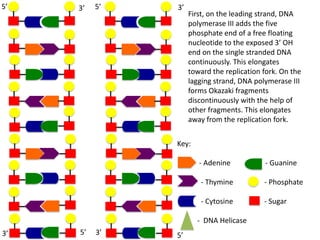
First, on the leading strand, DNA
polymerase III adds the five
phosphate end of a free floating
nucleotide to the exposed 3’ OH
end on the single stranded DNA
continuously. This elongates
toward the replication fork. On the
lagging strand, DNA polymerase III
forms Okazaki fragments
discontinuously with the help of
other fragments. This elongates
away from the replication fork.

Key:
- Adenine

- Guanine

- Thymine

- Phosphate

- Cytosine

- Sugar

- DNA Helicase
3’

5’

3’

5’
5’

3’

5’

3’

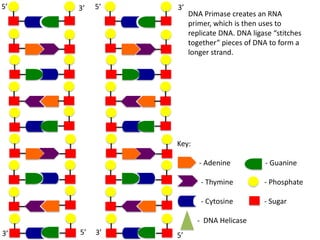
DNA Primase creates an RNA
primer, which is then uses to
replicate DNA. DNA ligase “stitches
together” pieces of DNA to form a
longer strand.

Key:
- Adenine

- Guanine

- Thymine

- Phosphate

- Cytosine

- Sugar

- DNA Helicase
3’

5’

3’

5’

NickConstantDNAReplication

  • 1.
  • 2.
    5’ 3’ This is aDNA molecule. On each side in this example, there are 9 nucleotides. A nucleotide is made up of a phosphate, a sugar, and a base. The four examples of bases are adenine, thymine, cytosine and guanine. Adenine and thymine are always paired and cytosine and guanine are paired. To replicate, the hydrogen bond between the bases much be split for each pair. DNA replication occurs during the S stage of mitosis in the nucleus. Key: - Adenine - Guanine - Thymine - Phosphate - Cytosine - Sugar - DNA Helicase 3’ 5’
  • 3.
    To replicate, thehelicase unwinds of DNA and the hydrogen bonds between the bases are broken. Key: - Adenine - Guanine - Thymine - Phosphate - Cytosine - Sugar - DNA Helicase
  • 4.
    To replicate, thehelicase unwinds of DNA and the hydrogen bonds between the bases are broken. Key: - Adenine - Guanine - Thymine - Phosphate - Cytosine - Sugar - DNA Helicase
  • 5.
    To replicate, thehelicase unwinds of DNA and the hydrogen bonds between the bases are broken. Key: - Adenine - Guanine - Thymine - Phosphate - Cytosine - Sugar - DNA Helicase
  • 6.
    To replicate, thehelicase unwinds of DNA and the hydrogen bonds between the bases are broken. Key: - Adenine - Guanine - Thymine - Phosphate - Cytosine - Sugar - DNA Helicase
  • 7.
    To replicate, thehelicase unwinds of DNA and the hydrogen bonds between the bases are broken. Key: - Adenine - Guanine - Thymine - Phosphate - Cytosine - Sugar - DNA Helicase
  • 8.
    To replicate, thehelicase unwinds of DNA and the hydrogen bonds between the bases are broken. Key: - Adenine - Guanine - Thymine - Phosphate - Cytosine - Sugar - DNA Helicase
  • 9.
    To replicate, thehelicase unwinds of DNA and the hydrogen bonds between the bases are broken. Key: - Adenine - Guanine - Thymine - Phosphate - Cytosine - Sugar - DNA Helicase
  • 10.
    To replicate, thehelicase unwinds of DNA and the hydrogen bonds between the bases are broken. Key: - Adenine - Guanine - Thymine - Phosphate - Cytosine - Sugar - DNA Helicase
  • 11.
    To replicate, thehelicase unwinds of DNA and the hydrogen bonds between the bases are broken. Key: - Adenine - Guanine - Thymine - Phosphate - Cytosine - Sugar - DNA Helicase
  • 12.
    To replicate, thehelicase unwinds of DNA and the hydrogen bonds between the bases are broken. Key: - Adenine - Guanine - Thymine - Phosphate - Cytosine - Sugar - DNA Helicase
  • 13.
    To replicate, thehelicase unwinds of DNA and the hydrogen bonds between the bases are broken. Leading Strand Lagging Strand Key: - Adenine - Guanine - Thymine - Phosphate - Cytosine - Sugar - DNA Helicase
  • 14.
    To replicate, thehelicase unwinds of DNA and the hydrogen bonds between the bases are broken. Key: - Adenine - Guanine - Thymine - Phosphate - Cytosine - Sugar - DNA Helicase
  • 15.
    To replicate, thehelicase unwinds of DNA and the hydrogen bonds between the bases are broken. Key: - Adenine - Guanine - Thymine - Phosphate - Cytosine - Sugar - DNA Helicase
  • 16.
    To replicate, thehelicase unwinds of DNA and the hydrogen bonds between the bases are broken. Key: - Adenine - Guanine - Thymine - Phosphate - Cytosine - Sugar - DNA Helicase
  • 17.
    To replicate, thehelicase unwinds of DNA and the hydrogen bonds between the bases are broken. Key: - Adenine - Guanine - Thymine - Phosphate - Cytosine - Sugar - DNA Helicase
  • 18.
    To replicate, thehelicase unwinds of DNA and the hydrogen bonds between the bases are broken. Key: - Adenine - Guanine - Thymine - Phosphate - Cytosine - Sugar - DNA Helicase
  • 19.
    To replicate, thehelicase unwinds of DNA and the hydrogen bonds between the bases are broken. Key: - Adenine - Guanine - Thymine - Phosphate - Cytosine - Sugar - DNA Helicase
  • 20.
    To replicate, thehelicase unwinds of DNA and the hydrogen bonds between the bases are broken. Key: - Adenine - Guanine - Thymine - Phosphate - Cytosine - Sugar - DNA Helicase
  • 21.
    To replicate, thehelicase unwinds of DNA and the hydrogen bonds between the bases are broken. Key: - Adenine - Guanine - Thymine - Phosphate - Cytosine - Sugar - DNA Helicase
  • 22.
    To replicate, thehelicase unwinds of DNA and the hydrogen bonds between the bases are broken. Key: - Adenine - Guanine - Thymine - Phosphate - Cytosine - Sugar - DNA Helicase
  • 23.
    First, on theleading strand, DNA polymerase III adds the five phosphate end of a free floating nucleotide to the exposed 3’ OH end on the single stranded DNA continuously. This elongates toward the replication fork. On the lagging strand, DNA polymerase III forms Okazaki fragments discontinuously with the help of other fragments. This elongates away from the replication fork. Key: - Adenine - Guanine - Thymine - Phosphate - Cytosine - Sugar - DNA Helicase
  • 24.
    First, on theleading strand, DNA polymerase III adds the five phosphate end of a free floating nucleotide to the exposed 3’ OH end on the single stranded DNA continuously. This elongates toward the replication fork. On the lagging strand, DNA polymerase III forms Okazaki fragments discontinuously with the help of other fragments. This elongates away from the replication fork. Key: - Adenine - Guanine - Thymine - Phosphate - Cytosine - Sugar - DNA Helicase
  • 25.
    First, on theleading strand, DNA polymerase III adds the five phosphate end of a free floating nucleotide to the exposed 3’ OH end on the single stranded DNA continuously. This elongates toward the replication fork. On the lagging strand, DNA polymerase III forms Okazaki fragments discontinuously with the help of other fragments. This elongates away from the replication fork. Key: - Adenine - Guanine - Thymine - Phosphate - Cytosine - Sugar - DNA Helicase
  • 26.
    First, on theleading strand, DNA polymerase III adds the five phosphate end of a free floating nucleotide to the exposed 3’ OH end on the single stranded DNA continuously. This elongates toward the replication fork. On the lagging strand, DNA polymerase III forms Okazaki fragments discontinuously with the help of other fragments. This elongates away from the replication fork. Key: - Adenine - Guanine - Thymine - Phosphate - Cytosine - Sugar - DNA Helicase
  • 27.
    First, on theleading strand, DNA polymerase III adds the five phosphate end of a free floating nucleotide to the exposed 3’ OH end on the single stranded DNA continuously. This elongates toward the replication fork. On the lagging strand, DNA polymerase III forms Okazaki fragments discontinuously with the help of other fragments. This elongates away from the replication fork. Key: - Adenine - Guanine - Thymine - Phosphate - Cytosine - Sugar - DNA Helicase
  • 28.
    First, on theleading strand, DNA polymerase III adds the five phosphate end of a free floating nucleotide to the exposed 3’ OH end on the single stranded DNA continuously. This elongates toward the replication fork. On the lagging strand, DNA polymerase III forms Okazaki fragments discontinuously with the help of other fragments. This elongates away from the replication fork. Key: - Adenine - Guanine - Thymine - Phosphate - Cytosine - Sugar - DNA Helicase
  • 29.
    First, on theleading strand, DNA polymerase III adds the five phosphate end of a free floating nucleotide to the exposed 3’ OH end on the single stranded DNA continuously. This elongates toward the replication fork. On the lagging strand, DNA polymerase III forms Okazaki fragments discontinuously with the help of other fragments. This elongates away from the replication fork. Key: - Adenine - Guanine - Thymine - Phosphate - Cytosine - Sugar - DNA Helicase
  • 30.
    First, on theleading strand, DNA polymerase III adds the five phosphate end of a free floating nucleotide to the exposed 3’ OH end on the single stranded DNA continuously. This elongates toward the replication fork. On the lagging strand, DNA polymerase III forms Okazaki fragments discontinuously with the help of other fragments. This elongates away from the replication fork. Key: - Adenine - Guanine - Thymine - Phosphate - Cytosine - Sugar - DNA Helicase
  • 31.
    First, on theleading strand, DNA polymerase III adds the five phosphate end of a free floating nucleotide to the exposed 3’ OH end on the single stranded DNA continuously. This elongates toward the replication fork. On the lagging strand, DNA polymerase III forms Okazaki fragments discontinuously with the help of other fragments. This elongates away from the replication fork. Key: - Adenine - Guanine - Thymine - Phosphate - Cytosine - Sugar - DNA Helicase
  • 32.
    First, on theleading strand, DNA polymerase III adds the five phosphate end of a free floating nucleotide to the exposed 3’ OH end on the single stranded DNA continuously. This elongates toward the replication fork. On the lagging strand, DNA polymerase III forms Okazaki fragments discontinuously with the help of other fragments. This elongates away from the replication fork. Key: Okazaki Fragments - Adenine - Guanine - Thymine - Phosphate - Cytosine - Sugar - DNA Helicase
  • 33.
    5’ 3’ 5’ 3’ First, on theleading strand, DNA polymerase III adds the five phosphate end of a free floating nucleotide to the exposed 3’ OH end on the single stranded DNA continuously. This elongates toward the replication fork. On the lagging strand, DNA polymerase III forms Okazaki fragments discontinuously with the help of other fragments. This elongates away from the replication fork. Key: - Adenine - Guanine - Thymine - Phosphate - Cytosine - Sugar - DNA Helicase 3’ 5’ 3’ 5’
  • 34.
    5’ 3’ 5’ 3’ DNA Primase createsan RNA primer, which is then uses to replicate DNA. DNA ligase “stitches together” pieces of DNA to form a longer strand. Key: - Adenine - Guanine - Thymine - Phosphate - Cytosine - Sugar - DNA Helicase 3’ 5’ 3’ 5’